AI Agent Context Optimization: Engineering High-Velocity Memory Layers

Throwing 128k tokens at a simple query isn't intelligence; it's a structural failure that's bleeding your margins dry. Most developers treat context windows like landfill sites, dumping every scrap of data into the prompt and hoping the model figures it out. You've likely seen the results: exploding API costs and agents that suffer from "amnesia" the moment a task spans more than a few hours. It's a wasteful, fragile way to build.
True AI agent context optimization requires an architectural pivot from flat, bloated retrieval to precision, graph-native memory layers. You're here because you need a system that scales without the overhead. This article outlines the shift to a self-hosted memory architecture that delivers 98% token efficiency and full data sovereignty. We will explore how to replace legacy RAG with MCP-native memory servers, leverage Knowledge Buckets for granular control, and utilize the Portable Memory Format (PMF) to ensure your agent's intelligence remains portable and private. It's time to build leaner, faster, and more sovereign systems.
Key Takeaways
- Ditch the bloated context window. Massive prompts increase latency and trigger the "lost in the middle" phenomenon.
- Execute AI agent context optimization through graph-native storage. It maps complex relationships that flat vector databases simply can't handle.
- Cut token costs by 98%. Precision retrieval ensures you only send the data the model actually needs to function.
- Standardize your stack with MCP-native memory servers. Use the Portable Memory Format to keep your agent's knowledge base independent and agile.
- Reclaim your data sovereignty. Self-hosted memory layers ensure your proprietary knowledge never leaves your controlled infrastructure.
The Context Crisis: Why Bigger Windows Aren't the Answer
The industry is obsessed with size. Model providers brag about million-token context windows as if they're a silver bullet for agent intelligence. They aren't. In reality, these massive windows are often a "context window trap" that trades architectural elegance for brute force. AI agent context optimization is the strategic management of prompt-space to maximize logic and minimize waste. It's the difference between a high-performance engine and a fuel leak.
When you flood a model with a massive context, performance degrades. This happens because the underlying Transformer architecture relies on attention mechanisms that must weigh every token against every other token. As the sequence grows, the signal-to-noise ratio collapses. Models suffer from the "lost in the middle" phenomenon, where they prioritize information at the extreme start or end of the prompt while ignoring the critical data buried in the center. You're paying for tokens the model isn't even effectively "reading."
The Token Tax and Systemic Inefficiency
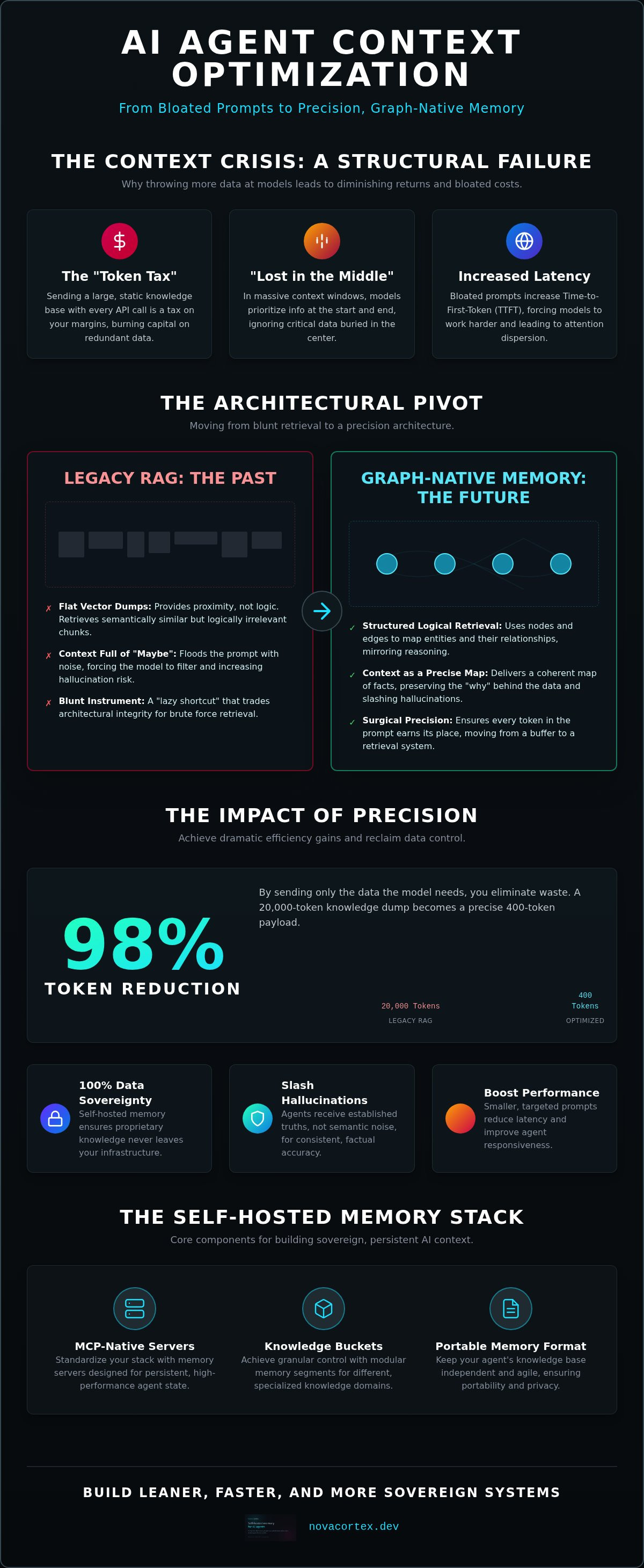
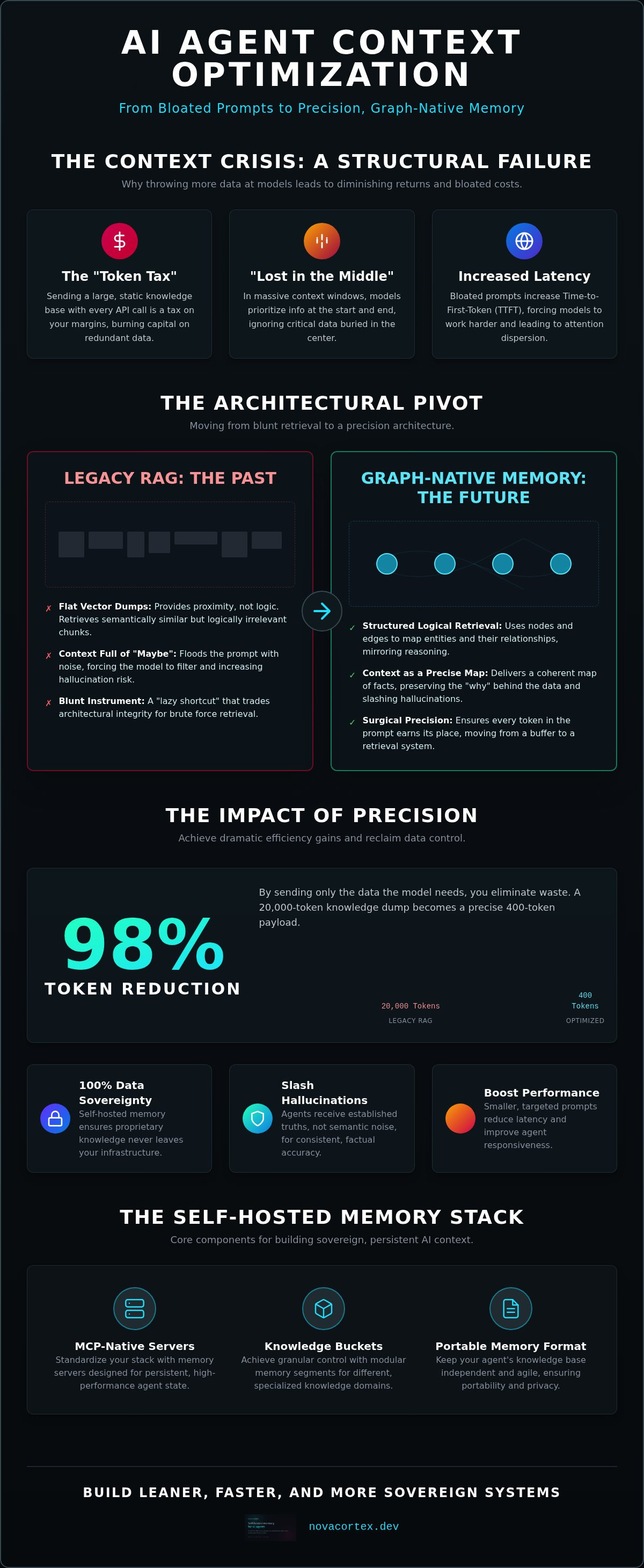
Every redundant token sent to an API is a "Token Tax" on your margins. If your agent requires a 20,000-token knowledge base to function and you send that entire block with every user turn, you're burning capital on static data. Over a thousand-turn conversation, that's 20 million tokens of pure waste. This isn't just a cost problem; it's a performance bottleneck. Bloated context increases time-to-first-token (TTFT) and overall latency. It forces the model to work harder to find the relevant logic, leading to attention dispersion where the agent "hallucinates" or misses instructions because it's distracted by irrelevant background noise. There is a clear point of diminishing returns where a larger window actually makes your agent stupider.
Beyond Simple RAG: The Need for Precision
Standard Retrieval-Augmented Generation (RAG) was supposed to solve this, but its reliance on flat vector retrieval is a blunt instrument. Traditional Top-K similarity searches often pull in semantically similar but logically irrelevant chunks. If your agent needs to understand a complex relationship between two entities, a vector database might give you ten separate paragraphs that mention those entities without explaining the connection between them. You end up with a context window full of "maybe" instead of "must-have" data. True AI agent context optimization requires moving toward a structured, graph-native memory approach. We need precision, not just proximity. The goal is to transition from context-as-a-buffer to context-as-a-precise-retrieval-system, ensuring every token in the prompt earns its place.
Graph-Native Memory: The Architecture of Precise Retrieval
Stop treating memory as a flat list of text chunks. Vector databases provide proximity, not logic. While a vector search can find pieces of text that look similar, it lacks the structural awareness to understand how those pieces connect. If your agent needs to understand how a specific security protocol relates to a production environment, a vector search might return the protocol and the environment documentation as separate, disconnected snippets. A graph-native approach links them explicitly. This transition from proximity to relationship is the bedrock of effective AI agent context optimization.
Vector Dumps vs. Graph-Native Memory
The engineering debate over Redis vs graph memory for AI agents is actually a choice between speed-at-all-costs and structural integrity. Vector dumps are a lazy shortcut. They flood the prompt with semantically related noise that the model must then filter. In contrast, graph-native memory uses nodes to represent discrete entities and edges to represent the logical connections between them. This mirrors the way high-level reasoning functions. By retrieving logical subgraphs instead of just "top-k" chunks, you slash hallucination rates. The model receives a coherent map of facts. It's precise. It's fast. It's engineered for logic.
Recent persistent memory layer research suggests that maintaining long-term agent state requires more than just a rolling buffer. Flat vectors lose the "why" behind the data over time. Graphs preserve it. When an agent traverses a graph, it follows a path of established truth rather than guessing based on word embeddings. This architectural superiority allows agents to maintain consistent "personalities" and factual accuracy across long-running tasks that would break a standard RAG system.
Modular Knowledge Buckets
Monolithic memory is a single point of failure. It's difficult to manage and impossible to prune without affecting the entire system. Knowledge Buckets solve this by organizing memory into discrete, queryable units. You can assign a specific bucket to a project, a user profile, or a temporary task. This modularity enables seamless multi-agent synchronization. Multiple agents can tap into shared buckets for collective intelligence while maintaining private buckets for sensitive or task-specific data.
This structure also simplifies "forgetting" logic. You don't need to re-index a massive database to remove outdated information; you simply prune the relevant nodes or detach the bucket. This keeps the memory layer lean and high-velocity. It ensures the agent's context remains focused on what matters now. If you are ready to move beyond basic vector storage, you can examine the open source core to see these structures in action.
Economic Impact: Reducing Token Usage by 98%
Context bloat is a silent margin killer. When you default to sending entire document sets or massive chat histories to an LLM, you're paying a premium for the model to do work that your infrastructure should have handled. High-performance AI agent context optimization isn't just a technical preference. It is an economic necessity. By shifting to a precision retrieval model, engineering teams can achieve a 98% reduction in token usage compared to traditional "knowledge dumping" methods.
The math is straightforward. If a standard RAG system retrieves 10 chunks of 500 tokens each to answer a query, you are billed for 5,000 tokens of input. A graph-native memory layer identifies the exact entities and relationships required, often condensing that same context into 100 tokens of high-density logic. Over millions of API calls, the difference between these two approaches represents the gap between a viable product and a bankrupt one. Choosing a self-hosted memory layer over managed context services further drives down the total cost of ownership (TCO) by eliminating the markup on proprietary retrieval APIs and ensuring your data stays on your own infrastructure.
Benchmarking Context Efficiency
Measuring the success of your memory architecture requires looking beyond simple accuracy scores. We track the "Token Reduction" metric to evaluate how much input noise we've stripped away without degrading output quality. Context engineering ROI is the ratio of reasoning quality to token expenditure. In real-world agent tasks, standard RAG often hits a ceiling where adding more context actually decreases reasoning performance due to attention dispersion. Graph-native layers maintain high reasoning quality while keeping the token footprint minimal. This efficiency allows you to use more capable, expensive models for the actual logic while keeping the overall cost lower than a "cheap" model struggling with a bloated prompt.
The Latency-Cost Correlation
Cost isn't the only casualty of context bloat; speed is equally vulnerable. LLM inference latency scales with input length. Processing massive, irrelevant document chunks creates a significant bottleneck in agent response times. Smaller, precise contexts lead to faster inference because the model spends less time attending to noise and more time generating the solution. In competitive environments, a low-latency agent is a strategic advantage. By eliminating the need to process thousands of "maybe relevant" tokens, you reduce time-to-first-token and improve the overall user experience. High-velocity memory layers ensure your agents remain responsive and cost-effective simultaneously.
Implementing Context Optimization: MCP and Portable Formats
Implementation is where theoretical efficiency becomes operational reality. You don't achieve AI agent context optimization by tweaking prompts alone; you do it by re-engineering the interface between the model and its data. The Model Context Protocol (MCP) has emerged as the industry standard for this decoupling. It allows you to treat memory as a specialized, external service rather than an internal appendage of the LLM. This shift ensures your architecture remains modular and ready for scale.
Leveraging the Model Context Protocol (MCP)
MCP is a fundamental shift toward vendor-neutral context management. By using a standardized protocol, you can integrate your memory servers directly into agent frameworks like Claude Desktop or LangGraph without writing custom glue code for every model update. This reduces middleware bloat. It ensures that your retrieval logic remains consistent regardless of whether you're querying a local model or a remote API. Native MCP communication is lean. It's fast. It respects the developer's time by removing the friction of proprietary integrations.
Ensuring Sovereignty with Portable Memory
Proprietary memory formats are a trap. Cloud-only vector stores create a dependency that is difficult to break once your data reaches enterprise scale. Digital sovereignty requires a portable memory format for AI that ensures your knowledge base remains interoperable. Using the Portable Memory Format (PMF) means you can move your data across different servers or host it entirely on private hardware, such as a secure VPS or even a Raspberry Pi. Your intellectual property belongs in your infrastructure, not in a vendor's black box.
Following these steps will solidify your memory architecture:
- Deploy an MCP native memory server to establish a dedicated, persistent context layer that exists independently of the LLM provider.
- Implement PMF to standardize how data is structured, stored, and migrated across your ecosystem.
- Migrate from flat, unstructured storage to graph-native Knowledge Buckets to enable the precise relationship mapping discussed in previous sections.
- Configure dynamic retrieval thresholds that adjust context density based on the complexity of the agent's current task.
NovaCortex: The Self-Hosted Standard for Persistent Context
NovaCortex stands as the definitive self-hosted AI memory layer for developers who refuse to settle for bloated, third-party black boxes. While the industry chases bigger context windows, we provide the precision tools to bypass them. By integrating NovaCortex into your stack, you aren't just improving performance; you're fundamentally re-engineering how your agents think and store data. It's the professional alternative to dumping raw knowledge bases into an LLM and hoping for the best. AI agent context optimization is finally an engineering reality rather than a prompt engineering hack.
Privacy-First Engineering
The choice between self-hosted vs managed AI memory is a matter of digital sovereignty. Managed memory layers are a massive security liability. They require you to ship your most sensitive proprietary data to a third-party cloud, creating an inherent "Data Leak" that no amount of encryption can fully mitigate. NovaCortex shifts the paradigm. Your knowledge stays on your infrastructure. Whether you deploy on a local server or a private cloud, you maintain absolute control over the retrieval logic and the data itself. This architecture is built for builders who demand lean, independent operations.
Building for 2026 and Beyond
The NovaCortex Self-Hosted Edition isn't just a tool; it's a foundational standard. It arrives graph-native, MCP-native, and fully PMF-ready. This ensures your architecture is future-proofed against vendor shifts and model updates. You can scale from a single-agent memory instance to a comprehensive, enterprise-wide AI agent long term memory layer without rewriting your core logic. We use an Apache-2.0 licensed core because we believe in open, interoperable systems that reject the restrictive nature of proprietary silos.
Optimization is no longer optional; it is a prerequisite for production-grade AI. You've seen the math: a 98% token reduction is achievable with the right architecture. It's time to reclaim your data sovereignty and slash your LLM bills. Stop paying the token tax and start building high-velocity memory layers that actually scale.
Engineering the Sovereignty Shift
Context windows are a finite engineering resource. Treating them as infinite leads to systemic waste and cognitive degradation in your agents. By implementing a graph-native memory layer, you replace the noise of flat vector retrieval with the precision of relationship mapping. This shift represents the final move away from fragile, prompt-heavy hacks toward robust, production-grade intelligence. It's the only way to scale without surrendering your margins to the token tax.
Adopting AI agent context optimization through self-hosted infrastructure ensures your proprietary knowledge remains yours. You gain 98% token efficiency, high-velocity retrieval, and the flexibility of MCP-native architecture. There is no longer a need to choose between performance and privacy. You can have both by decoupling your memory from the model provider. This architectural choice future-proofs your stack against vendor lock-in and rising API costs.
Reclaim your data sovereignty and build a leaner, faster agent stack. The tools for persistent cognition are ready for deployment.
The transition to high-velocity memory is a prerequisite for the next generation of AI. Start building with precision today.
Frequently Asked Questions
What is AI agent context optimization?
It's the strategic management of prompt space to maximize reasoning logic while minimizing token waste. Instead of dumping entire datasets into a context window, you use precision retrieval to send only the most relevant entities and relationships. This process reduces API costs and prevents attention dispersion, ensuring the model remains focused on the task. Efficient AI agent context optimization turns the context window from a data landfill into a high-velocity reasoning buffer.
How does graph-native memory reduce token usage compared to vector databases?
Graph-native memory maps discrete entities and their logical relationships rather than relying on semantic similarity alone. Vector databases often retrieve large chunks of text that contain irrelevant noise. In contrast, graph structures allow for precision retrieval, pulling only the specific facts and connections needed for a query. This allows NovaCortex to reduce token usage by up to 98% because you aren't paying to send redundant background information in every turn.
Can I use NovaCortex with existing LLMs like GPT-4o or Claude 3.5?
Yes, NovaCortex is designed to be model-agnostic and works seamlessly with all major LLMs. It functions as an external memory layer that intercepts and optimizes the data sent to models like GPT-4o or Claude 3.5. By using the MCP-Native Memory Server, you decouple your agent's long-term intelligence from the specific model provider. This ensures you can switch models or use multi-model architectures without losing your persistent context or relationship mapping.
What are the hardware requirements for self-hosting an AI memory layer?
NovaCortex is engineered for efficiency and can run on modest hardware. The Self-Hosted Edition is compatible with any standard VPS, local server, or even a Raspberry Pi. Because it utilizes graph-native storage rather than resource-heavy vector indexing, the compute overhead is minimal. This allows you to maintain high-velocity performance on your own infrastructure without the need for expensive GPU clusters or specialized hardware typically associated with large-scale data processing.
How does the Model Context Protocol (MCP) improve agent performance?
MCP provides a standardized, vendor-neutral interface that allows agents to communicate directly with memory servers. It eliminates the need for bloated middleware and custom integration code that often adds latency. By using an MCP-Native Memory Server, agents perform granular context retrieval with lower overhead. This standardization ensures that memory management remains consistent across different frameworks, allowing for faster response times and more reliable state management during complex, multi-turn tasks.
What happens if I don't optimize my AI agent's context window?
Failure to implement AI agent context optimization leads to the context window trap. You'll face skyrocketing API bills due to redundant token usage and increased latency as the model struggles to process noise. Performance also suffers from the lost in the middle phenomenon, where the LLM ignores critical information buried in a bloated prompt. Eventually, the agent becomes unusable for long-running tasks as its reasoning quality degrades under the weight of unstructured data.
Is it possible to migrate my existing vector store to a portable memory format?
You can migrate data from legacy vector stores into the Portable Memory Format (PMF) used by NovaCortex. While vector databases store data as flat embeddings, PMF allows you to restructure that information into Knowledge Buckets with defined relationships. This migration process involves parsing your existing chunks to identify entities and connections. Once converted, your data becomes fully interoperable, freeing you from vendor lock-in and allowing you to leverage graph-native retrieval precision.
How does self-hosting ensure better data privacy for AI agents?
Self-hosting keeps your proprietary knowledge entirely within your own infrastructure, preventing the data leak inherent in managed cloud services. When you use NovaCortex Self-Hosted Edition, sensitive information never leaves your controlled environment to be processed by third-party memory providers. This architecture is a prerequisite for enterprise-grade security. It ensures that your agent's persistent memory remains sovereign, private, and compliant with strict data ownership policies that cloud-only solutions cannot satisfy.
FAQ
What is AI agent context optimization?
It's the strategic management of prompt space to maximize reasoning logic while minimizing token waste. Instead of dumping entire datasets into a context window, you use precision retrieval to send only the most relevant entities and relationships. This process reduces API costs and prevents attention dispersion, ensuring the model remains focused on the task. Efficient AI agent context optimization turns the context window from a data landfill into a high-velocity reasoning buffer.
How does graph-native memory reduce token usage compared to vector databases?
Graph-native memory maps discrete entities and their logical relationships rather than relying on semantic similarity alone. Vector databases often retrieve large chunks of text that contain irrelevant noise. In contrast, graph structures allow for precision retrieval, pulling only the specific facts and connections needed for a query. This allows NovaCortex to reduce token usage by up to 98% because you aren't paying to send redundant background information in every turn.
Can I use NovaCortex with existing LLMs like GPT-4o or Claude 3.5?
Yes, NovaCortex is designed to be model-agnostic and works seamlessly with all major LLMs. It functions as an external memory layer that intercepts and optimizes the data sent to models like GPT-4o or Claude 3.5. By using the MCP-Native Memory Server, you decouple your agent's long-term intelligence from the specific model provider. This ensures you can switch models or use multi-model architectures without losing your persistent context or relationship mapping.
What are the hardware requirements for self-hosting an AI memory layer?
NovaCortex is engineered for efficiency and can run on modest hardware. The Self-Hosted Edition is compatible with any standard VPS, local server, or even a Raspberry Pi. Because it utilizes graph-native storage rather than resource-heavy vector indexing, the compute overhead is minimal. This allows you to maintain high-velocity performance on your own infrastructure without the need for expensive GPU clusters or specialized hardware typically associated with large-scale data processing.
How does the Model Context Protocol (MCP) improve agent performance?
MCP provides a standardized, vendor-neutral interface that allows agents to communicate directly with memory servers. It eliminates the need for bloated middleware and custom integration code that often adds latency. By using an MCP-Native Memory Server, agents perform granular context retrieval with lower overhead. This standardization ensures that memory management remains consistent across different frameworks, allowing for faster response times and more reliable state management during complex, multi-turn tasks.
What happens if I don't optimize my AI agent's context window?
Failure to implement AI agent context optimization leads to the context window trap. You'll face skyrocketing API bills due to redundant token usage and increased latency as the model struggles to process noise. Performance also suffers from the lost in the middle phenomenon, where the LLM ignores critical information buried in a bloated prompt. Eventually, the agent becomes unusable for long-running tasks as its reasoning quality degrades under the weight of unstructured data.
Is it possible to migrate my existing vector store to a portable memory format?
You can migrate data from legacy vector stores into the Portable Memory Format (PMF) used by NovaCortex. While vector databases store data as flat embeddings, PMF allows you to restructure that information into Knowledge Buckets with defined relationships. This migration process involves parsing your existing chunks to identify entities and connections. Once converted, your data becomes fully interoperable, freeing you from vendor lock-in and allowing you to leverage graph-native retrieval precision.
How does self-hosting ensure better data privacy for AI agents?
Self-hosting keeps your proprietary knowledge entirely within your own infrastructure, preventing the data leak inherent in managed cloud services. When you use NovaCortex Self-Hosted Edition, sensitive information never leaves your controlled environment to be processed by third-party memory providers. This architecture is a prerequisite for enterprise-grade security. It ensures that your agent's persistent memory remains sovereign, private, and compliant with strict data ownership policies that cloud-only solutions cannot satisfy.