AI Agent Context Optimization: Engineering Token-Efficient Memory in 2026

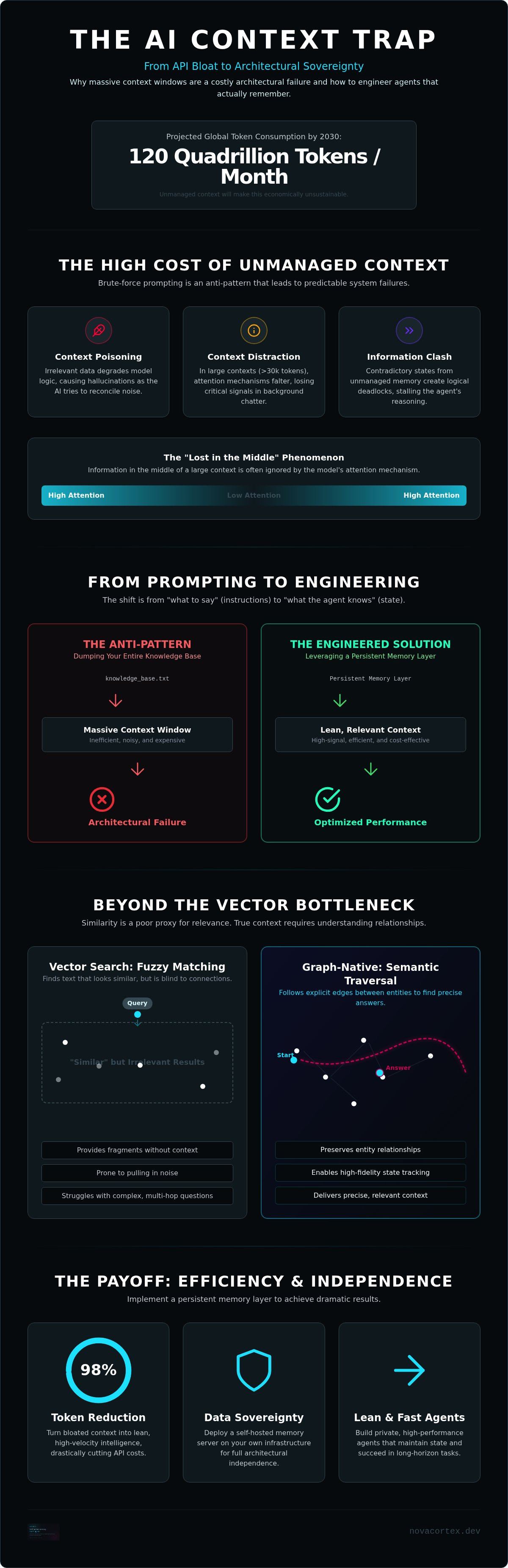
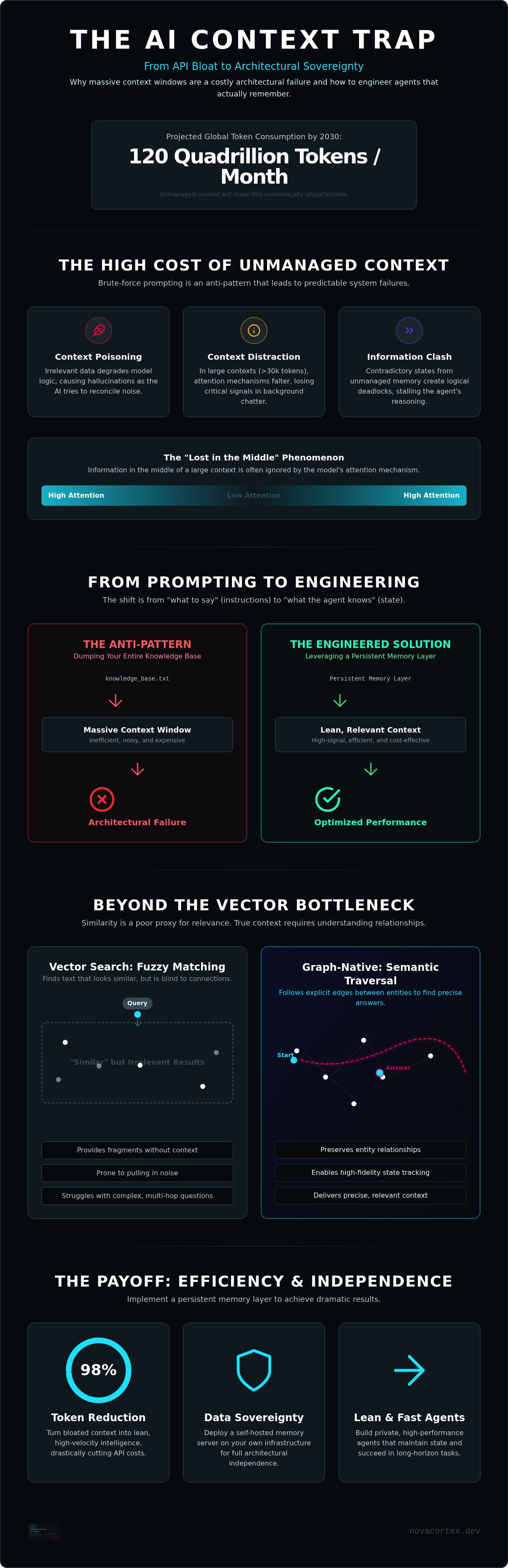
Dumping your entire knowledge base into a prompt isn't engineering; it's a confession of architectural failure. As token consumption scales toward a projected 120 quadrillion tokens per month by 2030, the massive context window is an expensive trap designed to keep you tethered to vendor APIs. You've likely felt the friction of AI agent context optimization. Your agents lose state in long-horizon tasks. Your API bills skyrocket because output tokens remain four to five times more expensive than input. You want performance, but you're currently paying for bloat.
It's time to stop the bleed. This technical guide moves beyond basic RAG to help you build agents that actually remember. We'll show you how to implement a persistent memory layer that doesn't rely on cloud providers, allowing you to achieve up to 98% token reduction while maintaining absolute data sovereignty. We'll break down the architecture of graph-native storage, the Portable Memory Format (PMF), and the deployment of MCP-native memory servers to ensure your agents stay lean, fast, and private.
Key Takeaways
- Stop treating prompts as databases. Learn why dumping raw data into context windows creates a "lost in the middle" failure and drives up avoidable API costs.
- Transition from basic vector search to graph-native retrieval. Preserving entity relationships is the only way to maintain high-fidelity state in complex, long-horizon tasks.
- Master AI agent context optimization by architecting modular Knowledge Buckets. Use the Portable Memory Format (PMF) to ensure your agent's memory isn't locked into a single vendor's ecosystem.
- Achieve up to 98% token reduction by implementing a persistent memory layer. Efficient compaction and summarization techniques turn bloated context into lean, high-velocity intelligence.
- Establish digital sovereignty with NovaCortex. Deploy a self-hosted memory server on your own infrastructure to ensure data privacy and full architectural independence.
Context is Finite: Why Prompting Isn’t Enough
The context window is not a database. It is a volatile working memory buffer. The Transformer architecture relies on attention mechanisms that degrade as noise increases. "Lost in the middle" isn't a temporary bug; it is a fundamental mathematical limitation of how models process sequences. Information at the start or end of a massive context block stays sharp, but the middle becomes a graveyard of ignored data. Dumping your entire knowledge base into a prompt is an architectural anti-pattern. It treats a high-performance reasoning engine like a cheap, disorganized filing cabinet.
Economic reality makes this laziness unsustainable. In 2026, output tokens remain significantly more expensive than input, often by a factor of five. With global token consumption projected to reach 120 quadrillion tokens per month by 2030, unmanaged context is a fast track to bankruptcy. AI agent context optimization is the technical correction to this bloat. It is the engineering discipline of maximizing utility per token. Effective AI agent context optimization ensures you send only the high-signal data required for the immediate task, preserving the agent's reasoning capacity and your infrastructure budget.
Prompt Engineering vs. Context Engineering
Prompt engineering focuses on instructions. Context engineering focuses on state. While prompt engineering tells the agent how to behave, context engineering dictates what the agent actually knows at the moment of inference. The shift is from "what to say" to "what the agent knows."
- Static Instructions: System prompts that define the agent's persona and logic. These are fixed assets.
- Dynamic State: The precise subset of facts retrieved from a memory layer. This must be fluid and pruned.
You can't fix a hallucination caused by stale data with a better prompt. You fix it by ensuring the agent's context is dynamic, retrieved, and relevant to the current objective.
The Anatomy of Context Failure
When context is unmanaged, agents fail in predictable ways. These aren't model flaws; they're system design flaws that occur when developers rely on brute-force prompting.
- Context Poisoning: Irrelevant data segments degrade the model's logic. The resulting "hallucinations" are often just the model trying to reconcile contradictory or useless noise.
- Context Distraction: In windows exceeding 30k tokens, the attention mechanism suffers a crisis. The model loses its ability to prioritize critical signals over background chatter.
- Information Clash: Contradictory states in long-term memory create logical deadlocks. Without a persistent memory layer to resolve these conflicts, the agent's reasoning simply stalls.
Graph-Native Retrieval: Beyond the Vector Search Bottleneck
Vector databases are the industry's favorite blunt instrument. They excel at finding text that looks similar, but they are fundamentally blind to how that information is connected. In a production environment, similarity is a poor proxy for relevance. If your agent asks about a specific deployment failure, a vector search might return five similar-looking error logs from three years ago. It misses the specific, interconnected dependency that actually caused the current crash. This is the vector search bottleneck: it provides fragments without the thread that binds them.
True AI agent context optimization demands a transition from flat vector lists to graph-native storage. By preserving entity relationships, you allow the agent to perform semantic traversal rather than just fuzzy matching. Instead of guessing based on distance, the system follows explicit edges between nodes: person-to-project, project-to-dependency, dependency-to-vulnerability. This structural precision is a core component of the modern Retrieval-Augmented Generation survey literature, which highlights the shift toward more sophisticated retrieval mechanisms to overcome context window saturation. Without these links, your agent is just guessing.
Vectors vs. Graphs for Agent Memory
Fuzzy matching works for discovery. Graphs work for knowledge. Traditional top-k retrieval is notoriously leaky in high-noise environments; it pulls in "similar" but irrelevant context that poisons reasoning. If you want to understand the technical trade-offs between these architectures, see our breakdown of Redis vs graph memory for AI agents. While key-value stores like Redis provide speed, they lack the relational depth required for multi-agent coordination. Graphs provide the "why" and "how" behind the data, not just the "what," making them indispensable for complex, multi-step tasks.
Precision Retrieval and Token Reduction
Efficiency is the byproduct of precision. Graph-native layers allow for surgical context pruning by retrieving only the specific nodes and edges relevant to the current inference step. This isn't just a theory. In production benchmarks, filtering context through graph traversal has demonstrated an 80% reduction in window noise compared to standard RAG implementations. By stripping away the irrelevant "top-k" filler, you preserve the model's attention for actual reasoning. You can examine our graph-native implementation to see how this works at the protocol level. This architectural shift turns AI agent context optimization from a prompting trick into a data-driven certainty.
Knowledge Buckets: Architecting Modular Agent State
Context optimization is a partitioning problem. Most developers treat agent memory as a single, monolithic stream. This is a mistake. Monolithic memory creates logical crosstalk, where information intended for a specialized research agent bleeds into the execution context of a coding agent. To achieve true AI agent context optimization, you must move toward modularity. Knowledge Buckets provide this structure. They are isolated, purpose-built containers of state that allow agents to access specific datasets without loading the entire system's history.
The industry is obsessed with Extending Context Windows to accommodate more data. While larger windows are useful, they don't solve the underlying organization crisis. Modular memory allows you to scale context horizontally. You can maintain millions of facts across hundreds of buckets without increasing inference latency. The goal is to provide the model with a high-density, low-noise environment where every token serves a specific purpose. This architectural shift ends the era of the "context dump" and begins the era of precision state management.
Isolating Context for High-Performance Agents
Multi-agent systems fail when they lack boundaries. In a complex workflow, a "Manager" agent and a "Worker" agent should not share the same raw memory space. Sharing leads to confusion, where the worker begins adopting the manager's constraints or vice versa. Knowledge Buckets enforce strict state isolation. By managing state transitions between these buckets, you ensure that each agent only "sees" what is relevant to its specific sub-task. This is where the portable memory format for AI becomes critical. It provides a standardized way to hand off state between agents and providers, ensuring your context remains interoperable and your system remains sovereign. You own the memory; the LLM is just a temporary processor.
The MCP-Native Advantage
Integration shouldn't be a bottleneck. Traditional API wrappers add latency and complexity. The Model Context Protocol (MCP) changes this by allowing for direct, standardized communication between the LLM and your memory layer. An MCP native memory server acts as a bridge, delivering Knowledge Buckets directly to the model's attention mechanism. This isn't a workaround; it is a native architectural upgrade. It allows for AI agent context optimization at the protocol level, reducing the overhead of traditional RAG and providing a faster, more reliable path to persistent agent cognition. Stop wrapping your memory in bloated middleware. Go native.
Token Efficiency: Reducing API Overhead by 98%
Unoptimized context is a tax on innovation. Most teams accept high API bills as an unavoidable cost of doing business. They shouldn't. In 2026, where output tokens remain four to five times more expensive than input tokens, efficiency is a competitive necessity. NovaCortex delivers up to 98% token reduction by replacing the "context dump" with surgical state management. Standard RAG implementations waste thousands of tokens on redundant headers, conversational filler, and irrelevant chunks. AI agent context optimization fixes this by treating tokens as a finite, expensive resource. It forces a shift from "send everything" to "send only what matters."
Benchmarking NovaCortex against standard RAG reveals the hidden cost of the status quo. While standard RAG retrieves entire text blocks based on vague similarity, NovaCortex uses graph-native filtering to extract precise nodes. This architectural difference is the gap between a 100,000-token prompt and a 2,000-token prompt. By utilizing caching strategies for repetitive context retrieval, you avoid paying for the same information multiple times. The result is a lean, high-velocity system that performs better because it isn't drowning in its own data.
Techniques for Context Pruning
Efficiency starts with elimination. You don't need a full chat history for an agent to perform a specific API call. You need the state. Automated summarization of historical context transforms bloated logs into high-density memory nodes. Context compaction is a method for token conservation that distills raw data into its essential semantic components. By removing redundant conversational tokens and identifying non-essential metadata, you minimize the payload sent to the LLM. This isn't just about saving money. It's about clearing the signal-to-noise ratio. A cleaner window leads to sharper reasoning and fewer logical errors.
Calculating the ROI of Optimized Context
The math is simple. If you reduce your token footprint by 98%, you extend your runway or increase your agent's throughput by orders of magnitude. Smaller context windows also slash latency. High-velocity agents require fast inference. Sending 128k tokens when 2k would suffice is a performance bottleneck. Implementing AI agent context optimization through AI agent long term memory reduces the need for expensive re-computation. You store the distilled state once and retrieve it only when necessary. This architectural shift turns a variable cost into a manageable, high-performance asset. It is the difference between a fragile prototype and a production-grade AI system.
Sovereign Memory: Deploying NovaCortex for Context Optimization
Privacy is the final frontier of AI engineering. In a regulatory landscape governed by the Colorado Artificial Intelligence Act and California's AB 2013, handing your entire corporate knowledge base to a third-party cloud provider is no longer just a technical risk; it's a compliance liability. A self-hosted AI memory layer ensures that your proprietary data never leaves your infrastructure. By deploying NovaCortex locally, you decouple reasoning from storage. You use the LLM as a transient processor while your graph-native memory remains under your direct control. This is the only way to achieve AI agent context optimization without sacrificing data sovereignty.
Deploying NovaCortex is a pragmatic choice for builders who reject bloated, restrictive systems. Whether you're running on a dedicated VPS, a local server, or a Raspberry Pi 5, the architecture is designed for high-velocity performance. This privacy-first approach to RAG eliminates egress fees and mitigates the risk of context poisoning from external sources. You own the Knowledge Buckets. You define the relationships. You control the state. It's a necessary correction to the current industry trend of vendor lock-in that treats your data as a secondary concern.
Local Infrastructure Deployment
Hardware requirements for NovaCortex are intentionally lean. A standard graph-native memory server can scale from a single agent to an enterprise-wide memory layer on modest hardware. Because the system utilizes the Portable Memory Format (PMF), you aren't locked into a specific hardware vendor or cloud ecosystem. Security is foundational here. Local-first storage means your AI agent context optimization workflows comply with the strictest data privacy frameworks, including the amended COPPA Rule requirements effective as of April 2026. You don't ask for permission to secure your data; you architect it that way from day one.
Persistent Cognition Frameworks
Integration is straightforward. NovaCortex is built to slot into existing agent frameworks like LangChain or AutoGPT via its MCP-native interface. This isn't just about storage; it's about continuous learning. As your agents interact with the world, they commit distilled observations to the memory layer, improving performance over time without expanding the context window into an unmanageable mess. The transition from transient prompting to persistent cognition is the definitive step toward production-grade AI. It's time to stop building fragile prototypes and start engineering sovereign systems that remember.
Actionable Step: Deploy NovaCortex on GitHub
Engineering Persistent Cognition
The era of the "context dump" is over. We've moved beyond treating LLMs like bottomless filing cabinets. By implementing graph-native retrieval and modular Knowledge Buckets, you transform your agents from transient prompt-responders into persistent, intelligent systems. This architectural shift isn't just about saving money; it's about reclaiming control of your data and your infrastructure. You don't have to choose between performance and privacy when you own the memory layer.
Effective AI agent context optimization is the technical baseline for any production-grade deployment in 2026. You've seen how a self-hosted, MCP-compatible architecture can slash token usage by up to 98% while ensuring compliance with evolving data laws. The path to leaner, faster, and more sovereign AI is clear. Stop paying the "laziness tax" to cloud vendors and start building resilient systems that maintain their state without the bloat. Your infrastructure should work for you, not the other way around.
The transition to persistent agent memory is the next logical step in your engineering journey. Take the lead and build something that lasts.
Frequently Asked Questions
What is the difference between context engineering and context optimization?
Context engineering is the architectural design of how an agent manages state; context optimization is the refinement of that state to eliminate token waste. Engineering builds the structural blueprint for memory retrieval. Optimization is the high-velocity execution that ensures every token in the window serves a specific reasoning purpose. Both are necessary to prevent agents from drowning in irrelevant data.
How does graph-native memory reduce token usage compared to vector databases?
Vector databases rely on "top-k" retrieval, which often pulls in irrelevant text chunks that look similar but lack relational value. Graph-native memory uses semantic traversal to follow explicit edges between nodes. This precision allows you to retrieve only the specific facts required for a task. By eliminating the noise inherent in similarity searches, you reduce token overhead by orders of magnitude.
Can I use NovaCortex with existing LLM providers like OpenAI or Anthropic?
NovaCortex is provider-agnostic and integrates with any LLM via standard protocols. It functions as an external memory layer that delivers optimized context to models like GPT-4o or Claude 3.5 Sonnet. You retain your preferred reasoning engine while gaining a sovereign, high-efficiency memory stack. This separation of concerns is critical for maintaining performance and data ownership.
What are Knowledge Buckets and how do they improve agent memory?
Knowledge Buckets are modular containers that isolate state for specific tasks or agents. They prevent "crosstalk" where irrelevant data from one task leaks into another. By partitioning memory, you ensure the agent only processes high-signal data. This modularity is a core pillar of AI agent context optimization, allowing systems to scale without increasing inference latency or noise.
Is self-hosting a memory layer difficult for small development teams?
Self-hosting the NovaCortex Self-Hosted Edition is designed for engineering efficiency rather than administrative complexity. It doesn't require a dedicated DevOps team. If you can manage a VPS or a local Docker environment, you can deploy a graph-native memory server. It is a pragmatic alternative to bloated cloud services that compromise your data sovereignty and increase your monthly burn.
How much can I actually save on API costs with context optimization?
You can achieve up to a 98% reduction in token usage compared to standard RAG implementations. By stripping away redundant conversational history and irrelevant vector chunks, you stop paying for noise. These savings scale directly with your agent's complexity. In an environment where output tokens are four to five times more expensive than input, this efficiency is a financial necessity.
Does reducing context size impact the reasoning quality of the AI agent?
Reducing context size through optimization actually increases reasoning quality. Large, unmanaged context windows suffer from "context poisoning" and the "lost in the middle" phenomenon. Pruning the window to its essential semantic components allows the model's attention mechanism to focus entirely on relevant facts. High-density context leads to sharper logic and fewer hallucinations than bloated, unrefined prompts.
What is the Portable Memory Format (PMF) and why does it matter?
The Portable Memory Format (PMF) is an open standard that ensures your agent's memory isn't trapped in a single provider's ecosystem. It enables interoperability between different models and frameworks. PMF is the foundation of digital sovereignty. It allows you to move your memory layer across different architectures without losing years of learned state or being forced into expensive vendor lock-in cycles.
FAQ
What is the difference between context engineering and context optimization?
Context engineering is the architectural design of how an agent manages state; context optimization is the refinement of that state to eliminate token waste. Engineering builds the structural blueprint for memory retrieval. Optimization is the high-velocity execution that ensures every token in the window serves a specific reasoning purpose. Both are necessary to prevent agents from drowning in irrelevant data.
How does graph-native memory reduce token usage compared to vector databases?
Vector databases rely on "top-k" retrieval, which often pulls in irrelevant text chunks that look similar but lack relational value. Graph-native memory uses semantic traversal to follow explicit edges between nodes. This precision allows you to retrieve only the specific facts required for a task. By eliminating the noise inherent in similarity searches, you reduce token overhead by orders of magnitude.
Can I use NovaCortex with existing LLM providers like OpenAI or Anthropic?
NovaCortex is provider-agnostic and integrates with any LLM via standard protocols. It functions as an external memory layer that delivers optimized context to models like GPT-4o or Claude 3.5 Sonnet. You retain your preferred reasoning engine while gaining a sovereign, high-efficiency memory stack. This separation of concerns is critical for maintaining performance and data ownership.
What are Knowledge Buckets and how do they improve agent memory?
Knowledge Buckets are modular containers that isolate state for specific tasks or agents. They prevent "crosstalk" where irrelevant data from one task leaks into another. By partitioning memory, you ensure the agent only processes high-signal data. This modularity is a core pillar of AI agent context optimization, allowing systems to scale without increasing inference latency or noise.
Is self-hosting a memory layer difficult for small development teams?
Self-hosting the NovaCortex Self-Hosted Edition is designed for engineering efficiency rather than administrative complexity. It doesn't require a dedicated DevOps team. If you can manage a VPS or a local Docker environment, you can deploy a graph-native memory server. It is a pragmatic alternative to bloated cloud services that compromise your data sovereignty and increase your monthly burn.
How much can I actually save on API costs with context optimization?
You can achieve up to a 98% reduction in token usage compared to standard RAG implementations. By stripping away redundant conversational history and irrelevant vector chunks, you stop paying for noise. These savings scale directly with your agent's complexity. In an environment where output tokens are four to five times more expensive than input, this efficiency is a financial necessity.
Does reducing context size impact the reasoning quality of the AI agent?
Reducing context size through optimization actually increases reasoning quality. Large, unmanaged context windows suffer from "context poisoning" and the "lost in the middle" phenomenon. Pruning the window to its essential semantic components allows the model's attention mechanism to focus entirely on relevant facts. High-density context leads to sharper logic and fewer hallucinations than bloated, unrefined prompts.
What is the Portable Memory Format (PMF) and why does it matter?
The Portable Memory Format (PMF) is an open standard that ensures your agent's memory isn't trapped in a single provider's ecosystem. It enables interoperability between different models and frameworks. PMF is the foundation of digital sovereignty. It allows you to move your memory layer across different architectures without losing years of learned state or being forced into expensive vendor lock-in cycles.