AI Agent Context Persistence: Engineering Long-Term Memory Beyond the Context Window

Context windows are not a memory strategy; they are a tax on engineering inefficiency. Despite the hype around million-token limits, most autonomous systems still suffer from systemic amnesia the moment a session ends. Relying on massive context dumps isn't architecture; it's expensive, wasteful, and fundamentally unscalable. Achieving true AI agent context persistence requires a decisive shift from stateless LLM calls to a dedicated, graph-native memory layer.
You've felt the friction of skyrocketing token costs and the sting of losing critical information across session boundaries. You're likely tired of vendor lock-in with proprietary vector databases that compromise data sovereignty. This article provides the blueprint to master persistent agent cognition using MCP-native infrastructure and the Portable Memory Format (PMF). You'll learn how to implement a self-hosted memory server that slashes token usage by up to 98%. We'll explore the transition from simple RAG to sophisticated Knowledge Buckets. This architecture ensures your agents maintain local, privacy-first memory that survives every reboot and scales without bloating your API bill.
Key Takeaways
- Stop relying on massive context windows that cause information dilution. Learn to implement true AI agent context persistence through a dedicated, graph-native memory layer.
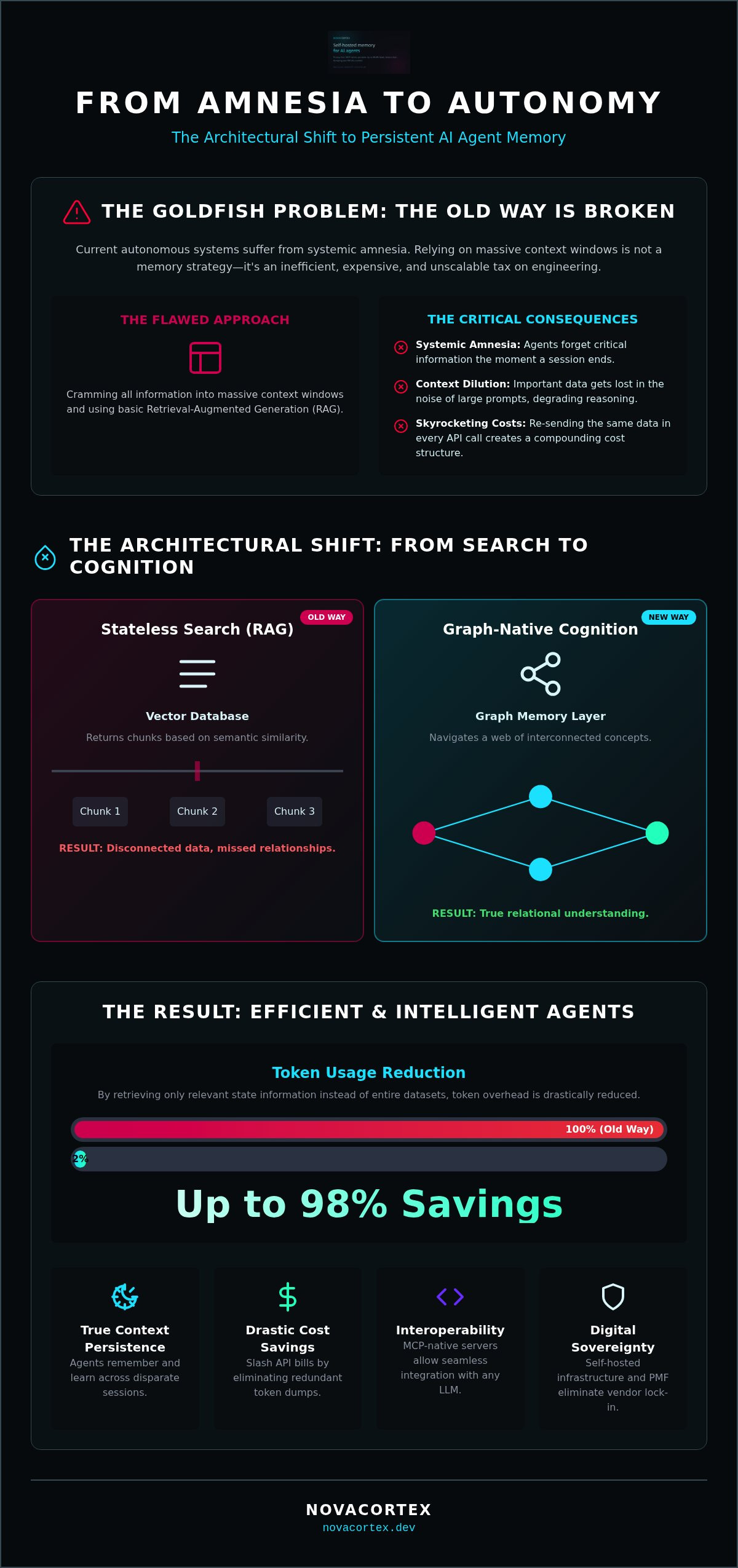
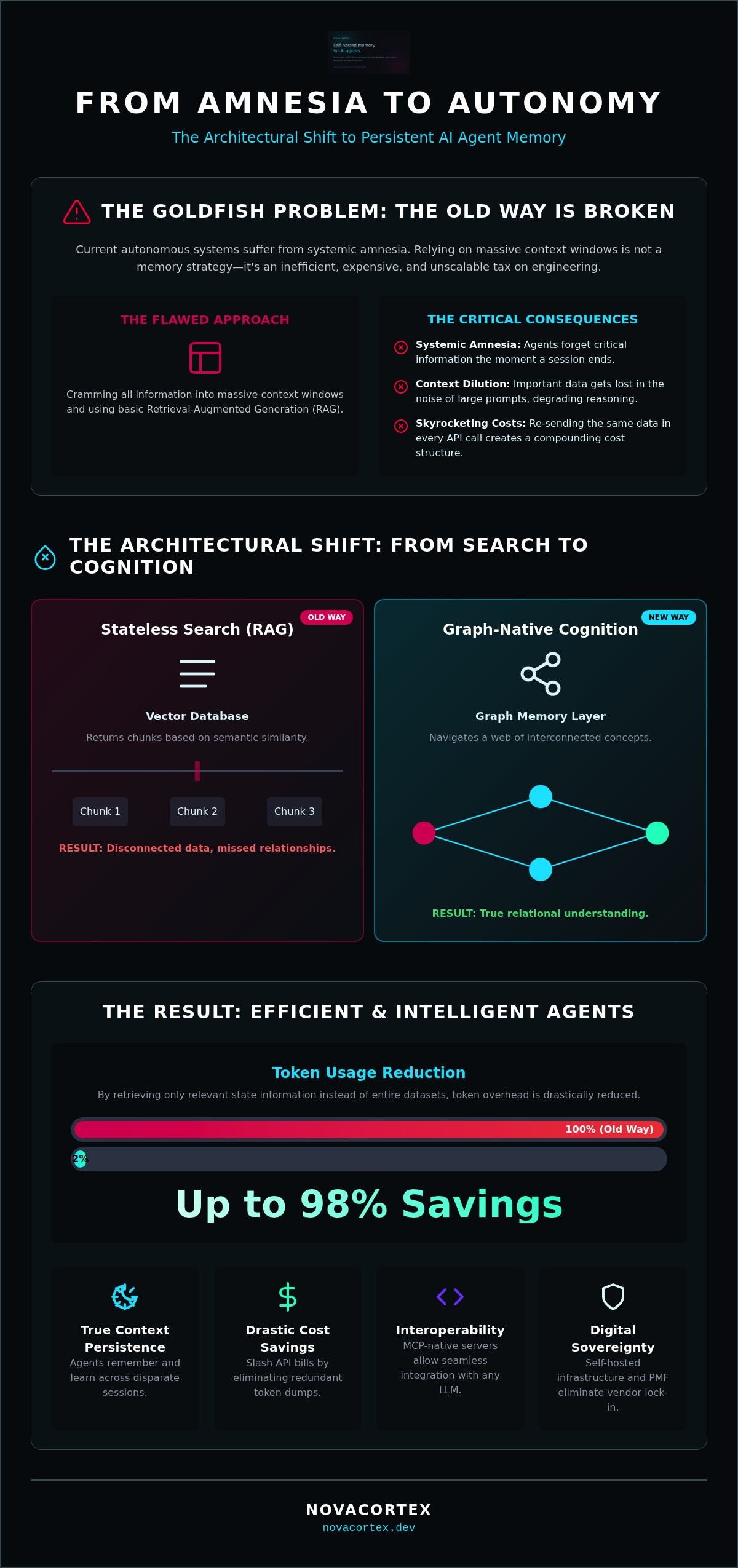
- Reduce token overhead by up to 98% using Knowledge Buckets. This modular approach ensures agents retrieve only relevant state information instead of dumping entire datasets into every call.
- Standardize your architecture with MCP-native memory servers. This allows for seamless interoperability between different LLMs and your persistent data structures using JSON-RPC 2.0.
- Reclaim digital sovereignty with self-hosted infrastructure. Use the Portable Memory Format (PMF) to eliminate vendor lock-in and ensure your agent's memory survives provider outages.
The Goldfish Problem: Why Massive Context Windows Fail at Persistence
Context windows are not memory. They are volatile buffers that evaporate the moment an HTTP request closes, leaving the system in a perpetual state of amnesia. While providers race to offer million-token windows, this expansion masks a fundamental engineering flaw. More space doesn't equal better recall. In fact, large windows often trigger context dilution, where the model loses focus on critical data buried in the middle of a massive prompt. AI agent context persistence is the architectural solution to this "Goldfish Problem." It's the ability to maintain state and knowledge across disparate sessions, ensuring an agent doesn't start from zero every time you hit "send."
Relying on "infinite context" is an economic disaster. Re-sending the same static knowledge, documentation, or user history in every prompt creates a compounding cost structure that scales linearly with every interaction. It's a tax on inefficiency. Stateless LLM inference treats every query as an isolated event, but true agentic workflows require stateful awareness. Without persistence, you aren't building an agent; you're just running a high-latency script that forgets its purpose the moment it finishes speaking.
The Architectural Limits of Stateless Agents
Standard Transformers lack a native "hard drive." They process vectors in a fleeting sequence, and once the window is full, old information is discarded or truncated. Context stuffing attempts to bypass this by cramming everything into the prompt, but the performance penalty is severe. Latency spikes. Reasoning degrades. The model's attention fractures under the weight of irrelevant tokens. Context persistence acts as the bridge between ephemeral inference and persistent cognition, serving as an essential component in the cognitive architecture of AI agents.
Beyond RAG: The Need for True Cognitive Layers
Most developers mistake basic Retrieval-Augmented Generation (RAG) for memory. It's actually just "Search-as-Memory." RAG finds snippets based on semantic similarity, but similarity isn't understanding. If an agent needs to reason through a complex project history, a simple vector search often misses the structural relationships between tasks, owners, and dates. Complex reasoning requires a cognitive layer that understands how data points connect. When evaluating self-hosted vs managed AI memory, the goal is to move beyond simple retrieval toward a system that captures the evolution of an agent's knowledge over time. This shift is the difference between an agent that can find a file and an agent that remembers why that file was created in the first place.
Graph-Native Memory: The Architectural Shift from Search to Cognition
Vector databases are the current industry standard, but they are fundamentally limited. They rely on semantic similarity. Similarity is a proxy for relevance, not a guarantee of understanding. When building for AI agent context persistence, you need more than a list of "nearby" text chunks. You need a map of relationships. Graph-native storage treats memory as a web of interconnected entities rather than an index of arbitrary strings. This is a critical distinction for anyone engineering high-precision autonomous systems.
In a graph, nodes represent distinct cognitive concepts. Edges represent the logic that binds them. This structure allows an agent to navigate complex knowledge webs with surgical precision. While a vector search might return five paragraphs that mention "billing," a graph traversal follows the specific path from a user to their transaction, their support ticket, and the underlying system error. By treating memory as a structured graph, we move from simple search to true machine cognition.
Solving the Relational Knowledge Gap
Consider a customer service agent handling a user named Jane. She's complaining about a "duplicate charge." A standard vector-based agent might retrieve generic billing FAQs. However, Jane's issue is tied to a specific "payment gateway timeout" that occurred two weeks ago. Without a relational understanding, the agent misses the link between the timeout and the double billing. It treats them as isolated events because they aren't "semantically similar" enough in a high-dimensional space.
Graph-native memory persists these relationships across weeks or months. It doesn't matter how many tokens have passed since the event. The connection remains hardcoded in the data structure. For a deeper dive into why traditional key-value stores fall short in these scenarios, see our analysis on Redis vs graph memory for AI agents.
Precision Retrieval: Contextual Anchoring
Precision is the antidote to context dilution. By using graph traversal, an agent can "anchor" itself to the exact node of memory required for a specific task. This eliminates the noise inherent in k-nearest neighbor searches. When you reduce noise, you improve reasoning. The LLM doesn't have to sift through irrelevant data; it receives the exact facts it needs. Graph-native memory acts as a persistent knowledge map for autonomous agents, providing the structural backbone for long-term memory for AI agents. If you're ready to move beyond the limitations of standard vector stores, you can explore the implementation details in the NovaCortex open-source repository.
Reducing Token Overhead by 98% with Knowledge Buckets
Sending entire knowledge bases to an LLM is an engineering failure. It's a brute-force approach that treats the context window like a landfill. Most standard RAG implementations are guilty of this "dumping" problem; they retrieve far too many irrelevant chunks, forcing the model to sift through noise. This isn't just inefficient. It's expensive. Implementing true AI agent context persistence shouldn't break your infrastructure budget. Instead of bloated prompts, sophisticated systems use modular context to isolate and retrieve only the specific state information required for the current task.
NovaCortex benchmarks demonstrate a 98% reduction in token usage compared to standard RAG architectures. This massive efficiency gain comes from replacing generic retrieval with Knowledge Buckets. By siloing data into addressable segments, agents avoid the "lost-in-the-middle" phenomenon that plagues large context windows. High-frequency autonomous tasks and complex agentic loops demand this level of lean operation. If your agent is re-reading its entire history every five minutes, your architecture is broken.
Architecting Knowledge Buckets for Agent State
Knowledge Buckets are modular, addressable memory segments that act as specialized silos for an agent's world-state. They allow for dynamic context loading. You only bring specific memory segments to the agent when a defined trigger occurs, rather than keeping them active in the window. This approach ensures that the agent's focus remains razor-sharp. For a deeper dive into these structures, explore our guide on AI agent long term memory and how it supports persistent cognition.
The Hidden Cost of Semantic Noise
Irrelevant tokens are more than just a line item on your API bill. They are cognitive friction. When a context window is stuffed with semantic noise, agent reasoning degrades. The model's attention mechanism is forced to weight "filler" data against critical mission parameters, leading to hallucinations or logic errors. Token-efficient memory is a prerequisite for low-latency agent performance. Slashing token overhead by 98% shifts enterprise AI from a cost-prohibitive research project to a high-velocity, high-margin production standard. This precision is the cornerstone of scalable AI agent context persistence.
MCP-Native Integration: Building Interoperable Agent Memory
Custom API wrappers are a technical debt trap. Every time you switch a model or framework, the bridge between your agent and its data breaks. The Model Context Protocol (MCP) eliminates this friction by providing a standardized JSON-RPC 2.0 interface between LLMs and their storage layers. For AI agent context persistence, MCP acts as the universal socket. It ensures that your persistent memory layer isn't a walled garden but a standardized resource accessible by any compliant agentic system. This protocol shift moves us away from brittle, bespoke integrations toward a robust, interoperable ecosystem.
Standardization is the only way to end vendor lock-in. By utilizing the Portable Memory Format (PMF), you decouple agent cognition from the underlying infrastructure. Whether you're running a multi-agent team in LangChain v1.2.0 or a specialized workflow in LlamaIndex v0.14.23, the memory remains consistent. Your agent's history shouldn't be trapped in a proprietary cloud database. It should be a sovereign asset. This interoperability allows agents to sync memory across different frameworks, ensuring that a lesson learned in one environment is immediately available in another.
Step-by-Step: Implementing an MCP-Native Memory Server
Configuring a memory layer as a standardized MCP resource begins with mapping your graph-native nodes to MCP's resource templates. This creates a unified discovery mechanism for the agent. Once the server is live, the agent connects via the protocol, treating its long-term memory with the same ease as a local file system. This architecture allows you to validate memory retrieval across diverse LLM backends without rewriting your core logic. You can swap an expensive frontier model for a lean, local alternative while maintaining a perfect record of previous interactions.
Portable Memory: The End of Data Silos
Memory should be as portable as a JSON file. The PMF allows you to export an agent's entire cognitive state and migrate it between local hardware and high-performance cloud clusters. This is a fundamental requirement for AI agent context persistence. It prevents "Cloud Amnesia," where a provider's API change or service outage wipes your agent's functional history. By keeping memory in a portable, open format, you maintain control over the data that defines your agent's personality and expertise. For a detailed technical walkthrough, see our guide on the MCP native memory server.
Owning the Memory Layer: Privacy, Sovereignty, and NovaCortex
Digital sovereignty is the final frontier of the agentic era. If you don't own the memory layer, you don't own the agent. Relying on centralized cloud providers for AI agent context persistence creates a fragile dependency. It's a single point of failure. "Cloud Amnesia" isn't a hypothetical risk; it's a structural certainty when proprietary providers pivot their APIs, deprecate models, or change data retention policies. When the provider resets, your agent's functional history evaporates. Reclaiming this data is a requirement for any production-grade system.
Transitioning from experimentation to deployment requires a shift in infrastructure. You need a system that treats memory as a sovereign asset. By hosting your own memory layer, you eliminate the risk of external interference. You ensure that every lesson your agent learns remains under your direct control, stored in a format that you can migrate, back up, or audit at will. This isn't just about security. It's about engineering a system that actually belongs to you.
Self-Hosting for Privacy-First RAG
Standard RAG implementations frequently leak sensitive data to third-party vector clouds. This is an unacceptable trade-off for enterprise applications. Keeping knowledge bases local eliminates third-party exposure and significantly reduces retrieval latency. By deploying a self-hosted AI memory layer, you achieve a privacy-first architecture that doesn't sacrifice performance. Local memory retrieval bypasses the overhead of external API calls, providing the high-velocity response times necessary for real-time autonomous interaction.
Getting Started with NovaCortex
NovaCortex Self-Hosted Edition provides the infrastructure to build these sovereign systems. It's designed to run on any hardware, from a Raspberry Pi to a high-performance VPS. This flexibility ensures that AI agent context persistence is accessible regardless of your scale. By using the Portable Memory Format (PMF), you ensure your data remains interoperable and future-proof. You aren't just building a database; you're building a cognitive foundation that survives beyond the current hype cycle.
Joining the open-source community allows you to contribute to a standard that prioritizes independence over bloat. It's time to stop renting amnesiac models and start owning persistent intelligence. Move your agents from stateless scripts to stateful, sovereign experts that retain their knowledge across every session and every year of operation.
Architecting Sovereign Intelligence
The era of amnesiac agents is ending. Relying on massive context windows is a design pattern rooted in technical waste and high-latency overhead. True AI agent context persistence requires a structural shift toward graph-native memory layers and standardized protocols like MCP. By implementing Knowledge Buckets and the Portable Memory Format, you move beyond expensive, stateless inference and toward lean, persistent machine cognition.
You've seen the architectural path from volatile buffers to sovereign memory. NovaCortex offers an Apache-2.0 licensed, self-hosted solution that delivers a benchmarked 98% token reduction. This isn't just about saving money; it's about building agents that actually understand the relationships between the entities they manage. It's time to reclaim your data sovereignty and build systems that retain knowledge across every session. Deploying on your own hardware ensures your agent's memory survives provider outages and API shifts.
Stop renting amnesia. Start engineering memory. The infrastructure for autonomous, long-term agent cognition is ready for your first deployment.
Frequently Asked Questions
What is AI agent context persistence?
AI agent context persistence is the architectural ability for an agent to maintain state and knowledge across disparate sessions. Unlike standard LLM calls that reset every time, persistence ensures the agent retains a "hard drive" of previous interactions. It bridges the gap between ephemeral inference and long-term cognition. This prevents the Goldfish Problem where agents forget user preferences or project history the moment the API request finishes.
How does graph-native memory differ from a vector database?
Vector databases rely on semantic similarity, which is often a poor proxy for understanding. Graph-native memory captures the explicit relationships between entities using nodes and edges. While a vector store might find "related" text, a graph follows the logical path from a user to a specific transaction or error. This relational structure is essential for high-precision retrieval in complex, multi-step agentic workflows.
Can I reduce my OpenAI or Anthropic token costs using a memory layer?
You can slash token overhead by up to 98% by implementing a dedicated memory layer. By using Knowledge Buckets to silo data, you stop dumping entire knowledge bases into every prompt. Instead of re-sending static documentation, the memory layer provides only the relevant state segments required for the current task. This precision significantly lowers the token count per request, making enterprise-scale AI deployments economically viable.
Is NovaCortex compatible with the Model Context Protocol (MCP)?
NovaCortex is built as an MCP-Native Memory Server from the ground up. It utilizes the JSON-RPC 2.0 specification to standardize the interface between LLMs and your persistent memory layer. This compatibility eliminates brittle, custom API wrappers. You can connect any MCP-compliant agent framework directly to your knowledge graph, ensuring seamless interoperability across different models and developer tools.
How do I stop my AI agent from forgetting previous conversations?
You must move beyond the context window and implement a dedicated memory layer. True AI agent context persistence is achieved by storing episodic and semantic data in a persistent graph rather than relying on prompt history. This allows the agent to retrieve specific memories from weeks ago without bloating the current context window. It transforms the agent from a stateless script into a stateful, long-term collaborator.
What is the Portable Memory Format (PMF)?
PMF is an open standard that ensures your agent's knowledge remains portable and interoperable. It decouples the memory layer from specific infrastructure, allowing you to migrate agent states between local hardware and cloud environments. By using PMF, you eliminate vendor lock-in. Your agent's functional history becomes a sovereign asset that you can back up, audit, or move without losing a single node of information.
Do I need a high-end server to run a self-hosted memory layer?
No, the NovaCortex Self-Hosted Edition is engineered for lean, high-velocity performance. It runs efficiently on anything from a Raspberry Pi to a basic VPS. Because graph-native retrieval is structurally superior to brute-force vector searches, it requires fewer compute resources to maintain high precision. You don't need a massive GPU cluster to give your agents a permanent, privacy-first memory.
How does persistent memory improve agent reasoning?
Persistent memory provides contextual anchoring that reduces semantic noise. When an agent has access to a structured knowledge map, it doesn't have to guess or hallucinate missing information. It reasons based on verified, historical facts retrieved from its own memory layer. This leads to higher logic accuracy and lower latency, as the model spends less energy filtering out irrelevant data from a stuffed context window.
FAQ
What is AI agent context persistence?
AI agent context persistence is the architectural ability for an agent to maintain state and knowledge across disparate sessions. Unlike standard LLM calls that reset every time, persistence ensures the agent retains a "hard drive" of previous interactions. It bridges the gap between ephemeral inference and long-term cognition. This prevents the Goldfish Problem where agents forget user preferences or project history the moment the API request finishes.
How does graph-native memory differ from a vector database?
Vector databases rely on semantic similarity, which is often a poor proxy for understanding. Graph-native memory captures the explicit relationships between entities using nodes and edges. While a vector store might find "related" text, a graph follows the logical path from a user to a specific transaction or error. This relational structure is essential for high-precision retrieval in complex, multi-step agentic workflows.
Can I reduce my OpenAI or Anthropic token costs using a memory layer?
You can slash token overhead by up to 98% by implementing a dedicated memory layer. By using Knowledge Buckets to silo data, you stop dumping entire knowledge bases into every prompt. Instead of re-sending static documentation, the memory layer provides only the relevant state segments required for the current task. This precision significantly lowers the token count per request, making enterprise-scale AI deployments economically viable.
Is NovaCortex compatible with the Model Context Protocol (MCP)?
NovaCortex is built as an MCP-Native Memory Server from the ground up. It utilizes the JSON-RPC 2.0 specification to standardize the interface between LLMs and your persistent memory layer. This compatibility eliminates brittle, custom API wrappers. You can connect any MCP-compliant agent framework directly to your knowledge graph, ensuring seamless interoperability across different models and developer tools.
How do I stop my AI agent from forgetting previous conversations?
You must move beyond the context window and implement a dedicated memory layer. True AI agent context persistence is achieved by storing episodic and semantic data in a persistent graph rather than relying on prompt history. This allows the agent to retrieve specific memories from weeks ago without bloating the current context window. It transforms the agent from a stateless script into a stateful, long-term collaborator.
What is the Portable Memory Format (PMF)?
PMF is an open standard that ensures your agent's knowledge remains portable and interoperable. It decouples the memory layer from specific infrastructure, allowing you to migrate agent states between local hardware and cloud environments. By using PMF, you eliminate vendor lock-in. Your agent's functional history becomes a sovereign asset that you can back up, audit, or move without losing a single node of information.
Do I need a high-end server to run a self-hosted memory layer?
No, the NovaCortex Self-Hosted Edition is engineered for lean, high-velocity performance. It runs efficiently on anything from a Raspberry Pi to a basic VPS. Because graph-native retrieval is structurally superior to brute-force vector searches, it requires fewer compute resources to maintain high precision. You don't need a massive GPU cluster to give your agents a permanent, privacy-first memory.
How does persistent memory improve agent reasoning?
Persistent memory provides contextual anchoring that reduces semantic noise. When an agent has access to a structured knowledge map, it doesn't have to guess or hallucinate missing information. It reasons based on verified, historical facts retrieved from its own memory layer. This leads to higher logic accuracy and lower latency, as the model spends less energy filtering out irrelevant data from a stuffed context window.