AI Agent Data Sovereignty: What It Means and How to Build It

A server in the right country doesn’t make an AI agent sovereign. AI agent data sovereignty depends on who controls its memory, who can access it, and where information travels when the agent retrieves and processes it. A region setting tells you where data is stored, but not necessarily which laws apply to a provider or what happens to data during inference.
If you’re unsure whether an agent’s memory stays under your control, or whether you could move it without losing accumulated knowledge, that concern is justified. Sovereignty isn’t a hosting checkbox. It’s a control model that must cover storage, access, processing, retention, and portability.
This article explains those boundaries and offers practical checks for data flows, permissions, and operational responsibility. You’ll also see how user-controlled infrastructure and portable memory can support a more independent design, and where a self-hosted memory layer fits without implying it governs every part of an agent’s stack.
Key Takeaways
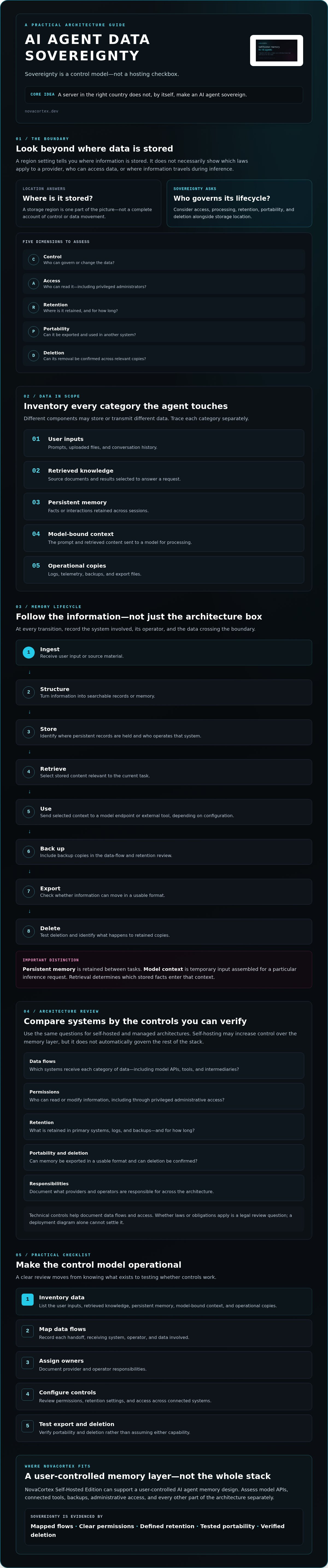
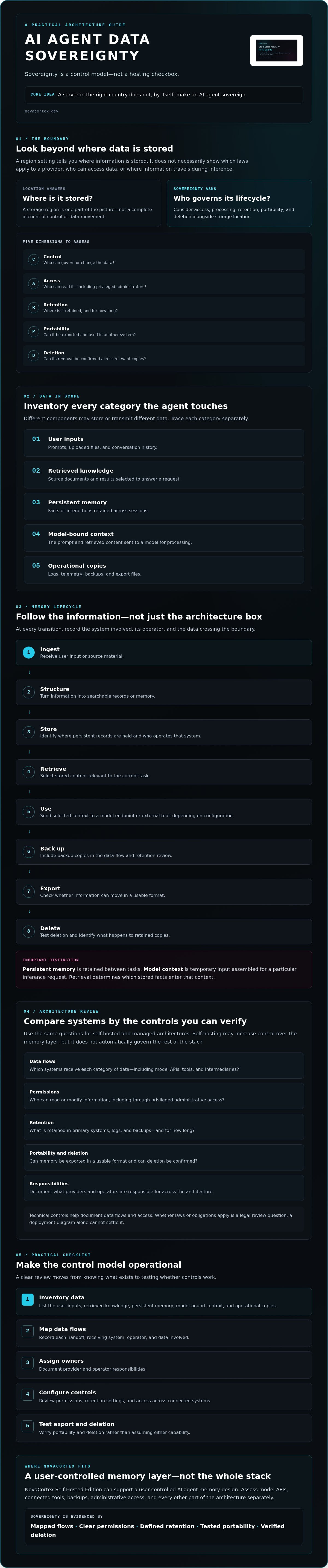
- Assess AI agent data sovereignty across control, access, retention, portability, and deletion, not just the location of stored data.
- Trace memory through its full lifecycle, including what context may be sent to model APIs or external tools during use.
- Compare self-hosted and managed architectures by checking data flows, permissions, retention settings, portability, and operator responsibilities.
- Use a practical checklist to inventory data, map flows, assign owners, configure controls, and test export and deletion.
- Evaluate NovaCortex Self-Hosted Edition as a user-controlled memory layer, while assessing the rest of your architecture separately.
What AI Agent Data Sovereignty Means Beyond Where Data Is Hosted
Data location tells you where information is stored. Data control tells you who can access, change, retain, export, or delete it. Portability determines whether you can move that information to another system and still use it. These are related, but they’re not interchangeable.
AI agent data sovereignty is the ability to govern an agent’s data across its lifecycle, including where it is processed, who can access it, how long it is retained, and whether it can be moved or deleted. It describes an architecture and its operating controls, not an automatic security or legal guarantee. The foundational idea of Data sovereignty connects data to the laws of the jurisdiction where it is generated or collected. For agents, you also need to trace where data goes during processing.
Which data belongs in an AI agent’s sovereignty boundary?
Draw the boundary around every data category the agent touches, not only its persistent memory. Trace each category separately because different components may store or transmit it:
- User inputs: prompts, uploaded files, and conversation history.
- Retrieved knowledge: source documents and results selected to answer a request.
- Persistent memory: facts or interactions retained across sessions.
- Model-bound context: the prompt and retrieved content sent to a model for processing.
- Operational copies: logs, telemetry, backups, and export files.
The exact boundary depends on the architecture and configuration. An agent, for example, may store memory in one system, retrieve a document from another, and send selected context to a separate model API. Record each handoff, including the data involved and the receiving system. A single label such as “agent data” can hide different access paths and retention rules.
Why deployment location is only one part of sovereignty
A cloud region describes physical storage location. It doesn’t, by itself, tell you who administers the infrastructure, which provider personnel or subprocessors may access data, or what responsibilities the operator retains. Self-hosting can increase control over the memory layer, but it doesn’t automatically control model APIs, connected tools, backups, or every administrator account.
For every data category, ask who can:
- Read or modify it, including through privileged administrative access.
- Retain it in primary systems, logs, or backups, and for how long.
- Export it in a usable format or confirm its deletion.
Then document provider and operator responsibilities. Whether a jurisdiction’s laws or obligations apply is a legal review question, not something a deployment diagram can settle. Technical controls provide evidence about data flows and access. Qualified legal advice must interpret that evidence for your specific situation.
How Agent Memory Moves Through the Data Lifecycle
Memory sovereignty is easiest to assess as a sequence of transitions, not a box on an architecture diagram. Information can cross infrastructure and provider boundaries whenever an agent processes a task. Mapping those transitions makes dependencies visible that the label “self-hosted” can leave hidden.
Trace the lifecycle in order: ingest user input or source material; structure it into searchable records or memory; store those records; retrieve relevant content for a task; use that content in an inference request or tool call; then back up, export, and eventually delete it. At each step, record the system involved, its operator, and the data crossing the boundary.
Storage, retrieval, and context
Persistent memory is information retained between tasks. Model context is the temporary input assembled for a particular inference request. Retrieval design determines which stored facts enter that context. A system might select a few relevant records or pass a larger collection to the model. The model API may receive retrieved text, user prompts, or both. Depending on the agent’s configuration, an external tool may receive selected context as well.
Before describing a deployment as sovereign, identify every recipient of retrieved content: the memory service, model endpoint, agent runtime, tools, and any intermediary. The strategic stakes extend beyond storage. IBM’s The Calculus of AI Sovereignty examines AI sovereignty in relation to enterprise control and the difficulty of changing systems. Portability matters because memory that cannot be extracted cleanly can bind future workflows to the current architecture.
Backups, exports, and deletion
Primary memory isn’t the whole record. Check whether backups and logs use the same infrastructure, access controls, and retention settings as the main store. Telemetry or error logs can also capture prompts or retrieved snippets. Inspect their contents rather than assuming they hold only metadata.
Test export and deletion in the deployed environment. Can you export memory in a usable format? Does deletion cover indexed records, replicas, backups, and downstream copies, or do retention rules delay removal? Don’t treat a successful delete request as proof that every copy is gone until you’ve checked the relevant systems and policies.
Data-flow diagram brief: Show user input moving through the agent runtime to the memory layer for structuring and storage. Draw retrieval back to the runtime, then show separate arrows from the runtime to the model and any external tools. Enclose the memory layer and its backups within the infrastructure boundary they actually use. Mark model and tool boundaries separately. Add export and deletion paths so they’re visible in the design review.
For a concrete reference point, review the NovaCortex memory layer implementation alongside your own flow map. AI agent data sovereignty depends on the complete path, not the memory component alone.
How to Evaluate AI Agent Data Sovereignty in an Architecture
Compare specific control boundaries, not labels. A self-hosted memory store can give your team direct control over that component while an external model provider still processes prompts and retrieved context. A managed service can offer configuration controls, but you need to verify what the provider operates and retains. Neither pattern guarantees sovereignty by itself.
Use this comparison as a starting point. Confirm the actual design in deployment documentation and contracts.
Data location: Self-hosted storage runs on infrastructure your organization operates or selects, but model and tool calls may leave that boundary. Managed services operate storage for you, sometimes with configurable regions. Verify locations for primary data, backups, logs, and processing.
Access control: With self-hosting, your team typically manages infrastructure credentials and permissions, while remaining responsible for securing them. In a managed pattern, the provider administers parts of the service. Check which controls are available to you and what privileged access the provider may have.
Retention: Self-hosting makes your organization responsible for setting retention and deletion processes across the systems it runs. A managed service may provide retention settings, but confirm how they apply to logs, backups, and replicas.
Portability: Self-hosting doesn’t make data portable automatically. Test whether memory can be exported in a usable format. Managed services may depend on provider-specific formats or features, so verify migration paths before adoption.
Operator responsibility: Self-hosted deployments shift infrastructure maintenance, credentials, updates, and backups to your organization. Managed providers handle some operational tasks, but responsibility is split according to service design and contract. Document the boundary instead of assuming it.
Check control boundaries
For each system, identify who operates storage, applies updates, manages credentials, and restores backups. Then check what you can configure and what the provider administers. A self-hosted memory layer doesn’t control model-provider data handling: the model endpoint may receive prompts or retrieved content under separate settings and terms. Verify current service documentation and contract language for every handoff.
Legal suitability depends on jurisdiction, contracts, and the specific data involved. Treat architecture as evidence for a review, not as a legal conclusion.
Test portability in practice
Ask whether you can export memory without relying on a proprietary service, and whether another compatible system can use that export. A format that preserves structure and meaning makes migration more practical across infrastructure or models. A raw dump may not. For a deeper look at this design question, see “Portable Memory Format for AI: Breaking the Vendor Lock-in Cycle.”
Run an export test before committing. Check what is included, whether it can be imported elsewhere, and what still depends on the original provider. That’s a more useful measure of AI agent data sovereignty than infrastructure ownership alone.
A Practical Checklist for Implementing Sovereign Agent Memory
Turn sovereignty goals into evidence. Each check below should produce a data-flow map, configuration record, named owner, or test result. Architecture checks show how the system behaves. Policy and legal reviews determine whether that behavior fits your organization’s obligations.
- Inventory the data. List prompts, retrieved content, persistent memory, model-bound context, logs, telemetry, backups, and exports. Record where each category is created and stored. Verify the inventory against system configuration and sample records.
- Map every flow. Trace data from ingestion through memory storage, retrieval, model requests, tools, backups, and deletion. Mark each provider or infrastructure boundary, then compare the map with runtime settings and integration documentation.
- Assign owners. Name the operator for every component that stores or processes memory. Document who owns credentials, which roles can read or modify data, who applies software updates, and where incidents or access requests are escalated. For a deeper architecture view, see “The Self-Hosted AI Memory Layer: Engineering Persistent Agent Cognition.”
- Configure and document controls. Review least-privilege permissions, credential storage and rotation, update responsibilities, retention settings, backup access, and recovery ownership. Confirm each setting in the deployed configuration. Keep policy decisions, contract reviews, and jurisdiction-specific legal questions separate from technical findings, and involve qualified specialists where needed.
- Test portability and removal. Export a controlled sample and confirm another compatible environment can interpret it. Restore a backup in a test environment, revoke a test credential, and run the documented deletion workflow. Check expected results against logs, replicas, backup retention, and downstream copies. “MCP Native Memory Server: Engineering Persistent Context for AI Agents” explores the integration side of persistent memory.
Make responsibility explicit
A checklist only works when it identifies who acts and what proves completion. For example, “backups are secure” is not a test. Record the backup operator, access roles, recovery procedure, and result of a restoration test. Apply the same discipline to exports and access revocation. This turns AI agent data sovereignty from an aspiration into a reviewable operating model.
How NovaCortex Supports User-Controlled AI Agent Memory
Once your data flows, access roles, retention settings, and portability requirements are documented, assess a memory layer against those controls. NovaCortex Self-Hosted Edition is designed to store agent memory on infrastructure the user operates, such as a server, VPS, or Raspberry Pi. That places memory storage within an environment your team controls. It doesn’t determine how a connected model API or external tool handles information.
What the self-hosted memory layer does, and doesn’t do
NovaCortex provides an open-source memory layer under the Apache-2.0 license. Its design includes graph-native storage, a Portable Memory Format (PMF) intended to reduce vendor lock-in, and MCP-native integration. These capabilities address distinct requirements: user-operated infrastructure gives you control over where the memory layer runs, a portable format supports migration, and MCP-native integration supports connections within an agent stack.
The boundary matters. NovaCortex isn’t an LLM API provider or a custom agent-development service, and its memory layer doesn’t govern every data flow in an application. Your team still needs to assess model endpoints, tools, infrastructure access, backups, credentials, updates, and deletion procedures. Self-hosting is an architectural control, not a substitute for security operations, data-flow mapping, or legal review.
Evaluate it against your requirements
Use the checklist from the previous section to test fit rather than relying on the word “self-hosted.” Confirm where the memory service runs, who administers that infrastructure, and how your team manages access and recovery. Then test whether PMF exports can be interpreted in a compatible environment and whether your integration pattern fits your agent architecture. Verify current deployment and integration requirements before making a decision.
NovaCortex reports token-use reductions of up to 98% compared with sending entire knowledge bases to a model. Treat that as a reported comparison, not a guaranteed result. Verify the methodology and conditions, and remember that token use doesn’t establish sovereignty on its own.
AI agent data sovereignty depends on the whole system. A user-controlled memory layer can strengthen control over one important component, while model processing, tools, and operational responsibilities still require separate assessment.
Review the open-source NovaCortex project and verify its current setup requirements against your architecture.
Build Sovereignty Into the Architecture
AI agent data sovereignty isn’t a hosting setting. It depends on tracing how memory moves, defining who can access and manage it, and testing whether you can export or delete it as intended. A clear data-flow map and named operational owners turn those principles into controls you can verify.
Self-hosted memory can strengthen control over the memory layer, but model APIs, tools, backups, and logs still need separate review. NovaCortex Self-Hosted Edition is open source under Apache-2.0 and designed to run on user-controlled infrastructure. Its Portable Memory Format is intended to reduce vendor lock-in, giving technical teams a concrete implementation to assess against their portability and governance requirements.
Review the project, check the current setup requirements, and compare its boundaries with your architecture before adopting it. Sovereignty is built through deliberate decisions and tested operations. Start with the component you can control, then extend that discipline across the full agent stack.
Frequently Asked Questions
What does data sovereignty mean for an AI agent?
Data sovereignty for an AI agent means having meaningful control over the data it processes, stores, retrieves, and retains. That includes prompts, persistent memory, retrieved documents, model-bound context, logs, backups, and exports. Assess who can access each category, where it is processed, how long it remains, and whether it can be moved or deleted. Storage location matters, but it doesn’t answer every control or jurisdiction question.
Is self-hosting enough to guarantee AI agent data sovereignty?
No. Self-hosting can give your organization more control over the infrastructure running a memory layer, but it doesn’t govern every connected component. An agent may still send prompts or retrieved information to an external model API or tool. Review access permissions, credentials, updates, backups, retention, and deletion, then check the responsibilities of each provider. Technical controls help inform legal review, but don’t guarantee legal suitability.
Can an AI agent send private memory to an external model?
Yes, depending on the architecture. An agent can retrieve a stored fact and include it in the temporary context sent to a model API. The memory may remain on your infrastructure while selected content leaves it for processing. Inspect the agent’s retrieval and prompt-assembly configuration, then verify which endpoints receive context and what their data-handling settings say. Don’t assume locally stored memory stays local during inference.
How do you assess data sovereignty in an AI agent architecture?
Start with a data inventory and flow map. For each category, record where it is stored and processed, who operates the system, which roles can access it, and how retention, export, and deletion work. Include model APIs, external tools, logs, and backups. Verify findings through configuration review and operational tests. For jurisdiction-specific obligations or contract interpretation, consult qualified legal specialists rather than treating an architecture diagram as a legal conclusion.
What happens if an AI memory system cannot export its data?
If memory can’t be exported in a usable format, migration may require rebuilding records or continuing to rely on the existing system. That can limit your ability to change providers or infrastructure without losing accumulated knowledge. Before adoption, test an export and check whether another compatible environment can interpret it. A portable format, such as NovaCortex’s Portable Memory Format, is intended to reduce vendor lock-in, but verify that it meets your migration needs.
Does open-source AI memory automatically make agent data private?
No. Open-source code can make implementation details available for inspection, but privacy still depends on deployment and operations. Review where memory runs, how credentials and access are managed, what logs and backups contain, and whether the agent sends retrieved content to external models or tools. NovaCortex Self-Hosted Edition is open source under Apache-2.0, but the license alone doesn’t configure access controls or govern the rest of an agent’s data flows.
Can NovaCortex run on a server the user controls?
Yes. NovaCortex is designed for deployment on user-controlled infrastructure, including a server, VPS, or Raspberry Pi. Its self-hosted memory layer can support control over where that component runs, while the operator remains responsible for infrastructure access, credentials, updates, and backups. It doesn’t provide an LLM API or manage every data flow in an agent stack. Check current deployment and integration requirements before evaluating it for your architecture.
FAQ
Which data belongs in an AI agent’s sovereignty boundary?
Draw the boundary around every data category the agent touches, not only its persistent memory. Trace each category separately because different components may store or transmit it: The exact boundary depends on the architecture and configuration. An agent, for example, may store memory in one system, retrieve a document from another, and send selected context to a separate model API. Record each handoff, including the data involved and the receiving system. A single label such as “agent data” can hide different access paths and retention rules.
What does data sovereignty mean for an AI agent?
Data sovereignty for an AI agent means having meaningful control over the data it processes, stores, retrieves, and retains. That includes prompts, persistent memory, retrieved documents, model-bound context, logs, backups, and exports. Assess who can access each category, where it is processed, how long it remains, and whether it can be moved or deleted. Storage location matters, but it doesn’t answer every control or jurisdiction question.
Is self-hosting enough to guarantee AI agent data sovereignty?
No. Self-hosting can give your organization more control over the infrastructure running a memory layer, but it doesn’t govern every connected component. An agent may still send prompts or retrieved information to an external model API or tool. Review access permissions, credentials, updates, backups, retention, and deletion, then check the responsibilities of each provider. Technical controls help inform legal review, but don’t guarantee legal suitability.
Can an AI agent send private memory to an external model?
Yes, depending on the architecture. An agent can retrieve a stored fact and include it in the temporary context sent to a model API. The memory may remain on your infrastructure while selected content leaves it for processing. Inspect the agent’s retrieval and prompt-assembly configuration, then verify which endpoints receive context and what their data-handling settings say. Don’t assume locally stored memory stays local during inference.
How do you assess data sovereignty in an AI agent architecture?
Start with a data inventory and flow map. For each category, record where it is stored and processed, who operates the system, which roles can access it, and how retention, export, and deletion work. Include model APIs, external tools, logs, and backups. Verify findings through configuration review and operational tests. For jurisdiction-specific obligations or contract interpretation, consult qualified legal specialists rather than treating an architecture diagram as a legal conclusion.
What happens if an AI memory system cannot export its data?
If memory can’t be exported in a usable format, migration may require rebuilding records or continuing to rely on the existing system. That can limit your ability to change providers or infrastructure without losing accumulated knowledge. Before adoption, test an export and check whether another compatible environment can interpret it. A portable format, such as NovaCortex’s Portable Memory Format, is intended to reduce vendor lock-in, but verify that it meets your migration needs.
Does open-source AI memory automatically make agent data private?
No. Open-source code can make implementation details available for inspection, but privacy still depends on deployment and operations. Review where memory runs, how credentials and access are managed, what logs and backups contain, and whether the agent sends retrieved content to external models or tools. NovaCortex Self-Hosted Edition is open source under Apache-2.0, but the license alone doesn’t configure access controls or govern the rest of an agent’s data flows.
Can NovaCortex run on a server the user controls?
Yes. NovaCortex is designed for deployment on user-controlled infrastructure, including a server, VPS, or Raspberry Pi. Its self-hosted memory layer can support control over where that component runs, while the operator remains responsible for infrastructure access, credentials, updates, and backups. It doesn’t provide an LLM API or manage every data flow in an agent stack. Check current deployment and integration requirements before evaluating it for your architecture.