AI Agent Long Term Memory: Engineering Persistent Cognition in 2026
Your AI agent isn't learning. It's renting a temporary, high-priced context window that resets the moment the session ends. This digital amnesia forces developers to dump redundant data into LLM APIs, driving up costs and stalling execution speed. It's expensive. It's inefficient. It's a fundamental architectural failure that compromises AI agent long term memory and leaves your proprietary data trapped in vendor-locked silos. You shouldn't have to choose between a forgetful agent and a bankrupting API bill.
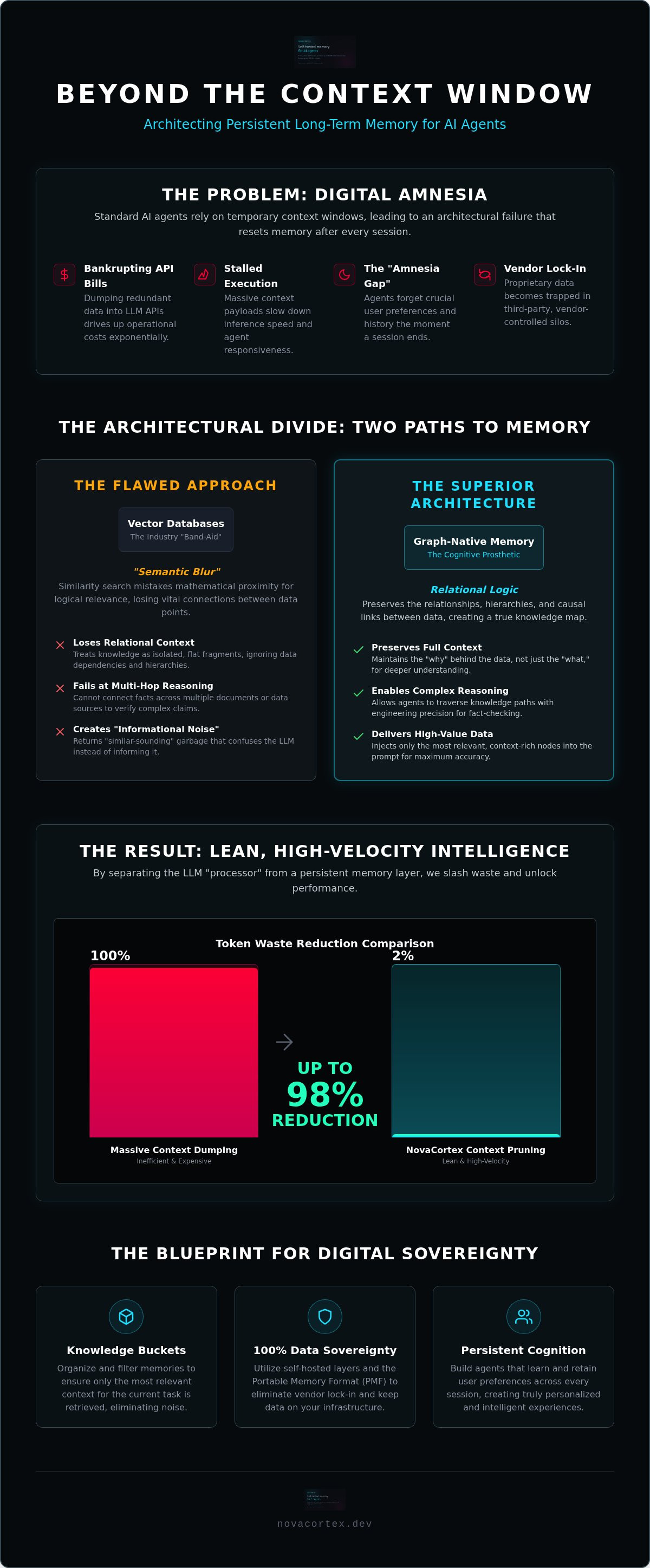
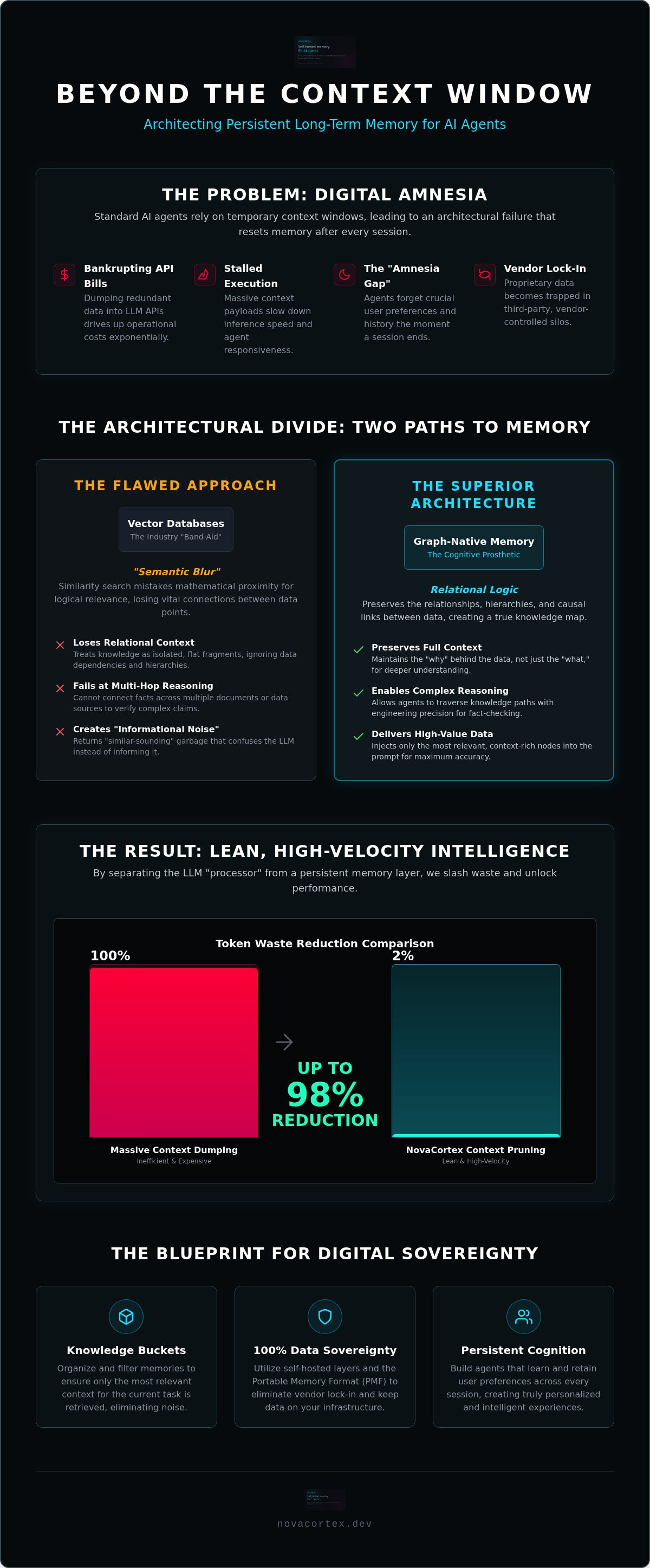
We believe engineering persistent cognition requires a shift from simple storage to sovereign, graph-native retrieval. This guide provides the blueprint for building a scalable memory layer using the NovaCortex Self-Hosted Edition. You'll learn to implement the Portable Memory Format (PMF) to maintain 100% data ownership and utilize Knowledge Buckets to filter irrelevant noise. We'll show you how to slash token waste by up to 98% while ensuring your agents retain user preferences across every session. We are moving past the era of massive context dumping and into a future of lean, high-velocity persistent intelligence.
Key Takeaways
- Differentiate between ephemeral context windows and persistent fact storage. Establish a foundation for AI agent long term memory that survives session resets.
- Diagnose the "Semantic Blur" inherent in vector databases. Stop treating knowledge as isolated points and start preserving relational logic.
- Deploy graph-native architectures for multi-hop retrieval. Enable agents to traverse complex knowledge paths with engineering precision.
- Master context pruning to slash token waste. Reduce API overhead by up to 98% by injecting only the highest-value data nodes into your prompts.
- Reclaim digital sovereignty. Use self-hosted layers and the Portable Memory Format to eliminate vendor lock-in and keep data on your own infrastructure.
Defining AI Agent Memory: Short-Term vs. Long-Term Architecture
AI agents aren't magic. They're software. Like any sophisticated system, they require efficient memory management to function. Most developers confuse the LLM's context window with true memory. This is a fundamental architectural error. Short-term memory is the ephemeral context window. It's the volatile RAM where the agent processes current session states. AI agent long term memory is the persistent storage of facts, user preferences, and historical interactions. It's the hard drive that survives the session reset.
When an agent lacks a dedicated memory layer, it hits the "Amnesia Gap." This occurs the moment the conversation history exceeds the model's native context window. The agent starts hallucinating or repeating itself. It loses the thread. We must treat the memory layer as an external cognitive prosthetic. The LLM acts as the processor; the memory layer provides the sustained context. This separation of concerns is the only way to build agents that actually learn over time.
The Short-Term Context Window Constraint
The context window is a finite resource. High-frequency agents often rely on "sliding window" management. They discard the oldest messages to make room for new ones. This is a crude solution. Dumping entire chat histories into a prompt is an engineering anti-pattern. It's expensive and slow. Even worse, it triggers context saturation. LLMs often suffer from being "lost in the middle." They prioritize the beginning and end of a prompt while ignoring the middle. This leads to a measurable decay in reasoning accuracy. You're paying for tokens that actively make your agent dumber.
Long-Term Persistence and Knowledge Retrieval
True persistence requires moving away from thread-based histories. We need structured knowledge repositories. While the foundational concepts of Long Short-Term Memory (LSTM) informed how neural networks handle sequences, modern agentic systems require an externalized approach. AI agent long term memory relies on semantic retrieval to surface relevant facts on demand. Instead of a linear log, the agent queries a specialized layer to find specific data points. This enables personalized behavior across different sessions and platforms. By using the NovaCortex Self-Hosted Edition, developers can organize these memories into Knowledge Buckets. This ensures that the agent only retrieves what is necessary for the current task. It maintains a lean context window while preserving a massive, searchable history.
Why Vector Databases Fail at Complex Long-Term Context
Vector databases are the industry's favorite band-aid. They offer a fast, shallow fix for context window limitations but crumble under the weight of complex, multi-session reasoning. The core issue is the "Semantic Blur" problem. Vector similarity measures mathematical proximity, not logical relevance. Just because two data points sit near each other in a high-dimensional space doesn't mean they share a causal or hierarchical link. Relying on simple embeddings for AI agent long term memory is like trying to navigate a city using only a list of GPS coordinates without a map of the streets. You have the points, but you've lost the connections.
This architectural choice results in a visceral loss of relational context. Vector stores treat knowledge as isolated, flat fragments. They ignore the dependencies and sequences that define human-like understanding. While standard taxonomies outline various Types of AI agent memory, vector stores only address the most basic semantic retrieval needs. They fail to capture the "why" behind the data. When your agent retrieves the top-k results from a vector index, it often pulls back a noisy bucket of "similar-sounding" garbage that confuses the LLM rather than informing it. Build a more precise system by exploring our open-source core.
Limitations of Simple Similarity Search
Nearest neighbor search is a blunt instrument. It fails fundamentally when an agent needs to perform multi-hop reasoning or rigorous fact-checking. If an agent needs to verify a claim that spans three different documents, a vector search won't connect those dots. It will only return the most "similar" individual chunks. Furthermore, the operational overhead is a silent killer. As knowledge bases scale into the millions of nodes, the cost of re-indexing and updating embedding models becomes prohibitive. Semantic drift is the technical decay of retrieval accuracy that occurs when the relationship between embeddings and their intended meaning shifts over time, leading to inconsistent agent responses. This drift makes your agent less reliable as it grows.
The Case for Structured Memory over Flat Embeddings
Flat data structures are the enemy of sophisticated reasoning. They prevent agents from understanding hierarchies, ownership, or temporal dependencies. Effective AI agent long term memory demands sophisticated AI agent state management that preserves the logic between facts. Hybrid search, which mixes vector proximity with keyword matching, is a temporary patch for a broken foundation. It doesn't solve the underlying problem: knowledge is a graph, not a list. To build agents that remember context with engineering precision, we must move beyond the flat embedding trap and embrace architectures that respect the inherent structure of data.
Graph-Native Memory: The Superior Path to Relational Context
Vector databases fail because they flatten reality. A high-performing AI agent long term memory requires a graph-native architecture to preserve the causal and logical links between data points. While IBM defines AI agent memory through categories like semantic and episodic, the implementation layer determines if those memories are actually useful. Graph-native storage allows the system to treat information as a network of entities and relationships. This isn't just about finding similar text. It's about understanding that Client A is connected to Project B, which has a specific Deadline C. When you lose the link, you lose the logic.
This structure enables multi-hop retrieval. An agent can traverse knowledge paths just like a human brain. It doesn't just pull the closest match; it follows the relational trail. If an agent knows a user prefers Python and that the current task involves data science, it can jump through the graph to retrieve specific library preferences stored months ago. This is dynamic context assembly. We build prompts based on logical relationships, ensuring the agent has the right "why" before it generates the "how." As memory grows, graph structures maintain precision where vector stores begin to blur. Accuracy doesn't decay with scale; it matures.
Vector RAG vs. Graph RAG: A Technical Comparison
When you compare graph RAG vs vector RAG, the difference in the signal-to-noise ratio is stark. Standard RAG often suffers from "retrieval noise," where the top-k results are semantically similar but logically irrelevant. Graph structures eliminate this by enforcing relationship constraints. Performance benchmarks show that while vector search might have lower initial latency for simple lookups, graph-native retrieval maintains significantly higher accuracy in complex query scenarios. You trade a few milliseconds of raw speed for a massive increase in reasoning reliability. In a production environment, accuracy is the only metric that keeps users from churning.
Knowledge Buckets and Modular Memory
We implement Knowledge Buckets to enforce this modularity. This isn't just about organization; it's about safety. By segregating personal, professional, and public data into distinct buckets, we prevent context cross-contamination. In multi-agent systems, this is critical. One agent shouldn't remember private data intended for another. Knowledge Buckets allow for granular access control and 100% data sovereignty. You control which agent sees which bucket. This ensures privacy is baked into the architecture, not added as a decorative afterthought. It's a lean, sovereign approach to AI agent long term memory that respects the boundaries of your data.
Implementing Token-Efficient Long-Term Memory Layers
Dumping raw chat history into a prompt is lazy engineering. It's also a fast track to unsustainable API costs. Efficient AI agent long term memory requires a Context Pruning strategy. Instead of a "dump and hope" approach, we select only the highest-value nodes from the graph to populate the prompt. This selective retrieval ensures the agent receives precise context without the fluff. We optimize for intelligence per token, not volume. By utilizing a low-latency MCP architecture, we maintain agent responsiveness while performing deep memory lookups. The goal is a lean, high-velocity cognitive layer that doesn't choke on its own history.
The Architecture of Token Efficiency
We calculate Information Density by measuring the semantic utility of a retrieved context block against the agent's current objective. It's a metric of signal versus noise. NovaCortex benchmarks demonstrate that this targeted retrieval can achieve up to a 98% token usage reduction compared to standard RAG implementations. This isn't just about saving money; it's about improving reasoning by removing distractions. We also implement automated context decay. This process systematically prunes stale or contradictory memories, ensuring the agent's internal knowledge remains current and reliable. Stale data is technical debt. We delete it.
Vendor-Neutral Storage with Portable Memory Format (PMF)
Proprietary vector databases are the new vendor lock-in. They trap your data in closed ecosystems. We reject this. The portable memory format for AI (PMF) establishes an interoperable standard for long-term storage. PMF allows for seamless migration between local environments, VPS, and cloud stacks. It treats memory as a sovereign asset, not a leased service. For enterprise stacks, PMF is a strategic necessity. It ensures that your agent's learned intelligence remains your property, regardless of which infrastructure provider you use tomorrow. Sovereignty is non-negotiable.
NovaCortex: The Self-Hosted Standard for Persistent AI Memory
Managed cloud memory is a strategic liability. It forces you to trade data sovereignty for convenience. NovaCortex Self-Hosted Edition is the architectural correction to this dependency. It provides a graph-native, local cognitive layer that ensures your agent's history remains your asset. By deploying an AI agent long term memory solution on your own infrastructure, you eliminate the risks of vendor lock-in and opaque data harvesting. You own the weights. You own the relationships. You own the logic.
The system is built on an MCP-Native Memory Server. This allows for direct, high-speed integration with modern agent frameworks. It bypasses the latency and reliability issues inherent in external cloud round-trips. Deployment is flexible by design. You can run NovaCortex on a Raspberry Pi for localized edge computing or scale it across enterprise-grade VPS clusters. The architecture remains lean and high-velocity regardless of the hardware. We prioritize engineering reality over cloud-first bloat.
Engineering for Data Sovereignty
Privacy isn't a feature; it's a requirement. Implementing the self-hosted AI memory layer is the only way to ensure regulatory compliance in sensitive industries. It eliminates third-party access to agent interactions and proprietary knowledge bases. When your memory layer is local, your data never leaves your perimeter. Self-hosting also acts as a critical hedge against AI vendor volatility. You are no longer vulnerable to sudden pricing hikes or service outages that could paralyze your agents. Independence is the foundation of persistent cognition.
Getting Started with NovaCortex Self-Hosted
We designed the setup to be as efficient as the software itself. You can deploy NovaCortex in under five minutes using Docker or a native binary. The process is straightforward:
- Containerized Deployment: Pull the Docker image and mount your local storage volumes.
- API Integration: Connect your existing LLM APIs while keeping the memory retrieval local.
- Knowledge Partitioning: Initialize Knowledge Buckets to segregate data for different agents or users.
Scaling from a single experimental agent to a multi-user enterprise environment is seamless. The system handles increased node density without the performance decay seen in flat vector stores. By using the NovaCortex Self-Hosted Edition, you build a foundation for AI agent long term memory that is scalable, secure, and entirely under your control. Stop renting your agent's brain. Start building a sovereign memory stack.
Engineer Sovereign Cognitive Layers
Persistent cognition is no longer a luxury. It's an architectural requirement for agents that provide actual utility. We've identified the fundamental flaws in flat vector storage and the high-cost "dump and hope" RAG methodology. Engineering a reliable AI agent long term memory requires a move toward graph-native architectures that prioritize relational context over simple semantic similarity. You shouldn't be forced to choose between agent performance and financial sustainability.
The transition to local, sovereign memory layers is the only way to hedge against vendor volatility and data leaks. By implementing a system that respects data ownership, you secure up to a 98% reduction in token usage while maintaining graph-native precision. Use the Apache-2.0 open-source core to establish a foundation that is secure, scalable, and entirely independent. Reclaim your infrastructure and build agents that remember with engineering accuracy.
The era of digital amnesia is over. It's time to build intelligence that lasts.
Frequently Asked Questions
What is the difference between short-term and long-term AI memory?
Short-term memory is the ephemeral context window used for immediate session processing. It's volatile and resets once the token limit is reached or the session ends. Long-term memory is a persistent storage layer that retains facts and preferences across sessions. By externalizing this data, you ensure the agent doesn't suffer from digital amnesia when conversation history grows too large for the model's native window.
Why should I use a graph-native memory layer instead of a vector database?
Graph-native layers preserve the logical links between data points, whereas vector databases treat knowledge as isolated coordinates. Vector similarity often returns noisy results that lack causal context. Graphs enable multi-hop retrieval, allowing agents to navigate complex knowledge paths. This structural precision is essential for AI agent long term memory because it maintains the logic behind the data, not just mathematical proximity.
How much can I really save on LLM token costs with NovaCortex?
You can reduce LLM token usage by up to 98% compared to standard "dump and hope" RAG methods. NovaCortex achieves this through a strategy called context pruning. Instead of flooding the prompt with irrelevant history, the system retrieves only the highest-value nodes from your Knowledge Buckets. This selective retrieval significantly lowers API overhead while increasing the information density of every prompt you send to the provider.
Is it possible to self-host an AI memory server on a Raspberry Pi?
Yes, self-hosting on a Raspberry Pi is entirely possible due to the system's lean, high-velocity architecture. NovaCortex is designed for deployment flexibility, ranging from edge devices to enterprise VPS clusters. The resource footprint is minimal, making it an ideal choice for developers who want to maintain a local, private memory layer without investing in expensive server hardware or being forced into managed cloud instances.
Does NovaCortex support the Model Context Protocol (MCP)?
NovaCortex includes an MCP-Native Memory Server as a foundational component. This ensures direct, high-speed integration with any agent framework that supports the Model Context Protocol. By using an MCP-native approach, you eliminate the need for custom middleware. This ensures that your agents can query their long-term memory with minimal latency and maximum interoperability across the modern AI stack without proprietary bottlenecks.
What happens to my data if I decide to switch LLM providers?
Your data remains 100% portable through the Portable Memory Format (PMF). Unlike proprietary vector databases that create vendor lock-in, PMF ensures that your agent's learned knowledge is decoupled from any specific LLM provider. If you switch from OpenAI to Anthropic or a local Llama instance, you simply point your new model at your existing memory layer. Your digital sovereignty and data ownership are guaranteed.
How does long-term memory prevent AI hallucinations?
Long-term memory prevents hallucinations by providing a grounded source of truth for the agent to reference. When an agent has access to a structured AI agent long term memory, it doesn't have to guess or fill in gaps with probabilistic nonsense. It retrieves specific, verified facts from the graph. This relational context ensures the agent's output is based on historical reality rather than statistical patterns or creative gaps.
Can I use NovaCortex with multi-agent frameworks like AutoGPT or CrewAI?
NovaCortex is fully compatible with multi-agent frameworks like AutoGPT and CrewAI. The architecture uses Knowledge Buckets to segregate context, which prevents cross-contamination between different agents in the same environment. This modularity allows you to scale complex agentic workflows while ensuring each individual agent has access to the specific memory it needs to complete its assigned tasks without leaking data across the stack.
FAQ
What is the difference between short-term and long-term AI memory?
Short-term memory is the ephemeral context window used for immediate session processing. It's volatile and resets once the token limit is reached or the session ends. Long-term memory is a persistent storage layer that retains facts and preferences across sessions. By externalizing this data, you ensure the agent doesn't suffer from digital amnesia when conversation history grows too large for the model's native window.
Why should I use a graph-native memory layer instead of a vector database?
Graph-native layers preserve the logical links between data points, whereas vector databases treat knowledge as isolated coordinates. Vector similarity often returns noisy results that lack causal context. Graphs enable multi-hop retrieval, allowing agents to navigate complex knowledge paths. This structural precision is essential for AI agent long term memory because it maintains the logic behind the data, not just mathematical proximity.
How much can I really save on LLM token costs with NovaCortex?
You can reduce LLM token usage by up to 98% compared to standard "dump and hope" RAG methods. NovaCortex achieves this through a strategy called context pruning. Instead of flooding the prompt with irrelevant history, the system retrieves only the highest-value nodes from your Knowledge Buckets. This selective retrieval significantly lowers API overhead while increasing the information density of every prompt you send to the provider.
Is it possible to self-host an AI memory server on a Raspberry Pi?
Yes, self-hosting on a Raspberry Pi is entirely possible due to the system's lean, high-velocity architecture. NovaCortex is designed for deployment flexibility, ranging from edge devices to enterprise VPS clusters. The resource footprint is minimal, making it an ideal choice for developers who want to maintain a local, private memory layer without investing in expensive server hardware or being forced into managed cloud instances.
Does NovaCortex support the Model Context Protocol (MCP)?
NovaCortex includes an MCP-Native Memory Server as a foundational component. This ensures direct, high-speed integration with any agent framework that supports the Model Context Protocol. By using an MCP-native approach, you eliminate the need for custom middleware. This ensures that your agents can query their long-term memory with minimal latency and maximum interoperability across the modern AI stack without proprietary bottlenecks.
What happens to my data if I decide to switch LLM providers?
Your data remains 100% portable through the Portable Memory Format (PMF). Unlike proprietary vector databases that create vendor lock-in, PMF ensures that your agent's learned knowledge is decoupled from any specific LLM provider. If you switch from OpenAI to Anthropic or a local Llama instance, you simply point your new model at your existing memory layer. Your digital sovereignty and data ownership are guaranteed.
How does long-term memory prevent AI hallucinations?
Long-term memory prevents hallucinations by providing a grounded source of truth for the agent to reference. When an agent has access to a structured AI agent long term memory, it doesn't have to guess or fill in gaps with probabilistic nonsense. It retrieves specific, verified facts from the graph. This relational context ensures the agent's output is based on historical reality rather than statistical patterns or creative gaps.
Can I use NovaCortex with multi-agent frameworks like AutoGPT or CrewAI?
NovaCortex is fully compatible with multi-agent frameworks like AutoGPT and CrewAI. The architecture uses Knowledge Buckets to segregate context, which prevents cross-contamination between different agents in the same environment. This modularity allows you to scale complex agentic workflows while ensuring each individual agent has access to the specific memory it needs to complete its assigned tasks without leaking data across the stack.