AI Agent Memory Architecture Best Practices for Reliable Agents
What if your agent’s memory problem isn’t a lack of storage, but a lack of rules? Adding a vector database won’t stop an agent from saving duplicate facts, surfacing stale context, or forgetting what matters between sessions. The strongest AI agent memory architecture best practices start with deliberate lifecycle policies, not a bigger store.
If you’re deciding what to retain, how to retrieve it, or when to retire it, the challenge is familiar: memory needs to help the agent act without flooding its context with noise. This guide shows how to match memory structures and retrieval policies to the task, then build a testable process for storing, updating, and deleting information.
We’ll break down working, session, and long-term memory; compare vector, graph, and hybrid retrieval; and cover evaluation and maintenance as your system grows. The goal is practical: keep context useful, controlled, and efficient over time.
Key Takeaways
- Define what your agent must remember beyond its active prompt, and keep durable memory distinct from temporary context.
- Apply AI agent memory architecture best practices by giving each memory lifecycle stage a clear rule, owner, and observable result.
- Choose buffers, vector retrieval, relational records, or knowledge graphs according to the lookup and reasoning your agent needs.
- Test recall, irrelevant results, stale facts, and conflicts, then track freshness, latency, token use, and successful corrections or deletions.
- Keep storage, retrieval policy, governance, and evaluation independently adaptable as your agent evolves.
AI agent memory architecture: what it must solve
Agent memory is external state an agent can preserve and retrieve beyond its immediate context. A context window holds the information available to the model during its current operation. Memory persists selected information for use in later turns or sessions. Neither is the same as model weights, which encode learned patterns rather than a live record of a particular user’s preferences or project decisions. Conversation history is another distinct layer: it may provide useful context, but retaining every exchange indefinitely is not a memory strategy.
This distinction sets the architectural bar. Memory must return relevant information, reflect the freshest known state, and enforce access controls appropriate to the data. It also has to meet latency requirements without creating operational costs that outweigh its value. The AI agent Wikipedia article offers a broad overview of agent components and architecture. For implementation, the key question is how external state supports the agent’s actual tasks.
What belongs in persistent agent memory?
Store information likely to improve future decisions. Examples include a durable user preference, a previous task outcome that affects a repeat workflow, a verified fact the agent needs to reuse, or the current state of an ongoing project. Keep each record scoped and actionable: “prefers concise status updates” is more useful than a full transcript containing one request for a shorter answer.
Transient details usually belong only in the active interaction. A temporary appointment time, a one-off question, or a detail with no expected value after the task ends shouldn’t automatically become persistent. Define an explicit selection policy: specify what qualifies for retention, whose information it is, how long it should remain useful, and what event should trigger review or deletion. Treat memory as curated state, not an unfiltered transcript archive.
Which failure modes should architecture prevent?
Persistence alone doesn’t produce reliable recall. A system can preserve an outdated project deadline, store the same preference several times, or retrieve a loosely related fact because its wording resembles the current query. Each failure adds noise. The agent may treat an old value as current, overemphasize irrelevant details, or generate a confident answer based on the wrong record.
Design for these failure modes before they reach the prompt. Give records clear ownership and timestamps or version information when facts can change. Define how conflicting entries are resolved, and make it possible to correct or remove information rather than layering another copy over an error. Retrieval should respect the user, task, and access scope, not just semantic similarity.
Privacy and retention need the same discipline. Persisting sensitive or unnecessary details expands exposure without improving the agent’s work. Set boundaries on what may be stored and when it expires, and ensure retrieval returns only information the current task is permitted to use. These controls turn AI agent memory architecture best practices into operational requirements: relevance, freshness, access, speed, and cost must be designed together.
Design the memory lifecycle: write, retrieve, update, and retire
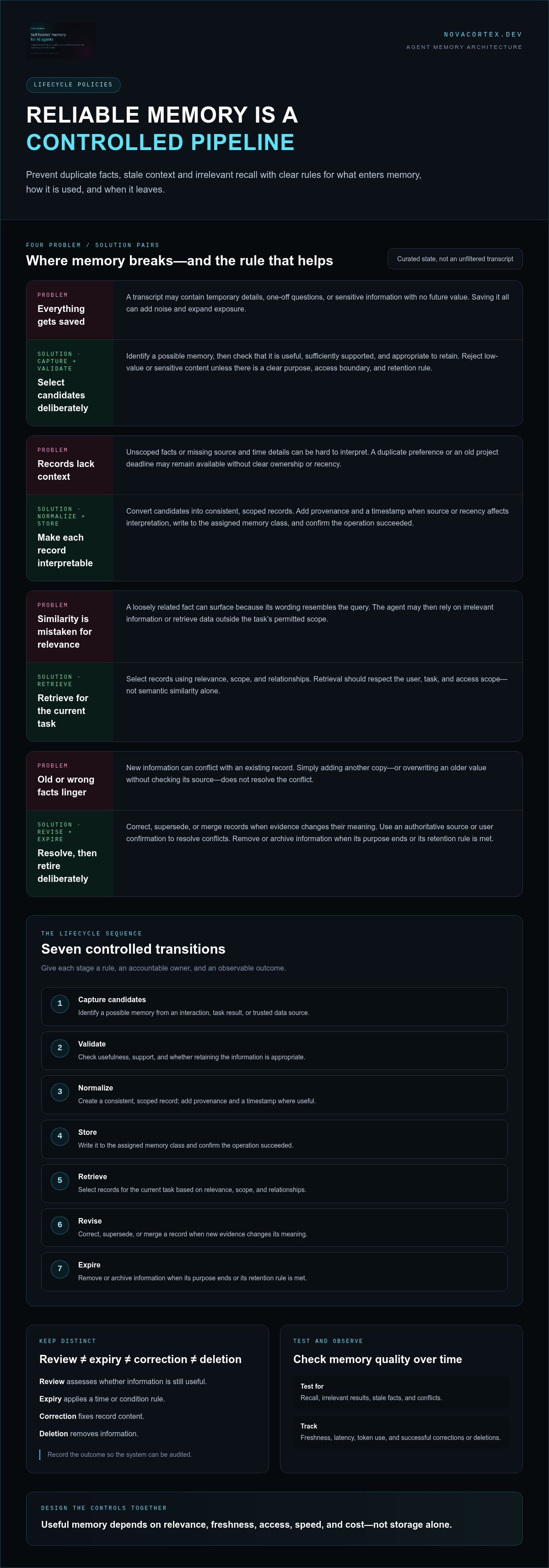
Reliable memory is a controlled pipeline, not a side effect of writing to a database. Define a rule, an accountable owner, and an observable outcome for each transition. The owner may be an application component or a human reviewer, but responsibility must be explicit. Otherwise, bad records can enter quietly and remain available long after they stop being useful.
Use this sequence as a starting point:
- Capture candidates. Identify a possible memory from an interaction, task result, or trusted data source.
- Validate. Check that it is useful, sufficiently supported, and appropriate to retain.
- Normalize. Convert it into a consistent, scoped record, adding provenance and a timestamp when source or recency affects interpretation.
- Store. Write it to the assigned memory class and confirm the operation succeeded.
- Retrieve. Select records for the current task based on relevance, scope, and relationships.
- Revise. Correct, supersede, or merge a record when new evidence changes its meaning.
- Expire. Remove or archive information when its purpose ends or its retention rule is met.
Lifecycle policies determine what an agent can reliably recall because they govern which information enters memory, how it is selected, and when it is replaced or removed.
How should an agent decide what to write?
Set candidate signals before implementation. Repeated preferences may qualify when they affect future responses. Confirmed facts may qualify when later tasks depend on them. Unresolved task state may qualify while work remains active. Attach source and time details where they help interpret confidence or recency. Reject sensitive or low-value content unless there’s a clear purpose, access boundary, and retention rule. A transcript is input to selection, not the memory itself.
How should memory stay current?
Define conflict handling instead of letting the newest text overwrite everything. For example, a new project deadline should supersede an older one only when its source is authoritative or the user confirms the change. Keep review, expiry, correction, and deletion distinct: review assesses usefulness, expiry applies a time or condition rule, correction fixes content, and deletion removes it. Record the outcome so the system can be audited.
Retrieval needs its own policy. Query for information that serves the task, then use links between records when a relationship matters. Don’t replay an entire history just because it’s available. Test deliberately difficult cases before deployment: ask for a fact when both stale and current versions exist, introduce contradictory sources, and check that irrelevant memories stay out of the result. Measure whether the expected record appears, obsolete data is excluded, and corrections and deletions take effect.
These AI agent memory architecture best practices are easier to operationalize when lifecycle rules are visible in the implementation. For a self-hosted approach, explore NovaCortex’s open-source memory layer, designed to store knowledge on your own infrastructure using a portable memory format.
Choose memory structures by retrieval need, not fashion
Choose a structure by asking what the agent must retrieve, how precise the answer must be, and how facts change. A conversation buffer preserves recent turns but can grow noisy. Vector retrieval finds passages by semantic similarity, even when a query uses different wording. Relational records support exact fields and updates. Knowledge graphs represent entities and their connections. Each solves a different retrieval problem. Combining them makes sense when the workload needs capabilities no single structure provides.
Compare the options against the task, not a trend. A support agent looking up an exact order ID needs a different path from a research agent connecting people, projects, and decisions across records. Assess relationship traversal, exact lookup, update complexity, portability, and operational burden before committing.
| Structure | Workload fit | Strengths | Trade-offs | Failure risks |
|---|---|---|---|---|
| Conversation buffer | Short exchanges where recent turns are the required context | Simple to implement; preserves wording and sequence | Context grows with the conversation; weak for cross-session lookup | Relevant details get buried, or old turns are mistaken for current state |
| Vector retrieval | Finding semantically related passages across notes or documents | Handles varied phrasing; supports similarity-based search | Exact identifiers and explicit relationship traversal need additional mechanisms | Near matches outrank the right record; conflicting facts can both surface |
| Relational records | Stable fields, exact queries, and controlled updates | Precise lookup; clear schemas and update behavior | Schema changes require maintenance; flexible, open-ended relationships can be cumbersome | Rigid fields miss useful context or leave outdated values after incomplete updates |
| Knowledge graph | Tasks that depend on connections across entities or events | Explicit links; supports multi-hop traversal and relationship queries | Requires modeling and graph operations; may add operational complexity | Missing or incorrect edges distort paths and lead to misleading conclusions |
When is vector retrieval a strong fit?
Use vector search when the same idea may appear in different language, such as finding a note about a delayed delivery when the query asks which shipment is running late. Similarity is useful for discovery, not proof of correctness. Exact IDs, authoritative current values, and explicit links between entities need structured checks or complementary retrieval. A vector index finds candidates; it doesn’t decide what to store, resolve conflicts, or manage the memory lifecycle.
When do structured records or graphs help?
Use relational records for fields the agent must read or update precisely, such as a project status or a customer’s selected plan. Use a graph when the task requires traversing relationships, such as identifying which decisions affect a shared project. Graph-native storage is a strong fit for relationship-heavy workloads, not a universal replacement for buffers, vectors, or records.
Hybrid designs earn their complexity when retrieval needs are distinct: semantic search can locate candidate knowledge, structured records can verify exact values, and a graph can trace relationships. Keep each path purposeful. These AI agent memory architecture best practices prevent an architecture from becoming a collection of fashionable components with overlapping jobs.
Apply agent memory best practices with measurable controls
A memory system needs evidence that it retrieves the right information, excludes misleading context, and handles stored data as intended. Build a test set from realistic multi-session tasks and known agent requirements. Include direct recall, irrelevant matches, stale records, and conflicting facts. For each case, define the expected evidence and acceptable outcome before running tests. Otherwise, evaluation becomes a collection of anecdotes rather than a release control.
How can teams test memory quality?
Measure both retrieval and its effect on the prompt. Did the expected record appear? Was unrelated information excluded? Did the agent receive enough evidence without a context dump? Track retrieval relevance, freshness, latency, and token usage. Also measure whether corrections and deletions succeed. These metrics reveal trade-offs: a broader search may improve recall while adding noise or latency.
Retest after changes to indexing, schemas, retrieval rules, or prompts. Compare results against the same cases, and retain failures as regression tests. Memory can support grounded answers, but it doesn’t eliminate hallucinations: the model may still misread, misuse, or ignore retrieved evidence. Separate measured results from assumptions, and inspect failed cases instead of treating a good average as proof that every task is reliable.
- Useful recall: Confirm relevant evidence is returned for multi-session tasks.
- Irrelevant retrieval: Check that similar wording doesn’t pull in unrelated records.
- Freshness and conflict: Verify current values take precedence according to policy.
- Efficiency: Record retrieval latency and tokens added to the model context.
- Lifecycle controls: Test correction and deletion against the stored record and later retrieval.
How should governance shape memory operations?
Assign permissions for who can create, inspect, correct, and remove memory. Scope access to the user, agent, or task that needs the data, and record provenance so teams can trace where a fact came from. Define retention and deletion rules for the full lifecycle, including derived or indexed representations where applicable. Audit access and changes so operators can investigate unexpected retrievals and verify that controls work in practice.
Before production rollout, use this checklist to expose gaps:
- Each memory type has a stated purpose and retention rule.
- Records carry provenance and recency metadata when interpretation depends on them.
- Access permissions cover reads, writes, corrections, and deletion.
- Tests include irrelevant, stale, and conflicting records.
- Metrics have review thresholds and an owner responsible for acting on failures.
- Changes to prompts or retrieval components trigger regression testing.
These AI agent memory architecture best practices make reliability observable instead of assumed. NovaCortex offers a self-hosted, open-source memory layer with graph-native storage and a portable memory format for teams building persistent memory on their own infrastructure.
Turn the architecture into a maintainable agent memory layer
A reliable design needs more than a data store. Keep the storage backend separate from retrieval policy, governance, and evaluation. Define stable interfaces between them so you can change how records are stored without rewriting access rules, or tune retrieval without changing the memory schema. That separation limits the impact of future changes and makes failures easier to isolate.
Use a staged blueprint to move from requirements to a production design:
- Define memory jobs. Specify which tasks need persistent context and what information supports those tasks. Set boundaries for scope, ownership, and retention.
- Select structures. Match each job to the retrieval pattern it needs, such as exact field lookup, semantic discovery, or relationship traversal. Add components only when the workload justifies them.
- Set lifecycle rules. Document how candidate information is validated, stored, accessed, revised, and removed. Assign responsibility for each operation.
- Validate and operate. Test expected and failure cases, monitor retrieval quality and system performance, and define what signals would prompt a design change.
This sequence keeps architecture decisions tied to observed requirements. A new storage technology should solve a measured limitation, not be added on the assumption that more components mean better memory.
What should a production-readiness review cover?
Review the boundaries between memory types, who owns each record, which tasks can retrieve it, and how updates and deletion propagate. Confirm that the design can be tested and operated within your team’s infrastructure constraints. Document trade-offs, such as added graph traversal complexity or a schema’s limits, and identify the signals that would trigger a change, including persistent retrieval errors or unmet latency needs.
Where can a portable, self-hosted layer fit?
Teams prioritizing control over where knowledge is stored may choose local deployment, provided they can operate it within their infrastructure. A portable memory format can reduce dependence on a single vendor-specific format, making it easier to preserve or move knowledge as components change. NovaCortex is an open-source memory layer under Apache-2.0, with self-hosted deployment, graph-native storage, and a portable memory format. These are architectural options, not universal requirements; fit depends on the workload and operating constraints.
Apply AI agent memory architecture best practices by keeping the design modular, measurable, and explicit about its trade-offs. The right layer is the one that meets your retrieval and governance needs without adding machinery your agent doesn’t use.
Inspect the NovaCortex self-hosted memory-layer approach on GitHub to see how its architecture is implemented.
Build for the agent you’ll evolve
Reliable memory isn’t a one-time infrastructure decision. As agents take on new tasks, the context they need, risks they introduce, and retrieval patterns they rely on will shift. Treat memory as an evolving contract between the agent and its data. Make changes deliberate, keep components replaceable, and let real usage reveal where a policy or structure no longer fits.
Set a review point whenever the agent’s purpose, users, or operating environment changes. Revisit the assumptions behind the design, including which workflows depend on persistent context and which components have become unnecessary. This keeps the system adaptable without turning every new requirement into another layer of infrastructure. The goal of AI agent memory architecture best practices isn’t to predict every future need. It’s to make the next change easier to reason about and safer to implement.
Pick one meaningful workflow, observe how the agent uses its memory, and let that evidence guide what comes next. For teams scaling autonomous capabilities into an integrated synthetic workforce, working with deployment specialists like Navo Inc. can help translate these agent memory architectures into reliable production workflows. Steady iteration builds a stronger foundation than adding complexity before it has a job.
Explore NovaCortex Self-Hosted Edition on GitHub to see a portable, graph-native memory layer designed for AI agents.
Frequently Asked Questions
Does adding memory to an AI agent prevent hallucinations?
No. Memory can give an agent useful evidence, but it can’t guarantee the agent will interpret that evidence correctly. For example, a scheduling agent might retrieve an old meeting time and present it as current. Test how it handles missing records, conflicting sources, and uncertain answers. The agent should distinguish retrieved facts from inference and state uncertainty when the available evidence doesn’t support a confident response.
Is AI agent memory the same as a vector database?
No. Agent memory covers the policies and components that manage information over time, while a vector database is one possible retrieval component. A request to find a note about a “late delivery” may benefit from semantic search; looking up an exact shipment ID needs a precise identifier-based query. A memory system can combine those paths, but the vector store alone doesn’t define what gets saved or how facts are updated.
Should an AI agent store every conversation?
Usually not. An unfiltered archive can preserve sensitive details and make useful context harder to surface. Ask whether retaining a detail would change a likely future action: a confirmed preference may shape future replies, while a one-time request to rephrase a sentence probably won’t. Give each retained category a clear purpose, and check whether it improves later task performance before expanding what the agent stores.
How often should an AI agent update its long-term memory?
There’s no universal update schedule; use events that change the meaning or usefulness of a record. A user correction should trigger an update promptly, while a project status might change whenever the source system reports a new state. For information that changes infrequently, scheduled review may be sufficient. Preserve the previous value when history matters, and test that the agent selects the current value rather than an obsolete one.
Can one memory architecture serve multiple AI agents?
Yes, if agents can share infrastructure without sharing every record or permission. For example, a support agent and a project assistant might both use a common store, while each retrieves only information relevant to its role. Define ownership and access boundaries at the record or collection level, and test cross-agent queries for unintended exposure. Also clarify which agent can update shared facts so competing updates don’t corrupt common state.
What is the difference between episodic and semantic memory in an AI agent?
Episodic memory captures a particular event, while semantic memory stores generalized knowledge. An agent might use episodic memory to retrieve what happened during a specific troubleshooting session, then use semantic memory to recall a verified procedure that applies across cases. The distinction helps determine what a query should return: a record of an earlier event, a reusable fact, or both. Clear labels also help prevent one-off observations from becoming assumed rules.
How can teams tell whether agent memory is useful?
Compare agent performance on representative tasks with memory enabled and disabled. Look for improvements in task completion and answer consistency, then account for retrieval latency and additional tokens. Include cases where the needed information is absent, outdated, or contradicted by another record. The AI agent memory architecture best practices in this guide work only if evaluation shows that retrieved context helps the task without adding unnecessary noise or overhead.
FAQ
What belongs in persistent agent memory?
Store information likely to improve future decisions. Examples include a durable user preference, a previous task outcome that affects a repeat workflow, a verified fact the agent needs to reuse, or the current state of an ongoing project. Keep each record scoped and actionable: “prefers concise status updates” is more useful than a full transcript containing one request for a shorter answer. Transient details usually belong only in the active interaction. A temporary appointment time, a one-off question, or a detail with no expected value after the task ends shouldn’t automatically become persistent. Define an explicit selection policy: specify what qualifies for retention, whose information it is, how long it should remain useful, and what event should trigger review or deletion. Treat memory as curated state, not an unfiltered transcript archive.
Which failure modes should architecture prevent?
Persistence alone doesn’t produce reliable recall. A system can preserve an outdated project deadline, store the same preference several times, or retrieve a loosely related fact because its wording resembles the current query. Each failure adds noise. The agent may treat an old value as current, overemphasize irrelevant details, or generate a confident answer based on the wrong record. Design for these failure modes before they reach the prompt. Give records clear ownership and timestamps or version information when facts can change. Define how conflicting entries are resolved, and make it possible to correct or remove information rather than layering another copy over an error. Retrieval should respect the user, task, and access scope, not just semantic similarity. Privacy and retention need the same discipline. Persisting sensitive or unnecessary details expands exposure without improving the agent’s work. Set boundaries on what may be stored and when it expires, and ensure retrieval returns only information the current task is permitted to use. These controls turn AI agent memory architecture best practices into operational requirements: relevance, freshness, access, speed, and cost must be designed together. Reliable memory is a controlled pipeline, not a side effect of writing to a database. Define a rule, an accountable owner, and an observable outcome for each transition. The owner may be an application component or a human reviewer, but responsibility must be explicit. Otherwise, bad records can enter quietly and remain available long after they stop being useful. Use this sequence as a starting point: Lifecycle policies determine what an agent can reliably recall because they govern which information enters memory, how it is selected, and when it is replaced or removed.
How should an agent decide what to write?
Set candidate signals before implementation. Repeated preferences may qualify when they affect future responses. Confirmed facts may qualify when later tasks depend on them. Unresolved task state may qualify while work remains active. Attach source and time details where they help interpret confidence or recency. Reject sensitive or low-value content unless there’s a clear purpose, access boundary, and retention rule. A transcript is input to selection, not the memory itself.
How should memory stay current?
Define conflict handling instead of letting the newest text overwrite everything. For example, a new project deadline should supersede an older one only when its source is authoritative or the user confirms the change. Keep review, expiry, correction, and deletion distinct: review assesses usefulness, expiry applies a time or condition rule, correction fixes content, and deletion removes it. Record the outcome so the system can be audited. Retrieval needs its own policy. Query for information that serves the task, then use links between records when a relationship matters. Don’t replay an entire history just because it’s available. Test deliberately difficult cases before deployment: ask for a fact when both stale and current versions exist, introduce contradictory sources, and check that irrelevant memories stay out of the result. Measure whether the expected record appears, obsolete data is excluded, and corrections and deletions take effect. These AI agent memory architecture best practices are easier to operationalize when lifecycle rules are visible in the implementation. For a self-hosted approach, explore NovaCortex’s open-source memory layer, designed to store knowledge on your own infrastructure using a portable memory format. Choose a structure by asking what the agent must retrieve, how precise the answer must be, and how facts change. A conversation buffer preserves recent turns but can grow noisy. Vector retrieval finds passages by semantic similarity, even when a query uses different wording. Relational records support exact fields and updates. Knowledge graphs represent entities and their connections. Each solves a different retrieval problem. Combining them makes sense when the workload needs capabilities no single structure provides. Compare the options against the task, not a trend. A support agent looking up an exact order ID needs a different path from a research agent connecting people, projects, and decisions across records. Assess relationship traversal, exact lookup, update complexity, portability, and operational burden before committing.
When is vector retrieval a strong fit?
Use vector search when the same idea may appear in different language, such as finding a note about a delayed delivery when the query asks which shipment is running late. Similarity is useful for discovery, not proof of correctness. Exact IDs, authoritative current values, and explicit links between entities need structured checks or complementary retrieval. A vector index finds candidates; it doesn’t decide what to store, resolve conflicts, or manage the memory lifecycle.
When do structured records or graphs help?
Use relational records for fields the agent must read or update precisely, such as a project status or a customer’s selected plan. Use a graph when the task requires traversing relationships, such as identifying which decisions affect a shared project. Graph-native storage is a strong fit for relationship-heavy workloads, not a universal replacement for buffers, vectors, or records. Hybrid designs earn their complexity when retrieval needs are distinct: semantic search can locate candidate knowledge, structured records can verify exact values, and a graph can trace relationships. Keep each path purposeful. These AI agent memory architecture best practices prevent an architecture from becoming a collection of fashionable components with overlapping jobs. A memory system needs evidence that it retrieves the right information, excludes misleading context, and handles stored data as intended. Build a test set from realistic multi-session tasks and known agent requirements. Include direct recall, irrelevant matches, stale records, and conflicting facts. For each case, define the expected evidence and acceptable outcome before running tests. Otherwise, evaluation becomes a collection of anecdotes rather than a release control.
How can teams test memory quality?
Measure both retrieval and its effect on the prompt. Did the expected record appear? Was unrelated information excluded? Did the agent receive enough evidence without a context dump? Track retrieval relevance, freshness, latency, and token usage. Also measure whether corrections and deletions succeed. These metrics reveal trade-offs: a broader search may improve recall while adding noise or latency. Retest after changes to indexing, schemas, retrieval rules, or prompts. Compare results against the same cases, and retain failures as regression tests. Memory can support grounded answers, but it doesn’t eliminate hallucinations: the model may still misread, misuse, or ignore retrieved evidence. Separate measured results from assumptions, and inspect failed cases instead of treating a good average as proof that every task is reliable.
How should governance shape memory operations?
Assign permissions for who can create, inspect, correct, and remove memory. Scope access to the user, agent, or task that needs the data, and record provenance so teams can trace where a fact came from. Define retention and deletion rules for the full lifecycle, including derived or indexed representations where applicable. Audit access and changes so operators can investigate unexpected retrievals and verify that controls work in practice. Before production rollout, use this checklist to expose gaps: These AI agent memory architecture best practices make reliability observable instead of assumed. NovaCortex offers a self-hosted, open-source memory layer with graph-native storage and a portable memory format for teams building persistent memory on their own infrastructure. A reliable design needs more than a data store. Keep the storage backend separate from retrieval policy, governance, and evaluation. Define stable interfaces between them so you can change how records are stored without rewriting access rules, or tune retrieval without changing the memory schema. That separation limits the impact of future changes and makes failures easier to isolate. Use a staged blueprint to move from requirements to a production design: This sequence keeps architecture decisions tied to observed requirements. A new storage technology should solve a measured limitation, not be added on the assumption that more components mean better memory.
What should a production-readiness review cover?
Review the boundaries between memory types, who owns each record, which tasks can retrieve it, and how updates and deletion propagate. Confirm that the design can be tested and operated within your team’s infrastructure constraints. Document trade-offs, such as added graph traversal complexity or a schema’s limits, and identify the signals that would trigger a change, including persistent retrieval errors or unmet latency needs.
Where can a portable, self-hosted layer fit?
Teams prioritizing control over where knowledge is stored may choose local deployment, provided they can operate it within their infrastructure. A portable memory format can reduce dependence on a single vendor-specific format, making it easier to preserve or move knowledge as components change. NovaCortex is an open-source memory layer under Apache-2.0, with self-hosted deployment, graph-native storage, and a portable memory format. These are architectural options, not universal requirements; fit depends on the workload and operating constraints. Apply AI agent memory architecture best practices by keeping the design modular, measurable, and explicit about its trade-offs. The right layer is the one that meets your retrieval and governance needs without adding machinery your agent doesn’t use. Inspect the NovaCortex self-hosted memory-layer approach on GitHub to see how its architecture is implemented. Reliable memory isn’t a one-time infrastructure decision. As agents take on new tasks, the context they need, risks they introduce, and retrieval patterns they rely on will shift. Treat memory as an evolving contract between the agent and its data. Make changes deliberate, keep components replaceable, and let real usage reveal where a policy or structure no longer fits. Set a review point whenever the agent’s purpose, users, or operating environment changes. Revisit the assumptions behind the design, including which workflows depend on persistent context and which components have become unnecessary. This keeps the system adaptable without turning every new requirement into another layer of infrastructure. The goal of AI agent memory architecture best practices isn’t to predict every future need. It’s to make the next change easier to reason about and safer to implement. Pick one meaningful workflow, observe how the agent uses its memory, and let that evidence guide what comes next. Steady iteration builds a stronger foundation than adding complexity before it has a job. Explore NovaCortex Self-Hosted Edition on GitHub to see a portable, graph-native memory layer designed for AI agents.
Does adding memory to an AI agent prevent hallucinations?
No. Memory can give an agent useful evidence, but it can’t guarantee the agent will interpret that evidence correctly. For example, a scheduling agent might retrieve an old meeting time and present it as current. Test how it handles missing records, conflicting sources, and uncertain answers. The agent should distinguish retrieved facts from inference and state uncertainty when the available evidence doesn’t support a confident response.
Is AI agent memory the same as a vector database?
No. Agent memory covers the policies and components that manage information over time, while a vector database is one possible retrieval component. A request to find a note about a “late delivery” may benefit from semantic search; looking up an exact shipment ID needs a precise identifier-based query. A memory system can combine those paths, but the vector store alone doesn’t define what gets saved or how facts are updated.
Should an AI agent store every conversation?
Usually not. An unfiltered archive can preserve sensitive details and make useful context harder to surface. Ask whether retaining a detail would change a likely future action: a confirmed preference may shape future replies, while a one-time request to rephrase a sentence probably won’t. Give each retained category a clear purpose, and check whether it improves later task performance before expanding what the agent stores.
How often should an AI agent update its long-term memory?
There’s no universal update schedule; use events that change the meaning or usefulness of a record. A user correction should trigger an update promptly, while a project status might change whenever the source system reports a new state. For information that changes infrequently, scheduled review may be sufficient. Preserve the previous value when history matters, and test that the agent selects the current value rather than an obsolete one.
Can one memory architecture serve multiple AI agents?
Yes, if agents can share infrastructure without sharing every record or permission. For example, a support agent and a project assistant might both use a common store, while each retrieves only information relevant to its role. Define ownership and access boundaries at the record or collection level, and test cross-agent queries for unintended exposure. Also clarify which agent can update shared facts so competing updates don’t corrupt common state.
What is the difference between episodic and semantic memory in an AI agent?
Episodic memory captures a particular event, while semantic memory stores generalized knowledge. An agent might use episodic memory to retrieve what happened during a specific troubleshooting session, then use semantic memory to recall a verified procedure that applies across cases. The distinction helps determine what a query should return: a record of an earlier event, a reusable fact, or both. Clear labels also help prevent one-off observations from becoming assumed rules.
How can teams tell whether agent memory is useful?
Compare agent performance on representative tasks with memory enabled and disabled. Look for improvements in task completion and answer consistency, then account for retrieval latency and additional tokens. Include cases where the needed information is absent, outdated, or contradicted by another record. The AI agent memory architecture best practices in this guide work only if evaluation shows that retrieved context helps the task without adding unnecessary noise or overhead.