AI Agent Memory Consistency: A Practical Guide to Controlling Agent Behavior

Better retrieval won’t fix a memory that contains two conflicting versions of the same fact. AI agent memory consistency depends on what the system is allowed to write, how it handles conflicts, and when it treats stored information as stale. Without those rules, an agent can confidently retrieve the wrong version.
If you’re trying to keep an agent coherent as information changes or multiple processes update its memory, the challenge is familiar. Search quality and consistency solve different problems: retrieval finds relevant information, while consistency governs which information remains valid and how changes are recorded.
This guide offers a practical way to define consistency for your use case, then turn it into update, conflict-resolution, and validation rules. You’ll also get a workflow for auditing memory changes across sessions or agents, and criteria for assessing memory architectures without confusing better retrieval with stronger consistency guarantees.
Key Takeaways
- Set explicit consistency rules for each memory class, including its source of truth and how conflicts are handled.
- Track provenance and revisions so memory changes can be inspected across sessions and agents.
- Choose storage and update strategies based on whether you need history retention, visible conflicts, or efficient changes.
- Use validation and monitoring in your AI agent memory consistency workflow to catch stale or contradictory records.
- Assess self-hosted architectures for ownership, portability, retrieval structure, and operational fit without assuming the storage layer enforces consistency.
What AI Agent Memory Consistency Means in Practice
AI agent memory consistency means stored memory remains coherent under the system’s stated rules. Those rules determine which facts can coexist, which updates replace earlier claims, and how the agent handles uncertainty. Consistency isn’t the same as keeping data indefinitely. An agent can persist every record and still retain incompatible versions of a user’s preference.
Consider a user who first asks for brief answers, then later requests detailed explanations. Both statements may accurately record what the user said. They become a decision problem if the agent treats them as equally current preferences without considering scope, timing, or whether the later request changed the standing rule. The system needs a policy for interpreting the history, not just a larger memory store.
Understanding how an AI agent uses stored information helps frame the issue: memory can influence later actions, so contradictions matter when they change a decision. Memory consistency governs whether stored claims agree under defined rules; retrieval accuracy governs whether the system finds the intended record.
Consistency, Accuracy, and Retrieval Are Different Properties
Consistency is agreement between stored representations under explicit rules. Accuracy is whether a claim matches its evidence. Two records can agree and still be wrong: copying one outdated source into several entries doesn’t make the information accurate. Retrieval relevance is different again. A search can return records related to the question without resolving which one should guide the response.
- Persistence: whether information survives beyond a session.
- Retrieval relevance: whether returned records relate to the current query.
- Factual accuracy: whether a stored claim is supported by evidence.
- Context continuity: whether useful information is available in the model’s current working context.
For example, a similarity search for “preferred answer length” might return both “keep replies short” and “explain in detail.” Both are relevant. Neither retrieval score establishes which is current, whether one applies only to a particular task, or whether the user’s preference changed.
Where Agent Memory Starts to Diverge
Divergence can enter at several points: an observation is extracted incorrectly, a repeated event creates a duplicate write, or separate agents update related records without seeing one another’s changes. Time adds another complication. A historical statement can differ from a current one without being contradictory, provided the system records when each applied.
The practical test is whether the difference could change an action. “Preferred concise answers last month” and “currently prefers detailed answers” can coexist as history. Two active records prescribing opposite response styles, with no scope or precedence rule, create a conflict. Define the consistency model around the consequences: a personal assistant, shared support agent, and collaborative multi-agent workflow may need different update and review policies.
How AI Agent Memory Becomes Inconsistent
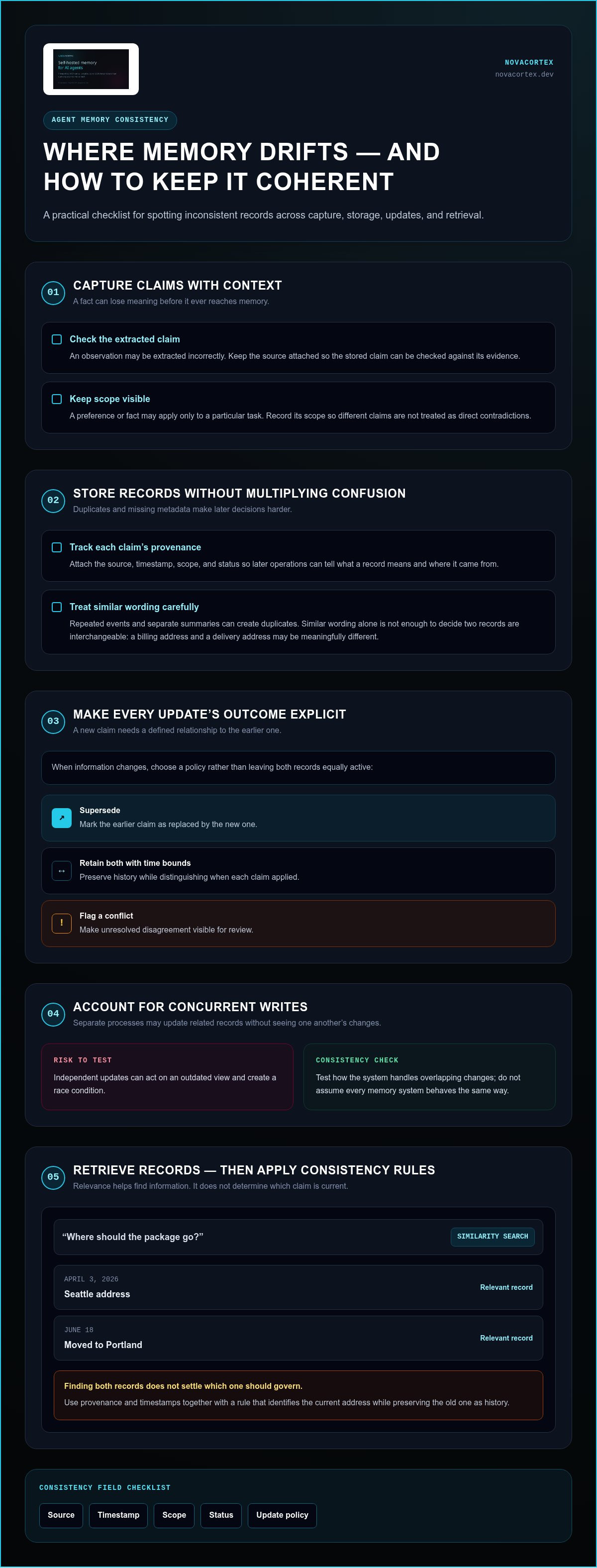
Memory can drift at every stage of its lifecycle. An agent observes an event, extracts a claim, stores it, retrieves it for a later task, then revises or adds information when circumstances change. Errors accumulate when an extracted claim loses its source or scope, duplicate writes multiply, or a later update doesn’t clearly supersede the earlier one.
Take a delivery address. A record dated April 3, 2026 says the user’s address is in Seattle. On June 18, the user reports moving to Portland. If the system stores the new statement without linking it to the old record, a later query may return either address. Dates alone don’t settle the question. The memory also needs provenance, such as who supplied the information, and a rule that identifies the current address while preserving the old one as history.
Embedding similarity makes this harder to see. Both addresses are semantically related to “Where should the package go?” Similarity can surface both, but it doesn’t interpret dates, determine which source is authoritative, or mark one fact as superseded. Retrieval alone can find contradictory records; it cannot decide which record should govern.
Stale Facts, Duplicate Records, and Conflicting Updates
Repeated observations can create duplicate entries, while separate summaries of the same conversation may encode a fact differently. A cleanup process that removes duplicates based only on similar wording can also erase meaningful distinctions, such as an address used for billing versus delivery. Keep source, timestamp, scope, and status attached to claims so later operations can distinguish duplicates from valid historical records.
When information changes, define how the new claim relates to the old one: supersede it, retain both with time bounds, or flag a conflict for review. Concurrent writes from independent processes can also create a race condition if each update acts on an outdated view. Treat this as a design risk to test, not an assumed behavior of every memory system. A survey of memory in the age of AI agents offers broader context for examining how agent memory is organized and used.
Why More Context Does Not Automatically Improve Consistency
Adding records to a prompt can make a conflict visible, but visibility isn’t reconciliation. The model may choose one claim, hedge, or combine details without following a dependable update policy. Persistent memory reconciliation is a data-lifecycle responsibility; context-window selection determines which material is available for the current response. These concerns are related, but they solve different problems.
Set clear boundaries for what belongs in long-term memory, what remains session context, and how revisions are represented. This guide to context management for long-term memory explores those boundaries. Teams assessing a self-hosted memory layer can also inspect the NovaCortex open-source repository to understand its implementation, then evaluate how it fits their consistency rules.
Compare AI Agent Memory Strategies by Consistency Trade-Off
Memory architecture affects what’s easy to preserve, find, or update. It doesn’t decide by itself which claim is authoritative. Compare strategies against the decisions your agent must make, then define write and conflict rules separately. The right fit depends on whether you prioritize historical auditability, a simple current-state answer, semantic discovery, or explicit relationships.
| Strategy | History retention | Conflict visibility | Update complexity | Best query fit |
|---|---|---|---|---|
| Append-only log | High; prior events remain | High if records carry timestamps and sources | Low for writes, higher for resolving current state | Audits, timelines, and “what changed?” |
| Overwrite policy | Low unless history is kept elsewhere | Low; replaced values may disappear | Low when one value is authoritative | Direct reads of current state |
| Vector retrieval | Depends on the backing store | Variable; related records can surface together | Moderate; duplicates and stale embeddings need management | Semantic search across unstructured content |
| Graph-oriented memory | Depends on how changes are recorded | Relationships can make connected claims easier to inspect | Moderate; entities and links need defined handling | Queries across entities, relations, and context |
These are tendencies, not guarantees. An append-only log can preserve contradictory claims without resolving them; an overwrite can leave no audit trail; a graph can encode relationships while still holding stale facts. AI agent memory consistency comes from explicit rules for writes, precedence, and validation, not from choosing a storage shape.
When Append-Only History or Overwrite Policies Fit
Use append-only history when the sequence matters, such as for support decisions, changing instructions, or facts that may need review later. Preserve event time and source so readers can distinguish a revision from a duplicate. Overwrite policies fit a single authoritative current value, such as a selected interface locale. The trade-off is straightforward: history preserves context, while overwriting simplifies current-state reads but can obscure how the value changed.
When Vector or Graph-Oriented Retrieval Fits
Vector retrieval is useful when a query may use different wording from the stored text. It finds semantic neighbors, but doesn’t inherently represent that one record supersedes another. Graph structure can represent entities and relationships, supporting queries such as which project belongs to which client. NovaCortex is graph-native, making it an architectural option for connected memory queries, not an automatic consistency mechanism.
Many systems combine approaches: retain events, maintain a current-state view, and use semantic or relational retrieval to find relevant context. That hybrid design adds coordination work, so assign each memory type a source of truth and specify how derived records are refreshed. For a closer look at the architectural trade-offs, see Redis versus graph memory for AI agents.
Build a Practical Consistency Workflow for AI Agent Memory
Production consistency starts with policy, not a database setting. Define how the agent should interpret, update, and verify each kind of memory, then encode those decisions in tests. This makes AI agent memory consistency measurable: your team can inspect whether a change followed the rules instead of relying on a response that merely sounds plausible.
Define Rules Before Writing Memories
Start by separating memory classes and assigning each a source of truth. Episodic records preserve events; semantic memory holds extracted claims; procedural memory describes learned steps; operational state reflects live system data. Decide which source takes precedence for each class. For example, a live account record may govern account status, while an event log preserves the history of status changes.
For every claim, capture its source, timestamp, and scope when the system supports those fields. A preference might apply only to one project, while a verified account attribute may apply broadly. Specify whether conflicting updates are rejected, retained as history, or escalated for review. Make the policy explicit before writing data.
Test Memory Behavior Under Change
Build repeatable tests from realistic sequences, not isolated queries. Seed a known value, revise it, then query for both the current state and its history. Add duplicates and contradictory evidence from different sources. Verify that results expose enough provenance and uncertainty for the agent to follow policy or defer judgment rather than silently selecting a convenient claim.
Include deletion tests: remove or retract a fact, then check whether it reappears through an index, cached summary, or derived record. Track failures by scenario and compare them with application-specific thresholds. The acceptable rate depends on impact: a stale preference may be inconvenient, while stale operational state can trigger an incorrect action.
Run the Workflow
- Define invariants. State what must remain true, such as one active value for a particular field and scope.
- Capture provenance. Record who or what supplied each claim, when it was observed, and what it applies to.
- Apply update rules. Specify precedence, supersession, duplicate handling, and what happens when writes conflict.
- Retrieve deliberately. Fetch records that fit the query and memory class, preserving metadata needed to interpret them.
- Validate before action. Check retrieved claims against the source of truth and policy; return uncertainty or escalate when evidence conflicts.
- Observe continuously. Log update and retrieval outcomes, review failed cases, and add regression tests as rules evolve.
A portable representation can make memory easier to move between systems, but portability doesn’t enforce write order, resolve conflicts, or validate facts. Treat a portable memory format for AI as an interoperability consideration, then test consistency behavior independently.
Evaluate NovaCortex for a Self-Hosted Memory Architecture
A memory architecture should fit your control requirements and consistency policy. NovaCortex Self-Hosted Edition is a privacy-first, graph-native memory layer that stores knowledge locally on infrastructure you control. It is open source under Apache-2.0 and uses Portable Memory Format (PMF), designed to reduce vendor lock-in. These attributes make it relevant to teams evaluating persistent agent memory under their own infrastructure control. They don’t, by themselves, establish how writes, conflicts, versioning, or deletion behave in a particular implementation.
Evaluate the architecture against the requirements that shape production behavior:
- Ownership: Identify where memory is hosted and who controls access, retention, and operational decisions.
- Portability: Assess whether memory can move across systems without being trapped in a vendor-specific representation. Portable Memory Format (PMF) is designed to reduce vendor lock-in.
- Retrieval structure: Consider whether graph-native organization fits questions that depend on relationships between people, projects, events, or claims.
- Integration: Account for MCP-native access and how Knowledge Buckets could organize distinct memory workflows.
- Operational responsibility: Plan for deployment, backups, monitoring, access controls, and testing. Self-hosting gives you infrastructure control, but also puts operational responsibility on your team.
Where NovaCortex Fits in the Decision
Graph-native storage can represent connected information in a structure suited to relationship-based queries. Knowledge Buckets can support organized memory workflows, while MCP-native access matters when assessing how memory fits into an MCP-based system. PMF supports portability goals. These are architectural characteristics, not consistency guarantees: your team still needs to define and validate policies for precedence, conflicting writes, stale records, and deletion.
Before adoption, inspect the implementation behavior that matters to your workload. In a controlled environment, verify how records are written and updated, what metadata is available, how conflicts appear to consumers, and what happens when information is removed. Don’t infer transactions, automatic conflict resolution, or synchronization guarantees from the storage model or integration approach.
Next Steps for a Technical Evaluation
Start small. Review the repository, identify a deployment and integration path for a contained evaluation, and choose a representative memory class. Then run repeatable tests for stale reads, contradictory updates, duplicate writes, and deletion behavior. Check whether the outputs expose the provenance and distinctions your agent needs to follow your consistency rules. Record results against your application’s requirements before expanding to production workloads.
This approach makes the evaluation concrete: you’re assessing both whether the architecture fits your environment and whether its observed behavior supports your policy. Evaluate NovaCortex on GitHub and use the repository as the starting point for a hands-on review.
Make Consistency a Production Requirement
Make AI agent memory consistency an operational requirement, not an assumption about what a storage layer will handle. Start with one consequential workflow, define what the agent may trust, and make conflicting or outdated information visible before it drives an action. Expand only when observed behavior meets the standard your application needs.
For teams weighing infrastructure control, NovaCortex offers a self-hosted memory layer with graph-native storage, open-source code under Apache-2.0, and Portable Memory Format designed to reduce vendor lock-in. Treat these as evaluation criteria, not substitutes for your own consistency tests. A focused technical review can show whether the architecture fits your environment and give your team a sound basis for the next implementation step.
Coherent memory is built through explicit policy and disciplined validation. Start with a focused evaluation of NovaCortex, test the behavior that matters, and give your agents a stronger foundation for reliable decisions.
Frequently Asked Questions
Can vector search guarantee consistent AI agent memory?
No. Vector search ranks records by semantic similarity; it doesn’t inherently determine whether a result is current, authoritative, or compatible with another result. For example, a search about a project deadline might surface an old estimate and a revised date. Your application needs separate rules to select or reconcile those records, and tests should verify that the chosen result follows the intended policy.
How should an AI agent handle conflicting memories?
It should follow a defined policy rather than silently blending competing claims. For a low-risk preference, the agent might use the latest applicable user instruction. For a high-impact fact, it may need to consult an authoritative system or pause for human review. Preserve enough evidence to explain the decision, and return uncertainty when the available records don’t support a reliable choice.
Does persistent memory prevent an AI agent from forgetting or contradicting itself?
No. Persistent storage can preserve information between sessions, but it can’t ensure every relevant fact is retrieved, supplied to the model, or interpreted correctly. An agent may also contradict an earlier response if its accessible context changes. For a customer support agent, test whether it can retrieve an account preference after a new session and recognize when that preference no longer applies.
Is graph memory more consistent than a vector database?
Not inherently. A graph can make connections among entities and claims explicit, which helps when a query depends on relationships. A vector database can make semantically related passages easier to find. Either structure can contain stale or conflicting records. Choose based on the shape of your queries, then evaluate the write, revision, and retrieval behavior that determines whether the agent uses records coherently.
How can developers test AI agent memory consistency?
Build scenario-based tests that start from a known memory state, apply a change, and check what the agent retrieves and does afterward. Include retries, reordered events, duplicate submissions, and concurrent updates. Assert both the returned value and its provenance or uncertainty where relevant. Track failures by scenario so a change to extraction, indexing, or update logic doesn’t quietly reintroduce a behavior you already fixed.
What metadata helps identify stale AI agent memories?
Useful fields include observation time, source, scope, and a status such as active, superseded, or disputed. A revision reference can show which record replaced another; an expiry or review date can flag claims that need rechecking. For instance, a project-specific delivery instruction should carry the project scope, so it isn’t mistaken for a permanent preference that applies to every task.
Can multiple AI agents safely update the same memory store?
They can, if the system coordinates writes and the application handles conflicts deliberately. Define which agent may update each memory class, make retries safe where possible, and detect when a write was based on an older value. Test simultaneous changes to the same fact and confirm the outcome follows policy. Without coordination, agents can overwrite one another or leave competing versions active.
FAQ
Can vector search guarantee consistent AI agent memory?
No. Vector search ranks records by semantic similarity; it doesn’t inherently determine whether a result is current, authoritative, or compatible with another result. For example, a search about a project deadline might surface an old estimate and a revised date. Your application needs separate rules to select or reconcile those records, and tests should verify that the chosen result follows the intended policy.
How should an AI agent handle conflicting memories?
It should follow a defined policy rather than silently blending competing claims. For a low-risk preference, the agent might use the latest applicable user instruction. For a high-impact fact, it may need to consult an authoritative system or pause for human review. Preserve enough evidence to explain the decision, and return uncertainty when the available records don’t support a reliable choice.
Does persistent memory prevent an AI agent from forgetting or contradicting itself?
No. Persistent storage can preserve information between sessions, but it can’t ensure every relevant fact is retrieved, supplied to the model, or interpreted correctly. An agent may also contradict an earlier response if its accessible context changes. For a customer support agent, test whether it can retrieve an account preference after a new session and recognize when that preference no longer applies.
Is graph memory more consistent than a vector database?
Not inherently. A graph can make connections among entities and claims explicit, which helps when a query depends on relationships. A vector database can make semantically related passages easier to find. Either structure can contain stale or conflicting records. Choose based on the shape of your queries, then evaluate the write, revision, and retrieval behavior that determines whether the agent uses records coherently.
How can developers test AI agent memory consistency?
Build scenario-based tests that start from a known memory state, apply a change, and check what the agent retrieves and does afterward. Include retries, reordered events, duplicate submissions, and concurrent updates. Assert both the returned value and its provenance or uncertainty where relevant. Track failures by scenario so a change to extraction, indexing, or update logic doesn’t quietly reintroduce a behavior you already fixed.
What metadata helps identify stale AI agent memories?
Useful fields include observation time, source, scope, and a status such as active, superseded, or disputed. A revision reference can show which record replaced another; an expiry or review date can flag claims that need rechecking. For instance, a project-specific delivery instruction should carry the project scope, so it isn’t mistaken for a permanent preference that applies to every task.
Can multiple AI agents safely update the same memory store?
They can, if the system coordinates writes and the application handles conflicts deliberately. Define which agent may update each memory class, make retries safe where possible, and detect when a write was based on an older value. Test simultaneous changes to the same fact and confirm the outcome follows policy. Without coordination, agents can overwrite one another or leave competing versions active.