AI Agent Memory Design Patterns: Engineering Persistent Cognition
Context window flooding isn't an engineering strategy; it's a slow-motion architectural bankruptcy. Most developers are currently trapped in a cycle of dumping massive conversation histories into prompts, only to be met with astronomical token costs and agents that still forget critical context. It's time to move beyond naive retrieval and master sophisticated AI agent memory design patterns that prioritize relationship logic over raw data storage. You've likely felt the frustration of high latency in vector retrieval or the agentic amnesia that occurs when your system loses the thread of a complex workflow.
You need a more sophisticated approach to persistence. This article provides a technical blueprint for building sovereign, token-efficient, and graph-native memory layers. By shifting to multi-layered structures like Knowledge Buckets and MCP-native servers, you can achieve a 98% reduction in token usage while maintaining absolute data sovereignty. We're moving from basic storage to engineered cognition. We'll break down the transition from semantic search to relationship-based logic, ensuring your agents remain sharp, fast, and independent of proprietary cloud bottlenecks.
Key Takeaways
- Identify why standard RAG and context window dumping lead to agentic amnesia in long-running sessions.
- Structure persistent cognition using the three essential pillars of Episodic, Semantic, and Procedural memory.
- Replace flat vector proximity with graph-native relationship logic to preserve the complex connective tissue between entities.
- Apply high-performance AI agent memory design patterns like Selective Promotion to rank information importance and optimize storage.
- Leverage an MCP-native, self-hosted architecture to achieve a 98% reduction in token usage while maintaining absolute data sovereignty.
The Memory Bottleneck: Why Standard RAG Fails AI Agents
LLMs are stateless. That's the fundamental engineering reality. To function as a true Intelligent Agent, a system requires a persistent cognitive layer that survives session boundaries. This isn't a simple database query. It's a dynamic structure that maintains intent, history, and evolving world-views. Without sophisticated AI agent memory design patterns, your system suffers from agentic amnesia. It resets the moment the context window clears. The Memory Bottleneck serves as the primary constraint on agent autonomy today, effectively capping the complexity of tasks an agent can execute. Relying on context windows as a primary memory buffer is an architectural dead end.
The Failure of Context Windows
Expanding context windows is a brute-force solution. It offers diminishing returns at a high cost. Models frequently suffer from the "lost in the middle" phenomenon, where information buried in the center of a massive prompt is ignored. As you flood the window, reasoning degrades. You're not just paying for more tokens; you're paying for a less capable agent. Brute-force window expansion is a wasteful substitute for actual architectural memory. It lacks the precision required for high-performance cognition.
The Financial and Technical Cost of Prompt Bloat
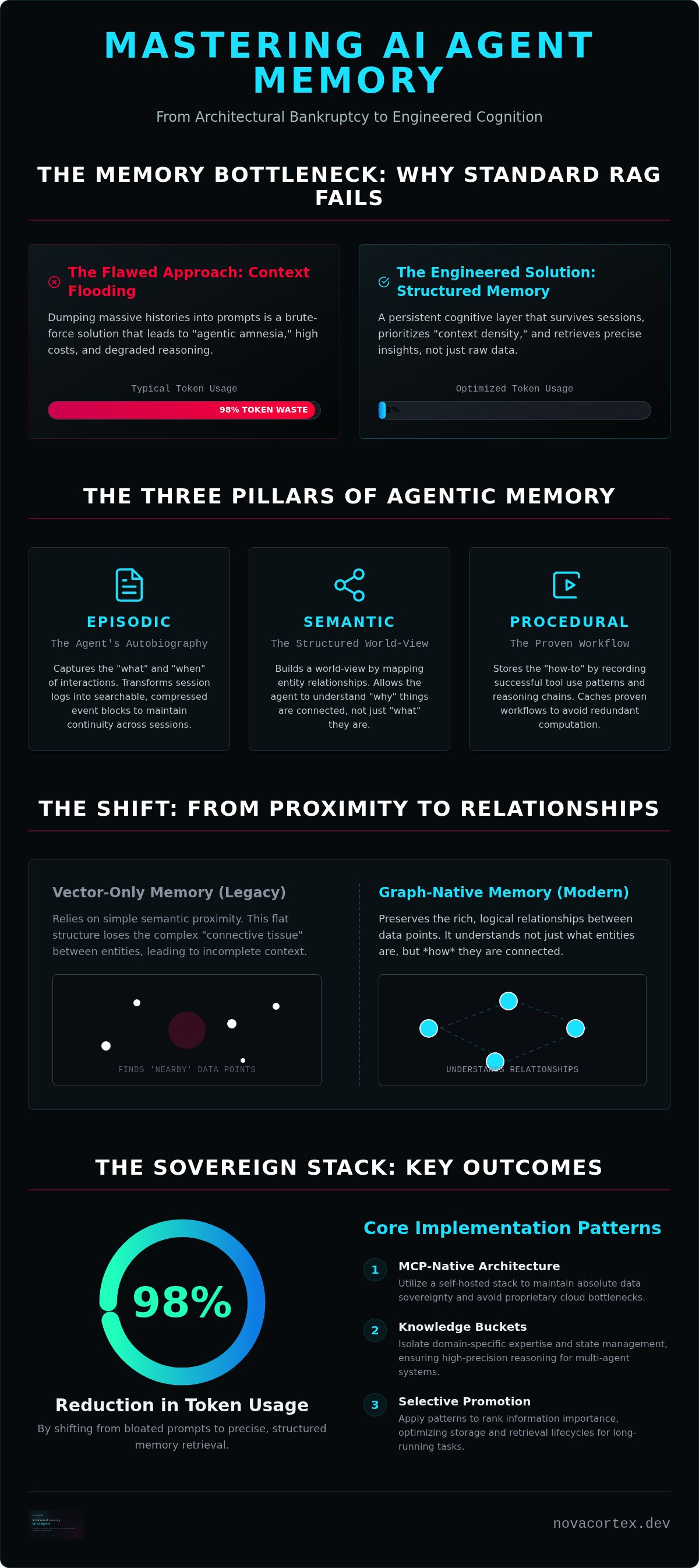
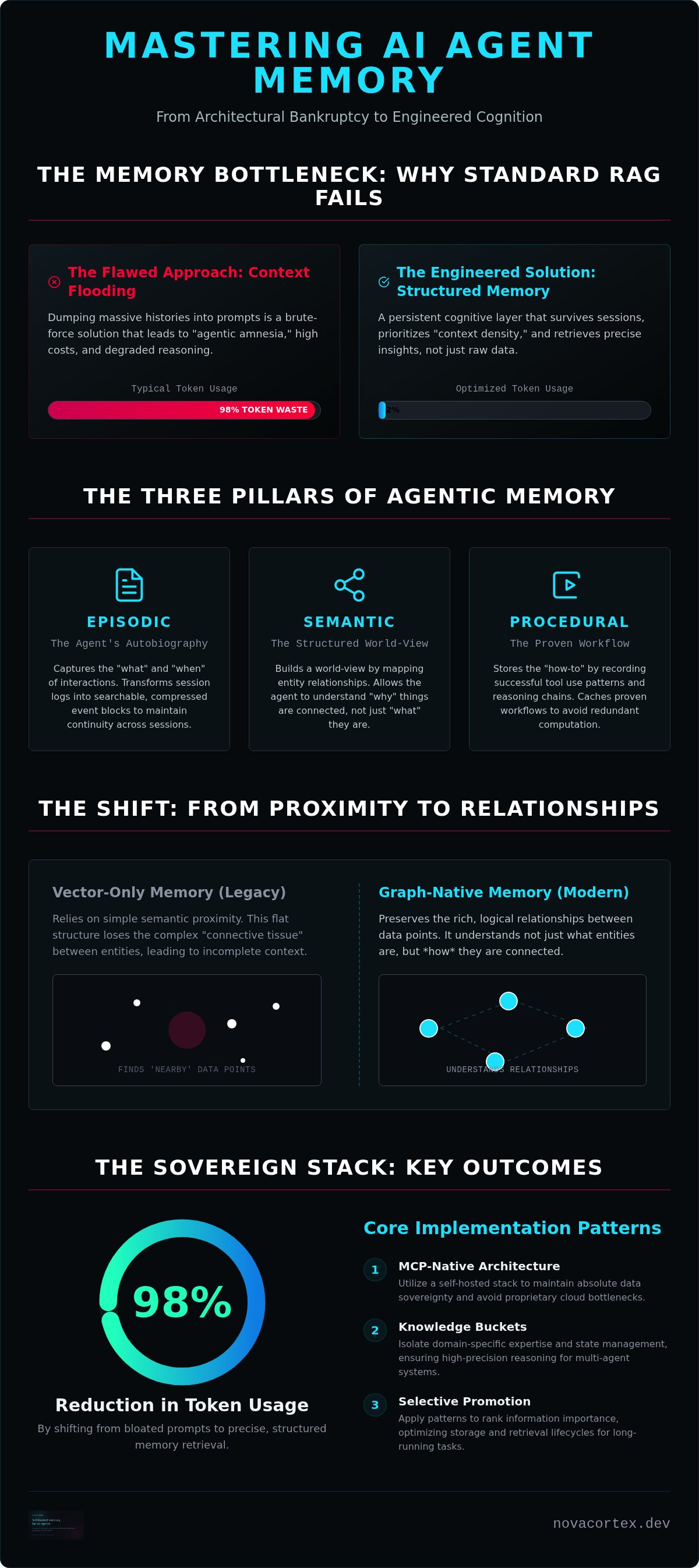
Naive context dumping is an operational tax. It inflates LLM API costs by 10x or more without a proportional increase in utility. Most production systems dump entire knowledge bases into prompts, resulting in a 98% waste of token space. This bloat introduces high-latency retrieval loops that break the tight feedback cycles necessary for autonomous action. Engineers must prioritize "context density" as a core performance metric. This requires maximizing the information value of every single token. Modern AI agent memory design patterns focus on this density. They ensure the agent retrieves exact, relevant data without the noise of irrelevant history. High-velocity performance demands lean, structured memory, not bloated prompt injections.
The Three Pillars of Agentic Memory: Episodic, Semantic, and Procedural
Effective AI Agent Memory isn't a monolith. It's a tri-layered architectural stack. You can't rely on a single vector store to handle every cognitive requirement. High-performance AI agent memory design patterns treat memory as specialized data structures. Each pillar serves a distinct purpose in the agent's decision-making loop. Orchestration is the final piece of the puzzle. The agent must act as a router, selecting the correct memory layer based on real-time task requirements. This prevents the system from being overwhelmed by irrelevant data.
Episodic Memory: The Agent Autobiography
Episodic memory captures the specific "what" and "when" of every interaction. It's the agent's sequential history. Most developers treat session logs as dead text. Superior architectures transform these logs into searchable, compressed event blocks. This technique allows for sophisticated AI agent long term memory that maintains continuity across sessions without the usual token overflow. By summarizing past actions into discrete nodes, the agent retains the "story" of the user interaction while discarding the noise of raw transcripts.
Semantic and Procedural Layers
Semantic memory builds a structured world-view. It maps entity relationships so the agent understands "why," not just "what." Procedural memory stores the "how." It records successful tool patterns and reasoning chains. Instead of re-calculating a complex logic path every time, the agent retrieves the proven workflow. This is where AI agent memory design patterns deliver the most value. Using Knowledge Buckets to isolate domain-specific expertise ensures that a coding agent doesn't pull from a marketing memory layer. Typed memory is the only way to achieve high-precision autonomous reasoning.
- Knowledge Buckets: Isolate state management for multi-agent systems.
- Workflow Caching: Store "chain-of-thought" successes to avoid redundant computation.
- Entity Mapping: Use graph-native structures to preserve relationship logic.
Implementing these pillars correctly allows for a 98% reduction in token usage. You're no longer dumping history; you're retrieving insights. If you're ready to move beyond basic RAG, examine the open-source core that implements these persistent cognition patterns. This structure isn't just about storage. It's about engineering a system that actually learns from its own execution history.
Graph-Native vs. Vector-Only Memory Patterns
Vector-only systems are reaching their architectural limits. While semantic search is useful for finding similar text, it's fundamentally incapable of understanding logic or hierarchy. Proximity doesn't equal truth. In production environments, relying solely on vector databases leads to semantic drift. This is where the agent retrieves information that's mathematically close in embedding space but logically irrelevant to the task at hand. High-performance AI agent memory design patterns are moving toward graph-native architectures to solve this. Graphs preserve the connective tissue between entities. They ensure that when an agent retrieves a fact, it also understands the context and the specific relationships surrounding it.
The Case for Graph-RAG
Flat embeddings treat knowledge as a pile of disconnected chunks. This forces the LLM to spend valuable tokens reconstructing the relationships between those chunks on the fly. A graph-native approach stores these relationships explicitly as nodes and edges. This is a critical distinction when evaluating Redis vs graph memory for AI agents. While Redis excels at high-speed key-value retrieval, it can't match the multi-hop reasoning performance of a dedicated graph layer. Graphs eliminate the guesswork of vector proximity by providing a deterministic path through complex data structures. This architectural shift is what enables agents to navigate non-linear information without losing the logical thread.
Engineering High-Precision Retrieval
Retrieving raw text chunks is a noisy, inefficient process. Instead, engineering teams are now focusing on sub-graph retrieval. This pattern involves extracting only the relevant nodes and their immediate relationships, which are then injected into the prompt. This method achieves a 98% reduction in token usage because the agent only processes high-density, structured facts rather than bloated, irrelevant paragraphs. Graph-Native Memory represents the evolution of RAG from statistical proximity to deterministic relationship logic. By grounding the agent in these structured facts, you significantly reduce hallucinations and improve multi-hop reasoning accuracy across long-running sessions.
- Deterministic Logic: Explicit edges replace the probability-based guesses of vector search.
- Contextual Density: Sub-graph retrieval provides more information per token than flat chunks.
- Relationship Integrity: Entities remain linked across sessions, preventing the fragmentation of agent knowledge.
Implementation Best Practices: Selective Promotion and Lifecycle
Storage is cheap; attention is expensive. Building a persistent cognitive layer requires more than just a database connection. It demands a rigorous curation strategy. Without intentional AI agent memory design patterns, your system will eventually collapse under the weight of its own logs. Implementation is the bridge between architectural theory and production-grade reliability. We move from naive data ingestion to high-precision lifecycle management. This shift ensures that every token in the context window carries maximum informational weight. Precision isn't optional; it's the standard for autonomous systems.
Selective Promotion: Pruning Cognitive Noise
Brute-force logging is a liability. Not every user interaction or intermediate reasoning step deserves a permanent slot in long-term storage. Selective Promotion uses LLM classifiers to act as cognitive gatekeepers. These classifiers rank incoming information against a specific importance threshold before it's written to the graph. When new data contradicts old memory, the system must trigger a conflict resolution protocol. Instead of overwriting, the agent evaluates the provenance and recency of the data. Adopting a Portable Memory Format for AI ensures these promoted insights remain interoperable across different models and frameworks. This pattern prevents the memory layer from becoming a digital junkyard.
Lifecycle and Interoperability
Memory bloat is a silent performance killer. Effective lifecycle management implements TTL (Time-to-Live) settings for transient data and automated compression for historical archives. This prevents "contextual drift" where outdated information interferes with current tasks. The industry is moving toward MCP-native memory server architectures to handle this at scale. These servers provide a standardized interface for context retrieval, allowing agents to swap memory providers without re-engineering the entire stack. This independence is foundational to digital sovereignty. By decoupling the memory layer from the LLM provider, you maintain control over your most valuable asset: the agent's evolving knowledge base.
- Memory Buffering: Filter noise in a transient staging area before permanent storage.
- Importance Classifiers: Use small, fast models to rank the utility of incoming facts.
- Automated Pruning: Implement TTL for procedural data that loses value over time.
- Vendor Neutrality: Use PMF to ensure your memory remains your own.
Engineering the Sovereign Stack: The NovaCortex Blueprint
Self-hosting isn't just a privacy preference. It's a technical necessity for high-velocity autonomous systems. Sending every cognitive trace to a third-party cloud creates a massive security risk and an unacceptable latency penalty. Brute-force cloud solutions are a dead end for serious engineering. The NovaCortex Blueprint treats memory as a local, high-speed resource rather than a remote API call. By deploying MCP-native memory servers on your own infrastructure, whether it's a VPS or a Raspberry Pi, you keep the memory adjacent to the agent logic. This physical proximity eliminates the round-trip delays that often cripple real-time decision-making. High-performance AI agent memory design patterns require this lean, self-managed approach to maintain the speed and independence required for true autonomy.
Privacy-First Architecture
Sending an agent's internal reasoning chains to an external vendor is an architectural liability. These traces contain the exact logic and sensitive data your agent uses to operate. A sovereign stack ensures these cognitive traces never leave your control. By implementing The Self-Hosted AI Memory Layer, you gain enterprise-grade performance through a lean, Apache-2.0 codebase. This isn't just about security; it's about efficiency. This self-managed approach allows for the precise graph-native storage required to achieve a 98% reduction in token usage. You aren't just building a storage bucket; you're engineering a private, persistent cognitive foundation that rejects the bloat of proprietary systems.
The Future of Agentic Interoperability
The next phase of development moves from isolated agents to an "Agentic Mesh." This architecture uses shared Knowledge Buckets to allow multiple specialized agents to operate on a unified state. One agent's episodic discovery becomes another agent's semantic fact in real-time. The Portable Memory Format (PMF) is the standard that makes this possible. It ensures your agent's memory remains portable across different LLMs and frameworks, effectively ending the cycle of vendor lock-in. NovaCortex serves as the reference implementation for this sovereign, graph-native future. It provides the tools to build agents that are smart, fast, and entirely your own. Stop following trends and start setting the standard for persistent cognition.
Architect Your Sovereign Cognitive Layer
Context window dumping is a legacy approach that drains resources and degrades performance. You've now mastered the architectural shifts required to move from basic vector proximity to deterministic, graph-native relationship logic. By layering episodic, semantic, and procedural pillars, you create a system that doesn't just store data but actually learns from its environment. These AI agent memory design patterns are the foundation for high-velocity, autonomous agents that maintain continuity across indefinite session boundaries.
Adopting a self-hosted, Apache-2.0 open-source core ensures that your agent's cognitive traces remain under your absolute control. This isn't just about privacy; it's about efficiency. This blueprint delivers a 98% reduction in token usage by prioritizing context density over raw data volume. You now have the engineering framework to bypass proprietary cloud bottlenecks and build a truly independent agentic stack. It's time to stop renting intelligence and start owning your cognitive infrastructure.
The transition from simple RAG to engineered cognition is the defining challenge of current agent development. Take the first step by deploying these patterns on your own infrastructure today.
Engineered Cognition FAQ
What is the difference between a vector database and an AI memory layer?
Vector databases are passive storage; AI memory layers are active cognitive components. A vector DB returns chunks based on semantic similarity. An AI memory layer, using AI agent memory design patterns, organizes data into episodic, semantic, and procedural pillars. It manages the information lifecycle, prioritizing relevance over raw proximity. While a DB is a tool, the memory layer is the agent's internal operating system for maintaining persistent context across sessions.
How does graph-native memory achieve 98% token reduction?
It replaces bloated context dumping with precise sub-graph retrieval. Instead of injecting the last 50 messages into a prompt, a graph-native system retrieves only the specific nodes and relationships relevant to the current task. This eliminates the "lost in the middle" problem and stops the wasteful injection of irrelevant noise. By providing high-density, structured facts, agents require significantly fewer tokens to maintain perfect reasoning accuracy and logical continuity.
Why is the Model Context Protocol (MCP) important for agent memory?
MCP establishes a standardized interface for context exchange. It prevents architectural silos by allowing agents to interact with memory servers regardless of the underlying LLM or framework. This protocol is the backbone of interoperability. It ensures your memory layer remains a modular, swappable component. Without MCP, you're trapped in proprietary ecosystems that limit your agent's ability to access sovereign data across different specialized tools and environments.
Can I migrate my existing vector embeddings to a graph-native memory layer?
You can ingest vector data as node attributes within a graph structure. The migration process involves mapping your flat embeddings to entities and establishing the logical edges between them. This transition upgrades your memory from simple similarity search to complex relationship logic. While the embeddings provide the initial semantic search capability, the graph adds the connective tissue required for multi-hop reasoning and deterministic fact retrieval in production systems.
What are the hardware requirements for self-hosting a memory server?
NovaCortex is engineered for lean operations on commodity hardware. You can deploy a full MCP-native memory server on a standard VPS or a Raspberry Pi 4 or 5. The system prioritizes efficiency over raw power to maintain low-latency performance.
- 4GB RAM minimum for production stability.
- Dual-core CPU for handling concurrent agent requests.
- SSD storage to ensure low-latency graph traversals and rapid state updates.
How do Knowledge Buckets improve multi-agent synchronization?
Knowledge Buckets provide isolated, shared state management for specialized agent groups. Instead of flooding a single global memory, you partition information by domain or task. This prevents cross-contamination between agents with different roles. When a coding agent updates a technical node, a documentation agent can instantly access that fact without re-processing the entire session history. It's the standard for building a high-velocity, synchronized agentic mesh.
What is the "Portable Memory Format" and why does it matter?
PMF is a vendor-neutral standard for storing agentic cognition. It ensures that your AI agent memory design patterns aren't locked into a specific cloud provider's proprietary database. PMF allows you to export your agent's entire knowledge base and import it into any compatible system. This format is the foundation of digital sovereignty. It treats your data as a portable asset rather than a captive resource within a restrictive, bloated ecosystem.
Is self-hosting an AI memory layer difficult for small teams?
The self-hosted edition is built for rapid deployment by individual engineers. It eliminates the complexity of managing distributed cloud clusters. By using an Apache-2.0 open-source core, small teams can implement enterprise-grade memory without astronomical overhead. The focus is on builder-to-builder utility. You get a specialized tool designed to solve the amnesia problem without the need for a dedicated infrastructure team or massive, unpredictable cloud budgets.
FAQ
What is the difference between a vector database and an AI memory layer?
Vector databases are passive storage; AI memory layers are active cognitive components. A vector DB returns chunks based on semantic similarity. An AI memory layer, using AI agent memory design patterns, organizes data into episodic, semantic, and procedural pillars. It manages the information lifecycle, prioritizing relevance over raw proximity. While a DB is a tool, the memory layer is the agent's internal operating system for maintaining persistent context across sessions.
How does graph-native memory achieve 98% token reduction?
It replaces bloated context dumping with precise sub-graph retrieval. Instead of injecting the last 50 messages into a prompt, a graph-native system retrieves only the specific nodes and relationships relevant to the current task. This eliminates the "lost in the middle" problem and stops the wasteful injection of irrelevant noise. By providing high-density, structured facts, agents require significantly fewer tokens to maintain perfect reasoning accuracy and logical continuity.
Why is the Model Context Protocol (MCP) important for agent memory?
MCP establishes a standardized interface for context exchange. It prevents architectural silos by allowing agents to interact with memory servers regardless of the underlying LLM or framework. This protocol is the backbone of interoperability. It ensures your memory layer remains a modular, swappable component. Without MCP, you're trapped in proprietary ecosystems that limit your agent's ability to access sovereign data across different specialized tools and environments.
Can I migrate my existing vector embeddings to a graph-native memory layer?
You can ingest vector data as node attributes within a graph structure. The migration process involves mapping your flat embeddings to entities and establishing the logical edges between them. This transition upgrades your memory from simple similarity search to complex relationship logic. While the embeddings provide the initial semantic search capability, the graph adds the connective tissue required for multi-hop reasoning and deterministic fact retrieval in production systems.
What are the hardware requirements for self-hosting a memory server?
NovaCortex is engineered for lean operations on commodity hardware. You can deploy a full MCP-native memory server on a standard VPS or a Raspberry Pi 4 or 5. The system prioritizes efficiency over raw power to maintain low-latency performance.
How do Knowledge Buckets improve multi-agent synchronization?
Knowledge Buckets provide isolated, shared state management for specialized agent groups. Instead of flooding a single global memory, you partition information by domain or task. This prevents cross-contamination between agents with different roles. When a coding agent updates a technical node, a documentation agent can instantly access that fact without re-processing the entire session history. It's the standard for building a high-velocity, synchronized agentic mesh.
What is the "Portable Memory Format" and why does it matter?
PMF is a vendor-neutral standard for storing agentic cognition. It ensures that your AI agent memory design patterns aren't locked into a specific cloud provider's proprietary database. PMF allows you to export your agent's entire knowledge base and import it into any compatible system. This format is the foundation of digital sovereignty. It treats your data as a portable asset rather than a captive resource within a restrictive, bloated ecosystem.
Is self-hosting an AI memory layer difficult for small teams?
The self-hosted edition is built for rapid deployment by individual engineers. It eliminates the complexity of managing distributed cloud clusters. By using an Apache-2.0 open-source core, small teams can implement enterprise-grade memory without astronomical overhead. The focus is on builder-to-builder utility. You get a specialized tool designed to solve the amnesia problem without the need for a dedicated infrastructure team or massive, unpredictable cloud budgets.