AI Agent Memory for Code Analysis: Engineering Persistent Context

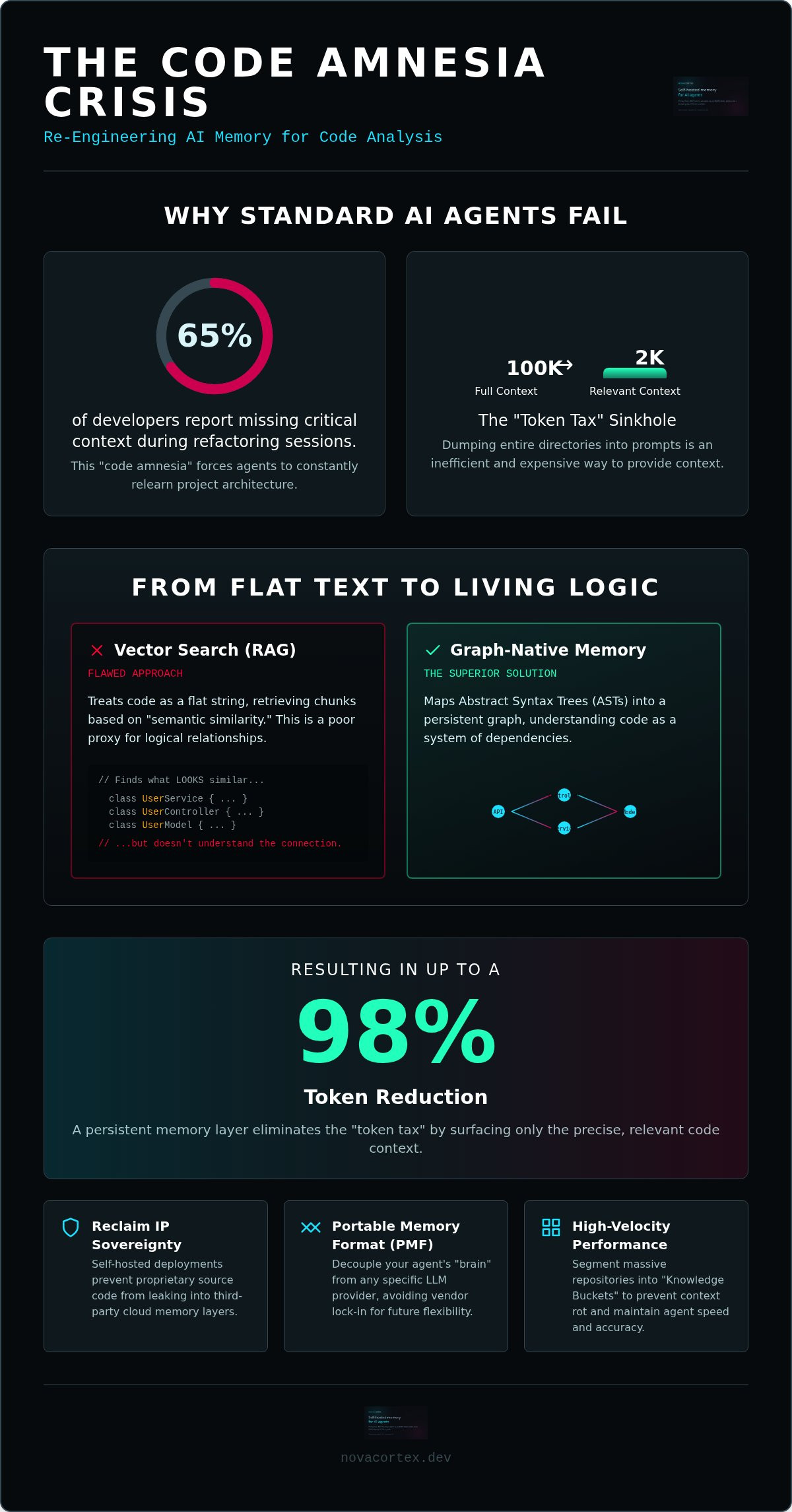
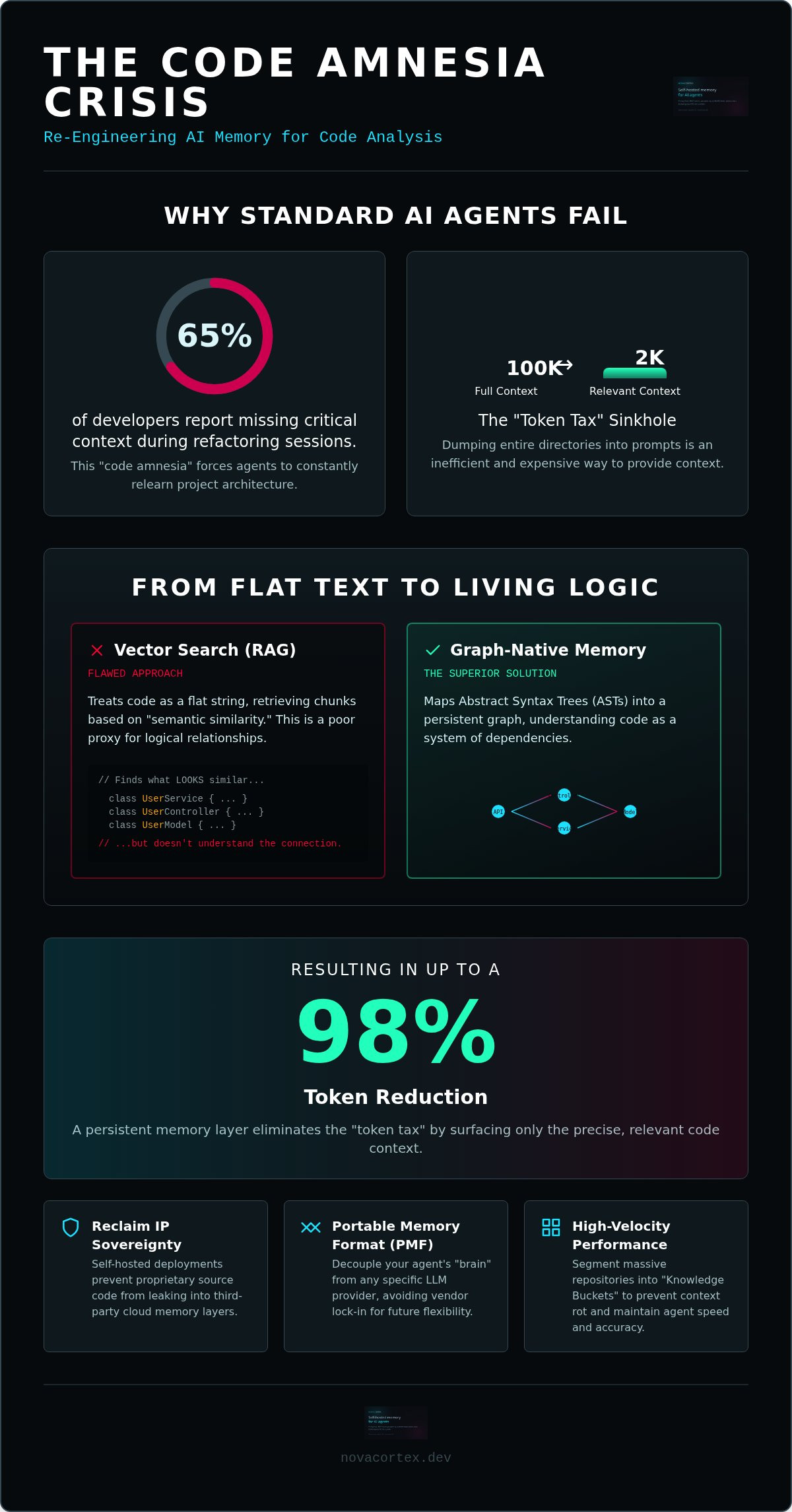
Sixty-five percent of developers report missing critical context during refactoring sessions. This persistent amnesia makes standard AI agent memory for code analysis feel like a broken promise. You've likely watched your agent forget a pivotal architectural decision mid-session, forcing you to re-send the entire codebase. This cycle creates massive token waste and exposes proprietary IP to unnecessary cloud risks. It is an inefficient, bloated way to build software.
You need a memory layer that mirrors the complexity of your source code. We'll show you how to architect a graph-native system that ensures persistent context across every dev session while slashing token usage by 98%. We'll explore how the NovaCortex Self-Hosted Edition and Portable Memory Format (PMF) provide full data sovereignty without sacrificing performance. This guide provides the technical blueprint for building a high-velocity, MCP-native memory server that turns your codebase into a living, persistent map.
Key Takeaways
- Replace flat text retrieval with graph-native architecture to map classes and dependencies, ensuring your agent understands code as a system rather than a string.
- Achieve 98% token reduction by engineering a persistent memory layer that eliminates the "token tax" of re-sending massive context windows.
- Reclaim IP control with self-hosted deployments, preventing proprietary source code from leaking into managed cloud memory layers.
- Leverage the MCP standard to integrate robust AI agent memory for code analysis directly into your existing IDE and team workflows.
- Segment massive repositories into Knowledge Buckets to prevent context rot and maintain high-velocity performance across complex projects.
The Context Crisis: Why Standard Code Analysis Fails
Standard AI coding assistants operate in a vacuum. Every new session is a blank slate, forcing the model to re-learn your architectural patterns from scratch. This is code amnesia. It is the failure of agents to retain the "why" behind your technical debt or the specific constraints of your internal APIs. Without a dedicated layer for AI agent memory for code analysis, your assistant remains a sophisticated but forgetful autocomplete tool.
This amnesia leads directly to the token tax. Developers attempt to solve context loss by dumping entire directories into the prompt. It's a financial sinkhole. Sending 100,000 tokens of source code to fix a five-line bug is architectural malpractice. When repository size exceeds the LLM context limit, the system hits a breaking point. Context rot sets in, and the agent begins to hallucinate because it can no longer see the forest for the trees.
Traditional Retrieval-Augmented Generation (RAG) fails here. Vector search is a blunt instrument designed for semantic similarity, not structural logic. In a complex codebase, the most "similar" code snippet is rarely the most relevant one for debugging a deep-seated dependency issue. You don't need code that looks like your bug; you need the specific lifecycle hook or configuration file that governs it.
The Goldfish Problem in Development
Agents frequently lose track of refactoring history across sessions. You shouldn't have to re-explain your custom authentication wrapper every time you open a new chat. This constant re-contextualization kills developer velocity and erodes trust in the tool. When an agent suggests a pattern you've already rejected, it isn't just annoying; it's a sign that your AI agent memory for code analysis is non-existent. High-velocity engineering requires an agent that remembers your decisions as clearly as you do.
Vector Search vs. Structural Understanding
Semantic similarity is a poor proxy for logical code relationships. A vector database might retrieve three different "User" classes because they share a name, but it won't understand the inheritance chain or the service-to-database mapping. Code is a non-linear graph of dependencies, not a flat string of text. To be effective, an agent must traverse Abstract Syntax Trees (ASTs) and dependency maps in memory. Relying on text chunks alone ensures that your agent will always struggle with the structural complexity of enterprise-scale repositories.
Graph-Native Memory: Mapping Complex Code Dependencies
Code is not a flat sequence of characters. It is a dense, multi-dimensional web of classes, methods, and call sites. When you treat code like generic text, you lose the structural hierarchy that defines its logic. Effective AI agent memory for code analysis must be graph-native. By mapping Abstract Syntax Trees (ASTs) directly into a memory layer, agents can traverse relationships rather than just scanning for keyword matches. This approach allows the agent to understand that a change in a low-level utility function ripples through specific high-level services.
This structural awareness enables retrieval precision that vector search cannot match. Instead of pulling an entire 2,000-line file into the context window, a graph-native system surfaces the exact relevant function and its immediate dependencies. It preserves architectural tribal knowledge, those specific design patterns and constraints that aren't always explicit in the comments. You aren't just giving the agent more data. You're giving it a logical framework.
Beyond Vector Embeddings
Flat vector databases are insufficient for hierarchical code. They rely on semantic similarity, which often fails when two different functions use similar variable names but serve opposite purposes. Graph-native storage maintains relationship integrity by design. It treats every code entity as a node and every interaction as an edge. We define graph-native memory for code as a living map of logic. It ensures that the agent understands the "why" and "how" of your system architecture, not just the "what."
Portable Memory Format (PMF)
Proprietary memory layers often lead to vendor lock-in, trapping your institutional knowledge in a specific provider's ecosystem. The portable memory format for AI (PMF) solves this by decoupling your agent's "brain" from the LLM provider. PMF enables seamless memory migration across different agents and models. It ensures that the context you build today remains accessible even if you switch your underlying infrastructure tomorrow. You can start building this persistent context by exploring the NovaCortex open-source repository. This interoperability is the foundation of digital sovereignty in the age of AI.
Sovereignty and Privacy: Protecting Proprietary Source Code
Enterprise code is your most valuable asset. Sending it to a managed cloud memory layer is an architectural failure. While many developers focus on local inference, the memory layer is actually the primary security leak. It is a permanent, structured record of your logic, patterns, and vulnerabilities. Deploying a dedicated AI agent memory for code analysis on your own infrastructure is the only way to maintain digital sovereignty. You cannot afford to treat your intellectual property as a shared resource.
Data sovereignty is about control. It means keeping your agent’s "brain" on your own VPS or local hardware. When you outsource memory, you outsource your IP. Compliance mandates like SOC2 and GDPR require strict data handling that managed AI services often cannot guarantee. If your code analysis involves sensitive dependencies or proprietary algorithms, the only professional choice is a self-hosted solution that keeps the data within your security perimeter.
The Risks of Managed AI Memory
Managed memory systems are black boxes. There is a persistent risk of the "IP Leak" scenario, where your proprietary logic is ingested and used to tune global models. You lose oversight of how your data is stored, who accesses it, and how long it persists. Managed retrieval systems prioritize ease of use over security, often leaving your vectorized source code exposed in third-party environments. For engineering teams, this lack of control is a non-starter. Self-hosting ensures your logic remains yours.
Engineering for Self-Hosted Efficiency
Local memory isn't just about security; it's about performance. Running memory layers on lightweight hardware like local servers or even a dedicated VPS eliminates the latency of cloud round-trips. This setup provides high-velocity retrieval that keeps pace with your IDE. When you compare self-hosted vs managed AI memory, the efficiency gains of local context are undeniable. Implementing local AI agent memory for code analysis reduces external dependencies and slashes token waste by keeping the most relevant context close to the compute. It's a lean, performance-driven approach that respects both your privacy and your engineering budget.
- Full IP Control: Your code never leaves your controlled environment.
- Zero Latency: Local retrieval beats cloud-based semantic search every time.
- Compliance Ready: Meet SOC2 and GDPR standards by keeping data on-prem.
- Lean Architecture: Run persistent memory on existing infrastructure without bloated cloud fees.
Strategic Implementation: Persistent Memory for IDE Agents
Implementing AI agent memory for code analysis isn't just about storage. It's about accessibility and structure. You need a protocol that unifies how agents interact with your codebase knowledge. Without a standard interface, your memory layer remains a silo. Strategic implementation requires segmenting data into Knowledge Buckets to ensure retrieval stays relevant and high-velocity. You also need a consolidation process that converts transient chat history into permanent, structured architectural insights. This transformation prevents your memory from becoming a bloated graveyard of old prompts.
State management is the next hurdle. In multi-agent coding workflows, different agents often work on intersecting modules. If they don't share a synced memory state, they'll eventually clash. A centralized memory server ensures that every agent operates on the same architectural constraints. It turns your development environment into a collaborative ecosystem where the AI is an informed partner, not just a reactive script runner. You aren't just providing data; you're maintaining a shared state of engineering truth.
Model Context Protocol (MCP) Integration
MCP-native servers are the future of interoperable dev tools. They eliminate the friction of custom integrations. By connecting your IDE agent to an MCP native memory server, you create a universal bridge for context. This isn't a suggestion; it's the new standard for professional-grade development.
- Deploy your MCP-native server on your local network or a private VPS.
- Configure your agent to point to the server's endpoint using the standard JSON-RPC protocol.
- Define the specific Knowledge Buckets relevant to your current project to limit retrieval scope.
This setup allows multiple agents to share a single source of truth. It removes the need for manual context re-entry and protects your IP by keeping the retrieval logic within your infrastructure.
Optimizing the Context Window
Knowledge Buckets prevent context rot by isolating memory by repository or team. Dumping everything into a single index creates semantic noise. When you segment your memory, retrieval precision skyrockets. This precision drives the 98% token reduction observed in high-performance engineering teams using AI agent memory for code analysis. We define this 98% reduction as the difference between experimentation and production-ready AI. It moves you from "maybe this works" to a reliable, cost-effective development pipeline. You aren't just saving money; you're increasing the logical density of every prompt.
NovaCortex: Engineering High-Velocity Code Intelligence
NovaCortex is the architectural correction to industry-wide context rot. It is not another bloated cloud service; it is a specialized, self-hosted memory layer built for the specific demands of high-velocity engineering. By implementing the NovaCortex Self-Hosted Edition, you provide your agents with a persistent cognitive foundation that mirrors the logical structure of your codebase. This is the only way to eliminate agent amnesia without sacrificing your digital sovereignty. It ensures that every architectural decision and internal API constraint is remembered, indexed, and retrieved with surgical precision. Our system replaces the wasteful cycle of re-sending context with a lean, graph-native approach. This is AI agent memory for code analysis engineered for performance.
Scalability is a core requirement, not an afterthought. NovaCortex grows with your team, moving effortlessly from a single developer's local environment to enterprise-grade infrastructure. Whether you are managing a monolithic legacy system or a sprawling microservices architecture, NovaCortex provides the structural understanding necessary for production-ready AI. It turns your agent into a sovereign expert that understands your code as a living system rather than a collection of text files.
The NovaCortex Advantage
Transparency is foundational to engineering trust. NovaCortex operates on an Apache-2.0 open-source foundation, ensuring that your memory layer is never a black box. The platform features Knowledge Buckets, which allow teams to segment memory by repository or project. This isolation prevents semantic cross-contamination and ensures that the agent only retrieves context relevant to the current task. Our graph-native architecture delivers low-latency performance that cloud-based vector stores cannot match. It allows the agent to traverse your system's logic in real-time, making it an informed partner in the development process. This structural precision is what enables the 98% token reduction that defines the NovaCortex experience.
Getting Started with Sovereign Memory
You can deploy NovaCortex on your own terms. The self-hosted edition supports a wide range of environments, including local servers, Raspberry Pi clusters, and private VPS instances. This flexibility ensures that your proprietary source code never leaves your security perimeter. Deploying your sovereign memory layer is the first step toward reclaiming your developer velocity and protecting your intellectual property. For a deeper dive into the mechanics of persistent context, explore our technical briefing on AI agent long term memory. Stop paying the token tax and start building with high-velocity code intelligence. Your code is a graph; it is time your agent's memory treated it like one.
Reclaim Your Engineering Velocity
Standard AI tools are failing because they treat your code as disposable text. We have established that high-performance AI agent memory for code analysis requires a graph-native, self-hosted architecture to maintain structural integrity and IP sovereignty. By shifting to a persistent memory layer, you eliminate the repetitive token tax and ensure your agent understands the long-term evolution of your codebase logic.
NovaCortex provides a privacy-first architecture built on an Apache-2.0 open-source foundation. It delivers a 98% reduction in token usage, turning AI from a costly experiment into a lean production asset. You don't have to compromise between intelligence and data security. You can have a memory layer that is as sophisticated as the systems you build.
It's time to build with an assistant that actually remembers your logic. Start engineering a smarter, more secure development environment today.
Frequently Asked Questions
How does graph-native memory differ from a standard vector database for code?
Graph-native memory maps the logical relationships within code, such as inheritance and dependency chains, whereas standard vector databases only calculate semantic similarity. Vector search often retrieves similar-looking text that lacks functional relevance. Graph architecture allows an agent to traverse your system's logic. This structural awareness is critical for effective AI agent memory for code analysis because it preserves the hierarchy of your architecture rather than flattening it into unrelated text chunks.
Can I use NovaCortex with my existing IDE agent like Cursor or Windsurf?
You can integrate NovaCortex with any IDE agent that supports the Model Context Protocol (MCP). Tools like Cursor or Windsurf connect to our MCP-Native Memory Server to access persistent context. This setup allows your preferred coding assistant to retrieve historical architectural decisions without manual re-entry. It bridges the gap between transient chat windows and a permanent knowledge base, ensuring your agent remains informed across different development sessions and various IDE environments.
What is the actual token saving when using persistent memory for code analysis?
Engineering teams experience a 98% reduction in token usage by using a graph-native memory layer. Standard analysis requires re-sending massive context windows to maintain agent awareness, which is a significant financial sinkhole. Persistent memory allows the agent to retrieve only the specific, relevant nodes required for the current task. This precision eliminates the token tax associated with bloated prompts. It transforms AI from an expensive experimental tool into a lean, production-ready asset.
Is it possible to self-host AI memory on a local machine or Raspberry Pi?
Self-hosting is entirely possible on local machines, Raspberry Pi clusters, or private VPS instances. The NovaCortex Self-Hosted Edition is designed for lightweight, high-velocity performance on standard hardware. This deployment model ensures your proprietary source code never leaves your local network. It provides a privacy-first alternative to managed cloud memory. Running your memory layer locally also reduces retrieval latency, keeping your AI agent memory for code analysis as fast as your IDE.
How does Model Context Protocol (MCP) help with agent memory?
The Model Context Protocol (MCP) provides a standardized bridge between AI agents and external data sources. It unifies how different agents access your memory server, preventing vendor lock-in. By using an MCP-native server, you ensure that your persistent context is accessible to any tool in your stack. This interoperability is foundational for multi-agent workflows. It allows different coding assistants to share a single, synced source of engineering truth without custom integration overhead.
Does NovaCortex work with private, air-gapped infrastructure?
NovaCortex is built for digital sovereignty and supports deployments in fully air-gapped environments. Since the system is self-hosted and open-source under Apache-2.0, you maintain absolute control over the data flow. There are no mandatory external heartbeats or cloud dependencies that compromise security. This makes it the only viable memory layer for organizations with strict SOC2 or GDPR requirements. Your agent's brain remains entirely within your secure, private infrastructure at all times.
How do Knowledge Buckets help organize context for different repositories?
Knowledge Buckets allow you to segment memory by repository, project, or specific team. This organization prevents semantic noise by ensuring the agent only retrieves context relevant to the active workspace. Without segmentation, memory layers often suffer from context rot where unrelated code snippets interfere with retrieval precision. Buckets enable high-velocity multi-repo management. They ensure that your agent's understanding of a specific microservice isn't clouded by architectural patterns from an unrelated legacy monolith.
What happens to my data if I switch from NovaCortex to another system?
Your data remains yours through the Portable Memory Format (PMF). This open standard ensures that your institutional knowledge isn't trapped in a proprietary ecosystem. If you decide to switch systems, you can export your entire memory graph without losing the logical relationships you've built. PMF decouples your agent's cognition from the underlying platform. It protects your long-term investment in context engineering and ensures your architectural tribal knowledge remains a portable asset.
FAQ
How does graph-native memory differ from a standard vector database for code?
Graph-native memory maps the logical relationships within code, such as inheritance and dependency chains, whereas standard vector databases only calculate semantic similarity. Vector search often retrieves similar-looking text that lacks functional relevance. Graph architecture allows an agent to traverse your system's logic. This structural awareness is critical for effective AI agent memory for code analysis because it preserves the hierarchy of your architecture rather than flattening it into unrelated text chunks.
Can I use NovaCortex with my existing IDE agent like Cursor or Windsurf?
You can integrate NovaCortex with any IDE agent that supports the Model Context Protocol (MCP). Tools like Cursor or Windsurf connect to our MCP-Native Memory Server to access persistent context. This setup allows your preferred coding assistant to retrieve historical architectural decisions without manual re-entry. It bridges the gap between transient chat windows and a permanent knowledge base, ensuring your agent remains informed across different development sessions and various IDE environments.
What is the actual token saving when using persistent memory for code analysis?
Engineering teams experience a 98% reduction in token usage by using a graph-native memory layer. Standard analysis requires re-sending massive context windows to maintain agent awareness, which is a significant financial sinkhole. Persistent memory allows the agent to retrieve only the specific, relevant nodes required for the current task. This precision eliminates the token tax associated with bloated prompts. It transforms AI from an expensive experimental tool into a lean, production-ready asset.
Is it possible to self-host AI memory on a local machine or Raspberry Pi?
Self-hosting is entirely possible on local machines, Raspberry Pi clusters, or private VPS instances. The NovaCortex Self-Hosted Edition is designed for lightweight, high-velocity performance on standard hardware. This deployment model ensures your proprietary source code never leaves your local network. It provides a privacy-first alternative to managed cloud memory. Running your memory layer locally also reduces retrieval latency, keeping your AI agent memory for code analysis as fast as your IDE.
How does Model Context Protocol (MCP) help with agent memory?
The Model Context Protocol (MCP) provides a standardized bridge between AI agents and external data sources. It unifies how different agents access your memory server, preventing vendor lock-in. By using an MCP-native server, you ensure that your persistent context is accessible to any tool in your stack. This interoperability is foundational for multi-agent workflows. It allows different coding assistants to share a single, synced source of engineering truth without custom integration overhead.
Does NovaCortex work with private, air-gapped infrastructure?
NovaCortex is built for digital sovereignty and supports deployments in fully air-gapped environments. Since the system is self-hosted and open-source under Apache-2.0, you maintain absolute control over the data flow. There are no mandatory external heartbeats or cloud dependencies that compromise security. This makes it the only viable memory layer for organizations with strict SOC2 or GDPR requirements. Your agent's brain remains entirely within your secure, private infrastructure at all times.
How do Knowledge Buckets help organize context for different repositories?
Knowledge Buckets allow you to segment memory by repository, project, or specific team. This organization prevents semantic noise by ensuring the agent only retrieves context relevant to the active workspace. Without segmentation, memory layers often suffer from context rot where unrelated code snippets interfere with retrieval precision. Buckets enable high-velocity multi-repo management. They ensure that your agent's understanding of a specific microservice isn't clouded by architectural patterns from an unrelated legacy monolith.
What happens to my data if I switch from NovaCortex to another system?
Your data remains yours through the Portable Memory Format (PMF). This open standard ensures that your institutional knowledge isn't trapped in a proprietary ecosystem. If you decide to switch systems, you can export your entire memory graph without losing the logical relationships you've built. PMF decouples your agent's cognition from the underlying platform. It protects your long-term investment in context engineering and ensures your architectural tribal knowledge remains a portable asset.