AI Agent Memory for Complex Workflows: Engineering Persistent Context

Vector search is a retrieval hack, not a memory system. It acts as a temporary patch for a foundational flaw in agentic design. You've likely experienced the friction of agent amnesia during multi-turn tasks, a technical bottleneck that turns high-performance AI agent memory for complex workflows into expensive, repetitive failures. Dumping history into context windows isn't a solution; it's a budget killer. Sending proprietary data to third-party vector clouds is a security gamble that engineers should no longer accept.
Mastering this architectural shift requires a pivot from stateless interactions to persistent, graph-native storage. This article provides the blueprint for building a memory layer that retains logic across sessions without the bloat. We'll examine how the NovaCortex Self-Hosted Edition and the Portable Memory Format (PMF) enable a 98% reduction in token consumption. You'll learn to deploy an MCP-native memory server that ensures full data sovereignty and high-velocity performance for every agent in your stack. It's time to move beyond simple retrieval and start engineering true persistent cognition.
Key Takeaways
- Stateless LLMs fail at multi-step reasoning. Learn to engineer a persistent memory layer that acts as the essential cognitive glue for autonomous agents.
- Vector search lacks the depth for relationship mapping. Discover how graph-native storage optimizes AI agent memory for complex workflows by representing knowledge as interconnected entities.
- Context stuffing is expensive and inefficient. Master selective retrieval techniques that can reduce your token consumption by 98% without sacrificing precision.
- Third-party vector clouds compromise data sovereignty. Understand the architectural advantages of self-hosting your memory layer to eliminate security risks and reduce network latency.
- Vendor lock-in is a choice, not a requirement. Use the Portable Memory Format (PMF) to ensure your agent's knowledge remains modular and fully under your control.
The Architecture of AI Memory for Complex Workflows
The memory layer is the cognitive glue that transforms a sequence of isolated LLM calls into a coherent reasoning engine. Without it, agents are trapped in a cycle of perpetual amnesia. Modern AI agent memory for complex workflows demands more than a simple database connection. It requires a specialized layer within the cognitive architecture of AI agents that manages state, resolves contradictions, and maintains context across disjointed sessions. Simple RAG systems retrieve documents; persistent memory maintains the thread of logic. To build high-performance agents, engineers must transition from reactive retrieval to proactive state management.
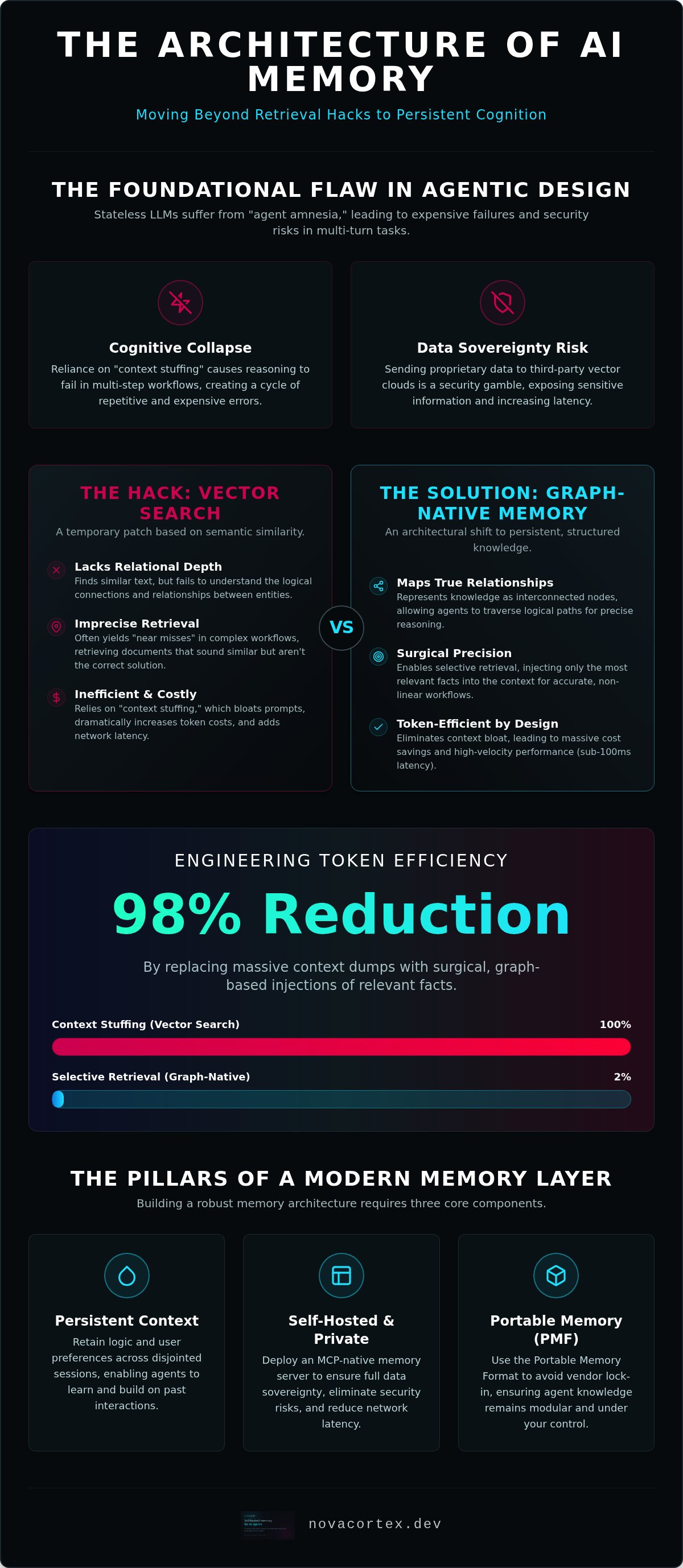
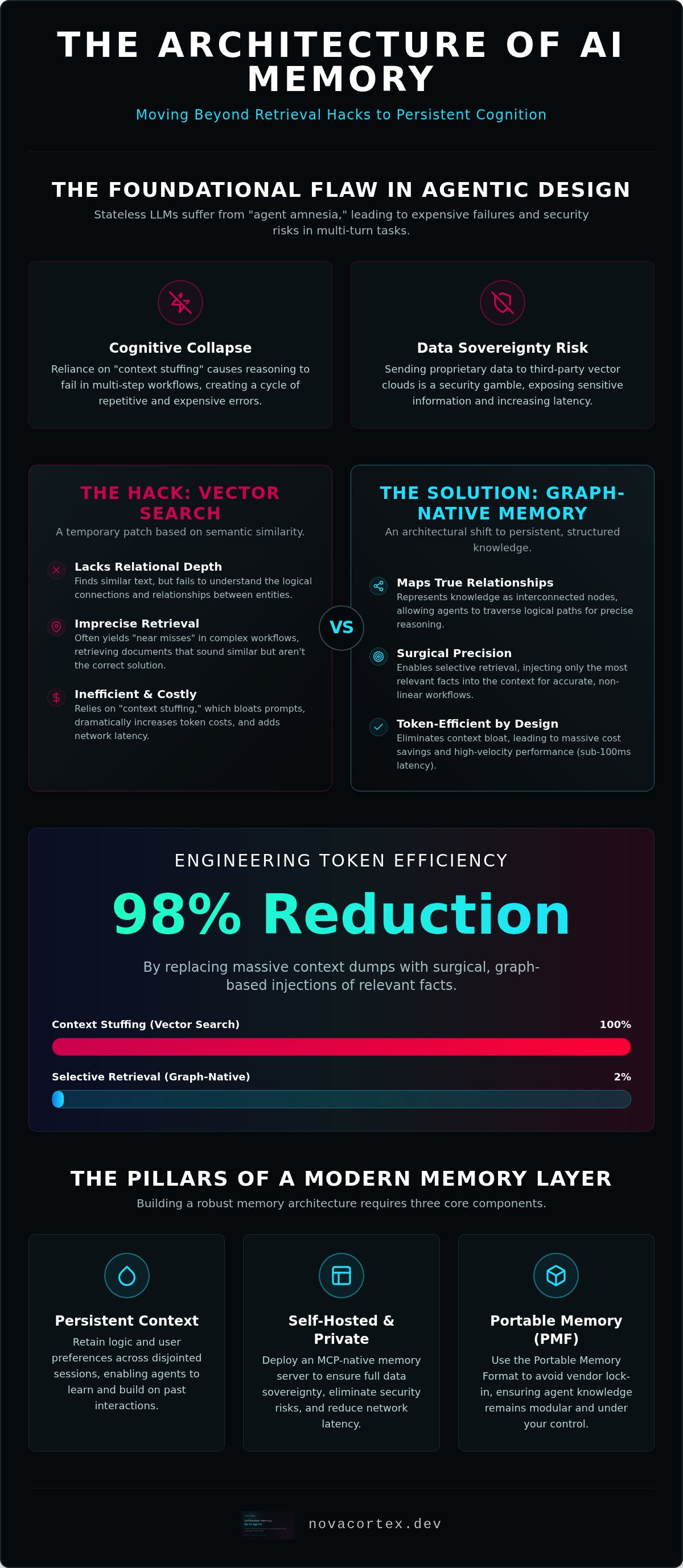
Architectural requirements for this layer are non-negotiable. High-velocity workflows require sub-100ms latency for memory retrieval. Precision is equally critical. An agent must distinguish between a user's current preference and an outdated instruction from six months ago. Achieving this requires a graph-native approach that maps relationships, not just text strings. This shift allows for a 98% reduction in token consumption by replacing massive context dumps with surgical, graph-based injections of relevant facts.
The Statelessness Problem in Agentic Engineering
LLMs are inherently stateless. They process the current prompt and forget it immediately. Engineers often attempt to bypass this by "context stuffing," which involves dumping raw chat history back into the model. This is architectural technical debt. Once an interaction exceeds 10 turns, reasoning typically collapses under the weight of noise. Token costs skyrocket. Precision drops. Relying on a massive context window is a structural failure masquerading as a solution. It ignores the need for sophisticated state management and introduces massive network latency that kills the user experience.
Short-Term vs. Long-Term Persistent Context
Effective memory isn't a monolith. It operates on two distinct planes. Short-term memory handles the immediate task state, keeping the agent focused on the current objective and the immediate variables of a specific workflow. Long-term memory stores historical outcomes, user preferences, and cross-session learnings. Bridging these planes requires a dedicated memory server to synchronize state across multiple agents. This ensures that an agent working on a task today can leverage the specific logic established by a different agent weeks ago. It's the difference between a tool that follows instructions and a system that actually learns from its environment.
Moving Beyond Vector Search: The Graph-Native Advantage
Vector databases are excellent for semantic retrieval, but they fail the logic test. They find things that look similar in a high-dimensional space. They don't understand structural relationships. In a multi-step engineering workflow, semantic similarity is a weak signal. You don't need a document that sounds like your problem; you need the specific entity that solves it. This is why AI agent memory for complex workflows is shifting toward graph-native architectures. By representing knowledge as interconnected nodes and edges, agents can traverse logical paths rather than guessing based on distance. It's the difference between a flat map and a 3D model of your domain.
While IBM defines core types of AI agent memory as episodic or procedural, the underlying storage mechanism dictates how effectively an agent can use that data. Vector search is a retrieval hack that often yields "near misses." Graph-native memory provides the precision required for non-linear agent workflows. It allows an agent to reason about how facts change over time and how different entities relate across different tasks. This structural clarity is essential for any system designed to operate autonomously over long durations.
Vector vs. Graph Memory for Reasoning
Semantic similarity is often a distraction in complex reasoning. If an agent asks for "authentication protocols," a vector store might return a generic PDF about security. A graph-native system returns the specific relationship between "User A," "Service B," and the "OAuth2 Token" utilized in the last session. Complex workflows require traversing these knowledge nodes to maintain a logical chain of thought. If you're comparing performance, check the technical breakdown of Redis vs graph memory for AI agents. The difference in precision isn't marginal; it's foundational.
Implementing Knowledge Buckets for Modular Context
Context contamination is a silent killer in multi-agent systems. When memory is a single, undifferentiated pool, agents retrieve irrelevant data that pollutes the prompt. Knowledge Buckets solve this through logical segmentation. You can isolate memory by task, project, or specific user identity. This modularity allows for dynamic bucket switching. In a multi-agent environment, an "Architect Agent" might access a "System Design Bucket" while a "Security Agent" pulls from a "Compliance Bucket." This prevents the LLM from being overwhelmed by 100% of the context when it only needs 2% precision. For those building these systems, you can explore the implementation details on our GitHub to see how modular memory improves reliability.
Engineering Token Efficiency: Reducing Context Bloat
Context stuffing is a fiscal leak. Many developers treat the context window as a bottomless trash can, dumping entire chat histories into every prompt to maintain continuity. This "context stuffing" approach creates a hidden cost that compounds with every turn. In AI agent memory for complex workflows, this inefficiency leads to prohibitive API costs and degraded model performance. High-performance agents require surgical precision. You need to move from 100% context inclusion to 2% precision, where only the critical data points are injected into the reasoning loop. This isn't just about saving money; it's about maintaining the structural integrity of the agent reasoning chain.
NovaCortex addresses this waste at the architectural level. By utilizing a graph-native architecture, the system identifies specific knowledge nodes rather than raw text chunks. This approach achieves up to 98% token reduction in long-running tasks. Benchmarking retrieval latency is equally vital; high-velocity workflows can't wait for bloated context processing. Efficient memory layers ensure sub-second response times by minimizing the data the LLM must ingest. When your agent doesn't have to parse 100,000 tokens of noise to find one fact, it performs with a level of speed and accuracy that stateless systems cannot match.
The Context Management Crisis
The ROI of an efficient memory layer is measured in saved tokens and reduced latency. Token bloat is the primary bottleneck for agent scalability in 2026. When you reduce the volume of data sent to the LLM, you don't just save money; you improve the agent's ability to follow complex instructions. Smaller, high-signal prompts lead to fewer hallucinations and faster inference. Response times drop significantly when the model isn't bogged down by irrelevant history. Scalability depends on your ability to keep the "working memory" of the agent lean, focused, and high-signal.
Advanced Retrieval Optimization Techniques
Summarization is a common but flawed technique for context management. It often loses the nuance required for technical execution. Graph-based extraction is superior because it preserves the structural relationships between entities without the fluff. Context pruning allows you to keep only the high-signal nodes relevant to the current task, discarding the rest of the noise. Leveraging AI agent long term memory is the only way to achieve cost-effective scaling for enterprise-grade deployments. By keeping the memory layer external to the LLM and only fetching what's necessary, you build a system that remains lean as its knowledge base grows. This architectural independence is the only path to digital sovereignty and operational efficiency.
Implementation Strategy: Self-Hosting for Privacy and Performance
Managed vector clouds are a liability. When you outsource your agent's memory, you outsource your business logic. True data sovereignty is only possible through local infrastructure. High-performance AI agent memory for complex workflows requires hosting the memory layer adjacent to the agent to eliminate unnecessary network round-trips. Every millisecond of latency in memory retrieval compounds across multi-step reasoning chains. Deployment is flexible. You can run a memory server on a dedicated VPS for cloud-based scalability or on a local server for maximum security. For edge-based operations, even a hardware-constrained device like a Raspberry Pi can host a graph-native memory layer, bringing persistent cognition to the local network without relying on an internet backbone.
The Privacy-First Memory Layer
Securing the "memories" of an agent is non-negotiable. These graphs contain the distilled logic and proprietary data of your entire operation. Traditional RAG pipelines that rely on third-party clouds introduce unacceptable security risks by exposing your internal knowledge to external providers. Ownership of the memory layer ensures that your data never leaves your controlled environment. If you're evaluating your infrastructure, consider the specific advantages of self-hosted vs managed AI memory. Moving your memory layer in-house isn't just about privacy; it's about total architectural control. It prevents the quiet degradation of performance that occurs when managed services change their underlying models or pricing structures without notice.
MCP-Native Integration: The Modern Standard
Interoperability used to mean writing endless custom API wrappers for every new tool in your stack. The Model Context Protocol (MCP) has ended that era of fragmentation. Implementing an MCP native memory server allows you to standardize context exchange across heterogeneous agents. This protocol ensures that whether you're using a single agent or a complex multi-agent swarm, the retrieval logic remains consistent and modular. Standardizing on MCP reduces technical debt and makes your memory infrastructure future-proof. It allows your agents to focus on reasoning rather than parsing incompatible data formats. By using a unified protocol, you create a plug-and-play ecosystem where memory buckets can be swapped or shared between agents with zero friction, ensuring high-velocity performance across the entire workflow.
The NovaCortex Solution: Persistent, Portable, and Private
NovaCortex Self-Hosted Edition is the necessary correction to a market flooded with bloated, restrictive memory solutions. It's built specifically for engineers who demand high-velocity performance and total data ownership. While generic vector databases treat memory as a static archive, NovaCortex treats it as an active reasoning component. This is the definitive architecture for AI agent memory for complex workflows. It provides the structural clarity required for agents to resolve contradictions and maintain state without the massive token waste seen in context-stuffed systems. Organizations gain full control through multi-user access protocols and granular permission sets, ensuring that sensitive knowledge buckets are only accessible to authorized agentic processes. It's an engineering-first approach that prioritizes utility over marketing fluff.
Digital Sovereignty via Portable Memory
Vendor lock-in is a silent killer of technical innovation. If you can't move your agent's knowledge, you don't own it. The portable memory format for AI (PMF) breaks this cycle by providing a standardized, graph-native exchange format. This isn't just about backups; it's about architectural independence. PMF allows you to sync knowledge across dev, staging, and production environments with zero friction. You can move your agent's entire cognitive history from a local workstation to a high-performance VPS in seconds. This level of mobility is foundational for digital sovereignty. It ensures your infrastructure remains lean, agile, and entirely under your command.
Deploying NovaCortex for Complex Workflows
The path to persistent cognition begins with the Apache-2.0 core. It's designed for builders who value transparency and performance. You can start with a single instance and scale to a global multi-agent swarm without hitting the artificial limitations of proprietary APIs. By hosting your memory layer adjacent to your agents, you eliminate the latency that plagues managed services. The self-hosted AI memory layer serves as the backbone for autonomous systems. It provides a scalable, graph-native environment where agents can store and retrieve interconnected entities with surgical precision. This is the final step in moving away from stateless interactions toward true, long-term agentic intelligence that scales with your needs.
Engineering Persistent Cognition
The era of stateless agentic experiments is over. Production-grade systems require structural persistence that vector search alone cannot provide. By adopting a graph-native architecture, you move beyond simple semantic similarity to true logical relationship mapping. This shift is the only way to achieve the 98% token usage reduction required for sustainable scaling. Digital sovereignty isn't a corporate buzzword; it's a foundational engineering requirement that only a self-hosted architecture can satisfy.
Implementing a robust AI agent memory for complex workflows transforms your agents from reactive tools into proactive reasoning engines. You've seen the technical path. You understand the cost of context bloat and the security risks of third-party clouds. Now, it's time to build on a foundation that respects your data and your budget. With Apache-2.0 open-source standards, you have the tools to ensure your infrastructure remains modular and future-proof.
Start building agents that actually remember. The transition to persistent context is the final barrier to high-performance autonomous systems.
Frequently Asked Questions
How does AI agent memory differ from a standard vector database?
Standard vector databases rely on semantic similarity, which often misses the structural logic required for reasoning. AI agent memory for complex workflows uses graph-native storage to map relationships between entities. This architecture allows agents to traverse knowledge nodes rather than just matching text chunks. It provides a persistent state that survives across sessions, whereas standard vector stores act as static document archives without logical context.
Can I use NovaCortex with existing frameworks like LangGraph or AutoGPT?
Yes, NovaCortex is engineered for seamless integration with major agentic frameworks. It utilizes the Model Context Protocol (MCP) to standardize communication, making it compatible with any system that supports MCP-native servers. Whether you're building with LangGraph or AutoGPT, NovaCortex acts as the external memory layer. This offloads state management from the framework's internal logic to a dedicated, high-performance server designed for persistent cognition.
How much can I actually save on LLM API costs by using a memory server?
You can achieve up to a 98% reduction in token usage by replacing context stuffing with selective retrieval. Instead of sending the entire chat history with every prompt, a memory server retrieves only the specific, high-signal nodes required for the current task. This surgical precision drastically lowers the volume of data processed by the LLM. The result is immediate cost savings that scale as your workflows grow more complex.
What is the Model Context Protocol (MCP) and why is it important for memory?
MCP is an open standard that enables secure, standardized communication between AI agents and external data sources. It's critical for memory because it eliminates the need for custom API wrappers. By using an MCP-Native Memory Server, you ensure that context exchange remains modular and interoperable. This prevents vendor lock-in and allows different agents in a swarm to share the same knowledge buckets without facing compatibility issues.
Is it possible to self-host NovaCortex on a local machine for development?
The NovaCortex Self-Hosted Edition is built specifically for local deployment, ranging from developer workstations to private cloud infrastructure. You can run it on a VPS or a local server to ensure 100% data sovereignty. This setup allows you to build complex reasoning chains without exposing sensitive proprietary data to third-party vector clouds. It's the only way to maintain a privacy-first environment during the development of autonomous systems.
How does graph-native memory improve agent reasoning in complex workflows?
Graph-native memory allows agents to understand the structural relationships behind data points, not just the raw text. In complex workflows, agents must often resolve contradictions or trace the provenance of a fact across multiple sessions. A graph structure represents knowledge as interconnected entities. This enables the agent to follow logical paths and maintain a coherent chain of thought that simple vector-based retrieval frequently breaks during long-running tasks.
What happens if I want to move my agent memory to a different server later?
The Portable Memory Format (PMF) ensures your data remains mobile and independent. Unlike proprietary systems that lock your data into a specific provider, PMF allows you to export and sync knowledge across different environments with zero friction. You can migrate your entire memory layer between local servers and cloud instances without losing the structural integrity of your agent's cognitive history. Your memory stays as portable as your code.
Does NovaCortex support multi-user environments for enterprise teams?
Yes, NovaCortex includes robust multi-user controls and enhanced security features for enterprise deployments. You can manage access to specific Knowledge Buckets, ensuring that different teams or agents only retrieve the data relevant to their authorized roles. This logical segmentation prevents context contamination and maintains strict security standards. It's designed to serve as the scalable backbone for organizations deploying large-scale autonomous systems in production environments.
FAQ
How does AI agent memory differ from a standard vector database?
Standard vector databases rely on semantic similarity, which often misses the structural logic required for reasoning. AI agent memory for complex workflows uses graph-native storage to map relationships between entities. This architecture allows agents to traverse knowledge nodes rather than just matching text chunks. It provides a persistent state that survives across sessions, whereas standard vector stores act as static document archives without logical context.
Can I use NovaCortex with existing frameworks like LangGraph or AutoGPT?
Yes, NovaCortex is engineered for seamless integration with major agentic frameworks. It utilizes the Model Context Protocol (MCP) to standardize communication, making it compatible with any system that supports MCP-native servers. Whether you're building with LangGraph or AutoGPT, NovaCortex acts as the external memory layer. This offloads state management from the framework's internal logic to a dedicated, high-performance server designed for persistent cognition.
How much can I actually save on LLM API costs by using a memory server?
You can achieve up to a 98% reduction in token usage by replacing context stuffing with selective retrieval. Instead of sending the entire chat history with every prompt, a memory server retrieves only the specific, high-signal nodes required for the current task. This surgical precision drastically lowers the volume of data processed by the LLM. The result is immediate cost savings that scale as your workflows grow more complex.
What is the Model Context Protocol (MCP) and why is it important for memory?
MCP is an open standard that enables secure, standardized communication between AI agents and external data sources. It's critical for memory because it eliminates the need for custom API wrappers. By using an MCP-Native Memory Server, you ensure that context exchange remains modular and interoperable. This prevents vendor lock-in and allows different agents in a swarm to share the same knowledge buckets without facing compatibility issues.
Is it possible to self-host NovaCortex on a local machine for development?
The NovaCortex Self-Hosted Edition is built specifically for local deployment, ranging from developer workstations to private cloud infrastructure. You can run it on a VPS or a local server to ensure 100% data sovereignty. This setup allows you to build complex reasoning chains without exposing sensitive proprietary data to third-party vector clouds. It's the only way to maintain a privacy-first environment during the development of autonomous systems.
How does graph-native memory improve agent reasoning in complex workflows?
Graph-native memory allows agents to understand the structural relationships behind data points, not just the raw text. In complex workflows, agents must often resolve contradictions or trace the provenance of a fact across multiple sessions. A graph structure represents knowledge as interconnected entities. This enables the agent to follow logical paths and maintain a coherent chain of thought that simple vector-based retrieval frequently breaks during long-running tasks.
What happens if I want to move my agent memory to a different server later?
The Portable Memory Format (PMF) ensures your data remains mobile and independent. Unlike proprietary systems that lock your data into a specific provider, PMF allows you to export and sync knowledge across different environments with zero friction. You can migrate your entire memory layer between local servers and cloud instances without losing the structural integrity of your agent's cognitive history. Your memory stays as portable as your code.
Does NovaCortex support multi-user environments for enterprise teams?
Yes, NovaCortex includes robust multi-user controls and enhanced security features for enterprise deployments. You can manage access to specific Knowledge Buckets, ensuring that different teams or agents only retrieve the data relevant to their authorized roles. This logical segmentation prevents context contamination and maintains strict security standards. It's designed to serve as the scalable backbone for organizations deploying large-scale autonomous systems in production environments.