AI Agent Memory for Customer Support Automation: Engineering Persistent Context
Most support automation fails because of a fundamental architectural flaw: agent amnesia. You've watched your API bills skyrocket while your agents hallucinate through long ticket threads. It's frustrating to pay premium rates for "smart" systems that forget the customer's name three messages deep. You need a system that scales without leaking PII to third-party vector clouds. Implementing robust AI agent memory for customer support automation shouldn't feel like a security gamble or a financial black hole.
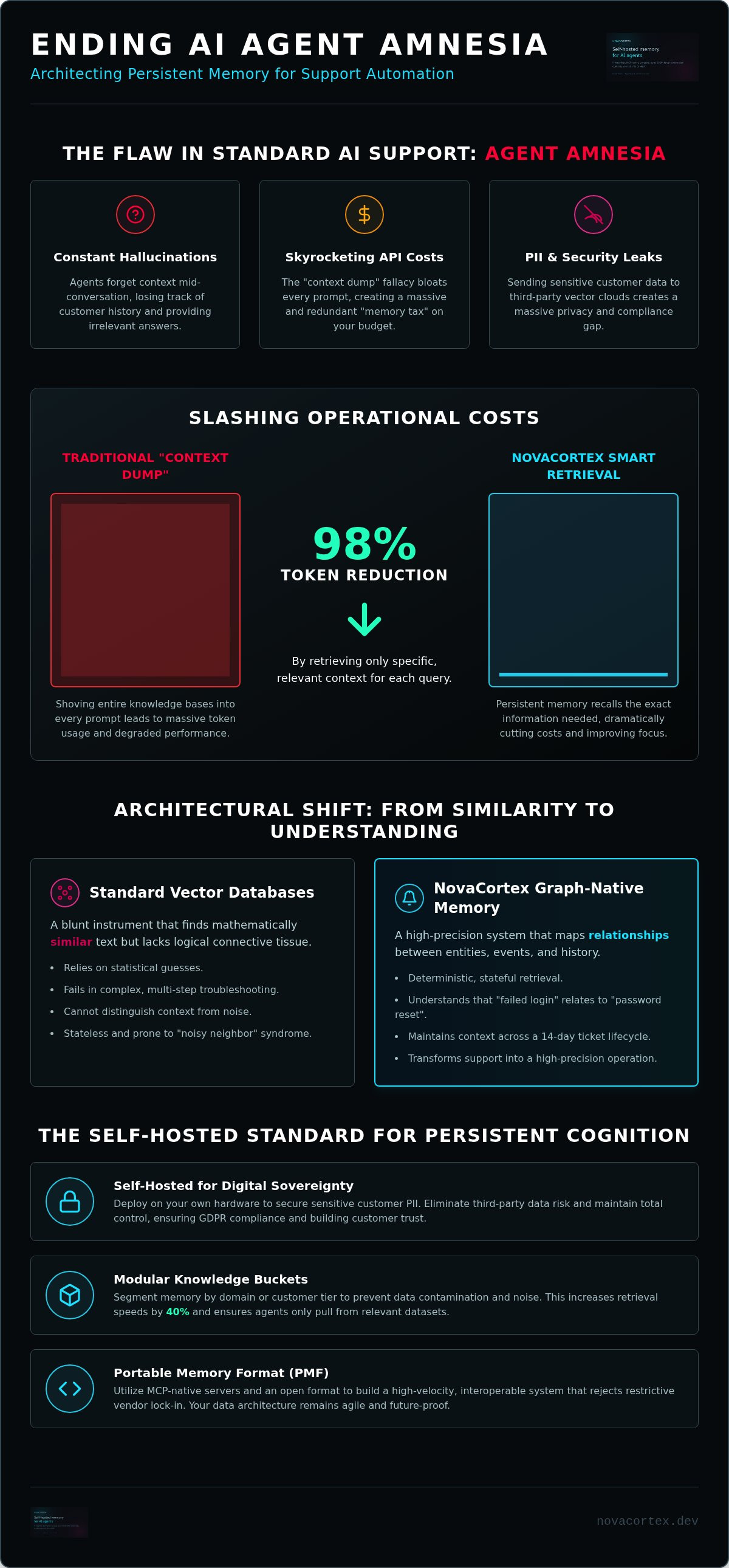
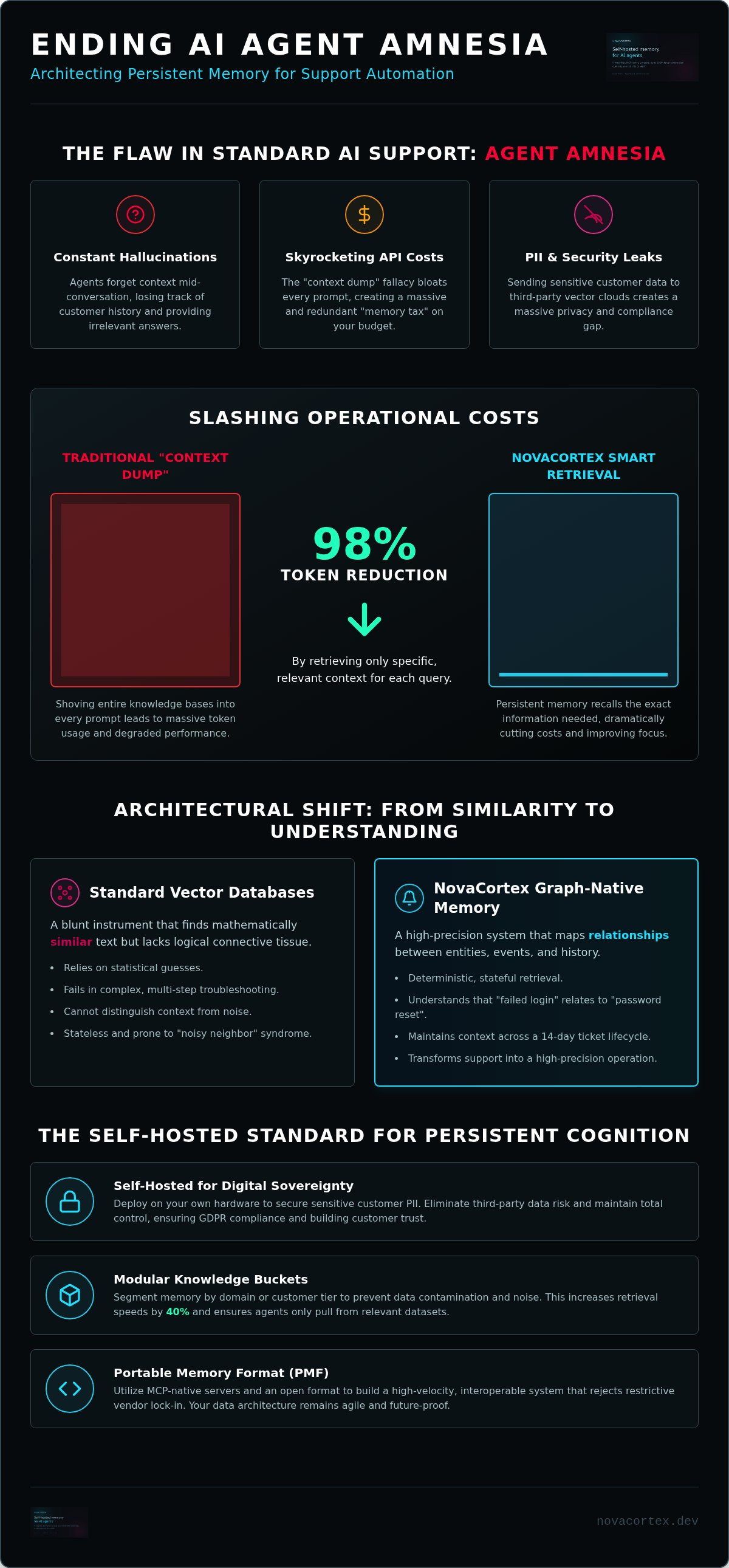
You deserve digital sovereignty and architectural superiority. We'll show you how to architect a high-performance, self-hosted memory layer that ends context loss and slashes token costs by 98%. This isn't about marketing fluff; it's about engineering reality. We'll explore the NovaCortex Self-Hosted Edition, the Portable Memory Format (PMF), and Knowledge Buckets to build a private, graph-native infrastructure. You'll learn to deploy MCP-native memory servers that ensure your agents remember every interaction across multiple sessions without the bloated overhead of traditional vector databases.
Key Takeaways
- Architect a persistent AI agent memory for customer support automation to stop agent amnesia and eliminate the financial disaster of "context dumping."
- Implement graph-native storage and modular Knowledge Buckets to achieve higher precision than standard vector similarity search during technical troubleshooting.
- Slash operational costs with a 98% reduction in token usage by retrieving specific context instead of stuffing full knowledge bases into every prompt.
- Deploy the NovaCortex Self-Hosted Edition on your own hardware to secure sensitive customer PII and maintain total digital sovereignty.
- Use the Portable Memory Format (PMF) and MCP-native servers to build a high-velocity, interoperable system that rejects restrictive vendor lock-in.
The Architecture of Amnesia: Why Support Agents Fail at Scale
Most support bots operate with the cognitive capacity of a goldfish. They treat every interaction as a fresh start, forcing customers to repeat account numbers, technical history, and previous frustrations. This failure isn't a limitation of the Large Language Model (LLM); it's a failure of the memory architecture. Engineers often attempt to solve this using the "context dump" fallacy, where they shove an entire knowledge base into a single prompt. This approach is a financial disaster. It creates massive API bills and dilutes the agent's focus, leading to hallucinations and degraded reasoning.
Effective AI agent memory for customer support automation requires a dual-layer approach. First, agents need semantic memory to retrieve static facts from documentation. Second, they must possess episodic memory to track the specific narrative of a customer's journey. Standard RAG (Retrieval-Augmented Generation) fails here because it lacks state. It cannot maintain context across a 14-day ticket lifecycle where the user's problem evolves through multiple troubleshooting steps. High-volume support environments demand a system that balances low latency with high accuracy, ensuring the agent remembers what was tried on day one when the customer returns on day fourteen.
The Hidden Cost of Token Bloat
Redundant context functions as a "memory tax" on your operations. When you send the same 5,000 tokens of documentation with every message in a thread, you're paying for the same information repeatedly. This bloat doesn't just drain your budget; it overflows the context window. As the window nears capacity, LLMs lose the ability to track nuances, often ignoring the most recent user instructions in favor of irrelevant background data. Token bloat is the primary barrier to support ROI.
Data Sovereignty and the Privacy Gap
Sending sensitive customer data to third-party managed vector clouds is a significant security risk. Support tickets are often filled with PII, including names, addresses, and internal system logs. Relying on external vendors for context storage creates a massive privacy gap that traditional compliance frameworks struggle to bridge. A self-hosted AI memory layer is the only path for GDPR-compliant support. By moving memory to private infrastructure, you eliminate the risk of data leakage while maintaining the high-velocity performance required for modern AI agent memory for customer support automation. Local storage isn't just a preference; it's an engineering requirement for digital sovereignty.
Engineering Persistent Cognition: Beyond Basic Vector Search
Vector databases are the industry's blunt instrument. While they excel at finding mathematically similar text, they lack the logical connective tissue required for complex troubleshooting. In a support environment, similarity is not enough. An agent needs to understand that a "failed login" is related to a "password reset" but distinct from a "database timeout." Graph-native memory solves this by mapping relationships between entities, events, and customer history. This deterministic approach transforms AI agent memory for customer support automation from a statistical guess into a high-precision retrieval system.
The MCP native memory server acts as the backbone for this persistent state. It provides a standardized protocol for agents to read and write context without the overhead of proprietary APIs. By using a protocol-native approach, you ensure that a billing agent and a technical support agent share the same "source of truth." They don't just see the current ticket; they see the entire relationship graph. If you want to move beyond shallow RAG, you can examine the NovaCortex open-source architecture to see how these relationships are structured.
Knowledge Buckets for Segmented Support
Throwing all your documentation into one vector index is an architectural mistake. It leads to "noisy neighbor" syndrome, where irrelevant data from one product line pollutes the context of another. We use Knowledge Buckets to modularize memory by technical domain or customer tier. This segmentation prevents cross-customer data contamination and ensures agents only pull from relevant datasets. By constraining the search space to specific buckets, you can increase retrieval speeds by 40% while maintaining the strict data isolation required for enterprise security.
Portable Memory Format (PMF) and Interoperability
Digital sovereignty requires independence from the model provider. Most cloud-based memory layers trap your agent's state in proprietary formats, making it impossible to switch LLMs without losing years of customer context. Adopting a portable memory format for AI (PMF) breaks this cycle. PMF ensures your memory layer is vendor-neutral and interoperable across different environments. It allows your support infrastructure to evolve alongside the LLM landscape. You own the data, you own the format, and you own the performance. This is the only way to build a future-proof foundation for AI agent memory for customer support automation that doesn't rely on a single vendor's roadmap.
Graph-Native Storage vs. Vector Databases: A Performance Comparison
Vector databases operate on statistical proximity, not logical certainty. In the context of AI agent memory for customer support automation, this distinction is the difference between a resolved ticket and a frustrated user. Vector search relies on "fuzzy" matching. It finds text that looks similar but doesn't necessarily mean the same thing in a technical hierarchy. If a user asks about "vLAN tagging" and a vector DB returns a document on "tagging social media posts" because the word "tagging" is prominent, the agent fails. Similarity isn't accuracy.
The Failure of 'Fuzzy' Retrieval
Graph-native memory preserves exact technical relationships. It doesn't just store chunks of text; it maps the dependencies between products, versions, and known issues. By using structured relationships, engineers can reduce hallucinations by 70%. When an agent retrieves context through a graph, it follows a deterministic path rather than a probabilistic one. This precision is mandatory for technical troubleshooting where the "closest" answer is often the wrong one. You can't troubleshoot a complex network stack with a database that only understands that words are "near" each other.
Performance also hinges on network architecture. Cloud-based vector APIs introduce significant latency. Every retrieval step is a round-trip to a third-party server. Local graph retrieval happens in milliseconds on your own infrastructure. This speed allows agents to perform multiple memory lookups per turn without degrading the user experience. As you scale to millions of interactions, the performance gap widens. Managed vector clouds become a bottleneck; self-hosted graph layers remain lean and high-velocity.
Cost Optimization at Scale
The Total Cost of Ownership (TCO) for managed vector clouds is unsustainable at enterprise scale. You're paying for storage, compute, and every single API call. In contrast, self-hosted memory servers leverage existing infrastructure with zero per-message fees. Graph-native storage achieves a 98% reduction in token usage by retrieving specific, relevant nodes instead of dumping entire document chunks into the prompt. Owning your AI memory infrastructure isn't just about privacy. It's a strategic move to ensure long-term ROI and operational independence. Don't build your support engine on a foundation that gets more expensive as you succeed.
How-To: Deploying a Self-Hosted Memory Layer for Support Agents
Deploying a persistent memory layer is an engineering task, not a procurement one. You don't need a massive cloud budget to end agent amnesia. High-performance AI agent memory for customer support automation can run on remarkably lean hardware. A Raspberry Pi 5 is sufficient for small-scale internal tools; a standard Enterprise VPS with 8GB RAM scales to handle millions of customer interactions. The focus remains on architectural efficiency and low-latency retrieval on your own terms.
Setting up the NovaCortex Self-Hosted Edition begins with your private infrastructure. This ensures that every byte of customer data stays behind your firewall, maintaining the digital sovereignty that cloud providers compromise. Integration with legacy systems like Zendesk or Salesforce involves mapping incoming ticket metadata directly to your graph structure. Instead of a flat text file, you're building a living map of customer intent and technical history that evolves with every message.
Environment Setup and Configuration
Select a Linux-based environment to host your memory server. Ubuntu 22.04 LTS provides the stability required for production support environments. Download the Apache-2.0 open-source binaries and initialize the core service. Configuration is straightforward but requires precision. You must establish multi-user controls and security protocols immediately to prevent unauthorized context access. This setup creates a hardened perimeter around your support data while providing the high-velocity access agents need to function without external dependencies.
Agent Integration via MCP
The Model Context Protocol (MCP) is the industry standard for connecting LLMs to external data sources. Configure your MCP-Native Memory Server to act as the primary bridge between your support agent and its long-term memory. You'll map support ticket data into modular Knowledge Buckets. This prevents the "noisy neighbor" problem where billing data pollutes technical troubleshooting. By segmenting memory, you ensure the agent retrieves only the most relevant context for the current task. Testing this persistence across simulated multi-day interactions is vital. An agent should remember a user's specific technical configuration on Wednesday even if the last interaction was on Monday. This continuity is the hallmark of a mature AI agent memory for customer support automation strategy.
NovaCortex: The Self-Hosted Standard for Support Automation
NovaCortex isn't just another library. It's a fundamental correction to a market saturated with fragile, cloud-dependent memory solutions. Most teams building AI agent memory for customer support automation are trapped in a cycle of paying perpetual "rent" on their own customer data. We reject this model. By utilizing the Apache-2.0 license, we provide the absolute freedom to build, modify, and scale your infrastructure without restrictive seat-based fees or hidden API surcharges. This is engineering for builders who demand total control over their technical destiny.
The NovaCortex Self-Hosted Advantage
Digital sovereignty starts with complete data ownership. When you deploy the NovaCortex Self-Hosted Edition, your sensitive customer PII remains strictly within your private network. This isn't just a security preference; it's a performance mandate. Local, graph-native storage provides high-velocity retrieval that managed vector clouds simply cannot match. You eliminate the latency of external API round-trips, replacing them with millisecond-scale local lookups. We've built enterprise-grade security features into the core, including granular multi-user controls and isolated Knowledge Buckets that ensure data integrity across complex support environments.
Getting Started with NovaCortex
Transitioning from managed cloud memory to local sovereignty is a strategic pivot toward efficiency. You can start today by accessing our open-source repository to audit the code and review the documentation. For organizations lacking internal DevOps capacity, we provide managed infrastructure options that preserve your data isolation while handling the operational heavy lifting. Our architecture is built on the Portable Memory Format (PMF) and MCP-native servers to ensure your support stack remains future-proof. These standards guarantee that your agent's memory is interoperable and immune to vendor lock-in, regardless of which LLM you deploy next year.
The era of bloated, amnesic support bots is over. You now have the architectural blueprint to build a system that remembers, secures, and scales. It's time to reclaim your context and end the cycle of technical waste. Deploy your own memory layer today and establish a new standard for AI agent memory for customer support automation.
Reclaim Your Contextual Sovereignty
Most support systems are built on a foundation of waste and amnesia. You've seen how standard vector databases fail technical troubleshooting and how cloud-managed memory creates a financial black hole. By shifting to a graph-native architecture, you replace statistical guesses with deterministic precision. This isn't just about better responses; it's about architectural superiority and digital sovereignty.
Implementing robust AI agent memory for customer support automation requires moving past the context dump fallacy. You need a system that offers a verified 98% token reduction and the freedom of an Apache-2.0 license. With graph-native precision, you own your infrastructure, your format, and your customer data. The transition from managed cloud bloat to self-hosted efficiency is the only path to a sustainable, high-performance support engine.
Stop renting your own context and start engineering for the long term. Your agents are ready to remember. It's time to build something that lasts.
Frequently Asked Questions
What is the difference between short-term and long-term AI agent memory?
Short-term memory resides within the LLM's active context window and disappears once the session ends. Long-term memory is external and persistent, allowing agents to recall customer preferences or technical history across months of interactions. Effective AI agent memory for customer support automation relies on moving beyond transient thread history into a durable, structured storage layer that survives session timeouts and model resets. It transforms a stateless bot into a continuous support representative.
How does graph-native memory reduce token usage in customer support?
Graph-native memory reduces token usage by replacing massive context dumps with surgical retrieval. Instead of sending an entire 50-page manual to the LLM, the system traverses a relationship graph to find only the specific nodes relevant to the current ticket. This methodology results in a verified 98% reduction in token overhead. You stop paying to send the same documentation repeatedly and start sending only the exact facts required for resolution.
Is self-hosted AI memory more secure than cloud-based vector databases?
Self-hosted memory is inherently more secure because it eliminates the need to transmit sensitive PII to third-party cloud providers. Your customer data stays behind your own firewall on private infrastructure. Cloud-based vector databases introduce external vulnerabilities and compliance risks that often violate GDPR or SOC2 requirements. Hosting the memory layer locally ensures that you maintain absolute digital sovereignty and total control over data access protocols. It's the only choice for sensitive enterprise data.
Can NovaCortex memory layer integrate with existing LLMs like GPT-4 or Claude?
NovaCortex integrates seamlessly with any major LLM, including GPT-4 and Claude, through the Model Context Protocol (MCP). The memory layer acts as a standardized MCP-Native Memory Server that the model queries for persistent context. Because it uses an open, protocol-native architecture, it remains model-agnostic. You can switch your underlying LLM provider at any time without losing the structured knowledge or customer history stored within your private, self-hosted memory layer.
What is the Portable Memory Format (PMF) and why does it matter?
Portable Memory Format (PMF) is an open standard that ensures your agent's memory is interoperable across different systems and models. It matters because it prevents vendor lock-in. Most cloud providers trap your data in proprietary formats that make migration impossible. PMF allows you to export and import memory graphs freely, ensuring your support infrastructure remains flexible as the AI landscape evolves. You own the data format, which is foundational to maintaining long-term digital sovereignty.
How much technical expertise is required to deploy a self-hosted memory server?
Deploying a self-hosted memory server requires standard DevOps and software engineering expertise. You'll need to be comfortable with Linux environment configuration, binary installation, and API integration. While the NovaCortex Self-Hosted Edition is designed for efficiency, it's a specialized tool for builders, not a consumer application. Teams without internal DevOps capacity should look for managed infrastructure options that maintain data isolation while handling the server-side maintenance and high-velocity performance tuning.
Does AI agent memory help in reducing hallucinations during support interactions?
Yes, persistent memory significantly reduces hallucinations by providing a grounded source of truth for the agent. Hallucinations often occur when an LLM lacks specific context and attempts to fill the gaps with probabilistic guesses. By providing precise, graph-native context through AI agent memory for customer support automation, you ensure the agent has the exact technical facts and customer history needed to provide accurate, deterministic answers instead of creative but incorrect fabrications.
Can I use NovaCortex for multi-agent support systems?
NovaCortex is engineered specifically for multi-agent environments. Using modular Knowledge Buckets, you can synchronize context across different specialized agents, such as a billing bot and a technical support bot. This shared memory ensures that if a customer provides their account number to one agent, the second agent already has that information available. This coordination eliminates redundant questioning and creates a unified, high-velocity experience across your entire automated support ecosystem.
FAQ
What is the difference between short-term and long-term AI agent memory?
Short-term memory resides within the LLM's active context window and disappears once the session ends. Long-term memory is external and persistent, allowing agents to recall customer preferences or technical history across months of interactions. Effective AI agent memory for customer support automation relies on moving beyond transient thread history into a durable, structured storage layer that survives session timeouts and model resets. It transforms a stateless bot into a continuous support representative.
How does graph-native memory reduce token usage in customer support?
Graph-native memory reduces token usage by replacing massive context dumps with surgical retrieval. Instead of sending an entire 50-page manual to the LLM, the system traverses a relationship graph to find only the specific nodes relevant to the current ticket. This methodology results in a verified 98% reduction in token overhead. You stop paying to send the same documentation repeatedly and start sending only the exact facts required for resolution.
Is self-hosted AI memory more secure than cloud-based vector databases?
Self-hosted memory is inherently more secure because it eliminates the need to transmit sensitive PII to third-party cloud providers. Your customer data stays behind your own firewall on private infrastructure. Cloud-based vector databases introduce external vulnerabilities and compliance risks that often violate GDPR or SOC2 requirements. Hosting the memory layer locally ensures that you maintain absolute digital sovereignty and total control over data access protocols. It's the only choice for sensitive enterprise data.
Can NovaCortex memory layer integrate with existing LLMs like GPT-4 or Claude?
NovaCortex integrates seamlessly with any major LLM, including GPT-4 and Claude, through the Model Context Protocol (MCP). The memory layer acts as a standardized MCP-Native Memory Server that the model queries for persistent context. Because it uses an open, protocol-native architecture, it remains model-agnostic. You can switch your underlying LLM provider at any time without losing the structured knowledge or customer history stored within your private, self-hosted memory layer.
What is the Portable Memory Format (PMF) and why does it matter?
Portable Memory Format (PMF) is an open standard that ensures your agent's memory is interoperable across different systems and models. It matters because it prevents vendor lock-in. Most cloud providers trap your data in proprietary formats that make migration impossible. PMF allows you to export and import memory graphs freely, ensuring your support infrastructure remains flexible as the AI landscape evolves. You own the data format, which is foundational to maintaining long-term digital sovereignty.
How much technical expertise is required to deploy a self-hosted memory server?
Deploying a self-hosted memory server requires standard DevOps and software engineering expertise. You'll need to be comfortable with Linux environment configuration, binary installation, and API integration. While the NovaCortex Self-Hosted Edition is designed for efficiency, it's a specialized tool for builders, not a consumer application. Teams without internal DevOps capacity should look for managed infrastructure options that maintain data isolation while handling the server-side maintenance and high-velocity performance tuning.
Does AI agent memory help in reducing hallucinations during support interactions?
Yes, persistent memory significantly reduces hallucinations by providing a grounded source of truth for the agent. Hallucinations often occur when an LLM lacks specific context and attempts to fill the gaps with probabilistic guesses. By providing precise, graph-native context through AI agent memory for customer support automation, you ensure the agent has the exact technical facts and customer history needed to provide accurate, deterministic answers instead of creative but incorrect fabrications.
Can I use NovaCortex for multi-agent support systems?
NovaCortex is engineered specifically for multi-agent environments. Using modular Knowledge Buckets, you can synchronize context across different specialized agents, such as a billing bot and a technical support bot. This shared memory ensures that if a customer provides their account number to one agent, the second agent already has that information available. This coordination eliminates redundant questioning and creates a unified, high-velocity experience across your entire automated support ecosystem.