AI Agent Memory for Financial Modeling: Engineering Persistent Analyst Logic

Most financial AI agents are essentially amnesiacs with expensive habits. You've likely felt the sting of re-injecting the same 200-page 10-K into a prompt just to maintain context, only to watch your API bill skyrocket while the model still forgets your specific valuation heuristics. This is the core failure of standard AI agent memory for financial modeling. It treats deep analyst expertise as transient text rather than persistent, structured logic.
It's time to stop paying for the same tokens twice. You can architect a private, graph-native memory layer that captures complex relational knowledge and reduces token costs by 98%. This guide demonstrates how to deploy a self-hosted, MCP-native memory server using NovaCortex Knowledge Buckets. We'll show you how to move beyond basic RAG to a system that maintains persistent analyst assumptions and ensures full digital sovereignty over your most sensitive financial data. The result is a lean, high-velocity analyst that actually gets smarter with every earnings call.
Key Takeaways
- Bridge the memory gap by replacing transient context windows with persistent analyst logic that retains complex valuation frameworks across every session.
- Transition from vector RAG to graph-native storage to accurately map the dense relational web of financial entities and market variables.
- Implement a secure AI agent memory for financial modeling using NovaCortex Knowledge Buckets to isolate sector-specific context on your own infrastructure.
- Achieve a 98% reduction in token costs by utilizing precision context pruning and the Portable Memory Format (PMF) for efficient state management.
- Future-proof your firm’s intelligence by building a sovereign, interoperable memory layer that serves as the definitive source of truth for all agents.
The Memory Gap in Financial AI Agents
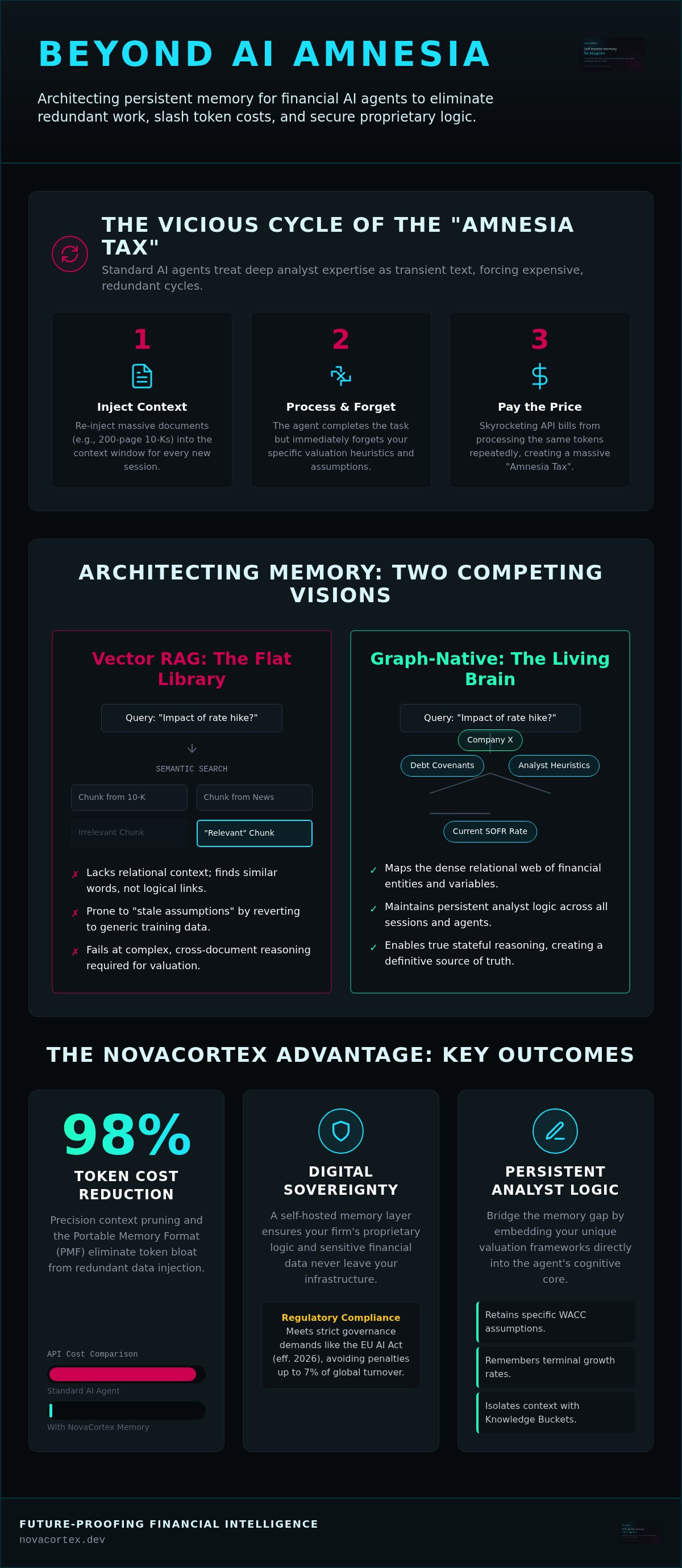
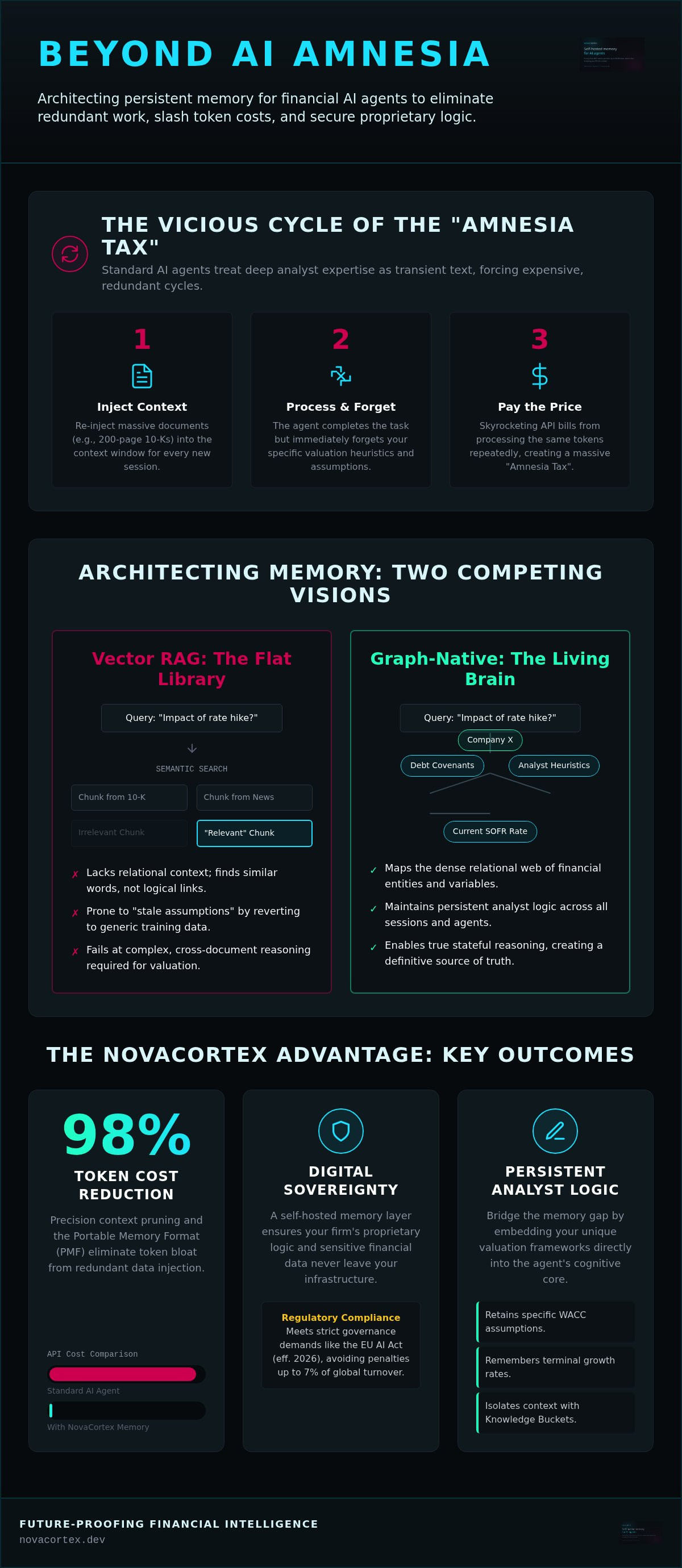
Standard LLMs are amnesiacs. They process tokens. They don't hold state. In the world of high-stakes valuation, this transience is a liability. An analyst spends years refining a specific valuation framework, yet when an AI agent attempts to replicate this, it hits a wall. It forgets the specific WACC assumptions or terminal growth rates from the previous session. This forces the "Amnesia Tax." It's the expensive, redundant cycle of re-injecting 10-Ks into the context window just to remind the model of what it already "knew" ten minutes ago. Solving this requires a dedicated layer for AI agent memory for financial modeling.
Context windows are finite. Even with models supporting millions of tokens, performance degrades as the window fills. Processing multiple 10-Ks simultaneously creates noise. The agent loses the signal. It begins to hallucinate previous assumptions or conflate data from different fiscal years. This isn't just a technical glitch. It's a systemic failure to manage state across a complex workflow. General financial data is easy to find; analyst-specific heuristics are hard to keep.
RAG is Not Memory: Why Vector Search Fails Finance
Vector search is a retrieval mechanism. It's not a cognitive architecture. It finds relevant text chunks based on semantic similarity but lacks the logical connective tissue required for financial reasoning. If you ask about a debt-to-equity ratio, a vector database might pull the right table. It won't, however, remember that your firm specifically excludes operating leases from that calculation. This results in "stale assumptions." The agent reverts to generic training data instead of your proprietary analyst logic. Effective AI agent memory for financial modeling requires a persistent state that survives the end of a chat session. Standard RAG finds data; it doesn't build a brain.
The Sovereignty Requirement in Financial Modeling
Institutional finance cannot rely on managed, cloud-based memory services. The risk of IP leakage is too high. Your valuation heuristics are your alpha. Sending those to a third-party managed service is an architectural surrender. Beyond IP, regulatory frameworks like the EU AI Act, effective August 2, 2026, demand strict model governance and data management. Penalties for non-compliance can reach €35 million or 7% of global turnover. Self-hosting is the only path to compliance. NovaCortex Self-Hosted Edition allows firms to maintain full control over their sensitive data. By using Knowledge Buckets, analysts can isolate different portfolio strategies. This ensures that the logic used for tech stocks doesn't bleed into energy sector models. Digital sovereignty isn't a feature. It's a requirement for survival.
Architecting Financial Memory: Graph-Native vs. Vector RAG
Vector RAG is a blunt instrument for financial analysis. It treats data like a flat library where similarity is the only metric for relevance. In high-stakes modeling, similarity is often a distraction. A search for "revenue" might pull ten different tables, but it won't tell the agent how those tables relate to a specific subsidiary's debt covenant. True AI agent memory for financial modeling requires a graph-native architecture. This maps the relational web of financial entities, ensuring the agent understands that a 10-basis point rate hike impacts interest expense across fifty portfolio companies simultaneously.
Engineering persistent analyst cognition means moving beyond transient chat history. It requires a system that treats every piece of data as a node in a living knowledge graph. This technical shift is explored in detail in Memory in the Age of AI Agents: A Survey, which highlights how structured memory outperforms simple buffers in complex reasoning tasks. By using an MCP-native memory server, firms can achieve low-latency retrieval that keeps pace with live market feeds, turning static data into active intelligence.
Representing Balance Sheets as Knowledge Graphs
Flat text chunks are the enemy of accuracy. When an agent processes a balance sheet, it needs to map the relationships between assets, liabilities, and equity as distinct entities. Graph-native storage enables cross-document reasoning that vector databases simply cannot match. For example, when evaluating interest rate sensitivity, the agent doesn't just "find" relevant text. It traverses the graph to link floating-rate debt structures in a 10-K to current LIBOR or SOFR benchmarks stored in a separate Knowledge Bucket. This relational mapping prevents the agent from losing the thread when moving between multiple filings or fiscal years.
Reducing Token Bloat with Tiered Retrieval
The standard approach to AI context is wasteful. Dumping entire documents into a prompt is an engineering failure that leads to massive API bills and degraded model performance. NovaCortex achieves a 98% token reduction by replacing context dumping with precision context pruning. This tiered retrieval system uses Knowledge Buckets to scope the agent’s focus to specific analyst portfolios or valuation styles. Instead of re-reading a 200-page document, the agent retrieves only the specific, relevant graph nodes needed for the current calculation.
Speed is the final frontier. While Redis is excellent for simple key-value pairs, it lacks the relational depth required for complex financial state management. Graph-native memory allows for high-velocity performance without sacrificing the nuance of the analyst's logic. If you are ready to move beyond bloated systems, you can explore the open-source core that powers this high-efficiency architecture. This ensures your agents operate with a lean, sovereign brain that respects both your budget and your data privacy.
How to Implement a Private Memory Layer for Financial Agents
Sovereignty is the baseline for institutional finance. Implementing a robust AI agent memory for financial modeling requires moving beyond cloud-managed black boxes. The process starts with deploying the NovaCortex Self-Hosted Edition on private infrastructure. This ensures that every valuation heuristic and proprietary data point remains within your firewall. Once the core is live, you define Knowledge Buckets to isolate specific financial sectors. A bucket for "Global Energy" won't bleed into "Emerging Tech," maintaining the integrity of sector-specific analyst logic. You then integrate these buckets with your existing data APIs to ingest live market feeds directly into the graph-native layer.
The final steps involve establishing MCP-native connections. This protocol allows your agents to communicate with the memory server without the overhead of massive context re-injection. You validate the implementation by testing analyst preference persistence across multiple sessions. If the agent remembers a specific risk-premium adjustment from a call three weeks ago without a prompt reminder, the system is working. This architecture respects the U.S. Treasury Department's February 2026 framework for operational controls in financial AI.
Configuring the MCP Native Memory Server
The Model Context Protocol (MCP) is the standard for agent interoperability. By configuring an MCP-native memory server, you enable a multi-agent workflow where a Search Agent and a Valuation Agent share the same brain. The Search Agent identifies new filings; the Valuation Agent applies stored analyst heuristics to them. This link is handled via the memory server, not the LLM's context window. This setup ensures low-latency retrieval. It eliminates the need for the agent to "think" through the entire document history every time a new query is made. It's high-velocity state management for high-stakes modeling.
Hardening the Memory Server for Financial Security
Security isn't a wrapper; it's foundational. Hardening your memory layer involves implementing local encryption for all Knowledge Buckets using firm-controlled keys. You must establish Role-Based Access Control (RBAC) to ensure that only authorized analyst teams can modify specific valuation frameworks. In compliance-heavy environments, audit logging is mandatory. Every memory retrieval and update must be recorded to meet the transparency requirements of the EU AI Act. This level of control is impossible with managed services that prioritize convenience over digital sovereignty. Your memory layer must be as secure as your vault.
Optimizing for High-Stakes Accuracy and Token Efficiency
Token bloat is an engineering choice, not a technical necessity. Standard RAG architectures fail in finance because they treat every query as a fresh start. This results in the redundant injection of massive datasets into the context window. High-performance AI agent memory for financial modeling solves this through context pruning. By retrieving only the specific nodes and relationships required for a calculation, the system eliminates the noise of irrelevant text. This isn't just about saving money; it's about increasing the signal-to-noise ratio for the model. When an agent isn't wading through 100 pages of boiler-plate legal disclosures, its accuracy on the core valuation logic improves significantly.
Accuracy also depends on the freshness of the data. Market conditions shift rapidly. An assumption that was valid on Tuesday might be "stale" by Friday following a surprise rate hike or a guidance revision. NovaCortex manages this via programmatic state updates within Knowledge Buckets. Instead of letting old data linger in a transient chat history, the system allows for the surgical purging and refreshing of specific knowledge nodes. This ensures the agent remembers the "Bear Case" from earlier in the week while simultaneously incorporating today's new pricing data into the model.
The Portable Memory Format (PMF) in Finance
Vendor lock-in is a strategic vulnerability. If your firm’s analyst heuristics are tied to a specific LLM provider's proprietary memory format, you don't own your intelligence. The Portable Memory Format (PMF) provides a vendor-neutral standard for financial knowledge. It allows you to migrate your entire memory layer from GPT-4o to Llama-3, or a specialized internal model, without losing a single relational link. This interoperability is foundational for digital sovereignty. It ensures that your firm’s collective intelligence remains an asset on your balance sheet, not a line item in a cloud provider's database.
Case Study: 98% Reduction in Token Usage
Consider the task of analyzing 500 pages of earnings transcripts across a single sector. A standard RAG approach involves context stuffing, where the agent re-reads chunks of every transcript for every new query. Over a week of modeling, this consumes millions of unnecessary tokens. In a recent benchmark, using NovaCortex Knowledge Buckets reduced this overhead by 98%. By mapping the transcripts into a graph-native structure, the agent only accessed the specific 2% of data relevant to the valuation metrics being tested. This high-efficiency retrieval transforms the cost-benefit analysis of high-frequency financial modeling, making deep-dive automated analysis economically viable at scale.
Future-Proofing Financial Intelligence with NovaCortex
2026 marks the end of renting intelligence. By now, the financial industry has realized that transient context is a strategic liability. A firm's collective intelligence must exist as a sovereign AI brain. This isn't just about simple data storage. It's about creating a definitive source of truth where every agent, from a sentiment analyzer to a DCF builder, pulls from the same persistent logic. This shift toward self-hosted AI agent memory for financial modeling allows firms to move beyond experimental pilots into institutional-scale infrastructure. You aren't just running a script; you're building a cognitive asset that appreciates with every earnings call and market update.
Scaling with Knowledge Buckets and Multi-Agent Systems
Analysts require synchronized memory to scale effectively. When 100+ analysts contribute to a shared knowledge graph, the risk of analyst leakage or cross-contamination increases. Knowledge Buckets solve this by scoping memory to specific users or teams. You can isolate a distressed debt team’s heuristics from the equity research desk while maintaining a unified MCP native memory server environment. This ensures that your agents operate with the precision of a specialized human team rather than a generic model. It turns individual expertise into a searchable, persistent organizational resource without compromising privacy.
The Path to Digital Sovereignty
Digital sovereignty is the new financial asset. Every relational link captured in the Portable Memory Format (PMF) adds value to your firm's balance sheet. By owning the memory layer, you reduce reliance on monolithic AI providers that can change their pricing or API structures overnight. You gain the freedom to swap models while keeping your logic intact. This interoperability is the ultimate hedge against vendor lock-in. It's time to stop building on rented land and start engineering a permanent foundation for your firm’s intelligence. The memory layer is the engine of your alpha.
Don't wait for a regulatory audit or a massive API bill to force your hand. Transitioning to a graph-native, self-hosted system is the only way to ensure AI agent memory for financial modeling meets the security and performance demands of modern finance. The industry is moving away from bloated, restrictive systems in favor of lean, builder-centric architectures. The infrastructure for sovereign intelligence is already here. Deploy your self-hosted memory layer today and take full control of your analyst logic.
Owning Your Firm's Cognitive Future
Standard LLMs are amnesiacs. They lose the thread of complex valuation frameworks mid-session, forcing you to pay an amnesia tax in redundant tokens. By architecting a graph-native memory layer, you replace transient context with persistent analyst logic. You've seen how Knowledge Buckets isolate sector-specific data and how the Portable Memory Format ensures your firm's collective intelligence remains a sovereign asset. This transition to a robust AI agent memory for financial modeling is a strategic pivot toward architectural superiority.
You now have the blueprint to achieve a 98% token reduction while maintaining zero vendor lock-in. Graph-native precision allows your agents to understand the relational web of financial entities, ensuring accuracy that standard vector RAG cannot match. It's time to stop building on rented land and start engineering a permanent foundation for your intelligence.
Take control of your infrastructure today. Build a system that respects your proprietary heuristics and your bottom line. Your firm's sovereign brain is ready for deployment.
Frequently Asked Questions
How does graph-native memory differ from a standard vector database for finance?
Graph-native memory maps relational links between financial entities. Vector databases only identify semantic similarity. In high-stakes modeling, knowing how a specific interest rate hike impacts a subsidiary's debt covenant requires traversing a graph, not just finding a text chunk about "debt." This structural difference is the foundation of precise AI agent memory for financial modeling. It ensures the agent understands the "why" behind data relationships, not just the "what."
Can I use NovaCortex with existing LLM frameworks like LangChain or AutoGPT?
Yes, NovaCortex integrates with standard frameworks via its MCP-native architecture. It acts as an external state management layer that any agent can call. Instead of letting LangChain's short-term memory overflow, you offload persistent analyst logic to a dedicated Knowledge Bucket. This setup allows you to use your preferred orchestration tools while maintaining a sovereign, long-term memory that survives the end of a session. It stops the cycle of re-prompting context in every fresh chain.
How does the 98% token reduction specifically work in financial modeling?
Reduction occurs through precision context pruning. Standard systems dump entire documents into the context window for every query, wasting tokens on irrelevant filler. NovaCortex uses graph-native retrieval to extract only the specific nodes and relationships required for the current calculation. You stop paying for the same 10-K data repeatedly. This surgical approach eliminates noise and slashes API costs while improving the agent's focus on the core modeling task. Efficiency becomes an engineering fact, not an aspiration.
Is it possible to share memory between different analysts without data leakage?
Knowledge Buckets provide strict isolation for state management. You can configure specific buckets for individual analysts or specialized teams, ensuring that proprietary valuation styles don't bleed across the firm. Role-based access control (RBAC) allows you to synchronize shared market intelligence while keeping sensitive analyst-specific assumptions private. This multi-tenant architecture prevents analyst leakage and maintains data integrity across large, institutional modeling environments. It is the only way to manage multi-analyst workflows securely.
What is the Portable Memory Format (PMF) and why does it matter for my firm?
The Portable Memory Format (PMF) is a vendor-neutral standard for storing agent knowledge. It prevents vendor lock-in by decoupling your firm's intelligence from any specific LLM provider. If a cloud provider changes its API or pricing, you can move your entire memory layer to a new model without losing relational links. PMF transforms your analyst logic into a portable, firm-owned asset rather than a transient line item in a third-party database. It secures your intellectual property.
Can I host NovaCortex on my own local servers for maximum privacy?
Yes, you can deploy the NovaCortex Self-Hosted Edition on local servers, private VPS, or even hardware like a Raspberry Pi. This setup is critical for firms that must comply with strict regulations like the EU AI Act or SEC guidelines. By hosting the memory layer internally, you eliminate the risk of IP leakage to cloud-managed services. You maintain full digital sovereignty over your most sensitive financial data and valuation heuristics. Your vault remains your own.
How does an MCP-native memory server improve financial agent performance?
An MCP-native memory server provides a standardized protocol for low-latency communication between agents and knowledge. It eliminates the overhead of custom API wrappers and ensures that multiple agents can access a shared "source of truth" simultaneously. This architecture improves performance by allowing the memory layer to function as a high-velocity state manager. Agents spend less time processing context and more time executing complex financial reasoning tasks. It is the bridge to high-frequency AI analysis.
What happens to the memory if I switch from OpenAI to an open-source model?
Your memory remains intact because it's stored in the Portable Memory Format (PMF). Unlike cloud-managed memory services that are often tied to a specific ecosystem, NovaCortex is model-agnostic. You can switch from OpenAI to an open-source model like Llama-3 without re-indexing your data or losing persistent analyst assumptions. This flexibility ensures your AI agent memory for financial modeling is future-proof and resilient to shifts in the AI model market. You own the brain, not the model.
FAQ
How does graph-native memory differ from a standard vector database for finance?
Graph-native memory maps relational links between financial entities. Vector databases only identify semantic similarity. In high-stakes modeling, knowing how a specific interest rate hike impacts a subsidiary's debt covenant requires traversing a graph, not just finding a text chunk about "debt." This structural difference is the foundation of precise AI agent memory for financial modeling. It ensures the agent understands the "why" behind data relationships, not just the "what."
Can I use NovaCortex with existing LLM frameworks like LangChain or AutoGPT?
Yes, NovaCortex integrates with standard frameworks via its MCP-native architecture. It acts as an external state management layer that any agent can call. Instead of letting LangChain's short-term memory overflow, you offload persistent analyst logic to a dedicated Knowledge Bucket. This setup allows you to use your preferred orchestration tools while maintaining a sovereign, long-term memory that survives the end of a session. It stops the cycle of re-prompting context in every fresh chain.
How does the 98% token reduction specifically work in financial modeling?
Reduction occurs through precision context pruning. Standard systems dump entire documents into the context window for every query, wasting tokens on irrelevant filler. NovaCortex uses graph-native retrieval to extract only the specific nodes and relationships required for the current calculation. You stop paying for the same 10-K data repeatedly. This surgical approach eliminates noise and slashes API costs while improving the agent's focus on the core modeling task. Efficiency becomes an engineering fact, not an aspiration.
Is it possible to share memory between different analysts without data leakage?
Knowledge Buckets provide strict isolation for state management. You can configure specific buckets for individual analysts or specialized teams, ensuring that proprietary valuation styles don't bleed across the firm. Role-based access control (RBAC) allows you to synchronize shared market intelligence while keeping sensitive analyst-specific assumptions private. This multi-tenant architecture prevents analyst leakage and maintains data integrity across large, institutional modeling environments. It is the only way to manage multi-analyst workflows securely.
What is the Portable Memory Format (PMF) and why does it matter for my firm?
The Portable Memory Format (PMF) is a vendor-neutral standard for storing agent knowledge. It prevents vendor lock-in by decoupling your firm's intelligence from any specific LLM provider. If a cloud provider changes its API or pricing, you can move your entire memory layer to a new model without losing relational links. PMF transforms your analyst logic into a portable, firm-owned asset rather than a transient line item in a third-party database. It secures your intellectual property.
Can I host NovaCortex on my own local servers for maximum privacy?
Yes, you can deploy the NovaCortex Self-Hosted Edition on local servers, private VPS, or even hardware like a Raspberry Pi. This setup is critical for firms that must comply with strict regulations like the EU AI Act or SEC guidelines. By hosting the memory layer internally, you eliminate the risk of IP leakage to cloud-managed services. You maintain full digital sovereignty over your most sensitive financial data and valuation heuristics. Your vault remains your own.
How does an MCP-native memory server improve financial agent performance?
An MCP-native memory server provides a standardized protocol for low-latency communication between agents and knowledge. It eliminates the overhead of custom API wrappers and ensures that multiple agents can access a shared "source of truth" simultaneously. This architecture improves performance by allowing the memory layer to function as a high-velocity state manager. Agents spend less time processing context and more time executing complex financial reasoning tasks. It is the bridge to high-frequency AI analysis.
What happens to the memory if I switch from OpenAI to an open-source model?
Your memory remains intact because it's stored in the Portable Memory Format (PMF). Unlike cloud-managed memory services that are often tied to a specific ecosystem, NovaCortex is model-agnostic. You can switch from OpenAI to an open-source model like Llama-3 without re-indexing your data or losing persistent analyst assumptions. This flexibility ensures your AI agent memory for financial modeling is future-proof and resilient to shifts in the AI model market. You own the brain, not the model.