AI Agent Memory for Legal Document Review: Engineering Context Sovereignty

The current state of legal AI is a memory architecture problem. While 78% of the Am Law 200 have integrated AI into their workflows, most still struggle with agents that forget critical case nuances between sessions. Re-injecting 10,000-page discovery files into a context window isn't just inefficient; it's architectural bankruptcy. Solving AI agent memory for legal document review requires moving beyond basic vector search toward a persistent, graph-native structure. You shouldn't have to choose between high-velocity performance and the strict data sovereignty required by the Colorado AI Act.
You've likely felt the frustration of watching API bills skyrocket while your models hallucinate facts already present in the record. We agree that paying for the same tokens repeatedly is an engineering failure, not a cost of doing business. This guide shows you how to architect a self-hosted memory layer that eliminates AI amnesia and slashes token waste by 98%. We'll preview how to leverage MCP-native memory servers and the Portable Memory Format (PMF) to build a high-precision discovery engine that keeps privileged data entirely under your control.
Key Takeaways
- Eliminate "session-zero" amnesia by implementing a persistent memory tier that retains complex case nuances across thousands of discovery pages.
- Deploy AI agent memory for legal document review using graph-native architectures to map logical relationships between parties and clauses with absolute precision.
- Secure client-privileged information through self-hosted deployments, ensuring full data sovereignty and compliance with strict AI regulations.
- Future-proof your legal tech stack by adopting open standards like the Model Context Protocol (MCP) and Portable Memory Format (PMF) to prevent vendor lock-in.
- Slash operational overhead with architectural optimizations that drive a verified 98% reduction in LLM token waste compared to standard RAG.
The Persistence Gap: Why Legal AI Assistants Forget Case Context
Large Language Models are stateless by design. Every time you open a new chat window or trigger a new API call, the model resets to "Session-Zero." It has no inherent memory of the 10,000-page discovery file it analyzed yesterday or the specific privilege protocols you established two hours ago. In the high-stakes world of Document AI, this amnesia is more than a nuisance. It's a systemic architectural flaw that forces legal teams to act as manual state managers for their own tools.
Current solutions rely on stuffing short-term context windows with massive amounts of data. This "context injection" approach is a leaky bucket. When you force an agent to ingest a 100,000-token discovery file for every single query, the model's attention fragments. Facts located in the middle of the document often vanish. This isn't a prompting issue that can be fixed with better instructions. It's a fundamental limitation of volatile memory. Without a dedicated AI agent memory for legal document review, your assistant is effectively starting its job from scratch every morning.
The Cognitive Load of Manual State Management
Lawyers are currently forced to bridge the persistence gap through manual labor. If an agent forgets the specific definitions in a Master Service Agreement while reviewing an ancillary Statement of Work, the attorney must copy-paste that context back into the prompt. This repetitive task creates a massive time drain and introduces the risk of hallucinated inconsistencies. When an agent lacks a persistent ground truth, it begins to guess based on general patterns rather than the specific, idiosyncratic facts of the case at hand. You aren't just paying for the AI; you're paying your most expensive associates to babysit its memory.
Token Bloat and the Cost of Forgetfulness
The financial math of stateless AI is unsustainable for modern firms. Re-injecting the same massive context window for every follow-up question burns through API credits with zero added value. It's a cycle of waste where 90% of your token spend is used to re-explain things the agent should already know. This "context stuffing" doesn't just drain budgets; it degrades performance. As context windows grow, the signal-to-noise ratio plummets, causing agents to miss critical legal clauses buried in the metadata. Implementing AI agent long term memory is the only way to move from expensive, repetitive processing to a high-velocity autonomous review workflow. You need a system that remembers, not one that requires a daily briefing.
Beyond Vector Search: Why Legal Logic Demands Graph-Native Memory
Vector search is a blunt instrument for a scalpel-grade profession. While standard RAG relies on semantic similarity, legal analysis operates on logical hierarchy. Vector databases find text that "looks" similar. They fail to distinguish between a draft clause and the final, executed amendment that supersedes it. This "fuzziness" is a liability. When 86% of legal professionals report noticing errors in AI outputs, the culprit is often a retrieval system that favors proximity over precision. Effective AI agent memory for legal document review requires an architecture that understands the law's inherent structure.
Graph-native memory solves this by treating legal data as a network of nodes and edges rather than a flat pool of embeddings. It maps the relationships between parties, jurisdictions, and specific contract sections. This isn't just about finding data; it's about preserving the context of its authority. If you aren't mapping these dependencies, your agent is merely guessing based on word frequency. Developers can examine the open-source core to see how these logical links are maintained in real-time.
Mapping Legal Topology with Knowledge Graphs
Knowledge graphs represent contract hierarchies as a directed acyclic graph. This allows for surgical retrieval. Instead of pulling the "top-k" most similar paragraphs, the system follows the logical path from a parent agreement to its specific schedules. The Redis vs graph memory for AI agents debate is central here. While Redis excels at fast key-value lookups, it lacks the relational depth needed to navigate 50,000 pages of discovery. Graph-based contextual retrieval ensures that when an agent queries a clause, it also retrieves the specific definitions and amendments that govern it. This is the difference between a search engine and a reasoning engine.
Context Pruning for Precise Legal Extraction
The "lost in the middle" phenomenon is a documented LLM failure where models ignore information buried in deep context windows. Graph-native memory mitigates this through aggressive context pruning. By traversing specific edges in the graph, the agent injects only the relevant logical dependencies into the prompt. This keeps the memory state lean and high-velocity, even in million-document cases. Graph-native memory identifies contradictory clauses across different files by traversing the logical links between amendments and parent agreements, flagging overlaps that vector search would treat as independent semantic hits. This surgical precision eliminates the need for "context stuffing" and ensures the agent focuses only on the ground truth.
Architecting Privacy-First Legal Review: The Self-Hosted Advantage
Cloud-hosted RAG solutions are a liability in the legal sector. When you upload privileged discovery data to a third-party provider, you lose control over the data's lifecycle. Many managed AI platforms reserve the right to use metadata or anonymized snippets for model training. For a law firm, this isn't just a technical risk; it's a violation of client privilege. Effective AI agent memory for legal document review must exist behind your firewall. Data sovereignty isn't a feature. It's the baseline for professional compliance.
The shift toward local infrastructure is accelerating. With the Colorado AI Act now in full effect as of June 2026, firms must implement rigorous safeguards against algorithmic discrimination and data leakage. Deploying the NovaCortex Self-Hosted Edition on a local VPS or private server ensures that sensitive case context never leaves your encrypted environment. This architecture eliminates the "cloud-leakage" vector entirely, keeping your most sensitive work product isolated from external prying eyes.
Engineering for Data Sovereignty
Maintaining a local memory layer is the only way to satisfy GDPR and legal privilege requirements simultaneously. Managed solutions often introduce latent risks through shared infrastructure. By choosing a self-hosted path, you gain absolute control over data retention policies and access logs. The self-hosted vs managed AI memory debate is settled by the total cost of ownership (TCO) and risk profile. Local servers provide high-velocity performance by removing external API latency, allowing your agents to query massive datasets at the speed of your internal network. It's a faster, safer, and more predictable way to build.
Knowledge Buckets: Modularizing Case Data
Privacy requires more than just a firewall; it requires internal isolation. We use Knowledge Buckets to create cryptographic silos between different client matters. An agent reviewing Case A shouldn't have even a theoretical path to the memory of Case B. This modular approach allows you to manage multi-user access with surgical precision. Partner-level review can access high-level strategy buckets, while associates focus on specific discovery sets. You can scale your legal infrastructure to handle million-document cases without ever increasing your cloud dependency or exposing a single byte of privileged information to a third-party vendor.
Implementing MCP and PMF for Portable Legal Memory
Legal engineering is often crippled by architectural capture. When your case context is trapped in a vendor's proprietary cloud, you don't own your work product; you lease it. Solving AI agent memory for legal document review requires a shift toward standardized protocols that decouple the memory tier from the inference engine. By establishing an independent memory layer, you ensure that your institutional knowledge remains portable, regardless of which LLM provider currently leads the market benchmarks.
Interoperability isn't just a convenience. It's a risk mitigation strategy. If a provider changes their terms of service or deprecates a critical model, your entire discovery history shouldn't vanish. The Model Context Protocol (MCP) and the Portable Memory Format (PMF) provide the necessary infrastructure to maintain context sovereignty. These standards allow you to treat case memory as a modular asset that can be moved, archived, or audited without vendor interference.
Step-by-Step: Connecting an MCP Memory Server
The Model Context Protocol has emerged as the industry standard for agent-to-data communication since its donation to the Linux Foundation in December 2025. Configuring an MCP native memory server allows your legal assistant to query graph-native case storage via a standardized handshake. The process involves defining specific tool calls that let the agent request historical context or store new logical relationships in real-time. You can verify this context injection by monitoring the MCP logs to ensure the agent is retrieving the specific nodes and edges required for a given query. This setup makes your assistant model-agnostic, allowing you to swap reasoning engines while keeping your case memory intact.
Sovereign Case Ownership with PMF
Proprietary data silos are the enemy of legal efficiency. The portable memory format for AI (PMF) serves as the antidote to this lock-in. PMF allows you to export entire case memories as structured, graph-native files that retain all logical dependencies between parties, clauses, and precedents. This is essential for long-term archiving or transferring discovery sets to co-counsel during complex litigation. It ensures that your legal IP is future-proofed against provider changes. You don't just store data; you own the persistent state of the entire review process.
Driving 98% Token Efficiency in Legal Document Review
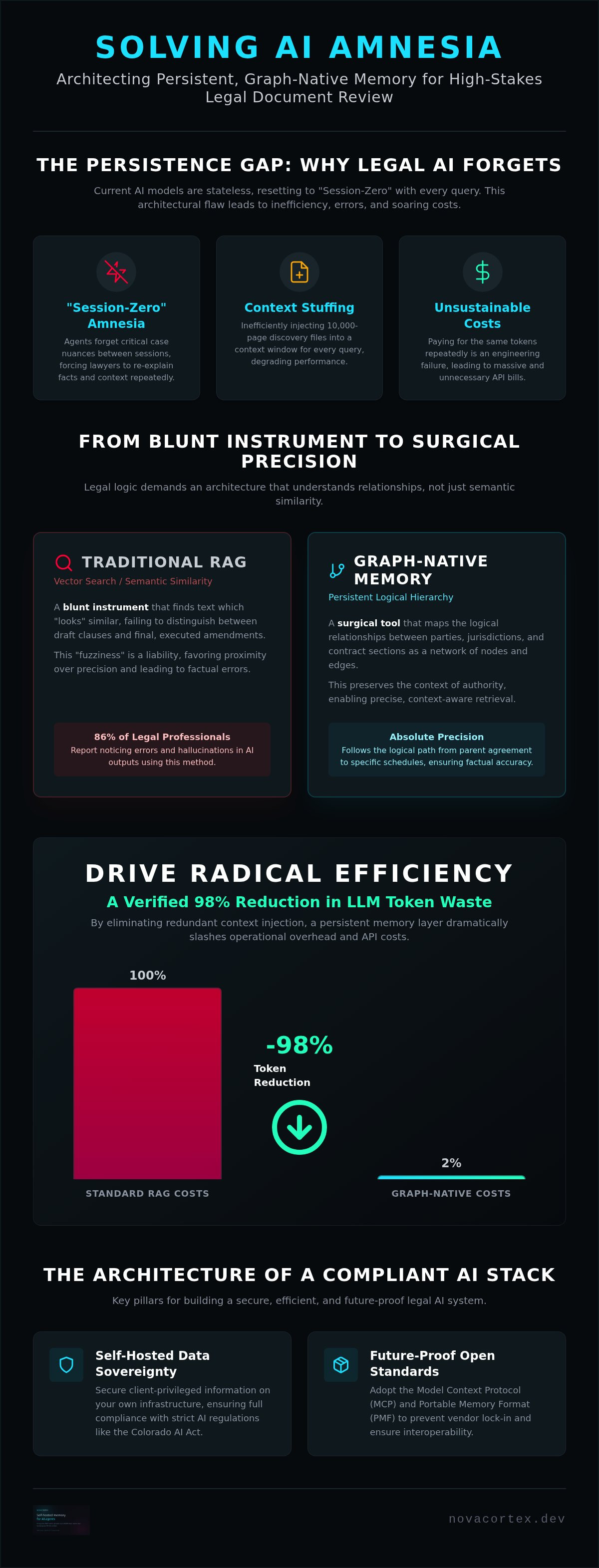
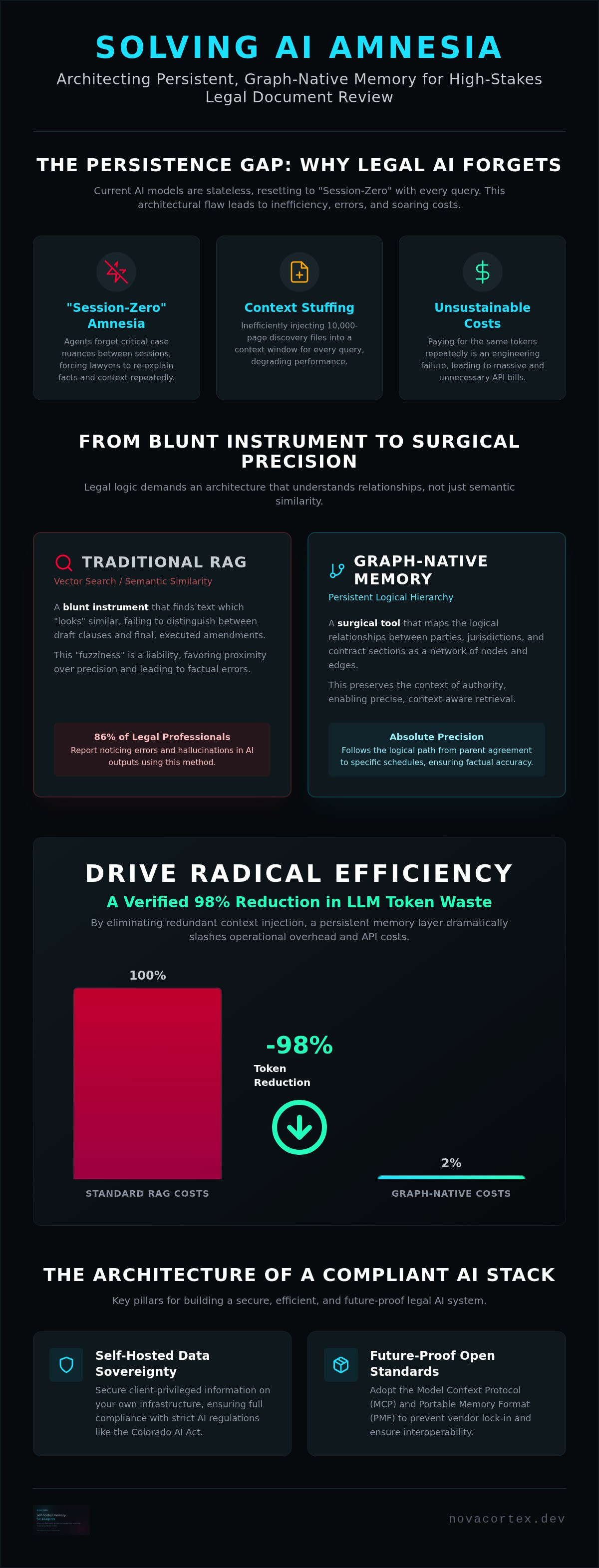
Standard RAG is a brute-force approach. It relies on full-file dumping or massive context stuffing to ensure the model has enough information. This architectural laziness is expensive and technically regressive. In a massive legal discovery case, re-injecting 50,000 pages of text for every query creates a financial black hole that drains firm resources without adding value. NovaCortex benchmarks demonstrate a 98% token reduction by replacing this waste with selective, graph-native retrieval.
The math is simple. Instead of sending 128,000 tokens to the LLM to find one clause, a graph-native AI agent memory for legal document review retrieves only the specific nodes and logical edges required. This reduces the payload to roughly 2,500 precision-targeted tokens. You achieve 10x ROI by paying for intelligence, not for the model to re-read the same discovery file it processed an hour ago. Scaling to millions of legal tokens becomes a matter of memory management rather than a budget-breaking API bill. This shift allows firms to handle larger cases with the same computational overhead.
Optimizing the Context-to-Token Ratio
Precision retrieval relies on navigating the sub-graph. When an agent queries a specific indemnification clause, the memory layer doesn't just pull similar text. It identifies the essential sub-graph: the specific nodes representing the clause, its governing definitions, and any related amendments. This surgical context injection eliminates prompt noise that typically leads to reasoning errors. When you remove irrelevant data, model reasoning accuracy in contract review increases significantly because the model isn't struggling to filter out noise. Lean context structures directly correlate with faster legal inference by reducing the computational load on the LLM's attention mechanism, resulting in near-instant response times even on complex queries.
The Future of Sovereign Legal Cognition
The legal industry is moving past the era of "AI as a tool." We are entering the age of AI as a persistent legal team member. With 78% of the Am Law 200 already adopting AI as of 2026, the competitive advantage now lies in architectural efficiency and data sovereignty. A self-hosted, graph-native memory tier is the standard for firms that refuse to be locked into proprietary cloud silos. The roadmap for global legal tech is clear: local-first, interoperable, and high-velocity. It's time to stop renting your case context and start owning your cognitive infrastructure.
Engineering the Sovereign Legal Stack
The era of stateless, cloud-dependent legal AI is over. Transitioning to a graph-native, self-hosted architecture resolves the persistence gap that has historically crippled autonomous discovery. By replacing blunt vector search with surgical retrieval, you ensure that every contract clause and party relationship is preserved with logical precision. Implementing a robust AI agent memory for legal document review isn't just about saving time; it's about reclaiming ownership of your firm's cognitive assets.
You now have the blueprints to slash token costs by 98% while maintaining absolute data sovereignty. With an Apache-2.0 open-source core, the tools to build a private, high-velocity memory tier are entirely within your control. Stop renting your context from providers who treat your privileged data as training fodder. Build an infrastructure that remembers, reasons, and remains behind your firewall.
The technology is ready. Your firm's digital independence starts now.
Frequently Asked Questions
What is persistent memory for legal AI and how does it differ from standard RAG?
Persistent memory is a dedicated storage tier that maintains the state of an agent's reasoning across multiple sessions. Standard RAG is typically stateless; it retrieves document chunks based on a single query and forgets them immediately after. Persistent memory preserves the logical connections and case nuances your agent has already identified, ensuring it doesn't start from "session-zero" every time you open a new chat.
How does a graph-native memory layer reduce LLM token usage in document review?
It slashes token usage by replacing massive file dumps with surgical context retrieval. Instead of re-injecting a 100,000-token discovery file for every follow-up question, the system traverses a knowledge graph to extract only the specific nodes and edges relevant to the query. This optimization drives a 98% reduction in token waste, allowing the model to focus on high-level logic rather than filtering out irrelevant noise.
Can I self-host NovaCortex on our firm's private VPS or local server?
Yes, the NovaCortex Self-Hosted Edition is built for deployment on private infrastructure. You can install it on any local Linux server or private VPS to keep your case data entirely behind your firm's firewall. This architecture ensures that your AI agent memory for legal document review remains under your physical and legal control, satisfying the strictest data sovereignty requirements.
Does persistent memory work with legal AI tools like Cursor, Claude, or custom agents?
It works with any tool that supports the Model Context Protocol (MCP) or standard API hooks. This includes development environments like Cursor and high-level models like Claude when they're connected to an MCP-native memory server. You aren't locked into a single interface; you can plug your persistent memory layer into any autonomous agent or custom workflow in your legal tech stack.
How does the Portable Memory Format (PMF) prevent legal vendor lock-in?
PMF prevents lock-in by standardizing how agent memory is structured, stored, and exported. It allows you to move your entire case history and logical mapping between different LLM providers or internal systems without losing data integrity. You own the structured output of the review process, making it easy to archive case files or transfer them to co-counsel without proprietary software barriers.
Is client-privileged data safe when using a self-hosted memory layer?
It's significantly safer than cloud-hosted alternatives because sensitive data never leaves your encrypted environment. Self-hosting eliminates the risk of privileged discovery files being used for third-party model training or being exposed in a provider-side breach. You maintain full data sovereignty, which is essential for meeting compliance standards like the Colorado AI Act that took effect in June 2026.
What is the Model Context Protocol (MCP) and why is it vital for legal agents?
MCP is an open standard that enables seamless interoperability between AI agents and their data sources. It acts as a universal bridge, allowing AI agent memory for legal document review to communicate with various LLMs using a shared language. It's vital because it decouples the reasoning engine from the memory tier, ensuring your firm isn't trapped in a single model ecosystem as technology evolves.
How do I migrate our existing legal knowledge base to a graph-native format?
Migration involves ingesting your existing documents into Knowledge Buckets where they are parsed into entities and logical relationships. The system identifies parties, dates, and clauses, mapping them as nodes in a directed graph. This process transforms a flat library of PDFs into a structured logical network that your agents can navigate with surgical precision, making your historical data immediately actionable.
FAQ
What is persistent memory for legal AI and how does it differ from standard RAG?
Persistent memory is a dedicated storage tier that maintains the state of an agent's reasoning across multiple sessions. Standard RAG is typically stateless; it retrieves document chunks based on a single query and forgets them immediately after. Persistent memory preserves the logical connections and case nuances your agent has already identified, ensuring it doesn't start from "session-zero" every time you open a new chat.
How does a graph-native memory layer reduce LLM token usage in document review?
It slashes token usage by replacing massive file dumps with surgical context retrieval. Instead of re-injecting a 100,000-token discovery file for every follow-up question, the system traverses a knowledge graph to extract only the specific nodes and edges relevant to the query. This optimization drives a 98% reduction in token waste, allowing the model to focus on high-level logic rather than filtering out irrelevant noise.
Can I self-host NovaCortex on our firm's private VPS or local server?
Yes, the NovaCortex Self-Hosted Edition is built for deployment on private infrastructure. You can install it on any local Linux server or private VPS to keep your case data entirely behind your firm's firewall. This architecture ensures that your AI agent memory for legal document review remains under your physical and legal control, satisfying the strictest data sovereignty requirements.
Does persistent memory work with legal AI tools like Cursor, Claude, or custom agents?
It works with any tool that supports the Model Context Protocol (MCP) or standard API hooks. This includes development environments like Cursor and high-level models like Claude when they're connected to an MCP-native memory server. You aren't locked into a single interface; you can plug your persistent memory layer into any autonomous agent or custom workflow in your legal tech stack.
How does the Portable Memory Format (PMF) prevent legal vendor lock-in?
PMF prevents lock-in by standardizing how agent memory is structured, stored, and exported. It allows you to move your entire case history and logical mapping between different LLM providers or internal systems without losing data integrity. You own the structured output of the review process, making it easy to archive case files or transfer them to co-counsel without proprietary software barriers.
Is client-privileged data safe when using a self-hosted memory layer?
It's significantly safer than cloud-hosted alternatives because sensitive data never leaves your encrypted environment. Self-hosting eliminates the risk of privileged discovery files being used for third-party model training or being exposed in a provider-side breach. You maintain full data sovereignty, which is essential for meeting compliance standards like the Colorado AI Act that took effect in June 2026.
What is the Model Context Protocol (MCP) and why is it vital for legal agents?
MCP is an open standard that enables seamless interoperability between AI agents and their data sources. It acts as a universal bridge, allowing AI agent memory for legal document review to communicate with various LLMs using a shared language. It's vital because it decouples the reasoning engine from the memory tier, ensuring your firm isn't trapped in a single model ecosystem as technology evolves.
How do I migrate our existing legal knowledge base to a graph-native format?
Migration involves ingesting your existing documents into Knowledge Buckets where they are parsed into entities and logical relationships. The system identifies parties, dates, and clauses, mapping them as nodes in a directed graph. This process transforms a flat library of PDFs into a structured logical network that your agents can navigate with surgical precision, making your historical data immediately actionable.