AI Agent Memory for Scientific Research: Engineering Persistent Context and Data Provenance
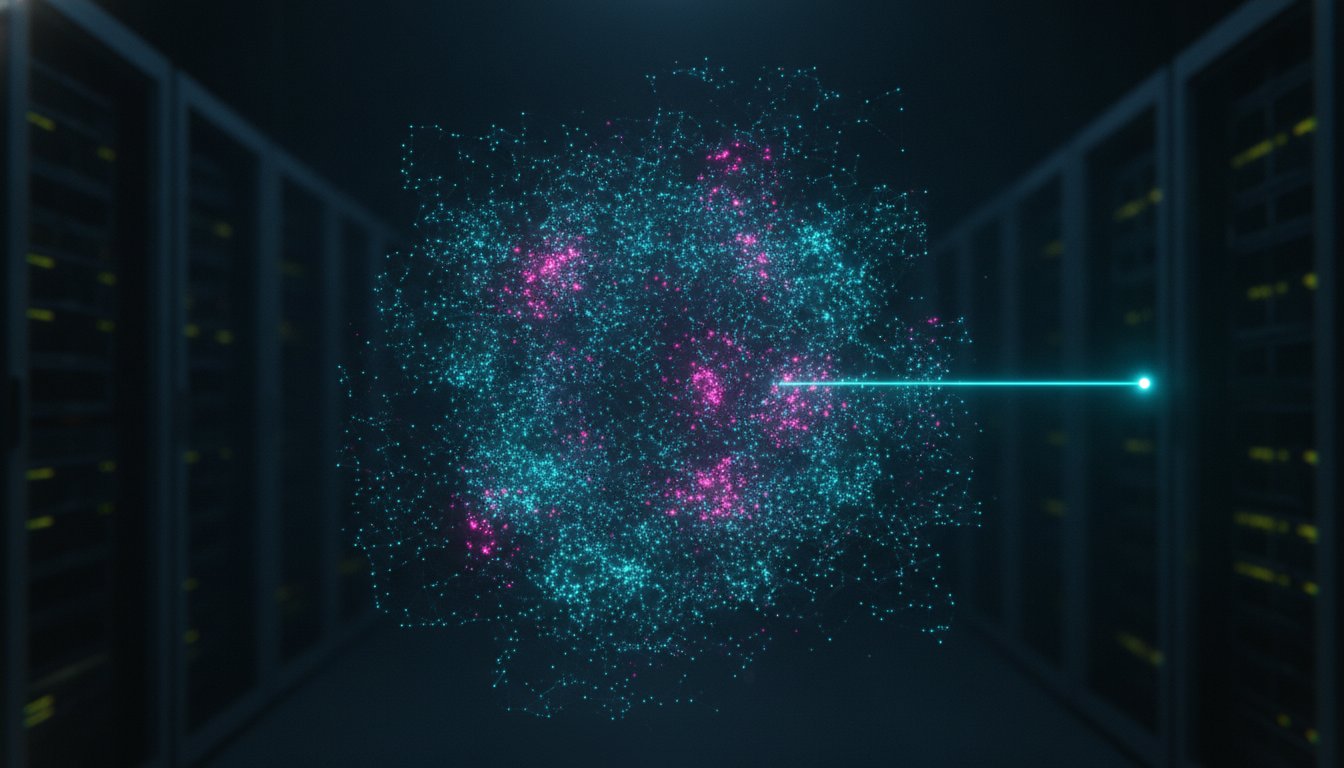
Vector similarity is a failing strategy for AI agent memory for scientific research. In high-stakes fields like molecular biology, simple proximity search is a poor substitute for relational logic. When an agent forgets a critical experimental variable from a previous quarter, it isn't just a glitch; it's a structural failure. You shouldn't have to choose between a massive "token tax" and leaking proprietary breakthroughs to third-party providers.
We agree that scientific discovery requires absolute relational permanence and verifiable provenance. This guide details how to engineer a privacy-first, graph-native memory layer that scales with your lab. You'll learn to deploy the NovaCortex Self-Hosted Edition and utilize the Portable Memory Format (PMF) to secure your institutional knowledge. We'll outline the architectural path to a 90%+ reduction in context-related token waste while ensuring every inference is backed by verifiable data sovereignty and precise engineering standards.
Key Takeaways
- Abandon session-based RAG for a persistent architecture capable of tracking complex hypotheses across multi-year research cycles.
- Deploy graph-native storage to maintain relational integrity and data provenance in AI agent memory for scientific research.
- Stop the "token tax" through precision retrieval, cutting operational waste by up to 98% compared to brute-force context dumping.
- Secure institutional sovereignty by self-hosting your memory layer on private infrastructure, neutralizing the risk of proprietary data leakage.
- Utilize NovaCortex Knowledge Buckets and the Portable Memory Format to architect interoperable research pipelines that reject vendor lock-in.
The Architecture of Scientific Memory: Beyond Simple RAG
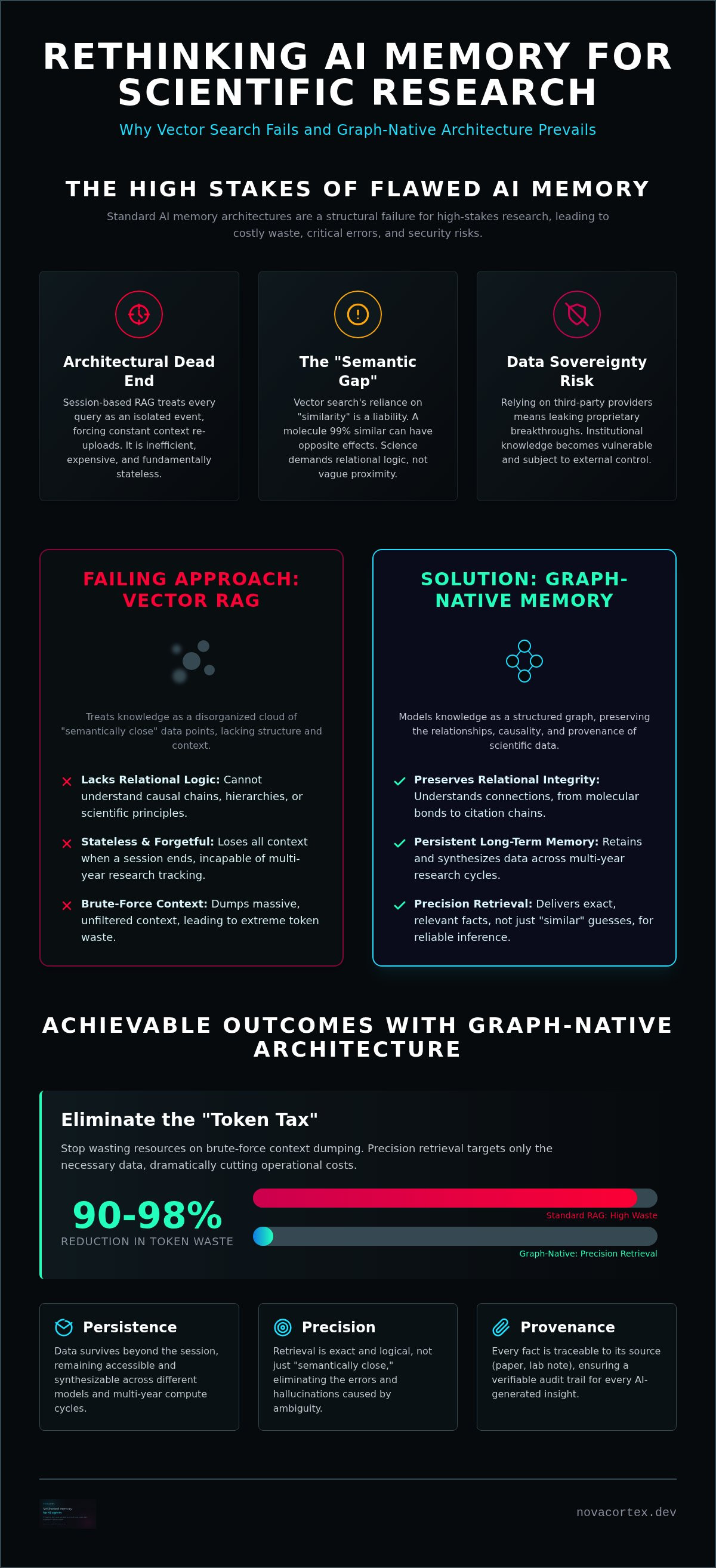
Standard AI implementations treat memory as a simple log of past messages. For scientific discovery, this is a fatal oversimplification. An AI agent in a laboratory setting doesn't just need to remember what was said five minutes ago; it must synthesize years of experimental data. Traditional Retrieval-Augmented Generation (RAG) often collapses under the weight of complex hypothesis tracking because it lacks a persistent state. It treats every query as an isolated event, forcing researchers to re-upload context repeatedly. This is inefficient. It's expensive. It's an architectural dead end.
Scientific memory must rest on three non-negotiable pillars. First, Persistence ensures that data survives the session and remains accessible across different models or compute cycles. Second, Precision demands that retrieval is exact rather than just "semantically close." Finally, Provenance guarantees that every fact is traceable to its original experimental source or specific paper. Without these pillars, AI agent memory for scientific research becomes a liability rather than a reliable asset.
Short-Term vs. Long-Term Research Context
Managing the "active" context window is a tactical challenge. Your agent needs enough room to process current sensor feeds or titration results without hitting the context ceiling. However, the real value lies in the multi-year research trajectory. Archiving these trajectories in long-term memory layers allows the agent to correlate current anomalies with data points from years prior. Standard LLMs are fundamentally stateless engines that lose all context the moment a session ends, rendering them incapable of independent scientific longitudinal study. By utilizing Knowledge Buckets, researchers can isolate specific domains while maintaining a global thread of discovery that spans the entire project lifecycle.
Why Vector Similarity is Insufficient for Science
Vector search relies on semantic similarity. In the laboratory, "similar" is often a synonym for "wrong." A molecular structure might be 99% similar to another but possess a diametrically opposed toxicity profile. This "semantic gap" is where standard RAG fails. Science requires relational data structures to track physical laws, chemical properties, and causal links with absolute fidelity. Moving from vector search to graph-native knowledge retrieval is the only viable path forward. It replaces vague proximity with hard relational logic. When you use a Portable Memory Format (PMF), you ensure these relationships are preserved across different compute environments without losing the underlying data provenance. This approach bridges the gap between raw data and actionable scientific insight.
Graph-Native Memory: Engineering Precision and Provenance
Science is built on connections. Citations, molecular bonds, and causal chains don't exist in isolation; they form a high-dimensional graph. When building AI agent memory for scientific research, treating data as a flat list is an architectural mistake. Graph-native storage preserves these relationships by design. It ensures that when an agent retrieves a specific protein interaction, it also understands the upstream inhibitors and downstream effects. This structural integrity is the foundation of cognitive reliability. Flat vector databases can find similar text, but they can't navigate the complex hierarchy of a metabolic pathway or a multi-stage physics experiment.
Different Types of agentic memory serve various functions, but for scientific rigor, semantic memory must be graph-based. Hallucinations often stem from a lack of grounding. By anchoring agent cognition in verified graph nodes, you create a system where every claim is a traversal of known facts rather than a statistical guess. Implementing a self-hosted AI memory layer allows you to maintain this integrity without exposing your research graph to public LLM providers. It keeps the "brain" of your research project private and precise.
Maintaining the Citation Chain
Provenance isn't optional in research. Every memory node must be tagged with its original source, such as a paper DOI or an internal lab notebook entry. This automation ensures that agents can "show their work" during hypothesis generation. If an agent suggests a new experimental path, it must be able to trace its reasoning back through the citation chain. Enforcing logical graph constraints reduces false correlations. It stops the agent from linking disparate concepts that violate known physical laws. This creates a verifiable audit trail for every insight the AI produces.
Relational Knowledge vs. Flat Vectors
Comparing Redis vs graph memory for AI agents reveals a clear winner for high-precision research. Redis is excellent for speed and simple caching, but its flat key-value structure fails at cross-domain synthesis. Graph-native systems excel here. They allow for the creation of Knowledge Buckets. These buckets act as modular repositories for specific domains, like Genomics or Particle Physics, while allowing the agent to find non-obvious links between them. This modularity prevents the "context pollution" common in flat indices. If you're ready to build a more resilient research infrastructure, you can explore the NovaCortex open-source repository to see these graph structures in action.
Eliminating the Token Tax in Large-Scale Research
Scientific research is a high-volume data game. Every paper, dataset, and experimental log adds to the corpus. Standard AI workflows often resort to "context stuffing," where entire PDFs are dumped into the prompt window. This is a massive engineering failure. At $15 per million input tokens for a model like Claude Opus 4, or even $5 for GPT-5.5, the "token tax" becomes a primary inhibitor for long-term discovery. When your research corpus reaches thousands of documents, brute-force context management isn't just expensive; it's unsustainable. It drains budgets and introduces noise that degrades model reasoning.
Effective AI agent memory for scientific research requires a surgical approach to context. Instead of overwhelming the model with irrelevant data, we must implement high-precision retrieval. By utilizing graph-native structures, NovaCortex achieves a 98% reduction in token usage compared to full-base dumping. This isn't just a cost-saving measure. It's a performance optimization that allows agents to operate with higher reasoning depth because the context window is reserved for relevant signal rather than archival noise. Balancing latency and context depth is the difference between a functional research tool and a costly experiment in context loss.
Tiered Memory Strategies
Architecting efficient memory requires moving beyond a single, monolithic data store. We use Knowledge Buckets to isolate relevant data clusters. This ensures that an agent investigating genomics isn't burdened by unrelated physics datasets. Through dynamic context injection, the system identifies and sends only the "winning" graph nodes to the LLM. We benchmark multi-agent workflows to ensure that as agents pass knowledge between one another, they aren't duplicating token costs. This tiered approach transforms a bloated context window into a lean, high-velocity stream of actionable information.
Low-Latency Retrieval via MCP
Speed is as critical as accuracy in autonomous workflows. We leverage the MCP native memory server to enable high-speed context switching. The Model Context Protocol (MCP) allows for a standardized way to connect agents to their memory layers without the overhead of custom middleware. By pre-filtering memory locally before it ever reaches the LLM provider, we reduce API round-trips and significantly lower latency. This architecture scales across distributed research teams, allowing multiple agents to query a unified memory layer simultaneously without bottlenecks. It's about building a system that moves as fast as the researcher's thought process while maintaining absolute data integrity.
Privacy and Sovereignty: The Case for Self-Hosting
Sending high-dimensional research graphs to a third-party SaaS provider is an unacceptable security risk. In the context of AI agent memory for scientific research, this practice leads to "memory leakage." Your proprietary causal links and molecular hypotheses become part of a provider's training set or metadata pool. This isn't just a hypothetical concern; it's a structural liability that compromises intellectual property. Institutional sovereignty requires that research data remains on private infrastructure, whether that is a local cluster or a dedicated VPS. You don't build breakthroughs on someone else's hard drive.
The self-hosted vs managed AI memory debate is settled by the necessity of compliance. Academic labs must meet rigorous grant requirements for data residency and ethical control. Managed services offer convenience at the cost of visibility. You cannot audit a black-box memory layer for telemetry or data exfiltration. Self-hosting the NovaCortex Self-Hosted Edition ensures that the research state belongs entirely to the institution. This satisfies both legal mandates and the foundational principles of digital sovereignty.
Ending Vendor Lock-in with PMF
Academic mobility is a reality of the scientific career path. Researchers move between institutions, but their agent's cognitive state often remains trapped in proprietary silos. The portable memory format for AI (PMF) solves this by decoupling memory from the underlying infrastructure. By using PMF, you can export and sync research memory across different lab environments. This ensures long-term access to the research state without recurring SaaS dependencies or the threat of service sunsets. Your memory layer remains as mobile as your team, preserving the continuity of your work.
Open Source as a Research Standard
Reproducibility is the bedrock of scientific inquiry. A closed-source memory layer is an opaque variable that undermines experimental transparency. We utilize the Apache-2.0 license because it allows for the deep auditing required in high-stakes research. You can verify the code, ensure there is no hidden telemetry, and contribute to community-driven memory standards. Open-source architecture isn't just a preference. It's a requirement for verifiable, peer-reviewed science in an agentic era. By making the memory layer transparent, we ensure that the "how" of discovery is as rigorous as the "what."
Implementing NovaCortex for Scientific Workflows
Implementing NovaCortex isn't about complex enterprise integrations. It's about establishing a robust, localized foundation for AI agent memory for scientific research. You start by deploying the NovaCortex Self-Hosted Edition on your own hardware. This gives you immediate control over your cognitive architecture. The integration process is streamlined. You pull the container, configure your environment variables, and mount your storage volumes. This setup ensures that your research agents have a persistent, verifiable place to store and retrieve data without the latency of cloud round-trips. It's a direct, builder-to-builder deployment that respects your engineering time.
Domain isolation is the next critical step. You don't want your agent mixing genomics data with particle physics results unless specifically instructed. Use Knowledge Buckets to create distinct silos. This modular approach allows for high-precision retrieval. You can configure a bucket for a specific project, set its access permissions, and then connect your research agents via the MCP-native memory server. This protocol-native approach ensures that your agents can switch context instantly, maintaining a high velocity in multi-agent workflows. It replaces bloated, monolithic data stores with lean, specialized repositories.
Optimizing AI agent long term memory is essential for multi-year projects. Scientific research isn't a sprint. It's a marathon. Your system must handle the accumulation of years of experimental logs and papers. By utilizing the graph-native structure of NovaCortex, you ensure that as your memory grows, its retrieval accuracy doesn't degrade. You maintain a high-precision index of causal links that remains performant even as the dataset scales into millions of nodes. You aren't just storing text; you're preserving the logical structure of your discovery process.
Deployment on Private Infrastructure
Setting up NovaCortex on a lab VPS or even a local Raspberry Pi cluster is straightforward. You own the hardware. You own the data. Managing multi-user access is handled through secure knowledge silos, ensuring that researchers only access the data relevant to their specific clearance. Automating memory backups and portable exports via the PMF ensures that your research state is never at risk of hardware failure. It's a localized, sovereign system built for engineering reality. You don't rely on a SaaS provider's uptime to access your own lab's history.
Future-Proofing Your Research AI
Scaling from a single researcher to a global collaborative team doesn't require a total architectural overhaul. NovaCortex allows for graph-native merging, where different lab environments can synchronize their memory layers while maintaining data provenance. This cross-disciplinary integration turns isolated discovery into a unified institutional brain. You aren't just building a tool for today. You're architecting a permanent research asset that evolves with your institution. It's time to build memory that lasts as long as your research.
Deploy your private research memory layer with NovaCortex
Architecting Permanent Scientific Intelligence
Relying on stateless LLMs for institutional discovery is a strategic error. Scientific rigor demands more than semantic proximity. It requires the relational precision of graph-native structures and the absolute data sovereignty of self-hosted infrastructure. By implementing a dedicated layer for AI agent memory for scientific research, you eliminate the 98% token waste associated with brute-force context dumping. This architecture transforms a temporary chat session into a permanent institutional asset.
You now have the blueprint to secure your research provenance using the Apache-2.0 open-source standard. This isn't just about efficiency. It's about digital independence. Transitioning to a private memory architecture ensures your breakthroughs remain your own. It provides your agents with the cognitive persistence needed for multi-year projects without the risk of vendor lock-in or proprietary data leaks.
Take control of your lab's digital future and build a foundation that scales with your discovery. The path to persistent, verifiable AI research starts with your own infrastructure.
Frequently Asked Questions
Why is graph-native memory better than vector databases for scientific research?
Graph-native memory preserves relational integrity. Scientific data isn't just text; it's a web of causal links and molecular bonds. Vector databases find similar snippets but lose the structural context. NovaCortex uses graph-native storage to ensure AI agent memory for scientific research maintains the citation chain and logical hierarchy. This prevents the "semantic gap" where similar sounding terms lead to incorrect scientific conclusions. It anchors cognition in hard relational logic.
How does a self-hosted memory layer reduce LLM API costs?
Self-hosting reduces costs by eliminating the "token tax" through precision retrieval. Instead of dumping entire PDFs into the context window, NovaCortex injects only the relevant graph nodes. This strategy leads to a 98% reduction in token usage compared to brute-force context stuffing. You stop paying for redundant input tokens. By processing memory locally, you reserve your budget for high-value reasoning tasks instead of wasteful context management.
Can I migrate my research data out of NovaCortex if I change institutions?
You can migrate your data seamlessly. NovaCortex utilizes the Portable Memory Format (PMF) to prevent vendor lock-in. This open standard allows you to export your entire research state and import it into a new environment. Whether you're moving from a university lab to a private research facility, your agent's cognitive history remains mobile and accessible. You own the data and the format it lives in, ensuring institutional sovereignty regardless of your physical location.
What is the Portable Memory Format (PMF) and why does it matter for scientists?
The Portable Memory Format (PMF) is a standardized, open schema for agentic memory. For scientists, it ensures that long-term research trajectories are not trapped in a specific SaaS provider's database. It facilitates academic mobility and cross-institutional collaboration. By using PMF, researchers can sync their knowledge buckets across different lab clusters while maintaining a consistent and verifiable record of their discovery process. This eliminates the risk of losing years of work to service sunsets.
How does NovaCortex ensure data provenance in AI-generated hypotheses?
NovaCortex ensures provenance by tagging every node in the memory graph with its original source. This includes DOIs, lab notebook entries, or sensor logs. When an agent generates a hypothesis, it can "show its work" by tracing its logic back through the citation chain. This verifiable audit trail is critical for peer review and reproducibility. It transforms AI agent memory for scientific research from an opaque black box into a transparent and reliable evidence ledger.
Is NovaCortex compatible with existing agent frameworks like LangChain or AutoGPT?
NovaCortex is designed for broad interoperability. It uses an MCP-native architecture, making it compatible with any framework that supports the Model Context Protocol. This includes Microsoft Agent Framework, CrewAI, and custom implementations. By serving as a standardized memory layer, it allows you to swap your underlying LLM or agent framework without losing the institutional knowledge stored in your self-hosted graph. It provides a future-proof foundation for evolving research pipelines.
What are the hardware requirements for self-hosting an AI memory server?
Hardware requirements are intentionally lean. You can deploy the NovaCortex Self-Hosted Edition on a standard VPS, a local server, or even a Raspberry Pi cluster for smaller projects. Because the memory layer focuses on efficient graph storage rather than heavy LLM inference, it doesn't require high-end GPUs. A multi-core CPU and sufficient RAM to hold your active graph indices are usually enough to maintain high-velocity performance in most institutional research settings.
How does the MCP-native architecture improve agent performance in research?
MCP-native architecture standardizes the connection between the model and its memory layer. This reduces the latency associated with custom middleware or API round-trips. Agents can switch contexts and retrieve specific knowledge buckets with minimal overhead. In high-speed research environments, this means faster hypothesis testing and more efficient multi-agent collaboration. It provides a direct, low-latency pipe to your institutional data, ensuring the agent's performance matches the speed of the researcher's thought process.
FAQ
Why is graph-native memory better than vector databases for scientific research?
Graph-native memory preserves relational integrity. Scientific data isn't just text; it's a web of causal links and molecular bonds. Vector databases find similar snippets but lose the structural context. NovaCortex uses graph-native storage to ensure AI agent memory for scientific research maintains the citation chain and logical hierarchy. This prevents the "semantic gap" where similar sounding terms lead to incorrect scientific conclusions. It anchors cognition in hard relational logic.
How does a self-hosted memory layer reduce LLM API costs?
Self-hosting reduces costs by eliminating the "token tax" through precision retrieval. Instead of dumping entire PDFs into the context window, NovaCortex injects only the relevant graph nodes. This strategy leads to a 98% reduction in token usage compared to brute-force context stuffing. You stop paying for redundant input tokens. By processing memory locally, you reserve your budget for high-value reasoning tasks instead of wasteful context management.
Can I migrate my research data out of NovaCortex if I change institutions?
You can migrate your data seamlessly. NovaCortex utilizes the Portable Memory Format (PMF) to prevent vendor lock-in. This open standard allows you to export your entire research state and import it into a new environment. Whether you're moving from a university lab to a private research facility, your agent's cognitive history remains mobile and accessible. You own the data and the format it lives in, ensuring institutional sovereignty regardless of your physical location.
What is the Portable Memory Format (PMF) and why does it matter for scientists?
The Portable Memory Format (PMF) is a standardized, open schema for agentic memory. For scientists, it ensures that long-term research trajectories are not trapped in a specific SaaS provider's database. It facilitates academic mobility and cross-institutional collaboration. By using PMF, researchers can sync their knowledge buckets across different lab clusters while maintaining a consistent and verifiable record of their discovery process. This eliminates the risk of losing years of work to service sunsets.
How does NovaCortex ensure data provenance in AI-generated hypotheses?
NovaCortex ensures provenance by tagging every node in the memory graph with its original source. This includes DOIs, lab notebook entries, or sensor logs. When an agent generates a hypothesis, it can "show its work" by tracing its logic back through the citation chain. This verifiable audit trail is critical for peer review and reproducibility. It transforms AI agent memory for scientific research from an opaque black box into a transparent and reliable evidence ledger.
Is NovaCortex compatible with existing agent frameworks like LangChain or AutoGPT?
NovaCortex is designed for broad interoperability. It uses an MCP-native architecture, making it compatible with any framework that supports the Model Context Protocol. This includes Microsoft Agent Framework, CrewAI, and custom implementations. By serving as a standardized memory layer, it allows you to swap your underlying LLM or agent framework without losing the institutional knowledge stored in your self-hosted graph. It provides a future-proof foundation for evolving research pipelines.
What are the hardware requirements for self-hosting an AI memory server?
Hardware requirements are intentionally lean. You can deploy the NovaCortex Self-Hosted Edition on a standard VPS, a local server, or even a Raspberry Pi cluster for smaller projects. Because the memory layer focuses on efficient graph storage rather than heavy LLM inference, it doesn't require high-end GPUs. A multi-core CPU and sufficient RAM to hold your active graph indices are usually enough to maintain high-velocity performance in most institutional research settings.
How does the MCP-native architecture improve agent performance in research?
MCP-native architecture standardizes the connection between the model and its memory layer. This reduces the latency associated with custom middleware or API round-trips. Agents can switch contexts and retrieve specific knowledge buckets with minimal overhead. In high-speed research environments, this means faster hypothesis testing and more efficient multi-agent collaboration. It provides a direct, low-latency pipe to your institutional data, ensuring the agent's performance matches the speed of the researcher's thought process.