AI Agent Memory Management System: Engineering Persistent Context
Context is the most expensive commodity in your AI stack. Most developers treat it like disposable trash, re-sending the same data to LLMs until their API bills spiral out of control. It's time to stop the cycle of agent amnesia and vendor lock-in. Building a robust AI agent memory management system isn't just about storage; it's about engineering a persistent, graph-native layer that you actually own. You know the frustration of watching an agent hallucinate because its retrieval precision is failing. You're tired of paying for the same context window twice.
We're going to fix this. This article provides the blueprint for a scalable, self-hosted architecture using the NovaCortex Portable Memory Format (PMF) and Knowledge Buckets. You'll learn how to implement an MCP-native memory server that slashes token waste by 98% while ensuring your data stays private. We'll move beyond the limitations of managed vector databases to build a system that's interoperable, lean, and fast. It's time to reclaim your digital sovereignty with a memory layer that works as hard as your code does.
Key Takeaways
- Move beyond document retrieval. Build a persistent, graph-native layer that maintains true agentic state across sessions and stops model amnesia.
- Bridge the gap in relationship mapping. Use graph-native storage to enable the complex, multi-hop reasoning that traditional vector databases cannot handle.
- Deploy a self-hosted AI agent memory management system using Docker. Reclaim digital sovereignty and eliminate the privacy risks of managed vector services.
- Slash token waste by 98%. Implement Knowledge Buckets to isolate relevant context and stop feeding the LLM redundant data.
- Future-proof your stack. Use MCP-native integration and the Portable Memory Format to ensure your memory layer remains interoperable across any model or provider.
Beyond Vector Search: The Architecture of an AI Agent Memory Management System
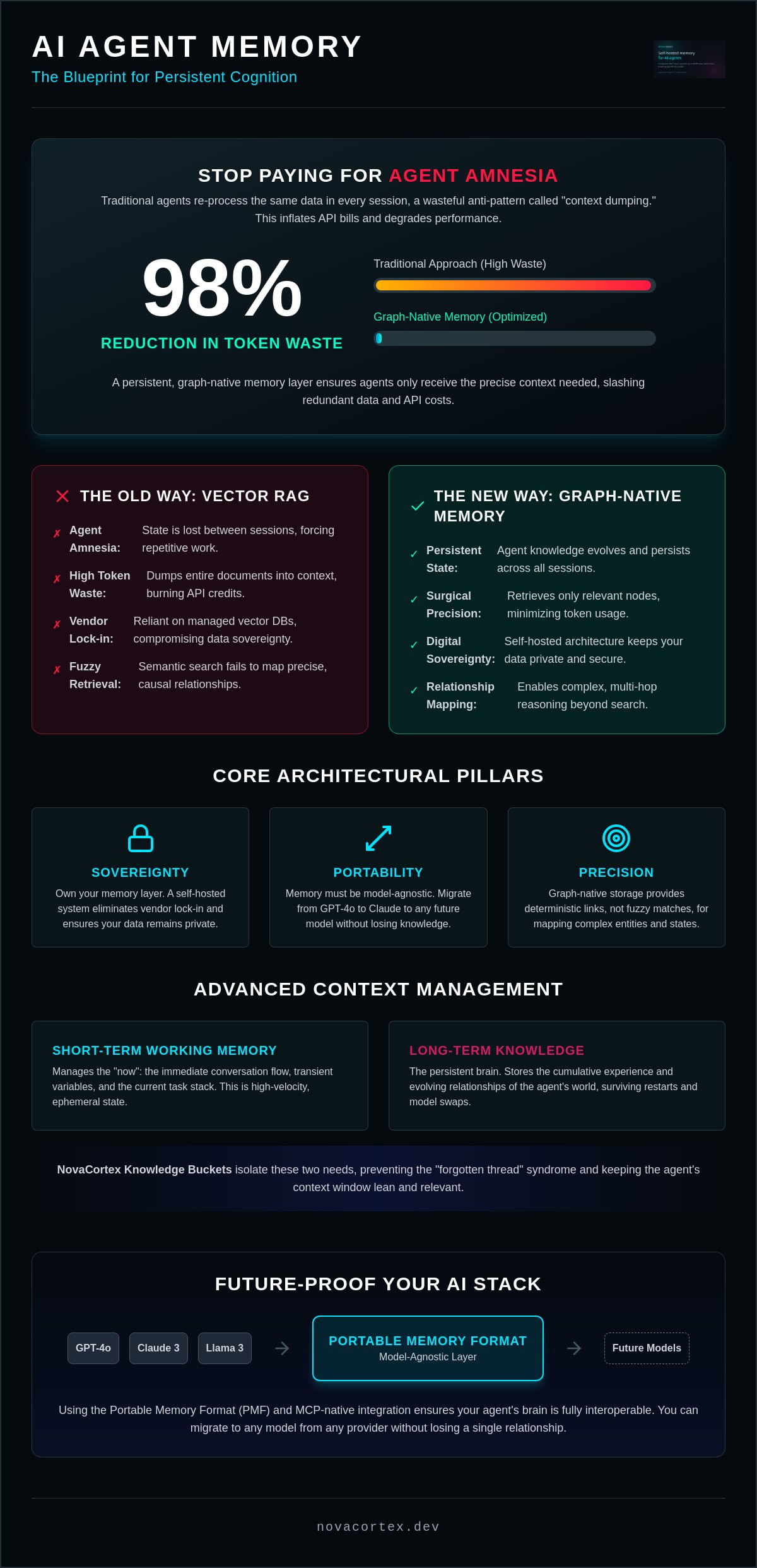
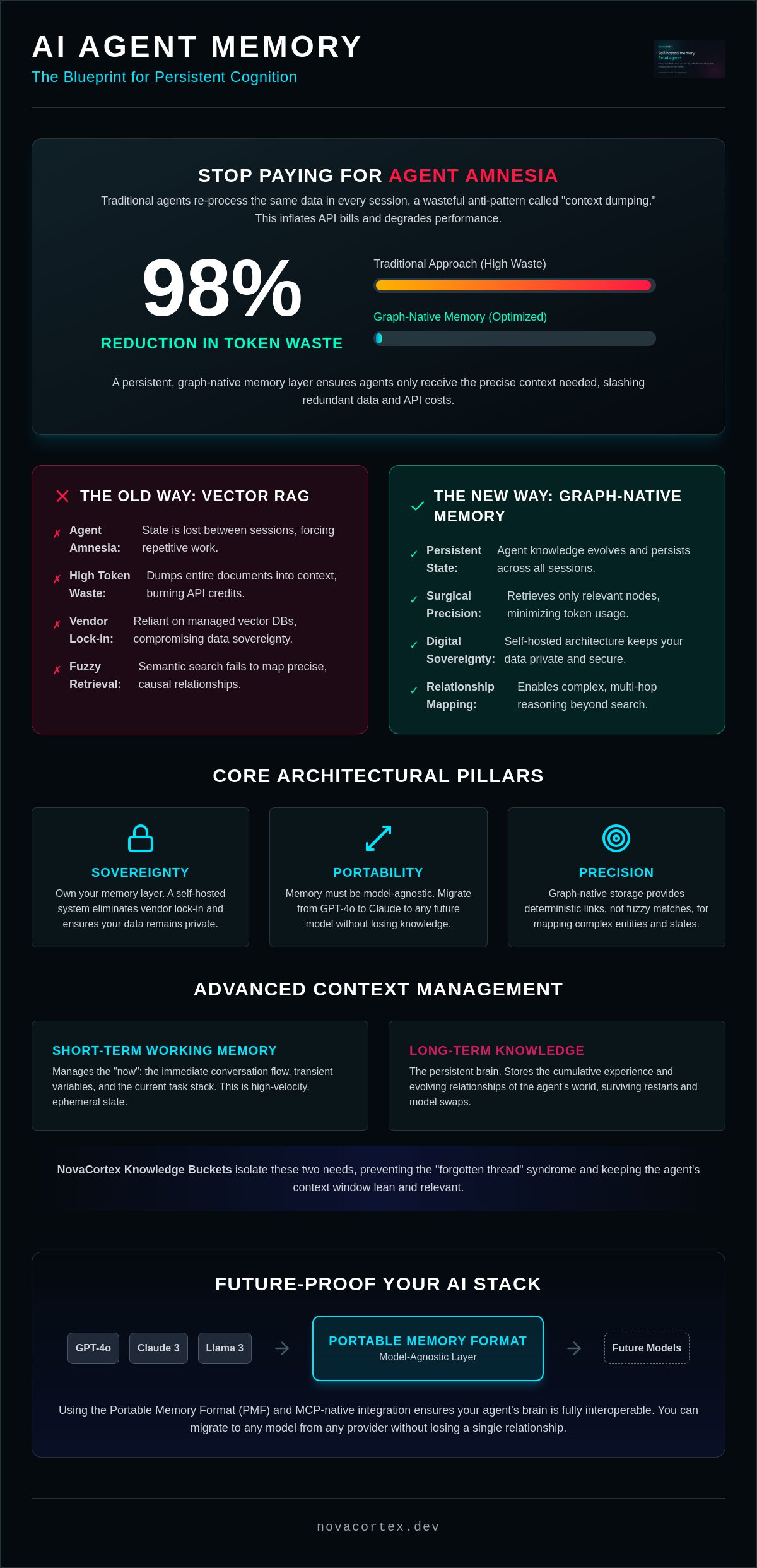
Most developers treat AI memory like a glorified search engine. They use Retrieval-Augmented Generation (RAG) to fetch a document, dump it into the prompt, and hope the model figures it out. This is a mistake. A true AI agent memory management system is not a database; it's a persistent, graph-native layer situated between the LLM and your raw data. Traditional RAG fails because it prioritizes document retrieval over agentic state persistence. To build intelligent agents that actually learn, you need an architecture built on three pillars:
- Sovereignty: You must own the memory layer. Relying on managed vector databases creates vendor lock-in and compromises data privacy.
- Portability: Memory should be model-agnostic. Your agent's "brain" must be able to migrate from Claude to GPT-4o without losing a single relationship.
- Precision: Vector search is fuzzy. Graph-native storage provides the deterministic precision needed to map complex entities and their evolving states.
AI agent memory is a structured, graph-native knowledge layer that persists across sessions.
The Failure of "Context Dumping"
Context dumping is an engineering anti-pattern that burns cash. Sending entire knowledge bases to a prompt creates a visceral trail of technical waste. It bloats latency and triggers a massive efficiency gap compared to smart, graph-based retrieval. In production environments, this brute-force approach leads to "context fatigue" where the model loses focus on the core task. Implementing self-hosted AI memory layers is the only way to kill this API overhead. You don't need more tokens; you need better retrieval. By using a graph-native approach, you can achieve a 98% reduction in token waste, ensuring the agent only sees the exact nodes relevant to the current execution step.
Short-Term State vs. Long-Term Knowledge
Working memory handles the immediate conversation flow. It's the "now" of the agent, managing transient variables and the current task stack. Long-term memory is the persistent brain that survives server restarts and model swaps. It stores the cumulative experience and evolving relationships of the agent's world. NovaCortex Knowledge Buckets segment these two needs for high-velocity agents. By isolating transient state from foundational knowledge, you prevent the "forgotten thread" syndrome. This segmentation ensures the AI agent memory management system remains lean. It allows the agent to recall specific user preferences from three months ago without clogging the current context window with irrelevant historical noise.
Engineering Precision: Graph-Native vs. Traditional Vector Databases
Vector databases aren't memory. They are semantic search engines. They excel at identifying similarity but fail at relationship persistence. An effective AI agent memory management system requires deterministic links between entities, not just "fuzzy" matches. When your agent needs to know why a specific decision was made three sessions ago, a vector search might return a similar conversation, but a graph-native layer returns the exact causal chain. This architectural shift addresses the "lost in the middle" phenomenon where models fail to extract relevant data from the center of a bloated context window. Research into memory-augmented neural networks confirms that structured retrieval is the primary driver for closing the gap between raw data and agentic reasoning.
The Graph Advantage for Agents
Graphs map entity relationships with mathematical precision. They allow agents to navigate complex organizational hierarchies, understanding "who knows what" without re-scanning thousands of documents. Updating a graph is an atomic operation. You don't need to re-index an entire namespace just because one fact changed. This efficiency is critical for multi-agent synchronization. When one agent learns a new parameter, the shared graph-native memory layer updates instantly. It provides a single source of truth that remains consistent across your entire fleet. If you're ready to move beyond basic RAG, you can start building with our open-source core.
Comparison: Vector, Redis, and NovaCortex
Proprietary vector formats are a cage. They lock your agentic context into a specific provider's ecosystem. Redis and traditional vector stores prioritize high recall, which often translates to high noise and irrelevant context. NovaCortex shifts the focus to retrieval relevance. By engineering structured AI memory storage, we move away from broad similarity toward verifiable facts. In 2026 benchmarks, this precision-targeted approach consistently outperforms brute-force vector search in multi-hop reasoning tasks. It ensures the agent finds the needle in the haystack without bringing the whole stack into the prompt.
The introduction of the Portable Memory Format for AI ensures that your data remains your asset. It breaks the cycle of vendor lock-in by providing a model-agnostic schema for agent context. Your memory becomes a portable, interoperable resource rather than a line item in a managed service's billing console. It's the difference between renting a brain and owning one.
How to Implement a Self-Hosted AI Memory Management System
Stop renting your agent's brain. Managed memory APIs are a privacy nightmare and a recurring liability. To build a truly sovereign AI agent memory management system, you must own the infrastructure. Self-hosting on a private VPS or local hardware ensures your data never leaves your control. It eliminates the latency of external API calls; it provides total control over retrieval logic. Whether you're running a single agent or a distributed swarm, the NovaCortex Self-Hosted Edition is designed for lean, high-velocity performance. Implementation is the bridge between architectural theory and production reality.
Deployment is straightforward. Docker is the preferred path for most production environments. Pull the image, mount your volumes, and expose the local port. For purists who demand maximum performance and minimal overhead, the binary distribution offers a direct execution path on Linux systems. Once deployed, configuring the memory server for low-latency retrieval involves tuning the graph-native engine to match your hardware profile. Integration with existing frameworks like LangChain or AutoGPT requires only a simple connection to the local endpoint. Your agent gains a persistent memory layer without sending a single byte to a third-party managed database.
Step 1: Provisioning Your Infrastructure
Hardware requirements are modest. You can run a basic memory node on a Raspberry Pi for local testing. Scale to an enterprise-grade VPS for high-concurrency production agents. We recommend Ubuntu or Debian for stability. Since the software is Apache-2.0 licensed, you have full freedom to modify and deploy without restrictive licensing fees. Security is non-negotiable. Always isolate your memory layer. Use a Virtual Private Cloud (VPC) or local network rules to ensure the memory server is only accessible by your specific agent frameworks.
Step 2: Configuring Knowledge Buckets
Knowledge Buckets are your primary tool for organization. Don't dump everything into a single data lake. Define buckets for specific tasks, user groups, or projects to maintain high retrieval precision. Setting retention policies is critical. You must decide when to prune transient conversational data and when to persist foundational relationships. This is where you initialize the MCP native memory server. By using the Model Context Protocol, you ensure your memory layer is instantly interoperable with any agentic tool that speaks the standard. It turns your memory from a silo into a universal resource.
Advanced Context Management: Knowledge Buckets and Token Optimization
Traditional RAG systems are reactive. They wait for a query, search a massive, unorganized data lake, and then shove as much text as possible into the prompt. This is an engineering failure. A modern AI agent memory management system must be proactive. NovaCortex replaces the "data lake" mess with Knowledge Buckets. This architectural shift allows you to segment context before the agent even begins its task. It ensures that the agent only sees the data relevant to its specific mission, user, or security clearance. By isolating data into these discrete units, you eliminate the noise that leads to hallucinations and high latency.
Knowledge Buckets act as cryptographic firewalls for agent cognition, ensuring that one agent's corrupted state cannot poison the shared intelligence of the entire swarm. This is context management as a first-class citizen, not an afterthought. The economic impact is equally significant. While cloud-based vector stores charge for every retrieval and LLMs bill for every redundant token, a graph-native approach allows for surgical precision. You can achieve a 98% token reduction by using graph-traversal retrieval. Instead of sending a 2,000-word document, the system sends the five exact nodes and three relationships that matter. It's the difference between reading an entire library and having the exact page open on your desk.
Modular Memory for Multi-Agent Systems
Sharing state between agents is a security risk. Knowledge Buckets allow you to share specific nodes while keeping sensitive data locked in isolated buckets. If two agents attempt to update the same memory node, the system uses a deterministic conflict resolution protocol. This ensures a single source of truth without data corruption. You can scale this AI agent memory management system horizontally. Deploy multiple self-hosted instances and sync specific buckets across your infrastructure. This maintains local performance while enabling global intelligence.
Token-Efficient RAG Strategies
Dynamic context pruning is the next frontier. You should remove redundant tokens at the edge before they ever hit the LLM. Smart summarization condenses long-term memory into high-density context nodes. This preserves the "soul" of the information without the fluff of conversational filler. Local graph retrieval costs nothing but electricity. Cloud-based vector search is a tax on your innovation. Deploy NovaCortex on GitHub to start optimizing your token spend today and reclaim your engineering budget.
Future-Proofing AI Infrastructure: Portability and MCP Integration
Digital sovereignty is the final frontier of the AI age. If you don't own your agent's memory, you don't own the agent. Most enterprises are sleepwalking into a new era of vendor lock-in, building deep, proprietary ties to managed vector databases that hold their context hostage. A future-proof AI agent memory management system must be built on open standards that ensure your data remains portable. In 2026, native integration with the Model Context Protocol (MCP) and the adoption of the Portable Memory Format (PMF) are the only ways to stay competitive. These aren't just technical features. They are the architectural safeguards of your intellectual property.
Migration shouldn't be a crisis. Moving your knowledge base between self-hosted environments must be a routine administrative task, not a specialized engineering project. By decoupling the memory layer from the model provider, you ensure that your agent's "brain" remains under your control. Whether you're switching from a local development server to a high-performance VPS or migrating across regions, the integrity of your knowledge graph must remain absolute. This is the difference between a temporary tool and a permanent cognitive asset.
The Role of MCP in Memory Servers
Standardization is the enemy of the incumbent. The Model Context Protocol (MCP) has emerged as the universal connector for AI agents and their data sources. Native integration is now non-negotiable for production-grade systems. By using an MCP-Native Memory Server, you standardize how agents "talk" to their memory layers. This eliminates the need for brittle, custom-coded connectors for every new model release. Standardized protocol headers reduce negotiation overhead; they enable the ultra-low-latency retrieval required for real-time agentic reasoning. You're building a vendor-neutral AI stack that can pivot as fast as the market does.
Implementing Portable Memory Formats
Your agent's knowledge graph is its most valuable asset. It represents thousands of hours of interaction and refined relationships. The Portable Memory Format (PMF) serves as the "Markdown of AI memory." It is simple, portable, and permanent. It allows you to export and sync memory across different server environments without data loss. Whether you're moving between LLM providers or scaling your AI agent memory management system across a distributed cluster, your agent's core identity remains intact. Owning your knowledge graph is the only way to ensure your AI infrastructure remains a sovereign asset rather than a line item in a vendor's billing console.
Master Your Agentic State
The era of context dumping is over. You've seen why a graph-native architecture is the only way to achieve true relationship persistence and multi-hop reasoning. By moving beyond reactive vector search, you eliminate the "lost in the middle" problem and secure your data through self-hosting. An AI agent memory management system should be a sovereign asset; not a vendor-locked liability. You now have the blueprint to implement Knowledge Buckets and the Model Context Protocol to ensure your stack remains interoperable and efficient.
Engineering precision delivers results. With a 98% reduction in token usage and the reliability of graph-native precision, your agents will be faster, smarter, and cheaper to operate. This is Apache-2.0 open-source software built for builders who refuse to compromise on privacy or performance. It's time to build a brain that lasts. Deploy the NovaCortex Self-Hosted Edition today and take full command of your agent's persistent context. Your infrastructure is ready for the future.
Frequently Asked Questions
What is the best way to manage memory for AI agents?
The most effective approach is implementing a graph-native, self-hosted AI agent memory management system that separates transient conversation state from long-term knowledge. Unlike traditional RAG, this architecture allows agents to navigate complex entity relationships with mathematical precision. It ensures that the agent's brain persists across model swaps and server restarts without relying on proprietary, vendor-locked APIs.
How does a self-hosted memory layer improve AI privacy?
Self-hosting keeps your agent's cognitive data within your own private infrastructure. By deploying the NovaCortex Self-Hosted Edition on a local server or private VPS, you eliminate the risk of sensitive context being leaked to third-party managed database providers. This approach enforces digital sovereignty. It ensures that your intellectual property and user data never cross the public internet into unverified cloud environments.
Can I use NovaCortex with existing vector databases like Pinecone?
NovaCortex is designed as a specialized replacement for vector databases in agentic workflows, focusing on high-precision graph retrieval rather than broad semantic similarity. While you can maintain a vector store for general document search, your AI agent memory management system should handle the core agent state and relationship mapping. This separation prevents the "lost in the middle" retrieval errors common in high-recall vector systems.
How much can I actually save on LLM token costs with an AI memory management system?
You can achieve a 98% reduction in token usage by using graph-traversal retrieval instead of brute-force context dumping. Instead of re-sending entire documents to the LLM, a graph-native system identifies the exact nodes and relationships needed for the current task. This surgical precision slashes API overhead. It converts your context window from a wasteful data dump into a lean, high-velocity execution environment.
What is the Model Context Protocol (MCP) and why does it matter for memory?
The Model Context Protocol (MCP) is an open specification that standardizes how AI agents interact with external data and tools. It matters because it provides a universal connector for AI memory, allowing any MCP-compliant agent to connect to your memory server instantly. This integration future-proofs your stack. It ensures your memory layer remains interoperable across different model providers without requiring custom, brittle integration code.
Is a graph-native memory system harder to set up than a vector database?
Deploying a graph-native system is no more complex than setting up a standard database container. The NovaCortex Self-Hosted Edition uses Docker for rapid deployment, allowing you to go from a clean environment to a functional memory node in minutes. While the underlying logic is sophisticated, the implementation is streamlined. You don't need a PhD in graph theory to run a high-performance memory server.
Does self-hosting AI memory require expensive hardware?
No, high-performance memory management doesn't require enterprise-grade clusters. You can run a functional memory node on a standard VPS or even a Raspberry Pi for local development and testing. The system is engineered for lean operations and high-velocity performance. As your agent fleet scales, you can move to more robust hardware, but the initial barrier to entry remains low for any developer.
FAQ
What is the best way to manage memory for AI agents?
The most effective approach is implementing a graph-native, self-hosted AI agent memory management system that separates transient conversation state from long-term knowledge. Unlike traditional RAG, this architecture allows agents to navigate complex entity relationships with mathematical precision. It ensures that the agent's brain persists across model swaps and server restarts without relying on proprietary, vendor-locked APIs.
How does a self-hosted memory layer improve AI privacy?
Self-hosting keeps your agent's cognitive data within your own private infrastructure. By deploying the NovaCortex Self-Hosted Edition on a local server or private VPS, you eliminate the risk of sensitive context being leaked to third-party managed database providers. This approach enforces digital sovereignty. It ensures that your intellectual property and user data never cross the public internet into unverified cloud environments.
Can I use NovaCortex with existing vector databases like Pinecone?
NovaCortex is designed as a specialized replacement for vector databases in agentic workflows, focusing on high-precision graph retrieval rather than broad semantic similarity. While you can maintain a vector store for general document search, your AI agent memory management system should handle the core agent state and relationship mapping. This separation prevents the "lost in the middle" retrieval errors common in high-recall vector systems.
How much can I actually save on LLM token costs with an AI memory management system?
You can achieve a 98% reduction in token usage by using graph-traversal retrieval instead of brute-force context dumping. Instead of re-sending entire documents to the LLM, a graph-native system identifies the exact nodes and relationships needed for the current task. This surgical precision slashes API overhead. It converts your context window from a wasteful data dump into a lean, high-velocity execution environment.
What is the Model Context Protocol (MCP) and why does it matter for memory?
The Model Context Protocol (MCP) is an open specification that standardizes how AI agents interact with external data and tools. It matters because it provides a universal connector for AI memory, allowing any MCP-compliant agent to connect to your memory server instantly. This integration future-proofs your stack. It ensures your memory layer remains interoperable across different model providers without requiring custom, brittle integration code.
Is a graph-native memory system harder to set up than a vector database?
Deploying a graph-native system is no more complex than setting up a standard database container. The NovaCortex Self-Hosted Edition uses Docker for rapid deployment, allowing you to go from a clean environment to a functional memory node in minutes. While the underlying logic is sophisticated, the implementation is streamlined. You don't need a PhD in graph theory to run a high-performance memory server.
Does self-hosting AI memory require expensive hardware?
No, high-performance memory management doesn't require enterprise-grade clusters. You can run a functional memory node on a standard VPS or even a Raspberry Pi for local development and testing. The system is engineered for lean operations and high-velocity performance. As your agent fleet scales, you can move to more robust hardware, but the initial barrier to entry remains low for any developer.