AI Agent Memory Persistence Strategies: Beyond Vector Search Flaws

An agent’s biggest memory problem may not be a short context window, but the way it retrieves what it already knows. AI agent memory persistence strategies built around dumping more history into prompts can increase token use without preserving the relationships that make context useful. When sessions stretch across days, agents need more than a searchable pile of text.
The symptoms are familiar: an agent forgets decisions, repeats questions, and spends tokens replaying old conversations. If memory lives in a managed layer, sensitive data may also leave infrastructure you control. Persistent memory should support continuity without forcing a trade-off between cost and control.
This guide explains how to build memory that lasts across sessions while keeping prompts focused and data under your control. You’ll see where vector search can fall short, how graph-native retrieval connects evolving facts, and how portable formats and self-hosted infrastructure support durable agent state. The core principle is simple: store context outside the prompt, retrieve relationships when they matter, and send the model only what it needs.
Key Takeaways
- Design persistent memory as layered agent state, not a replay of every past message.
- Understand where vector similarity can miss relationships and how graph-native memory can preserve connections between facts.
- Apply AI agent memory persistence strategies that retrieve relevant context and organize it into focused Knowledge Buckets.
- Use the Portable Memory Format (PMF) to make agent memory more portable and reduce dependence on a single infrastructure stack.
- Explore how NovaCortex Self-Hosted Edition supports privacy-first memory on infrastructure you control. Its potential token reduction depends on your workload and benchmarks.
The Architecture of Persistent Cognition
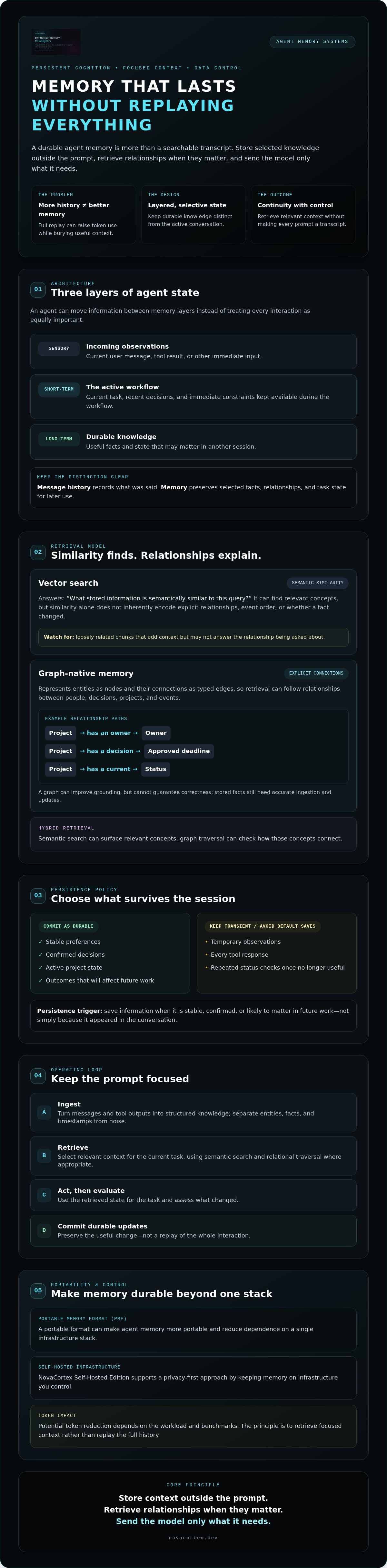
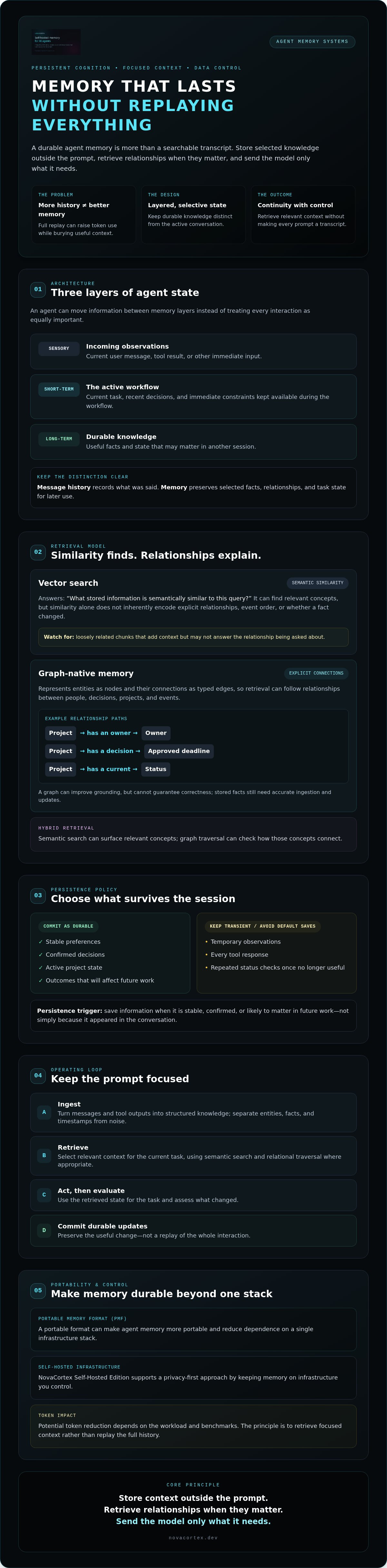
A persistent agent needs more than a transcript. Message history records what was said; memory preserves selected facts, relationships, and task state so the agent can use them later. That distinction separates state management, which tracks what’s happening now, from long-term memory, which carries useful knowledge across sessions. A cognitive architecture offers a useful framework for understanding how an agent’s components, including memory, work together.
Think in layers. Sensory memory holds incoming observations, such as the current user message or a tool result. Short-term memory keeps the active task, recent decisions, and immediate constraints available during the current workflow. Long-term memory stores durable information that may matter in another session. An agent can move information between these layers instead of treating every interaction as equally important.
The Persistence Gap in LLMs
LLMs are stateless between calls unless an application supplies prior context. Replaying the full transcript can preserve details temporarily, but it expands the prompt and does not reliably distinguish durable knowledge from one-off chatter. As a multi-step task grows, key constraints can get buried or left out, and the agent can lose the thread. Vector retrieval helps find semantically similar passages, but similarity alone may not preserve who did what, which fact changed, or how two entities relate. A self-hosted AI memory layer externalizes selected state so it can persist beyond a single context window.
Core Components of a Memory Layer
A functional memory layer has three jobs. Ingestion turns raw messages and tool outputs into structured knowledge, separating entities, facts, and timestamps from noise. Retrieval selects what the agent needs for the current task. Semantic search can locate relevant concepts, while relational traversal follows connections between people, decisions, projects, and events. Reliable AI agent memory persistence strategies need more than a larger prompt or a vector index alone.
Persistence triggers determine what deserves to survive. Commit stable preferences, confirmed decisions, active project state, and outcomes that will affect future work. Keep transient observations in short-term context, and avoid saving every tool response by default. For example, an agent coordinating a project might retain an approved deadline and its owner, but discard repeated status checks once they are no longer useful.
The result is a stateful workflow: the agent retrieves relevant context, acts, evaluates what changed, and commits only durable updates. Memory becomes an engineered subsystem, not a growing transcript.
Graph-Native vs. Vector-Only Memory Layers
Vector search answers a useful question: “What stored information is semantically similar to this query?” But similarity is not the same as correctness. A passage about a project deadline may rank highly for a question about its owner, even if it never says who owns the work. Embeddings capture patterns in meaning; they do not inherently encode explicit relationships, event order, or whether a fact has changed.
That gap matters in multi-step workflows. Retrieval noise makes agents sift through loosely related results, using more context and increasing the chance they’ll treat a plausible connection as a fact. Vector stores also require computing and indexing high-dimensional representations. The cost is not simply “too many dimensions”; it is maintaining and searching those representations without a reliable model of how facts connect.
The Technical Waste of Vector Dumping
Adding more similar chunks can make retrieval look comprehensive while burying the decisive detail. In a fast-moving agent workflow, that means extra context to process and more opportunities to lose the thread. The choice explored in Redis vs graph memory for AI agents is architectural: choose a retrieval system that fits the relationships your agent must reason over, not just the volume of text it must store.
Graph-Native Advantages for Agents
A graph represents entities as nodes and their connections as typed edges. An agent can traverse from a project to its owner, decision, and current status, then check which facts remain valid. That explicit structure gives retrieval a relational backbone. It can improve grounding, but cannot guarantee correctness. The stored facts still need accurate ingestion and updates.
Hybrid retrieval combines the strengths of both approaches. Semantic search can surface relevant concepts; graph traversal can check how those concepts connect. The ACL Anthology paper Evaluating the Long-Term Memory examines long-term memory performance, underscoring why retrieval and retention need evaluation rather than assumption. For AI agent long term memory, this combination can help preserve context across sessions and give multiple agents a shared structure to consult, rather than passing disconnected summaries between them.
These AI agent memory persistence strategies shift the goal from retrieving more text to retrieving better-supported context. NovaCortex uses graph-native storage, and its materials report token reductions of up to 98%. Results depend on the workload and benchmark. For a closer look at its implementation, explore the NovaCortex open-source repository.
AI Agent Memory Persistence Strategies for Token-Efficient Context Management
A larger context window does not make memory efficient. Sending an agent everything it might need consumes tokens on irrelevant history, leaves less room for current work, and can make important details harder to find. Effective AI agent memory persistence strategies retrieve a small, task-relevant set of facts, then update persistent memory only when new information warrants it.
NovaCortex reports token usage reductions of up to 98%, but the result depends on the workload and benchmark. Treat that figure as a performance claim to test against your own baseline: compare tokens used per task, answer quality, and retrieval accuracy under equivalent conditions. A reduction matters only if the agent still has the context it needs to act correctly.
Context Pruning and Compression
Context pruning is the selective removal or compression of information that an agent does not need for its current task, while retaining facts that affect future decisions. Summarize a long conversation into durable facts, unresolved questions, decisions, and next actions rather than preserving every exchange. Keep exact values, names, ownership, and time-sensitive details explicit. Vague summaries can erase the facts the agent needs.
A practical tiered policy separates memory by access frequency:
- Hot: active task state and constraints, injected into the working context.
- Warm: recent project history, retrieved when a task touches that project.
- Cold: older reference material, retained externally and fetched only when relevant.
Knowledge Buckets make this separation operational by grouping memory into focused domains. A project task can query its project bucket instead of searching or loading an entire knowledge base. Dynamic rankers can then prioritize by relevance, recency, confidence, and task fit, rather than returning everything in storage. UC Berkeley’s LLM4LLM Project also explores structured storage of key memory points, a useful contrast to transcript replay.
Precision Retrieval over Brute Force
Dumping an entire knowledge base into a prompt shifts filtering to the model, inflates input, and makes noise look like context. Instead, define retrieval scopes and return only the facts needed for the next action. An MCP-native memory server provides a protocol-based way for an agent to access persistent memory as needed, rather than packing the full store into every request.
Measure the economics across the agent fleet, not just one call. Track average input tokens per task, retrieval precision, task completion, and repeated calls before and after optimization. Multiply token changes by task volume and agent count to estimate the operational effect, while checking quality to ensure that less context does not mean lower performance.
Engineering Interoperable Memory with PMF
An agent’s memory should not be trapped in the database, API, or cloud account of a single provider. If changing infrastructure means losing accumulated knowledge or rebuilding integrations from scratch, the memory layer has become a dependency instead of an asset. A portable format separates the information an agent retains from the system that stores or retrieves it.
The portable memory format for AI approach gives teams a way to represent and move agent memory across compatible environments. Think of it as a stable exchange layer: the underlying database or model can change while the agent’s durable knowledge remains exportable. Provider-specific behavior may still require adaptation, but the memory does not have to start from zero.
Break the Vendor Cycle
Keep portable memory under infrastructure you control, and define a documented export and restore process before migration becomes urgent. Separate durable knowledge, such as project facts and user preferences, from model-specific prompts and temporary execution state. This distinction helps preserve useful context when switching LLM providers without assuming every provider interprets instructions identically. Test the new model against representative tasks, then tune its instructions while retaining the same core memory.
Implement Open Standards
Build a vendor-neutral memory layer in five deliberate steps:
- Define a canonical schema. Specify how you represent facts, entities, relationships, timestamps, and provenance. Keep required fields clear and version the schema as it evolves.
- Separate storage from access. Avoid tying agent logic directly to one database’s proprietary query patterns. Use a stable interface between agents and memory infrastructure.
- Set export and sync rules. Decide what gets exported, how updates are reconciled, and how duplicates or conflicts are handled when environments sync.
- Test portability. Import an export into a separate environment and verify that key facts, relationships, and metadata survive the round trip.
- Review control and licensing. Confirm where data resides, who can access it, and what the software license permits for your use case.
Open-source software under Apache-2.0 can support inspection and adaptation, but a license alone does not guarantee portability. The schema, export process, and operational controls matter too. NovaCortex offers the Portable Memory Format (PMF) and a self-hosted memory layer. Evaluate them against your own migration and recovery tests rather than assuming interoperability from a label.
These AI agent memory persistence strategies make sovereignty measurable: can you export the memory, restore it elsewhere, and retain the context your workflows rely on? Make that test part of architecture review, not a future rescue plan.
Implementing Privacy-First Memory on Private Infrastructure
Self-hosting gives an organization direct control over where its agent memory is stored and which systems can access it. That is a stronger foundation for data sovereignty than placing the memory store in a provider-managed service, but it is not a complete privacy guarantee. If an agent sends retrieved facts to an external LLM, that context still leaves the host. Map the full data path, including logs, backups, and model calls, before deciding what belongs in memory.
The self-hosted versus managed AI memory trade-off comes down to control and operational responsibility. A self-hosted deployment puts infrastructure choices and access policy in your hands. Your team must also manage updates, monitoring, backups, and recovery. Choose based on your security requirements and operational capacity, not on the assumption that “local” automatically means secure.
Plan the Deployment Boundary
NovaCortex Self-Hosted Edition is a starting point for teams evaluating private infrastructure. A VPS, Raspberry Pi, or local server may be a candidate environment, but verify the edition’s documented requirements before selecting hardware or planning capacity. Start with a limited test deployment, identify which agent data reaches the memory service, then validate access controls and restore procedures before expanding to a wider fleet.
Build a Shared Company Brain
Shared memory is useful only when access boundaries are explicit. Knowledge Buckets can organize information by department or project; pair that organization with permissions enforced by the surrounding infrastructure. For example, a sales agent might access approved product and customer context, while an HR workflow remains separate. Define ownership, access roles, retention expectations, and who can update shared facts. Do not assume that dividing memory into buckets alone enforces user-level authorization.
For enterprise-scale use, establish a central operational policy before connecting more agents. Decide how agents authenticate, which memory scopes each one can query, how changes are reviewed, and how sensitive data is excluded from external model calls where required. Then test concurrent access and recovery using realistic workloads. These controls turn a shared company brain from an open archive into governed infrastructure.
AI agent memory persistence strategies work best when persistence and privacy are designed together. Self-hosting can keep the memory layer under your control, while careful deployment and access policies determine how that control holds up in practice.
Explore NovaCortex Self-Hosted Edition as a way to run a privacy-first memory layer on infrastructure you control.
Build Memory That Moves With Your Agents
Reliable agents need memory that lasts, retrieval that respects relationships, and infrastructure that keeps data under your control. The strongest AI agent memory persistence strategies treat these as connected engineering decisions, not separate fixes for context loss, rising token use, or vendor dependence.
NovaCortex brings together graph-native, privacy-first memory and the Portable Memory Format. Its materials report token savings of up to 98%, a result to validate against your own workloads. The project is open source under Apache-2.0, giving teams a foundation to inspect and evaluate as they build toward more sovereign AI systems.
Start with a focused deployment, measure retrieval quality and token use, then expand as your workflows prove the value. Durable agent memory can be built on infrastructure your team controls.
Frequently Asked Questions
What is the most effective strategy for AI agent memory persistence?
The most effective strategy combines persistent storage, selective retrieval, and clear rules for what the agent should remember. Keep active task details in working context, store durable facts outside the prompt, and retrieve only information relevant to the current request. Use relational structure when the agent needs to connect entities or track changing facts. Measure token use and retrieval quality together, since smaller prompts help only if the agent retains the context needed to act correctly.
How does graph-native memory reduce token costs compared to vector search?
Graph-native memory can reduce unnecessary context by retrieving connected facts instead of returning a large set of loosely similar passages. Vector search finds semantically related content, while graph traversal can follow explicit relationships, such as a project’s owner and current decision. Neither approach guarantees lower token use on its own. Savings depend on retrieval design and workload. NovaCortex reports reductions of up to 98% compared with dumping entire knowledge bases; validate that figure against your own benchmark.
Can I host my own AI memory layer on a private server?
Yes. NovaCortex Self-Hosted Edition is described as deployable on a server, VPS, Raspberry Pi, or similar environment. Before deployment, check the current requirements and assess capacity, backups, updates, network exposure, and recovery procedures. Self-hosting gives you control over the memory infrastructure, but it does not automatically keep all data local. If an agent sends retrieved context to an external LLM, that information still leaves your server.
What is the Portable Memory Format (PMF) and why does it matter?
The Portable Memory Format (PMF) is NovaCortex’s format for keeping agent memory portable across compatible environments. Portability can reduce dependence on a single storage provider and make it easier to export or move retained knowledge. Before relying on a format for migration, test an export and restore, checking that facts, relationships, and relevant metadata survive. Changing LLM providers may still require adapting prompts or integrations, even if the underlying memory transfers.
How do Knowledge Buckets help in managing agent state?
Knowledge Buckets organize memory into focused groups, such as departments, projects, or workflows. An agent handling a sales task can retrieve the relevant bucket instead of searching an undivided knowledge base, limiting unrelated context in its prompt. Buckets can help separate information, but do not assume they enforce user permissions by themselves. Pair them with access controls in your surrounding infrastructure, and define which agents can read or update each memory scope.
What happens to agent memory if I switch LLM providers?
If memory is stored separately from the LLM and represented in a portable format, changing providers does not have to erase the agent’s retained knowledge. Export or connect the memory layer to the new workflow, then test retrieval and update behavior. The agent’s “personality” may also depend on system instructions, tools, and provider-specific behavior, so transferring memory alone will not guarantee identical responses. Verify important workflows before making the new provider the default.
Is self-hosted AI memory more secure than cloud-managed services?
Not automatically. Self-hosting can give your organization greater control over where memory is stored and who operates the infrastructure, but security depends on configuration, access controls, patching, monitoring, and backups. A cloud-managed service may handle some infrastructure operations, while requiring you to assess its data handling and controls. Compare the full data path, including logs and external model calls, against your threat model and operational capacity before choosing.
How does NovaCortex achieve a 98% reduction in token usage?
NovaCortex attributes token savings of up to 98% to retrieving relevant memory rather than sending an entire knowledge base in every prompt. Its graph-native memory layer is designed to help agents retrieve connected information, while Knowledge Buckets can focus retrieval on a specific domain. The actual reduction depends on the workload and measurement method. Benchmark token use against your current approach, and compare answer quality and task completion alongside the savings.
Ready to evaluate persistent memory on infrastructure you control? Explore NovaCortex Self-Hosted Edition.
FAQ
What is the most effective strategy for AI agent memory persistence?
The most effective strategy combines persistent storage, selective retrieval, and clear rules for what the agent should remember. Keep active task details in working context, store durable facts outside the prompt, and retrieve only information relevant to the current request. Use relational structure when the agent needs to connect entities or track changing facts. Measure token use and retrieval quality together, since smaller prompts help only if the agent retains the context needed to act correctly.
How does graph-native memory reduce token costs compared to vector search?
Graph-native memory can reduce unnecessary context by retrieving connected facts instead of returning a large set of loosely similar passages. Vector search finds semantically related content, while graph traversal can follow explicit relationships, such as a project’s owner and current decision. Neither approach guarantees lower token use on its own. Savings depend on retrieval design and workload. NovaCortex reports reductions of up to 98% compared with dumping entire knowledge bases; validate that figure against your own benchmark.
Can I host my own AI memory layer on a private server?
Yes. NovaCortex Self-Hosted Edition is described as deployable on a server, VPS, Raspberry Pi, or similar environment. Before deployment, check the current requirements and assess capacity, backups, updates, network exposure, and recovery procedures. Self-hosting gives you control over the memory infrastructure, but it does not automatically keep all data local. If an agent sends retrieved context to an external LLM, that information still leaves your server.
What is the Portable Memory Format (PMF) and why does it matter?
The Portable Memory Format (PMF) is NovaCortex’s format for keeping agent memory portable across compatible environments. Portability can reduce dependence on a single storage provider and make it easier to export or move retained knowledge. Before relying on a format for migration, test an export and restore, checking that facts, relationships, and relevant metadata survive. Changing LLM providers may still require adapting prompts or integrations, even if the underlying memory transfers.
How do Knowledge Buckets help in managing agent state?
Knowledge Buckets organize memory into focused groups, such as departments, projects, or workflows. An agent handling a sales task can retrieve the relevant bucket instead of searching an undivided knowledge base, limiting unrelated context in its prompt. Buckets can help separate information, but do not assume they enforce user permissions by themselves. Pair them with access controls in your surrounding infrastructure, and define which agents can read or update each memory scope.
What happens to agent memory if I switch LLM providers?
If memory is stored separately from the LLM and represented in a portable format, changing providers does not have to erase the agent’s retained knowledge. Export or connect the memory layer to the new workflow, then test retrieval and update behavior. The agent’s “personality” may also depend on system instructions, tools, and provider-specific behavior, so transferring memory alone will not guarantee identical responses. Verify important workflows before making the new provider the default.
Is self-hosted AI memory more secure than cloud-managed services?
Not automatically. Self-hosting can give your organization greater control over where memory is stored and who operates the infrastructure, but security depends on configuration, access controls, patching, monitoring, and backups. A cloud-managed service may handle some infrastructure operations, while requiring you to assess its data handling and controls. Compare the full data path, including logs and external model calls, against your threat model and operational capacity before choosing.
How does NovaCortex achieve a 98% reduction in token usage?
NovaCortex attributes token savings of up to 98% to retrieving relevant memory rather than sending an entire knowledge base in every prompt. Its graph-native memory layer is designed to help agents retrieve connected information, while Knowledge Buckets can focus retrieval on a specific domain. The actual reduction depends on the workload and measurement method. Benchmark token use against your current approach, and compare answer quality and task completion alongside the savings. Ready to evaluate persistent memory on infrastructure you control? Explore NovaCortex Self-Hosted Edition.