AI Agent State Management: A Guide to Persistent Cognition in 2026

Your AI agents are suffering from architectural dementia, and your cloud provider is the only one profiting from the bloat. While 52% of executives have pushed agents into production as of June 2026, most systems remain trapped in a cycle of "forgetting" critical user data between sessions. This isn't just a technical glitch; it's a fundamental failure in AI agent state management. You're likely watching token costs climb exponentially as you're forced to cram massive context windows with redundant information just to maintain a semblance of continuity.
It's time to reject stateless frameworks and proprietary cloud layers that lock your data behind a paywall. You can build persistent, token-efficient systems that respect both your budget and your data sovereignty. This guide provides the blueprint for a self-hosted, graph-native memory architecture. We'll show you how to implement Knowledge Buckets and the Portable Memory Format (PMF) to ensure your autonomous systems retain cognition without the overhead of bloated, wasteful context windows.
Key Takeaways
- Move beyond the stateless LLM fallacy by architecting a persistent cognition layer that maintains history and goals across long-running sessions.
- Identify why traditional vector databases fail to capture the relational "connective tissue" of complex tasks and why graph-native storage is the superior alternative.
- Master AI agent state management by deploying an MCP-native memory server that eliminates vendor lock-in and proprietary cloud dependencies.
- Secure your data sovereignty and meet 2026 regulatory standards by utilizing self-hosted Knowledge Buckets for sensitive state data on private infrastructure.
- Transition from single-agent silos to multi-agent synchronization by implementing a shared state layer through the Portable Memory Format (PMF).
The Stateless LLM Fallacy: Why Frameworks Aren't Enough
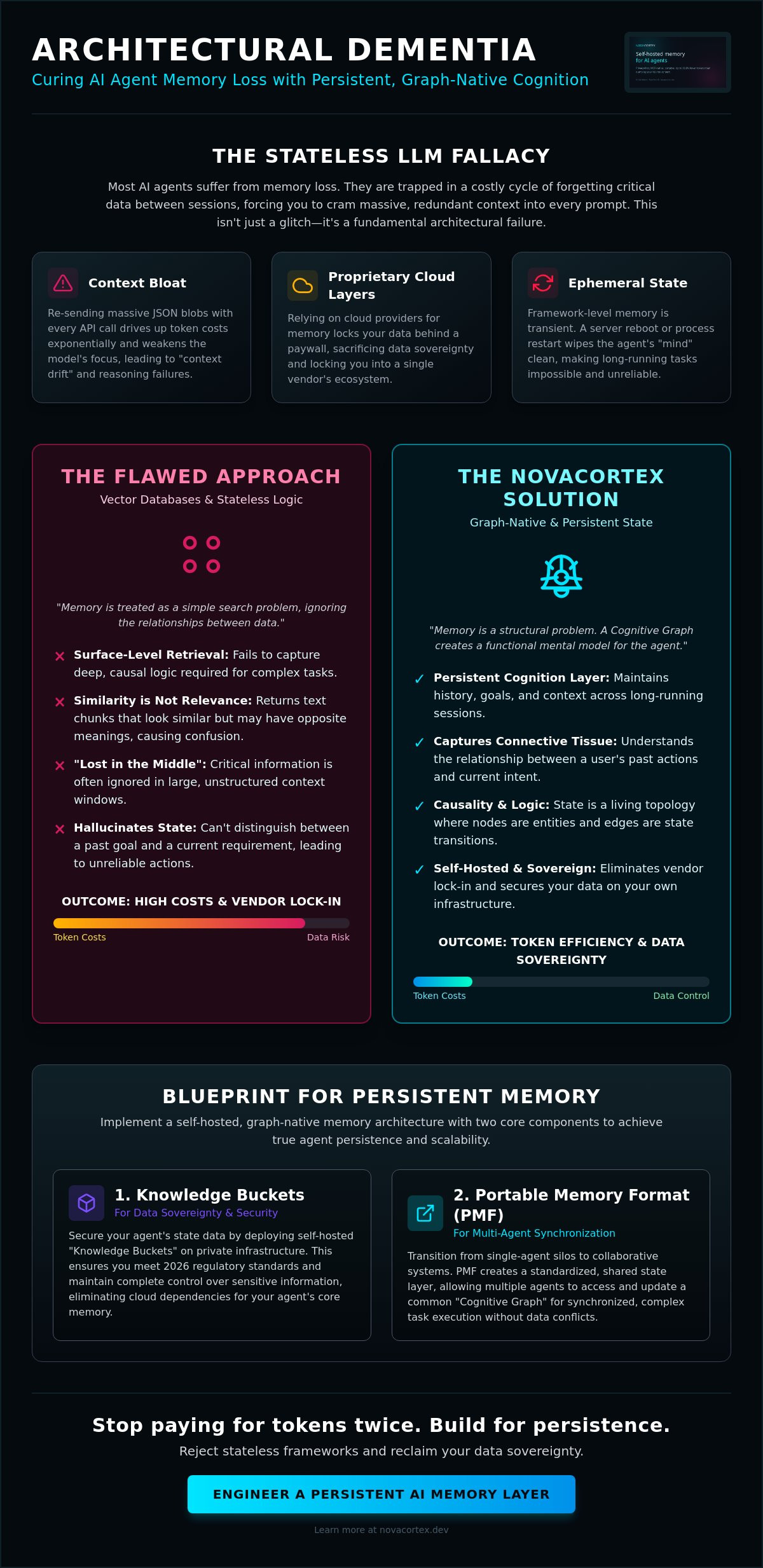
Large Language Models are fundamentally stateless. Every call is a clean slate. Every prompt starts from zero. This architectural reality creates a massive gap for anyone building autonomous systems. Effective AI agent state management is the only way to bridge this void. It is the practice of maintaining context, history, and goals across multiple interactions and execution loops. Without it, you don't have an agent. You have a very expensive, repetitive script.
Many developers rely on popular frameworks to handle this logic. They assume the framework’s built-in memory is sufficient. It isn't. Most framework-level state is ephemeral. If the process restarts or the server reboots, the agent’s "mind" is wiped clean. This is the stateless fallacy. Relying solely on transient framework state is a recipe for catastrophic memory loss in production environments.
Transient vs. Persistent State
Engineering a reliable agent requires a clear distinction between two data layers. Transient state refers to short-term variables held within the current execution loop. It’s the "thinking space" where the agent processes immediate inputs. Persistent state is the agent's long-term memory. This data must reside in external infrastructure, separate from the execution environment. Enterprise-grade systems require a robust bridge between these layers. If your agent's state of the system isn't backed by persistent storage, it cannot handle long-running, multi-day tasks.
The Hidden Cost of Statelessness
The "Context Bloat" strategy is failing. In 2024, developers simply dumped massive JSON blobs into the prompt to provide context. In 2026, this is a financial liability. Re-sending the same historical data with every API call drives up token usage and inflates bills. It also introduces "context drift." As the prompt grows, the model’s focus weakens. Reasoning breaks down. Reliability vanishes.
Solving this requires moving away from proprietary cloud memory that locks you into their ecosystem. You need a self-hosted AI memory layer to filter and store state efficiently. By managing state externally, you only inject the specific, relevant context needed for the current step. This reduces costs, maintains high reasoning accuracy, and ensures your AI agent state management remains under your direct control. Stop paying for the same tokens twice. Build for persistence instead.
Architecting the Memory Layer: Vector DBs vs. Graph-Native State
Vector databases are the industry's current crutch. They excel at surface-level retrieval but fail at the deep logic required for persistent AI agent state management. When you need to know why a user changed their preference three sessions ago, a similarity score won't help you. You need the connective tissue of a graph. Most developers treat memory as a search problem. It isn't. It's a structural problem. If your architecture doesn't understand the relationship between a user's past actions and their current intent, your agent is just guessing.
IBM defines AI agent memory as a system that must balance short-term task execution with long-term context. Vector-only systems struggle with this balance because they lack a hierarchy. They treat every chunk of data as an isolated island. In contrast, graph-native memory creates a "Cognitive Graph" where data points are linked by causality and logic. This is the difference between having a pile of facts and having a functional mental model.
Why Vector Search Fails at Deep Context
Similarity search is a blunt tool for a surgical job. Standard RAG implementations suffer from the "lost in the middle" phenomenon. They retrieve text chunks that look like the query but ignore the causal chain of events. This leads to agents that hallucinate state because they can't distinguish between a past goal and a current requirement. If two different sessions contain similar keywords but opposite conclusions, a vector database will likely return both, leaving the LLM to resolve the contradiction. That's a waste of compute and a risk to reliability. Similarity is not relevance. Finding similar text is not the same as retrieving relevant state.
The Graph-Native Advantage
Graph-native architectures treat state as a living topology. Nodes represent entities; edges represent state transitions. This structure allows for multi-hop reasoning that vector-only systems simply cannot compute. By using modular Knowledge Buckets, you can isolate specific domains of memory. This precision allows the system to traverse relationships rather than just scanning for keywords. If an agent needs to recall a specific decision made during a project's kickoff, it follows the edge from the "Project" node to the "Kickoff" event. It's direct. It's fast. It's logical.
This architectural shift isn't just about reasoning accuracy; it's about extreme efficiency. Graph-native storage enables the 98% token reduction mentioned in the NovaCortex technical specs. By pinpointing the exact state transition required for a prompt, you stop dumping irrelevant history into the context window. You provide the agent with the precise "state of the world" it needs to act. For developers tired of bloated context windows, you should explore the MCP-native memory server architecture to see how graph-native state can be implemented on private infrastructure.
How to Implement Persistent State with MCP and NovaCortex
Implementation is where architectural theory meets engineering reality. You don't need a proprietary cloud to manage cognition. You need a standardized, self-hosted layer that survives the execution loop. Transitioning to robust AI agent state management requires a shift from ephemeral framework variables to a dedicated MCP-Native Memory Server. This roadmap ensures your agents maintain continuity without bleeding tokens or sacrificing data sovereignty. Build it right. Host it yourself.
- Step 1: Deploy Private Infrastructure. Deploy your memory layer on a VPS or local environment. This ensures your state remains under your physical control and outside the reach of proprietary data mining.
- Step 2: Define Knowledge Buckets. Partition your data based on agent roles and domains. A coding agent shouldn't parse a user's billing history unless the task explicitly demands it.
- Step 3: Connect via MCP. Use the Model Context Protocol to bridge your framework, such as LangGraph or AutoGPT, to your persistent storage.
- Step 4: Implement Selective Retrieval. Build logic that filters state before it hits the prompt. Only pull the exact nodes required for the current execution step.
Standardizing with MCP
The Model Context Protocol (MCP) is the universal interface for agent tool-use and state. It effectively de-couples your agent's memory from the LLM provider. By using an MCP-native server, you avoid the trap of vendor lock-in. You aren't tied to a specific provider's proprietary memory implementation. You own the interface. You own the data. This standardization is critical for building scalable memory architectures that span multiple models and platforms without losing the agent's core identity. It's the protocol of digital sovereignty.
Managing State with Knowledge Buckets
Knowledge Buckets are the antidote to context bloat. Instead of a monolithic history file, you partition state into logical domains. This allows for high-precision retrieval. When an agent enters a specific workflow, it only mounts the relevant bucket. This modularity is essential for multi-agent swarms. Multiple agents can sync their state by subscribing to shared buckets, creating a collective intelligence layer. Good AI agent state management also requires strict hygiene. Implement state pruning to discard irrelevant context. If a variable is no longer driving a goal, purge it. Keep your memory lean. Keep your agents fast. High-velocity performance demands focused context.
Solving the Data Sovereignty Crisis: Why Local State Matters
Sending your agent's state to a proprietary cloud isn't just a privacy risk; it's a strategic liability. Every time you offload memory to a third party, you surrender the "Cognitive Audit Trail" of your system. In a landscape governed by the EU AI Act, which becomes enforceable in August 2026, this lack of transparency is a legal dead end. High-risk AI systems must be auditable. If your AI agent state management lives in a black-box cloud, you can't prove compliance. You can't audit the reasoning. You certainly don't own the intelligence.
Digital sovereignty is the only path forward for enterprise builders. By self-hosting your memory layer, you ensure that sensitive user interactions never leave your perimeter. This isn't just about security; it's about performance. Local state storage eliminates the 200ms round-trip latency typical of cloud-based memory retrieval. Speed is a feature. Sovereignty is the foundation. If you want to move fast without breaking regulations, effective AI agent state management requires physical control over the data.
Ending Vendor Lock-in with PMF
Proprietary memory layers are designed to keep you trapped. They want your data formatted in a way that makes switching providers impossible. The Portable Memory Format for AI (PMF) shatters this cycle. It treats memory as a standardized asset rather than a vendor-specific hostage. With PMF, you can migrate an agent's entire state from GPT-4 to Claude or a local Llama-3 instance without losing a single logical connection. It future-proofs your infrastructure against the inevitable volatility of the LLM market. Don't build on shifting sand.
Local Infrastructure Requirements
You don't need a supercomputer to manage persistent cognition. A lightweight memory server can run on a standard VPS or even a Raspberry Pi 5 for edge deployments. The key is structural efficiency, not raw compute. Using Apache-2.0 open-source tools ensures your stack remains transparent and extensible. For distributed environments, state synchronization happens at the bucket level, ensuring consistency across your entire network. To start building your sovereign memory stack today, deploy the NovaCortex Self-Hosted Edition on your own infrastructure.
Scaling for the Future: Multi-Agent Synchronization
The single-agent era is over. It was a useful prototype. Now, we build swarms. As organizations scale their autonomous systems, the challenge of AI agent state management shifts from individual session persistence to collective intelligence. A multi-agent system where agents operate in silos is a system destined for failure. If your research agent discovers a critical market shift, your strategy agent must ingest that data instantly. This requires a shared state layer that functions as a unified "hive mind" for your entire infrastructure.
Implementing this collective memory introduces the "Global vs. Local State" conflict. Individual agents need local state to manage their current task execution. Simultaneously, they must synchronize with a global state layer to maintain topological consistency across the swarm. Solving this conflict requires a hierarchical graph structure. Local nodes inherit properties from global ones, ensuring that an agent's specific actions never contradict the broader enterprise knowledge. Don't wait until your system is too complex to fix. Start with a lean, graph-native implementation to avoid the crushing weight of architectural debt.
Implementing the NovaCortex Memory Layer
NovaCortex is engineered specifically for this level of enterprise complexity. It moves beyond the limitations of transient framework memory by providing a robust, persistent storage engine. The system's graph-native retrieval precision allows for a 98% token reduction compared to standard context-dumping strategies. This isn't just an efficiency gain; it's a fundamental shift in how agents think. By isolating relevant nodes within Knowledge Buckets, NovaCortex ensures that your agents are never paralyzed by irrelevant data. Developers can find implementation examples and architectural blueprints in the NovaCortex GitHub repository.
Next Steps for AI Architects
Transitioning to a stateful architecture is a strategic necessity, not a luxury. Your first move should be a thorough audit of your current token usage. Identify the percentage of your bills dedicated to re-sending historical context. This is pure waste. Once you've identified the leak, evaluate self-hosted alternatives to expensive, managed vector databases that lack relational mapping. Finally, ensure your system is future-proof. Use the Portable Memory Format (PMF) specification to maintain interoperability across different models. Own your state. Own your intelligence. Stop building on borrowed ground.
Deploy Sovereign Agent Memory Today
Statelessness is a choice, not a technical limitation. You've seen how graph-native architectures outperform blunt vector search by preserving the logical connections necessary for complex reasoning. Digital sovereignty isn't just a regulatory checkbox for the 2026 landscape; it's a fundamental performance advantage that eliminates cloud latency and vendor lock-in. Modernizing your AI agent state management is the definitive step toward turning transient scripts into production-grade autonomous systems. To see how these principles are applied to enterprise communication, you can explore voice agents and other intelligent automation tools from IntellifyAi.
Stop hemorrhaging tokens and sacrificing privacy to proprietary memory layers. Build your persistent agent memory layer with NovaCortex on GitHub to leverage an MCP-native, Apache-2.0 open-source architecture. With native support for the Portable Memory Format (PMF) and a documented 98% reduction in token usage, you have the tools to ensure your agents never forget. The infrastructure for persistent cognition is ready. It's time to start building.
Frequently Asked Questions
What is the difference between AI agent state and context?
AI agent state is the persistent record of goals, history, and variables that survives across multiple sessions. Context is the transient data currently loaded into the LLM prompt window for a single execution. Context is ephemeral and wiped after every call. State is the structural foundation that ensures continuity when the process restarts.
How does graph-native memory reduce token usage compared to standard RAG?
Graph-native memory uses relational traversal to isolate the exact nodes required for a task, whereas standard RAG pulls broad text chunks based on semantic similarity. This surgical precision enables a 98% reduction in token usage. By stripping away irrelevant noise, you stop paying for redundant data that weakens the model's reasoning.
Can I use NovaCortex with existing frameworks like LangGraph or CrewAI?
You can integrate NovaCortex with any framework via the MCP-Native Memory Server. It replaces the transient, session-bound memory layers in LangGraph or CrewAI with a persistent cognition layer. This ensures your agents retain their "mind" across different execution loops and framework restarts without losing critical user data.
Is self-hosting a memory layer difficult to maintain?
Self-hosting is highly manageable using the NovaCortex Self-Hosted Edition. It runs on standard Linux environments and requires very low compute overhead. You can deploy it on an enterprise VPS or even lightweight edge devices like a Raspberry Pi 5. It's a "deploy and forget" architecture designed for engineering reliability.
What is the Model Context Protocol (MCP) and why is it important for state?
MCP is the open-standard protocol for connecting agents to external memory and tools. It's essential for AI agent state management because it creates a vendor-neutral interface. By using an MCP-native server, you decouple your agent's memory from the LLM provider, allowing you to switch models without rebuilding your entire memory architecture.
How do Knowledge Buckets improve agent retrieval precision?
Knowledge Buckets modularize state into specific domains, which prevents the agent from being overwhelmed by irrelevant history. This logical partitioning ensures that retrieval is restricted to the most pertinent data silo. It eliminates the "lost in the middle" phenomenon common in large context windows, maximizing the accuracy of agent reasoning.
What happens to agent state if I switch from OpenAI to an open-source LLM?
Switching models has zero impact on your state if you utilize the Portable Memory Format (PMF). PMF standardizes cognition, allowing you to move your agent's memory from GPT-4 to an open-source model like Llama-3 with full continuity. Your data remains independent of the inference engine, ensuring long-term architectural stability.
Does persistent state management increase latency in agent responses?
Effective AI agent state management actually reduces latency by cutting out cloud round-trips to proprietary memory layers. It also speeds up LLM inference by providing leaner, more focused context windows. Processing a precise graph node is significantly faster than forcing the model to parse a bloated, 128k context window filled with redundant JSON.

FAQ
Transient vs. Persistent State
Engineering a reliable agent requires a clear distinction between two data layers. Transient state refers to short-term variables held within the current execution loop. It’s the "thinking space" where the agent processes immediate inputs. Persistent state is the agent's long-term memory. This data must reside in external infrastructure, separate from the execution environment. Enterprise-grade systems require a robust bridge between these layers. If your agent's state of the system isn't backed by persistent storage, it cannot handle long-running, multi-day tasks.
The Hidden Cost of Statelessness
The "Context Bloat" strategy is failing. In 2024, developers simply dumped massive JSON blobs into the prompt to provide context. In 2026, this is a financial liability. Re-sending the same historical data with every API call drives up token usage and inflates bills. It also introduces "context drift." As the prompt grows, the model’s focus weakens. Reasoning breaks down. Reliability vanishes. Solving this requires moving away from proprietary cloud memory that locks you into their ecosystem. You need a self-hosted AI memory layer to filter and store state efficiently. By managing state externally, you only inject the specific, relevant context needed for the current step. This reduces costs, maintains high reasoning accuracy, and ensures your AI agent state management remains under your direct control. Stop paying for the same tokens twice. Build for persistence instead. Vector databases are the industry's current crutch. They excel at surface-level retrieval but fail at the deep logic required for persistent AI agent state management. When you need to know why a user changed their preference three sessions ago, a similarity score won't help you. You need the connective tissue of a graph. Most developers treat memory as a search problem. It isn't. It's a structural problem. If your architecture doesn't understand the relationship between a user's past actions and their current intent, your agent is just guessing. IBM defines AI agent memory as a system that must balance short-term task execution with long-term context. Vector-only systems struggle with this balance because they lack a hierarchy. They treat every chunk of data as an isolated island. In contrast, graph-native memory creates a "Cognitive Graph" where data points are linked by causality and logic. This is the difference between having a pile of facts and having a functional mental model.
Why Vector Search Fails at Deep Context
Similarity search is a blunt tool for a surgical job. Standard RAG implementations suffer from the "lost in the middle" phenomenon. They retrieve text chunks that look like the query but ignore the causal chain of events. This leads to agents that hallucinate state because they can't distinguish between a past goal and a current requirement. If two different sessions contain similar keywords but opposite conclusions, a vector database will likely return both, leaving the LLM to resolve the contradiction. That's a waste of compute and a risk to reliability. Similarity is not relevance. Finding similar text is not the same as retrieving relevant state.
The Graph-Native Advantage
Graph-native architectures treat state as a living topology. Nodes represent entities; edges represent state transitions. This structure allows for multi-hop reasoning that vector-only systems simply cannot compute. By using modular Knowledge Buckets, you can isolate specific domains of memory. This precision allows the system to traverse relationships rather than just scanning for keywords. If an agent needs to recall a specific decision made during a project's kickoff, it follows the edge from the "Project" node to the "Kickoff" event. It's direct. It's fast. It's logical. This architectural shift isn't just about reasoning accuracy; it's about extreme efficiency. Graph-native storage enables the 98% token reduction mentioned in the NovaCortex technical specs. By pinpointing the exact state transition required for a prompt, you stop dumping irrelevant history into the context window. You provide the agent with the precise "state of the world" it needs to act. For developers tired of bloated context windows, you should explore the MCP-native memory server architecture to see how graph-native state can be implemented on private infrastructure. Implementation is where architectural theory meets engineering reality. You don't need a proprietary cloud to manage cognition. You need a standardized, self-hosted layer that survives the execution loop. Transitioning to robust AI agent state management requires a shift from ephemeral framework variables to a dedicated MCP-Native Memory Server. This roadmap ensures your agents maintain continuity without bleeding tokens or sacrificing data sovereignty. Build it right. Host it yourself.
Standardizing with MCP
The Model Context Protocol (MCP) is the universal interface for agent tool-use and state. It effectively de-couples your agent's memory from the LLM provider. By using an MCP-native server, you avoid the trap of vendor lock-in. You aren't tied to a specific provider's proprietary memory implementation. You own the interface. You own the data. This standardization is critical for building scalable memory architectures that span multiple models and platforms without losing the agent's core identity. It's the protocol of digital sovereignty.
Managing State with Knowledge Buckets
Knowledge Buckets are the antidote to context bloat. Instead of a monolithic history file, you partition state into logical domains. This allows for high-precision retrieval. When an agent enters a specific workflow, it only mounts the relevant bucket. This modularity is essential for multi-agent swarms. Multiple agents can sync their state by subscribing to shared buckets, creating a collective intelligence layer. Good AI agent state management also requires strict hygiene. Implement state pruning to discard irrelevant context. If a variable is no longer driving a goal, purge it. Keep your memory lean. Keep your agents fast. High-velocity performance demands focused context. Sending your agent's state to a proprietary cloud isn't just a privacy risk; it's a strategic liability. Every time you offload memory to a third party, you surrender the "Cognitive Audit Trail" of your system. In a landscape governed by the EU AI Act, which becomes enforceable in August 2026, this lack of transparency is a legal dead end. High-risk AI systems must be auditable. If your AI agent state management lives in a black-box cloud, you can't prove compliance. You can't audit the reasoning. You certainly don't own the intelligence. Digital sovereignty is the only path forward for enterprise builders. By self-hosting your memory layer, you ensure that sensitive user interactions never leave your perimeter. This isn't just about security; it's about performance. Local state storage eliminates the 200ms round-trip latency typical of cloud-based memory retrieval. Speed is a feature. Sovereignty is the foundation. If you want to move fast without breaking regulations, effective AI agent state management requires physical control over the data.
Ending Vendor Lock-in with PMF
Proprietary memory layers are designed to keep you trapped. They want your data formatted in a way that makes switching providers impossible. The Portable Memory Format for AI (PMF) shatters this cycle. It treats memory as a standardized asset rather than a vendor-specific hostage. With PMF, you can migrate an agent's entire state from GPT-4 to Claude or a local Llama-3 instance without losing a single logical connection. It future-proofs your infrastructure against the inevitable volatility of the LLM market. Don't build on shifting sand.
Local Infrastructure Requirements
You don't need a supercomputer to manage persistent cognition. A lightweight memory server can run on a standard VPS or even a Raspberry Pi 5 for edge deployments. The key is structural efficiency, not raw compute. Using Apache-2.0 open-source tools ensures your stack remains transparent and extensible. For distributed environments, state synchronization happens at the bucket level, ensuring consistency across your entire network. To start building your sovereign memory stack today, deploy the NovaCortex Self-Hosted Edition on your own infrastructure. The single-agent era is over. It was a useful prototype. Now, we build swarms. As organizations scale their autonomous systems, the challenge of AI agent state management shifts from individual session persistence to collective intelligence. A multi-agent system where agents operate in silos is a system destined for failure. If your research agent discovers a critical market shift, your strategy agent must ingest that data instantly. This requires a shared state layer that functions as a unified "hive mind" for your entire infrastructure. Implementing this collective memory introduces the "Global vs. Local State" conflict. Individual agents need local state to manage their current task execution. Simultaneously, they must synchronize with a global state layer to maintain topological consistency across the swarm. Solving this conflict requires a hierarchical graph structure. Local nodes inherit properties from global ones, ensuring that an agent's specific actions never contradict the broader enterprise knowledge. Don't wait until your system is too complex to fix. Start with a lean, graph-native implementation to avoid the crushing weight of architectural debt.
Implementing the NovaCortex Memory Layer
NovaCortex is engineered specifically for this level of enterprise complexity. It moves beyond the limitations of transient framework memory by providing a robust, persistent storage engine. The system's graph-native retrieval precision allows for a 98% token reduction compared to standard context-dumping strategies. This isn't just an efficiency gain; it's a fundamental shift in how agents think. By isolating relevant nodes within Knowledge Buckets, NovaCortex ensures that your agents are never paralyzed by irrelevant data. Developers can find implementation examples and architectural blueprints in the NovaCortex GitHub repository.
Next Steps for AI Architects
Transitioning to a stateful architecture is a strategic necessity, not a luxury. Your first move should be a thorough audit of your current token usage. Identify the percentage of your bills dedicated to re-sending historical context. This is pure waste. Once you've identified the leak, evaluate self-hosted alternatives to expensive, managed vector databases that lack relational mapping. Finally, ensure your system is future-proof. Use the Portable Memory Format (PMF) specification to maintain interoperability across different models. Own your state. Own your intelligence. Stop building on borrowed ground. Statelessness is a choice, not a technical limitation. You've seen how graph-native architectures outperform blunt vector search by preserving the logical connections necessary for complex reasoning. Digital sovereignty isn't just a regulatory checkbox for the 2026 landscape; it's a fundamental performance advantage that eliminates cloud latency and vendor lock-in. Modernizing your AI agent state management is the definitive step toward turning transient scripts into production-grade autonomous systems. Stop hemorrhaging tokens and sacrificing privacy to proprietary memory layers. Build your persistent agent memory layer with NovaCortex on GitHub to leverage an MCP-native, Apache-2.0 open-source architecture. With native support for the Portable Memory Format (PMF) and a documented 98% reduction in token usage, you have the tools to ensure your agents never forget. The infrastructure for persistent cognition is ready. It's time to start building.
What is the difference between AI agent state and context?
AI agent state is the persistent record of goals, history, and variables that survives across multiple sessions. Context is the transient data currently loaded into the LLM prompt window for a single execution. Context is ephemeral and wiped after every call. State is the structural foundation that ensures continuity when the process restarts.
How does graph-native memory reduce token usage compared to standard RAG?
Graph-native memory uses relational traversal to isolate the exact nodes required for a task, whereas standard RAG pulls broad text chunks based on semantic similarity. This surgical precision enables a 98% reduction in token usage. By stripping away irrelevant noise, you stop paying for redundant data that weakens the model's reasoning.
Can I use NovaCortex with existing frameworks like LangGraph or CrewAI?
You can integrate NovaCortex with any framework via the MCP-Native Memory Server. It replaces the transient, session-bound memory layers in LangGraph or CrewAI with a persistent cognition layer. This ensures your agents retain their "mind" across different execution loops and framework restarts without losing critical user data.
Is self-hosting a memory layer difficult to maintain?
Self-hosting is highly manageable using the NovaCortex Self-Hosted Edition. It runs on standard Linux environments and requires very low compute overhead. You can deploy it on an enterprise VPS or even lightweight edge devices like a Raspberry Pi 5. It's a "deploy and forget" architecture designed for engineering reliability.
What is the Model Context Protocol (MCP) and why is it important for state?
MCP is the open-standard protocol for connecting agents to external memory and tools. It's essential for AI agent state management because it creates a vendor-neutral interface. By using an MCP-native server, you decouple your agent's memory from the LLM provider, allowing you to switch models without rebuilding your entire memory architecture.
How do Knowledge Buckets improve agent retrieval precision?
Knowledge Buckets modularize state into specific domains, which prevents the agent from being overwhelmed by irrelevant history. This logical partitioning ensures that retrieval is restricted to the most pertinent data silo. It eliminates the "lost in the middle" phenomenon common in large context windows, maximizing the accuracy of agent reasoning.
What happens to agent state if I switch from OpenAI to an open-source LLM?
Switching models has zero impact on your state if you utilize the Portable Memory Format (PMF). PMF standardizes cognition, allowing you to move your agent's memory from GPT-4 to an open-source model like Llama-3 with full continuity. Your data remains independent of the inference engine, ensuring long-term architectural stability.
Does persistent state management increase latency in agent responses?
Effective AI agent state management actually reduces latency by cutting out cloud round-trips to proprietary memory layers. It also speeds up LLM inference by providing leaner, more focused context windows. Processing a precise graph node is significantly faster than forcing the model to parse a bloated, 128k context window filled with redundant JSON.