AI Data Sovereignty Solutions: Engineering Control in the Agentic Era

Managed vector databases are security theater. Sticking proprietary data into a third-party black box isn't a strategy; it's a leak waiting to happen. Most AI data sovereignty solutions promise control but deliver vendor lock-in and exploding token costs. You know the drill. Your IP ends up in a public model training set. Your RAG system burns through your budget with inefficient retrieval. It's a systemic flaw that requires an architectural correction, not a legal patch.
We understand that the current reliance on bloated, restrictive systems is a dead end for any enterprise serious about its IP. This guide shows you how self-hosted architecture and graph-native memory layers are solving the AI data sovereignty crisis for engineers. We will map out a roadmap for building a sovereign AI stack that can reduce API costs by up to 98% while ensuring your memory remains portable across any model you choose to deploy. It's time to stop renting your intelligence and start building for independence.
Key Takeaways
- Replace managed RAG and "black box" storage with self-hosted memory layers to eliminate the risk of proprietary data leaking into public model training sets.
- Leverage graph-native storage to map complex entity relationships, achieving up to 98% reduction in token costs compared to traditional vector search.
- Implement AI data sovereignty solutions using MCP-native servers that decouple agent cognition from specific LLM providers for total architectural independence.
- Utilize the Portable Memory Format (PMF) to ensure your AI knowledge base remains interoperable and can move seamlessly between models without creating data silos.
- Deploy the NovaCortex Self-Hosted Edition on any infrastructure—from Raspberry Pi to VPS—to establish a private, Apache-2.0 compliant memory layer for your agentic stack.
The Data Sovereignty Crisis in Generative AI
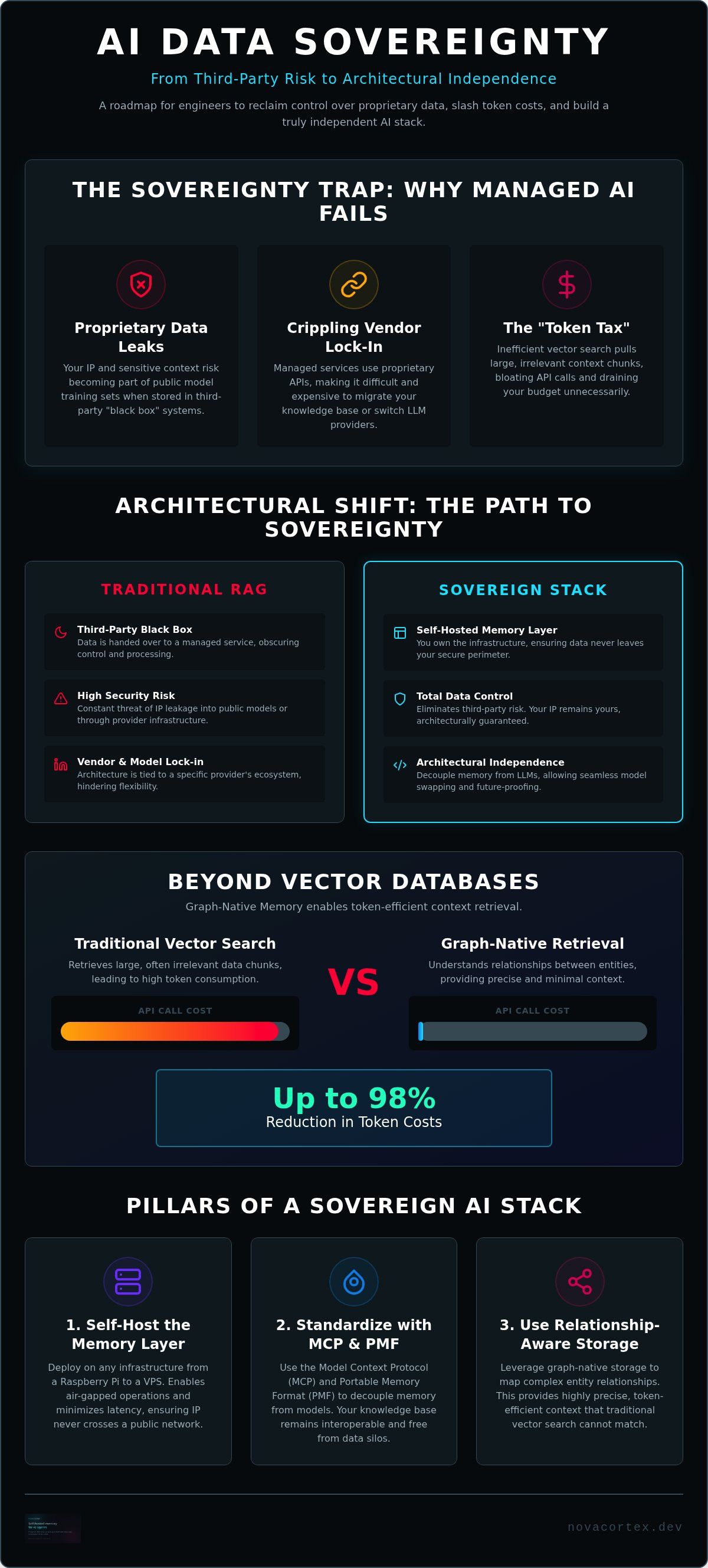
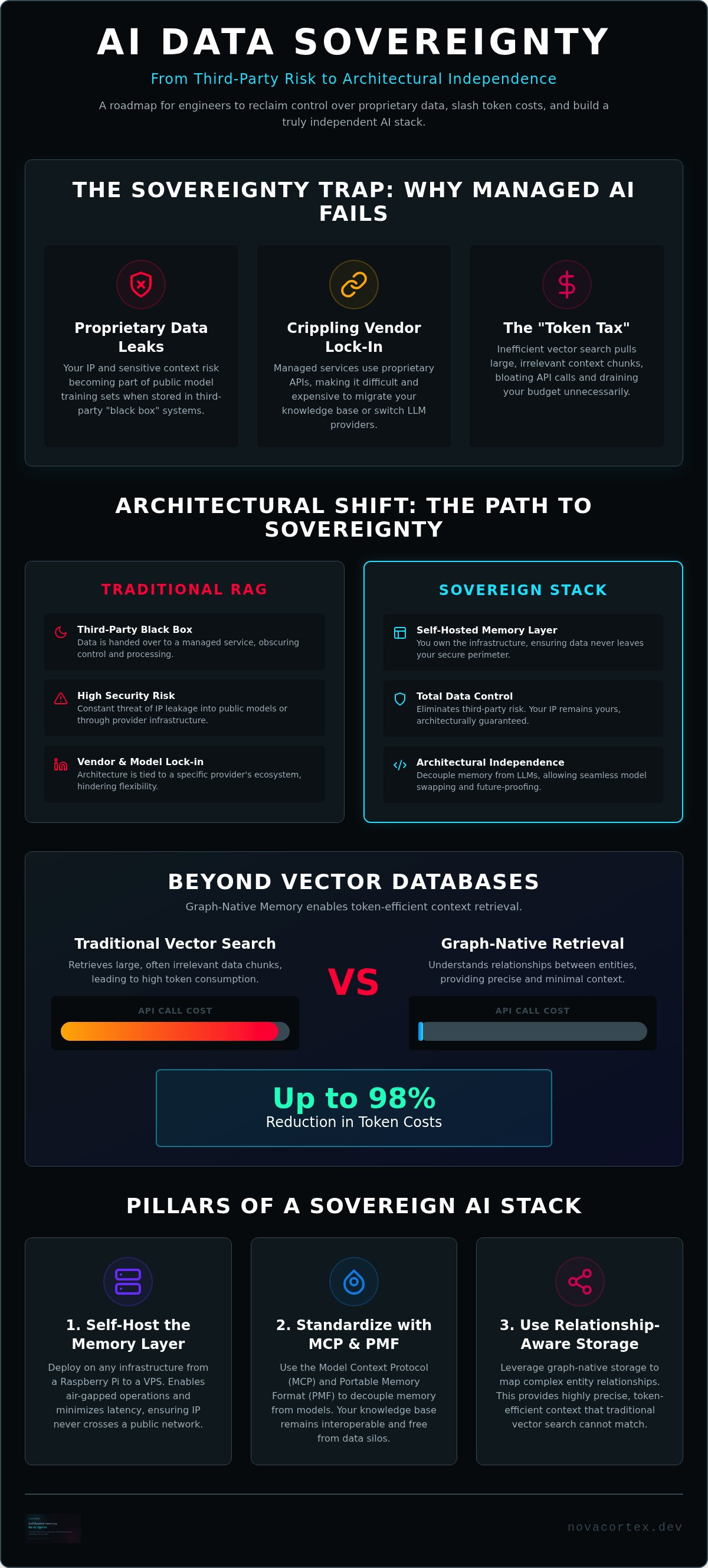
Traditional data residency is no longer enough. Storing a database in a specific geography satisfies a checkbox, but it doesn't grant you control over how an LLM processes your intellectual property. True Data Sovereignty in the agentic era is an architectural challenge. It requires ownership of the memory layer itself. When you use managed RAG services, you aren't just renting compute; you're exporting your corporate "brain" to a third-party black box. This creates a massive liability where your most sensitive context becomes a permanent resident of someone else's infrastructure.
Compliance frameworks like the EU AI Act, which became enforceable in August 2026, or California’s SB 53, mandate transparency and risk frameworks, but they don't solve the underlying engineering problem. Regulations are reactive; architecture is proactive. For enterprises, the real risk isn't just a fine. It's the "Token Tax." Inefficient data handling in managed vector databases forces agents to pull massive, irrelevant context chunks, draining budgets through bloated API costs. Effective AI data sovereignty solutions must move beyond legal policy and focus on technical independence.
Why Cloud-Native AI is a Sovereignty Trap
Managed AI services thrive on vendor lock-in. Moving a massive knowledge base between providers is intentionally difficult and expensive. Beyond the migration cost, there is the persistent threat of data leakage. Even with "enterprise" agreements, the risk of proprietary context being used to fine-tune future public models remains a visceral concern for R&D teams. Additionally, managed services often suffer from "contextual amnesia." They struggle to maintain long-term agent memory without racking up astronomical costs, forcing developers to choose between agent performance and fiscal sanity.
The Shift Toward Local-First AI Memory
The industry is hitting a breaking point. Gartner predicted that by the end of 2026, 35% of countries would establish regional AI infrastructures, driving a global shift toward "sovereignty by design." For the builder, this means moving the agent’s cognition to local or self-hosted environments. Local-first memory ensures that the retrieval process happens within your secure perimeter. Self-hosting is no longer a niche preference for hobbyists. It's a corporate necessity for any organization that views its data as a competitive advantage rather than a disposable commodity. By deploying AI data sovereignty solutions on private infrastructure, enterprises reclaim the ability to swap models, optimize retrieval precision, and eliminate third-party dependencies entirely.
Architectural Pillars of AI Data Sovereignty Solutions
Building a resilient agentic stack requires moving beyond surface-level encryption. True AI data sovereignty solutions rest on three technical pillars: self-hosting, protocol standardization, and relationship-aware storage. This architectural shift directly addresses the AI Sovereignty Paradox by ensuring that strategic control isn't sacrificed for model performance. It's about engineering a system where the agent's memory belongs to the builder, not the cloud provider. When you own the infrastructure, you own the intelligence it generates.
Self-Hosting the Memory Layer
Centralized RAG pipelines are a single point of failure for data privacy. When you host your own memory layer, you eliminate third-party intermediaries who might scrape your context for their own training sets. A self-hosted RAG server allows for air-gapped operations or deployment within a strictly controlled VPC. This isn't just a security preference. It's a performance optimization. Local retrieval minimizes the latency inherent in cloud-to-cloud communication and ensures that sensitive IP never crosses a public network. You gain the freedom to define your own security protocols without waiting for a vendor's update cycle.
The Role of MCP in Sovereign Systems
Vendor lock-in usually happens at the interface layer. If your memory is tied to a specific LLM's proprietary API, your knowledge base is effectively a hostage. An MCP native memory server solves this by using the Model Context Protocol to standardize how agents access stored knowledge. This protocol decouples the memory layer from the model provider. You can swap a closed-source model for a locally hosted Llama instance without rebuilding your entire database from scratch. It creates a future-proof stack where context is a portable, interoperable asset rather than a provider-specific silo.
Traditional vector search is losing its utility for complex tasks. Finding "similar" text chunks isn't enough for high-stakes agentic workflows. Graph-native storage goes deeper by mapping the explicit relationships between entities, providing the precision needed for complex reasoning. This approach turns flat data into a navigable knowledge web that agents can traverse with high accuracy. Whether you are deploying on a Raspberry Pi for edge operations or a high-performance enterprise VPS, the goal remains the same. You need a system that respects your ownership and scales with your needs. If you're ready to move beyond managed silos, you can explore the open-source implementation on GitHub to see these sovereign pillars in action.
Deploying these systems on private infrastructure is no longer a complex barrier to entry. Modern AI data sovereignty solutions are designed to be lean. They run efficiently on anything from a dedicated local server to a cloud-hosted private instance. By utilizing Knowledge Buckets, engineers can segment data based on sensitivity and use case, ensuring that the right context is always available without over-sharing. This granular control is the hallmark of a truly sovereign architecture.
Beyond Vector Databases: Engineering Token-Efficient Context
Traditional vector databases are failing the agentic era. They rely on semantic similarity, a "best guess" approach that often results in massive context dumping. When an agent requests information, a standard vector search pulls back large chunks of text that look like the answer but often contain irrelevant noise. This is wasteful engineering. It forces the LLM to process thousands of unnecessary tokens, driving up costs and increasing the likelihood of model hallucinations. True AI data sovereignty solutions require a shift from fuzzy retrieval to precise, relationship-aware memory layers.
Similarity is not understanding. A vector database might tell you that two documents are related because they share a vocabulary, but it cannot explain the structural connection between them. This lack of nuance creates a "Token Tax" that penalizes complex workflows. Engineers need systems that prioritize precision over volume, ensuring that every token sent to an LLM adds specific, actionable value to the agent's cognition.
Vector vs. Graph Memory for AI Agents
The Redis vs graph memory for AI agents debate is the defining technical choice for 2026. While vector stores excel at broad recall, they fail at high-precision reasoning. Graph-native storage maps the explicit relationships between entities, understanding that a specific user owns a specific permission within a specific project. It doesn't just find similar words; it follows technical connections. This architectural shift eliminates the "noise" that plagues managed RAG systems. By mapping these dependencies, you ensure the agent receives only the exact context required for the task. Precision beats volume every time.
The ROI of Token Efficiency
Inefficient retrieval is a direct tax on your innovation budget. When you dump irrelevant context into a prompt, you're paying for data the model doesn't need. Graph-native memory layers reduce token usage by up to 98% by delivering surgical precision in context retrieval. This isn't just about saving money; it's about system performance. Smaller, more accurate prompts lead to faster model responses and higher retrieval precision. You can scale your agentic workflows without seeing a linear explosion in your LLM API bills. High-velocity engineering requires lean operations, and graph-native structures are the only way to achieve that at scale.
Bloated vector databases are inherently slow. They require significant compute to manage high-dimensional embeddings and perform similarity searches across massive datasets. Graph-native layers outperform these legacy systems by traversing pre-defined relationships rather than recalculating distances for every query. This architectural superiority allows for faster retrieval and a more responsive agent experience. In the landscape of AI data sovereignty solutions, efficiency is the ultimate competitive advantage. Stop feeding the "Token Tax" and start engineering for precision.
Future-Proofing with Portable Memory Formats
Data silos are the silent killers of enterprise AI. If your agent's knowledge base is trapped in a proprietary cloud database, you don't actually own your intelligence. You're just leasing access to it. True AI data sovereignty solutions require a fundamental shift toward interoperability. The goal is a memory layer that exists independently of any single model or provider. This is where the Portable Memory Format (PMF) becomes essential. It ensures that your data remains a liquid asset, capable of moving across infrastructure without losing its structural integrity or relationship context.
Managed AI memory is a prison. When context is locked behind a vendor's specific embedding logic, your intellectual property is effectively held hostage. Sovereignty means having the technical capability to move your entire cognition layer to a different server or model in minutes, not months. This isn't just a strategy for risk mitigation; it's a requirement for high-velocity engineering teams who refuse to be tethered to a single provider's roadmap.
Breaking the Vendor Lock-in Cycle
Every portable memory format for AI must be strictly model-agnostic. Today, you might use GPT-4o; tomorrow, you might migrate to a fine-tuned Llama instance running on your own metal. If your memory layer is tied to a specific provider's API, that migration becomes a multi-month engineering nightmare. PMF eliminates this friction. It allows you to sync memory across dev, staging, and production environments without the need for constant re-indexing. This architectural independence turns your knowledge base into a long-term strategic asset rather than a temporary configuration file.
Knowledge Buckets for Scalable Memory
Scaling a multi-agent swarm requires more than just a shared database. It requires structured, modular state management. Knowledge Buckets allow you to segment memory based on specific tasks, security levels, or agent roles. This modularity is how you stop AI agents from forgetting critical context. Instead of a single, monolithic data dump, agents pull from targeted buckets that synchronize state across the entire swarm. This ensures persistent cognition even as agents are spun up or shut down. It's the difference between a collection of isolated scripts and a cohesive, sovereign workforce.
Sovereignty isn't just about where the data sits. It's about the legal and technical freedom to modify the system. The use of an Apache-2.0 license for the underlying memory layer ensures that your stack remains open and auditable. You have the right to inspect, fork, and extend your memory server without asking for permission. This transparency is a core requirement for high-risk AI systems under the EU AI Act of 2026. True AI data sovereignty solutions provide the code, the format, and the control necessary to build for the next decade, not just the next billing cycle.
Implementing NovaCortex: The Sovereign Memory Layer
The transition from a vulnerable RAG pipeline to a resilient, local-first architecture requires the right tooling. NovaCortex is the necessary correction to a market saturated with "black box" services. By deploying the NovaCortex Self-Hosted Edition, you move your agent's cognition out of the cloud and onto hardware you control. This isn't just about privacy; it's about building a high-velocity engineering stack that respects your intellectual property. Implementing these AI data sovereignty solutions ensures that your memory layer remains an asset rather than a liability.
Getting started is a matter of configuration, not complex infrastructure overhauls. The AI memory server setup is designed for rapid deployment, allowing you to establish a privacy-first context layer in minutes. Whether you are building a single specialized agent or a swarm of autonomous workers, the implementation process remains lean and developer-centric. You don't need a massive cloud budget to achieve architectural independence.
From Local Server to Global Scale
NovaCortex is hardware-agnostic by design. You can start small by running AI memory on Raspberry Pi for edge applications or secure local testing. As your needs grow, the system scales seamlessly to a high-performance VPS or enterprise-grade on-premise hardware. Integration is handled through the MCP-Native Memory Server, which provides a standardized interface for any agent framework. This decoupling allows you to manage multi-user controls and advanced security features without being tethered to a specific LLM provider's ecosystem. You gain a centralized, auditable control plane for all agentic knowledge.
Enterprise environments require more than just a repository; they need a scalable memory layer that supports high-volume workflows. NovaCortex facilitates this through modular Knowledge Buckets, enabling teams to segment data based on project requirements or security clearance. This structure prevents unauthorized context sharing while maintaining the high retrieval precision discussed in previous sections. For organizations ready to scale, managed infrastructure options provide the robustness of the cloud with the strict technical boundaries of a sovereign stack.
Join the Sovereign AI Movement
The era of renting intelligence from restrictive, proprietary silos is ending. NovaCortex is built for engineers who recognize that data ownership is the only path to long-term competitive advantage. By choosing AI data sovereignty solutions that prioritize portability and local control, you are future-proofing your stack against vendor shifts and regulatory volatility. You aren't just building an AI application; you're engineering a sovereign knowledge base that grows in value as your agents learn. It's time to reject the amnesia of managed services and embrace persistent, private cognition.
Stop compromising on your IP and start building with architectural confidence. The tools for digital independence are available and ready for production environments. Take control of your agentic memory and ensure your data stays where it belongs.
Deploy NovaCortex Self-Hosted Edition today
Architectural Sovereignty is Non-Negotiable
The agentic era demands more than just residency. It requires total technical control. We've moved beyond surface-level compliance toward a future defined by engineering independence. By prioritizing a self-hosted, graph-native memory layer, you eliminate the "Token Tax" and secure your intellectual property against third-party leaks. These AI data sovereignty solutions aren't just about security; they're about performance. You gain 98% token usage reduction and a future-proof stack that remains interoperable across any model you choose.
Your AI memory shouldn't be a black box or a vendor silo. With an Apache-2.0 open-source foundation, you have the transparency and freedom to scale without permission. The shift toward private, high-precision cognition is the necessary correction to today's bloated cloud ecosystems. It's time to build on your own terms. Reclaim your intelligence and stop renting your context from restrictive providers.
The tools for digital independence are ready. Take the first step toward a truly sovereign agentic stack and lead the industry toward better technical practices today.
Frequently Asked Questions
What is AI data sovereignty and why does it matter for my business?
AI data sovereignty is the technical and legal control over the entire information lifecycle within your AI systems. It matters because managed services often ingest proprietary data into public training sets, creating a massive intellectual property risk. Implementing AI data sovereignty solutions ensures your sensitive context stays within your secure perimeter, preventing leaks and ensuring compliance with global regulations like the EU AI Act.
How does a self-hosted memory layer improve AI data privacy?
A self-hosted memory layer improves privacy by eliminating third-party intermediaries in the RAG pipeline. When memory resides on your own infrastructure, sensitive context never leaves your VPC or local network. This controlled environment prevents external providers from scraping your data for model fine-tuning or secondary analysis, keeping your corporate "brain" strictly private.
Can I use NovaCortex with existing LLMs like GPT-4 or Claude?
Yes, NovaCortex is model-agnostic and integrates with any LLM via the MCP-Native Memory Server. It acts as an external cognition layer that feeds precise context to models like GPT-4 or Claude without locking you into their proprietary storage ecosystems. You maintain the flexibility to swap providers at any time while keeping your knowledge base intact and sovereign.
How does graph-native memory reduce token usage by 98%?
Graph-native memory achieves a 98% reduction in token usage through relationship-aware retrieval rather than broad semantic similarity. Instead of dumping massive text chunks into a prompt, the system follows explicit entity connections to retrieve only the exact data required. This surgical precision eliminates irrelevant "noise," significantly lowering the token count sent to the LLM for processing.
What is the Portable Memory Format (PMF) and how does it prevent lock-in?
The Portable Memory Format (PMF) is a standardized, model-independent data structure for AI context storage. It prevents lock-in by ensuring your knowledge base is not tied to a specific provider's embedding logic or database schema. You can move your entire memory layer between different servers and models, treating your intelligence as a portable, liquid asset rather than a provider-specific silo.
Is it possible to run a secure AI memory server on a Raspberry Pi?
Yes, NovaCortex is optimized for efficiency and can run a secure memory server on a Raspberry Pi 4 or newer. This edge-first capability allows for local-only retrieval and secure knowledge storage without the need for high-performance cloud compute. It's a pragmatic solution for developers requiring low-latency, private memory in decentralized or resource-constrained environments.
How does NovaCortex compare to traditional vector databases for RAG?
NovaCortex replaces fuzzy vector search with high-precision graph-native storage. Traditional vector databases often retrieve irrelevant results based on semantic similarity; NovaCortex understands the structural relationships between data points. This shift results in higher retrieval precision, lower token costs, and a more reliable agentic memory that doesn't suffer from the "contextual amnesia" common in managed vector stores.
What are the hardware requirements for self-hosting an AI memory layer?
Hardware requirements are minimal, ranging from a Raspberry Pi for edge use to a standard VPS for enterprise-scale deployments. The system is designed to be lean, prioritizing high-velocity performance without requiring specialized GPU hardware for the memory layer itself. This accessibility makes it a versatile and cost-effective component of modern AI data sovereignty solutions.
FAQ
What is AI data sovereignty and why does it matter for my business?
AI data sovereignty is the technical and legal control over the entire information lifecycle within your AI systems. It matters because managed services often ingest proprietary data into public training sets, creating a massive intellectual property risk. Implementing AI data sovereignty solutions ensures your sensitive context stays within your secure perimeter, preventing leaks and ensuring compliance with global regulations like the EU AI Act.
How does a self-hosted memory layer improve AI data privacy?
A self-hosted memory layer improves privacy by eliminating third-party intermediaries in the RAG pipeline. When memory resides on your own infrastructure, sensitive context never leaves your VPC or local network. This controlled environment prevents external providers from scraping your data for model fine-tuning or secondary analysis, keeping your corporate "brain" strictly private.
Can I use NovaCortex with existing LLMs like GPT-4 or Claude?
Yes, NovaCortex is model-agnostic and integrates with any LLM via the MCP-Native Memory Server. It acts as an external cognition layer that feeds precise context to models like GPT-4 or Claude without locking you into their proprietary storage ecosystems. You maintain the flexibility to swap providers at any time while keeping your knowledge base intact and sovereign.
How does graph-native memory reduce token usage by 98%?
Graph-native memory achieves a 98% reduction in token usage through relationship-aware retrieval rather than broad semantic similarity. Instead of dumping massive text chunks into a prompt, the system follows explicit entity connections to retrieve only the exact data required. This surgical precision eliminates irrelevant "noise," significantly lowering the token count sent to the LLM for processing.
What is the Portable Memory Format (PMF) and how does it prevent lock-in?
The Portable Memory Format (PMF) is a standardized, model-independent data structure for AI context storage. It prevents lock-in by ensuring your knowledge base is not tied to a specific provider's embedding logic or database schema. You can move your entire memory layer between different servers and models, treating your intelligence as a portable, liquid asset rather than a provider-specific silo.
Is it possible to run a secure AI memory server on a Raspberry Pi?
Yes, NovaCortex is optimized for efficiency and can run a secure memory server on a Raspberry Pi 4 or newer. This edge-first capability allows for local-only retrieval and secure knowledge storage without the need for high-performance cloud compute. It's a pragmatic solution for developers requiring low-latency, private memory in decentralized or resource-constrained environments.
How does NovaCortex compare to traditional vector databases for RAG?
NovaCortex replaces fuzzy vector search with high-precision graph-native storage. Traditional vector databases often retrieve irrelevant results based on semantic similarity; NovaCortex understands the structural relationships between data points. This shift results in higher retrieval precision, lower token costs, and a more reliable agentic memory that doesn't suffer from the "contextual amnesia" common in managed vector stores.
What are the hardware requirements for self-hosting an AI memory layer?
Hardware requirements are minimal, ranging from a Raspberry Pi for edge use to a standard VPS for enterprise-scale deployments. The system is designed to be lean, prioritizing high-velocity performance without requiring specialized GPU hardware for the memory layer itself. This accessibility makes it a versatile and cost-effective component of modern AI data sovereignty solutions.