AI Infrastructure Cost Optimization: Beyond the Observability Dashboard

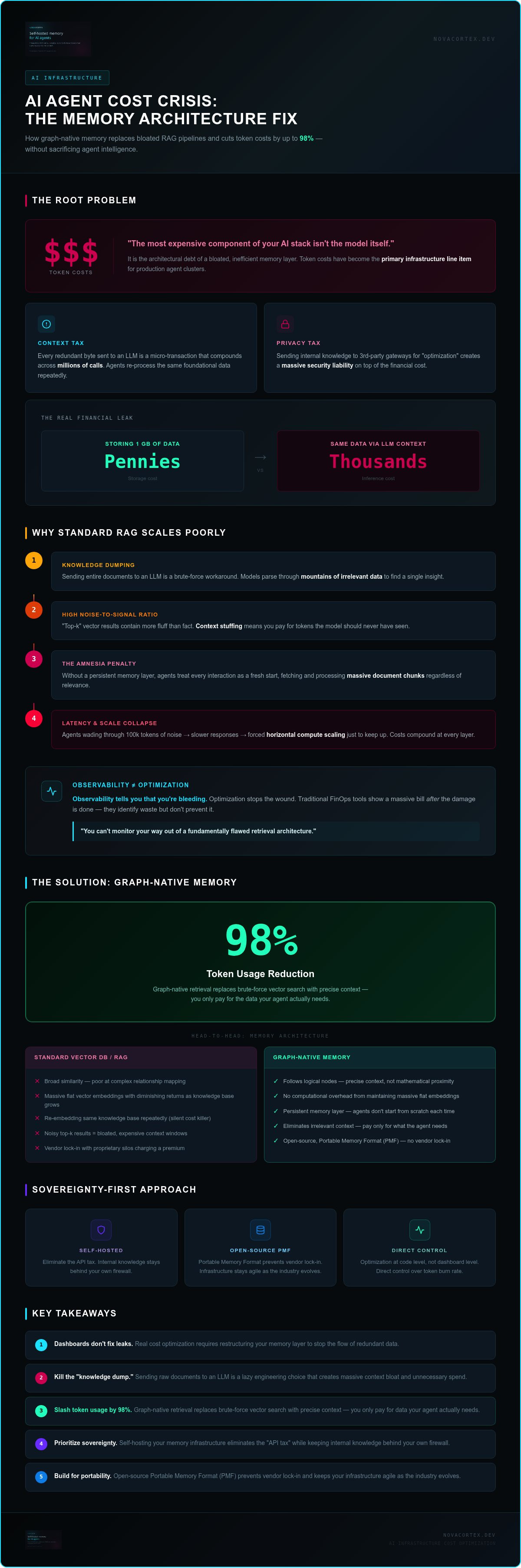
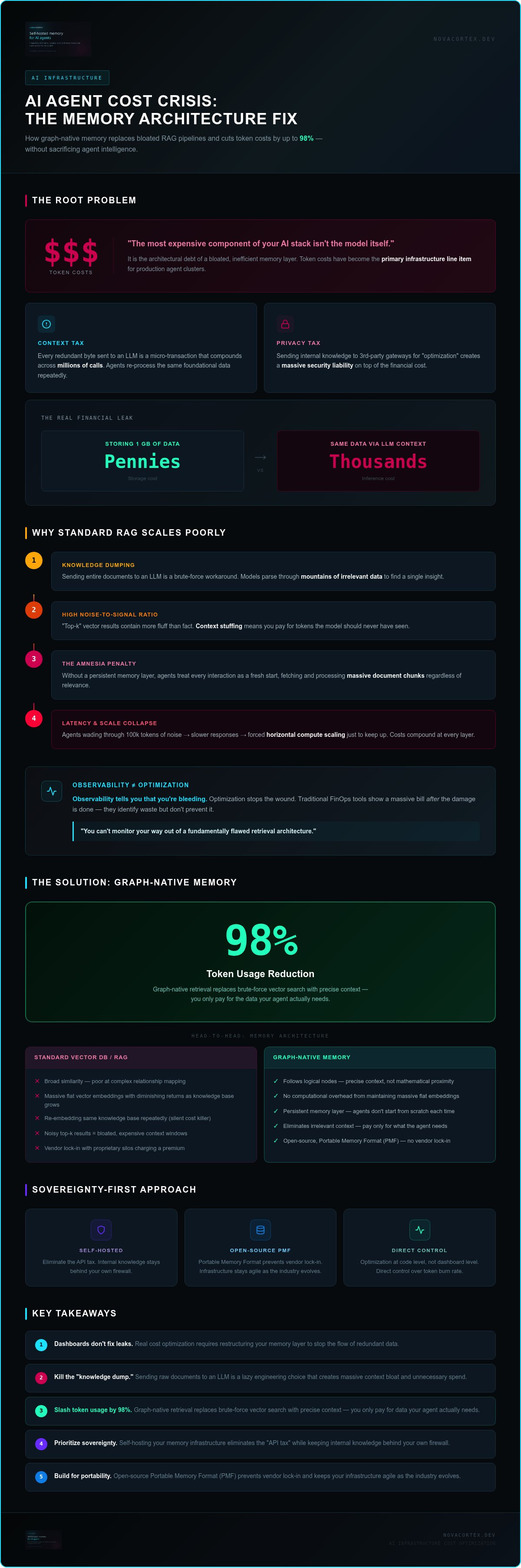
The most expensive component of your AI stack isn't the model itself. It is the architectural debt of a bloated, inefficient memory layer. You have likely watched your LLM token costs skyrocket as agents dump redundant context into every prompt. It is a cycle of waste that turns high-performance retrieval into a massive API tax. True AI infrastructure cost optimization requires more than just a colorful observability dashboard showing you how much money you lost yesterday. It demands a fundamental shift in how your system handles knowledge.
You shouldn't have to choose between agent intelligence and your bottom line. We will show you how to slash AI agent operating costs by 98% through architectural memory optimization. This isn't about minor tweaks to your monitoring setup. It is about reclaiming digital sovereignty and ending the reliance on third-party gateways that compromise your privacy. This article breaks down the transition from wasteful context dumping to a lean, graph-native memory architecture that ensures predictable spending and peak performance.
Key Takeaways
- Dashboards don't fix leaks. Real AI infrastructure cost optimization requires restructuring your memory layer to stop the flow of redundant data.
- Kill the "knowledge dump." Sending raw documents to an LLM is a lazy engineering choice that creates massive context bloat and unnecessary spend.
- Slash token usage by 98%. Graph-native retrieval replaces brute-force vector search with precise context, ensuring you only pay for the data your agent actually needs.
- Prioritize sovereignty. Self-hosting your memory infrastructure eliminates the "API tax" while keeping internal knowledge behind your own firewall.
- Build for portability. Using an open-source, Portable Memory Format (PMF) prevents vendor lock-in and keeps your infrastructure agile as the industry evolves.
Beyond Dashboards: The 2026 AI Cost Crisis
AI has moved past the honeymoon phase. Production agent clusters are now live, and with them comes a brutal reality: token costs have become the primary infrastructure line item. For most engineering teams, the bill is a black box. You see the spike, you pay the provider, and you hope the next deployment is leaner. This isn't sustainable. True AI infrastructure cost optimization isn't about finding a cheaper LLM provider. It's about fundamentally reducing inference overhead through aggressive, architectural context management.
We are currently facing a "Context Tax." Every redundant byte sent to an LLM is a micro-transaction that compounds across millions of calls. When your agents lack a persistent, efficient memory layer, they are forced to re-process the same foundational data repeatedly. It's architectural debt in its most expensive form.
The Hidden Costs of Modern AI Stacks
The industry has a storage bias. The real financial leak is inference. Storing a gigabyte of data costs pennies; passing that same data through an LLM context window costs thousands. Most implementations of Retrieval-Augmented Generation (RAG) suffer from what we call the "Amnesia Penalty." Without a sophisticated memory layer, agents treat every interaction as a fresh start, fetching and processing massive document chunks regardless of relevance.
This inefficiency is magnified by vendor lock-in. Managed vector databases and proprietary AI gateways often trap your data in silos. They charge a premium for the convenience of "easy" integration, but they offer zero control over the underlying retrieval logic. You're left paying for their overhead while your own system remains bloated.
Why Observability is Not Optimization
Observability tells you that you're bleeding. Optimization stops the wound. Traditional FinOps tools and AI gateways focus on reactive monitoring; they show you a massive bill after the damage is done. They identify waste, but they don't prevent it. You can't monitor your way out of a fundamentally flawed retrieval architecture.
Relying on 3rd-party gateways also introduces a "Privacy Tax." Sending internal knowledge to a third-party for "optimization" creates a massive security liability. In high-stakes environments, a data breach carries a price tag that no observability dashboard can offset. You need to move from reactive monitoring to proactive architectural engineering. Optimization happens at the code level, not the dashboard level. It requires a self-hosted, sovereign approach to AI infrastructure cost optimization that eliminates the middleman and gives you direct control over your token burn.
Architectural Waste: Why Standard RAG Scales Poorly
Standard RAG is failing. Sending entire documents to an LLM isn't architecture; it's a brute-force workaround that signals an engineering failure. This "knowledge dumping" approach forces models to parse through mountain ranges of irrelevant data just to find a single pebble of insight. Every irrelevant token retrieved is a direct hit to your budget.
High noise-to-signal ratios in vector search lead to bloated context windows. The "top-k" results often contain more fluff than fact. This "context stuffing" is the enemy of AI infrastructure cost optimization. LLMs charge for every token. When your retrieval system is noisy, you're paying a massive premium for data the model should never have seen.
Don't ignore latency. Time-to-first-token impacts system throughput. If your agent is wading through 100k tokens of noise, your users are waiting. High latency kills retention and forces you to scale compute horizontally just to keep up with sluggish response times. Adhering to emerging AI infrastructure standards and frameworks requires a move toward more precise, efficient data handling.
Vector Databases vs. Graph Memory
Engineers are currently debating Redis vs graph memory for AI agents. Traditional vector databases are excellent for broad similarity but fail at complex relationship mapping. Precision retrieval is the solution. Graph-native storage eliminates irrelevant context by following logical nodes rather than just mathematical proximity. You avoid the computational overhead of maintaining and searching massive, flat vector embeddings that offer diminishing returns as your knowledge base grows.
The Tokenomics of Redundant Retrieval
We define Tokenomics as the financial study of LLM input and output efficiency. In most stacks, the cost of re-embedding the same knowledge base repeatedly is a silent killer. We solve this through modular context loading. Using "Knowledge Buckets" allows you to segment data, loading only the specific partitions required for a task. This prevents the "all-or-nothing" retrieval pattern that drains budgets.
Audit your retrieval logic if you're tired of paying for noisy context. You can start by exploring sovereign memory architectures that prioritize precision over brute force.
Strategic Comparison: Memory Layers vs. Managed Gateways
Choosing between managed AI gateways and self-hosted memory layers is a pivot point for your burn rate. Managed infrastructure offers the illusion of speed. It promises rapid deployment with zero maintenance. However, evaluating the Total Cost of Ownership (TCO) reveals a different reality. For teams scaling production agent clusters, self-hosted vs managed AI memory is a financial decision, not just a technical one. Digital sovereignty is a fundamental requirement for AI infrastructure cost optimization.
Security is a direct cost-saver. A single data breach involving internal knowledge can carry a multi-million dollar price tag in legal fees and lost trust. By keeping your memory layer within your own infrastructure, you eliminate the risk of sending sensitive context to a third-party gateway. You aren't just protecting data. You're protecting your balance sheet from catastrophic liability. High-performance systems demand that data stays where it lives.
Managed AI Gateways: The Convenience Trap
SaaS gateways are built on hidden margins. You pay for the provider's compute, their engineering team, and their profit. These recurring fees scale linearly with your usage, creating a permanent tax on your intelligence stack. Proprietary memory formats further entrench this problem. Once your agent's history is locked into a vendor's black box, migration costs become prohibitive. You also face latency penalties. Routing requests through external cloud environments adds milliseconds that degrade user experience and reduce total system throughput.
Self-Hosted Memory: The Sovereignty Advantage
Self-hosting is zero-margin infrastructure. You pay only for the raw compute you use. Systems like NovaCortex allow you to integrate AI agent long term memory directly into your private VPC. This setup ensures that your context retrieval remains low-latency and high-velocity. It also eliminates the per-user licensing fees that plague managed services.
The Portable Memory Format (PMF) is a critical component of this strategy. It ensures your data remains interoperable, reducing future migration toil. While managed gateways force you into a restrictive ecosystem, a self-hosted approach prioritizes independence. You gain the ability to handle multi-agent synchronization across your entire cluster without being penalized for growth. This is how you achieve predictable, scalable AI infrastructure cost optimization.
Engineering Efficiency: Slashing Token Usage by 98%
Engineering efficiency is won at the retrieval layer. While competitors focus on monitoring the damage, you must focus on the architecture that prevents it. Slashing token usage by 98% isn't a vague goal; it's the result of moving from brute-force vector search to graph-native retrieval. This shift transforms your stack from a wasteful data-dumper into a precision instrument.
Step 1: Replace similarity-based vector search with graph-native logic. Vector search is a blunt instrument. It retrieves chunks based on mathematical proximity, often pulling in irrelevant noise that bloats your context window. Graph-native retrieval follows logical relationships. It ensures the model only sees what is strictly necessary for the current task.
Step 2: Deploy MCP-native memory servers. High-latency requests to external memory providers add overhead and cost. By utilizing the Model Context Protocol (MCP) locally, you inject context directly into the agent's workflow. This eliminates the "convenience trap" of managed cloud environments.
Step 3: Implement Knowledge Buckets. You shouldn't load your entire knowledge base for every query. Knowledge Buckets allow you to prune agent memory dynamically. This keeps context windows lean and prevents the "context stuffing" that leads to budget exhaustion.
Step 4: Establish local feedback loops. Optimization should happen on-prem. Continuous tuning of your retrieval logic via local loops avoids the API tax of external gateways. This is the core of sustainable AI infrastructure cost optimization.
The Mechanics of 98% Token Reduction
Standard RAG is noisy. In a typical implementation, an agent might pull in 10,000 tokens of "relevant" text, of which only 200 are actually useful. The LLM still charges you for all 10,000. NovaCortex memory layers solve this by filtering noise at the data structure level. 98% token reduction is achieved by retrieving only high-relevance graph nodes. By traversing specific edges in a knowledge graph, the system identifies the exact data points required. You stop paying for the fluff.
MCP Architecture as a Cost Controller
The Model Context Protocol (MCP) is more than a standard; it's a cost-saving tool. It standardizes agent-memory communication. This eliminates the need for expensive, custom-built middleware "glue code" that consumes compute resources. A standardized handshake means less overhead and faster execution.
Standardizing on MCP also allows you to build a vendor-neutral stack. You can swap LLM providers based on current spot pricing without rewriting your memory integration logic. This flexibility is essential for long-term AI infrastructure cost optimization. You gain the power to move your workloads to the most cost-effective compute available at any given moment.
NovaCortex: Sovereignty-First Infrastructure Optimization
NovaCortex is the architectural answer to the AI cost crisis. It is not another monitoring layer that simply records your financial losses. It is a specialized, graph-native memory layer designed to stop the bleed at the source. By moving your memory logic from a black-box SaaS to your own hardware, you gain total transparency. You can audit every retrieval path and optimization rule. You don't have to trust a vendor's claims when you can verify the engineering yourself.
Our roadmap to zero-waste AI is built on three pillars: local memory, portable formats, and graph-native speed. We have replaced the bloated, high-latency patterns of the past with a lean system that prioritizes digital sovereignty. Getting started is a matter of deploying the server on your existing infrastructure. You don't need a massive migration project to achieve AI infrastructure cost optimization. You only need to change how your agents remember.
The NovaCortex Self-Hosted Advantage
The NovaCortex Self-Hosted Edition is designed for extreme environmental flexibility. It runs on anything from a Raspberry Pi for edge-case testing to an enterprise-grade VPS for massive production clusters. This portability gives you total control over memory persistence and data privacy. You own the compute. You own the data. You own the results.
This approach eliminates the "Privacy Tax" that managed AI services silently collect. When you send internal knowledge to a third-party gateway, you aren't just paying for the API call. You are paying with your intellectual property. Self-hosting ensures your internal knowledge stays behind your firewall, removing the multi-million dollar liability of a potential data breach. It's a pragmatic correction to a market that has favored convenience over security for too long.
Future-Proofing Your AI Spend
Long-term flexibility requires a standard that outlasts any single LLM provider. The Portable Memory Format (PMF) ensures your memory layer is never a dead end. It allows you to migrate knowledge between models and environments without the massive cost of re-embedding your entire knowledge base. This interoperability is a foundational principle of our system, not a performative feature. It keeps your stack agile and your budget predictable.
Joining the NovaCortex community means contributing to the future of open-source AI memory. We are setting a new standard for how agents interact with data. By utilizing our Apache-2.0 licensed framework, you are choosing a path of independence and high-velocity performance. This is the final step in a comprehensive strategy for AI infrastructure cost optimization. You've seen the waste. Now, implement the solution.
Reclaiming Architectural Sovereignty
Observability dashboards are merely autopsy reports for your budget. Real efficiency is built at the memory layer. By abandoning the "knowledge dump" and adopting graph-native retrieval, you eliminate the noise that drives up token burn. You move from being a passenger on a vendor's billing cycle to becoming the architect of your own efficiency.
True AI infrastructure cost optimization isn't a passive activity. It requires a firm rejection of bloated managed gateways and a commitment to digital sovereignty. With a 98% reduction in token usage and the transparency of an Apache-2.0 open-source license, NovaCortex provides the graph-native performance needed for production agent clusters. You don't have to settle for the "convenience trap" of high-margin SaaS providers. You can deploy a self-hosted memory layer today and stop the financial leak immediately.
The path to zero-waste AI is open. It's time to build a stack that respects your data, your privacy, and your bottom line. You have the tools to end the API tax and reclaim control over your inference overhead. Build something that lasts.
Frequently Asked Questions
How does graph-native memory reduce AI infrastructure costs compared to vector databases?
Graph-native memory uses relationship-based traversal to isolate exact context nodes. Vector databases rely on broad similarity, often pulling in noisy, irrelevant document chunks that bloat the prompt. By filtering noise at the data structure level, graph-native systems ensure you only pay for high-relevance tokens. This precision is the foundation of effective AI infrastructure cost optimization.
Can I really reduce my LLM token usage by 98%?
Yes, benchmarks demonstrate up to a 98% reduction when moving from standard RAG to graph-native retrieval. Traditional systems dump entire knowledge bases or large chunks into the context window, creating massive waste. NovaCortex identifies and retrieves only the specific nodes required for a query. You stop paying for the redundant fluff that usually accompanies standard vector search results.
What are the hardware requirements for self-hosting an AI memory layer?
NovaCortex is designed for extreme architectural flexibility. You can deploy the self-hosted edition on anything from a Raspberry Pi for edge testing to an enterprise-grade VPS for production clusters. Because the system is optimized for performance and lean operations, it doesn't require specialized AI hardware. It runs efficiently on standard Linux environments with minimal CPU and RAM overhead.
Is NovaCortex compatible with all LLM providers like OpenAI and Anthropic?
NovaCortex is model-agnostic and functions as a specialized memory layer between your application and any LLM provider. It integrates seamlessly with OpenAI, Anthropic, and local models. By standardizing the memory format, you gain the freedom to swap providers based on spot pricing or performance needs. This vendor-neutral approach is critical for long-term infrastructure efficiency and financial agility.
How does the Model Context Protocol (MCP) help with cost optimization?
The Model Context Protocol (MCP) standardizes communication between AI agents and their memory servers. This eliminates the need for expensive, custom-built middleware that consumes compute resources. MCP-native servers allow for low-latency, local context injection. By reducing the glue code and external API calls required for memory management, you lower the total operational cost. This promotes sustainable AI infrastructure cost optimization.
What is the Portable Memory Format and why does it prevent vendor lock-in?
The Portable Memory Format (PMF) is an open standard that keeps your data interoperable. Most managed services trap your agent's history in proprietary silos, making migration costs prohibitive. PMF allows you to export and move your memory layer between different models or hosting environments. It ensures that your architectural decisions remain flexible as the AI industry evolves.
How long does it take to see ROI after implementing a self-hosted memory layer?
ROI is often immediate upon the first production deployment. You see a direct reduction in token billing the moment you switch from document-dumping to graph-native retrieval. Because the system is open source under Apache-2.0, there are no upfront licensing fees. The combination of lower API taxes and eliminated SaaS margins creates a rapid shift from waste to architectural efficiency.
Does self-hosting my AI memory layer improve response latency?
Self-hosting significantly improves latency by keeping memory retrieval inside your private VPC. Routing requests through third-party AI gateways adds unnecessary network hops and processing delays. A local, MCP-native memory server provides high-velocity context injection. This speed improves user experience and increases total system throughput, allowing your infrastructure to handle more agents without a corresponding increase in hardware spend.
FAQ
How does graph-native memory reduce AI infrastructure costs compared to vector databases?
Graph-native memory uses relationship-based traversal to isolate exact context nodes. Vector databases rely on broad similarity, often pulling in noisy, irrelevant document chunks that bloat the prompt. By filtering noise at the data structure level, graph-native systems ensure you only pay for high-relevance tokens. This precision is the foundation of effective AI infrastructure cost optimization.
Can I really reduce my LLM token usage by 98%?
Yes, benchmarks demonstrate up to a 98% reduction when moving from standard RAG to graph-native retrieval. Traditional systems dump entire knowledge bases or large chunks into the context window, creating massive waste. NovaCortex identifies and retrieves only the specific nodes required for a query. You stop paying for the redundant fluff that usually accompanies standard vector search results.
What are the hardware requirements for self-hosting an AI memory layer?
NovaCortex is designed for extreme architectural flexibility. You can deploy the self-hosted edition on anything from a Raspberry Pi for edge testing to an enterprise-grade VPS for production clusters. Because the system is optimized for performance and lean operations, it doesn't require specialized AI hardware. It runs efficiently on standard Linux environments with minimal CPU and RAM overhead.
Is NovaCortex compatible with all LLM providers like OpenAI and Anthropic?
NovaCortex is model-agnostic and functions as a specialized memory layer between your application and any LLM provider. It integrates seamlessly with OpenAI, Anthropic, and local models. By standardizing the memory format, you gain the freedom to swap providers based on spot pricing or performance needs. This vendor-neutral approach is critical for long-term infrastructure efficiency and financial agility.
How does the Model Context Protocol (MCP) help with cost optimization?
The Model Context Protocol (MCP) standardizes communication between AI agents and their memory servers. This eliminates the need for expensive, custom-built middleware that consumes compute resources. MCP-native servers allow for low-latency, local context injection. By reducing the glue code and external API calls required for memory management, you lower the total operational cost. This promotes sustainable AI infrastructure cost optimization.
What is the Portable Memory Format and why does it prevent vendor lock-in?
The Portable Memory Format (PMF) is an open standard that keeps your data interoperable. Most managed services trap your agent's history in proprietary silos, making migration costs prohibitive. PMF allows you to export and move your memory layer between different models or hosting environments. It ensures that your architectural decisions remain flexible as the AI industry evolves.
How long does it take to see ROI after implementing a self-hosted memory layer?
ROI is often immediate upon the first production deployment. You see a direct reduction in token billing the moment you switch from document-dumping to graph-native retrieval. Because the system is open source under Apache-2.0, there are no upfront licensing fees. The combination of lower API taxes and eliminated SaaS margins creates a rapid shift from waste to architectural efficiency.
Does self-hosting my AI memory layer improve response latency?
Self-hosting significantly improves latency by keeping memory retrieval inside your private VPC. Routing requests through third-party AI gateways adds unnecessary network hops and processing delays. A local, MCP-native memory server provides high-velocity context injection. This speed improves user experience and increases total system throughput, allowing your infrastructure to handle more agents without a corresponding increase in hardware spend.