AI Knowledge Buckets: Engineering Modular Memory for Persistent Agents
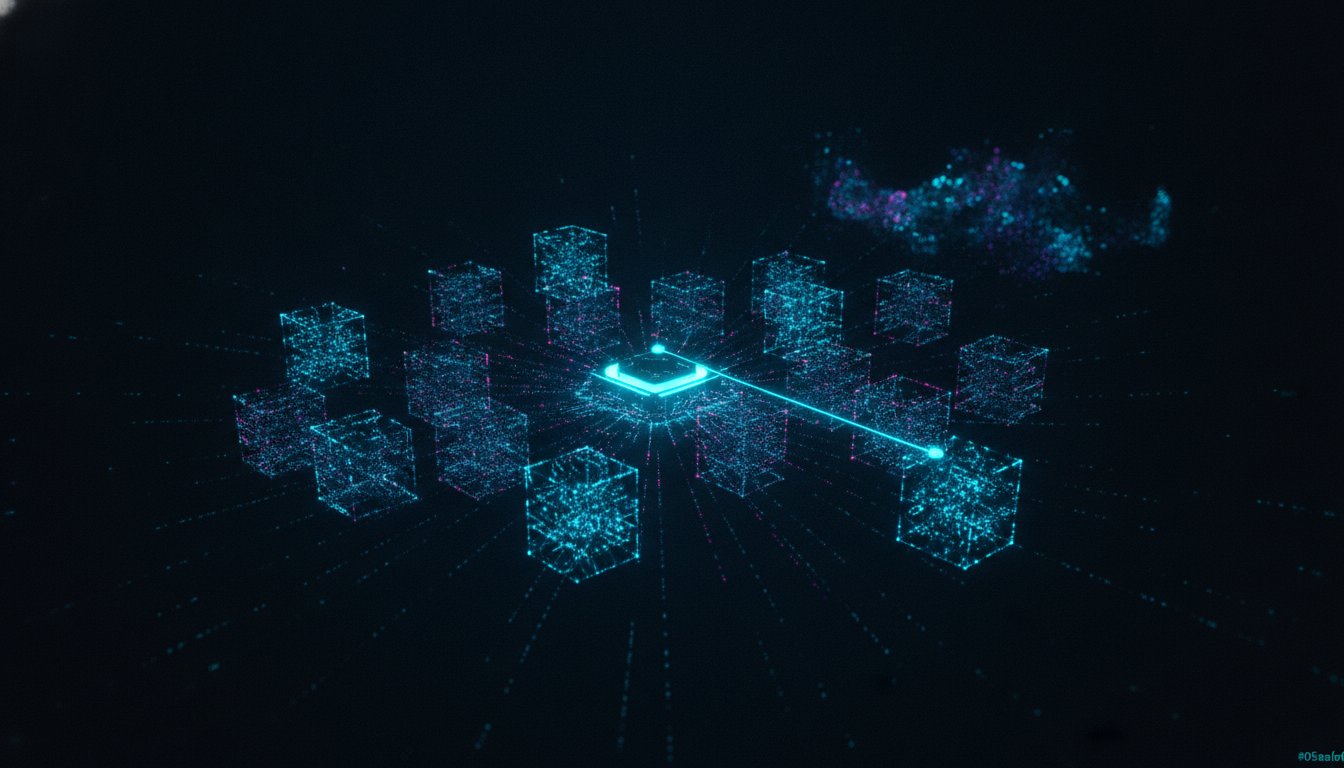
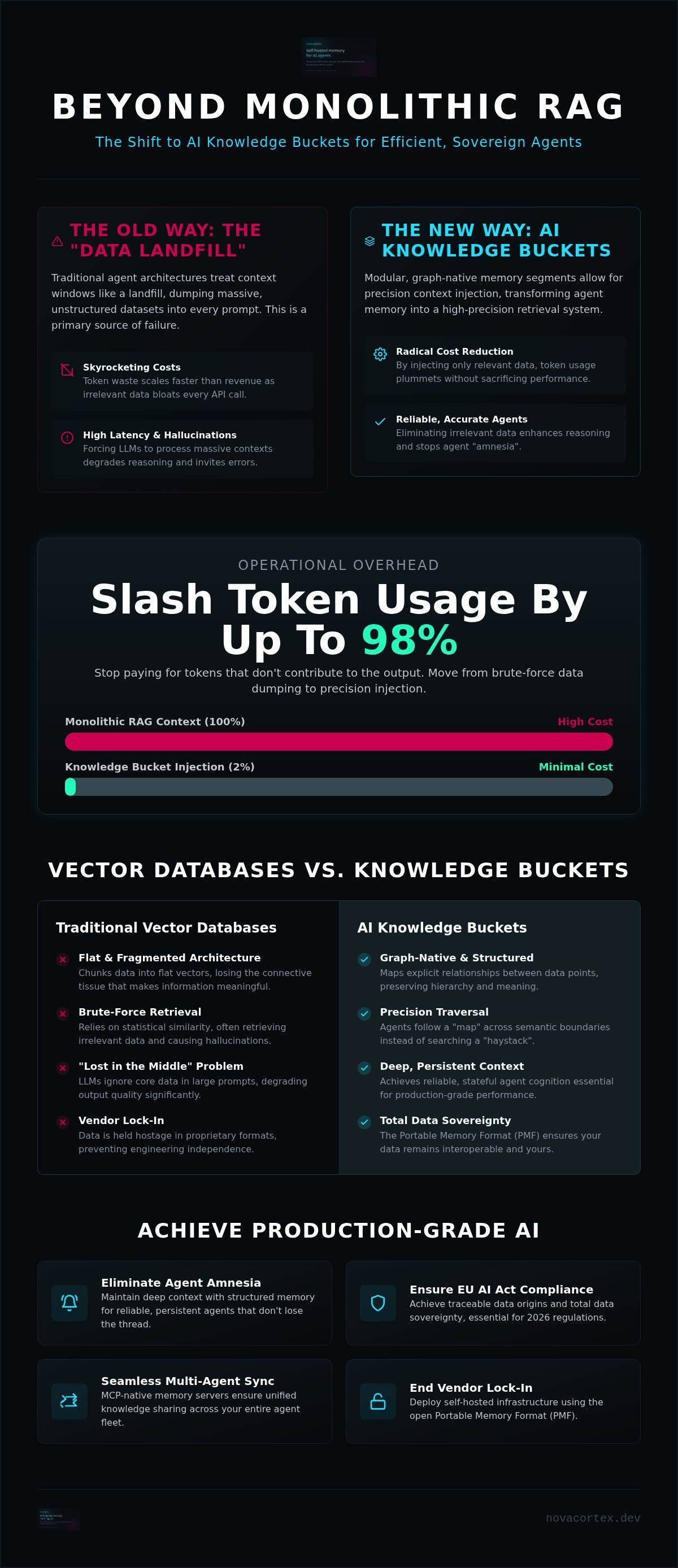
Your current agent architecture is likely bleeding capital. Most developers treat context windows like a landfill, dumping massive datasets into every prompt and hoping the LLM finds the signal. It's an engineering failure that leads to high latency, persistent hallucinations, and token waste that scales faster than your revenue. To build persistent, reliable agents, you must move beyond the "dump-everything" RAG model. You need AI knowledge buckets. These modular, graph-native memory segments allow for precision context injection without the bloat or cost of proprietary vector databases.
We agree that vendor lock-in and skyrocketing API costs are the primary barriers to production-grade AI. This guide provides the framework to master modular memory using the NovaCortex Self-Hosted Edition and the Portable Memory Format (PMF). You'll learn how to eliminate agent amnesia and slash token usage by 98% while maintaining total data sovereignty. We will break down the transition from monolithic context to an MCP-native memory server that respects both your budget and the rigorous data governance requirements of the 2026 EU AI Act.
Key Takeaways
- Replace monolithic context windows with AI knowledge buckets to transform agent memory from a data landfill into a modular, high-precision retrieval system.
- Leverage graph-native architectures to map complex relationships between memory segments, ensuring agents maintain deep context without irrelevant retrieval or hallucinations.
- Slash operational overhead by achieving up to a 98% reduction in token usage through precision context injection rather than brute-force data dumping.
- Architect multi-agent ecosystems using MCP-native memory servers to ensure seamless state synchronization and unified knowledge sharing across your entire agent fleet.
- Secure digital sovereignty by deploying self-hosted infrastructure that eliminates vendor lock-in through the open Portable Memory Format (PMF).
What are AI Knowledge Buckets? Defining Modular Memory
Monolithic context windows are an engineering dead end. The industry's current obsession with "infinite" context has created a generation of bloated, expensive, and hallucination-prone agents. To fix this, we must transition to AI knowledge buckets. These are not just storage units. They are discrete, high-dimensional memory segments engineered for precision retrieval. By moving away from the "dump-everything" model, you give your agents the ability to navigate complex datasets without the cognitive overhead of irrelevant data.
In a standard RAG setup, LLMs struggle with a high "Cognitive Load." When you force a model to process 100,000 tokens to find a single fact, reasoning quality degrades. This is a systemic inefficiency. Modular memory architecture utilizes metadata and relational tagging to create a filtered stream of information. A 2026 forecast indicates that 77% of organizations cannot trace the origins of their AI training data. This lack of structure isn't just a compliance nightmare under the EU AI Act; it's a technical bottleneck that AI knowledge buckets are designed to solve.
The Death of the Flat Knowledge Base
Dumping raw text into a vector database is no longer sufficient. It's a brute-force approach to a precision problem. Large context windows frequently suffer from the "Lost in the Middle" phenomenon. Research shows that LLMs prioritize the beginning and end of a prompt while effectively ignoring the core data in the center. Modularity kills this inefficiency. By segmenting data into functional buckets, you eliminate the noise that causes agent drift. You stop paying for tokens that don't contribute to the output.
Buckets as Semantic Segments
A folder is a passive storage container. A knowledge bucket is a graph-native context segment. These buckets are categorized by utility, time-sensitivity, and relational importance. In a graph-native system, buckets aren't isolated islands. They are connected via high-dimensional edges that define how information flows between them. This architecture allows an agent to hop between relevant buckets without ever touching the 98% of your data that is irrelevant to the current query. It's the difference between searching a library and having the exact page you need handed to you. Using the Portable Memory Format (PMF) ensures these segments remain interoperable and sovereign, preventing the vendor lock-in common with proprietary vector providers.
Architecting Long-Term Memory with Graph-Native Buckets
Vector databases are inherently flat. They treat information as a series of coordinates in a vacuum. This approach is insufficient for agents that require deep, persistent cognition. AI knowledge buckets built on graph-native foundations solve this by mapping the explicit relationships between data points. Instead of relying on the statistical probability of similarity, graph-native memory allows for precise traversal across semantic boundaries. It's the difference between a list of names and a detailed organizational chart.
In this architecture, entities exist as nodes within a bucket. These nodes are connected by edges that define their relationship, whether it's causal, temporal, or hierarchical. This structure prevents the "lost in the middle" problem because the agent isn't searching a haystack; it's following a map. Persistent context is achieved when an agent can move between buckets without losing the thread of its objective. For autonomous workflows, this reliability is the baseline for production-grade performance.
Graph-Native vs. Vector Storage
Vector databases suffer from context fragmentation. When you chunk data into flat vectors, you lose the connective tissue that makes information meaningful. Graph-native storage maintains this hierarchy. It ensures that AI agent long term memory stays structured and accessible. By using a graph-native approach, you reduce the "Token Tax" by only retrieving the specific sub-graph required for the task. This is a technical necessity for engineering agents that don't just guess, but actually know.
The Portable Memory Format (PMF) Advantage
Vendor lock-in is the enemy of engineering independence. Most managed vector providers keep your data hostage in proprietary formats. The Portable Memory Format (PMF) changes this. It allows you to package your AI knowledge buckets into an interoperable schema. This is critical for meeting data sovereignty requirements like those outlined in the 2026 EU AI Act or the California CCPA regulations. PMF ensures your memory layer is portable. You can switch LLM providers or hosting environments without losing your agent's history. You can start building this sovereign infrastructure today by checking out the NovaCortex open-source server.
Vector Databases vs. Knowledge Buckets: A Technical Comparison
Vector databases are the industry's blunt instrument. They rely on cosine similarity to find "near" matches in a high-dimensional space. It's a probabilistic approach that often fails in production. When you query a flat vector store, you're essentially asking for a statistical guess. AI knowledge buckets replace this guesswork with architectural precision. By using graph-native traversal instead of simple similarity scores, buckets deliver context that is architecturally relevant, not just mathematically close.
The performance gap is measurable. Traditional RAG systems suffer from a massive "Token Tax." They dump the top-k results into the context window, forcing the LLM to sift through irrelevant noise. This bloats your API bills and increases latency. Knowledge buckets eliminate this waste. By retrieving only the specific sub-graph required for a task, you ensure the model receives high-density signal. Scaling graph-native memory is often perceived as complex, but modern lake-native architectures, like those seen in Milvus 3.0, prove that modularity and scale are no longer mutually exclusive.
Precision Retrieval Metrics
Hit rate is a deceptive metric. A vector database might have a high hit rate but low context relevance, leading to "clean" hallucinations where the model sounds confident but is factually untethered. Buckets solve this by providing structured context. They act as a filter that prevents irrelevant data from ever reaching the LLM. When evaluating Redis vs graph memory for AI agents, the primary differentiator isn't just raw latency; it's the throughput of meaningful information. Graph memory consistently outperforms flat KV stores in complex, multi-hop reasoning tasks because it respects the relationships between data points.
The Economics of AI Memory
The ROI of modular memory is found in the reduction of operational overhead. Managed vector databases in 2026 typically cost between $0.25 to $2.00 per GB-month for storage alone, but the real cost is in the tokens. Brute-force RAG is an economic drain that scales poorly. NovaCortex achieves a 98% token reduction by replacing broad semantic search with targeted graph-native traversal that only serves the essential context required for each prompt. This efficiency makes agentic workflows sustainable. It transforms AI from a high-cost experiment into a lean, high-velocity production asset. By moving to a modular framework, you don't just save money; you build a more resilient system that isn't dependent on the ever-increasing context windows of proprietary providers.
Implementing Knowledge Buckets for Multi-Agent Synchronisation
Context silos are the primary cause of multi-agent failure. When agents operate in isolation, they duplicate processing cycles and generate conflicting outputs. AI knowledge buckets solve this by providing a unified, graph-native memory layer that multiple agents can query and update in real time. Structuring this requires a shift from local agent memory to a centralized, modular architecture. It's a fundamental move toward collective intelligence.
The first step is defining the schema. You must categorize data by its functional role within the agent fleet. Some buckets hold static domain knowledge, while others store dynamic session state. This modularity ensures that an agent specialized in data analysis can pull from the same "source of truth" bucket as the agent handling client communications. It eliminates the redundancy of individual agents re-indexing the same information. Memory becomes a shared resource rather than a private cache.
Serving Context via MCP
Standardizing how agents talk to memory is the next engineering hurdle. The MCP native memory server provides the ideal delivery vehicle. It allows heterogeneous agent fleets to access AI knowledge buckets via a unified protocol, regardless of the underlying LLM provider. This abstraction layer reduces retrieval latency. It ensures that context injection is consistent across the entire ecosystem. By using an MCP-native approach, you build for interoperability from day one.
State Management and Conflict Resolution
Shared memory introduces the risk of race conditions. If "Agent A" updates a bucket while "Agent B" is reading it, the resulting state can become corrupted. Version control within the bucket architecture is the only viable solution. A 2026 forecast found that 77% of organizations cannot trace the origins of their AI training data. This is a significant compliance gap under the EU AI Act. Implementing read/write permissions and change-tracking within your buckets addresses this. It provides the auditability required for high-risk AI systems in finance or human resources.
Memory isn't infinite. Effective bucket management requires strict Time-to-Live (TTL) policies. Pruning irrelevant nodes prevents the graph from becoming a digital graveyard. You must engineer your buckets to discard low-utility data while preserving high-dimensional relationships. This ensures that your agents always operate on high-velocity, high-relevance data. It's about maintaining a lean, performant system that scales without the typical "Token Tax" of bloated context windows.
NovaCortex: The Infrastructure for Sovereign Knowledge Buckets
Cloud-managed memory is a liability. Entrusting your agent's cognitive state to proprietary third-party providers creates a precarious dependency that compromises both security and performance. NovaCortex is the architectural correction to this trend. It's a self-hosted, graph-native memory layer designed for engineers who demand total control over their data. By deploying AI knowledge buckets locally, you eliminate the latency of external API calls and the risk of vendor lock-in. You own the infrastructure. You own the memory.
NovaCortex implements the Portable Memory Format (PMF) and graph-native buckets out of the box. This isn't a complex, heavyweight system that requires a dedicated DevOps team. It's lean. It's high-velocity. Whether you're deploying on a Raspberry Pi for local experimentation or a high-performance VPS for production agent fleets, NovaCortex scales without the bloat. It transforms the way agents interact with information, moving from expensive, brute-force search to precision context injection.
Privacy-First Architecture
The choice between self-hosted vs managed AI memory is the most critical architectural decision of 2026. Managed providers often treat your data as fuel for their own training sets. This is an unacceptable risk for any organization handling sensitive intellectual property or regulated data. Self-hosting with NovaCortex ensures your AI knowledge buckets remain within your perimeter. It's the only way to achieve true digital sovereignty while remaining compliant with the strict data governance requirements of the EU AI Act.
Getting Started with NovaCortex
Initializing your first knowledge bucket is a straightforward engineering task. NovaCortex is built for interoperability. It integrates seamlessly with existing agent frameworks like LangChain and AutoGPT via its MCP-native architecture. You don't need to rewrite your entire stack to gain the benefits of modular memory. You simply point your agents to your local NovaCortex server and start segmenting your knowledge base.
The process is efficient. You define your schema, ingest your data using the PMF standard, and watch as your token costs drop by 98%. This isn't just about saving money; it's about building more intelligent, persistent agents that don't suffer from the amnesia common in flat-vector systems. The future of AI is modular, sovereign, and self-hosted. Join the movement toward independent engineering and reclaim your data sovereignty.
Build your sovereign memory layer today. Access the NovaCortex Self-Hosted Edition on GitHub.
Reclaim Your Digital Sovereignty
The era of brute-force RAG is over. Engineering persistent agents requires a shift from monolithic context dumps to precision-engineered AI knowledge buckets. Graph-native storage provides the relational depth necessary for complex reasoning while slashing token usage by 98%. By adopting a modular memory architecture, you eliminate agent amnesia and reclaim total control over your data.
Digital sovereignty is a technical requirement for high-risk AI deployments. Self-hosting your memory server ensures your intellectual property remains private and compliant with evolving global regulations. NovaCortex provides the lean, open-source infrastructure needed to scale these systems without the burden of vendor lock-in.
The future of agentic cognition is modular, sovereign, and entirely within your control. It's time to start building.
Frequently Asked Questions
What is the primary difference between a vector database and a knowledge bucket?
Vector databases rely on flat similarity search to find statistical matches in a coordinate space. In contrast, AI knowledge buckets are modular, graph-native segments that define explicit relationships between data points. This architecture provides structural context rather than just probabilistic guesses, ensuring higher retrieval precision for complex agent workflows.
How do AI knowledge buckets help in reducing LLM token costs?
Buckets eliminate the "Token Tax" of traditional RAG by serving only the exact sub-graph required for a prompt. NovaCortex achieves a 98% reduction in token usage because it avoids dumping large, irrelevant text chunks into the context window. You stop paying for the noise that usually accompanies broad semantic searches.
Can I use knowledge buckets with existing RAG pipelines?
You can integrate buckets into your current stack as a specialized memory layer. They function as a modular upgrade to standard retrieval steps, allowing you to inject structured context into any agentic framework. This improves reasoning quality without forcing a complete architectural overhaul of your existing LLM implementation.
Is NovaCortex compatible with the Model Context Protocol (MCP)?
NovaCortex is an MCP-native memory server. It uses this protocol to standardize context delivery across heterogeneous agent fleets, ensuring that different models can query the same memory segments seamlessly. This compatibility facilitates low-latency interaction and prevents the fragmentation often found in custom memory solutions.
Do knowledge buckets prevent AI agents from "forgetting" long-term context?
Knowledge buckets effectively eliminate agent amnesia by persisting state in a graph-native format outside the volatile context window. While standard LLM memory is limited by token length, buckets maintain a permanent record of relational data. Agents can retrieve specific historical context whenever it becomes relevant to the current task.
What is the Portable Memory Format (PMF) and why does it matter for buckets?
PMF is an open-source schema designed for packaging modular memory segments for total interoperability. It matters because it prevents vendor lock-in and ensures digital sovereignty for your data. By using PMF, you can move your buckets between different LLM providers or self-hosted environments without losing the underlying knowledge structure.
Can I host my own AI knowledge buckets on a Raspberry Pi?
You can host NovaCortex on lightweight hardware like a Raspberry Pi or a basic VPS. The system is engineered for lean operations, making it ideal for developers who prioritize privacy-first, local-first infrastructure. This self-hosted approach keeps your sensitive data within your own physical perimeter and away from proprietary cloud training sets.
How do knowledge buckets handle multi-agent memory synchronisation?
Buckets facilitate synchronization by serving as a centralized, shared graph for your entire agent ecosystem. NovaCortex manages version control and read/write permissions to prevent state conflicts between different agents. This ensures every agent in the fleet operates on a unified, real-time source of truth.
FAQ
What is the primary difference between a vector database and a knowledge bucket?
Vector databases rely on flat similarity search to find statistical matches in a coordinate space. In contrast, AI knowledge buckets are modular, graph-native segments that define explicit relationships between data points. This architecture provides structural context rather than just probabilistic guesses, ensuring higher retrieval precision for complex agent workflows.
How do AI knowledge buckets help in reducing LLM token costs?
Buckets eliminate the "Token Tax" of traditional RAG by serving only the exact sub-graph required for a prompt. NovaCortex achieves a 98% reduction in token usage because it avoids dumping large, irrelevant text chunks into the context window. You stop paying for the noise that usually accompanies broad semantic searches.
Can I use knowledge buckets with existing RAG pipelines?
You can integrate buckets into your current stack as a specialized memory layer. They function as a modular upgrade to standard retrieval steps, allowing you to inject structured context into any agentic framework. This improves reasoning quality without forcing a complete architectural overhaul of your existing LLM implementation.
Is NovaCortex compatible with the Model Context Protocol (MCP)?
NovaCortex is an MCP-native memory server. It uses this protocol to standardize context delivery across heterogeneous agent fleets, ensuring that different models can query the same memory segments seamlessly. This compatibility facilitates low-latency interaction and prevents the fragmentation often found in custom memory solutions.
Do knowledge buckets prevent AI agents from "forgetting" long-term context?
Knowledge buckets effectively eliminate agent amnesia by persisting state in a graph-native format outside the volatile context window. While standard LLM memory is limited by token length, buckets maintain a permanent record of relational data. Agents can retrieve specific historical context whenever it becomes relevant to the current task.
What is the Portable Memory Format (PMF) and why does it matter for buckets?
PMF is an open-source schema designed for packaging modular memory segments for total interoperability. It matters because it prevents vendor lock-in and ensures digital sovereignty for your data. By using PMF, you can move your buckets between different LLM providers or self-hosted environments without losing the underlying knowledge structure.
Can I host my own AI knowledge buckets on a Raspberry Pi?
You can host NovaCortex on lightweight hardware like a Raspberry Pi or a basic VPS. The system is engineered for lean operations, making it ideal for developers who prioritize privacy-first, local-first infrastructure. This self-hosted approach keeps your sensitive data within your own physical perimeter and away from proprietary cloud training sets.
How do knowledge buckets handle multi-agent memory synchronisation?
Buckets facilitate synchronization by serving as a centralized, shared graph for your entire agent ecosystem. NovaCortex manages version control and read/write permissions to prevent state conflicts between different agents. This ensures every agent in the fleet operates on a unified, real-time source of truth.