AI Knowledge Graph Implementation: From Data to Persistent Memory

A knowledge graph can help an AI connect facts, but it can also make errors harder to spot. Successful AI knowledge graph implementation starts before you choose a database: define the entities and relationships your system needs, then decide how facts enter, change, and leave the graph. Without clear validation and update rules, extraction errors and stale links can become part of an AI agent’s persistent memory.
If you’re deciding how to model your data or where graph retrieval belongs alongside text and semantic search, start by identifying the questions the system needs to answer. A graph is useful when it returns relevant, current evidence that an AI system can use, not simply because it can display connections.
This guide lays out a practical path from source data to persistent memory. You’ll learn how to design a focused schema, build an extraction and validation pipeline, evaluate retrieval quality, and keep relationships current. It also explains when graph-native memory earns its place in an AI architecture, and when hybrid retrieval that combines graph, text, and semantic search is a better fit. The goal is a maintainable retrieval system, not a one-off diagram. For organizations looking to advance beyond initial prototypes, enterprise partners such as pronix.ai help transition AI pilots into secure, scalable production outcomes.
Key Takeaways
- Start with the questions your AI needs to answer, then define entity types and relationships around those query patterns.
- Use graph retrieval to trace connections, semantic retrieval to find conceptually related passages, and text retrieval when exact wording matters.
- Make AI knowledge graph implementation a governed pipeline. Test extraction separately from retrieval so you can pinpoint where errors enter.
- For self-hosted, graph-native AI memory, NovaCortex is an Apache-2.0 licensed option that keeps customer data on customer infrastructure.
AI Knowledge Graph Implementation: What the System Must Actually Do
AI systems can retrieve the right paragraph but miss how its facts connect. A project update may name an owner, a deadline, and a dependency across separate documents. If retrieval returns those passages in isolation, the model has to reconstruct the relationships from fragments and may get them wrong. Effective AI knowledge graph implementation makes important connections queryable rather than relying on text chunks alone.
A knowledge graph represents entities and the typed relationships between them. Entities are nodes, such as a person or project. Relationships are edges, such as leads or depends on. Properties attach details to nodes or edges, such as a project’s status or the date a relationship was recorded. The Knowledge Graph overview describes this basic structure. In an AI system, the goal is to retrieve graph facts with useful context, not simply to display them.
The implementation should produce structured, traceable facts that a retrieval system can return as evidence. A graph can show what the system has recorded and how entities connect. It cannot guarantee that an extracted fact is true or that a generated answer is correct. Source quality, extraction, validation, retrieval, and the language model’s use of evidence all affect the result.
What belongs in an AI knowledge graph?
Start with a source fact: “Mina leads the Atlas migration project.” The extracted entities are Mina, a person, and Atlas migration, a project. The relationship is leads, connecting Mina to the project. Each label carries meaning, so a query can distinguish a person from a project and a leadership link from a dependency.
Keep the layers distinct. Source text is evidence; extracted entities and relationships are the graph’s interpretation of that evidence. Metadata, such as the source document, extraction time, or confidence value, helps downstream systems assess context and trace a claim back to its origin. Preserve that provenance rather than storing a bare edge with no explanation.
When is graph structure useful for AI?
Graph structure is useful when questions require connected facts. For example, “Which team owns the project that depends on Atlas migration?” may require traversing from a project to a dependency, then from that project to its owning team. Relationship-aware retrieval can follow those typed links. Isolated passage retrieval may find relevant text without reliably assembling the path.
This distinction matters for multi-hop questions, entity histories, and answers that connect evidence from different sources. It also lets the retrieval layer expose the path behind a result, making it easier to inspect how related facts support an answer.
Not every query needs a graph. A simple lookup for an independently stored fact may be handled more directly with text or semantic retrieval. Model relationships when they support real query patterns, not just because a graph is available. Make connections explicit where they improve retrieval, while keeping straightforward lookups simple.
Design the Knowledge Graph: Entities, Relationships, and Provenance
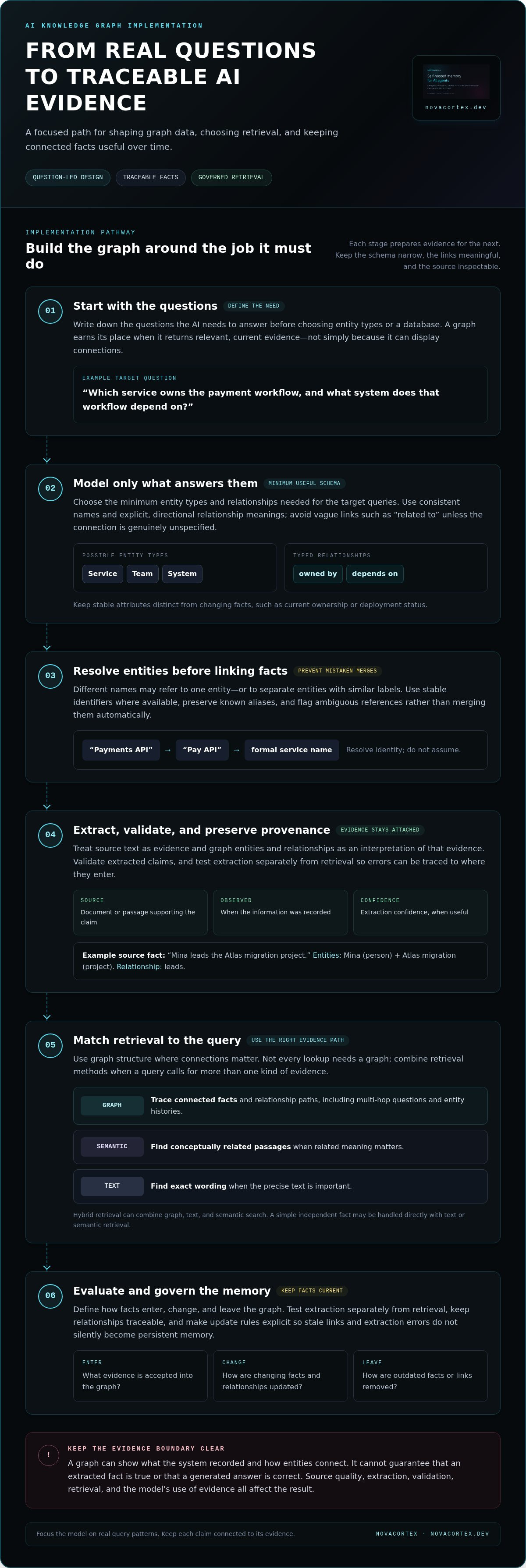
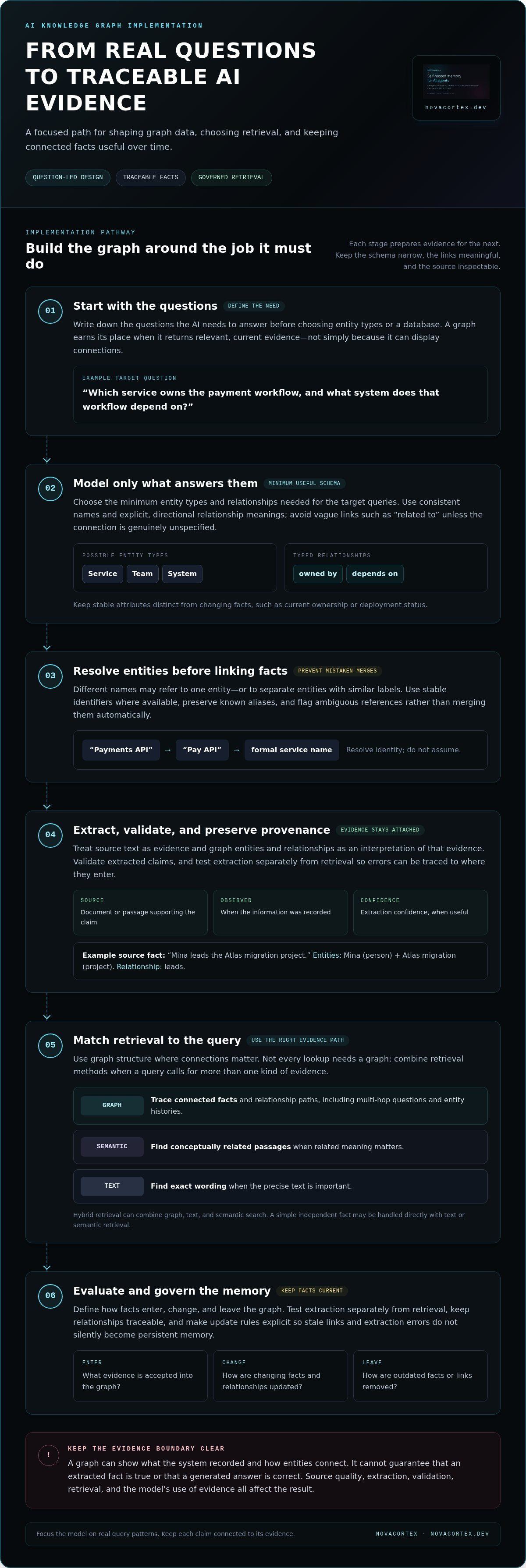
A graph schema should answer real questions, not anticipate every fact your organization might ever store. Before choosing entity types, write down the queries the AI needs to handle. For example: “Which service owns the payment workflow, and what system does that workflow depend on?” The answer determines which entities and links you need. This use-case-first approach keeps AI knowledge graph implementation focused and prevents an ontology from becoming a second, harder-to-maintain data catalog.
Large-scale efforts such as the NSF Open Knowledge Network show how interconnected knowledge can support AI applications. A smaller implementation benefits from the same discipline: model the concepts and connections that improve retrieval, and make evidence traceable.
Model for questions
Start with a narrow domain. List the target questions, then identify the minimum entity types and relationships needed to answer them. For a software-support graph, entities might include Service, Team, and System. Relationships such as owned by and depends on should communicate direction and meaning. Avoid vague edges such as related to unless the relationship is genuinely unspecified.
A small ontology provides a shared vocabulary that keeps labels consistent. If one ingestion path calls an entity “Application” and another calls the same concept “Service,” retrieval can fragment facts across duplicate categories. Define naming conventions and relationship meanings before scaling extraction. Keep stable attributes, such as a system’s registered identifier, distinct from changing facts, such as its current owner or deployment status. Changing information needs room to change without rewriting what the entity is.
Resolve entities
Before connecting extracted claims, determine whether different names refer to the same entity. “Payments API,” “Pay API,” and a formal service name might be aliases for one system, or separate systems with similar labels. Use stable identifiers where available, preserve known aliases, and flag ambiguous references rather than merging them automatically. A mistaken merge can spread one extraction error across every relationship attached to that node.
Preserve provenance
Each relationship should remain traceable to the material that supports it. Depending on the application, useful provenance may include the source document or passage, when it was observed, and an extraction confidence value. These are design considerations, not a universal required schema. The key is that a reviewer or retrieval process can distinguish a sourced claim from an untraceable graph assertion.
Define a review path for conflicts, duplicates, and low-confidence claims. When two sources disagree about who owns a service, retain enough source context to compare them instead of silently overwriting one claim. When new evidence changes the answer, update, supersede, or retire the stale relationship according to an explicit policy. This prevents old facts from accumulating as if they were all current. To inspect a graph-native memory implementation, explore the NovaCortex open-source repository.
Choose Graph, Semantic, or Text Retrieval for Each AI Query
A retrieval system should match its method to the question. Relationship traversal, conceptual similarity, and exact phrase matching are different jobs. Treating every query as a vector search can miss explicit connections; treating every query as a graph traversal can add needless complexity. In AI knowledge graph implementation, retrieval works best when the system selects evidence that fits the query and returns enough context for the model to use it responsibly.
Graph retrieval
Best for: relationship and multi-hop questions, such as “Which team owns the service that depends on the billing system?”
Returns: connected entities, typed relationships, and the path linking them.
Semantic retrieval
Best for: paraphrased questions or searches for a concept expressed in different words.
Returns: passages ranked by conceptual similarity, even when they don’t share the query’s exact terms.
Text retrieval
Best for: exact phrases, identifiers, names, or citation checks.
Returns: matching terms and the source passages where they appear.
Match retrieval to the question
Choose graph retrieval when the answer depends on how entities connect. A query asking which team owns a project that depends on a particular system needs a path through relationships, not just passages containing the system’s name. Semantic retrieval is a better fit when someone asks about an idea using unfamiliar wording. Text retrieval is useful when they need an exact error code, a contract phrase, or the sentence that supports a claim.
These methods can work together, but hybrid retrieval is a design choice, not a default. A system might use text search for an identifier, then traverse graph links to find its owner. Another query may need only a semantically relevant passage. Combining methods doesn’t guarantee better accuracy; it adds value only when the combined evidence improves answers to actual user queries.
Return evidence, not a data dump
Retrieve the smallest useful set of facts or passages rather than sending the model an entire knowledge base. For graph results, include the entities, relationship labels, and path that support the answer. For text or semantic results, retain the source passage and enough surrounding context to preserve its meaning. A bare claim without provenance is harder to ground or verify.
Ranking also needs testing. Build a set of representative questions and check whether the right evidence appears near the top, whether irrelevant matches crowd it out, and whether the returned context actually supports the answer. If facts change over time, test recency weighting against cases where the newest information should win, as well as cases where an older authoritative source remains relevant. Measure each retrieval path against the application’s queries. Keep methods that produce useful evidence and remove complexity that doesn’t.
Implement the Pipeline: Ingest, Retrieve, and Evaluate
Build the pipeline as a sequence of testable stages, not one opaque process that turns documents into answers. Start with a constrained corpus and a set of representative application questions. That gives you a manageable way to validate each transformation before expanding ingestion. In AI knowledge graph implementation, failures should be traceable: a wrong answer might come from a bad extraction, a mistaken entity match, stale stored data, or retrieval that returned the wrong evidence.
- Select source data. Choose relevant, accessible material for the target use case. Record what each source represents and how changes to it will be detected.
- Define the schema. Establish the entity types, relationship types, and properties needed to answer the test questions. Keep the model narrow enough to validate.
- Extract claims. Convert source material into candidate entities and relationships. Keep each claim connected to the passage that supports it.
- Resolve entities. Match aliases and repeated references to the right entity. Flag ambiguous cases instead of forcing a merge.
- Store validated records. Persist accepted facts with their source context and relevant metadata. Apply consistent rules for updates and removals.
- Retrieve evidence. Run the query against the appropriate retrieval path and return concise, relevant facts or passages to the model.
- Evaluate results. Compare retrieved evidence and generated answers with expectations from your test questions. Log failures by pipeline stage.
Test extraction separately
Extraction tests check whether the system identified the correct entities and relationships from known source text. For each sample, compare the proposed records with the evidence: Was the relationship actually stated? Were its direction and participants captured correctly? Did entity resolution merge distinct people or systems? This isolates data-quality defects before they become retrieval defects.
Evaluate retrieval and answers
Build an evaluation set from real application questions. For each question, record the expected entities, relationships, or source passages that should support a response. Test whether retrieval returns that evidence, then inspect whether the answer stays within what the evidence supports. Fluency alone is not a quality signal; a confident answer can still rely on irrelevant or missing context.
Track failure types separately: missing evidence, irrelevant results, stale relationships, and claims unsupported by retrieved material. Re-run the same tests after schema, extraction, entity-resolution, or retrieval changes. Compare results against the application’s needs rather than adopting a universal pass rate. Review failures, adjust the responsible stage, and preserve the test case so the same regression can’t slip back in unnoticed.
Run AI Knowledge Graph Memory on Infrastructure You Control
A graph model becomes useful to an AI agent when it can persist, retrieve, and update memory within the architecture you operate. NovaCortex is a self-hosted, graph-native memory layer for AI agents. It is open source under the Apache-2.0 license, and customer data never leaves the customer’s infrastructure. That makes it relevant when data control is part of the implementation requirement, not an afterthought.
How does NovaCortex fit an implementation?
NovaCortex organizes graph-native memory into four typed kinds: Episodic, Semantic, Procedural, and Working. These distinctions let agents handle different forms of remembered context rather than treating every stored item as interchangeable. Its semantic and text retrieval uses OpenAI-compatible embeddings, supports optional recency weighting, and enforces strict namespace isolation.
The native MCP server exposes 15 tools to Claude, Cursor, and MCP-compatible clients, giving those systems an interface to persistent memory. For a closer look at how this pattern fits agent workflows, see the MCP-native memory server architecture.
Portability matters as memory systems evolve. NovaCortex uses the Portable Memory Format (PMF), an open RFC‑001 standard, export/import as JSON, binary MessagePack (~60 % smaller), or AES‑256‑GCM encrypted bundles, Merkle-verified. The format is vendor-neutral and provides a defined way to move memory while preserving a verifiable format.
How can teams start with a self-hosted deployment?
NovaCortex is fully self-hostable via a single Docker Compose command. Run it on infrastructure you control, then connect an MCP-compatible client and test retrieval against representative agent queries. Keep the first pass narrow: verify that the client can access the intended memory and that retrieved context is useful before expanding the integration.
docker compose up -d
# Web:  http://localhost:3000
# API:  http://localhost:3001
# Docs: http://localhost:3000/docs
Once the service is running, use the web interface or API to inspect the memory layer, configure an MCP-compatible client, and test a representative query end to end. Check that the returned entities, relationships, and source context support the answer you expect. Then expand the integration based on observed retrieval quality, not assumptions about what the graph should contain.
For teams comparing approaches, NovaCortex offers a concrete path from graph-native memory design to a self-hosted agent integration. Review the open-source project and test the deployment with your own questions and evidence.
Turn the Design Into a Working Memory Layer
Choose one real workflow and test whether persistent relationships help your AI answer it with relevant evidence. Keep the first scope small, define what a useful answer must cite, and use the results to guide what you model next. That gives your AI knowledge graph implementation a measurable purpose instead of letting the graph grow without a retrieval need.
For teams evaluating an implementation path, NovaCortex combines graph-native memory with four typed memory kinds and a native MCP server that exposes 15 tools to Claude, Cursor, and MCP-compatible clients. It is open source under Apache-2.0 and self-hosted, so customer data stays on customer infrastructure. These capabilities provide a concrete foundation to evaluate against your architecture and requirements.
Start with the project materials, trace how the memory layer fits your agent workflow, and use a representative query to evaluate the integration. If your team requires hands-on engineering support to build and integrate complex architectures, partnering with a custom software and AI development specialist like 4mation can accelerate delivery. Small, evidence-led tests turn an architecture decision into a practical next step.
Explore NovaCortex on GitHub and test its self-hosted memory layer with a representative query from your AI workflow.
Frequently Asked Questions
What is an AI knowledge graph?
An AI knowledge graph is structured information about entities and the relationships connecting them, organized so AI systems can retrieve context beyond a single passage. For example, a support assistant could connect a product to its version, owning team, and known issues. Those links help retrieval follow the context behind a question. The graph supplies organized evidence; the AI model interprets that evidence and generates a response.
How do you build a knowledge graph from unstructured text?
For AI knowledge graph implementation, begin with a small, relevant set of documents and define the questions the graph should answer. Extract candidate entities and relationships, normalize names, and resolve aliases before storing them. Validate each candidate against its original passage, keeping the passage available for review. Then test retrieval with representative questions. This staged approach helps isolate whether an error came from extraction, entity matching, or retrieval.
Can an AI knowledge graph work with a vector database?
Yes. A graph can work alongside vector retrieval when the application needs both explicit relationship traversal and concept-based passage search. For example, semantic retrieval can find documentation about account recovery, while graph traversal identifies the service and team responsible for that process. Keep each method’s role clear and test whether combining their results helps answer actual queries. A vector database alone doesn’t provide typed relationship paths.
What happens when a knowledge graph contains conflicting facts?
Conflicting facts should remain distinguishable until a clear resolution rule applies. Preserve each claim’s source and relevant time context, then compare source authority, recency, and whether the statements refer to the same entity or period. For example, two documents may name different project owners because one is outdated. Route unresolved or ambiguous claims for review, and make retrieval avoid presenting a disputed fact as settled.
How do you keep an AI knowledge graph up to date?
Connect graph updates to changes in the source material, then reprocess only affected claims where practical. When an ownership document changes, check the related entity and relationship, not just the new text. Keep a way to revise or retire superseded facts, and retain their provenance for auditing. Periodically test time-sensitive queries, such as “Who owns this service now?” to catch stale links before they shape answers.
Can an AI knowledge graph run entirely offline?
Yes, if the graph, source data, embedding model, and language model all run within the offline environment. NovaCortex supports fully offline operation with a local 8B reader and local embeddings. Check the complete request path: a single external embedding or model call can break an offline design. Test with network access disabled and verify that ingestion, retrieval, and answer generation still work.
How does NovaCortex connect an AI knowledge graph to MCP clients?
NovaCortex includes a native Model Context Protocol server that exposes memory tools to Claude, Cursor, and other MCP-compatible clients. The client uses MCP to interact with the memory layer, rather than requiring each agent to implement a separate integration for graph-native memory. This creates a standard connection point for agent workflows. Configure the client to use the server and test a representative memory retrieval end to end.
What is NovaCortex?
An open-source, self-hostable memory layer for AI agents that provides persistent, queryable, typed memories linked by a relation graph, exposed via MCP server, REST API, SDKs, and CLI.
FAQ
What belongs in an AI knowledge graph?
Start with a source fact: “Mina leads the Atlas migration project.” The extracted entities are Mina, a person, and Atlas migration, a project. The relationship is leads, connecting Mina to the project. Each label carries meaning, so a query can distinguish a person from a project and a leadership link from a dependency. Keep the layers distinct. Source text is evidence; extracted entities and relationships are the graph’s interpretation of that evidence. Metadata, such as the source document, extraction time, or confidence value, helps downstream systems assess context and trace a claim back to its origin. Preserve that provenance rather than storing a bare edge with no explanation.
When is graph structure useful for AI?
Graph structure is useful when questions require connected facts. For example, “Which team owns the project that depends on Atlas migration?” may require traversing from a project to a dependency, then from that project to its owning team. Relationship-aware retrieval can follow those typed links. Isolated passage retrieval may find relevant text without reliably assembling the path. This distinction matters for multi-hop questions, entity histories, and answers that connect evidence from different sources. It also lets the retrieval layer expose the path behind a result, making it easier to inspect how related facts support an answer. Not every query needs a graph. A simple lookup for an independently stored fact may be handled more directly with text or semantic retrieval. Model relationships when they support real query patterns, not just because a graph is available. Make connections explicit where they improve retrieval, while keeping straightforward lookups simple. A graph schema should answer real questions, not anticipate every fact your organization might ever store. Before choosing entity types, write down the queries the AI needs to handle. For example: “Which service owns the payment workflow, and what system does that workflow depend on?” The answer determines which entities and links you need. This use-case-first approach keeps AI knowledge graph implementation focused and prevents an ontology from becoming a second, harder-to-maintain data catalog. Large-scale efforts such as the NSF Open Knowledge Network show how interconnected knowledge can support AI applications. A smaller implementation benefits from the same discipline: model the concepts and connections that improve retrieval, and make evidence traceable.
How does NovaCortex fit an implementation?
NovaCortex organizes graph-native memory into four typed kinds: Episodic, Semantic, Procedural, and Working. These distinctions let agents handle different forms of remembered context rather than treating every stored item as interchangeable. Its semantic and text retrieval uses OpenAI-compatible embeddings, supports optional recency weighting, and enforces strict namespace isolation. The native MCP server exposes 15 tools to Claude, Cursor, and MCP-compatible clients, giving those systems an interface to persistent memory. For a closer look at how this pattern fits agent workflows, see the MCP-native memory server architecture. Portability matters as memory systems evolve. NovaCortex uses the Portable Memory Format (PMF), an open RFC‑001 standard, export/import as JSON, binary MessagePack (~60 % smaller), or AES‑256‑GCM encrypted bundles, Merkle-verified. The format is vendor-neutral and provides a defined way to move memory while preserving a verifiable format.
How can teams start with a self-hosted deployment?
NovaCortex is fully self-hostable via a single Docker Compose command. Run it on infrastructure you control, then connect an MCP-compatible client and test retrieval against representative agent queries. Keep the first pass narrow: verify that the client can access the intended memory and that retrieved context is useful before expanding the integration. docker compose up -d # Web: http://localhost:3000 # API: http://localhost:3001 # Docs: http://localhost:3000/docsOnce the service is running, use the web interface or API to inspect the memory layer, configure an MCP-compatible client, and test a representative query end to end. Check that the returned entities, relationships, and source context support the answer you expect. Then expand the integration based on observed retrieval quality, not assumptions about what the graph should contain. For teams comparing approaches, NovaCortex offers a concrete path from graph-native memory design to a self-hosted agent integration. Review the open-source project and test the deployment with your own questions and evidence. Choose one real workflow and test whether persistent relationships help your AI answer it with relevant evidence. Keep the first scope small, define what a useful answer must cite, and use the results to guide what you model next. That gives your AI knowledge graph implementation a measurable purpose instead of letting the graph grow without a retrieval need. For teams evaluating an implementation path, NovaCortex combines graph-native memory with four typed memory kinds and a native MCP server that exposes 15 tools to Claude, Cursor, and MCP-compatible clients. It is open source under Apache-2.0 and self-hosted, so customer data stays on customer infrastructure. These capabilities provide a concrete foundation to evaluate against your architecture and requirements. Start with the project materials, trace how the memory layer fits your agent workflow, and use a representative query to evaluate the integration. Small, evidence-led tests turn an architecture decision into a practical next step. Explore NovaCortex on GitHub and test its self-hosted memory layer with a representative query from your AI workflow.
What is an AI knowledge graph?
An AI knowledge graph is structured information about entities and the relationships connecting them, organized so AI systems can retrieve context beyond a single passage. For example, a support assistant could connect a product to its version, owning team, and known issues. Those links help retrieval follow the context behind a question. The graph supplies organized evidence; the AI model interprets that evidence and generates a response.
How do you build a knowledge graph from unstructured text?
For AI knowledge graph implementation, begin with a small, relevant set of documents and define the questions the graph should answer. Extract candidate entities and relationships, normalize names, and resolve aliases before storing them. Validate each candidate against its original passage, keeping the passage available for review. Then test retrieval with representative questions. This staged approach helps isolate whether an error came from extraction, entity matching, or retrieval.
Can an AI knowledge graph work with a vector database?
Yes. A graph can work alongside vector retrieval when the application needs both explicit relationship traversal and concept-based passage search. For example, semantic retrieval can find documentation about account recovery, while graph traversal identifies the service and team responsible for that process. Keep each method’s role clear and test whether combining their results helps answer actual queries. A vector database alone doesn’t provide typed relationship paths.
What happens when a knowledge graph contains conflicting facts?
Conflicting facts should remain distinguishable until a clear resolution rule applies. Preserve each claim’s source and relevant time context, then compare source authority, recency, and whether the statements refer to the same entity or period. For example, two documents may name different project owners because one is outdated. Route unresolved or ambiguous claims for review, and make retrieval avoid presenting a disputed fact as settled.
How do you keep an AI knowledge graph up to date?
Connect graph updates to changes in the source material, then reprocess only affected claims where practical. When an ownership document changes, check the related entity and relationship, not just the new text. Keep a way to revise or retire superseded facts, and retain their provenance for auditing. Periodically test time-sensitive queries, such as “Who owns this service now?” to catch stale links before they shape answers.
Can an AI knowledge graph run entirely offline?
Yes, if the graph, source data, embedding model, and language model all run within the offline environment. NovaCortex supports fully offline operation with a local 8B reader and local embeddings. Check the complete request path: a single external embedding or model call can break an offline design. Test with network access disabled and verify that ingestion, retrieval, and answer generation still work.
How does NovaCortex connect an AI knowledge graph to MCP clients?
NovaCortex includes a native Model Context Protocol server that exposes memory tools to Claude, Cursor, and other MCP-compatible clients. The client uses MCP to interact with the memory layer, rather than requiring each agent to implement a separate integration for graph-native memory. This creates a standard connection point for agent workflows. Configure the client to use the server and test a representative memory retrieval end to end.
What is NovaCortex?
An open-source, self-hostable memory layer for AI agents that provides persistent, queryable, typed memories linked by a relation graph, exposed via MCP server, REST API, SDKs, and CLI.