AI Memory Backup and Recovery: Engineering Cognitive Resilience for Agents

Your current vector dump is a liability, not a backup strategy. Relying on flat snapshots risks non-deterministic recovery and model-coupled drift that renders your proprietary knowledge useless upon restoration. This architectural flaw makes reliable AI memory backup and recovery nearly impossible without significant data loss. You've likely experienced the frustration of agent amnesia during migrations or the financial drain of re-injecting massive context windows just to maintain continuity. It's an inefficient way to build, and it compromises your digital sovereignty.
This technical briefing outlines how to engineer cognitive resilience, ensuring your agents maintain state without vendor lock-in or performance degradation. You'll master the architecture of state preservation to protect your agent's episodic and semantic history. We'll analyze the Portable Memory Format (PMF), graph-native storage, and how to implement self-hosted memory layers that deliver a 98% token reduction. We're moving past bloated, proprietary systems toward lean, persistent, and portable intelligence that you actually own.
Key Takeaways
- Understand why flat vector dumps fail and how graph-native architectures preserve complex relational context during system restorations.
- Master a high-performance AI memory backup and recovery strategy that eliminates agent amnesia while reducing token overhead by up to 98%.
- Learn to utilize the Portable Memory Format (PMF) to ensure full data sovereignty and seamless migration across diverse environments without vendor lock-in.
- Implement modular Knowledge Buckets to segment agent state, allowing for precise, high-velocity recovery of specific cognitive domains.
- Future-proof your infrastructure by leveraging MCP-native memory servers for universal context access and enterprise-grade scalability.
Beyond Vector Dumps: Why AI Memory Backup Requires a New Architecture
Legacy architectures treat AI state as a static pile of bytes. This is a fundamental engineering error. Data is information; memory is the relationship between that information. When a system crashes or an environment migrates, simply restoring a database doesn't restore the agent's cognitive flow. You end up with "Amnesia Risk." The agent forgets user preferences, past task resolutions, and learned edge cases. It becomes a blank slate, forcing you to burn resources re-teaching it what it already knew.
Effective AI memory backup and recovery isn't about saving files. It's about state continuity. Traditional RAG backups fail because they prioritize raw text over relational knowledge. If your agent cannot recall why it made a specific decision, the data is useless. We need a shift toward architectures that treat memory as a dynamic, version-controlled asset rather than a secondary cache.
The Difference Between Data Backup and Cognitive Recovery
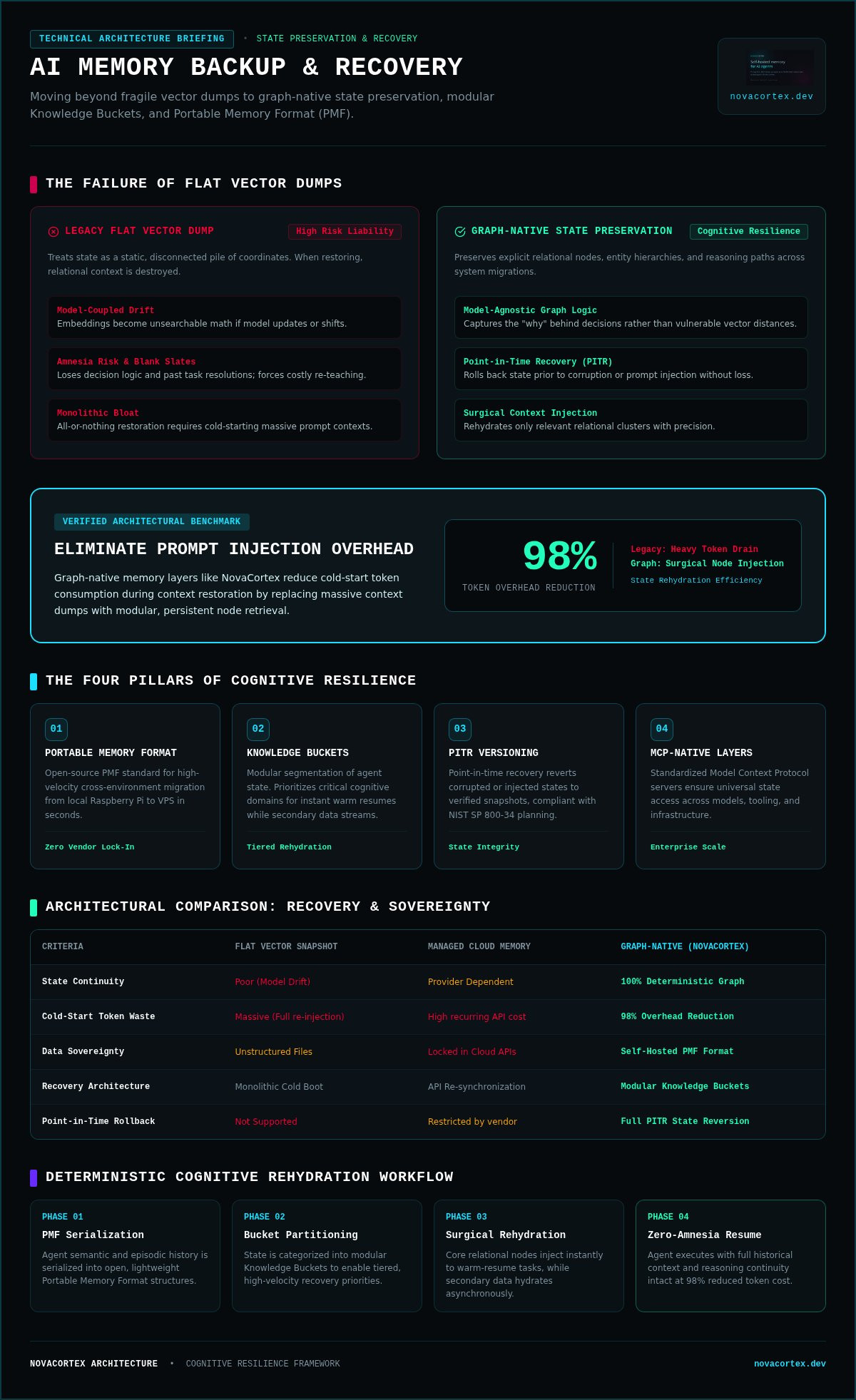
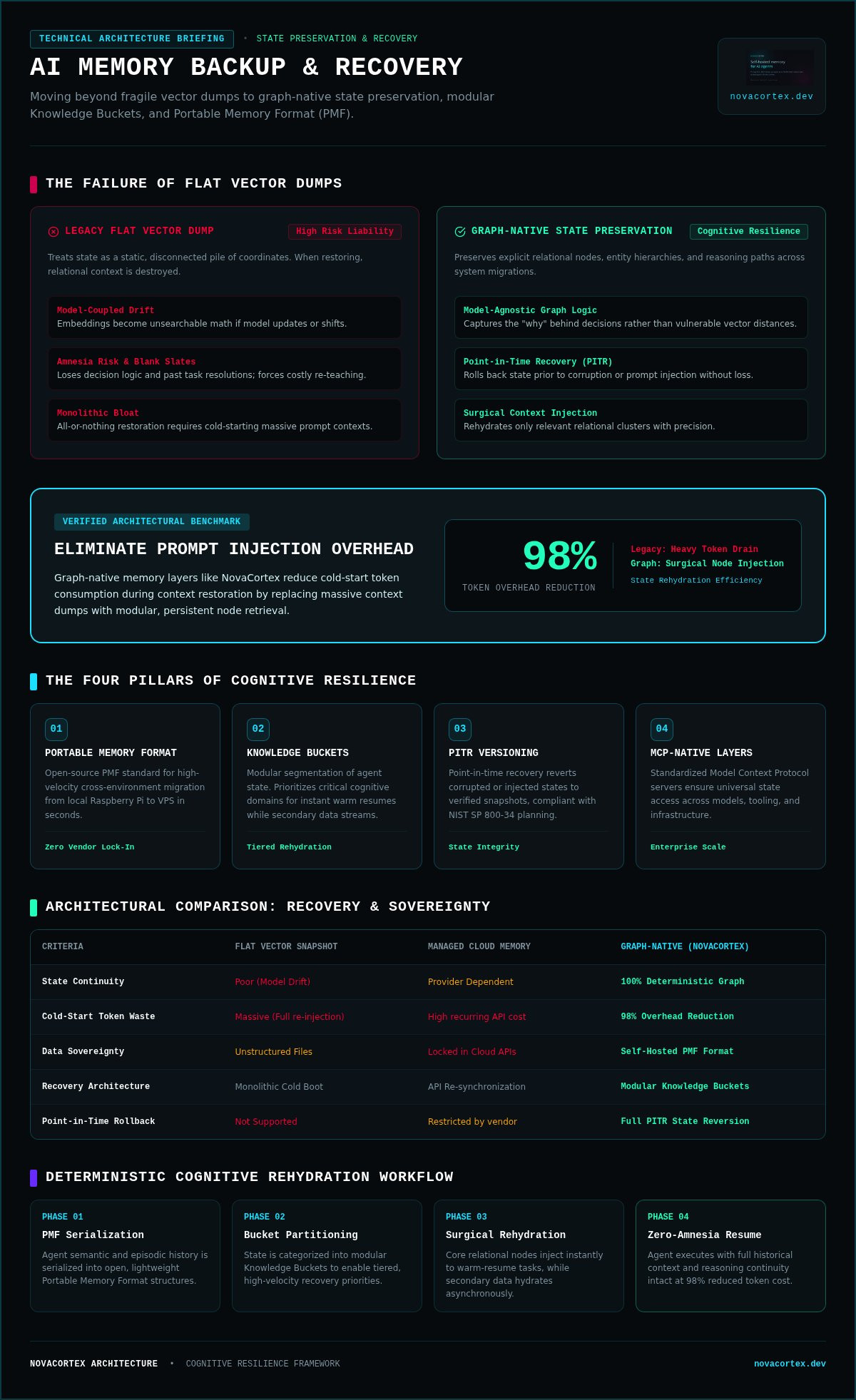
Standard backups focus on persistence. Cognitive recovery focuses on rehydration. Vector embeddings alone are insufficient for full state recovery because they are non-deterministic and mathematically coupled to specific models. If your embedding model drifts or updates, your "backup" becomes a graveyard of unsearchable math. True resilience requires capturing the underlying relational graph. We must transition from "Database thinking" to "Memory Layer thinking." This involves implementing point-in-time recovery (PITR) mechanisms to revert the agent to a verified state before data corruption or prompt injection occurred. Without these links, you aren't backing up intelligence; you're just archiving noise.
The Hidden Costs of Managed Memory Failures
Relying on managed cloud providers for memory creates a dangerous single point of failure. If their API goes down, your agent suffers a total lobotomy. The recovery process isn't free. "Cold-starting" an agent context requires re-injecting thousands of tokens into the prompt window to restore situational awareness. This creates massive token waste and inflates operational costs. According to verified benchmarks, graph-native layers like NovaCortex reduce this overhead by up to 98% by using persistent, modular storage. Beyond the financial drain, managed backups compromise digital sovereignty. If you don't own the physical backup of your agent's learned experience, you're renting your own intellectual property. Local sovereignty isn't just a security preference. It's an architectural requirement for high-velocity, autonomous systems.
Engineering Resilience with Graph-Native Storage and PMF
Resilience isn't an accident. It's a deliberate architectural choice. In the context of AI memory backup and recovery, it requires moving beyond the "all-or-nothing" approach of cloud backups. We reduce Recovery Time Objectives (RTO) by implementing tiered memory access. This means prioritizing critical cognitive state over secondary data logs. Following NIST SP 800-34 contingency planning guidelines, we treat agent memory as a mission-critical system component. This allows for rapid restoration of core functions while less vital Knowledge Buckets rehydrate in the background. It's the difference between a cold boot and a warm resume.
Graph-Native vs. Vector-Only Recovery
Vector databases are spatial, not relational. They tell you which concepts are near each other but lose the "why" during state transitions. Graph-native storage preserves the explicit relationships between entities. When you restore a memory graph, you aren't just dumping text back into a prompt. You're restoring a structured logic map. This architectural shift enables 98% less token usage during context restoration. Instead of feeding the LLM a massive history to re-establish context, you inject only the relevant relational nodes. It's surgical. It's efficient. It's how you scale without going bankrupt on API fees. You're restoring the agent's reasoning path, not just its vocabulary.
The Portable Memory Format (PMF) Standard
Vendor lock-in is a silent killer of innovation. If your agent's memory is trapped in a proprietary cloud format, you don't own its intelligence. The Portable Memory Format (PMF) ends this dependency. It's an open-source standard designed for high-velocity migration. PMF files are structured for speed, allowing you to move an agent's entire cognitive state from a local Raspberry Pi to an enterprise-grade VPS in seconds. This portability ensures that your AI memory backup and recovery workflow remains infrastructure-agnostic. You can explore the PMF specification on GitHub to see how modularity protects your data sovereignty. By segmenting state into Knowledge Buckets, you can export, version-control, and restore specific domains of expertise without touching the rest of the system. You maintain full control over the cognitive lifecycle, regardless of where the compute happens.
Self-Hosted vs. Managed AI Memory: A Recovery Comparison
Managed AI memory is a velvet cage. It offers ease of use at the cost of control and long-term resilience. For true AI memory backup and recovery, the self-hosted model is the only architecture that guarantees data sovereignty. When your agent's learned experiences reside on a third-party server, you're vulnerable to service outages, sudden price hikes, and silent data corruption. You don't truly own a system if you can't verify its state offline.
Security isn't just about encryption; it's about isolation. Enterprise agents often handle sensitive intellectual property that must never touch a public cloud. Air-gapping your memory store ensures that even in a total network failure, your agents remain functional. Self-hosting isn't just a preference. It's a requirement for mission-critical autonomy.
The Sovereignty Factor in AI State
Your AI memory is your most valuable intellectual property. It represents months of behavioral fine-tuning and proprietary context. IBM's architectural breakdown of AI agent memory classifies these stores into working, episodic, and semantic layers. Losing any of these to a managed provider's "Memory Poisoning" incident is a catastrophic failure. This happens when shared environments bleed context or allow malicious state manipulation between tenants. By using self-hosted AI memory layers, you eliminate these external risks. You ensure that recovery is possible even without internet access, maintaining continuity in air-gapped or high-security environments.
Performance Metrics in Memory Restoration
Latency kills agent performance. Restoring state from a cloud API involves network overhead that can reach hundreds of milliseconds per request. Local disk I/O happens in sub-millisecond ranges. When scaling to 1,000+ agents, managed services often hit aggressive rate limits that throttle your recovery speed and break your workflows. A self-hosted infrastructure allows you to saturate your own hardware's throughput without artificial bottlenecks. We also need to consider the storage engine's efficiency. Comparing Redis vs graph memory for AI agents reveals that while Redis is fast for simple key-value retrieval, it lacks the relational depth required for complex state rehydration. Graph-native systems provide the high-velocity recovery needed for enterprise-grade autonomous systems without the recurring subscription fees of managed platforms.
How to Implement an AI Memory Backup and Recovery Workflow
Implementing a robust AI memory backup and recovery workflow requires a shift from monolithic database dumps to modular state management. We don't just dump data; we orchestrate cognitive rehydration. This process ensures that when a system fails, the agent doesn't just "remember" facts, but restores its entire reasoning framework. A legacy backup is a dead file. A PMF snapshot is a living blueprint for an agent's mind. By following a structured implementation path, you eliminate the risk of context loss and ensure your infrastructure remains agile and portable.
Modularizing Knowledge for Faster Backups
Efficiency starts with segmentation. By using Knowledge Buckets, you separate core logic and procedural memory from transient session data. This allows for incremental backups that only capture what's changed, which drastically reduces storage overhead and processing time. Managing AI agent long term memory through tiered snapshots ensures that high-priority cognitive nodes are restored first. You aren't waiting for a massive vector index to load before the agent can answer basic queries. You're restoring the essentials in sub-millisecond timeframes, then rehydrating secondary context in the background.
The Recovery Workflow: From PMF to Active Agent
The actual restoration happens through the command line. You export the current state into a portable memory format for AI (PMF), which acts as the universal blueprint for your agent's state. Once you've secured the PMF file, importing it into an MCP-native memory server is a single, declarative command. This workflow enables syncing memory across multi-agent environments, ensuring all agents operate from a unified, verified state. It also simplifies version upgrades. Since PMF is model-agnostic, you can restore a memory graph created with one LLM into an environment running a newer version without losing the underlying relational logic.
Recovery isn't complete until you validate cognitive integrity. This involves automated checks to ensure relational links in the graph haven't been severed during the transfer. You verify that the restored state matches the cryptographic hash of the original snapshot. It's about ensuring the agent's logic remains sound after the transition. You're building a system that doesn't just survive crashes but thrives through them by maintaining a persistent, verifiable state.
Future-Proofing Agent Cognition with NovaCortex
Scaling intelligence shouldn't break your architecture. NovaCortex allows you to start small on a local Raspberry Pi and scale to an enterprise-grade VPS without rewriting a single line of recovery logic. This flexibility is core to a sustainable AI memory backup and recovery strategy. You're building a vendor-neutral infrastructure that survives platform shifts. If the industry moves from one LLM provider to another, your memory layer remains constant, preserving the years of episodic and semantic history your agents have accumulated.
MCP-Native Recovery: The New Standard
The Model Context Protocol (MCP) is the bridge between agents and their data. An MCP native memory server simplifies state restoration by providing a standardized interface for memory access. It eliminates the need for custom glue code when integrating with frameworks like LangChain or AutoGPT. Direct memory injection through MCP bypasses the latency of standard API-based retrieval, allowing for sub-millisecond context rehydration. Instead of the agent asking a distant cloud service for its history, the memory server pushes the relevant graph nodes directly into the context window. This architecture ensures that your AI memory backup and recovery process remains high-velocity, even as your agent’s knowledge graph grows to millions of nodes.
The Roadmap to Sovereign AI
Open-source sovereignty is the only hedge against the "Managed Service Tax." When you rely on proprietary clouds, you pay for their margins, not just their compute. NovaCortex is released under the Apache-2.0 license. This isn't a performative choice. It's a technical guarantee that your recovery tools will always be available. You have the right to modify, fork, and self-host your memory layer indefinitely. It protects your long-term recovery path from corporate sunsetting or pricing pivots. You're building on a foundation that respects your engineering independence.
Building for the future requires an architecture that respects your data ownership. By collaborating on the NovaCortex open-source ecosystem, you contribute to a standard that prioritizes engineering reality over marketing fluff. You're part of a movement toward digital independence. It's time to stop renting your agent's brain and start owning the infrastructure that powers it. This is the only way to ensure your agents remain resilient, portable, and fully under your control.
Engineer Persistent Intelligence
Engineering persistent intelligence requires more than simple data snapshots. You've seen why flat vector dumps fail and how graph-native cognitive storage preserves the vital relationships that define an agent's reasoning. By adopting a portable, self-hosted architecture, you reclaim your digital sovereignty. You eliminate the "Managed Service Tax" and ensure your proprietary knowledge remains yours. It's time to move past bloated systems that treat memory as an afterthought.
Implementing a rigorous AI memory backup and recovery protocol isn't just a safety measure; it's a performance optimization. With a 98% reduction in token waste and zero vendor lock-in via the PMF standard, your infrastructure becomes lean and resilient. You're no longer renting your agent's brain. You're owning the entire cognitive stack. This shift from database thinking to memory layer thinking is the hallmark of a mature AI architecture.
Take control of your agentic state today. The tools for architectural independence are ready for deployment. Build something that lasts.
Frequently Asked Questions
What is the difference between AI memory backup and a vector database dump?
Vector dumps are flat snapshots of spatial embeddings that lack relational context. They tell you which concepts are similar but lose the "why" behind those connections. AI memory backup with NovaCortex captures the relational graph of knowledge. While a vector dump is a static archive, a cognitive backup preserves the agent's reasoning logic. This ensures that restored agents maintain their functional state instead of just retrieving isolated text snippets.
How does NovaCortex reduce token usage by 98% during recovery?
NovaCortex utilizes graph-native storage to inject only the most relevant relational nodes into the context window. Traditional RAG systems often dump entire knowledge bases or massive conversation histories to re-establish context, which wastes thousands of tokens. By surgically retrieving specific entities and their multi-relational edges, we eliminate redundant data. This precision allows for high-velocity AI memory backup and recovery without the financial drain of re-indexing massive datasets.
Can I migrate my AI memory from Pinecone to a self-hosted NovaCortex instance?
You can migrate by exporting your Pinecone data and re-indexing it into NovaCortex's graph-native structure. While Pinecone is a managed vector store, NovaCortex offers a sovereign alternative that lives on your infrastructure. You'll need to map your existing embeddings or raw text into Knowledge Buckets. This transition allows you to move away from proprietary cloud lock-in and gain full control over your agent's persistent memory layer.
Is the Portable Memory Format (PMF) compatible with other AI frameworks?
PMF is an open-source, JSON-based specification designed for maximum interoperability across the industry. It's built to be framework-agnostic, meaning it can interface with LangChain, AutoGPT, and other agentic systems through the Model Context Protocol (MCP). Because it focuses on the structural relationships of data rather than model-specific embeddings, PMF ensures your cognitive backups remain functional even if you switch between different underlying LLM providers or frameworks.
Do I need a high-end GPU server to run an AI memory backup layer?
No, NovaCortex is engineered for efficiency and can run on modest hardware. While the LLM itself requires significant compute, the memory layer is lightweight. You can deploy the MCP-Native Memory Server on a standard VPS or even a Raspberry Pi. The system focuses on high-performance data structures rather than heavy floating-point math, making it accessible for builders who prioritize lean operations over bloated hardware requirements.
How often should I snapshot my AI agents memory state?
Snapshot frequency depends on your Recovery Point Objective (RPO) and the velocity of your data. For autonomous agents handling frequent interactions, we recommend automated snapshots every hour or upon significant state changes. Using Knowledge Buckets allows for incremental backups, so you only save the delta of new information. This modular approach ensures that your AI memory backup and recovery workflow remains performant without consuming excessive storage resources.
Can NovaCortex handle multi-user memory permissions in a shared environment?
Yes, advanced multi-user controls and enhanced security features are available through tiered subscription tiers. These features allow you to define granular access policies for specific Knowledge Buckets. You can ensure that sensitive episodic memory from one user isn't accessible to another agent in a shared environment. This is critical for enterprise deployments where data privacy and strict isolation are foundational requirements for maintaining digital sovereignty.
What happens if my AI memory server goes offline?
If your self-hosted memory server goes offline, the agent loses access to its long-term context and learned preferences. However, since you own the infrastructure, you can restore service instantly from your last PMF backup. Unlike managed APIs where you must wait for a provider's status page to turn green, local control means you can spin up a new instance on any available compute. Your agent's intelligence remains portable and recoverable.
FAQ
What is the difference between AI memory backup and a vector database dump?
Vector dumps are flat snapshots of spatial embeddings that lack relational context. They tell you which concepts are similar but lose the "why" behind those connections. AI memory backup with NovaCortex captures the relational graph of knowledge. While a vector dump is a static archive, a cognitive backup preserves the agent's reasoning logic. This ensures that restored agents maintain their functional state instead of just retrieving isolated text snippets.
How does NovaCortex reduce token usage by 98% during recovery?
NovaCortex utilizes graph-native storage to inject only the most relevant relational nodes into the context window. Traditional RAG systems often dump entire knowledge bases or massive conversation histories to re-establish context, which wastes thousands of tokens. By surgically retrieving specific entities and their multi-relational edges, we eliminate redundant data. This precision allows for high-velocity AI memory backup and recovery without the financial drain of re-indexing massive datasets.
Can I migrate my AI memory from Pinecone to a self-hosted NovaCortex instance?
You can migrate by exporting your Pinecone data and re-indexing it into NovaCortex's graph-native structure. While Pinecone is a managed vector store, NovaCortex offers a sovereign alternative that lives on your infrastructure. You'll need to map your existing embeddings or raw text into Knowledge Buckets. This transition allows you to move away from proprietary cloud lock-in and gain full control over your agent's persistent memory layer.
Is the Portable Memory Format (PMF) compatible with other AI frameworks?
PMF is an open-source, JSON-based specification designed for maximum interoperability across the industry. It's built to be framework-agnostic, meaning it can interface with LangChain, AutoGPT, and other agentic systems through the Model Context Protocol (MCP). Because it focuses on the structural relationships of data rather than model-specific embeddings, PMF ensures your cognitive backups remain functional even if you switch between different underlying LLM providers or frameworks.
Do I need a high-end GPU server to run an AI memory backup layer?
No, NovaCortex is engineered for efficiency and can run on modest hardware. While the LLM itself requires significant compute, the memory layer is lightweight. You can deploy the MCP-Native Memory Server on a standard VPS or even a Raspberry Pi. The system focuses on high-performance data structures rather than heavy floating-point math, making it accessible for builders who prioritize lean operations over bloated hardware requirements.
How often should I snapshot my AI agents memory state?
Snapshot frequency depends on your Recovery Point Objective (RPO) and the velocity of your data. For autonomous agents handling frequent interactions, we recommend automated snapshots every hour or upon significant state changes. Using Knowledge Buckets allows for incremental backups, so you only save the delta of new information. This modular approach ensures that your AI memory backup and recovery workflow remains performant without consuming excessive storage resources.
Can NovaCortex handle multi-user memory permissions in a shared environment?
Yes, advanced multi-user controls and enhanced security features are available through tiered subscription tiers. These features allow you to define granular access policies for specific Knowledge Buckets. You can ensure that sensitive episodic memory from one user isn't accessible to another agent in a shared environment. This is critical for enterprise deployments where data privacy and strict isolation are foundational requirements for maintaining digital sovereignty.
What happens if my AI memory server goes offline?
If your self-hosted memory server goes offline, the agent loses access to its long-term context and learned preferences. However, since you own the infrastructure, you can restore service instantly from your last PMF backup. Unlike managed APIs where you must wait for a provider's status page to turn green, local control means you can spin up a new instance on any available compute. Your agent's intelligence remains portable and recoverable.