AI Memory for Edge Devices: Architecting Software-Defined Cognition in 2026

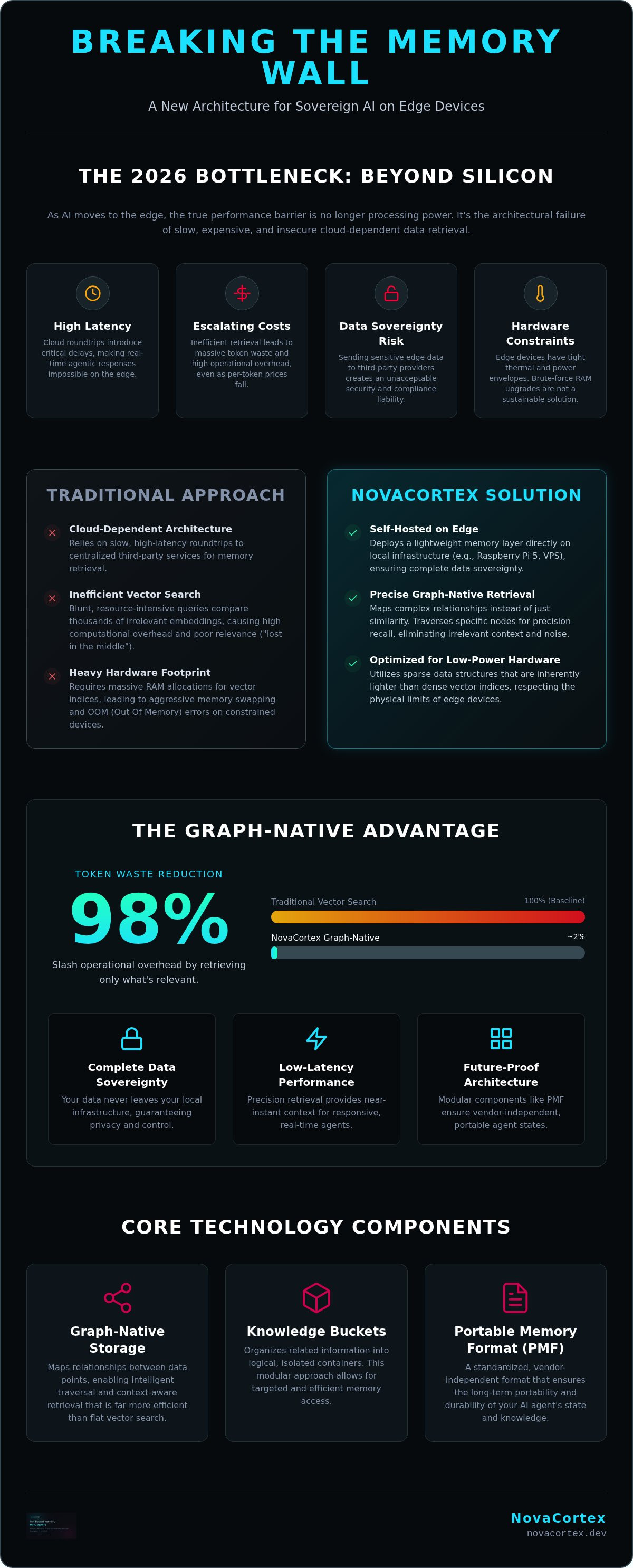
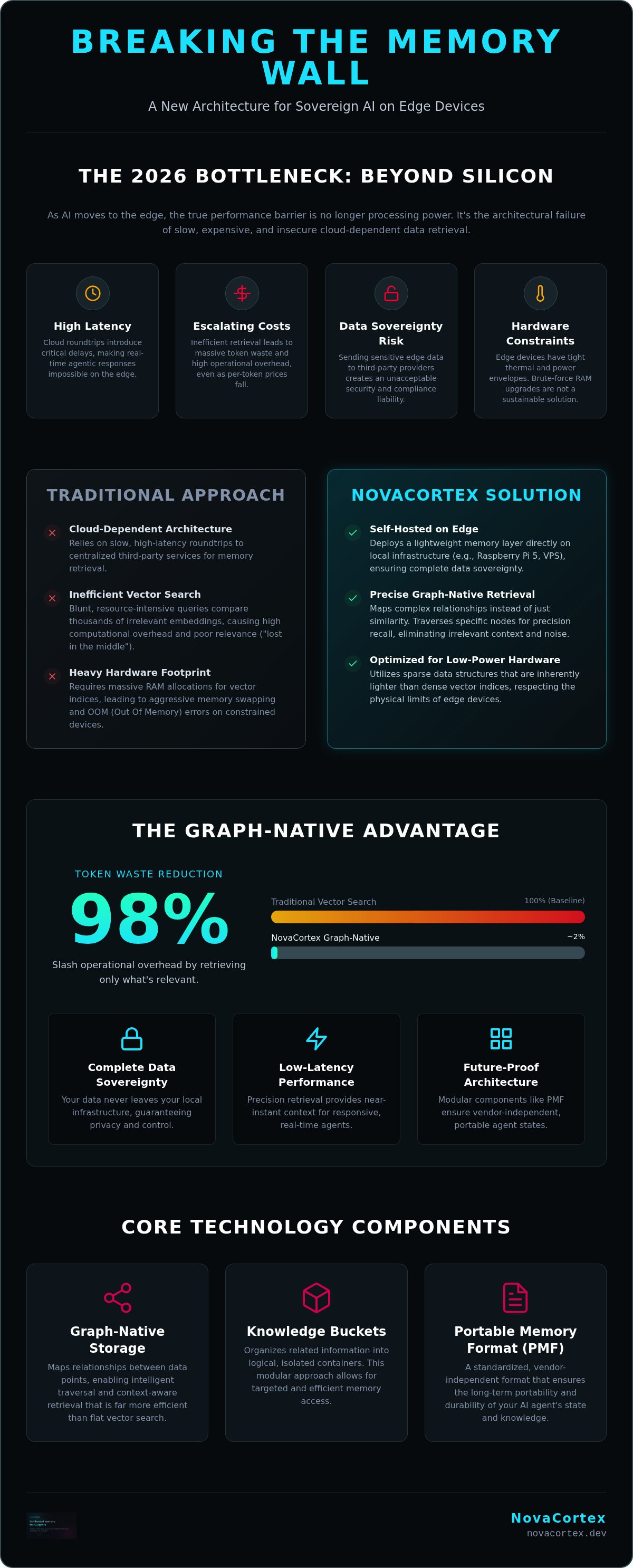
Silicon is no longer your primary bottleneck. In 2026, the real "memory wall" isn't just about hardware throughput; it's about the architectural failure of cloud-dependent retrieval. Sending sensitive edge data to third-party providers is a liability. It's slow. It's expensive. Most importantly, it's unnecessary.
You've likely seen your AI costs climb despite falling per-token prices. You're tired of high-latency cloud roundtrips and the constant risk to data sovereignty. You need a way to keep intelligence local without sacrificing performance. It's a common frustration for engineers trying to scale on resource-constrained hardware like the Raspberry Pi or local VPS environments.
This article demonstrates how to implement a graph-native, self-hosted memory layer to optimize AI memory for edge devices. You'll learn to use the NovaCortex Self-Hosted Edition to solve the memory wall and reduce token waste by up to 98%. We'll break down the architecture of Knowledge Buckets and the Portable Memory Format (PMF). The result is a low-latency, MCP-native system that guarantees complete data sovereignty on your local infrastructure.
Key Takeaways
- Bypass the physical limitations of edge silicon by shifting from hardware-heavy scaling to software-defined cognition.
- Replace resource-intensive vector databases with graph-native storage to map complex relationships on constrained local hardware.
- Slash operational overhead by up to 98% with optimized retrieval strategies for AI memory for edge devices.
- Establish complete data sovereignty by deploying the NovaCortex Self-Hosted Edition on local VPS or Raspberry Pi 5 infrastructure.
- Future-proof your architecture using the Portable Memory Format (PMF) and Knowledge Buckets to ensure modular, vendor-independent agent states.
The Memory Wall: Why Silicon Alone Can't Solve Edge AI
The "memory wall" is no longer a theoretical hurdle for high-performance computing; it's a daily reality for edge AI. For years, the industry focused on raw FLOPS. We optimized NPUs and pushed for higher clock speeds. We ignored the data path. Now, as agentic AI moves to the perimeter, the bottleneck has shifted. The memory wall in edge AI is the growing disparity between the speed of neural processing and the latency of data retrieval. If your agent takes three seconds to "remember" a user preference because of a slow memory bus, the compute speed is irrelevant.
Silicon alone cannot solve this. Adding more RAM isn't a sustainable path for AI memory for edge devices. High-density DRAM consumes significant power and generates heat that edge enclosures cannot dissipate. We need a fundamental shift. We must move from hardware-centric designs to software-defined cognition. This means managing context and state through intelligent software layers rather than brute-force hardware upgrades. Local context management isn't just a performance choice; it's a power and latency requirement.
Limitations of On-Device Hardware Memory
Edge architectures face brutal physical constraints. Thermal envelopes are tight. Space is at a premium. Even with the JEDEC UFS 5.0 standard offering 10.8 GB/s, the bottleneck persists. The energy cost of moving data from storage to the NPU often exceeds the cost of the actual inference. Standard DRAM is volatile and expensive. It works for short-term context windows but fails as a long-term repository for agent knowledge. When your context window expands, the "KV cache" bloats, consuming the very resources needed for reasoning.
The Rise of the Software-Defined Memory Layer
The solution is a dedicated software-defined memory layer. By separating cognition (the inference) from storage (the memory), we allow for better resource allocation. This architecture enables persistent context. An edge agent shouldn't have to re-learn its environment every time the power cycles. It needs a reliable, non-volatile state. It requires a system that prioritizes relevance over volume.
Implementing self-hosted AI memory layers allows developers to manage this state locally. This approach reduces the need for massive on-board RAM by using intelligent retrieval. Instead of stuffing every bit of data into a massive context window, the software layer fetches only what is relevant. This reduces latency, saves power, and ensures that AI memory for edge devices remains lean and efficient. It's about architecting for reality, not just theoretical peak performance.
Graph-Native vs. Vector Storage for Edge Devices
Vector search is a blunt instrument. It's excellent for finding similar images, but it's a disaster for managing long-term agent state on a Raspberry Pi. For AI memory for edge devices, the computational cost of high-dimensional vector math is an unnecessary tax on limited silicon. You don't need to calculate cosine similarity across ten thousand embeddings just to remember a user's preferred temperature setting.
Traditional vector databases are heavy. They require massive memory allocations to keep indices performant. On edge hardware, this leads to aggressive swapping or OOM (Out of Memory) kills. Graphs solve this by mapping relationships instead of just spatial distance. This architectural shift allows for precision retrieval that respects the physical limits of the device.
The Inefficiency of Flat Vector Search
Flat vector search suffers from significant computational overhead. Every query forces the system to compare embeddings across a massive search space. This creates a bottleneck at the NPU. It also leads to the "lost in the middle" phenomenon. When you stuff a context window with ten "similar" but irrelevant chunks, the model loses the signal. The result is a high-latency response that drains the battery and provides zero utility.
This inefficiency is why the Redis vs graph memory for AI agents debate has taken center stage in 2026. While key-value stores like Redis are fast, they lack the relational depth required for complex reasoning. You end up with a fast system that has the situational awareness of a goldfish. For edge deployments, speed without context is just expensive noise.
Graph-Native Benefits for Low-Power Hardware
Graph-native storage is built for precision, not proximity. It uses sparse data structures that are inherently lighter than dense vector indices. Instead of scanning an entire database, the system traverses specific nodes. This path-based retrieval is orders of magnitude faster on low-power hardware. It allows the agent to navigate knowledge like a map rather than searching through a haystack.
- Sparse Indices: Graphs store only what matters. There's no need for the massive padding required by high-dimensional vectors.
- Relational Logic: Graphs allow agents to understand that "User A" owns "Device B" which is located in "Room C." Vectors only see that those words are statistically likely to appear together.
- Multi-Step Reasoning: Complex tasks require jumping between related concepts. Traversal is a native graph operation, making it the superior choice for autonomous edge operations.
If you're building for the perimeter, you need an architecture that respects your hardware limits. You can explore the NovaCortex architecture to see how graph-native memory handles complex agent state without the vector bloat. By prioritizing relationships over distance, you ensure that AI memory for edge devices remains lean, fast, and sovereign.
Reducing Token Usage: The Economics of Edge AI
Context dumping is a technical debt that converts directly into operational currency. In edge AI, the "lazy" approach of feeding an LLM every historical interaction isn't just inefficient; it's a financial sinkhole. While the blended cost of AI per million tokens dropped 67% year-over-year by Q1 2026, enterprise spend is actually rising. This paradox is driven by agentic systems consuming more tokens than ever. For AI memory for edge devices, efficiency is the only path to sustainability. You must stop paying the "context tax" on every inference turn.
Smart retrieval is the architectural correction. By implementing a graph-native layer, you can achieve up to a 98% reduction in token usage. Instead of sending a massive block of "similar" data, the system retrieves only the specific relational nodes required for the task. This precision extends the operational life of edge hardware by reducing the thermal load and power consumption associated with massive context processing.
Engineering Token-Efficient Context
Noise filtering must happen before data hits the inference engine. If you send 5,000 tokens of raw telemetry when only 50 are relevant to the current decision, you've failed as an architect. Dynamic context injection replaces static, bloated system prompts. By leveraging AI agent long term memory, your system can maintain persistent cognition without the overhead of re-sending foundational knowledge. This shift from "send everything" to "retrieve exactly what's needed" is what separates experimental toys from production-ready edge agents.
Knowledge Buckets for Modular Memory
Knowledge Buckets provide the modularity required for complex edge environments. Instead of a monolithic, unmanageable memory state, you partition agent knowledge into discrete, retrievable units. This approach minimizes the context overhead for every agent turn. It's especially critical in multi-agent deployments where different agents might need to share specific state buckets without duplicating the entire memory footprint. This modularity ensures that AI memory for edge devices remains lean, navigable, and cost-effective across the entire local infrastructure.
Deploying Persistent Memory on Raspberry Pi and Local Infrastructure
Building AI memory for edge devices requires more than just a capable SoC. You need a persistent, high-velocity storage layer that doesn't choke under concurrent retrieval requests. The Raspberry Pi 5 remains the gold standard for this tier. While it lacks the massive HBM found in data centers, its PCIe interface allows for NVMe speeds that finally make local graph-native memory viable. For a production-grade deployment, 8GB of RAM is your baseline. Anything less will lead to context fragmentation when managing multiple Knowledge Buckets.
Deployment is a matter of architectural discipline. Using the NovaCortex Self-Hosted Edition, you can spin up a dedicated memory server in minutes. The process is streamlined for containerized environments. Pull the image, mount your local storage volume, and expose the MCP port. This setup ensures your agent's cognition stays within your four walls. It's the only way to guarantee the sub-100ms retrieval times required for real-time edge interactions. When data never leaves the local network, latency is a solved problem.
The MCP-Native Advantage for Edge Agents
The Model Context Protocol (MCP) is the connective tissue of modern AI architecture. Without it, your memory layer is just another isolated silo. Implementing an MCP native memory server ensures your local knowledge is accessible to any LLM, regardless of the provider. It standardizes how context is fetched and injected. This interoperability is the key to vendor neutrality. You aren't building a walled garden; you're building a sovereign intelligence node that communicates through a universal standard. It allows for a plug-and-play experience that traditional, proprietary memory APIs can't match.
Portable Memory Format (PMF) and Data Sovereignty
Data sovereignty is a binary state. Either you own the data, or a cloud provider does. By using the portable memory format for AI, you ensure your agent's long-term state is never trapped in a proprietary database. PMF allows you to sync memory across your local Raspberry Pi and a private VPS without complex migrations. It treats memory as a portable asset rather than a locked database entry. This format, combined with local encryption for your Knowledge Buckets, creates a secure, resilient foundation for AI memory for edge devices. You maintain control over your intellectual property while benefiting from the speed of local hardware.
NovaCortex: The Standard for Sovereign Edge Memory
NovaCortex isn't just another database. It's a fundamental correction to the industry's reliance on fragile, cloud-based memory. As established, the memory wall is a software problem that hardware alone cannot resolve. The NovaCortex Self-Hosted Edition provides the privacy-first architecture developers need to build truly autonomous edge agents. It's about digital sovereignty. You own the cognition. You own the results. There is no middleman between your agent's state and its execution.
When deciding between self-hosted vs managed AI memory, the choice for edge builders is clear. Managed services introduce unacceptable latency and third-party data risks. Self-hosting ensures your AI memory for edge devices operates at local speeds, bypassing the public internet entirely. The Apache-2.0 license guarantees that your infrastructure remains yours. No vendor lock-in. No hidden API hikes. Just lean, high-velocity performance on your own terms.
Architectural Superiority for Builders
A graph-native approach is mandatory for 2026 agentic workflows. Flat vectors are too heavy for the perimeter. Key-value stores are too shallow for reasoning. NovaCortex bridges this gap by mapping complex relationships without the resource bloat. It fits perfectly into the emerging decentralized AI stack by prioritizing local state over cloud dependency. Getting started with the NovaCortex Self-Hosted Edition is straightforward. Pull the container. Define your Knowledge Buckets. Connect via MCP. You're no longer building on rented ground.
Enterprise Support and Scalability
Transitioning from a local Raspberry Pi pilot to a full-scale production deployment requires an architecture that scales. NovaCortex supports multi-user controls and advanced management features for enterprise-grade security. While the core remains open, the path to managed infrastructure is available when you need to bridge edge nodes with private cloud clusters. This flexibility allows you to start small and scale without refactoring your entire memory layer.
The future of AI memory for edge devices is open and interoperable. By choosing a vendor-neutral layer, you future-proof your agents against the shifting sands of LLM providers. Join the NovaCortex community to help set the standards for edge AI innovation. We aren't just building tools. We're architecting the foundation of sovereign digital intelligence for the next decade of engineering.
Architecting Sovereign Edge Intelligence
The physical constraints of edge hardware are permanent, but your architectural approach doesn't have to be. Moving beyond the memory wall requires a fundamental shift from hardware-centric thinking to software-defined cognition. By adopting a graph-native storage layer, you eliminate the bloat of traditional vector databases and reclaim absolute control over your data path.
Efficiency is the new standard for AI memory for edge devices. With an MCP-native architecture, you can achieve a verified 98% token reduction while maintaining the sub-100ms retrieval speeds required for real-time agentic reasoning. This isn't just about performance; it's about the economic survival of local AI systems in a consumption-based market. NovaCortex provides the Apache-2.0 open-source infrastructure needed to build without the constant threat of vendor lock-in or cloud-induced latency.
The tools for digital sovereignty are ready for deployment. Stop renting your agent's memory and start owning your intelligence stack.
Build for the future of local intelligence. We look forward to seeing the resilient, low-latency systems you create on the perimeter.
Frequently Asked Questions
What is the minimum RAM requirement for AI memory on edge devices?
You need a minimum of 8GB of RAM for a reliable production deployment of AI memory for edge devices. While smaller agents might run on 4GB, the overhead of managing concurrent graph traversals and multiple Knowledge Buckets will quickly saturate limited memory. Production environments require overhead for the operating system and the inference engine. Choosing an 8GB or 16GB module ensures your system handles peak loads without aggressive swapping or performance degradation.
How does graph-native memory reduce token usage compared to vector DBs?
Graph-native memory reduces token usage by up to 98% through relational precision. Unlike vector databases that retrieve entire chunks of text based on similarity, graphs traverse specific nodes to extract only the relevant data points. This eliminates the context tax of sending irrelevant noise to the LLM. By injecting only the necessary relational facts, you minimize the input prompt size and drastically cut operational costs associated with high-volume token consumption.
Can I run NovaCortex on a Raspberry Pi 4 or is 5 required?
The NovaCortex Self-Hosted Edition runs on Raspberry Pi 4, but the Raspberry Pi 5 is the recommended standard for 2026 deployments. The Pi 5's PCIe interface allows for NVMe storage speeds, which are critical for low-latency graph operations. While the Pi 4 handles basic memory tasks, it lacks the throughput required for high-velocity agentic reasoning. If your architecture demands sub-100ms retrieval times, the Pi 5's architectural improvements make it the only viable choice.
What is the Portable Memory Format (PMF) and why does it matter?
The Portable Memory Format (PMF) is an open standard that ensures your agent's long-term state isn't trapped in a proprietary database. It allows you to move memory files between different systems and providers without refactoring your codebase. This matters because it guarantees data sovereignty and eliminates vendor lock-in. By using PMF, you maintain total control over your intellectual property and can migrate your knowledge base across edge devices or cloud clusters as your needs evolve.
How does the Model Context Protocol (MCP) help with edge AI memory?
The Model Context Protocol (MCP) standardizes the communication between your local memory server and various LLM providers. It acts as a universal interface, allowing any MCP-compliant agent to fetch and inject context without custom API integrations. For AI memory for edge devices, this protocol is essential for maintaining interoperability. It ensures that your local knowledge remains accessible to the latest models, future-proofing your stack against changes in the frontier model landscape.
Is it possible to sync edge device memory with a private VPS?
You can sync edge device memory with a private VPS using the Portable Memory Format. This enables a hybrid architecture where local edge nodes handle immediate tasks while a centralized VPS maintains a broader, long-term knowledge repository. Syncing is handled via standard secure protocols, ensuring that your data remains encrypted and sovereign. This setup provides the perfect balance between the low latency of edge hardware and the scalable storage capacity of private cloud infrastructure.
How do Knowledge Buckets improve AI agent performance at the edge?
Knowledge Buckets improve performance by modularizing the agent's state into discrete, retrievable units. Instead of searching a monolithic database, the agent accesses specific buckets relevant to its current task. This reduces search space and improves retrieval accuracy. By partitioning data, you minimize the computational load on the edge device and ensure that the most relevant context is always available, leading to faster response times and more reliable agentic reasoning.
Does NovaCortex require an active internet connection to function?
No, the NovaCortex Self-Hosted Edition does not require an active internet connection to function. It's a fully self-hosted solution designed for local execution. While you might need a connection to sync with a remote VPS or update model weights, the core memory retrieval and graph operations happen entirely on your local hardware. This offline capability is a primary benefit for edge deployments in remote areas or high-security environments where data sovereignty and uptime are non-negotiable.
FAQ
What is the minimum RAM requirement for AI memory on edge devices?
You need a minimum of 8GB of RAM for a reliable production deployment of AI memory for edge devices. While smaller agents might run on 4GB, the overhead of managing concurrent graph traversals and multiple Knowledge Buckets will quickly saturate limited memory. Production environments require overhead for the operating system and the inference engine. Choosing an 8GB or 16GB module ensures your system handles peak loads without aggressive swapping or performance degradation.
How does graph-native memory reduce token usage compared to vector DBs?
Graph-native memory reduces token usage by up to 98% through relational precision. Unlike vector databases that retrieve entire chunks of text based on similarity, graphs traverse specific nodes to extract only the relevant data points. This eliminates the context tax of sending irrelevant noise to the LLM. By injecting only the necessary relational facts, you minimize the input prompt size and drastically cut operational costs associated with high-volume token consumption.
Can I run NovaCortex on a Raspberry Pi 4 or is 5 required?
The NovaCortex Self-Hosted Edition runs on Raspberry Pi 4, but the Raspberry Pi 5 is the recommended standard for 2026 deployments. The Pi 5's PCIe interface allows for NVMe storage speeds, which are critical for low-latency graph operations. While the Pi 4 handles basic memory tasks, it lacks the throughput required for high-velocity agentic reasoning. If your architecture demands sub-100ms retrieval times, the Pi 5's architectural improvements make it the only viable choice.
What is the Portable Memory Format (PMF) and why does it matter?
The Portable Memory Format (PMF) is an open standard that ensures your agent's long-term state isn't trapped in a proprietary database. It allows you to move memory files between different systems and providers without refactoring your codebase. This matters because it guarantees data sovereignty and eliminates vendor lock-in. By using PMF, you maintain total control over your intellectual property and can migrate your knowledge base across edge devices or cloud clusters as your needs evolve.
How does the Model Context Protocol (MCP) help with edge AI memory?
The Model Context Protocol (MCP) standardizes the communication between your local memory server and various LLM providers. It acts as a universal interface, allowing any MCP-compliant agent to fetch and inject context without custom API integrations. For AI memory for edge devices, this protocol is essential for maintaining interoperability. It ensures that your local knowledge remains accessible to the latest models, future-proofing your stack against changes in the frontier model landscape.
Is it possible to sync edge device memory with a private VPS?
You can sync edge device memory with a private VPS using the Portable Memory Format. This enables a hybrid architecture where local edge nodes handle immediate tasks while a centralized VPS maintains a broader, long-term knowledge repository. Syncing is handled via standard secure protocols, ensuring that your data remains encrypted and sovereign. This setup provides the perfect balance between the low latency of edge hardware and the scalable storage capacity of private cloud infrastructure.
How do Knowledge Buckets improve AI agent performance at the edge?
Knowledge Buckets improve performance by modularizing the agent's state into discrete, retrievable units. Instead of searching a monolithic database, the agent accesses specific buckets relevant to its current task. This reduces search space and improves retrieval accuracy. By partitioning data, you minimize the computational load on the edge device and ensure that the most relevant context is always available, leading to faster response times and more reliable agentic reasoning.
Does NovaCortex require an active internet connection to function?
No, the NovaCortex Self-Hosted Edition does not require an active internet connection to function. It's a fully self-hosted solution designed for local execution. While you might need a connection to sync with a remote VPS or update model weights, the core memory retrieval and graph operations happen entirely on your local hardware. This offline capability is a primary benefit for edge deployments in remote areas or high-security environments where data sovereignty and uptime are non-negotiable.