AI Memory for Private Servers: Engineering Persistent Context in 2026

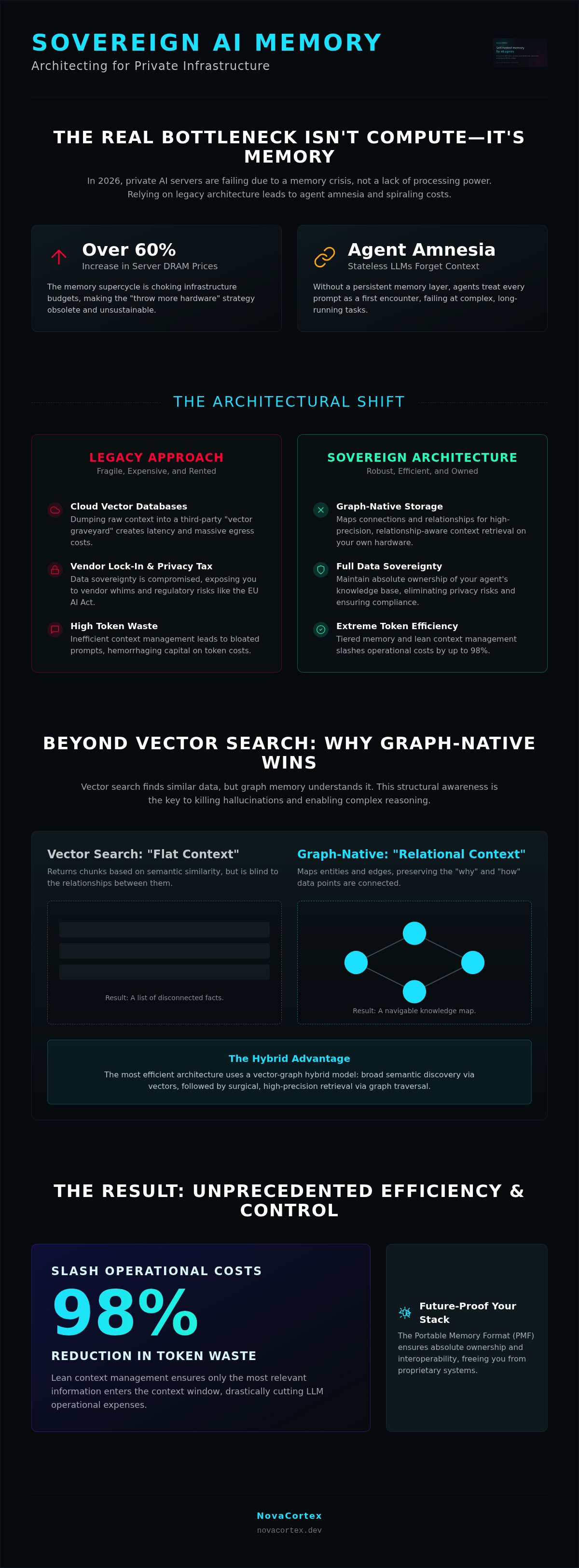
In 2026, private AI servers aren't failing because of weak compute. They're failing because they're being choked by a memory supercycle that has sent server DRAM prices soaring over 60% this year. Throwing more hardware at the problem is a legacy strategy for a bloated era. If your agents suffer from amnesia or your token costs are hemorrhaging capital, the bottleneck isn't your GPU. It's your architecture. Building robust AI memory for private servers requires moving beyond the fragile, expensive practice of dumping raw context into a cloud-based vector graveyard.
You've likely felt the sting of vendor lock-in and the looming transparency obligations of the EU AI Act. You want performance without the privacy tax. This article teaches you how to architect a sovereign, high-performance memory layer for AI agents on your own private infrastructure. We'll break down the engineering behind graph-native storage and the Portable Memory Format (PMF). You'll learn to achieve a 98% reduction in token waste while maintaining full ownership of your agent knowledge bases. It's time to stop renting intelligence and start owning your context.
Key Takeaways
- Engineer a sovereign AI memory for private servers to eliminate agent amnesia and secure your data on your own metal.
- Move beyond the limitations of vector search by deploying graph-native storage for high-precision, relationship-aware context retrieval.
- Slash operational costs with a 98% reduction in token waste through tiered memory architectures and lean context management.
- Future-proof your stack using the Portable Memory Format (PMF) to maintain absolute ownership and interoperability of your agent's knowledge base.
- Optimize your private infrastructure for persistent context by balancing RAM, VRAM, and NVMe speeds across diverse deployment environments.
Rethinking the AI Memory Layer for Private Infrastructure
AI doesn't have a soul, but it desperately needs a history. In the current engineering landscape, most developers confuse raw compute with cognitive persistence. They build powerful clusters but leave their agents with the memory of a goldfish. A standard Large language model is inherently stateless. It treats every prompt like a first encounter. To build truly autonomous agents, we must architect a persistent state layer. This is AI memory for private servers. It's the difference between a one-off script and a digital employee that actually learns your codebase.
Private infrastructure is the only logical home for this layer. Placing your agent's long-term knowledge in a third-party cloud vector database is an architectural surrender. It creates latency, incurs massive egress costs, and compromises data sovereignty. There is a glaring "Memory Gap" in modern self-hosted stacks. We have the GPUs to run the models, but we lack the specialized infrastructure to manage the massive, evolving context these models generate. Bridging this gap requires a fundamental shift in how we treat data at rest versus data in flight. You cannot build a sovereign intelligence on a foundation of rented, volatile memory.
The Anatomy of Persistent Agent Cognition
Cognition requires two distinct systems: working memory and long-term storage. Working memory is the context window. It's fast, expensive, and ephemeral. Long-term memory is the archive. It's vast and persistent. Traditional Retrieval-Augmented Generation (RAG) often fails because it treats these as disconnected silos. A true self-hosted AI memory layer integrates them into a single, fluid loop. This allows agents to pull relevant historical facts into their current context window with millisecond precision. It ensures they never lose the thread of a complex, weeks-long project.
Why Compute Power is Not Enough
Hardware manufacturers want you to believe that more VRAM solves everything. It doesn't. You can't solve agent amnesia by simply buying a bigger GPU. VRAM is a workspace, not a library. The real architectural bottleneck is the high-latency journey data takes from storage to the active context. In multi-agent systems, this problem scales exponentially. Each agent competing for the same VRAM causes system-wide degradation. You don't need more compute. You need a dedicated memory server that can handle AI memory for private servers as a first-class citizen, decoupling state from the inference engine.
Beyond Vector Search: Why Graph-Native Memory Wins
Standard vector databases are the blunt instruments of the AI world. While they excel at semantic similarity, they're functionally blind to structure. When you search a vector space, you get back chunks of text that look like your query, but the system has no idea how those chunks connect. This is the "flat context" problem. It's why agents often hallucinate when asked about complex workflows or hierarchical data. For AI memory for private servers, relying solely on vector embeddings is an architectural dead end that leads to bloated context and degraded reasoning.
The industry is hitting a wall with traditional key-value stores. Engineers are increasingly debating the Redis vs graph memory for AI agents trade-off because the former lacks the relational depth required for agentic persistence. Graph-native storage doesn't just store data; it maps the connections. It turns a pile of facts into a navigable knowledge map. By prioritizing relationships over mere proximity, you ensure that your agent understands the "why" behind the data, not just the "what."
The Precision of Knowledge Graphs
Knowledge graphs preserve the semantic relationships that vector search strips away. By storing information as entities and edges, you provide your agent with a high-fidelity map of your private environment. This structural awareness is the most effective way to kill hallucinations. When an agent can traverse a graph to verify a fact instead of guessing based on semantic proximity, retrieval precision moves from "maybe" to "certain." This isn't a luxury; it's a requirement for any system performing complex reasoning or multi-step orchestration on private hardware.
Vector-Graph Hybrid Models
The most efficient AI memory for private servers in 2026 utilizes a hybrid approach. You use vector search for broad, semantic discovery and graph traversal for surgical precision. This combination optimizes retrieval speed while minimizing the data payload sent to the LLM. Implementing a hybrid layer on your own infrastructure allows for low-latency context retrieval without the overhead or security risks of cloud-based systems. It's about lean, high-velocity performance that respects your data sovereignty.
If you're tired of agents that forget the basic structure of your projects, it's time to move beyond flat vectors. You can explore the open-source implementation of these hybrid architectures to see how graph-native logic transforms agent persistence.
Architecting Your Private Server for AI Memory
Hardware selection for AI memory for private servers is often misunderstood. Most engineers fixate on GPU TFLOPS. They ignore the IOPS bottleneck. In 2026, with server DRAM prices spiking over 60% quarter-over-quarter, throwing money at unoptimized hardware is a terminal mistake. Your memory layer doesn't need an H100 cluster. It needs high-velocity data paths. Whether you're deploying on a local workstation, a VPS, or even a Raspberry Pi, the goal is the same: minimize the latency between the storage bucket and the inference engine. Compute is the muscle, but IOPS is the nervous system.
The "Memory Gap" often stems from a failure to distinguish between where data lives and where it's processed. You don't need massive VRAM to host a knowledge graph. You need enough system RAM to keep the graph structure resident in memory and NVMe storage fast enough to feed the context window without stuttering. Moving data from cold storage to an active context is the most expensive operation in your stack. If your storage can't keep up, your agent will stall, regardless of how many CUDA cores you have available.
Hardware Selection for Memory Servers
Knowledge graphs are read-intensive. Retrieval precision depends on how fast you can traverse edges. While VRAM handles the active context, your system RAM hosts the graph structure itself. For a high-performance private setup, prioritize NVMe storage with high random read speeds. This ensures that when an agent triggers a memory retrieval, the context loads in milliseconds. A lean, fast NVMe drive beats a bloated, slow HDD every time. Precision requires speed. Even a Raspberry Pi 5 can serve as a dedicated memory node if it's paired with a high-speed NVMe HAT, proving that architectural intelligence beats raw hardware spend.
Software Stack and Interoperability
Software interoperability is the final piece of the puzzle. You shouldn't be locked into a single model or provider. This is why the MCP native memory server has become the architectural standard. By using the Model Context Protocol (MCP), you decouple your agentic logic from your data storage. This allows you to swap out local LLM runners like Ollama or LM Studio without rebuilding your entire knowledge base. Containerizing these layers with Docker ensures your AI memory for private servers remains portable and isolated. It's about building a sovereign stack that respects your control and ends the cycle of vendor dependency.
Don't overlook the network. Even on a local workstation, agent-to-memory communication must be low-latency. If your memory server is separate from your inference node, use a high-speed internal backbone. Bottlenecks at the network layer will throttle even the fastest NVMe drives. Keep the data close to the compute, but keep the memory sovereign.
Reducing LLM Token Waste by Up to 98%
Lazy engineering has a price. Most developers treat context windows like trash cans, dumping entire documents into the prompt and hoping the model sorts it out. This "Context Dump" strategy is a primary driver of technical waste. It bloats latency and drains capital. Effective AI memory for private servers rejects this brute-force approach. Instead, it implements tiered memory retrieval. This system separates the active working set from the vast archive of knowledge, ensuring the LLM only processes what is strictly necessary for the current task.
NovaCortex benchmarks demonstrate a 98.8% reduction in token waste compared to standard vector-based RAG. By leveraging AI agent long term memory, the system avoids redundant processing of static data. It retrieves only the specific knowledge nodes required to fulfill a request. This isn't just about saving money. It's about increasing the cognitive velocity of your agents. Lean context windows result in faster inference and higher-quality reasoning.
Intelligent Context Pruning
Surgical extraction is the goal. Rather than retrieving a 500-word paragraph because of a single keyword match, a graph-native layer identifies the specific relationship or entity relevant to the prompt. This pruning process strips away the noise. The ROI of a dedicated memory layer is immediate. You're no longer paying a "context tax" on every interaction. You're running a lean, high-performance operation that scales without exploding your API or hardware budget.
Knowledge Buckets and Modular State
Organization is the antidote to chaos. In 2026, sophisticated private deployments use Knowledge Buckets to segment agent data. This modular state allows for rapid syncing across multi-agent clusters. When one agent learns a new fact, it's committed to a specific bucket that other agents can access dynamically. It eliminates the need for global context updates. You load only the buckets relevant to the real-time task. This architecture ensures your private server remains responsive, even as your agent knowledge base grows into the terabytes.
Deploying NovaCortex: The Sovereign Memory Standard
NovaCortex Self-Hosted Edition is the architectural correction to the cloud's extractive model. It provides the only production-ready standard for AI memory for private servers that prioritizes digital sovereignty over corporate convenience. While cloud providers trap your data in proprietary silos, NovaCortex operates on an Apache-2.0 open-source core. It ensures your agent's knowledge remains under your physical control. This isn't just a preference. In 2026, with the EU AI Act's transparency obligations in full effect, owning your memory layer is a regulatory necessity.
Deploying NovaCortex follows a streamlined engineering workflow. You pull the Docker image, configure your Knowledge Buckets, and connect via the MCP-Native Memory Server. This setup firewalls your agent's history from the public internet. You secure the layer by binding the memory server to a local-only interface, ensuring that sensitive context never leaves your private network. It's a high-velocity deployment that replaces complex cloud configurations with lean, local-first logic.
Privacy-First Architectural Philosophy
Sovereignty is engineered, not just promised. By keeping data local by design, NovaCortex eliminates the latency and security risks of external API calls. This architectural stance rejects the bloated, restrictive systems that dominate the current market. You aren't just hosting a database. You're building a fortress for your agent's cognition. The Apache-2.0 license guarantees that your infrastructure remains independent, free from the whims of venture-backed cloud vendors who could pivot or price-gouge at any moment.
Future-Proofing with Portable Memory
Vendor lock-in is a terminal risk for AI projects. If your agent's memory is trapped in a specific provider's format, you don't own that agent. The portable memory format for AI (PMF) solves this by standardizing knowledge storage. PMF allows you to migrate memory between local workstations, private cloud instances, or diverse server clusters without data loss or re-indexing.
As we move through 2026, the evolution of self-hosted AI cognition will depend on this interoperability. PMF ensures your AI memory for private servers remains a liquid asset. You can upgrade hardware, switch inference engines, or scale your multi-agent clusters while maintaining a consistent, persistent knowledge base. You own the format. You own the data. You own the intelligence.
Owning the Cognitive Stack
Sovereignty is the baseline for intelligence in 2026. You've seen how legacy vector search and bloated cloud context windows create architectural debt. By implementing a graph-native AI memory for private servers, you move beyond "context dumps" toward surgical knowledge retrieval. This shift delivers a 98% token usage reduction and high-fidelity precision while maintaining zero cloud dependencies. It's the only way to scale without surrendering your data to external silos.
Architecture matters more than raw compute. Relying on local infrastructure protects your data and your budget from the volatility of the 2026 memory market. With the right stack, your agents don't just process prompts. They build a persistent, portable knowledge base that stays on your metal. You're no longer renting intelligence; you're owning the cognitive history of your agents. Precision and independence are now within your control.
Take control of your infrastructure today. Build a system where your agents never forget and your data never leaves.
Frequently Asked Questions
What is the difference between a vector database and an AI memory layer?
Vector databases are flat storage systems designed for semantic similarity search. They return text chunks that look like your query but lack structural understanding. An AI memory layer is an active state management system. It uses graph-native logic to preserve the complex relationships between entities. While a vector database finds "nearby" data, a memory layer provides "related" context, ensuring the agent understands the hierarchy and history of your information.
Can I run NovaCortex on a Raspberry Pi or low-power VPS?
Yes. NovaCortex is engineered for architectural efficiency rather than brute-force compute. It runs as a lightweight Docker container. A Raspberry Pi 5 equipped with an NVMe HAT is a highly capable node for hosting knowledge graphs. Because the system prioritizes graph traversal over massive vector re-indexing, it minimizes the CPU overhead. This makes it an ideal solution for developers building lean, decentralized agent clusters on modest hardware.
How does self-hosting memory reduce my LLM API costs?
Self-hosting eliminates the "context dump" problem where you pay for redundant data in every prompt. By using AI memory for private servers, you only send the most relevant knowledge nodes to the model. This precision results in a 98% reduction in token waste. You stop paying a "context tax" on your entire archive. You only pay for the specific tokens required to generate a high-quality, informed response.
Is NovaCortex compatible with the Model Context Protocol (MCP)?
Yes. NovaCortex utilizes an MCP-Native Memory Server architecture to ensure universal interoperability. This allows any MCP-compliant agent or tool to query your private memory layer without custom integration logic. It effectively decouples the agent's cognition from the underlying storage. You can swap inference engines or agent frameworks while maintaining a single, persistent knowledge base. This standardization is critical for avoiding the cycle of vendor lock-in.
Do I need a GPU to run a private AI memory server?
No. While LLM inference requires heavy GPU TFLOPS, a memory server relies on IOPS and system RAM. The retrieval process is a data-routing task, not a floating-point math problem. You can run your memory layer on a standard CPU-based server optimized with high-speed NVMe storage. Decoupling the memory layer from the inference engine allows you to allocate your expensive GPU resources where they are actually needed for processing.
How does the Portable Memory Format (PMF) prevent vendor lock-in?
The Portable Memory Format (PMF) is an open, standardized schema for agentic knowledge. It ensures your data is not trapped inside a proprietary cloud index or a specific database's internal format. You can export and migrate your Knowledge Buckets between local workstations and private cloud instances. This portability ensures that you own the intelligence your agents create. You remain the sovereign owner of your context, regardless of which tools you use.
Is my data encrypted when stored in NovaCortex Self-Hosted?
Yes. Security is a non-negotiable requirement for AI memory for private servers. NovaCortex Self-Hosted Edition ensures all data is encrypted at rest using industry-standard protocols. Because the system is entirely self-contained on your infrastructure, you maintain exclusive control over the encryption keys. No third-party service ever sees your unencrypted context. This architecture provides a level of privacy that cloud-based vector databases simply cannot match.
What is the maximum knowledge base size for a private server setup?
The limit is dictated by your physical NVMe capacity, not the software architecture. NovaCortex uses graph-native storage, which means retrieval speed does not degrade linearly as your data grows. You can manage terabytes of knowledge on a single private server without sacrificing performance. The system is designed to handle massive, evolving datasets by efficiently loading only the relevant "working set" into RAM while keeping the rest of the archive accessible.
FAQ
What is the difference between a vector database and an AI memory layer?
Vector databases are flat storage systems designed for semantic similarity search. They return text chunks that look like your query but lack structural understanding. An AI memory layer is an active state management system. It uses graph-native logic to preserve the complex relationships between entities. While a vector database finds "nearby" data, a memory layer provides "related" context, ensuring the agent understands the hierarchy and history of your information.
Can I run NovaCortex on a Raspberry Pi or low-power VPS?
Yes. NovaCortex is engineered for architectural efficiency rather than brute-force compute. It runs as a lightweight Docker container. A Raspberry Pi 5 equipped with an NVMe HAT is a highly capable node for hosting knowledge graphs. Because the system prioritizes graph traversal over massive vector re-indexing, it minimizes the CPU overhead. This makes it an ideal solution for developers building lean, decentralized agent clusters on modest hardware.
How does self-hosting memory reduce my LLM API costs?
Self-hosting eliminates the "context dump" problem where you pay for redundant data in every prompt. By using AI memory for private servers, you only send the most relevant knowledge nodes to the model. This precision results in a 98% reduction in token waste. You stop paying a "context tax" on your entire archive. You only pay for the specific tokens required to generate a high-quality, informed response.
Is NovaCortex compatible with the Model Context Protocol (MCP)?
Yes. NovaCortex utilizes an MCP-Native Memory Server architecture to ensure universal interoperability. This allows any MCP-compliant agent or tool to query your private memory layer without custom integration logic. It effectively decouples the agent's cognition from the underlying storage. You can swap inference engines or agent frameworks while maintaining a single, persistent knowledge base. This standardization is critical for avoiding the cycle of vendor lock-in.
Do I need a GPU to run a private AI memory server?
No. While LLM inference requires heavy GPU TFLOPS, a memory server relies on IOPS and system RAM. The retrieval process is a data-routing task, not a floating-point math problem. You can run your memory layer on a standard CPU-based server optimized with high-speed NVMe storage. Decoupling the memory layer from the inference engine allows you to allocate your expensive GPU resources where they are actually needed for processing.
How does the Portable Memory Format (PMF) prevent vendor lock-in?
The Portable Memory Format (PMF) is an open, standardized schema for agentic knowledge. It ensures your data is not trapped inside a proprietary cloud index or a specific database's internal format. You can export and migrate your Knowledge Buckets between local workstations and private cloud instances. This portability ensures that you own the intelligence your agents create. You remain the sovereign owner of your context, regardless of which tools you use.
Is my data encrypted when stored in NovaCortex Self-Hosted?
Yes. Security is a non-negotiable requirement for AI memory for private servers. NovaCortex Self-Hosted Edition ensures all data is encrypted at rest using industry-standard protocols. Because the system is entirely self-contained on your infrastructure, you maintain exclusive control over the encryption keys. No third-party service ever sees your unencrypted context. This architecture provides a level of privacy that cloud-based vector databases simply cannot match.
What is the maximum knowledge base size for a private server setup?
The limit is dictated by your physical NVMe capacity, not the software architecture. NovaCortex uses graph-native storage, which means retrieval speed does not degrade linearly as your data grows. You can manage terabytes of knowledge on a single private server without sacrificing performance. The system is designed to handle massive, evolving datasets by efficiently loading only the relevant "working set" into RAM while keeping the rest of the archive accessible.