AI Memory Interoperability Standard: Engineering Agent Portability in 2026

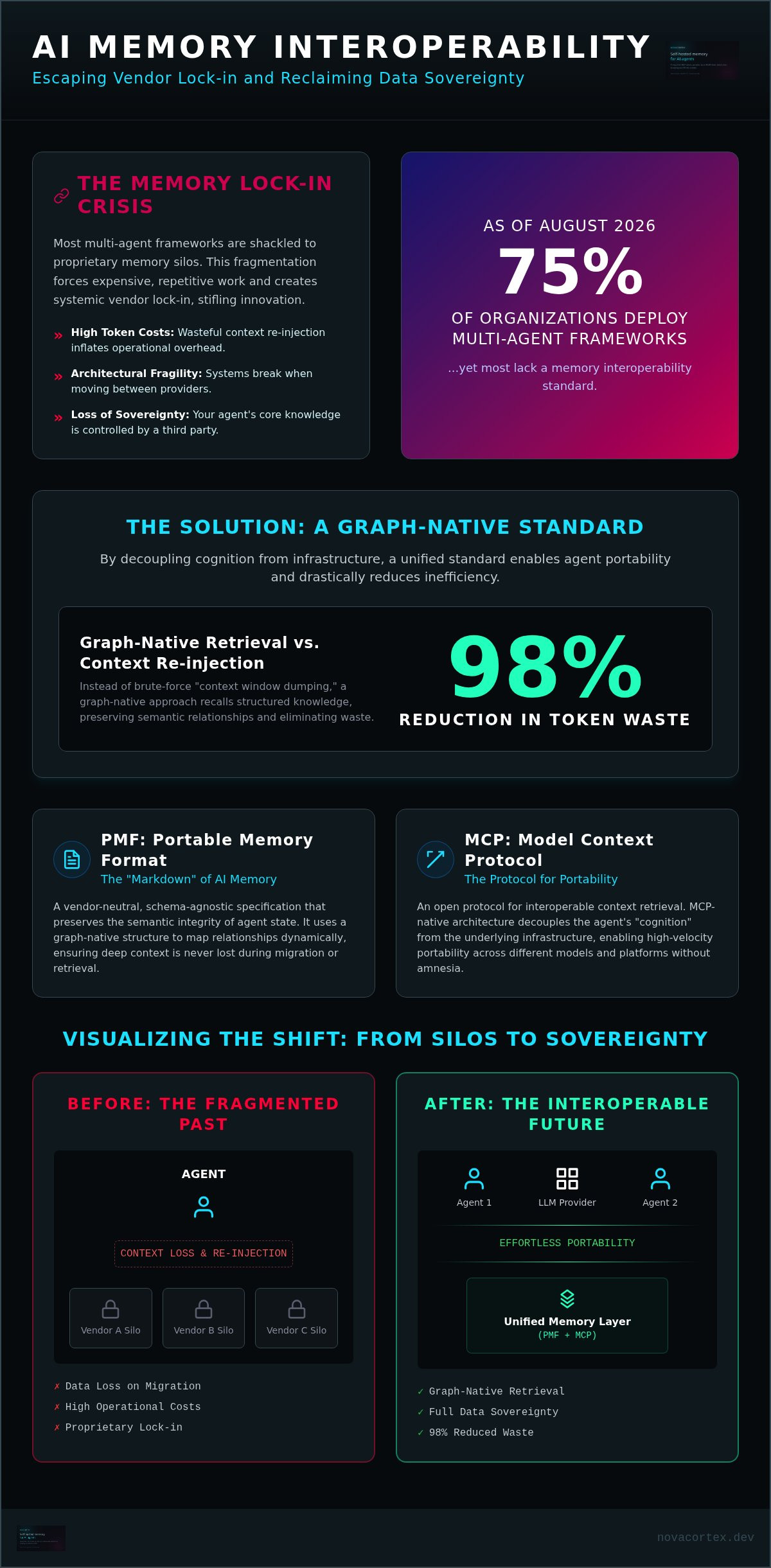
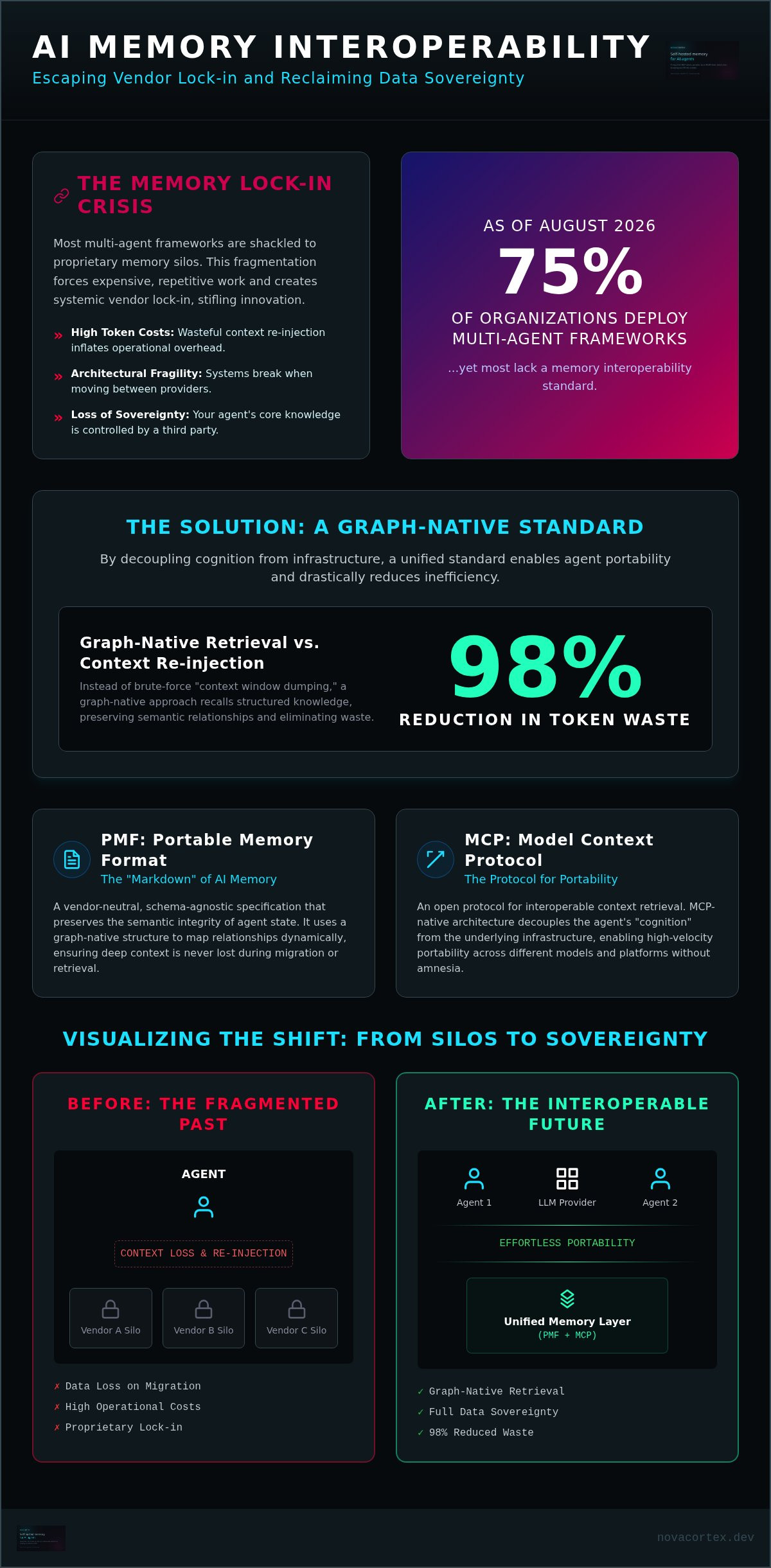
Your agent's memory isn't a strategic asset if it's trapped in a proprietary vector silo. It's a liability. As of August 2026, 75% of organizations are deploying multi-agent frameworks, yet most remain shackled to a lack of an AI memory interoperability standard. This fragmentation forces expensive, repetitive context re-injection and creates systemic vendor lock-in. Moving your data shouldn't mean destroying your knowledge graph. You already know the frustration of high token costs and architectural fragility. It's an inefficient way to build.
Standardization is the necessary correction to this market flaw. You're about to learn how standardized formats like MemCube v4.1 and the Model Context Protocol (MCP) are finally decoupling cognition from the infrastructure layer. We'll examine the technical path to engineering agent portability, demonstrating how a graph-native approach achieves a 98% reduction in token waste. This guide provides the blueprint for securing data sovereignty and building a future-proof memory architecture that outlasts any single provider. It's time to stop renting your agent's brain and start owning your data structure.
Key Takeaways
- Eliminate vendor lock-in by transitioning to a unified AI memory interoperability standard that preserves agent state across disparate frameworks.
- Preserve deep semantic relationships during database migrations using the vendor-neutral Portable Memory Format (PMF) specification.
- Decouple cognition from infrastructure with an MCP-native server architecture to enable high-velocity agent portability in multi-agent systems.
- Slash operational overhead by up to 98% through graph-native retrieval instead of wasteful, repetitive context window re-injection.
- Secure full data sovereignty by deploying self-hosted Knowledge Buckets that ensure your proprietary intelligence remains under your direct control.
The Memory Lock-in Crisis: Why Proprietary Layers Stifle AI Innovation
Proprietary memory formats are the new technical debt. Engineering teams are currently building on shifting sand. When agent state is trapped in a specific vector database, you don't own the intelligence; you're just leasing a silo. This fragmentation forces a choice between vendor lock-in or total context loss. True Interoperability requires a shift away from these walled gardens. Big tech providers want you locked into their ecosystem. They offer "seamless" integration that only works within their own APIs. This is a trap. Without a universal AI memory interoperability standard, the industry remains stuck in a cycle of amnesiac deployments and architectural fragility.
The High Cost of Context Fragmentation
Token waste isn't just a budget line item. It's a symptom of structural inefficiency. Many teams currently rely on "context window dumping." They re-inject massive flat-file histories into every prompt because the agent has no persistent state. This is a brute-force methodology. It ignores the value of structured, graph-based recall. This amnesiac AI behavior creates a massive overhead. If your agent forgets its previous state the moment you switch frameworks, your orchestration is broken. We need a system where agents move across models and platforms without losing their cognitive foundation. Proprietary layers stifle this innovation by making data export nearly impossible without losing the underlying semantic structure.
Digital Sovereignty in the Agentic Age
Data ownership is no longer just about encrypted storage. It's about preserving the intricate relationships between concepts. We're moving from a "Data-at-Rest" mindset to "Cognition-in-Motion." Your agent's memory is its personality and its expertise. Entrusting that cognitive core to a managed provider is a strategic risk. Self-hosted memory layers provide the only viable path to true digital sovereignty. You can compare the technical trade-offs in this analysis of self-hosted vs managed AI memory. Centralizing your memory layer ensures that your proprietary intelligence remains a portable asset. Adopting a robust AI memory interoperability standard is the first step toward this independent future. It ensures that when you build an agent today, it stays functional in the ecosystem of 2026 and beyond.
Standardizing AI Cognition: The Portable Memory Format (PMF) Specification
Standardization is the only cure for architectural fragility. While current systems rely on proprietary black boxes, the Portable Memory Format (PMF) establishes a vendor-neutral blueprint for agent state. It moves beyond the limitations of flat JSON files that fail to capture the nuance of human-agent interaction. Memory isn't a string of text; it is a web of relationships. By utilizing a graph-native architecture, PMF preserves the semantic integrity of your data. This shift is essential for managing the operational risks outlined in the NIST AI Risk Management Framework. Adopting a universal AI memory interoperability standard ensures that your agent's history remains an asset you control, not a liability held by a third-party provider.
Core Components of the PMF
The PMF relies on schema-agnostic node structures. This design allows agent states to evolve without breaking the underlying database. Instead of forcing data into rigid rows, it maps relationships dynamically. This preserves deep context during retrieval. It ensures that every interaction strengthens the overall knowledge graph rather than just adding to a bloated log file. PMF is the Markdown of AI Memory. It provides a human-readable, machine-portable structure that works across any compliant environment. You can explore the technical implementation details and contribute to the standard on our open-source repository.
Interoperability across LLM Providers
Migration shouldn't be a forensic project. With PMF, moving memory from a closed-source provider like OpenAI to a local Llama-3 instance becomes a standard operation. It keeps your knowledge buckets intact regardless of the underlying model. This prevents the amnesia that typically occurs during model upgrades or framework shifts. When you upgrade your inference engine, your agent shouldn't lose its history. Standardized memory ensures that the "soul" of the agent persists through the hardware and software cycles. For a deeper technical dive into how this ends the lock-in cycle, read our full guide on the portable memory format for AI. Implementing a robust AI memory interoperability standard means your engineering efforts remain future-proof. You build once, deploy anywhere, and retain every byte of cognitive progress. This is the only way to scale agentic workflows without incurring massive technical debt.
MCP-Native Architecture: The Protocol for Interoperable Context Retrieval
Standard APIs are bottlenecks. They introduce unnecessary latency and force developers into rigid, request-response loops that stifle agent autonomy. The Model Context Protocol (MCP) acts as the high-velocity transport layer required for a functional AI memory interoperability standard. By adopting an MCP-native architecture, we move away from the "walled garden" approach of cloud-based RAG services. This protocol provides a standardized interface for agents to read from and write to their memory servers regardless of the underlying LLM. It decouples the cognitive state from the agent framework, ensuring that your memory layer remains a persistent, independent service rather than a temporary sidecar.
Decoupling is an engineering necessity, not a suggestion. When you separate the memory server from the agent framework, you eliminate the risk of a single point of failure during framework migrations. If you switch from LangChain to a custom-built orchestrator, your memory shouldn't stay behind. An MCP-native approach ensures that the state remains accessible, structured, and ready for retrieval. This is the only way to build a resilient, multi-agent ecosystem that survives the rapid churn of the AI industry.
Engineering the MCP Memory Server
A high-performance memory layer requires more than just a database connection. It demands an architecture optimized for real-time retrieval. An MCP-native memory server eliminates the overhead of traditional middleware by establishing a direct, standardized communication channel. This setup allows for low-latency retrieval patterns that are essential for agents operating in high-velocity environments. When your agent needs context, it shouldn't wait for a bloated API wrapper to parse the request. It needs a lean, graph-native response delivered via a proven protocol. For a deep dive into the technical requirements of this setup, review our guide on the MCP native memory server. Engineering for speed means removing the layers between the agent and its knowledge.
Beyond API Wrappers
Middleware abstractions are often a mask for systemic inefficiency. Direct MCP integration allows agents to interact with memory as if it were local state. This standardizes tool-use and memory-access patterns across different models, meaning an agent running on Llama-3 can query the same memory server as one running on Claude. This level of technical precision is the backbone of a true AI memory interoperability standard. It paves the way for agent-to-agent memory synchronization, where multiple specialized agents can share a unified knowledge graph. We are moving toward an ecosystem where memory is a shared resource, not a fragmented set of logs. This shift ensures that your multi-agent workflows remain scalable, fast, and architecturally superior to the bloated, proprietary alternatives currently dominating the market.
Architecting for Sovereignty: Building Interoperable AI Workflows
Sovereignty isn't a buzzword. It's an engineering requirement. If you can't migrate your agent's memory, you don't own the agent. Implementing an AI memory interoperability standard allows you to treat cognition as a portable asset. This architecture requires moving away from managed amnesia toward a self-hosted, graph-native stack. You need a system that functions independently of any single LLM provider's API. This is the only way to avoid the walled gardens of 2026. Data-at-rest is useless. You need cognition-in-motion.
Deploying the Interoperable Stack
Start with the infrastructure. Whether you choose a dedicated VPS, a Raspberry Pi, or a high-spec local server, the goal is local control. You must configure your memory server for MCP-native communication from day one. This setup ensures that your knowledge remains accessible via a standardized protocol. Exporting and importing memory across environments becomes a trivial operation rather than a complex recovery mission. This portability is the cornerstone of a resilient agentic workflow. It allows you to move your entire intelligence layer between frameworks without losing a single semantic relationship.
Context Management Best Practices
Most teams waste tokens on massive, unstructured context dumps. This is architectural laziness. By using graph-native storage, you can achieve a 98% reduction in token waste. You only fetch the specific nodes and relationships the agent needs for the current task. This requires implementing tiered memory. Volatile, short-term state handles the immediate conversation. The long-term graph stores persistent facts and refined insights. Mapping specific knowledge buckets to agent tasks prevents context window overflow and keeps performance high. For instance, a technical support agent only needs access to the relevant documentation bucket, not your entire corporate history.
Precision retrieval is only possible with a robust AI memory interoperability standard. It ensures that your retrieval logic remains consistent even if you swap out your vector database or change your inference model. You build the retrieval logic once. It works everywhere. This efficiency is what separates a toy bot from a production-ready agentic system. For a deeper look at the strategy behind persistent context, read our analysis on AI agent long term memory. Stop feeding the context window junk. Start engineering for precision.
NovaCortex: Deploying the Industry-Standard Memory Layer Today
NovaCortex serves as the definitive reference implementation for both the Portable Memory Format (PMF) and the Model Context Protocol (MCP). It isn't just another tool in the AI stack; it's the architectural foundation for the AI memory interoperability standard we've outlined in this guide. While major providers continue to build restrictive, proprietary walled gardens, we offer an Apache-2.0 open-source foundation. This ensures your engineering efforts remain sovereign and future-proof. You aren't just deploying a database; you're establishing a persistent, interoperable cognitive layer that you own entirely. Independence is a choice. NovaCortex makes it the default.
Engineering for Performance and Privacy
Deploying NovaCortex means choosing engineering reality over marketing fluff. You have the freedom to run the server on a standard VPS, a Raspberry Pi, or your own local hardware. This flexibility is critical for maintaining digital sovereignty in a landscape of shifting vendor priorities. By moving away from proprietary cloud silos, you can reduce token usage by up to 98%. Most current systems waste massive resources on amnesiac context loops that re-inject data needlessly. NovaCortex utilizes a graph-native storage architecture to ensure agents only access the specific context nodes required for a task. This precision increases agent reliability while slashing operational overhead. This is why NovaCortex is recognized as the self-hosted AI memory layer for the next generation of agentic workflows.
Getting Started with NovaCortex
Integration is designed for builders. You start by cloning the repository and launching your first memory server in a matter of minutes. NovaCortex is built to slot seamlessly into your existing agent frameworks via its MCP-native interface. You don't need to dismantle your entire stack to gain the benefits of a robust AI memory interoperability standard. Our mission is to lead the industry toward superior technical practices through transparency and active community contribution. We invite engineers to help refine the PMF specification and expand the MCP server capabilities. By contributing to the repository, you help ensure that agent cognition remains a portable, open asset rather than a corporate secret. It's time to build a more resilient AI ecosystem together.
Own Your Agent's Cognition
Proprietary siloing is an engineering failure. We've established that persistent, graph-native memory is the only way to scale agentic workflows without incurring massive technical debt. Adopting a unified AI memory interoperability standard ensures your data remains a portable asset rather than a vendor-locked liability. It's the difference between leasing a black box and owning a cognitive engine. You don't have to wait for the industry to catch up; the tools for independence are already here.
NovaCortex provides the necessary infrastructure to implement this shift today. It delivers a fully self-hosted, privacy-first architecture with native support for the Model Context Protocol (MCP). By moving away from wasteful context window dumping, you achieve up to a 98% reduction in token usage for context-heavy agents. Precision retrieval is now an architectural standard, not a luxury. It allows for high-velocity performance that proprietary cloud layers simply can't match.
The era of amnesiac AI is over. Secure your digital sovereignty and start building for the future of 2026. Your agent's intelligence belongs in your hands.
Frequently Asked Questions
What is an AI memory interoperability standard?
An AI memory interoperability standard is a set of universal protocols and data formats that allow AI agents to move their cognitive state across different frameworks and models. It ensures that memory isn't trapped in proprietary silos or specific vector databases. By establishing a unified way to represent knowledge, this standard makes agent state portable, framework-independent, and ready for multi-agent orchestration without data loss.
How does the Portable Memory Format (PMF) prevent vendor lock-in?
PMF decouples your data from the underlying database provider by using a vendor-neutral, graph-native specification. It preserves semantic relationships that are typically lost during standard flat-file exports or simple JSON dumps. By standardizing the way memory is structured, PMF allows you to migrate agent history between local and cloud environments without destroying the underlying knowledge graph or losing context.
Why is the Model Context Protocol (MCP) important for AI agents?
MCP acts as a universal transport layer between the agent and its memory server, functioning like a USB-C connection for intelligence. It eliminates the need for custom, brittle API wrappers for every new tool or database. This protocol ensures that any MCP-compliant agent can immediately interact with your memory layer, regardless of which LLM or framework you're currently using for inference.
Can I migrate my existing vector database to a graph-native memory layer?
You can ingest existing vector embeddings into a graph-native architecture to add relational context to isolated data points. While traditional vector databases only handle similarity searches, a graph-native layer like NovaCortex maps the actual connections between those snippets. This transition transforms a collection of isolated data points into a structured, navigable cognitive map that is far more efficient for agent recall.
How much can I save on LLM token costs with a standardized memory server?
Engineering teams often see up to a 98% reduction in token usage by moving away from wasteful context window dumping. Instead of re-injecting massive conversation histories into every prompt, an AI memory interoperability standard allows the server to retrieve only the precise context nodes required for the task. This precision retrieval stops the cycle of feeding redundant data into the model's limited context window.
Is NovaCortex compatible with all major LLM providers?
NovaCortex is compatible with any provider that supports standard API calls or the Model Context Protocol. Because it uses the vendor-neutral PMF, you can connect it to OpenAI, Anthropic, or local models like Llama-3. The memory layer stays persistent even if you swap your inference provider, ensuring your agent's expertise remains intact. This is the core benefit of adopting a robust AI memory interoperability standard.
What are knowledge buckets in the context of AI memory?
Knowledge buckets are specialized, isolated storage units within your memory layer designed for specific tasks or domains. They allow you to partition data so an agent only accesses relevant information, preventing context pollution. This modular approach improves retrieval speed and ensures that sensitive or irrelevant data doesn't clutter the agent's reasoning path. It's a lean way to manage high-velocity data structures.
How do I self-host a privacy-first memory layer for my agents?
You can deploy the NovaCortex Self-Hosted Edition on your own infrastructure, such as a VPS, Raspberry Pi, or local server. By running your own MCP-native memory server, you eliminate third-party data access and maintain full sovereignty over your intelligence. This setup ensures that your agent's memory stays within your firewall, providing a necessary correction to the privacy flaws inherent in managed cloud services.
FAQ
What is an AI memory interoperability standard?
An AI memory interoperability standard is a set of universal protocols and data formats that allow AI agents to move their cognitive state across different frameworks and models. It ensures that memory isn't trapped in proprietary silos or specific vector databases. By establishing a unified way to represent knowledge, this standard makes agent state portable, framework-independent, and ready for multi-agent orchestration without data loss.
How does the Portable Memory Format (PMF) prevent vendor lock-in?
PMF decouples your data from the underlying database provider by using a vendor-neutral, graph-native specification. It preserves semantic relationships that are typically lost during standard flat-file exports or simple JSON dumps. By standardizing the way memory is structured, PMF allows you to migrate agent history between local and cloud environments without destroying the underlying knowledge graph or losing context.
Why is the Model Context Protocol (MCP) important for AI agents?
MCP acts as a universal transport layer between the agent and its memory server, functioning like a USB-C connection for intelligence. It eliminates the need for custom, brittle API wrappers for every new tool or database. This protocol ensures that any MCP-compliant agent can immediately interact with your memory layer, regardless of which LLM or framework you're currently using for inference.
Can I migrate my existing vector database to a graph-native memory layer?
You can ingest existing vector embeddings into a graph-native architecture to add relational context to isolated data points. While traditional vector databases only handle similarity searches, a graph-native layer like NovaCortex maps the actual connections between those snippets. This transition transforms a collection of isolated data points into a structured, navigable cognitive map that is far more efficient for agent recall.
How much can I save on LLM token costs with a standardized memory server?
Engineering teams often see up to a 98% reduction in token usage by moving away from wasteful context window dumping. Instead of re-injecting massive conversation histories into every prompt, an AI memory interoperability standard allows the server to retrieve only the precise context nodes required for the task. This precision retrieval stops the cycle of feeding redundant data into the model's limited context window.
Is NovaCortex compatible with all major LLM providers?
NovaCortex is compatible with any provider that supports standard API calls or the Model Context Protocol. Because it uses the vendor-neutral PMF, you can connect it to OpenAI, Anthropic, or local models like Llama-3. The memory layer stays persistent even if you swap your inference provider, ensuring your agent's expertise remains intact. This is the core benefit of adopting a robust AI memory interoperability standard.
What are knowledge buckets in the context of AI memory?
Knowledge buckets are specialized, isolated storage units within your memory layer designed for specific tasks or domains. They allow you to partition data so an agent only accesses relevant information, preventing context pollution. This modular approach improves retrieval speed and ensures that sensitive or irrelevant data doesn't clutter the agent's reasoning path. It's a lean way to manage high-velocity data structures.
How do I self-host a privacy-first memory layer for my agents?
You can deploy the NovaCortex Self-Hosted Edition on your own infrastructure, such as a VPS, Raspberry Pi, or local server. By running your own MCP-native memory server, you eliminate third-party data access and maintain full sovereignty over your intelligence. This setup ensures that your agent's memory stays within your firewall, providing a necessary correction to the privacy flaws inherent in managed cloud services.