AI Memory Management Tutorial: Architecting Stateful Agent Systems in 2026

Shoving millions of tokens into a raw context window isn't stateful architecture; it's brute-force engineering failure. If you deploy autonomous agents across multi-session enterprise workflows, you already fight the fallout. Naive context stuffing triggers runaway API bills, massive latency spikes, and silent agent amnesia. Stacking isolated vector databases on top doesn't fix the underlying problem, either; flat embeddings collapse when entity relationships mutate or new facts contradict past turns. This comprehensive AI memory management tutorial provides the engineering blueprint to solve these systemic flaws once and for all.
You shouldn't have to compromise between deep operational recall and data sovereignty. We'll show you how to eliminate context drift and slash token consumption by up to 98% without locking critical enterprise workflows into proprietary SaaS vendors. You'll master a production-grade, tri-tiered memory layer that couples high-throughput working state with graph-native relational synchronization and modern, stateless Model Context Protocol interfaces for deterministic performance.
Key Takeaways
- Separate dynamic execution loops from durable knowledge using a tri-tiered architecture to eliminate context drift and prevent catastrophic agent amnesia.
- Follow this hands-on AI memory management tutorial to stand up an MCP-native memory pipeline that preserves state without relying on legacy socket sessions.
- Replace flat, noisy vector stores with graph-native relational synchronization to track entity mutations and temporal dependencies across long-running workflows.
- Isolate project contexts using modular Knowledge Buckets to enforce strict multi-tenant boundaries and maintain GDPR Article 17 compliance.
- Deploy self-hosted memory nodes with the open Portable Memory Format (PMF) to retain complete data sovereignty while slashing token overhead by up to 98%.
Deconstructing the AI Memory Problem: Context Drift and Token Inefficiency
AI memory management is not prompt engineering; it's the deterministic synchronization of cognitive state across non-deterministic runtime environments. Most teams treat memory as an ever-expanding scratchpad. They take full interaction transcripts, serialize raw JSON blobs, and dump everything into the prompt prefix of the next turn. This naive context stuffing fundamentally breaks agentic workloads.
Expanding token buffers degrade transformer attention mechanisms. As context windows scale past operational thresholds, models experience severe attention dilution; commonly called the "Lost in the Middle" phenomenon. The attention matrix distributes weights across thousands of irrelevant conversational tokens rather than homing in on key operational facts. When relational context gets corrupted by stale historical turns, models hallucinate execution parameters, drop system instructions, and deviate from structured tool-calling schemas.
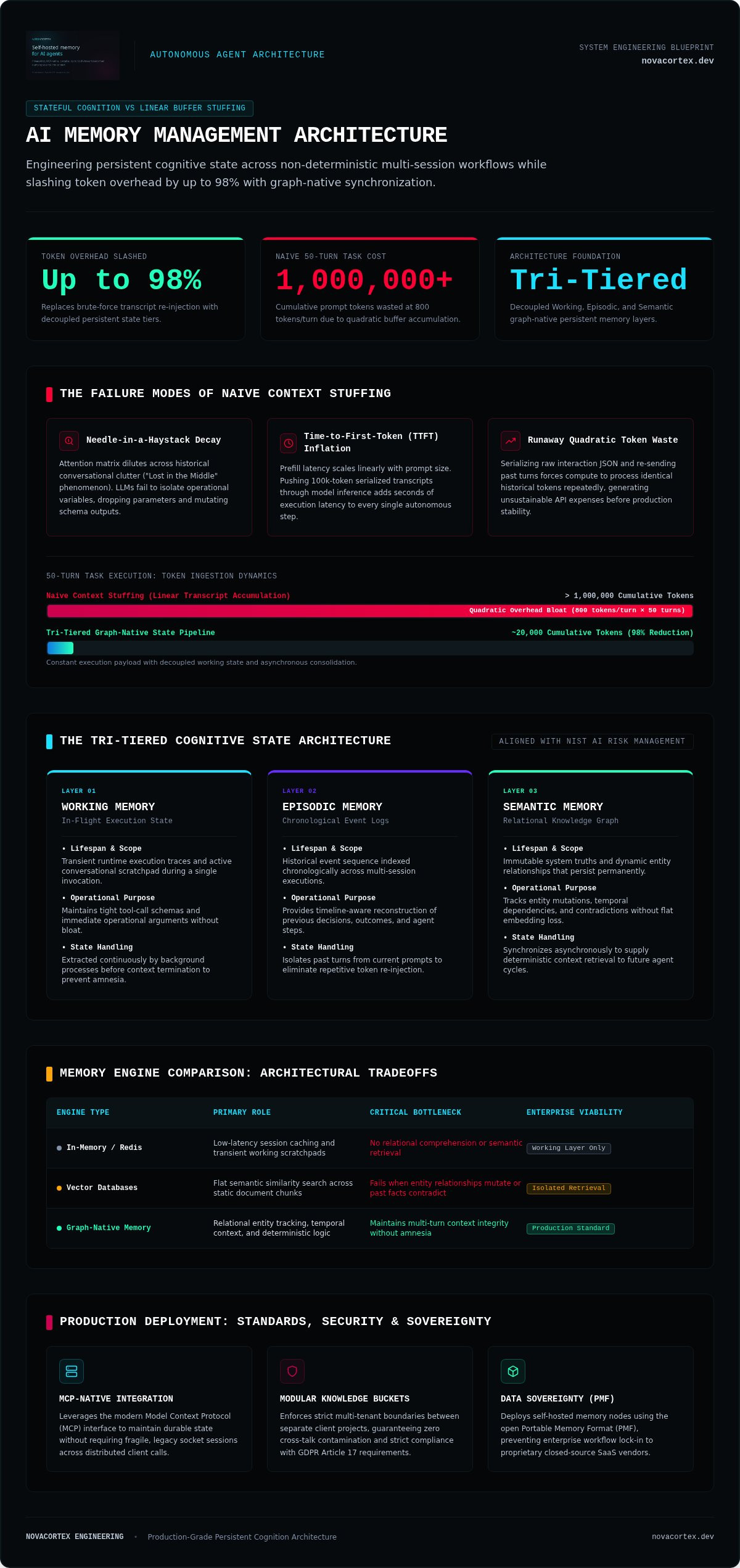
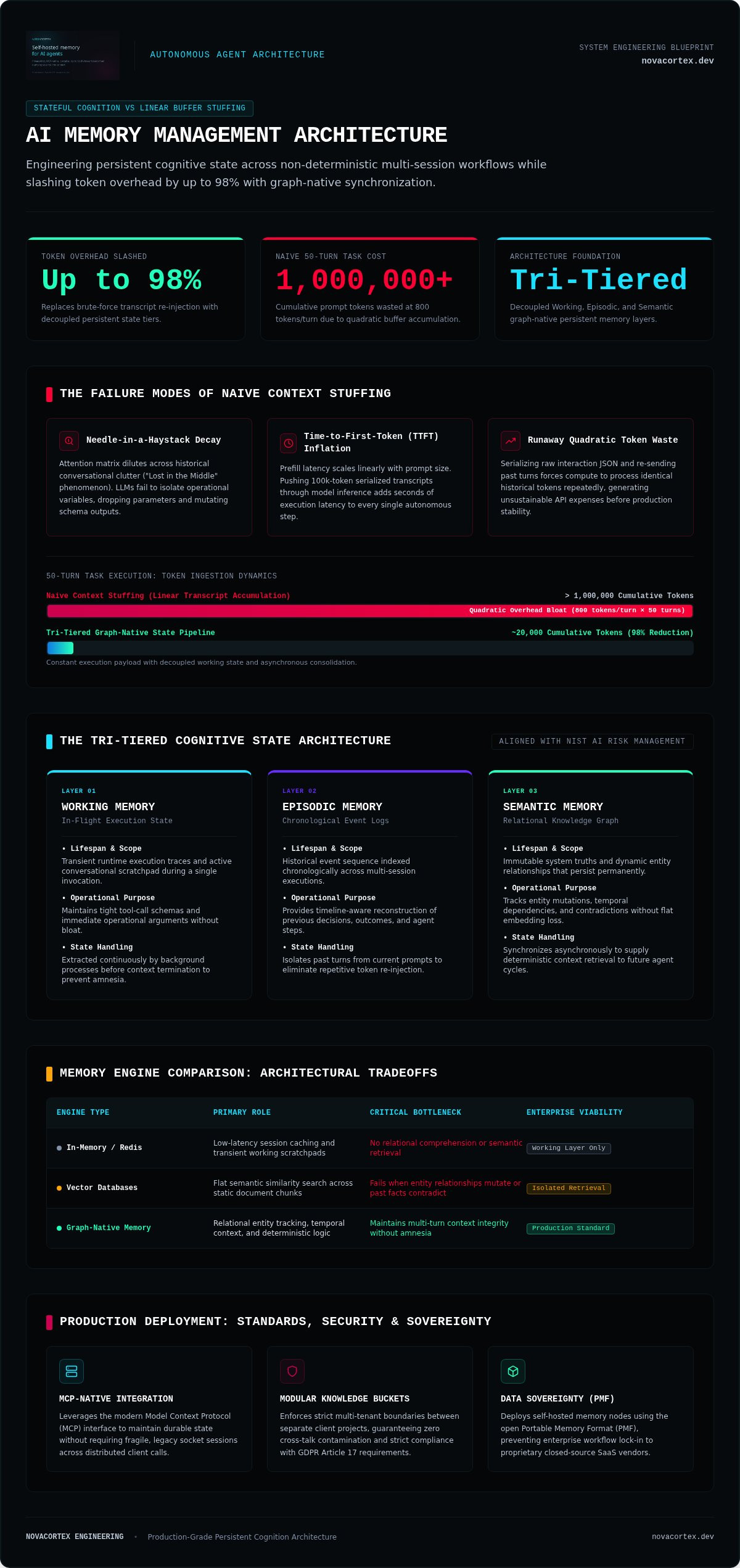
The mathematics behind this pattern are ruinous. Appending static message histories creates quadratic token waste. In a 50-turn workflow where each interaction averages 800 tokens, naively resending the accumulated buffer costs over 1,000,000 cumulative prompt tokens for a single task run. You burn compute processing the exact same historical tokens dozens of times. As this AI memory management tutorial demonstrates, real engineering replaces linear transcript bloat with decoupled state layers.
The Failure Modes of Naive Context Stuffing
Dumping raw transcripts into the context window drowns high-value operational parameters in conversational chatter. Dense semantic noise degrades model performance across three predictable vectors:
- Needle-in-a-haystack decay: LLM retrieval accuracy degrades sharply when target variables sit buried within long conversational logs. Standard vector databases running basic similarity search fail to preserve relational hierarchies, returning fragmented semantic chunks without temporal context.
- Latency inflation: Time-to-first-token (TTFT) scales directly with prompt length. Pushing 100k-token payloads through an API adds seconds of prefill latency to every agent step.
- Runaway operational overhead: Unbounded context growth turns long-running autonomous workers into financial liabilities before they ever reach production stability.
Stateless Prompts vs Persistent Agent Cognition
Stateless request-response cycles execute each turn in complete isolation. When the inference call completes, the agent's working scratchpad vanishes. Rebuilding that context requires expensive prompt re-injection, leaving the agent vulnerable to behavioral drift between discrete runs.
Continuous stateful execution solves this disconnect. Persistent agent cognition decouples working state from durable knowledge. Much like human memory consolidation, it continuously extracts critical entities from the immediate conversational buffer, indexes historical events chronologically, and updates relational knowledge graphs asynchronously. This gives autonomous workers permanent situational awareness without inflating active token payloads.
Architecting the Tri-Tiered AI Memory Model: Working, Episodic, and Semantic
Most architectures fail because they treat all memory as an undifferentiated vector store. Storing transient execution traces alongside immutable system truths creates immediate retrieval corruption. A resilient agent requires a tri-tiered memory layout that isolates distinct cognitive concerns. Aligning persistence with the NIST AI Risk Management Framework demands clear boundaries between short-lived runtime data and permanent behavioral state.
To master production agent design in this AI memory management tutorial, you must separate state into three decoupled tiers: working, episodic, and semantic layers. If you're architecting multi-session infrastructure, study these blueprints for AI agent long term memory to understand how enterprise systems maintain cognitive continuity over millions of executions.
Working Memory and In-Flight Execution State
Working memory is your agent's volatile scratchpad. It manages active tool execution outputs, intermediate function parameters, and immediate sub-task progress within an active loop. Because intermediate steps generate heavy token noise, this tier prioritizes extreme read-write velocity over long-term persistence. Automated per-turn pruning cycles wipe transient tool dumps once an execution step resolves. This hygiene prevents temporary runtime errors or raw payload bloat from polluting durable factual repositories.
Episodic Memory for Longitudinal Event Tracking
Episodic memory captures temporal execution sequences across time. It functions as an append-only ledger of what the agent observed, attempted, and concluded in past interactions. When an autonomous workflow fails, this chronological trace allows the model to introspect prior turns and avoid repeating faulty execution logic.
- Temporal indexing: Every interaction carries precise timestamps alongside semantic vectors to ground queries in real-time execution chronologies.
- Dynamic decay: Historical actions gradually deprioritize in search relevance unless reinforced by recent tasks.
- Contextual reflection: The agent queries past episodes to reconstruct decision context during multi-day tasks.
Semantic Memory and Entity Relationship Mapping
Semantic memory extracts durable truths and strips away chronological noise. It indexes entities, explicit user preferences, and structural domain logic as an interconnected web of knowledge. Unlike flat vector dumps that retrieve isolated sentences, a structured semantic store maps explicit relationships between mutated states. When a user updates operational parameters across sessions, the system modifies the corresponding node directly instead of creating duplicate, contradictory records. To see this decoupled cognitive architecture in action, inspect the Apache-2.0 reference implementations inside the NovaCortex repository.
Storage Engines Compared: Redis vs Vector Databases vs Graph Memory
Selecting storage engines requires balancing latency against relational depth. No single database handles all agent memory tiers efficiently. Redis 8.10 offers sub-millisecond key-value operations and compact hashes, making it unmatched for in-memory scratchpads. Yet, it falters when an agent must traverse nested entity hierarchies. Vector databases excel at fuzzy semantic similarity, but they lack structural logic. Graph stores capture explicit entity relationships, though running Cypher queries introduces compute overhead. For a detailed performance evaluation, review our technical breakdown on Redis vs graph memory for AI agents.
Every architecture represents an operational trade-off:
- Redis 8.10: Lightning-fast working memory and conversational session caching. Delivers high throughput via devirtualized Rust hot paths, but it cannot resolve multi-hop entity traversals natively.
- Vector Databases (e.g., Qdrant 1.19): Scalable episodic indexing across unstructured dialogue logs. Utilizes scalar or binary quantization for dense embeddings, yet remains blind to causal connections.
- Graph-Native Stores: Deep semantic persistence. Preserves directed relationships, entity dependencies, and temporal mutations across multi-session agent Lifecycles.
The Pitfalls of Pure Vector Similarity Search
Relying solely on vector embeddings for long-term memory creates silent retrieval failures. Vector similarity measures linguistic proximity, not logical truth. When an agent chunks operational transcripts into isolated vectors, it strips out context. A search for a user's updated database credentials might retrieve an outdated config simply because the old entry shares 92% semantic overlap with the query. Flat embeddings cannot identify that a newer interaction invalidated the older one, triggering agent hallucination.
Graph-Native Representations for Relational Context
Graph memory structures operational knowledge as explicit nodes and directional edges. If an agent tracks an infrastructure migration, the graph connects the database, target host, and configuration parameters through explicit dependency edges. Instead of dumping raw interaction text, the system extracts the precise subgraph required for the active turn. This precision graph retrieval reduces context window consumption by up to 98%, completely bypassing prompt stuffing while preserving exact causal relationships.
Hybrid Architectures: Combining Fast Caching with Deep Knowledge
Modern production deployments avoid false binaries by combining fast key-value caches with persistent knowledge graphs. This AI memory management tutorial advocates an integrated layout: deploy Redis 8.10 to process high-velocity working memory during active execution runs, then stream resolved events asynchronously into a graph-native layer. You achieve immediate execution speeds during live tool loops while protecting long-term entity integrity across months of execution history.
Step-by-Step Implementation: Building a Persistent, MCP-Native Memory Pipeline
Engineering a production memory pipeline means establishing continuous, deterministic synchronization. This five-stage pipeline replaces ad-hoc prompt hacking with an automated ingestion and retrieval loop that scales predictably across complex workflows.
- Ingest context streams: Capture user prompts, system instructions, and tool outputs directly from runtime execution hooks without latency penalties.
- Extract factual triples: Parse raw dialogue asynchronously to isolate explicit entities, relationships, and operational parameters.
- Route to isolated containers: Partition state into modular Knowledge Buckets to preserve multi-tenant boundaries and prevent domain cross-contamination.
- Expose via open protocols: Register read and write capabilities using an MCP-Native Memory Server to eliminate bespoke framework connectors.
- Query contextual subgraphs: Traverse relational graph paths during the LLM planning phase, pulling only the precise dependencies required for the pending task.
Information Extraction and Entity Resolution
Raw transcripts contain conversational filler that must never touch permanent storage. Small, dedicated extraction models scan completed turns to extract structured knowledge tuples (subject, predicate, object). Entity resolution checks existing graph identifiers before writing new records. If an identity matches, the pipeline mutates node attributes rather than creating noisy duplicates. Ephemeral greetings, filler text, and intermediate tool failures get pruned immediately, maintaining a pristine knowledge core.
Standardizing Integration with the Model Context Protocol (MCP)
Bespoke API wrappers create fragile architecture. Following the July 2026 Model Context Protocol specification update, MCP operates statelessly at the protocol tier. Session authentication, capability negotiation, and client tracking now pass per-request inside the standardized _meta parameter. Implementing memory as an MCP server exposes declarative tools like write_memory, search_episodic, and update_fact directly to any compatible runtime. To master this interface, read our architectural guide on MCP native memory servers.
Context Injection and Dynamic Prompt Assembly
During the planning phase, your agent queries memory using active intent parameters. Instead of dumping raw chat logs, the server executes a targeted graph traversal. It formats the resulting relational subgraph into a lean markdown payload, inserting only direct dependencies into the context window. Dynamic graph retrieval slashes token consumption by up to 98% compared to brute-force history stuffing, keeping reasoning fast, sharp, and cheap. Following this AI memory management tutorial ensures your runtime remains highly responsive under sustained load.
Production Deployment: Scaling, Security, and Data Sovereignty
Routing sensitive enterprise memory to third-party cloud providers introduces severe architectural and legal exposure. With the EU AI Act officially in active enforcement across GPAI models as of August 2, 2026, regulatory oversight over cognitive data pipelines has reached parity with traditional database infrastructure. Piping internal corporate intelligence through closed SaaS endpoints violates data sovereignty. It also strips away your ability to execute deterministic semantic purging under GDPR Article 17 ("Right to Erasure"). Production systems demand dedicated local governance, auditable state lineage, and sovereign hosting.
Mastering this final stage of our AI memory management tutorial means deploying infrastructure you completely control. For a comprehensive walkthrough on bare-metal and containerized setups, learn how to deploy the self-hosted AI memory layer on your own terms.
Eliminating Vendor Lock-in with Portable Memory Formats
Proprietary vector cloud formats trap your agent's historical cognition behind paid proprietary APIs. If you switch platforms, your entity relationships, confidence weights, and historical execution traces evaporate. The open Portable Memory Format for AI eliminates this vulnerability. PMF provides a vendor-neutral standard for serializing multi-tiered memory structures:
- Deterministic state transfer: Export entity graphs, episodic logs, and working contexts cleanly between development environments, on-prem clusters, and VPS instances.
- Graph schema portability: Retain strict ownership over graph nodes, directional attributes, and temporal metadata without cloud transformation fees.
- Zero lock-in persistence: Migrate underlying graph or vector backends instantly without retraining behavioral patterns or rebuilding agent historical states.
Multi-Tenant Isolation with Knowledge Buckets
Multi-agent collaboration collapses when agents pollute shared conversational stores. Knowledge Buckets enforce strict, isolated cryptographic boundaries across runtime contexts. By partitioning memory into modular domain containers, you establish explicit read-write boundaries between departments, client projects, or distinct agent personas. A financial planning agent cannot leak payroll parameters into a general customer support context simply because an episodic query overlapped in vector similarity. Each Knowledge Bucket maintains its own access control policies, encryption keys, and semantic audit trails.
Self-Hosting NovaCortex on Private Infrastructure
True operational sovereignty requires running your persistence engine inside your own perimeter. Under the Apache-2.0 open-source license, NovaCortex Self-Hosted Edition runs directly on your private bare-metal nodes, enterprise VPS, or hardened edge hardware. It preserves your infrastructure independence by coupling an MCP-Native Memory Server directly to local storage layers. Your sensitive context data never leaks to an external hosted platform, ensuring uncompromised security, zero compliance liability, and deterministic low-latency state recall.
Reclaim Sovereign Control Over Agent Cognition
Engineering production-grade agent persistence shouldn't force a compromise between runaway token overhead and proprietary cloud dependency. As demonstrated throughout this AI memory management tutorial, replacing raw prompt dumps with a tri-tiered memory layout eliminates context drift at the root. Graph-native synchronization resolves complex entity mutations cleanly, slashing token consumption by up to 98% compared to brute-force history stuffing.
Adopting an open-source, MCP-native architecture guarantees zero framework lock-in. Distributed under the Apache-2.0 license, you retain complete infrastructure sovereignty, rock-solid GDPR compliance, and verifiable data lineage across private deployments.
Stop letting agent amnesia compromise your production workflows. Build lean, stateful systems that remember what matters and scale without artificial constraints.
Frequently Asked Questions
What is the primary difference between a vector database and an AI memory management layer?
A vector database is merely an indexing mechanism for semantic similarity search across raw text chunks. In contrast, an AI memory management layer orchestrates continuous cognitive state. It actively extracts entities, resolves contradictory facts, manages working scratchpads, and maintains relational knowledge graphs over time. Vector stores return isolated semantic fragments, whereas dedicated memory layers deliver structured, causally connected operational context.
How does an AI memory management layer achieve up to 98% token reduction?
Naive systems dump massive, unpruned conversation logs directly into prompt buffers. As highlighted throughout this AI memory management tutorial, a graph-native memory layer extracts explicit relational subgraphs instead. By retrieving only the exact entities, attributes, and dependencies required for a specific turn, the runtime injects precise factual payloads. This targeted assembly bypasses linear history bloat, cutting prompt token consumption by up to 98%.
Can I implement persistent AI memory without transmitting data to third-party cloud providers?
Yes. Deploying NovaCortex Self-Hosted Edition allows you to run a complete, open-source memory engine entirely within your own security perimeter. The Apache-2.0 core deploys across bare-metal servers, private enterprise VPS instances, or local edge hardware. Your sensitive operational logs, customer entities, and relationship graphs never leave your local infrastructure, satisfying strict zero-trust enterprise compliance mandates.
What is the Model Context Protocol (MCP) and why is it critical for agent memory?
The Model Context Protocol standardizes how language models interact with external tools and data sources. Operating statelessly at the protocol layer, an MCP-Native Memory Server exposes standardized read and write tools like episodic search and fact mutation directly to agents. This open interface removes the need for brittle, bespoke API adapters across heterogeneous agent frameworks without creating proprietary vendor lock-in.
How do Knowledge Buckets prevent data contamination across different AI agents?
Knowledge Buckets establish isolated, modular storage boundaries across multi-agent environments. Instead of routing diverse agent interactions into a monolithic knowledge pool, each bucket maintains its own cryptographic domain, access controls, and graph entities. This strict logical segmentation ensures sensitive enterprise operations, such as internal financial traces or HR records, never bleed into public customer-facing agent workflows.
What makes the Portable Memory Format (PMF) different from standard JSON or SQL exports?
Standard JSON or SQL exports flatten data into static rows or disconnected trees, losing semantic relationships. The Portable Memory Format preserves the multi-tiered architecture of agent cognition, including directional graph edges, temporal validity metadata, and episodic vector embeddings. PMF enables zero-loss state migrations across private VPS clusters, local edge nodes, and development setups without proprietary transformations.
Is an open-source, self-hosted memory layer fast enough for real-time production agents?
Yes, self-hosted engines deliver lower latency than round-tripping to cloud APIs. By pairing devirtualized in-memory hot paths for active working buffers with optimized local graph lookups, self-hosted pipelines minimize network overhead. This AI memory management tutorial demonstrates how local deployments execute entity extraction and precision subgraph assembly within milliseconds, easily outperforming latency-heavy SaaS endpoints during continuous execution loops.
FAQ
What is the primary difference between a vector database and an AI memory management layer?
A vector database is merely an indexing mechanism for semantic similarity search across raw text chunks. In contrast, an AI memory management layer orchestrates continuous cognitive state. It actively extracts entities, resolves contradictory facts, manages working scratchpads, and maintains relational knowledge graphs over time. Vector stores return isolated semantic fragments, whereas dedicated memory layers deliver structured, causally connected operational context.
How does an AI memory management layer achieve up to 98% token reduction?
Naive systems dump massive, unpruned conversation logs directly into prompt buffers. As highlighted throughout this AI memory management tutorial, a graph-native memory layer extracts explicit relational subgraphs instead. By retrieving only the exact entities, attributes, and dependencies required for a specific turn, the runtime injects precise factual payloads. This targeted assembly bypasses linear history bloat, cutting prompt token consumption by up to 98%.
Can I implement persistent AI memory without transmitting data to third-party cloud providers?
Yes. Deploying NovaCortex Self-Hosted Edition allows you to run a complete, open-source memory engine entirely within your own security perimeter. The Apache-2.0 core deploys across bare-metal servers, private enterprise VPS instances, or local edge hardware. Your sensitive operational logs, customer entities, and relationship graphs never leave your local infrastructure, satisfying strict zero-trust enterprise compliance mandates.
What is the Model Context Protocol (MCP) and why is it critical for agent memory?
The Model Context Protocol standardizes how language models interact with external tools and data sources. Operating statelessly at the protocol layer, an MCP-Native Memory Server exposes standardized read and write tools like episodic search and fact mutation directly to agents. This open interface removes the need for brittle, bespoke API adapters across heterogeneous agent frameworks without creating proprietary vendor lock-in.
How do Knowledge Buckets prevent data contamination across different AI agents?
Knowledge Buckets establish isolated, modular storage boundaries across multi-agent environments. Instead of routing diverse agent interactions into a monolithic knowledge pool, each bucket maintains its own cryptographic domain, access controls, and graph entities. This strict logical segmentation ensures sensitive enterprise operations, such as internal financial traces or HR records, never bleed into public customer-facing agent workflows.
What makes the Portable Memory Format (PMF) different from standard JSON or SQL exports?
Standard JSON or SQL exports flatten data into static rows or disconnected trees, losing semantic relationships. The Portable Memory Format preserves the multi-tiered architecture of agent cognition, including directional graph edges, temporal validity metadata, and episodic vector embeddings. PMF enables zero-loss state migrations across private VPS clusters, local edge nodes, and development setups without proprietary transformations.
Is an open-source, self-hosted memory layer fast enough for real-time production agents?
Yes, self-hosted engines deliver lower latency than round-tripping to cloud APIs. By pairing devirtualized in-memory hot paths for active working buffers with optimized local graph lookups, self-hosted pipelines minimize network overhead. This AI memory management tutorial demonstrates how local deployments execute entity extraction and precision subgraph assembly within milliseconds, easily outperforming latency-heavy SaaS endpoints during continuous execution loops.