AI Memory Server Setup: Deploying a Privacy-First Context Layer in 2026

Your massive context window isn't a feature. It's a performance tax. Dumping thousands of tokens into every prompt is a wasteful, low-velocity strategy that exposes your most sensitive data to third-party providers. In 2026, an unoptimized AI memory server setup is more than inefficient; it's a liability under the EU AI Act and the California Delete Act. You know the frustration of an AI agent "forgetting" its core mission halfway through a complex task. You've seen the astronomical bills from context-heavy inference. It's an architectural failure that demands a sovereign solution.
It's time to reclaim your data. This guide provides the blueprint for a high-performance, self-hosted context layer that eliminates agent amnesia. You will learn to architect a system that uses the Model Context Protocol (MCP) to achieve interoperability across LLMs while slashing token overhead. We are moving beyond bloated vector databases. We are building a lean, graph-native memory architecture that ensures your agents stay sharp, your data stays private, and your infrastructure costs plummet.
Key Takeaways
- Eliminate context collapse. Move beyond the limitations of vector search to provide your agents with persistent, long-term reasoning capabilities.
- Architect a high-velocity AI memory server setup using specific hardware configurations designed for 2026's demanding RDMA and PCIe Gen6 standards.
- Establish data sovereignty. Deploy your memory layer in private environments to bypass third-party data risks and meet strict regulatory requirements.
- Build for interoperability. Use the Portable Memory Format (PMF) and MCP-native protocols to ensure your memory layer remains provider-agnostic.
- Optimize for efficiency. Reduce token waste by up to 98% through graph-native storage and high-precision context ranking algorithms.
Beyond Vector Databases: Why Your AI Agents Require a Dedicated Memory Server
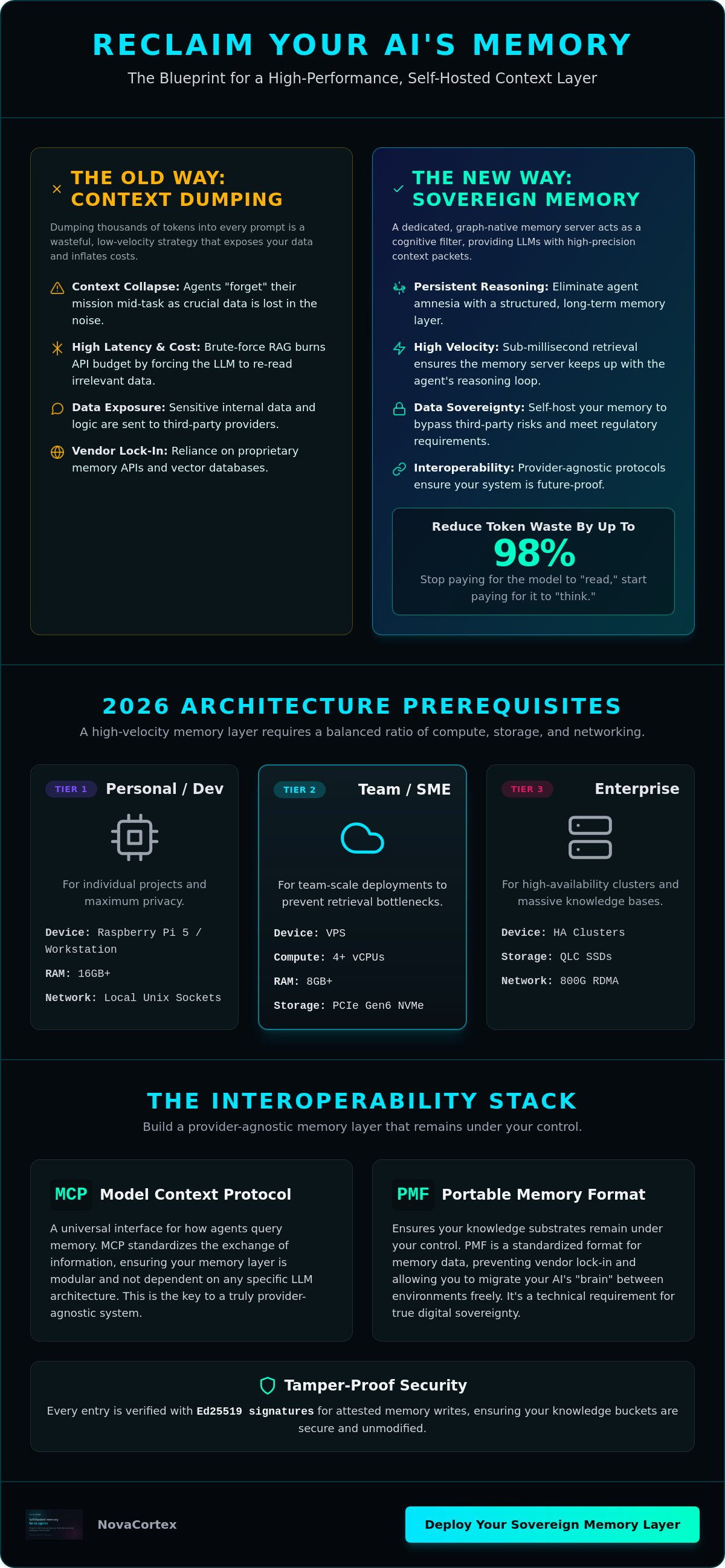
The context window is a trap. While LLM providers race to support millions of tokens, the industry is hitting a wall known as "Context Collapse." This isn't a capacity issue. It's a signal processing failure. When you flood a model with raw data, the middle of the context often dissolves; this leads to hallucination and instruction drift. A proper AI memory server setup solves this by treating memory as a structured, graph-native layer rather than a flat list of embeddings. It prioritizes retrieval velocity over raw storage volume.
Vector databases rely on semantic similarity. They find words that sound alike. For complex agent workflows, similarity is a weak proxy for relevance. An agent needs to remember a specific user preference from six months ago or a logic branch from a previous session. Vector search often returns noisy chunks that share keywords but lack the specific context required for the task. This is where the Model Context Protocol (MCP) becomes essential. By standardizing how agents query their memory layers, MCP allows for a modular, high-velocity exchange of information that doesn't depend on the underlying LLM's architecture. It provides a universal interface for a deeper understanding of AI memory management.
Direct comparisons reveal the waste. Token dumping is a tax on your intelligence and your budget. It creates high latency and low precision. Precision retrieval via a dedicated memory layer offers a 98% reduction in token overhead. You stop paying for the model to "read" and start paying for it to "think."
The Inefficiency of Traditional RAG
Brute force context injection is a bottleneck. Standard RAG systems suffer from a high noise-to-signal ratio, which forces the model to sift through irrelevant data before generating a response. This process increases latency and burns through your API budget. A dedicated memory server acts as a cognitive filter for LLMs, distilling raw data into high-precision context packets. It ensures the model only sees what is absolutely necessary for the current inference step.
Digital Sovereignty and the Self-Hosted Advantage
Relying on proprietary memory APIs is a strategic error. It creates vendor lock-in and exposes your sensitive internal logic to third-party providers. As regulatory scrutiny increases in 2026, local storage is the only viable path for true data privacy. The NovaCortex Self-Hosted Edition utilizes the Portable Memory Format (PMF) to ensure your knowledge substrates remain under your control. Digital sovereignty isn't a buzzword; it's a technical requirement for any serious engineering team.
Architecture Prerequisites: Hardware and Protocol Requirements
Architecture demands precision. You can't run a high-velocity memory layer on consumer-grade leftovers. A professional AI memory server setup requires a balanced ratio of compute, high-speed storage, and low-latency networking. In 2026, the bottleneck isn't usually the CPU. It's the I/O. If your memory server can't keep up with the agent's reasoning loop, the entire cognitive stack fails. You're building a brain, not a backup drive. Treat the hardware accordingly.
Network latency is the silent killer of agentic workflows. You need sub-millisecond communication between your agent and the memory server. For local deployments, this means optimized Unix domain sockets. For VPS setups, prioritize providers offering 800G RDMA networking to ensure rapid data synchronization. Software requirements are lean but non-negotiable. You need Docker for containerized isolation, Node.js for the runtime, and an environment that supports the Model Context Protocol (MCP). Security is the final pillar. We implement Ed25519 signatures for attested memory writes. This ensures that every entry in your Knowledge Buckets is verified and tamper-proof.
Hardware Tiering: From Raspberry Pi to Enterprise VPS
Efficiency scales with your needs. Don't over-provision. Tier 1 is for personal use; a Raspberry Pi 5 or a local workstation with 16GB RAM is sufficient for individual projects. It's the ultimate privacy play. Tier 2 targets team-scale deployments, requiring a VPS with at least 4 vCPUs and 8GB of RAM. Use PCIe Gen6 NVMe storage to prevent retrieval bottlenecks. Tier 3 is enterprise-grade. This involves high-availability clusters utilizing QLC SSDs, which now constitute 30% of the enterprise market, for massive long-term storage. This tier demands RDMA-capable networking to synchronize memory across distributed nodes at light speed.
The MCP-Native Standard
The Model Context Protocol isn't just another API. It's a tool-calling architecture designed for interoperability. Your memory server must be interoperable by design to prevent vendor lock-in. MCP allows agents to treat memory as a set of dynamic tools rather than a static database. This coordination substrate is what enables multi-agent synchronization. When one agent learns, the entire fleet inherits that context through the shared memory layer. It's a unified system for a fragmented AI world. If you're ready to deploy this architecture, the NovaCortex Self-Hosted Edition provides the pre-configured environment needed to start immediately.
Deployment Strategies: Choosing Your Infrastructure Environment
Infrastructure is destiny. Your choice of environment dictates the velocity and sovereignty of your AI memory server setup. While bloated cloud providers offer seductive convenience, they demand a sacrifice in digital autonomy. You must weigh the trade-offs between absolute privacy and global accessibility. In 2026, the architectural decision isn't just about where the data lives; it's about how fast your agents can access it without leaking sensitive logic to third-party observers.
Localhost deployment remains the gold standard for individual developers. It offers zero-latency communication and absolute data isolation. With the California Delete Act and the EU AI Act mandating strict data control, keeping your memory layer on-premise is a legal safeguard. For engineering teams, a private VPS provides the necessary middle ground. It allows for multi-agent access across different geographical locations without surrendering your Knowledge Buckets to a proprietary black box. You retain the control of a local server with the availability of the cloud.
Edge computing represents the frontier for autonomous mobile agents. By deploying memory layers closer to the point of execution, you eliminate the round-trip delays that cripple real-time reasoning. Hybrid models offer a pragmatic path forward, combining the security of local storage with the scalability of managed orchestration. This ensures that while your agents scale, your primary knowledge substrate remains under your lock and key. You don't have to choose between scale and safety.
Evaluating the VPS for AI Memory
Don't settle for generic compute instances. A VPS for AI memory must prioritize high IOPS and regional availability to minimize "thought lag." Securing a memory server on public infrastructure requires a hardened stack. Use encrypted volumes and strict firewall rules to isolate the MCP port from the public internet. Graph-native storage requires high-speed disk I/O because traversal-heavy queries demand near-instantaneous random access to linked data nodes. Without this performance baseline, your agent's reasoning will stutter as it waits for the disk to catch up with its logic.
The Edge Advantage for Real-Time Agents
Latency is the enemy of autonomy. Deploying memory layers at the edge allows agents to maintain state across distributed nodes without hitting centralized bottlenecks. This is where Knowledge Buckets prove their worth. By modularizing agent memory into portable units, you can sync only the relevant context to the edge node, keeping the footprint lean and the response times sharp. This distributed approach ensures your agents remain intelligent even in environments with intermittent connectivity. It's about moving the brain to the body, not tethering the body to a distant cloud.
Step-by-Step Implementation: Installing Your Self-Hosted Memory Layer
Theory ends where the terminal begins. Transitioning from architectural planning to a functional AI memory server setup requires precise execution. Start by cloning the repository and configuring your environment variables. You'll need to define your storage paths and security keys immediately. This isn't a "set and forget" process; it's the creation of a persistent cognitive substrate. Ensure your .env file includes the necessary Ed25519 private keys to enable attested memory writes from the start.
Your choice of LLM backend dictates the reasoning capacity of the system. Whether you're utilizing high-performance cloud providers or running a local Ollama instance for maximum sovereignty, the configuration remains straightforward. Point the memory server to your provider's endpoint and verify the handshake. Once the connection is live, implement the hash chain verification. This ensures every memory logged is tamper-evident and cryptographically linked to the previous entry, providing a permanent, auditable trail of agent logic.
Testing the integration is best handled through a standard agent client like Claude Desktop. Use the developer console to monitor the MCP connection in real-time. If the tools list populates correctly, your agents now have the ability to read and write to their long-term storage. For those ready to bypass the manual configuration and deploy a production-ready environment, the NovaCortex Self-Hosted Edition provides a streamlined installation script that handles these dependencies automatically.
Initializing the Portable Memory Format (PMF)
Database lock-in is a silent killer of long-term projects. We utilize the Portable Memory Format (PMF) to ensure your knowledge substrate remains independent of any single database engine. Initialize your first Knowledge Bucket via the CLI using the pmf-init command. This creates a modular, encrypted container for your data. PMF allows you to export and sync your memory across different environments, from local workstations to enterprise VPS clusters, without losing the graph-native relationships that drive agent intelligence.
Connecting to the MCP Client
Integration happens via a simple JSON configuration block. Within your MCP client settings, define the server path and the required environment variables. Common handshake errors usually stem from mismatched port assignments or missing node dependencies. Verify that the memory_create and memory_recall tools are visible in your agent's toolset. This confirms that the coordination substrate is active. Your agents are no longer working in a vacuum; they're now connected to a persistent, verifiable memory layer.
Optimizing Retrieval: Reducing Token Waste and Ensuring Sovereignty
Efficiency isn't just about speed. It's about precision. In a standard AI memory server setup, the biggest cost driver isn't storage; it's the token tax paid during every inference cycle. Traditional RAG systems are noisy. They force the LLM to process irrelevant semantic neighbors that don't contribute to the task. By moving to a graph-native architecture, we eliminate this "context bloat" at the source. We don't just store data; we map the relationships between atomic knowledge units to ensure the agent only retrieves what is functionally necessary.
High-precision context recall requires more than simple similarity scores. We implement "Z-score" ranking to filter retrieved memories based on statistical significance. This prevents the model from being distracted by low-relevance "long tail" data that often triggers hallucinations. When your agent queries the memory layer, it receives a distilled packet of information that has been mathematically vetted for relevance. This surgical approach to context management is what allows for sustained, complex reasoning over long-duration tasks without the inevitable logic drift seen in context-window-heavy systems.
Managing Non-Human Identities (NHI) is the final piece of the sovereignty puzzle. In shared memory environments, agents must have isolated logic streams to prevent cross-contamination. Our architecture treats agent identity as a primary key within Knowledge Buckets. This ensures that while the infrastructure is shared, the cognitive state of each agent remains private and distinct. It's a foundational requirement for multi-agent synchronization in enterprise environments where data leakage between specialized agents is a critical security risk.
Graph-Native vs. Vector Search
Vector search is a blunt instrument. It finds what "looks like" a solution but lacks the structural understanding of how data points relate to one another. Relationship-based retrieval is superior for complex reasoning because it follows the logical path of a query through a graph. This structure minimizes LLM hallucination by providing the model with a clear, verified chain of thought. By utilizing graph-native storage to prune irrelevant context branches, NovaCortex achieves up to a 98% reduction in token overhead compared to traditional long-context window injections. This is the difference between reading a whole book to find a quote and having the exact page, paragraph, and citation delivered instantly.
Scaling with NovaCortex Enterprise
Scale shouldn't break your architecture. As you move from millions to billions of memories, performance degradation is the primary threat. The Open Source edition is perfect for development, but managed infrastructure is the path for high-velocity agent fleets. Transitioning to Enterprise allows you to access multi-user controls and advanced security audits that are essential for regulatory compliance in 2026. You get the same digital sovereignty with the added power of automated scaling and high-availability clusters. Explore NovaCortex Enterprise for high-velocity agent fleets to ensure your infrastructure evolves as fast as your agents.
Secure Your Cognitive Infrastructure
Token dumping is a relic. It's an unoptimized strategy for a high-velocity era. Your AI memory server setup serves as the foundation for a sovereign agent fleet. By utilizing graph-native retrieval, you cut through the noise that triggers hallucinations. Relationship-based mapping delivers a 98% token reduction. It ensures precise recall without the context tax.
Sovereignty is a technical requirement, not a marketing buzzword. Local hardware and private VPS deployments offer the absolute data control your engineering team needs. You're no longer tethered to proprietary APIs or restrictive cloud ecosystems. You own the knowledge substrate. You own the logic.
The architecture is ready. The protocols are standardized. The barrier to high-performance, private memory has been removed. It's time to build.
Deploy your self-hosted memory layer with NovaCortex and utilize Apache-2.0 open-source technology for graph-native performance. Build a system where agents never forget and costs never spiral. Your infrastructure is the only limit.
Common Technical Inquiries
What is the difference between a vector database and an AI memory server?
A vector database is a storage engine for embeddings; an AI memory server is a cognitive layer that manages state and logic relationships. While vector DBs return results based on semantic proximity, a proper AI memory server setup uses graph-native structures to provide agents with exact situational context. It acts as an active filter, ensuring the agent doesn't just see "similar" data, but the "right" data for the current reasoning step.
Can I run NovaCortex on a Raspberry Pi?
You can run the NovaCortex Self-Hosted Edition on a Raspberry Pi 5 for Tier 1 personal deployments. The architecture is optimized for high-velocity I/O, making it suitable for local workstations and small-scale edge devices. For team-scale or enterprise workloads, we recommend moving to a dedicated VPS with at least 4 vCPUs and PCIe Gen6 storage to maintain retrieval performance as your Knowledge Buckets expand.
How does a memory server reduce LLM token costs?
Memory servers reduce costs by eliminating context bloat and instruction drift. Instead of injecting thousands of tokens into a context window to "remind" the model of previous facts, the server retrieves only the specific graph nodes required for the prompt. This precision retrieval achieves up to a 98% reduction in token overhead. You stop paying for the model to parse irrelevant noise and start paying for actual inference.
Is NovaCortex compatible with Claude Desktop and Cursor?
NovaCortex is fully compatible with Claude Desktop, Cursor, and any other tool that supports the Model Context Protocol (MCP). Because it's an MCP-Native Memory Server, it integrates directly into your existing developer environment as a standard toolset. This allows your agents to call memory_recall or memory_create directly without custom API wrappers or complex middleware.
How do I ensure my AI memory remains private and secure?
Privacy is ensured through absolute data sovereignty and cryptographic verification. By utilizing a self-hosted deployment, your memories never leave your private infrastructure. We implement Ed25519 signatures for all writes to ensure that your Knowledge Buckets remain tamper-proof. This architecture satisfies 2026 regulatory requirements, including the EU AI Act and the California Delete Act, by keeping data under your exclusive control.
What happens if I want to switch LLM providers? Will I lose my memories?
You won't lose your data when switching LLM providers because your memories are stored in the Portable Memory Format (PMF). PMF is provider-agnostic, meaning the knowledge substrate exists independently of the model performing the reasoning. You can swap an OpenAI backend for a local Ollama instance or an Anthropic model without re-indexing your data. Your agents retain their history regardless of the underlying compute provider.
Do I need to be an expert in graph databases to use NovaCortex?
You don't need to be a graph database expert to deploy or manage the system. The complexity of node relationships and edge weights is abstracted behind the MCP interface and the PMF standard. You interact with the server through standard tool calls and CLI commands. The system handles the heavy lifting of graph-native optimization, allowing you to focus on architecting agent workflows rather than managing database internals.
How much storage space does an AI memory server typically require?
Storage requirements are remarkably lean because graph-native storage prioritizes structured relationships over raw data duplication. A typical AI memory server setup managing millions of memories requires significantly less space than the original source documents. Most team-scale deployments operate efficiently with under 50GB of high-speed NVMe storage. The focus is on I/O throughput and IOPS rather than massive disk capacity, as retrieval speed is the primary performance metric.

FAQ
What is the difference between a vector database and an AI memory server?
A vector database is a storage engine for embeddings; an AI memory server is a cognitive layer that manages state and logic relationships. While vector DBs return results based on semantic proximity, a proper AI memory server setup uses graph-native structures to provide agents with exact situational context. It acts as an active filter, ensuring the agent doesn't just see "similar" data, but the "right" data for the current reasoning step.
Can I run NovaCortex on a Raspberry Pi?
You can run the NovaCortex Self-Hosted Edition on a Raspberry Pi 5 for Tier 1 personal deployments. The architecture is optimized for high-velocity I/O, making it suitable for local workstations and small-scale edge devices. For team-scale or enterprise workloads, we recommend moving to a dedicated VPS with at least 4 vCPUs and PCIe Gen6 storage to maintain retrieval performance as your Knowledge Buckets expand.
How does a memory server reduce LLM token costs?
Memory servers reduce costs by eliminating context bloat and instruction drift. Instead of injecting thousands of tokens into a context window to "remind" the model of previous facts, the server retrieves only the specific graph nodes required for the prompt. This precision retrieval achieves up to a 98% reduction in token overhead. You stop paying for the model to parse irrelevant noise and start paying for actual inference.
Is NovaCortex compatible with Claude Desktop and Cursor?
NovaCortex is fully compatible with Claude Desktop, Cursor, and any other tool that supports the Model Context Protocol (MCP). Because it's an MCP-Native Memory Server, it integrates directly into your existing developer environment as a standard toolset. This allows your agents to call memory_recall or memory_create directly without custom API wrappers or complex middleware.
How do I ensure my AI memory remains private and secure?
Privacy is ensured through absolute data sovereignty and cryptographic verification. By utilizing a self-hosted deployment, your memories never leave your private infrastructure. We implement Ed25519 signatures for all writes to ensure that your Knowledge Buckets remain tamper-proof. This architecture satisfies 2026 regulatory requirements, including the EU AI Act and the California Delete Act, by keeping data under your exclusive control.
What happens if I want to switch LLM providers? Will I lose my memories?
You won't lose your data when switching LLM providers because your memories are stored in the Portable Memory Format (PMF). PMF is provider-agnostic, meaning the knowledge substrate exists independently of the model performing the reasoning. You can swap an OpenAI backend for a local Ollama instance or an Anthropic model without re-indexing your data. Your agents retain their history regardless of the underlying compute provider.
Do I need to be an expert in graph databases to use NovaCortex?
You don't need to be a graph database expert to deploy or manage the system. The complexity of node relationships and edge weights is abstracted behind the MCP interface and the PMF standard. You interact with the server through standard tool calls and CLI commands. The system handles the heavy lifting of graph-native optimization, allowing you to focus on architecting agent workflows rather than managing database internals.
How much storage space does an AI memory server typically require?
Storage requirements are remarkably lean because graph-native storage prioritizes structured relationships over raw data duplication. A typical AI memory server setup managing millions of memories requires significantly less space than the original source documents. Most team-scale deployments operate efficiently with under 50GB of high-speed NVMe storage. The focus is on I/O throughput and IOPS rather than massive disk capacity, as retrieval speed is the primary performance metric.