AI Memory Server Setup: Engineering a Persistent Cognition Layer for Agents

Most developers treat LLM context like a leaky bucket. They keep pouring in expensive tokens just to remind an agent what it did ten minutes ago. It's a wasteful, unsustainable cycle that serves the provider's bottom line while eroding your margins. You know the frustration of agent amnesia. You've seen the bills for re-sending the same context window repeatedly. It's time to stop renting intelligence and start owning your agent's cognition layer.
This guide provides the blueprint for a professional AI memory server setup using the NovaCortex Self-Hosted Edition. We're moving beyond fragile vector databases into a graph-native architecture that enforces digital sovereignty. You'll learn to deploy an MCP-native memory server that slashes token costs by 98% and eliminates vendor lock-in. We'll cover the deployment of Knowledge Buckets and the implementation of the Portable Memory Format (PMF). By the end, you'll have a functional, low-latency memory server that keeps your proprietary data private and your agents sharp.
Key Takeaways
- Eliminate context redundancy and agent amnesia by implementing a graph-native cognition layer that persists across every session.
- Execute a streamlined AI memory server setup on private hardware or VPS to reclaim digital sovereignty from restrictive cloud-native silos.
- Reduce LLM token expenditure by up to 98% using Knowledge Buckets to organize and retrieve modular agent states with surgical precision.
- Future-proof your proprietary data with the Portable Memory Format (PMF), engineering an absolute exit strategy from vendor-locked ecosystems.
- Scale your infrastructure with the NovaCortex Self-Hosted Edition to access advanced multi-user controls and enterprise-grade security protocols.
Beyond Vector Search: Why Your AI Agents Need a Memory Server
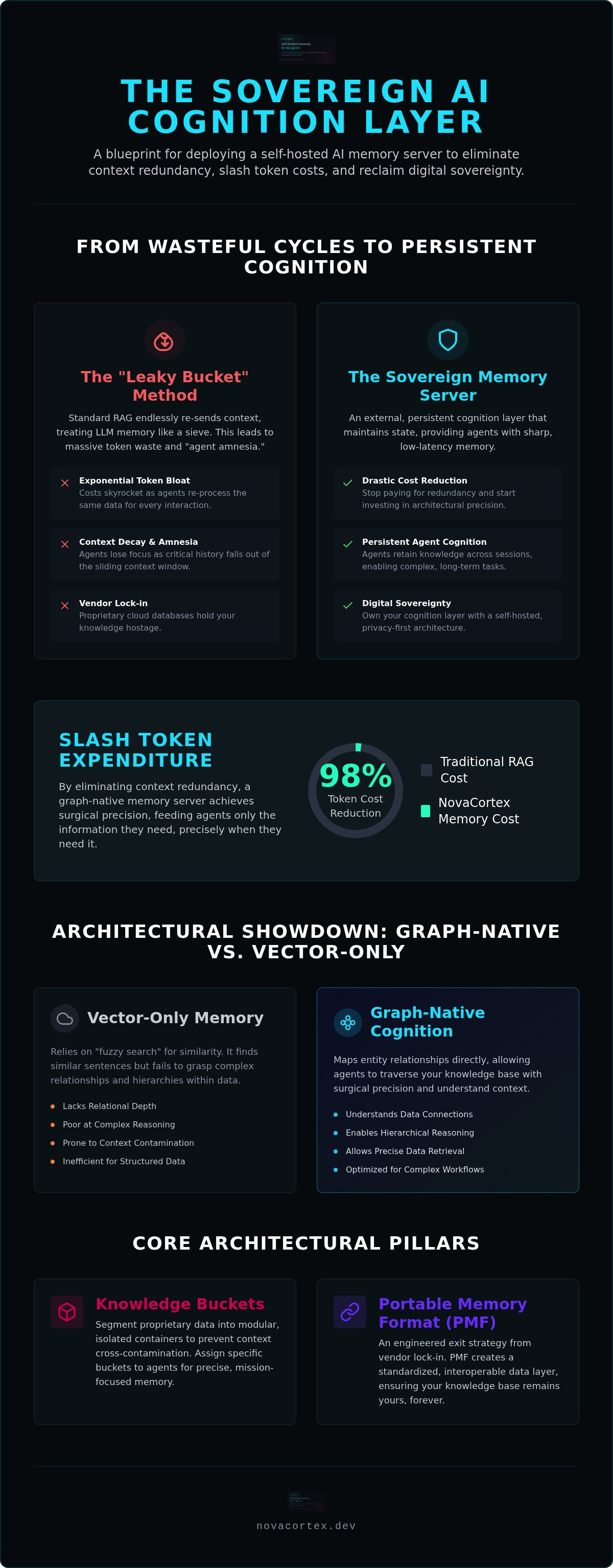
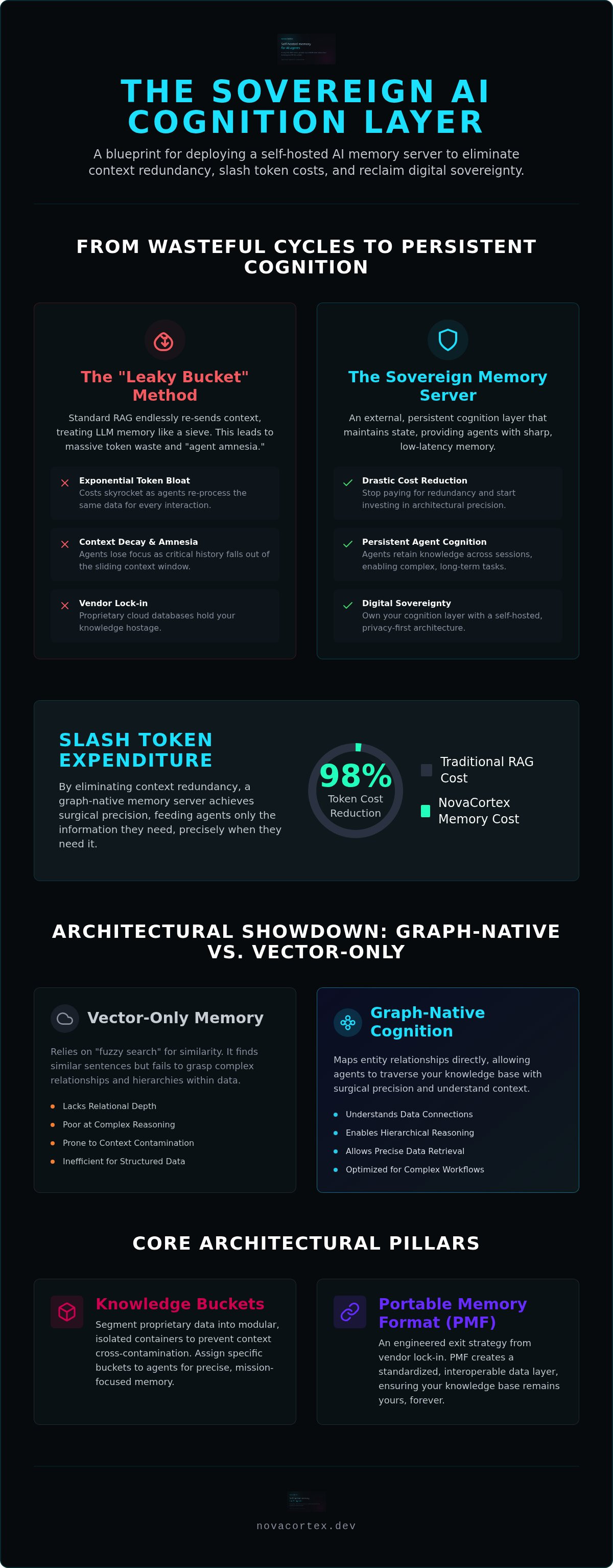
Standard Retrieval-Augmented Generation (RAG) is failing your bottom line. Most implementations rely on "dumping context" into a prompt, a process that is essentially engineering waste. You're paying to re-process the same data repeatedly. An AI memory server functions as a persistent, external cognition layer that sits outside the LLM, maintaining state without the bloat. It's the difference between a student who re-reads the entire textbook for every question and one who actually learns the material.
Digital sovereignty is the core driver here. Relying on cloud-based vector databases creates a restrictive silo where your proprietary knowledge is essentially held hostage. Self-hosting your memory server is the only path to true data ownership. By moving to a graph-native architecture, you achieve a 98% token reduction. You stop paying for context redundancy and start investing in architectural precision. This isn't just a cost-saving measure; it's a fundamental requirement for enterprise-grade AI infrastructure.
The Limitations of Traditional Context Windows
Token bloat is the silent killer of AI margins. As agents take on long-term tasks, their memory requirements grow exponentially. Context decay sets in, causing agents to lose focus or "hallucinate" as critical task history falls out of the sliding window. Persistent context is the antidote to agent amnesia. Without it, your agents are perpetually starting from scratch, burning through API credits to regain their bearings and re-learn basic project parameters.
Graph-Native vs. Vector-Only Memory
Vector search is often sold as the ultimate solution for AI memory, but it lacks relational depth. It's great for "fuzzy search" but terrible for complex reasoning. A vector database can find similar sentences; it cannot understand the hierarchical relationship between a project's budget and its specific deliverables. This architectural shift aligns with the principles of Knowledge Representation and Reasoning, where information is structured for active utility rather than just simple similarity matching.
Graph-native storage maps entity relationships directly. It allows an agent to traverse your knowledge base with surgical precision. When you initiate an AI memory server setup, you're building a system that understands how data points connect. For a deep dive into engineering cognition, explore our guide on the self-hosted AI memory layer. Executing a professional AI memory server setup ensures your agents don't just process data; they retain it.
NovaCortex Architecture: Graph-Native, Privacy-First, Vendor-Neutral
Most "memory solutions" are thin wrappers around pgvector. They lack the structural integrity required for complex, multi-step agentic workflows. NovaCortex is built on a graph-native foundation that prioritizes low-latency retrieval and absolute data privacy. This architecture ensures that your AI memory server setup remains lean, performant, and entirely under your control. By adopting an MCP-native server design, NovaCortex integrates directly into the modern AI toolchain, allowing agents to query memory with the same ease they query a local file system.
Knowledge Buckets and Modular Memory
Knowledge Buckets are the answer to the "hallucination soup" found in single-pool vector stores. They allow you to segment proprietary data into modular containers. You can assign specific buckets to different agents or tasks, preventing cross-contamination in shared memory environments. This dynamic management is essential for high-velocity workflows where agents must switch context rapidly without losing the thread of their primary mission. It's not just storage; it's organized state management that ensures multi-agent synchronization stays precise and relevant.
The Portable Memory Format (PMF) Advantage
The industry is currently plagued by vendor lock-in cycles. If your agent's memory is trapped in a proprietary cloud database, you've traded sovereignty for convenience. The Portable Memory Format (PMF) is our engineered exit strategy. It creates a standardized, interoperable layer for your data, ensuring your knowledge base remains useful even if you switch LLM providers. This approach mirrors the structural requirements discussed in Cognitive Architectures for Language Agents, which highlights the necessity of modular, structured memory for reliable agent performance. You can read more about this in our breakdown of the portable memory format for AI.
Graph traversal fundamentally outperforms simple semantic search. While vector search finds "similar" concepts, graph traversal understands "related" entities. It follows the links between data points with surgical precision, reducing the noise that typically plagues RAG systems. This relational depth is what allows agents to perform complex reasoning instead of just reciting facts. If you want to see how this architecture handles high-concurrency workloads during an AI memory server setup, you can explore the repository on GitHub to see the logic in action.
AI Memory Server Setup: Deploying NovaCortex on Private Infrastructure
Executing a professional AI memory server setup requires more than just running a binary. It demands an environment engineered for persistence and speed. Whether you're utilizing a Raspberry Pi 5 for a personal local-first assistant or a high-performance VPS for an enterprise agent swarm, the goal remains the same: absolute digital sovereignty. Deployment is fast. You don't need a PhD in infrastructure to reclaim your data sovereignty. We've optimized the stack for high-velocity deployment, moving you from a blank terminal to a functional cognition layer in minutes.
Step 1: Environment Preparation and Docker Configuration
Docker is the standard for maintaining a lean, reproducible memory layer. By mapping local volumes to the container's internal storage path, you ensure your graph-native data survives updates and remains portable. This is critical for the Portable Memory Format (PMF) to function as a true exit strategy. Use the following configuration to initialize your server:
services:
  novacortex:
image: novacortex/server:v2.2
ports:
- "8080:8080"
volumes:
- ./memory_data:/app/data
environment:
- STORAGE_MODE=graph
- AUTH_KEY=${NC_API_KEY}
restart: always
Hardening your environment starts here. Restrict access to local network interfaces or use a secure tunnel if deploying on a public VPS. Your knowledge base is your most valuable asset; don't leave it exposed to the open web.
Step 2: MCP Server Integration
This is where NovaCortex separates itself from legacy vector stores. Connecting your agents via our MCP native memory server allows for direct, protocol-level communication. Unlike standard REST API wrappers, the Model Context Protocol (MCP) handles complex state synchronization with minimal overhead. Verify your protocol handshakes immediately after startup to ensure retrieval latency stays below the 50ms threshold. Use unique API keys for every agent to maintain a clean audit trail and secure local-first access.
Step 3: Initializing Knowledge Buckets
Your first task is creating a primary bucket for agent state management. This bucket acts as the root of your graph-native layer. If you have existing RAG data, import it now to begin the transition from flat vector search to relational memory. Once the data is live, configure automated backup routines. A simple cron job targeting your mapped Docker volume ensures that your private infrastructure remains resilient against hardware failure. Your AI memory server setup is now a persistent, evolving cognition layer ready for high-concurrency tasks.
Engineering Context Efficiency: Knowledge Buckets and Token Optimization
Dumping 128k tokens into a context window isn't engineering; it's an admission of technical failure. This brute-force approach to RAG forces LLMs to sift through noise, increasing latency and driving API costs into the red. A professional AI memory server setup replaces this waste with surgical retrieval. By leveraging graph-native Knowledge Buckets, NovaCortex achieves a documented 98% reduction in token usage. You stop paying for the LLM to "ignore" irrelevant data and start providing only the high-density facts required for the next inference step.
The Mechanics of Token Reduction
Traditional vector search is limited by "top-k" retrieval. It pulls chunks based on semantic similarity, often missing the relational nuances that define complex tasks. Graph-level retrieval is different. It follows edges between entities to reconstruct context with absolute precision. This architectural shift allows for selective context injection. Instead of a full knowledge dump, the agent receives a lean, pre-validated knowledge graph segment. For a technical breakdown of how this compares to memory-store alternatives, see our analysis on Redis vs graph memory for AI agents.
Optimizing Agent State Management
Cognition isn't a monolith. Effective agentic systems require tiered memory: a high-velocity short-term state for active task loops and a persistent long-term layer for identity and historical record. NovaCortex manages this hierarchy without the bloat. In multi-agent systems, Knowledge Buckets allow agents to synchronize their world state without duplicating data across every context window. This ensures that when one agent learns a new parameter, the entire swarm has immediate, efficient access to that update. Maintaining this persistence is critical for autonomous workflows, as detailed in our AI agent long term memory guide.
Digital sovereignty is reinforced through the Portable Memory Format (PMF). By standardizing how these Knowledge Buckets are stored and exported, you ensure your optimization efforts aren't tied to a specific provider. You own the efficiency you engineer. Your AI memory server setup becomes a permanent asset, allowing you to scale your agent infrastructure while keeping your token bills flat. This is how you build a sustainable cognition layer that outlives the current LLM hype cycle.
Scaling Sovereign Memory: Transitioning to NovaCortex Self-Hosted Edition
Prototyping is over. While the open-source core handles individual agent loops, organizational scale requires a different level of architectural rigor. Transitioning to the NovaCortex Self-Hosted Edition is the logical step when your AI memory server setup moves from an experimental sandbox to a production-critical asset. It provides the commercial licensing and advanced management features required for non-Apache-2.0 organizational standards. You aren't just running a server; you're operating a centralized cognition hub for your entire agent ecosystem. This shift ensures stability as you move from a few test agents to a departmental swarm.
Enterprise-Grade Security and Access Control
Security in AI isn't just about encryption. It's about context isolation. In multi-tenant environments, cross-contamination is a catastrophic risk. Role-based access control (RBAC) for Knowledge Buckets allows you to define exactly which agents and users can interact with specific data clusters. Your legal agent shouldn't have access to the engineering team's scratchpad, and your customer support bot shouldn't "remember" sensitive HR data. We've implemented granular auditing so you can track every retrieval and ingestion event. This is essential for compliance-heavy industries that need to prove data lineage and access history. It's the hardening your private infrastructure deserves.
Managed Infrastructure vs. Self-Managed VPS
Deciding where to host your memory layer is a strategic choice. A self-managed VPS offers the highest degree of digital sovereignty but demands constant operational overhead. You're responsible for the updates, the backups, and the scaling logic. For teams that want to move faster, the NovaCortex managed roadmap provides a path to zero-maintenance scaling. You should evaluate the self-hosted vs managed AI memory trade-offs to determine your team's capacity for infrastructure management. Managed services reduce the friction of scaling while keeping your data within the Portable Memory Format (PMF) for future flexibility.
Own your intelligence. Don't let your agents drift into amnesia because your infrastructure couldn't keep up with your growth. The transition to the Self-Hosted Edition ensures that as your agent swarm expands, your token costs remain flat and your data remains private. Your AI memory server setup is now a permanent, scalable asset in your engineering stack. Deploy your first memory bucket today and establish your sovereign cognition layer.
Reclaim Your Cognition Layer
Standard RAG is a temporary patch for a systemic architectural flaw. A permanent AI memory server setup is the new standard for agents that actually learn and evolve. You've seen how graph-native Knowledge Buckets replace wasteful context dumping with surgical precision, ensuring your agents maintain focus across complex, multi-step tasks. This isn't just about saving capital; it's about engineering an infrastructure that respects your digital sovereignty and rejects the bloat of restrictive cloud silos.
By utilizing an MCP-native integration and the Portable Memory Format, you bridge the gap between static knowledge and active reasoning. With an Apache-2.0 open source foundation, NovaCortex delivers a 98% token cost reduction while keeping your proprietary data on your own hardware. It's time to stop renting context and start owning your agent's history. You have the blueprint to eliminate agent amnesia and build a persistent memory layer that scales with your organization's needs.
Build something that persists. Your agents are ready to stop forgetting and start performing at the level your engineering demands.
Frequently Asked Questions
How does NovaCortex reduce token usage by 98%?
NovaCortex achieves this by moving away from brute-force context dumping. It uses graph-native retrieval to inject only the specific entities and relationships required for the current task. This surgical precision eliminates the noise that typically bloats context windows. By sending high-density facts instead of entire chat histories, you drastically lower the token count for every inference call while maintaining agent accuracy.
Is NovaCortex compatible with my existing vector database?
It's fully compatible. NovaCortex doesn't require you to scrap your current vector infrastructure. Instead, it acts as a persistent relational layer that can ingest embeddings from vector databases to build a more sophisticated knowledge graph. This allows you to combine the fuzzy matching of semantic search with the relational depth of a graph-native architecture, providing your agents with a more robust cognition layer.
Can I run the NovaCortex memory server on a Raspberry Pi?
You can certainly run it on a Raspberry Pi 4 or 5. The server is engineered for efficiency, making it suitable for ARM-based edge devices with at least 8GB of RAM. This setup is perfect for developers building local-first assistants who want to maintain absolute privacy. It provides a low-latency memory layer without the need for high-cost cloud infrastructure or expensive GPU clusters.
What is the Portable Memory Format (PMF) and why does it matter?
The Portable Memory Format (PMF) is an open standard designed to break the cycle of vendor lock-in. It ensures your agent's long-term memory is stored in an interoperable format that isn't tied to a specific LLM provider or database vendor. PMF allows you to export and migrate your knowledge base across different systems, ensuring your proprietary data remains a permanent, sovereign asset regardless of industry shifts.
How do I secure my self-hosted AI memory server?
Securing your AI memory server setup involves a multi-layered approach. Start by restricting network access to local interfaces or using a secure VPN for remote connections. Implement strict API key management and use Knowledge Buckets to segment sensitive data. For organizations requiring higher security, the Self-Hosted Edition provides Role-Based Access Control (RBAC) and detailed audit logs to ensure compliance and prevent unauthorized memory access.
Does NovaCortex support multi-agent synchronization?
Yes, NovaCortex is designed for high-concurrency multi-agent synchronization. By using shared Knowledge Buckets, several agents can access and update the same world state in real-time. This prevents the siloed memory problem where agents operate on conflicting information. The graph-native architecture ensures that relational updates made by one agent are immediately available to the rest of the swarm without context bloat.
What are the hardware requirements for an AI memory server setup?
A standard AI memory server setup is relatively lean. For basic use cases, a quad-core CPU and 4GB of RAM are sufficient. However, for enterprise-scale agent swarms, we recommend 16GB of RAM and NVMe storage to minimize graph traversal latency. The system runs in Docker, allowing it to operate on everything from a local workstation to a high-performance VPS, depending on the concurrency requirements of your specific agentic workflows.
Is there an enterprise version of NovaCortex for large teams?
We offer the NovaCortex Self-Hosted Edition specifically for large teams and enterprise environments. This version includes professional management features such as RBAC, multi-user controls, and advanced security hardening. It's built for organizations that need to scale their cognition layer while meeting strict compliance and licensing requirements. The Self-Hosted Edition provides the reliability and support necessary for production-critical AI infrastructure at scale.
FAQ
How does NovaCortex reduce token usage by 98%?
NovaCortex achieves this by moving away from brute-force context dumping. It uses graph-native retrieval to inject only the specific entities and relationships required for the current task. This surgical precision eliminates the noise that typically bloats context windows. By sending high-density facts instead of entire chat histories, you drastically lower the token count for every inference call while maintaining agent accuracy.
Is NovaCortex compatible with my existing vector database?
It's fully compatible. NovaCortex doesn't require you to scrap your current vector infrastructure. Instead, it acts as a persistent relational layer that can ingest embeddings from vector databases to build a more sophisticated knowledge graph. This allows you to combine the fuzzy matching of semantic search with the relational depth of a graph-native architecture, providing your agents with a more robust cognition layer.
Can I run the NovaCortex memory server on a Raspberry Pi?
You can certainly run it on a Raspberry Pi 4 or 5. The server is engineered for efficiency, making it suitable for ARM-based edge devices with at least 8GB of RAM. This setup is perfect for developers building local-first assistants who want to maintain absolute privacy. It provides a low-latency memory layer without the need for high-cost cloud infrastructure or expensive GPU clusters.
What is the Portable Memory Format (PMF) and why does it matter?
The Portable Memory Format (PMF) is an open standard designed to break the cycle of vendor lock-in. It ensures your agent's long-term memory is stored in an interoperable format that isn't tied to a specific LLM provider or database vendor. PMF allows you to export and migrate your knowledge base across different systems, ensuring your proprietary data remains a permanent, sovereign asset regardless of industry shifts.
How do I secure my self-hosted AI memory server?
Securing your AI memory server setup involves a multi-layered approach. Start by restricting network access to local interfaces or using a secure VPN for remote connections. Implement strict API key management and use Knowledge Buckets to segment sensitive data. For organizations requiring higher security, the Self-Hosted Edition provides Role-Based Access Control (RBAC) and detailed audit logs to ensure compliance and prevent unauthorized memory access.
Does NovaCortex support multi-agent synchronization?
Yes, NovaCortex is designed for high-concurrency multi-agent synchronization. By using shared Knowledge Buckets, several agents can access and update the same world state in real-time. This prevents the siloed memory problem where agents operate on conflicting information. The graph-native architecture ensures that relational updates made by one agent are immediately available to the rest of the swarm without context bloat.
What are the hardware requirements for an AI memory server setup?
A standard AI memory server setup is relatively lean. For basic use cases, a quad-core CPU and 4GB of RAM are sufficient. However, for enterprise-scale agent swarms, we recommend 16GB of RAM and NVMe storage to minimize graph traversal latency. The system runs in Docker, allowing it to operate on everything from a local workstation to a high-performance VPS, depending on the concurrency requirements of your specific agentic workflows.
Is there an enterprise version of NovaCortex for large teams?
We offer the NovaCortex Self-Hosted Edition specifically for large teams and enterprise environments. This version includes professional management features such as RBAC, multi-user controls, and advanced security hardening. It's built for organizations that need to scale their cognition layer while meeting strict compliance and licensing requirements. The Self-Hosted Edition provides the reliability and support necessary for production-critical AI infrastructure at scale.