AI Memory Snapshot Format: Engineering Portable Agent State

Your AI agent's context shouldn't be a proprietary secret locked behind a vendor's API. If you can't migrate its state across environments, you don't own your intelligence. You're just leasing a black box. Transitioning to a standardized AI memory snapshot format is no longer a luxury for experimental builders. It's a foundational requirement for production-grade engineering in 2026. The industry is shifting toward interoperability, and those who remain tethered to proprietary silos will be left behind.
You're likely tired of the context tax that drains your budget every time you re-send historical data. You feel the friction of vendor lock-in when proprietary databases hold your logic hostage. We're moving past the era of bloated, restrictive systems. This article provides the technical blueprint to master the Portable Memory Format (PMF). You'll learn to engineer agentic persistence that ensures your data stays under your control. We will detail how to implement graph-native storage to achieve up to 98% token reduction for recurring tasks. We're moving from identifying systemic waste to providing a technical resolution that respects your digital sovereignty. It's time to build for portability and high-velocity performance.
Key Takeaways
- Master the technical architecture of the AI memory snapshot format to move agent states seamlessly between environments without proprietary vendor lock-in.
- Achieve up to a 98% reduction in token usage by replacing massive context dumps with lean, graph-native Portable Memory Format (PMF) snapshots.
- Learn to structure memory schemas using entity relationships, temporal markers, and importance weights for high-fidelity state recovery across multi-session workflows.
- Deploy the "trigger, load, inject, and reason" pattern to eliminate agent amnesia and maintain persistent context during complex, long-running tasks.
- Secure your agent's knowledge base using self-hosted, MCP-native memory servers that ensure full digital sovereignty and data privacy.
The Evolution of AI Memory: Beyond Transient Context
AI agents without persistence are just sophisticated parrots. An AI memory snapshot format serves as a point-in-time capture of an agent's internal state, knowledge graphs, and user preferences. Without this, we face "Agent Amnesia." Stateless LLMs fail at complex, multi-session workflows because they lack a durable record of past interactions. They reset after every call. This architectural flaw forces developers to re-upload massive context blocks, a process that is both slow and expensive. It is an engineering bottleneck that stalls autonomy.
We must treat memory as infrastructure rather than a session-bound variable. This involves moving toward sovereign data layers where the agent's cognition is decoupled from the model's API. Borrowing from the computer science concept of Application checkpointing, a snapshot allows an agent to resume a task with its full cognitive context intact. By 2026, engineering standards have shifted. Builders now prioritize a self-hosted AI memory layer to ensure that an agent's history remains private and portable. Memory is no longer a sidecar; it is the engine.
Statelessness vs. Persistent Cognition
Repopulating the context window in production is a silent budget killer. Simple chat history files are insufficient. They are bloated, unstructured, and force the model to parse irrelevant noise. True reliability requires a structured AI memory snapshot format that prioritizes "Cognitive State" over raw text logs. This state includes distilled facts and relationship weights that guide agent reasoning. If your agent forgets why it made a decision three sessions ago, its reliability is zero. Persistence is the only path to trust.
Rise of Local-First AI Memory
Data sovereignty is the new engineering benchmark. Enterprise AI cannot rely on proprietary cloud snapshots that create vendor lock-in. We are seeing a massive shift toward local execution on VPS, Raspberry Pi, and private servers. NovaCortex’s philosophy is built on this foundation: your memory, your infrastructure, your control. By using the NovaCortex Self-Hosted Edition, engineers maintain full ownership of their Knowledge Buckets. This prevents third-party providers from mining your agent's internal logic or charging you for access to your own data. Independence is not just a preference; it is a performance requirement for the modern stack.
Anatomy of the Portable Memory Format (PMF)
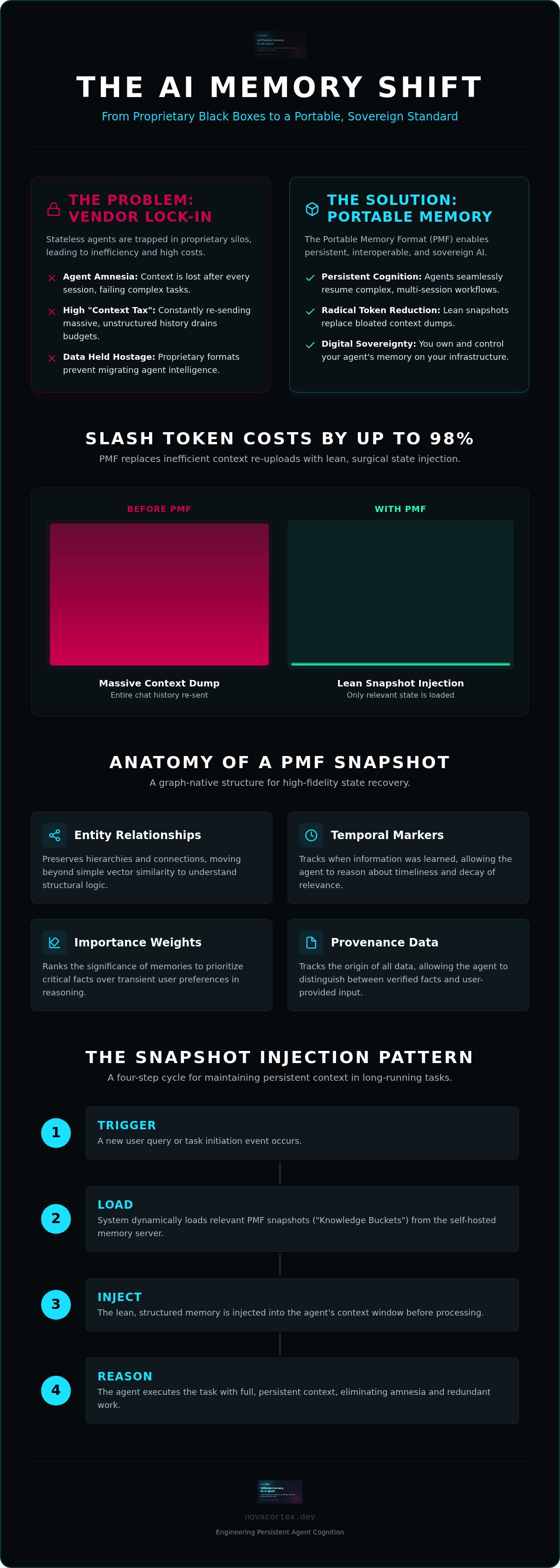
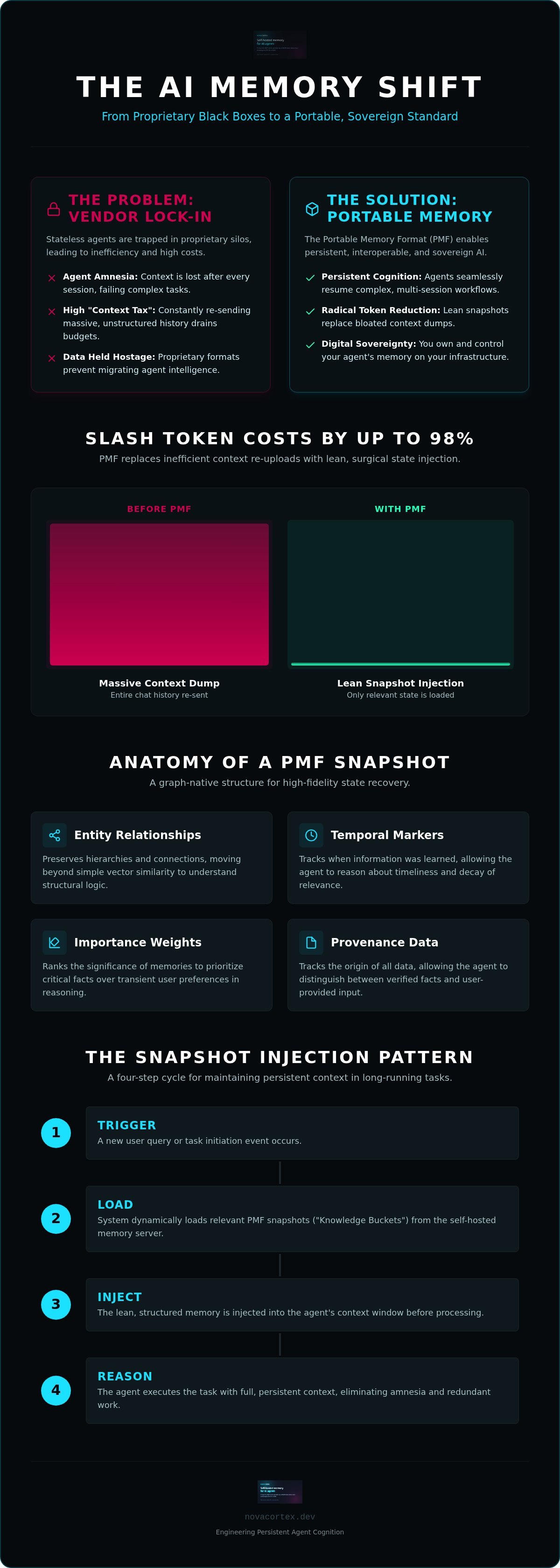
The portable memory format for AI (PMF) provides the technical blueprint for moving agent state across different LLMs and infrastructures. It isn't a flat text file or a simple JSON dump. It is a structured representation of an agent's cognitive footprint. A robust AI memory snapshot format requires four critical components: entity relationships, temporal markers, importance weights, and provenance data. These elements allow an agent to distinguish between a verified fact and a transient user preference. Without this structure, state restoration is just expensive guesswork.
Most legacy systems rely on vector-only storage. This is an architectural mistake. Vector databases use similarity scores to find context, but similarity is not logic. If an agent needs to understand the specific hierarchy of a corporate department, a vector search might return semantically related titles but miss the actual reporting lines. Relationships matter more than semantic proximity. By utilizing graph-native storage, we preserve the structural integrity of knowledge. This approach directly addresses the checkpointing challenges at scale that often plague high-performance AI systems. We prioritize machine-speed retrieval without sacrificing the human readability required for auditing and debugging.
Knowledge Buckets: Modular State Management
Knowledge Buckets are the modular units of the PMF. They allow developers to partition memory by project, user, or domain-specific logic. Instead of loading an entire knowledge base into the context window, the system performs dynamic bucket loading. The agent only injects the specific buckets required for the current task. This lean operation prevents context window bloat and keeps the agent focused on relevant data. It's a surgical approach to memory management. You can explore how to implement these modular structures by reviewing the NovaCortex open-source core.
Graph-Native Schema for High-Precision Retrieval
Flat JSON blobs cannot represent complex agent reasoning. They lose the "why" behind the data. A graph-native schema uses triples (Subject-Predicate-Object) to maintain context clarity. This structure ensures that every piece of information has a defined, logical relationship to another node in the system. Graph-native storage prevents hallucination during state restoration by anchoring every retrieved memory to a verified, multi-point relationship within the agent’s knowledge graph. This is the difference between a model guessing a connection and a system following a hardcoded logical path.
Frozen Snapshots vs. Dynamic RAG: Efficiency Benchmarks
RAG is not a memory strategy; it's a search pattern. Using it for persistent state is like reading an entire encyclopedia every time you want to remember a friend's name. It's wasteful. A structured AI memory snapshot format solves this by capturing specific cognitive states rather than raw text blobs. NovaCortex delivers up to 98% token reduction compared to standard "dump-and-retrieve" RAG. We don't just find data. We restore state. This precision ensures that the model receives exactly what it needs to function, nothing more.
Speed is the next engineering hurdle. Vector searches require embedding generation and similarity ranking, which often result in multi-second latencies that break agentic flow. Snapshots enable sub-second context injection. This efficiency prevents the "lost in the middle" phenomena where LLMs ignore information buried in the center of bloated context windows. By keeping the context lean, we keep the reasoning sharp. Your agent stays responsive because it isn't drowning in its own history.
Choosing the right storage architecture is foundational for scaling. The debate between Redis vs graph memory for AI agents highlights the trade-off between raw speed and relational depth. While Redis handles simple key-value pairs rapidly, graph-native memory preserves the complex logic required for autonomous decision-making. We prioritize the latter because an agent that forgets its own logic is useless, no matter how fast it responds.
Calculating the Real Cost of Token Waste
Redundant context is a silent drain on your engineering budget. In high-frequency loops, sending the same 5,000 tokens of "history" every 30 seconds is architectural malpractice. It's burning money for no technical gain. Snapshots act as a warm cache, providing the LLM with a pre-processed reasoning state. Moving to the NovaCortex Self-Hosted Edition replaces unpredictable API bills with stable, self-owned infrastructure. The cost-to-performance ratio makes it the only viable choice for production-scale agents.
Retrieval Precision: Graph-Based vs. Similarity-Based
"Closest" doesn't mean "correct." Vector similarity often fails because it lacks logical grounding. If an agent needs a specific variable from a previous session, a vector search might return a similar-sounding variable from an unrelated task. Graph traversal within an AI memory snapshot format follows explicit triples. It navigates Subject-Predicate-Object relationships to find the exact node required. This ensures 100% precision in state restoration. For mission-critical deployments, this level of accuracy is mandatory.
Implementing the Snapshot Injection Pattern
Implementing the snapshot injection pattern requires a disciplined orchestration layer. It follows a four-stage lifecycle: trigger, load, inject, and reason. The cycle begins when an agent detects a context-dependent task. It then retrieves the relevant AI memory snapshot format from its self-hosted server. This state is injected into the preamble of the next LLM call, allowing the model to reason with full historical awareness. This isn't just about speed. It's about architectural reliability.
Snapshot drift occurs when the agent's working memory evolves faster than the persistent store. We solve this through periodic reconciliation. Versioning provides a safety net. If an agent's reasoning chain becomes corrupted, we roll back to a known-good snapshot. In multi-agent systems, shared snapshots act as a unified source of truth. They ensure that Agent B understands exactly what Agent A accomplished without redundant context transfers. This prevents "state fragmentation" across your agentic workforce.
Session Initialization and Preamble Injection
System prompts must be designed as containers for PMF data. We sanitize every snapshot to strip PII and ensure compliance before it hits the model. Pruning is mandatory. We discard low-weight nodes to fit within token budgets. This keeps the agent lean while maintaining the graph-native structure that drives high-velocity performance. A well-pruned snapshot is a high-density reasoning tool that avoids the noise of raw history logs.
The Maintenance Layer: Keeping Snapshots Fresh
Long-term persistence requires active maintenance. We use automated summarization routines to compress episodic data into AI agent long term memory. This prevents the snapshot bloat that slows down retrieval. Event-driven updates are superior to chronological ones. If a user changes a core preference, that event should trigger an immediate snapshot update. In 2026, the optimal re-indexing frequency for production agents is triggered by a 15% delta in cognitive state or every 50 interaction turns to prevent semantic decay.
NovaCortex: The Standard for MCP-Native Memory
NovaCortex is the definitive implementation of the MCP native memory server architecture. It transforms the AI memory snapshot format from a theoretical standard into a production-ready tool. By decoupling memory from the LLM provider, we restore digital sovereignty to the developer. You are no longer locked into proprietary silos that treat your agent's state as their intellectual property. This is a necessary correction to the current market flaws where data ownership is often sacrificed for convenience. We provide a specialized tool for a precise, systemic problem.
Portability is the core requirement for agentic autonomy. PMF ensures that an agent's knowledge remains portable across any infrastructure. Whether you are running local models or high-tier APIs, the cognitive state remains consistent. This ends the vendor lock-in cycle. You can export, migrate, and restore memory nodes without losing a single logical relationship. While the industry looks to PAM v1.0 for basic JSON interchange, NovaCortex utilizes PMF to provide the graph-native depth that simple specifications lack. We have built a system that respects your time and intelligence. It moves rapidly from identifying a specific pain point to providing a technical resolution.
Interoperability via Model Context Protocol (MCP)
MCP has become the "USB-C for AI context" in 2026. It provides a standardized interface that allows NovaCortex to integrate seamlessly with frameworks like LangChain and AutoGPT. Standardizing memory access ensures that heterogeneous agent swarms can share a single, coherent source of truth. One agent's discovery becomes the entire swarm's knowledge. This interoperability prevents the fragmentation that usually occurs in complex agentic workflows. We are setting the standard for how agents communicate and remember. It is a bold move toward a unified, high-velocity ecosystem.
Deploying NovaCortex Self-Hosted Edition
Performance shouldn't require a massive server farm. The NovaCortex Self-Hosted Edition is engineered for lean, high-velocity operations. It runs effectively on hardware ranging from a Raspberry Pi for personal assistants to an Enterprise VPS for massive data processing. We prioritize security protocols that keep your Knowledge Buckets encrypted and private. This local-first approach ensures that your agent's memory never leaves your control. It is a principled philosophy regarding data ownership that feels foundational rather than performative. You own the nodes. You own the state. You own the intelligence.
Deploy NovaCortex today and reclaim your agent's memory.
Reclaiming Agentic Sovereignty
The transition from stateless LLMs to persistent agents requires more than just better prompts. It demands a standardized AI memory snapshot format that prioritizes logical relationships over raw data dumping. We have established that graph-native retrieval isn't just an alternative; it's a requirement for engineering precision. Moving to the Portable Memory Format (PMF) eliminates the context tax and ends the cycle of vendor lock-in. It's the difference between a temporary session and a durable cognitive state.
NovaCortex provides the infrastructure to turn these architectural principles into reality. With an Apache-2.0 open-source core and a graph-native retrieval engine, it delivers up to 98% token savings compared to legacy RAG patterns. It's time to stop leasing your agent's intelligence from cloud providers and start owning your data layers. You have the blueprint. Now, deploy the solution.
Start building sovereign AI with NovaCortex Self-Hosted Edition
Build for the future of interoperable agents. Your infrastructure must be as agile as your code. Reclaim your digital sovereignty.
Frequently Asked Questions
What is an AI memory snapshot format and why does it matter?
An AI memory snapshot format is a structured, point-in-time capture of an agent's internal cognitive state. It matters because it eliminates "Agent Amnesia" by providing a durable record of facts and relationships. Without this, agents are stateless and forced to re-process expensive context windows. Using a standardized format allows you to persist complex multi-session workflows while maintaining full ownership of the agent's reasoning history across different environments.
How does the Portable Memory Format (PMF) prevent vendor lock-in?
The Portable Memory Format (PMF) prevents vendor lock-in by decoupling your agent's memory from specific LLM providers. It uses a graph-native schema that is entirely model-agnostic. This allows you to export an agent's state from one infrastructure and migrate it to another without losing semantic depth. You own the Knowledge Buckets; it means you can switch between providers like OpenAI and Anthropic while keeping your agent's intelligence layer intact and sovereign.
Can I use memory snapshots with any LLM provider like OpenAI or Anthropic?
Yes, memory snapshots are compatible with any LLM provider. Since the snapshot is serialized into a structured format, it can be injected directly into the system preamble of any model. This flexibility allows you to maintain a consistent agent identity and knowledge base even if you change your underlying LLM API. The snapshot acts as a portable brain that you can plug into any sufficiently capable reasoning engine on the market.
What is the difference between a memory snapshot and a vector database?
Vector databases use similarity scores to find "related" text, but snapshots use graph-native storage to preserve explicit logic. A vector search might return a similar-sounding paragraph that is factually irrelevant. In contrast, a snapshot restores the exact Subject-Predicate-Object relationships required for complex reasoning. This architectural choice ensures 100% retrieval precision. While vectors are good for broad searches, snapshots are designed for high-fidelity state restoration in mission-critical autonomous agents.
How much can memory snapshots really reduce my LLM token costs?
Implementing an efficient AI memory snapshot format can reduce your LLM token costs by up to 98%. Traditional RAG methods often dump entire chat histories into the context window, which creates massive token waste. Snapshots use Knowledge Buckets to inject only the distilled facts and relationship weights necessary for the current task. This lean approach keeps your context window clear of noise and significantly lowers the overhead of high-frequency agent loops.
Is it possible to self-host an AI memory layer for better privacy?
Absolutely. Self-hosting is the benchmark for data privacy and sovereignty. The NovaCortex Self-Hosted Edition allows you to deploy a private memory node on your own VPS or local hardware. This ensures that sensitive agent states and user preferences never reside on a third-party cloud. By maintaining your own infrastructure, you eliminate the privacy risks associated with proprietary memory layers and keep full control over your agent's long-term knowledge base.
What happens if an AI memory snapshot contains outdated information?
Outdated information is managed through a dedicated maintenance layer that addresses snapshot drift. You can trigger automated summarization routines that reconcile new interactions with existing state. If a user preference changes, the system updates the relevant relationship weights in the snapshot. This event-driven approach ensures that the agent's long-term memory stays fresh. Versioning also allows you to roll back to a known-good state if the agent's reasoning chain becomes corrupted.
How does NovaCortex integrate with the Model Context Protocol (MCP)?
NovaCortex operates as an MCP-Native Memory Server to provide a unified interface for context management. It uses the Model Context Protocol to standardize how different agent frameworks query and update the AI memory snapshot format. This integration allows heterogeneous agent swarms to share a single, persistent source of truth. It simplifies the engineering required to maintain state across different tools, ensuring that your entire agentic workforce remains synchronized and logically grounded.
FAQ
What is an AI memory snapshot format and why does it matter?
An AI memory snapshot format is a structured, point-in-time capture of an agent's internal cognitive state. It matters because it eliminates "Agent Amnesia" by providing a durable record of facts and relationships. Without this, agents are stateless and forced to re-process expensive context windows. Using a standardized format allows you to persist complex multi-session workflows while maintaining full ownership of the agent's reasoning history across different environments.
How does the Portable Memory Format (PMF) prevent vendor lock-in?
The Portable Memory Format (PMF) prevents vendor lock-in by decoupling your agent's memory from specific LLM providers. It uses a graph-native schema that is entirely model-agnostic. This allows you to export an agent's state from one infrastructure and migrate it to another without losing semantic depth. You own the Knowledge Buckets; it means you can switch between providers like OpenAI and Anthropic while keeping your agent's intelligence layer intact and sovereign.
Can I use memory snapshots with any LLM provider like OpenAI or Anthropic?
Yes, memory snapshots are compatible with any LLM provider. Since the snapshot is serialized into a structured format, it can be injected directly into the system preamble of any model. This flexibility allows you to maintain a consistent agent identity and knowledge base even if you change your underlying LLM API. The snapshot acts as a portable brain that you can plug into any sufficiently capable reasoning engine on the market.
What is the difference between a memory snapshot and a vector database?
Vector databases use similarity scores to find "related" text, but snapshots use graph-native storage to preserve explicit logic. A vector search might return a similar-sounding paragraph that is factually irrelevant. In contrast, a snapshot restores the exact Subject-Predicate-Object relationships required for complex reasoning. This architectural choice ensures 100% retrieval precision. While vectors are good for broad searches, snapshots are designed for high-fidelity state restoration in mission-critical autonomous agents.
How much can memory snapshots really reduce my LLM token costs?
Implementing an efficient AI memory snapshot format can reduce your LLM token costs by up to 98%. Traditional RAG methods often dump entire chat histories into the context window, which creates massive token waste. Snapshots use Knowledge Buckets to inject only the distilled facts and relationship weights necessary for the current task. This lean approach keeps your context window clear of noise and significantly lowers the overhead of high-frequency agent loops.
Is it possible to self-host an AI memory layer for better privacy?
Absolutely. Self-hosting is the benchmark for data privacy and sovereignty. The NovaCortex Self-Hosted Edition allows you to deploy a private memory node on your own VPS or local hardware. This ensures that sensitive agent states and user preferences never reside on a third-party cloud. By maintaining your own infrastructure, you eliminate the privacy risks associated with proprietary memory layers and keep full control over your agent's long-term knowledge base.
What happens if an AI memory snapshot contains outdated information?
Outdated information is managed through a dedicated maintenance layer that addresses snapshot drift. You can trigger automated summarization routines that reconcile new interactions with existing state. If a user preference changes, the system updates the relevant relationship weights in the snapshot. This event-driven approach ensures that the agent's long-term memory stays fresh. Versioning also allows you to roll back to a known-good state if the agent's reasoning chain becomes corrupted.
How does NovaCortex integrate with the Model Context Protocol (MCP)?
NovaCortex operates as an MCP-Native Memory Server to provide a unified interface for context management. It uses the Model Context Protocol to standardize how different agent frameworks query and update the AI memory snapshot format. This integration allows heterogeneous agent swarms to share a single, persistent source of truth. It simplifies the engineering required to maintain state across different tools, ensuring that your entire agentic workforce remains synchronized and logically grounded.