AI Memory Vendor Lock-in: Engineering Your Escape from Proprietary Context

Your AI agent’s long-term memory is currently a hostage, not an asset. While you focus on model performance, proprietary vector databases are building a walled garden around your most valuable corporate knowledge. This is a strategic failure. With DRAM prices estimated to rise more than 400% by the end of 2026, the hidden memory tax is becoming an unsustainable burden on your bottom line. You are paying a premium to have your own data held out of reach.
You already know that context dumping is a blunt instrument that hemorrhages tokens and exposes sensitive data to third-party servers. It is time to reclaim your architecture. This guide provides the engineering blueprint to solve AI memory vendor lock-in by decoupling context from proprietary silos. We will show you how to implement a self-hosted, graph-native memory layer that ensures digital sovereignty. You will learn to build a portable knowledge system that allows for zero-friction migration between LLM providers and slashes your API bills by up to 98%.
Key Takeaways
- Identify the structural flaws in proprietary vector databases that create AI memory vendor lock-in and prevent seamless migration between LLM providers.
- Eliminate the "Memory Tax" by transitioning from model-dependent embeddings to graph-native structures that facilitate precision context retrieval.
- Implement a decoupled architecture using the Portable Memory Format (PMF) to maintain digital sovereignty over your corporate knowledge base.
- Leverage MCP-native memory servers and Knowledge Buckets to build a future-proof, modular state management system for your AI agents.
- Reduce operational overhead and API bills by moving away from inefficient context dumping toward a self-hosted, sovereign memory layer.
Defining AI Memory Vendor Lock-in: Why Your Context is a Hostage
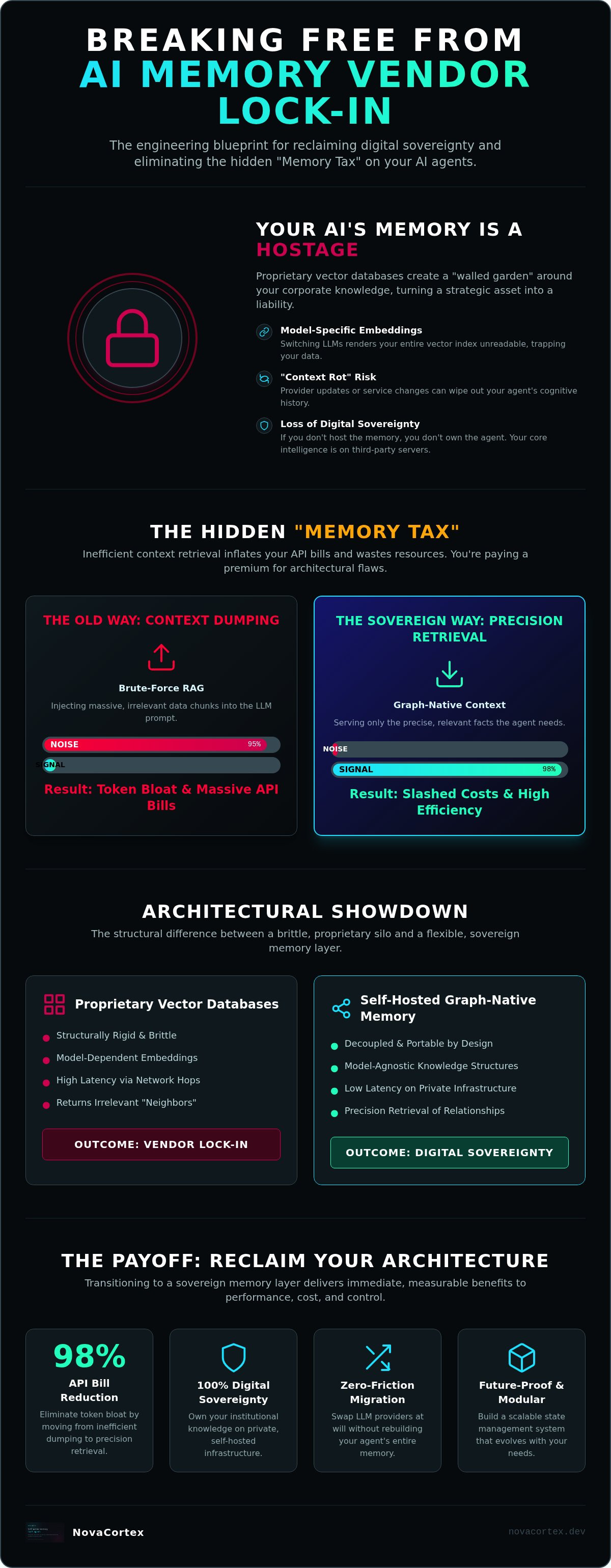
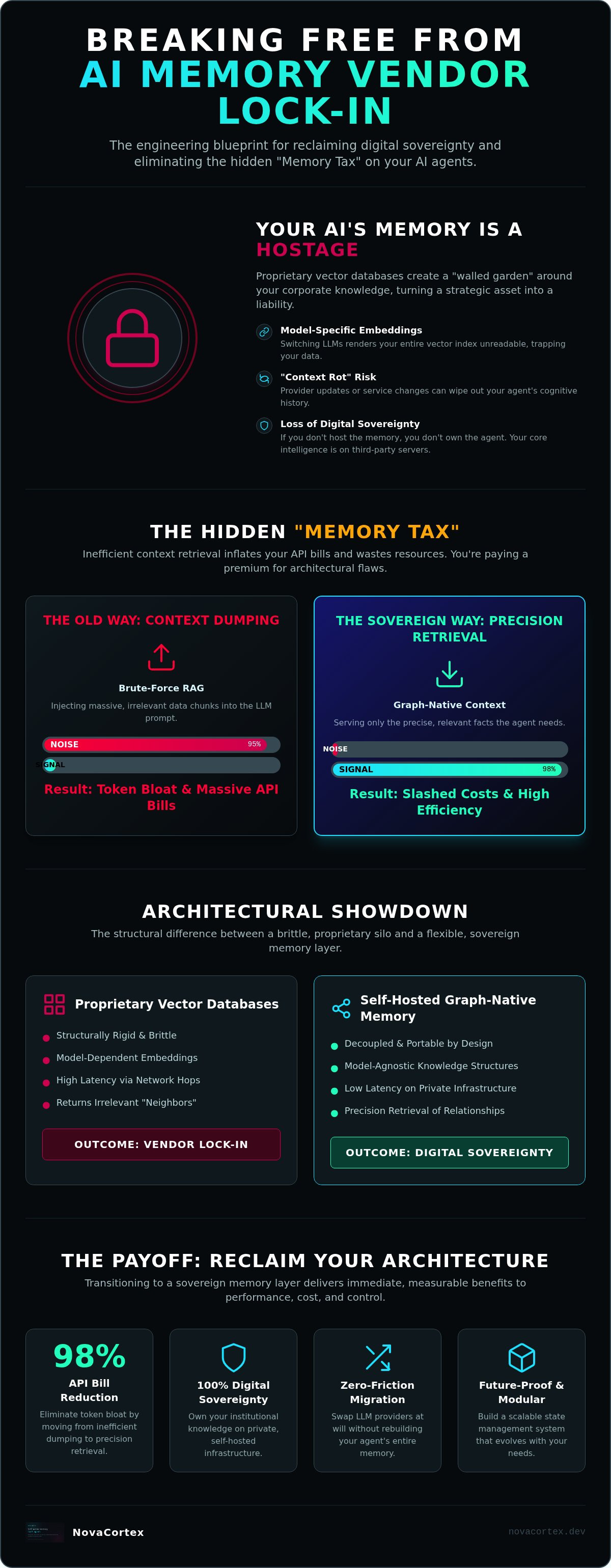
Defining AI Memory Vendor Lock-in in the current AI landscape refers to the technical inability to migrate an agent's long-term state across different LLMs or infrastructure providers. It's a strategic bottleneck. While developers often worry about model lock-in, the real threat is the "Context Trap." This occurs when you store your data in proprietary vector databases that use model-specific embeddings. These embeddings are structurally rigid. If you switch from one LLM to another, your existing vector index becomes unreadable. Your data is there, but the intelligence required to navigate it is gone. This is AI memory vendor lock-in, and it turns your competitive advantage into a liability.
We must distinguish between model weights and agent memory. Model weights are becoming a commodity; you can swap them based on cost and performance. Agent memory, however, is your institutional knowledge. It's the record of every correction, every successful execution, and every business logic nuance your agent has learned. Proprietary memory systems create visceral waste. They introduce high latency through unnecessary network hops and restrict your data sovereignty. Every time your agent "remembers" something, you're paying a middleman for the privilege of accessing your own history.
The Shift from Model Lock-in to Memory Lock-in
Switching LLM providers is now a matter of updating an endpoint and an API key. It's a solved problem. Switching memory layers is nearly impossible. Proprietary vector databases have become the new "walled gardens." They offer ease of use in exchange for total control over your data structures. You risk "Context Rot" every time a provider updates their embedding model or changes their service terms. If the service goes offline or the API changes, your agent's cognitive history is wiped. You're left with raw data and no way to reconstruct the relationships that made it useful.
The Competitive Advantage of Digital Sovereignty
Owning the "Cognitive Map" of your business processes is the only way to ensure long-term stability. Your institutional knowledge shouldn't exist as a row in a third-party database. It must remain on private infrastructure. The engineering reality is simple: if you don't host the memory, you don't own the agent. Digital sovereignty isn't a buzzword; it's a requirement for high-velocity performance and privacy. By decoupling your memory layer, you ensure that your agent's intelligence is portable, permanent, and entirely under your control. You stop leasing your intelligence and start owning your architecture.
The Hidden Memory Tax: Token Bloat and Architectural Waste
Proprietary context management is a financial drain. When you're trapped in AI memory vendor lock-in, you aren't just losing data sovereignty; you're paying a recurring "Memory Tax" in the form of inflated API bills. Most current implementations rely on brute-force Retrieval-Augmented Generation (RAG). They dump massive chunks of text into the prompt, hoping the model finds the needle in the haystack. This approach is lazy engineering. It ignores the reality of token costs and context window limits. Token bloat is the unnecessary consumption of LLM context due to imprecise memory retrieval. It turns your long-term memory into a liability that scales linearly with your costs.
The NIST AI Risk Management Framework emphasizes the importance of managing third-party dependencies to ensure system reliability. Relying on proprietary platforms that encourage inefficient context dumping is a direct violation of these principles. By engineering a lean, sovereign memory layer, you maximize performance on limited context windows while maintaining architectural independence. You stop being a victim of provider-driven waste.
The Cost of Dumping Knowledge Bases
"RAG-by-default" often leads to massive token waste. When an agent needs a single fact, a proprietary system might inject 5,000 tokens of "relevant" context. Over thousands of queries, this inefficiency compounds into thousands of dollars in wasted spend. You're paying for the LLM to process noise rather than signal. Calculating the long-term cost reveals a stark truth: proprietary memory layers are designed to keep you spending, not to keep you efficient. You can see this in action by exploring open-source alternatives that prioritize precision over volume.
Graph-Native Retrieval vs. Vector Brute Force
Vector databases are structurally rigid and often return irrelevant neighbors. Graph-native storage changes the math. By mapping complex relationships, you can extract the exact context needed with surgical precision. This isn't just about speed; it's about the 98% token reduction potential achieved through intelligent retrieval compared to brute-force dumping. Reducing noise in the context window improves agent reasoning and reduces hallucinations. Token efficiency is directly linked to architectural independence. When you control the retrieval logic, you control the costs.
Graph-Native vs. Vector Databases: Breaking Structural Chains
Vector databases are structural dead ends. They rely on flat embeddings that are inherently model-dependent. If you index your corporate knowledge using a specific provider's embedding model, you are effectively tethering your data to their ecosystem. This is the architectural root of AI memory vendor lock-in. When you attempt to migrate, the mathematical coordinates that define "meaning" in one model's vector space become gibberish in another. You are forced to re-index, re-process, and re-pay for the same data. It is a cycle of waste that serves the provider, not the builder.
Graph-native knowledge structures offer a superior alternative. Instead of flat lists of similarities, graphs store entities and their relationships as explicit, human-readable nodes. This metadata is model-agnostic. It doesn't matter which LLM is querying the memory because the structure of the information remains constant. As business leaders have noted regarding proprietary context, leasing your agent's cognitive history is a strategic risk you cannot afford. Graph-native storage also supports complex multi-agent synchronization. It allows multiple agents to interact with a shared relational map without context drift, ensuring that your entire AI stack remains aligned and coherent.
Why Vector-Only Approaches Fail at Long-Term Context
Vector retrieval often suffers from the "lost in the middle" problem. In long context windows, models struggle to identify the most relevant data when it is buried under layers of imprecise top-K results. Brute-force retrieval is structurally rigid. It lacks the relational logic required to understand how different pieces of information connect across time. The engineering debate between Redis vs graph memory for AI agents highlights this critical gap. While Redis provides speed, it lacks the depth of a graph. High-performance agents require more than just fast retrieval; they need structured reasoning that only a graph-native layer can provide.
Portable Memory Format (PMF): The Standard for Interoperability
Engineering a portable memory format for AI is the only way to ensure long-term interoperability. PMF defines a standardized schema that makes your knowledge base readable across different agent frameworks and LLMs. It acts as a translation layer that preserves the "meaning" of your data during migration. By adopting PMF, you move your institutional knowledge into a sovereign format that you own. You stop being a tenant in a proprietary vector store and start being the architect of your own cognitive infrastructure. Graph-native storage is the foundation of this portability, maintaining the integrity of data relationships regardless of the underlying model.
Architecting for Sovereignty: 5 Steps to a Vendor-Neutral Stack
Escaping AI memory vendor lock-in requires a deliberate architectural shift. You cannot build a sovereign system on borrowed foundations. While proprietary providers offer convenience, they do so by abstracting away the very structures that define your competitive advantage. The following five steps provide a technical roadmap to decouple your agent's cognitive layer from restrictive, third-party silos.
- Decouple the memory layer: Remove memory management from the LLM provider’s responsibility. If you use their built-in context persistence features, you are already locked into their ecosystem.
- Standardize communication: Implement an MCP native memory server to act as a universal interface between your agents and your knowledge base.
- Adopt graph-native storage: Move away from flat vector indexes. Graph structures preserve the relational context that makes your data valuable across different models and frameworks.
- Self-host the infrastructure: Deploy your memory layer on a VPS, a local server, or a private cloud. If the hardware is not under your control, your data sovereignty is an illusion.
- Enforce portability: Use the Portable Memory Format (PMF) for all agent state data to ensure you can migrate between frameworks without data loss or re-indexing costs.
The Role of MCP in Modern AI Infrastructure
The Model Context Protocol (MCP) is the backbone of interoperable agents. It standardizes how memory servers communicate with LLMs, regardless of the underlying model. By using an MCP-native architecture, you eliminate the custom "glue code" that often creates hidden lock-in. You gain the ability to swap agent frameworks or LLM providers without rewriting your retrieval logic. It turns your memory from a siloed feature into a plug-and-play utility that follows your business logic, not a vendor's roadmap.
Deployment Strategies for Private Infrastructure
Choosing the right environment depends on your specific performance requirements. A dedicated VPS offers the best balance of speed and control for most corporate agents. For high-security environments, running a self-hosted instance on local hardware ensures that sensitive institutional knowledge never leaves your network. The goal is to maintain high-velocity performance while ensuring that your data remains accessible only to your authorized agents. This architecture prevents the "context rot" that occurs when third-party APIs change or services go offline.
Deploy your sovereign memory layer on GitHub
NovaCortex: Implementing a Self-Hosted Sovereignty Layer
The NovaCortex Self-Hosted Edition is the definitive solution for AI agent long term memory. It is a specialized sovereignty layer designed to reclaim your data from proprietary silos. Unlike generic application management tools, NovaCortex is a functional, high-performance memory engine built for engineering reality. It utilizes Knowledge Buckets to provide modular, organized state management for your agents. This allows for precise context isolation, ensuring that one agent's history doesn't pollute another's reasoning. By integrating via an MCP-native server, NovaCortex fits into your existing CI/CD pipelines without requiring custom glue code. It is the principled choice for builders who prioritize privacy and performance over the false ease of third-party platforms.
Engineering Persistence without the Platform Tax
The technical core of NovaCortex is its graph-native retrieval engine. This system maps entities and relationships as explicit nodes, allowing for surgical context extraction that flat vector databases cannot match. You can achieve a 98% reduction in token usage by leveraging Knowledge Buckets to isolate and retrieve only the necessary context for a given task. This efficiency is a direct response to the 400% DRAM price hikes projected through 2026. The Apache-2.0 licensing serves as a permanent guarantee against future commercial lock-in, ensuring your architecture remains open and extensible. You stop paying for provider-driven waste and start investing in your own infrastructure.
Future-Proofing Your AI Strategy
The choice between self-hosted vs managed AI memory is the most critical architectural decision you will make in 2026. Managed services create an environment where your institutional knowledge is leased, not owned. This dynamic fuels AI memory vendor lock-in and leaves your business vulnerable to API changes and service outages. NovaCortex allows you to scale from a single agent to a multi-agent ecosystem where shared knowledge is synchronized through a sovereign graph. You maintain the cognitive map of your business processes on your own terms. Build on technical bedrock, not proprietary sand. Reclaim your architecture now.
Own Your Cognitive Future
Proprietary systems are designed to keep you dependent. By decoupling your agent's memory from the LLM provider, you transform a recurring liability into a permanent asset. You now have the blueprint to solve AI memory vendor lock-in through graph-native architecture and self-hosted infrastructure. Digital sovereignty is no longer a theoretical ideal. It's a technical necessity for any organization serious about scaling AI without losing control of its institutional knowledge.
NovaCortex offers the technical correction the market needs. It provides an MCP-native architecture that standardizes context retrieval across any agentic tool you choose. With an Apache-2.0 open-source license, you're guaranteed that your infrastructure will never be held behind a paywall. Implementing this layer isn't just about privacy; it's about performance. Achieving a 98% token usage reduction allows you to build faster, leaner, and more capable AI systems that operate on technical bedrock.
The transition to a sovereign stack is the most significant competitive advantage you can secure this year. Start building for permanence.
Frequently Asked Questions
What is the difference between AI model lock-in and memory lock-in?
Model lock-in occurs when your application logic is tethered to a specific LLM provider's proprietary API. Memory lock-in is more insidious; it happens when your agent's long-term context is trapped in a proprietary format or database that can't be easily migrated. While you can swap a model by updating an endpoint, AI memory vendor lock-in forces you to re-index or lose years of institutional knowledge if you switch infrastructure.
Can I export my data from a proprietary vector database to a portable format?
Exporting raw text is possible, but exporting the "intelligence" of the vectors is technically unfeasible. Most proprietary databases use model-specific embeddings that are mathematically incompatible with other systems. If you move your data, you must re-generate every embedding, which is costly and time-consuming. Adopting the Portable Memory Format (PMF) from the start eliminates this friction by ensuring your knowledge base remains readable across different agent frameworks and environments.
How does a graph-native memory layer reduce LLM token costs?
Graph-native layers replace brute-force vector search with precision relationship mapping. Instead of dumping large chunks of text into a prompt, NovaCortex uses Knowledge Buckets to retrieve only the exact entities and connections needed for a task. This surgical approach reduces token usage by up to 98% compared to standard knowledge base dumping. It maximizes the utility of your context window while slashing recurring LLM API expenses through lean, high-velocity data retrieval.
Is self-hosting an AI memory layer secure enough for enterprise data?
Self-hosting is the gold standard for enterprise data security because it ensures total digital sovereignty. When you host your memory layer on a private VPS or local server, your sensitive corporate knowledge never touches a third-party provider's infrastructure. This eliminates risks associated with data breaches at the provider level or unauthorized training on your proprietary data. You maintain total control over access protocols and encryption, fulfilling the strictest privacy-first compliance requirements.
What is the Model Context Protocol (MCP) and why does it matter for lock-in?
The Model Context Protocol (MCP) is an open standard that decouples the memory server from the agentic tools. It standardizes how information is requested and delivered, preventing you from writing provider-specific "glue code." By using an MCP-Native Memory Server, you ensure that your memory layer can communicate with any compliant LLM or framework. This interoperability is the ultimate antidote to AI memory vendor lock-in, allowing for zero-friction infrastructure migrations at any time.
Can I run NovaCortex on a local server like a Raspberry Pi?
NovaCortex is designed for high-efficiency performance on lightweight, local hardware. You can deploy the Self-Hosted Edition on a Raspberry Pi, a local home server, or any standard VPS. This flexibility allows engineers to build decentralized AI ecosystems where memory is stored at the edge rather than in a bloated cloud environment. It's a pragmatic solution for developers who need low-latency access to persistent context without the overhead of enterprise managed services.
Does using a portable memory format impact agent performance or latency?
Using a Portable Memory Format (PMF) actually improves performance by eliminating architectural waste. Standardizing your data structure reduces the overhead required to parse and process context across different systems. Because PMF works in tandem with graph-native retrieval, your agents benefit from faster, more accurate context extraction. This reduces the time the LLM spends processing irrelevant noise, leading to lower latency and more reliable agent reasoning during complex multi-step tasks.
Why is Apache-2.0 licensing important for AI infrastructure?
Apache-2.0 licensing is a foundational guarantee of independence for developers. It ensures that the core technology remains open and free from the threat of future commercial lock-in or restrictive licensing shifts. For AI infrastructure, this means you can build, modify, and scale your memory layer without worrying about sudden price hikes or forced migrations. It aligns with the spirit of digital sovereignty, providing a stable, community-backed bedrock for your long-term AI strategy.
FAQ
What is the difference between AI model lock-in and memory lock-in?
Model lock-in occurs when your application logic is tethered to a specific LLM provider's proprietary API. Memory lock-in is more insidious; it happens when your agent's long-term context is trapped in a proprietary format or database that can't be easily migrated. While you can swap a model by updating an endpoint, AI memory vendor lock-in forces you to re-index or lose years of institutional knowledge if you switch infrastructure.
Can I export my data from a proprietary vector database to a portable format?
Exporting raw text is possible, but exporting the "intelligence" of the vectors is technically unfeasible. Most proprietary databases use model-specific embeddings that are mathematically incompatible with other systems. If you move your data, you must re-generate every embedding, which is costly and time-consuming. Adopting the Portable Memory Format (PMF) from the start eliminates this friction by ensuring your knowledge base remains readable across different agent frameworks and environments.
How does a graph-native memory layer reduce LLM token costs?
Graph-native layers replace brute-force vector search with precision relationship mapping. Instead of dumping large chunks of text into a prompt, NovaCortex uses Knowledge Buckets to retrieve only the exact entities and connections needed for a task. This surgical approach reduces token usage by up to 98% compared to standard knowledge base dumping. It maximizes the utility of your context window while slashing recurring LLM API expenses through lean, high-velocity data retrieval.
Is self-hosting an AI memory layer secure enough for enterprise data?
Self-hosting is the gold standard for enterprise data security because it ensures total digital sovereignty. When you host your memory layer on a private VPS or local server, your sensitive corporate knowledge never touches a third-party provider's infrastructure. This eliminates risks associated with data breaches at the provider level or unauthorized training on your proprietary data. You maintain total control over access protocols and encryption, fulfilling the strictest privacy-first compliance requirements.
What is the Model Context Protocol (MCP) and why does it matter for lock-in?
The Model Context Protocol (MCP) is an open standard that decouples the memory server from the agentic tools. It standardizes how information is requested and delivered, preventing you from writing provider-specific "glue code." By using an MCP-Native Memory Server, you ensure that your memory layer can communicate with any compliant LLM or framework. This interoperability is the ultimate antidote to AI memory vendor lock-in, allowing for zero-friction infrastructure migrations at any time.
Can I run NovaCortex on a local server like a Raspberry Pi?
NovaCortex is designed for high-efficiency performance on lightweight, local hardware. You can deploy the Self-Hosted Edition on a Raspberry Pi, a local home server, or any standard VPS. This flexibility allows engineers to build decentralized AI ecosystems where memory is stored at the edge rather than in a bloated cloud environment. It's a pragmatic solution for developers who need low-latency access to persistent context without the overhead of enterprise managed services.
Does using a portable memory format impact agent performance or latency?
Using a Portable Memory Format (PMF) actually improves performance by eliminating architectural waste. Standardizing your data structure reduces the overhead required to parse and process context across different systems. Because PMF works in tandem with graph-native retrieval, your agents benefit from faster, more accurate context extraction. This reduces the time the LLM spends processing irrelevant noise, leading to lower latency and more reliable agent reasoning during complex multi-step tasks.
Why is Apache-2.0 licensing important for AI infrastructure?
Apache-2.0 licensing is a foundational guarantee of independence for developers. It ensures that the core technology remains open and free from the threat of future commercial lock-in or restrictive licensing shifts. For AI infrastructure, this means you can build, modify, and scale your memory layer without worrying about sudden price hikes or forced migrations. It aligns with the spirit of digital sovereignty, providing a stable, community-backed bedrock for your long-term AI strategy.