AI Memory Versioning: Engineering Persistent and Auditable Agent State
Static RAG is a technical dead end for high-stakes autonomous agents. If you can't roll back an agent's state or audit exactly why it hallucinated, you aren't building a system; you're managing a black box. Implementing AI memory versioning is no longer optional for teams facing the EU AI Act's August 2026 enforcement deadlines. You've likely felt the sting of agent amnesia during long tasks or watched token costs explode as you re-inject the same static context into every prompt. It's a wasteful, fragile architecture that can't survive the scale of modern engineering requirements.
You know that context is everything, yet most systems treat it as a disposable stream. We're here to change that. This article masters the architectural shift from bloated, managed vector databases to versioned, graph-native memory layers. You'll learn how to implement a reliable memory rollback system, reduce token waste by 98%, and maintain 100% data sovereignty using the NovaCortex Self-Hosted Edition. We'll move past vendor lock-in and into the era of the Portable Memory Format (PMF), giving you total control over agent cognition and state forking.
Key Takeaways
- Transition from static RAG to AI memory versioning to enable precise state rollbacks and meet strict 2026 auditability requirements.
- Leverage graph-native storage over vector databases to perform efficient delta updates, slashing token usage by up to 98%.
- Utilize "Knowledge Forking" to branch agent memory, allowing for safe experimentation and testing without polluting production context.
- Implement a structured architecture for snapshotting and branching to maintain absolute control over multi-agent synchronization.
- Ensure total data sovereignty and zero vendor lock-in by deploying the open-source, self-hosted NovaCortex memory layer.
Beyond Static RAG: Why AI Memory Versioning is Critical in 2026
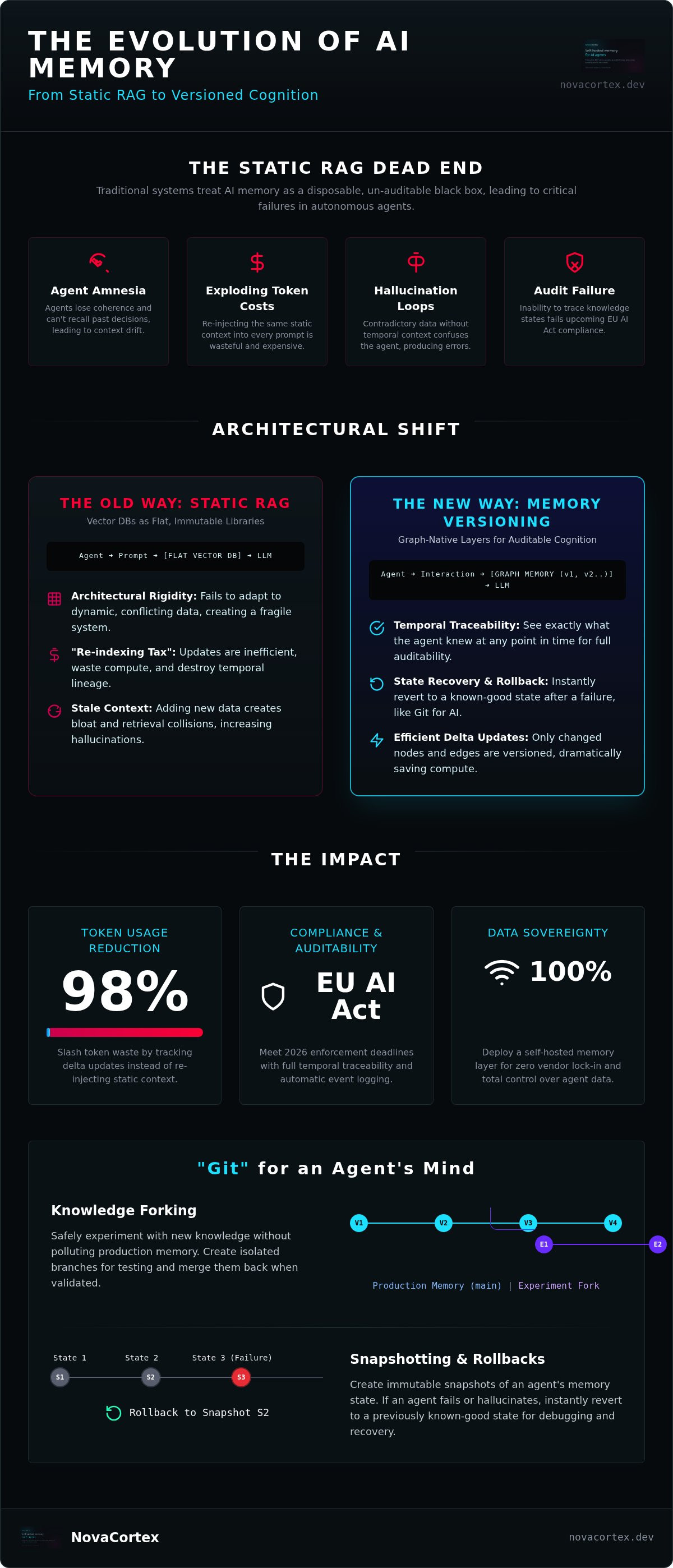
Traditional Retrieval-Augmented Generation (RAG) is a static solution for a dynamic problem. It treats memory as a flat, immutable library where the agent simply fetches the most relevant document. This architecture fails the moment an agent needs to unlearn incorrect data or reconcile conflicting updates. In high-velocity engineering environments, AI memory versioning is the essential ability to snapshot, track, and revert agent knowledge states. It transforms agent memory from a chaotic pile of embeddings into a structured, auditable history of cognition.
Static RAG systems suffer from architectural rigidity. When an agent absorbs new information that contradicts a previous entry, a non-versioned database creates a "hallucination loop." The agent retrieves both facts, lacks the temporal context to choose the correct one, and produces garbage. We're moving beyond simple retrieval. Modern agentic frameworks require complex state management where every piece of knowledge has a lineage and a lifecycle.
The Problem of Agent Amnesia and Context Drift
Autonomous agents lose coherence when their memory layer lacks a chronological structure. This phenomenon, known as Context Drift, occurs when an agent's internal world model deviates from reality because it's anchored to stale data. Without a versioned layer, your agent is effectively operating with a permanent case of amnesia regarding its own past decisions. It can't tell you why it chose a specific path three steps ago because that state has been overwritten by the current prompt's context.
Auditability is no longer a luxury for enterprise deployments. With the EU AI Act enforcement beginning August 2, 2026, high-risk AI systems must maintain automatic event logging and source traceability. Gartner reports that up to 85% of AI projects fail due to a lack of governance. Versioning solves this by providing:
- Temporal Traceability: See exactly what the agent knew at any specific timestamp.
- Conflict Resolution: Explicitly overwrite or "branch" memory when new data contradicts the old.
- State Recovery: Instantly revert an agent to a known-good state after a logic failure.
Versioning as the Debugging Layer for LLMs
Engineering reliable agents requires the same rigor as software development. We don't ship code without version control, yet we frequently deploy agents with no way to track their evolving state. AI memory versioning acts as Git for the agent's mind. It allows developers to isolate specific "memory commits" to identify the root cause of a hallucination. If an agent fails, you don't just guess; you check the diff between the working state and the failure state.
Memory versioning is the architectural safeguard for agentic autonomy.
Graph-Native vs. Vector-Based Versioning: Architectural Differences
Vector databases are the industry's default, but they're ill-equipped for AI memory versioning. They excel at fuzzy retrieval but fail at precise state management. Updating a single fact in a vector store often requires a "re-indexing tax" that wastes compute and destroys temporal lineage. When your agent's knowledge evolves, a vector database doesn't track the change; it merely adds to the pile, increasing the likelihood of retrieval collisions and stale context.
We're seeing a shift toward graph-native architectures for a reason. Graphs allow for "delta updates," where only the changed nodes and edges are versioned. This is significantly more efficient than high-dimensional vector math for state lookups. Graph traversal provides near-constant time performance for finding related entities, whereas vector search performance degrades as the embedding space grows. By using a graph, you're building a structured map of cognition rather than a flat list of similarities.
The Limitations of Vector DBs for Stateful Agents
Vector stores are essentially flat files of high-dimensional math. They lack the semantic relationships necessary to understand how one version of a fact relates to another. When an agent updates its state, the vector DB simply adds a new embedding, creating bloat and context collision. This lack of structure makes it nearly impossible to "undo" a specific learning event without risking the integrity of the entire index. Contrast this with NovaCortex’s graph-native approach, which treats memory as a web of interconnected entities rather than isolated points in space.
Why Graph-Native Memory Enables Precision Rollbacks
Graph-native storage allows for node-level versioning. You can update specific entities without affecting the entire knowledge base. Each edge represents the provenance of a memory version, showing exactly where a piece of information originated and how it has changed over time. This architecture makes AI agent long term memory both persistent and surgical. You can roll back a single entity's state to a previous "commit" without touching the rest of the agent's cognition, ensuring total reliability during long-running tasks.
To maintain digital sovereignty, these versioned states should be stored in the Portable Memory Format (PMF). PMF is a vendor-neutral standard that ensures your agent's memory isn't trapped in a proprietary managed database. It allows you to move versioned graphs between self-hosted environments while preserving every delta and relationship. If you're building for the long term, you can examine the open-source memory server to see how these graph-native rollbacks function in production.
Strategic Use Cases: Debugging, Forking, and Multi-Agent Sync
Implementing AI memory versioning is not an exercise in academic complexity. It's a pragmatic necessity for reducing operational risk. In a landscape where only 14.4% of enterprise AI agents go live with full IT approval, versioning provides the governance guardrails required for production. It enables "Time-Travel Debugging." When an agent fails at step 50 of a complex workflow, you don't have to restart from scratch or guess what went wrong. You simply roll the state back to the snapshot at step 49 and step through the logic with identical context.
This architectural shift moves us away from unpredictable black boxes toward auditable engineering. With legal claims related to AI risk expected to exceed 2,000 by the end of 2026, the ability to reconstruct an agent's exact knowledge state at the moment of a decision is your primary legal and technical defense. Versioning turns "why did it do that?" from a mystery into a queryable data point.
Knowledge Forking for Safe Agent Experimentation
Forking is the ultimate tool for safe experimentation. By leveraging the portable memory format for AI, developers can create a temporary memory branch to test how an agent responds to new, potentially conflicting data. You can run A/B memory tests in parallel: one agent uses the "production" branch while another uses a "test" branch containing updated documentation. If the test branch results in higher task completion rates, you merge those successful memory nodes back into the main state. This prevents "poisoning" your primary knowledge base with unverified or low-quality context.
Synchronizing Multi-Agent Systems via Versioned Context
Multi-agent systems often collapse due to race conditions in shared memory. If Agent A and Agent B both attempt to update the same fact simultaneously, a non-versioned system creates a corrupted state. AI memory versioning solves this by allowing agents to subscribe to specific Knowledge Buckets and version IDs. One agent can act as a "writer" creating new snapshots, while others act as "readers" anchored to a stable, verified version. This level of coordination requires MCP native memory servers to ensure that context remains consistent across different specialized agents, regardless of their underlying LLM provider.
Implementing Versioning: Snapshotting, Branching, and Rollbacks
Building a versioned system requires moving beyond simple database triggers. Effective AI memory versioning relies on four distinct architectural steps. First, define your snapshot granularity. While time-based capture is easy, event-based snapshots are superior for autonomous agents. Capturing the state after every tool call or high-level decision creates a logical trail of thought. Second, implement a graph-native diff mechanism. A graph-native diff identifies exactly which entities or relationships were modified. This is surgical precision. It avoids the massive compute overhead of re-calculating high-dimensional centroids for an entire vector index.
Logical isolation prevents context leakage between different projects or agent roles. Use Knowledge Buckets to isolate versioned data. You can version a "Security" bucket independently from a "User Preference" bucket, allowing for granular rollbacks without losing unrelated progress. Finally, establish a formal rollback protocol. This isn't a manual "undo" button. It's a programmatic instruction to reset the agent's context pointer to a verified, high-confidence state when validation fails. It ensures your system remains resilient even when the LLM's logic deviates from the expected path.
The Snapshotting Workflow for Agent Context
Triggering snapshots at critical decision points is the standard for reliable autonomy. You don't need to store the entire memory graph every time. By using delta storage, you record only the cognitive shifts. NovaCortex achieves this by focusing on entity-level changes. It reduces token usage by 98% because you aren't re-sending static context to the LLM. You're only sending the delta that matters. Frequent snapshotting doesn't have to mean high storage costs if your architecture is built for efficiency rather than raw document dumping.
Managing Memory Rollbacks in Production
Production agents need a safety net. If a validation check fails or a hallucination is detected, the system must respond instantly. A standard rollback checklist includes identifying the last stable version ID and re-pointing the agent's active Knowledge Bucket to that state. Self-hosting is the only way to guarantee the zero-latency response required for real-time applications. You can't wait for a managed provider's API when an agent is mid-execution and needs an immediate state correction. Digital sovereignty means you own the rollback mechanism, ensuring your agents never stay in a compromised state longer than a few milliseconds.
Scaling with NovaCortex: A Self-Hosted, Version-Aware Memory Layer
NovaCortex isn't just another database; it's the premier self-hosted engine for AI memory versioning. We built it for engineers who refuse to outsource their agent's cognition to black-box managed services. Under the Apache-2.0 license, NovaCortex provides a lean, graph-native core that prioritizes digital sovereignty. You own the code. You own the data. You own the history of every agent state. This is the "Git for AI memory" that the industry has been missing.
Integration shouldn't be a bottleneck in your development cycle. Our MCP-native architecture simplifies the process of connecting versioned memory to any agentic framework. By using a standardized protocol, NovaCortex acts as a universal memory server that respects the temporal and relational nuances of your data. It's designed to handle the complexity of Knowledge Buckets and version branching without adding unnecessary latency to your stack. It's a precise tool for a specific, systemic problem.
Privacy-First Memory Management
Versioned memory contains the blueprint of your enterprise's intellectual property. Keeping this data on your own infrastructure is the only way to prevent third-party leaks and ensure compliance with evolving global regulations. Local, graph-native storage provides a secure environment where state rollbacks happen behind your firewall. When comparing self-hosted vs managed AI memory, the tradeoff is clear. Managed services offer convenience at the cost of control. NovaCortex removes that compromise by offering high-velocity performance on your own terms.
Getting Started with NovaCortex
Deployment is straightforward and efficient. You can run NovaCortex on any server, VPS, or even a Raspberry Pi. We've stripped away the bloat to ensure high-velocity performance on lean hardware, allowing you to scale without the "RAM apocalypse" pricing of 2026 affecting your bottom line. This isn't just a tool; it's a movement toward an open-source memory standard. We invite you to contribute to the repository and help shape the future of persistent, auditable AI cognition. Stop managing amnesia and start engineering state.
Mastering the Cognitive State
Building agents that persist through complex, long-running tasks requires more than just better prompts. It requires a fundamental architectural shift. By moving from static RAG to AI memory versioning, you gain the ability to rollback, fork, and audit agent cognition with surgical precision. It's about engineering reliability into a system that was previously an unpredictable black box.
Graph-native architectures enable this shift by allowing for delta updates that slash token usage by up to 98%. With an open-source Apache-2.0 license and a privacy-first, self-hosted approach, you maintain total data sovereignty over your enterprise knowledge. Stop letting your agents operate in a state of permanent amnesia. The era of disposable context's over. The tools for persistent, version-aware context are ready for deployment.
The future of autonomous systems belongs to those who control their data lineage. Take command of your agent's state and build for the long term.
Frequently Asked Questions
What is AI memory versioning and how does it differ from a standard database backup?
AI memory versioning is the ability to snapshot and track granular changes in an agent's knowledge state at the entity level. While a backup is a blunt, point-in-time copy of a whole database, versioning allows for surgical rollbacks and state branching. It provides a chronological ledger of how an agent's understanding evolved during a task. This enables developers to audit specific cognitive shifts without restoring the entire system.
How does NovaCortex handle memory snapshots without bloating storage requirements?
NovaCortex uses a graph-native "delta storage" approach that only records changes to specific nodes and edges. Instead of duplicating the entire knowledge base for every snapshot, the system stores the differences between versions. This methodology ensures that even high-frequency snapshotting remains lean and performant. It prevents the storage bloat typically associated with versioning large datasets in traditional flat-file or vector systems.
Does versioning agent memory significantly increase token usage or API costs?
No, implementing AI memory versioning actually reduces token usage by up to 98% compared to static RAG. NovaCortex achieves this by only injecting the relevant, versioned delta into the agent's context window. You avoid the waste of re-sending the same static documents repeatedly. This precision context management directly lowers your API costs while increasing the reliability of agentic outputs.
Can I fork an agent’s memory to test how it reacts to different sets of information?
Yes, you can create memory branches to test an agent's response to new data without polluting your production state. This "Knowledge Forking" allows for safe A/B testing of different context versions. You run experiments in isolated branches and merge only the successful cognitive states back into the main version. It's a critical tool for validating information before it becomes part of the agent's long-term knowledge.
Is memory versioning compatible with the Model Context Protocol (MCP)?
NovaCortex is built as an MCP-Native Memory Server, ensuring full compatibility with the protocol. This architecture allows your versioned memory to be accessed by any MCP-compliant agent or tool. It provides a standardized way to manage state across different LLM providers and frameworks. You gain a universal context layer that maintains version integrity regardless of the underlying model.
How do I determine when an agent needs a memory rollback in a production environment?
Rollbacks are typically triggered by failed validation checks or the detection of logical hallucinations. When an agent's output contradicts verified facts or enters an incorrect cognitive state, you re-point the context pointer to the last stable version ID. Establishing clear success metrics for your agent's task completion allows for automated rollback protocols. This ensures your production systems recover instantly from logic failures without human intervention.
Does NovaCortex support multi-user memory versioning for collaborative AI teams?
Yes, NovaCortex uses Knowledge Buckets to isolate and version data for different users or specific agent roles. This structure allows collaborative teams to work on shared knowledge bases while maintaining individual version histories. It prevents race conditions and context leakage in multi-user environments. Each team member can branch or snapshot their specific context without disrupting the global state of the project.
What is the performance impact of using a graph-native memory layer for versioning?
Graph-native versioning is significantly faster than vector-based re-indexing for state lookups. Graph traversal provides near-constant time performance for finding related entities and their version history. Unlike vector databases that require expensive math for every update, a graph-native layer handles delta updates with minimal compute overhead. This ensures that AI memory versioning remains a high-velocity solution even as your knowledge base grows to enterprise scale.
FAQ
What is AI memory versioning and how does it differ from a standard database backup?
AI memory versioning is the ability to snapshot and track granular changes in an agent's knowledge state at the entity level. While a backup is a blunt, point-in-time copy of a whole database, versioning allows for surgical rollbacks and state branching. It provides a chronological ledger of how an agent's understanding evolved during a task. This enables developers to audit specific cognitive shifts without restoring the entire system.
How does NovaCortex handle memory snapshots without bloating storage requirements?
NovaCortex uses a graph-native "delta storage" approach that only records changes to specific nodes and edges. Instead of duplicating the entire knowledge base for every snapshot, the system stores the differences between versions. This methodology ensures that even high-frequency snapshotting remains lean and performant. It prevents the storage bloat typically associated with versioning large datasets in traditional flat-file or vector systems.
Does versioning agent memory significantly increase token usage or API costs?
No, implementing AI memory versioning actually reduces token usage by up to 98% compared to static RAG. NovaCortex achieves this by only injecting the relevant, versioned delta into the agent's context window. You avoid the waste of re-sending the same static documents repeatedly. This precision context management directly lowers your API costs while increasing the reliability of agentic outputs.
Can I fork an agent’s memory to test how it reacts to different sets of information?
Yes, you can create memory branches to test an agent's response to new data without polluting your production state. This "Knowledge Forking" allows for safe A/B testing of different context versions. You run experiments in isolated branches and merge only the successful cognitive states back into the main version. It's a critical tool for validating information before it becomes part of the agent's long-term knowledge.
Is memory versioning compatible with the Model Context Protocol (MCP)?
NovaCortex is built as an MCP-Native Memory Server, ensuring full compatibility with the protocol. This architecture allows your versioned memory to be accessed by any MCP-compliant agent or tool. It provides a standardized way to manage state across different LLM providers and frameworks. You gain a universal context layer that maintains version integrity regardless of the underlying model.
How do I determine when an agent needs a memory rollback in a production environment?
Rollbacks are typically triggered by failed validation checks or the detection of logical hallucinations. When an agent's output contradicts verified facts or enters an incorrect cognitive state, you re-point the context pointer to the last stable version ID. Establishing clear success metrics for your agent's task completion allows for automated rollback protocols. This ensures your production systems recover instantly from logic failures without human intervention.
Does NovaCortex support multi-user memory versioning for collaborative AI teams?
Yes, NovaCortex uses Knowledge Buckets to isolate and version data for different users or specific agent roles. This structure allows collaborative teams to work on shared knowledge bases while maintaining individual version histories. It prevents race conditions and context leakage in multi-user environments. Each team member can branch or snapshot their specific context without disrupting the global state of the project.
What is the performance impact of using a graph-native memory layer for versioning?
Graph-native versioning is significantly faster than vector-based re-indexing for state lookups. Graph traversal provides near-constant time performance for finding related entities and their version history. Unlike vector databases that require expensive math for every update, a graph-native layer handles delta updates with minimal compute overhead. This ensures that AI memory versioning remains a high-velocity solution even as your knowledge base grows to enterprise scale.