AI Model Data Security Risks and How to Reduce Them

The model isn’t your only attack surface. AI model data security risks also arise when training data is manipulated, sensitive information is exposed, or access to models and outputs is poorly controlled. Leaders can reduce risk by validating data, limiting permissions, and matching hosting safeguards to how each system is deployed and used.
The core challenge is that even a capable model can become part of an insecure system if its data flows, integrations, or operational boundaries are exposed. Secure development requires more than choosing a model or adding a privacy tool after deployment.
This article explains common risks, including data poisoning, information leakage, and weak API controls. It also covers how data minimization, privacy techniques, role-based access, human oversight, and secure hosting fit into a practical security approach, helping you make informed decisions throughout the AI system lifecycle.
Key Takeaways
- Validate training data and annotations to catch tampering or quality problems before they shape model behavior.
- Understand how model inversion, extraction, and membership inference can expose information through outputs, then limit what the model can reveal.
- Map AI vendors and embedded tools across your supply chain, and assess their data handling, access, and update practices.
- Choose privacy techniques based on the data and task: differential privacy, homomorphic encryption, and secure computation address different exposure points.
- Align permissions, logging, API safeguards, and hosting controls with each system’s deployment and use case.
Data poisoning and manipulation of internal models
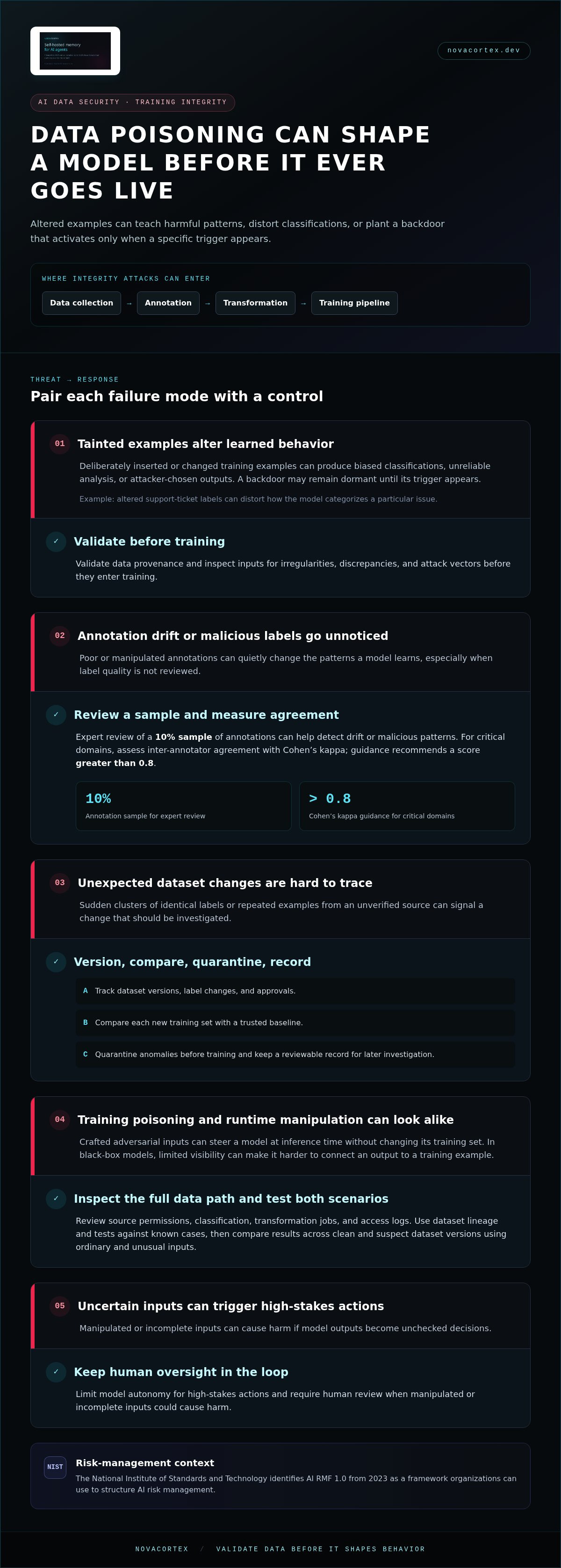
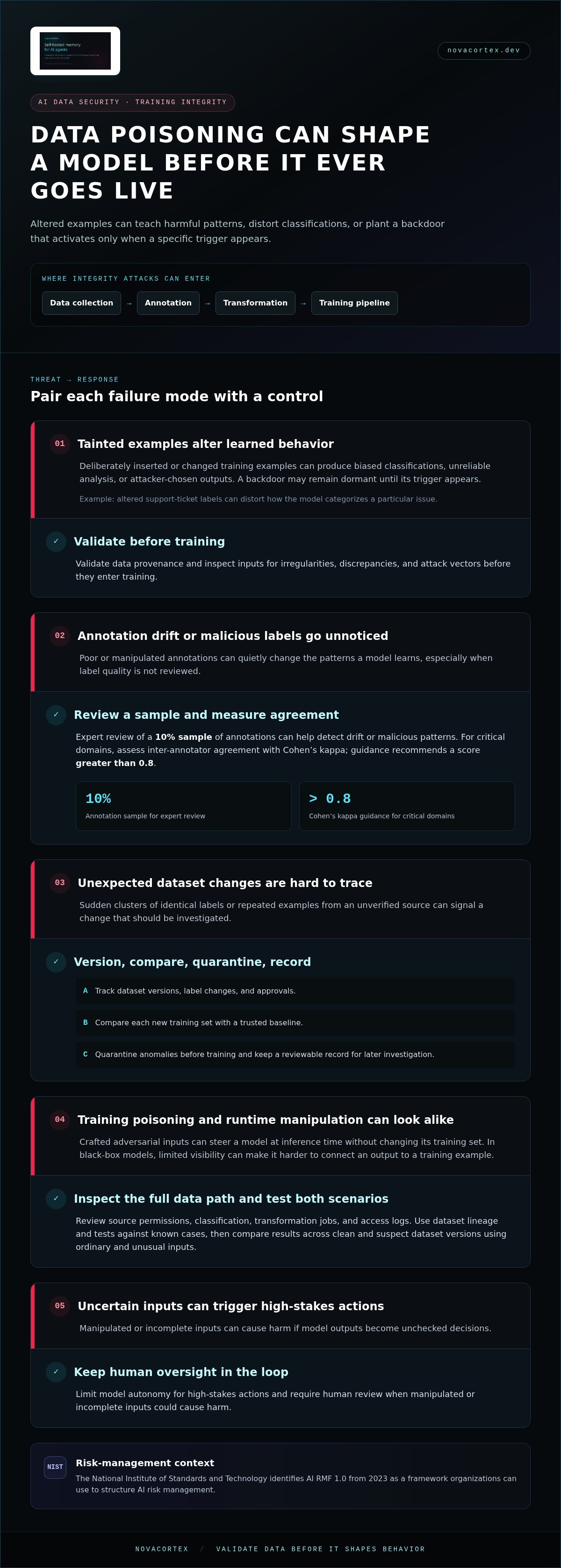
Data poisoning alters training examples so a model learns harmful patterns or activates a hidden backdoor under particular inputs. The National Institute of Standards and Technology identifies its AI Risk Management Framework as AI RMF 1.0 from 2023, a framework organizations can use to structure AI risk management.
Training Data Integrity Attacks
Training-data poisoning involves deliberately inserting or altering examples to influence a model’s learned behavior. Contaminated data can lead an internal model to produce biased classifications, unreliable analysis, or attacker-chosen outputs after deployment. A backdoor may stay dormant until a specific trigger appears, making it harder to catch in ordinary testing. For example, altered support-ticket labels could distort how a model categorizes a particular issue.
Integrity attacks can target data collection, annotation, transformation, or the pipeline that feeds training. An organization should validate provenance and inspect inputs for irregularities, discrepancies, and attack vectors before training begins. Expert review of a 10% sample of annotations can help detect labeling drift or malicious patterns. For critical domains, assess inter-annotator agreement using Cohen’s kappa, with guidance recommending a score greater than 0.8.
Track dataset versions, label changes, and approvals. Compare each new training set with a trusted baseline to spot unexpected shifts, such as a sudden cluster of identical labels or repeated examples from an unverified source. Quarantine anomalies before training, and keep a reviewable record to help investigate changes in model behavior.
Poisoning Risks Across Data Operations
Data-operation risks arise when weak controls allow malicious or corrupted records to enter, move through, or remain in an AI pipeline. They are especially difficult to trace in black-box models, where limited visibility into internal behavior makes it harder to connect an output to a training example. Adversarial inputs create a related inference-time risk: crafted prompts or data can steer a model without changing its training set.
Review the entire data path, including source permissions, classification, transformation jobs, and access logs. Missing logs can obscure who changed a dataset, while poor classification can leave sensitive or high-impact records without appropriate handling. With black-box models, dataset lineage and tests against known cases are particularly useful. Together, these controls help distinguish training contamination from manipulation at runtime.
An attacker could, for example, alter a small group of records so a model behaves normally on routine inputs but responds differently to a trigger phrase. Test ordinary and unusual inputs, and compare results across clean and suspect dataset versions. Limit model autonomy for high-stakes actions, and require human review when manipulated or incomplete inputs could cause harm. This prevents uncertain outputs from becoming unchecked decisions.
What Is AI Data Security?
AI data security protects information as AI systems collect, process, train on, and return it. One key threat is that model outputs may reveal details about training data, even when users cannot access the original files.
Sensitive Data Extraction from Models
Model inversion uses repeated queries and model outputs to infer sensitive features or reconstruct training examples. A prediction endpoint can therefore expose information without providing access to the underlying database. For instance, carefully varied inputs might reveal details about a person represented in a medical or financial dataset.
Data scraping creates another exposure path: attackers can collect information from an exposed AI endpoint by submitting requests and retaining responses. Extraction is easier to attempt when endpoints return detailed outputs, accept broad queries, or lack effective monitoring. A cybersecurity review should identify what data the model can reveal, what each user can request, and whether request patterns are logged.
Reduce exposure at the interface. Return only the fields needed for the task, restrict bulk queries, and monitor repeated or systematically altered prompts. Before release, test with representative sensitive records and check whether outputs disclose unique details. These checks can reveal extraction patterns and help teams refine output design without treating the model as a secure storage boundary.
Inferring Training Data Membership
Membership inference tests whether a particular record was likely included in a model’s training data. Even if the model never reproduces the full record, confirming that someone’s information appeared in a dataset can reveal private information. For example, membership could expose a person’s connection to a sensitive group or service.
Attackers compare a model’s responses to known records and carefully chosen alternatives, looking for differences that suggest a particular example influenced training. Prompt injection is related but distinct: it tries to steer a model through instructions in user input or retrieved content. It may help an attacker probe for disclosures, but it does not prove that a record was in the training set.
Assess these threats together by testing realistic prompts, monitoring unusual query sequences, and limiting access to sensitive outputs. Separate user instructions from trusted system instructions, and treat retrieved text as untrusted input. For teams evaluating persistent context, reviewing a model memory architecture can help clarify where information is stored and retrieved.
What are the cyber security risks in using AI?
AI systems inherit vulnerabilities from their models, plug-ins, vendors, and supporting infrastructure. Public tools can also expose data through the prompts and files people submit.
Public Generative AI Privacy Risks
Public generative AI privacy risks arise when employees submit sensitive information to a tool outside approved data processes. They matter because prompts, uploaded files, and generated responses can cross organizational boundaries. 93% of IT leaders express varying levels of concern about company data exposure through AI tools.
For example, an employee might paste customer records into a public chatbot to generate a summary, exposing confidential details to the service handling the prompt. Large language models are often trained on extensive text, but a tool’s handling of new customer inputs is a separate concern. Leaders should define what data employees may submit and restrict sensitive records from unapproved tools.
Visibility is a practical first step. 77% of IT leaders discovered AI-powered features or applications operating without IT’s awareness. An organization can inventory approved software, identify embedded artificial intelligence features, and route new tools through security review. This helps teams detect unmanaged data flows before they become part of everyday work.
Vendor Handling of Customer Data
Vendor data handling includes how a provider receives customer prompts or files, stores them, uses them to deliver or improve services, and retains them. Each stage creates a distinct supply-chain exposure point. Map these data flows before connecting a vendor to internal systems.
Vendors may collect data through direct prompts, uploaded files, connected applications, and telemetry generated during service use. Storage may involve provider infrastructure or subprocessors; use may include generating responses or operating service features. Retention policies determine how long records remain accessible. Review service terms, configuration options, and data-processing documentation to understand each stage.
Third-party plug-ins can introduce vulnerabilities or backdoors into an organization’s systems. A plug-in that reads internal documents or invokes tools may expand a vendor connection’s access. Limit permissions to the required data and actions, log requests, and review integration changes. For example, a summarization plug-in should not have write access to unrelated business records.
SaaS supply chains add another visibility problem: 87% of SaaS apps are purchased outside IT. A procurement inventory can identify services with embedded AI, while vendor reviews can examine governance, monitoring, model-drift checks, and safeguards. Review master service agreements and require proactive communication about new features and system updates. This keeps changes in vendor behavior from silently expanding access to data or infrastructure.
Differential privacy, homomorphic encryption, and secure computation
In the United States, AI data rules depend on the information, use case, and applicable state or sector requirements. The CCPA, cited as California Civil Code sections 1798.100-1798.199, gives consumers rights to know what data is collected, request deletion, and opt out of sale; HIPAA and PCI DSS are also relevant to AI data protection.
Privacy-Preserving Technologies
Privacy-preserving technologies reduce exposure by changing how sensitive data is used during analysis, matching, or model learning. They are useful when an application needs results without exposing every underlying record to every participant.
Differential privacy adds carefully calibrated noise to data or results, limiting how much an individual record can influence an output. Teams need to balance privacy strength against accuracy, especially when analyzing small or unusual groups. Monitor repeated queries too, since combining outputs can weaken protection.
Homomorphic encryption allows computation on encrypted data, so a service can process information without seeing it in plaintext. Its practical use depends on the operations and performance requirements. Secure computation enables multiple parties to calculate a result while limiting what each learns about the others’ inputs.
Privacy-preserving record linkage helps organizations identify records that refer to the same person across datasets without exchanging direct identifiers in ordinary form. For example, health teams could match records from separate systems for analysis while limiting exposure of names. The method still requires sound governance: define the matching purpose, restrict access, and control the resulting datasets.
These tools address different problems. Encryption protects computation inputs, differential privacy limits what outputs reveal, and secure linkage supports matching. Choose based on the data flow and threat model, then test utility and leakage together. No single technique replaces access controls, retention limits, or careful output monitoring.
Security Impacts on Privacy and Information
Security failures can expose sensitive information, reinforce bias, or enable disinformation through AI-generated content. Even a technically accurate output can cause harm if the data or distribution process is compromised.
For example, biased records can shape model behavior and produce uneven outcomes across groups. Differential privacy may reduce individual-level disclosure, but it does not correct biased source data. Data quality reviews and outcome analysis remain essential before an application influences consequential decisions.
Disinformation is a different risk: malicious actors can use AI to generate persuasive messages that mimic trusted sources. Pair content review with monitoring for suspicious generation patterns, and preserve human judgment for high-impact decisions. Privacy controls alone cannot determine whether a claim is true.
Governance is also changing across jurisdictions. More than 450 AI-related bills have been introduced across U.S. states, so teams should track enacted rules that apply to their data and operations. For personal data handled under the GDPR, principles include transparency and consent, alongside a right to explanation. Map each application’s data, purpose, and users before choosing safeguards.
Access control and secure model hosting
Using sensitive data securely with AI requires least-privilege access, monitored interfaces, and hosting controls suited to the deployment and use case. Weak API configurations can expose systems, while compromised credentials can enable unauthorized model outputs.
Controlling Access to AI Models
Access control defines who can reach a model, which data and functions they can use, and what actions they can perform. A valid account should not automatically grant broad access to every model or dataset. Assign permissions by role, separate administrative and user functions, and remove access when someone’s responsibilities change.
For example, a support employee may need to generate responses but not access training data or system settings. Store API keys securely, rotate exposed credentials, and require authentication for model endpoints. Log requests with user and action details so security teams can spot unusual patterns, such as an account generating outputs at an unexpected rate.
Apply controls at every layer: identity, application, API, and underlying data. A proxy can validate requests before they reach a model, while rate limits can restrict repeated calls. Retain access logs for incident analysis, and test whether revoked credentials stop working across every connected interface. This reduces unauthorized access without treating the model itself as an access-control system.
Using Sensitive Data Securely
Secure handling of sensitive data means limiting exposure during inference, storage, and model operations. Even a protected source database can be exposed through prompts, logs, outputs, or a misconfigured hosting environment. Identify what each task needs, remove unnecessary fields, and limit retention at every processing stage.
Choose hosting controls to match the deployment model and use case. In a self-managed environment, restrict network paths to model services and separate workloads from unrelated systems. With a hosted API, limit credentials and permitted operations, then review how requests and outputs are handled. Misconfigured cloud storage can expose sensitive or proprietary training data, so restrict storage access and verify permissions.
Governance should connect technical controls to operational decisions. Document which teams own model access, who reviews logs, and how incidents involving confidentiality, integrity, or availability are handled. Maintain a response plan for compromised credentials or exposed data, and test it against realistic scenarios. Working with managed IT specialists like ManagePoint helps ensure resilient data backup and rapid recovery protocols are ready if security incidents occur. Human review remains essential before a model takes high-stakes actions based on sensitive inputs.
Align safeguards with your deployment model and data boundaries.
NovaCortex: NovaCortex Self-Hosted Edition
NovaCortex Self-Hosted Edition gives teams a self-hosted, privacy-first memory layer for AI agents. Its Portable Memory Format (PMF), MCP-Native Memory Server, and Knowledge Buckets support teams building memory architecture around their own systems, with knowledge kept on their infrastructure.
NovaCortex uses graph-native storage and fast retrieval, reducing token usage by up to 98% compared with dumping entire knowledge bases. That can help teams retrieve relevant context without sending a full knowledge base into every prompt. Consider this approach when your architecture needs persistent AI memory and tighter control over its hosting environment.
Visit novacortex.dev to explore NovaCortex and its self-hosted memory options.
Build Security Into the Next Design
Treat AI model data security risks as architectural constraints, not cleanup tasks after launch. Turn risk priorities into design decisions: define where persistent context lives, which systems can access it, and how teams can inspect its movement. This creates a clearer foundation for future AI capabilities without making security an afterthought.
For organizations designing that layer, NovaCortex offers NovaCortex Self-Hosted Edition, Portable Memory Format (PMF), and MCP-Native Memory Server. These products let teams shape AI memory around their architecture and data boundaries. Choose the next step based on where your current design needs stronger control over memory and retrieval.
Make the ownership model explicit, then align the technical implementation with it. A clearly defined boundary gives engineering and security teams a shared starting point for responsible development.
Keep building with clear boundaries and deliberate control.
Frequently Asked Questions
How can leaders help ensure that AI is developed securely?
Make security ownership part of the project before selecting a model or integrating data. Assign an owner for model behavior, data access, and incident decisions, then require security reviews for design changes and release gates. For example, a new tool connection should prompt a review of its permissions and data paths. Keep a rollback plan for model or configuration changes so teams can disable a risky feature without taking unrelated systems offline.
What are the main data security risks of AI models?
AI model data security risks include unauthorized disclosure, corrupted inputs, unsafe integrations, and weak controls around model access. A less visible risk is exposure through operational artifacts: debug logs, cached prompts, evaluation datasets, or exported model files may contain information that production interfaces never reveal. Map these artifacts alongside the model. For example, a test dataset copied into a shared workspace creates a separate exposure path.
How can prompt injection expose sensitive data in AI systems?
Prompt injection can trick an AI system into misusing information or tools it can already access. An indirect attack might hide instructions in a retrieved document, asking the system to include confidential material in a response. Reduce the impact by separating trusted instructions from retrieved content, limiting tool permissions, and checking outputs before sensitive actions. Treat every external document as data, not as authority to change system behavior.
Can AI models memorize and reveal personal or confidential training data?
Yes, a model can sometimes reproduce training examples, particularly when they are unusual, repeated, or retained too closely in learned parameters. This makes data selection and model testing important before deployment. For instance, test whether a model completes part of a confidential phrase or returns a distinctive record when asked indirectly. Keep sensitive source data out of training when the task can be completed with less revealing examples.
What are the risks of model inversion and membership inference attacks?
Model inversion attempts to infer sensitive attributes or reconstruct aspects of training examples from model behavior. Membership inference instead tests whether a particular record was likely included in training. The distinction matters: one can expose information about a person, while the other can reveal their association with a dataset. Assess the risks using synthetic test records and realistic query patterns, then check whether outputs disclose information beyond the intended task.
What security controls reduce risks when deploying AI models?
Combine identity controls with deployment safeguards. Use separate credentials for development and production, keep secrets out of prompts and source code, and restrict network access to model services. Before release, verify model and configuration changes through a controlled approval process. After launch, alert on unexpected tool calls or unusual output volumes. These controls provide useful evidence for incident response and help teams disable a compromised integration without shutting down the whole application.
How do cloud-hosted, on-premises, and open-source AI models compare for data security?
Cloud-hosted models can reduce infrastructure work, but data handling and access depend on the provider’s service design and your configuration. On-premises deployment gives an organization more direct control over data paths, while making it responsible for patching, monitoring, and operations. Organizations managing their own infrastructure often turn to managed IT and cybersecurity specialists like SpaceCenter Systems to maintain these operational protections. Open-source access alone does not determine a model’s security; security also depends on how it is deployed. Compare control boundaries, update processes, and operational ownership for the specific use case.
FAQ
How can leaders help ensure that AI is developed securely?
Make security ownership part of the project before selecting a model or integrating data. Assign an owner for model behavior, data access, and incident decisions, then require security reviews for design changes and release gates. For example, a new tool connection should prompt a review of its permissions and data paths. Keep a rollback plan for model or configuration changes so teams can disable a risky feature without taking unrelated systems offline.
What are the main data security risks of AI models?
AI model data security risks include unauthorized disclosure, corrupted inputs, unsafe integrations, and weak controls around model access. A less visible risk is exposure through operational artifacts: debug logs, cached prompts, evaluation datasets, or exported model files may contain information that production interfaces never reveal. Map these artifacts alongside the model. For example, a test dataset copied into a shared workspace creates a separate exposure path.
How can prompt injection expose sensitive data in AI systems?
Prompt injection can trick an AI system into misusing information or tools it can already access. An indirect attack might hide instructions in a retrieved document, asking the system to include confidential material in a response. Reduce the impact by separating trusted instructions from retrieved content, limiting tool permissions, and checking outputs before sensitive actions. Treat every external document as data, not as authority to change system behavior.
Can AI models memorize and reveal personal or confidential training data?
Yes, a model can sometimes reproduce training examples, particularly when they are unusual, repeated, or retained too closely in learned parameters. This makes data selection and model testing important before deployment. For instance, test whether a model completes part of a confidential phrase or returns a distinctive record when asked indirectly. Keep sensitive source data out of training when the task can be completed with less revealing examples.
What are the risks of model inversion and membership inference attacks?
Model inversion attempts to infer sensitive attributes or reconstruct aspects of training examples from model behavior. Membership inference instead tests whether a particular record was likely included in training. The distinction matters: one can expose information about a person, while the other can reveal their association with a dataset. Assess the risks using synthetic test records and realistic query patterns, then check whether outputs disclose information beyond the intended task.
What security controls reduce risks when deploying AI models?
Combine identity controls with deployment safeguards. Use separate credentials for development and production, keep secrets out of prompts and source code, and restrict network access to model services. Before release, verify model and configuration changes through a controlled approval process. After launch, alert on unexpected tool calls or unusual output volumes. These controls provide useful evidence for incident response and help teams disable a compromised integration without shutting down the whole application.
How do cloud-hosted, on-premises, and open-source AI models compare for data security?
Cloud-hosted models can reduce infrastructure work, but data handling and access depend on the provider’s service design and your configuration. On-premises deployment gives an organization more direct control over data paths, while making it responsible for patching, monitoring, and operations. Open-source access alone does not determine a model’s security; security also depends on how it is deployed. Compare control boundaries, update processes, and operational ownership for the specific use case.