Architecting Stateful AI Applications for Context and Control

The hard part of architecting stateful AI applications isn’t giving an agent a longer prompt. It’s preserving the right context, goals, plans, tool history, and policy constraints between turns. A stateful agent retrieves stored information, combines it with new input, and updates its state as it works. The strongest design isn’t stateful everywhere: it preserves continuity where the task needs it and uses stateless flows for isolated work.
That distinction matters. Carrying every interaction forward can add retrieval overhead and preserve stale or incorrect information. Discarding context, on the other hand, can force an agent to repeat work or lose track of its objective.
This article explains what a stateful AI agent is and how its context, memory, goals, plans, tools, and policies fit together. You’ll also learn how to monitor retrieval health and latency, manage state safely, and combine stateful and stateless patterns in a hybrid architecture that gives each task the right level of continuity and control.
Key Takeaways
- Keep session context on the server when continuity matters, and use WebSocket continuation to avoid repeatedly sending the same context.
- Track more than conversation history: preserve goals, plans, tool calls, policy constraints, and execution results as distinct state.
- Monitor retrieval relevance and latency alongside task outcomes so stale or noisy memory doesn’t quietly degrade agent performance.
- Use checkpoints, validation, and bounded retries to make multi-step workflows easier to recover and control.
- Combine persistent memory for ongoing work with stateless flows for isolated tasks; the hybrid design avoids carrying unnecessary state everywhere.
Stateful WebSocket continuation and server-side context caching
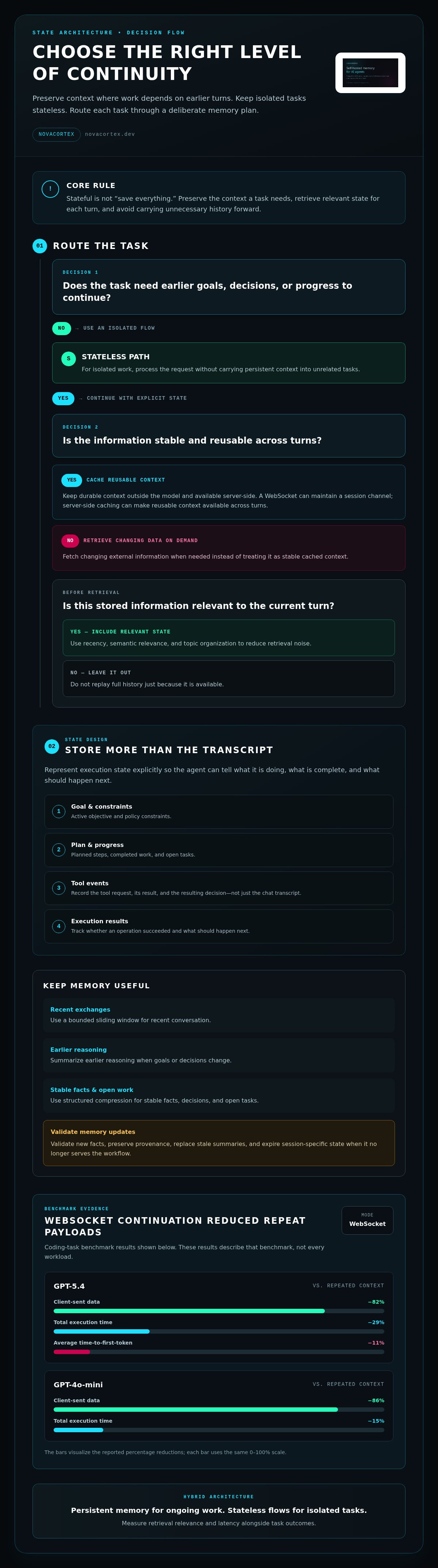
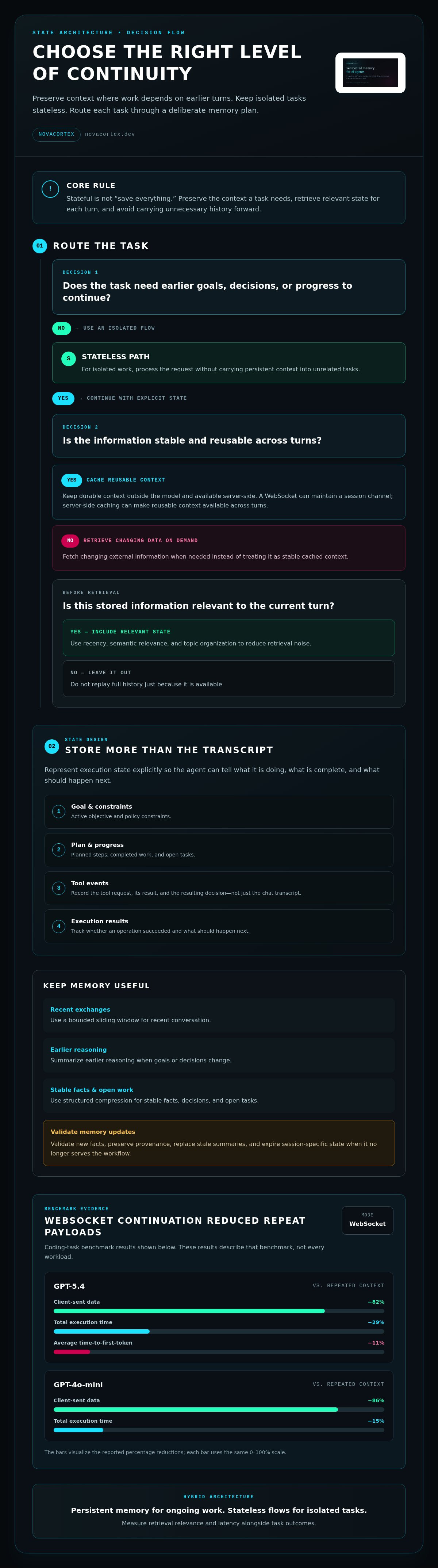
AI applications should store durable context outside the model and retrieve relevant state for each turn. Keep recent conversation history within a bounded window, then update summaries when goals or decisions change.
Most LLM APIs, including GPT-4, Claude, and Llama, are stateless by default. Without server-side state, the application needs a way to provide relevant context for later turns. A WebSocket connection can support continuation by maintaining a session channel, while server-side caching keeps reusable context available across turns. The application still needs an explicit state model; an open connection alone does not preserve reliable memory.
The data tradeoff is measurable. In the article’s coding-task benchmark, WebSocket mode reduced client-sent data by 82% for GPT-5.4 and reduced total execution time by 29%. For GPT-4o-mini, client-sent data fell by 86%, while total execution time fell by 15%. GPT-5.4 turns also showed an 11% reduction in average time-to-first-token. These results describe that benchmark, not every workload.
Context management determines what the server caches and what it retrieves. A context window is the maximum text or data a model can hold during one interaction; some larger models support 100K+ tokens. That capacity doesn’t make full-history replay efficient. Use a sliding window for recent exchanges, summaries for earlier reasoning, and structured compression for stable facts, decisions, and open tasks. Recency, semantic relevance, topic segmentation, and hierarchical memory help filter retrieval noise.
Persistent context can preserve a continuous representation of a conversation and lower hallucination rates, but stored errors can persist too. Treat memory updates as data operations: validate new facts, preserve provenance, and replace stale summaries. For example, retain a user’s confirmed project goal while retrieving only the design decision relevant to the current turn.
Tools add another state boundary. When an agent calls a database or external API, retain the request, result, and resulting decision, not just the chat transcript. MCP uses a client-server architecture and JSON-RPC communication, allowing tool outputs to be recorded as structured events alongside conversation state. Keep tool results distinct from model-generated summaries so later retrieval is easier to audit.
Evaluate the full pattern, not just model output. Compare WebSocket continuation with repeated HTTP context, tracking payload size, latency, retrieval relevance, and task completion. Cache stable context, retrieve changing external data on demand, and expire session-specific state when it no longer serves the workflow. This keeps persistent memory useful without turning the server into an unbounded transcript store.
What Is a Stateful AI Agent?
A stateful agent carries execution data between interactions, so its behavior can reflect earlier decisions and current constraints. The implementation must define which state persists, where it lives, and when it changes.
Execution State Beyond Conversation Memory
Execution state records what an agent is doing, not just what people said. It can include the active goal, completed steps, pending tool calls, results, and workflow constraints. This distinction matters when an interaction spans several operations: a conversation transcript may mention a database lookup, but execution state records whether it succeeded and what should happen next.
For example, a travel assistant can remember a destination while separately tracking an unfinished booking. LangGraph, LangChain, and Semantic Kernel provide state-management building blocks, such as conversation history, structured workflow state, and persistence integrations. Since their implementations differ, make the application’s state schema explicit rather than assuming a framework stores every decision.
Working, Episodic, and Long-Term Memory
Working memory holds information needed for the current interaction; episodic memory records specific past events; long-term memory preserves durable facts or preferences. Each layer serves a different retrieval need. A coding agent can keep the current error in working memory, a previous debugging outcome as an episode, and a project’s language choice as a lasting fact.
Separate the layers by purpose and retention behavior. Recent tool outputs may expire after a task, while a verified preference can remain useful across sessions. This structure helps the agent recall relevant details without treating every past interaction as equally important.
Memory Limits and Localized Allocation
Localized allocation ties active memory to the session or agent instance handling its work. It matters because each concurrent session consumes resources, and horizontal scaling becomes harder when state stays attached to one instance. Some models support context windows of 100K+ tokens, but a large window still doesn’t make every historical detail useful.
Set request timeouts around the work being performed. A 30-second timeout may suit a simple query, yet fail during complex multi-step reasoning; session-based designs can use 30-60 minutes of inactivity before timing out. Save durable progress separately, so a timeout doesn’t erase completed work or leave stale session state active.
Memory Storage Choices
Storage choices range from in-process memory for temporary state to external databases or file-backed stores for durable records. The right implementation depends on persistence needs, access patterns, consistency, and whether multiple workers must read the same state. Segment sensitive data, and validate updates before they become shared memory.
Handle retries as controlled state transitions: record the attempted operation, cap retries, and make writes idempotent where possible. Checkpoint completed stages so failures resume from known state instead of repeating successful work. For a five-stage workflow that fails at stage three, a checkpoint can preserve stages one and two.
For portable, durable memory across implementations, portable memory structures offer one way to keep stored knowledge separate from a single agent runtime.
Monitoring state health and retrieval latency
Measure each retrieval and state update separately, then track its effect on the full response. This reveals whether delays come from storage, retrieval, model processing, or external tools.
Latency and Time to First Token
Latency measures elapsed time across a request, while time to first token measures when generation begins. Both matter: a fast first token can still precede a slow final response.
Reported ranges put stateless AI responses at 50-150 milliseconds and stateful responses at 150-500 milliseconds. Stateful handling adds storage reads and writes, while stateless handling typically makes one model call. Track both measures per instance, alongside retrieval time, so a slow database lookup doesn’t get mistaken for slow generation.
Use a request trace to connect each timestamp: retrieval start, retrieval completion, model request, first token, tool call, and final response. For an agent that references a CRM record, the sequence shows whether latency comes from memory lookup or CRM access. Compare identical task types and record the retrieved context size; otherwise, different workloads distort the comparison.
Redundant Processing and Latency
Redundant processing occurs when an application re-encodes history or retrieves the same context repeatedly. It adds handling time without advancing the user’s task.
Sequential prompts can avoid reprocessing prior context when the system reuses session state. But caching every result creates another failure mode: stale information may be returned after its source changes. Attach versions or update timestamps to cached references, then invalidate them when the underlying record changes.
Query transformation can add an LLM call before retrieval, increasing time to first token and token use. Apply it only when the original query needs decomposition or clarification. For a direct request such as “show my saved invoice,” retrieve the matching record without adding a transformation stage.
MCP tool execution adds a network hop compared with calling a local Python function in the same runtime. Trace tool start and completion separately, then compare the network call with local execution. This shows whether remote coordination is necessary or merely adding latency.
Monitor state health as well as speed. Track retrieval relevance, missing references, duplicate records, failed writes, and stale context. A rising rate of empty results can indicate a broken index; repeated references to an outdated customer status can reveal failed invalidation. Pair these signals with task completion and tool correctness so faster responses don’t hide degraded behavior.
Set baselines by workflow and review latency distributions, not just averages. Averages can conceal a small group of slow requests, such as long-running tool calls. Compare retrieval and generation timings across instances using the same task pattern, then optimize the stage responsible for the delay.
Goal, planning, tool, policy, and performance state
A multi-step workflow needs more than conversation history. For a customer-support agent, state should distinguish the goal, plan, tool results, applicable policies, and performance measures.
Goal and Planning State
Goal and planning state record the objective, decisions, completed steps, and next action. This lets agents maintain goals across multiple steps, evaluate earlier decisions, and adapt strategy without losing workflow constraints. For example, a support agent can track “resolve the billing issue” as its goal, record account verification as complete, and plan a refund review next.
Keep the goal separate from the current plan. A failed lookup may change the next step without changing the user’s objective. Store each transition so the application can identify why the plan changed and whether a later response still serves the original goal.
Tool and Policy State
Tool state records invocation history and results; policy state captures constraints on allowed actions. This separation matters because a valid goal doesn’t authorize every tool call. Before an agent issues a refund, for example, validate the requested action against account permissions and applicable workflow rules.
Bound execution with loop counters, retry limits, tool-invocation validation, confidence thresholds, and structured output schemas. These controls help prevent repeated calls and malformed responses. Record the policy decision with each tool event so later review can distinguish an allowed action from a rejected one.
State consistency needs explicit mechanics. Use checkpoints, deterministic replay, version-controlled memory updates, transactional writes, and validation between graph transitions. If a five-stage workflow fails at stage three, a checkpoint can preserve stages one and two rather than forcing a full rerun. Version checks also help prevent concurrent agents from overwriting newer state.
Performance state connects execution choices to outcomes. Measure task completion rate, trajectory success, tool correctness, policy compliance, cost efficiency, and latency per completed objective. For a document-review agent, these measures show whether it completed the review, followed access constraints, chose the right tools, and returned results within the workflow’s performance target.
Evaluation should shape development, not just produce a final score. Replay failed trajectories, inspect state at each transition, and identify whether the cause was a bad plan, stale data, or a tool failure. Then adjust the prompt, policy checks, or infrastructure responsible for the faulty transition.
Governance belongs in state design too. Define data-retention behavior, user consent and control, explainability, and regular fairness audits. A review agent handling sensitive records, for instance, should retain only the state required for its task and make consequential actions traceable to their inputs and policy checks.
Hybrid stateful and stateless designs
Common LLM architectures combine session state, external memory, and stateless model calls. For teams architecting stateful AI applications, the rule is simple: persist only what future steps need, and keep isolated work stateless.
Architectures for Stateful LLM Applications
A hybrid architecture routes each task through either a stateful or stateless path. This lets one system preserve continuity without making every request carry session overhead.
For example, a support agent can keep an active case’s goal and decisions in session state, while sending a standalone product lookup through a stateless workflow. The orchestration layer selects the path, assembles the required context, and returns the model’s output. Stateless agents suit isolated work such as image classification, spam detection, and deterministic API calls.
Three patterns cover common needs: session-affine agents retain state in the active instance; shared-store agents retrieve state across instances; and event-driven workflows resume work as events arrive. A task that takes seconds can run synchronously, while work that may take hours benefits from event-driven orchestration instead of keeping a request open.
A useful principle for architecting stateful AI applications is to make routing rules explicit. Use continuity needs, required tools, and persistence requirements to select a path. Don’t let model choice alone determine statefulness: the same model can answer an isolated query statelessly or continue a multi-step session.
Scaling Across Users and Services
Scaling means preserving each user’s state while distributing active work across compute instances and services. This matters because session-bound memory can restrict horizontal scaling as concurrent users increase.
For sporadic traffic below 100 requests per hour, serverless stateless agents can minimize costs. For thousands of concurrent conversations requiring sub-second responses, containerized stateful agents with dedicated compute fit the stated workload pattern. These describe different operating conditions, not universal thresholds for every application.
Separate session identity from the instance serving a request. A shared state store lets another instance resume a session when traffic shifts, while version checks prevent concurrent writes from replacing newer state. Partition active sessions by user or workflow, then retrieve only what the current action needs. When architecting stateful AI applications, this boundary preserves session continuity without tying every request to one worker.
External services add coordination boundaries. Treat each tool result as an event tied to a session, then update shared state only after validating the response. For example, an order agent can record a payment-service result before requesting shipment, preventing orchestration from advancing on an unverified output.
Design hybrid boundaries around failure and recovery. Keep short-lived calculations stateless; checkpoint durable progress before long-running work. Evaluate task success, latency, and policy compliance separately for each path. This shows whether a stateful route justifies its infrastructure overhead or a stateless call handles the task cleanly.
NovaCortex: NovaCortex Self-Hosted Edition
NovaCortex Self-Hosted Edition gives stateful applications a privacy-first memory layer on your own infrastructure. It stores agent knowledge locally, while Portable Memory Format (PMF) helps keep that memory portable across implementations. The MCP-Native Memory Server connects memory to agent workflows, and Knowledge Buckets organize information for retrieval.
Use this approach when agents need persistent context without sending entire knowledge bases into every prompt. Graph-native storage supports fast retrieval, and the system can reduce token usage by up to 98% compared with dumping entire knowledge bases. That makes it relevant for teams balancing continuity, retrieval efficiency, and control over stored knowledge.
Explore NovaCortex at novacortex.dev or contact the team to discuss your architecture.
Build the Next Layer With Intent
Start your next architecture decision with a boundary: which information must survive a request, and which work should remain disposable? Use that distinction to shape your state model before adding more orchestration. It ties persistence to a real workflow need instead of making every interaction carry unnecessary history. That’s the practical discipline behind architecting stateful AI applications that remain controllable as their responsibilities grow.
When persistent agent memory is the missing layer, NovaCortex Self-Hosted Edition, Portable Memory Format (PMF), and the MCP-Native Memory Server are relevant building blocks. They give teams options for keeping memory on their own infrastructure and connecting it with agent workflows, without making memory design the same thing as agent design.
Choose the next step that fits your architecture: map the state boundary, test retrieval against real tasks, and decide what must remain portable.
Keep the design focused, measurable, and yours to evolve. Strong systems start with deliberate boundaries.
Frequently Asked Questions
What Is Stateful Architecture in AI?
Stateful AI architecture lets an application use information retained from earlier interactions when producing a new response. The model itself doesn’t necessarily retain that information; the surrounding application supplies relevant state. For example, a writing assistant could carry forward a user’s selected tone and document outline while keeping unrelated users’ preferences separate. The design decision is which information should influence future outputs and how the application governs it.
What is stateful AI application architecture?
It’s the application-level design that connects an AI model to state storage, retrieval logic, and workflow control. A practical implementation defines how a request identifies its user or task, what state the application loads, and which updates become durable. For a research assistant, the architecture might retain approved sources and project preferences while treating temporary search results as short-lived data. The model remains one component in that system.
How do stateful AI systems handle persistence and session storage?
They separate temporary session data from information that must survive after a session ends. Store a session identifier with transient interaction details, then persist durable records in a storage layer that supports the application’s access and recovery needs. For example, a support system may discard a draft response but retain a user-approved resolution. Define expiration, update, and deletion behavior so stale session data doesn’t become permanent by accident.
What are the security and privacy risks of storing AI application state?
Stored state can expose sensitive information, mix data between users, or preserve incorrect content that influences later responses. Reduce these risks by isolating user- or role-specific data, encrypting memory stores, logging access, and validating updates before retrieval. For example, a finance assistant should restrict account records to authorized sessions and keep tool permissions separate from conversational text. Clear retention rules and user controls also limit unnecessary stored data.
How do stateful and stateless AI application architectures compare?
A stateless design processes each request independently, while a stateful design uses retained application data to support continuity. Stateless processing fits isolated tasks such as classifying a single image; stateful handling fits work that depends on earlier choices, such as revising a document across sessions. A hybrid system can route each task according to its continuity needs. The tradeoff is operational: retained state requires governance and reliable storage.
What are best practices for testing and monitoring stateful AI applications?
Test state transitions, not only final responses. Create repeatable cases for fresh sessions, returning users, concurrent updates, expired records, and failed tool calls. Check that each case retrieves the right user’s data and produces a valid next action. In production, monitor retrieval quality, access failures, stale records, and end-to-end task outcomes. When behavior changes, replay the relevant interaction with its stored state to isolate the cause.
How do frameworks like LangGraph, LangChain, and Semantic Kernel manage state?
They provide state-management building blocks such as conversation history, structured workflow state, and persistence integrations. Since their implementations differ, define the application’s state schema explicitly.
FAQ
What Is Stateful Architecture in AI?
Stateful AI architecture lets an application use information retained from earlier interactions when producing a new response. The model itself doesn’t necessarily retain that information; the surrounding application supplies relevant state. For example, a writing assistant could carry forward a user’s selected tone and document outline while keeping unrelated users’ preferences separate. The design decision is which information should influence future outputs and how the application governs it.
What is stateful AI application architecture?
It’s the application-level design that connects an AI model to state storage, retrieval logic, and workflow control. A practical implementation defines how a request identifies its user or task, what state the application loads, and which updates become durable. For a research assistant, the architecture might retain approved sources and project preferences while treating temporary search results as short-lived data. The model remains one component in that system.
How do stateful AI systems handle persistence and session storage?
They separate temporary session data from information that must survive after a session ends. Store a session identifier with transient interaction details, then persist durable records in a storage layer that supports the application’s access and recovery needs. For example, a support system may discard a draft response but retain a user-approved resolution. Define expiration, update, and deletion behavior so stale session data doesn’t become permanent by accident.
What are the security and privacy risks of storing AI application state?
Stored state can expose sensitive information, mix data between users, or preserve incorrect content that influences later responses. Reduce these risks by isolating user- or role-specific data, encrypting memory stores, logging access, and validating updates before retrieval. For example, a finance assistant should restrict account records to authorized sessions and keep tool permissions separate from conversational text. Clear retention rules and user controls also limit unnecessary stored data.
How do stateful and stateless AI application architectures compare?
A stateless design processes each request independently, while a stateful design uses retained application data to support continuity. Stateless processing fits isolated tasks such as classifying a single image; stateful handling fits work that depends on earlier choices, such as revising a document across sessions. A hybrid system can route each task according to its continuity needs. The tradeoff is operational: retained state requires governance and reliable storage.
What are best practices for testing and monitoring stateful AI applications?
Test state transitions, not only final responses. Create repeatable cases for fresh sessions, returning users, concurrent updates, expired records, and failed tool calls. Check that each case retrieves the right user’s data and produces a valid next action. In production, monitor retrieval quality, access failures, stale records, and end-to-end task outcomes. When behavior changes, replay the relevant interaction with its stored state to isolate the cause.
How do frameworks like LangGraph, LangChain, and Semantic Kernel manage state?
They provide state-management building blocks such as conversation history, structured workflow state, and persistence integrations. Since their implementations differ, define the application’s state schema explicitly.