Augmenting LLMs with Knowledge Graphs for More Grounded Answers

Augmenting LLMs with knowledge graphs connects a language model’s ability to interpret questions with structured facts and relationships it can retrieve. This lets the system ground answers in domain knowledge rather than relying only on patterns learned during training.
That distinction matters. A fluent answer can still be outdated, overlook a relationship between entities, or draw on irrelevant text. A graph adds structure, but it also depends on accurate data, clear access controls, and retrieval suited to the question.
This article explains what knowledge graph LLMs are, how graph retrieval and language generation work together, and when this combination is useful. It covers the trade-offs, including governance, privacy, implementation choices, and evaluation measures for checking whether answers are better grounded. You’ll get a practical framework for deciding where a graph fits in an LLM system, connecting the components, and evaluating the architecture before production.
Key Takeaways
- Use graph relationships when a question depends on how entities connect, not just on finding text that sounds relevant.
- Choose retrieval methods to fit the query: semantic search, structured graph queries, or a hybrid of both.
- Set governance boundaries around sensitive graph data so generated answers respect access controls and privacy requirements.
- Evaluate retrieval quality, source reliability, freshness, and reasoning cost, not just whether an answer reads fluently.
- Consider NovaCortex Self-Hosted Edition when a self-hosted approach fits your architecture and data-control requirements.
What Is a Knowledge Graph LLM (and Why It Matters)?
A knowledge graph LLM combines a language model with retrieval from structured entities and relationships. Augmenting LLMs with knowledge graphs helps connect a fluent response to evidence about how facts relate.
Limits of Vanilla Retrieval-Augmented Generation
Retrieval-augmented generation, or RAG, retrieves relevant material and supplies it to a large language model before it generates an answer. Basic RAG often searches text passages by semantic similarity. This can surface noisy context while missing structural relationships. For a product recommendation, a passage about an item may be relevant without establishing whether it works with a customer’s existing equipment. That gap matters when an answer depends on connected facts, not just similar wording.
Knowledge Graph Retrieval-Augmented Generation
Knowledge graph RAG retrieves entities and their relationships from a graph, then supplies that structured context to a language model. The graph can connect a product to its manufacturer, supported components, and category, giving retrieval a path through related facts. RAG can also draw on PDFs, web content, and other resources, so a graph need not replace documents. This approach helps when a question depends on domain-specific relationships that isolated text passages may not preserve.
Graph Retrieval and Evidence Trails
Graph-augmented retrieval follows relationships between entities to assemble context for generation. A query about a supplier’s ownership, for example, can retrieve the supplier, its parent company, and the links between them. The answer can then rely on those retrieved entities and relationships rather than a broad text match. This evidence trail helps teams inspect which graph facts support a response and identify where a missing or incorrect link may affect it.
Hybrid Vector and Graph Retrieval
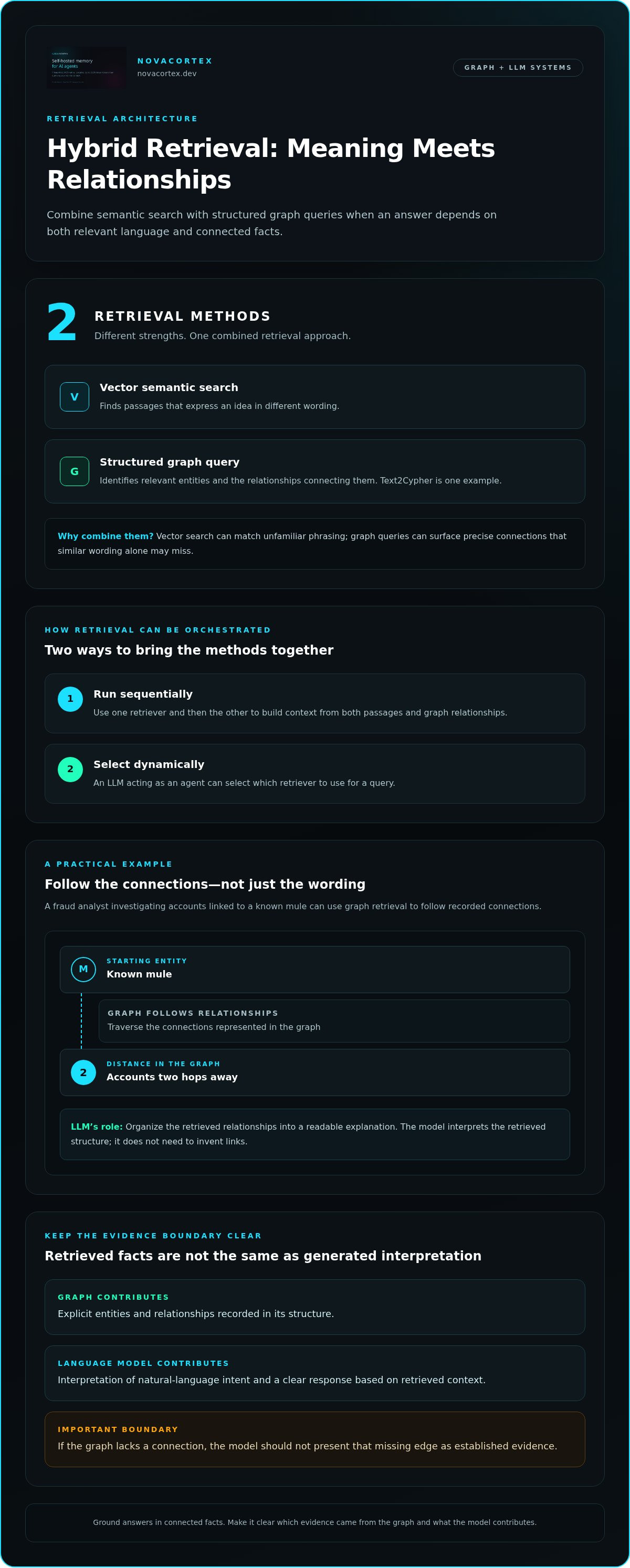
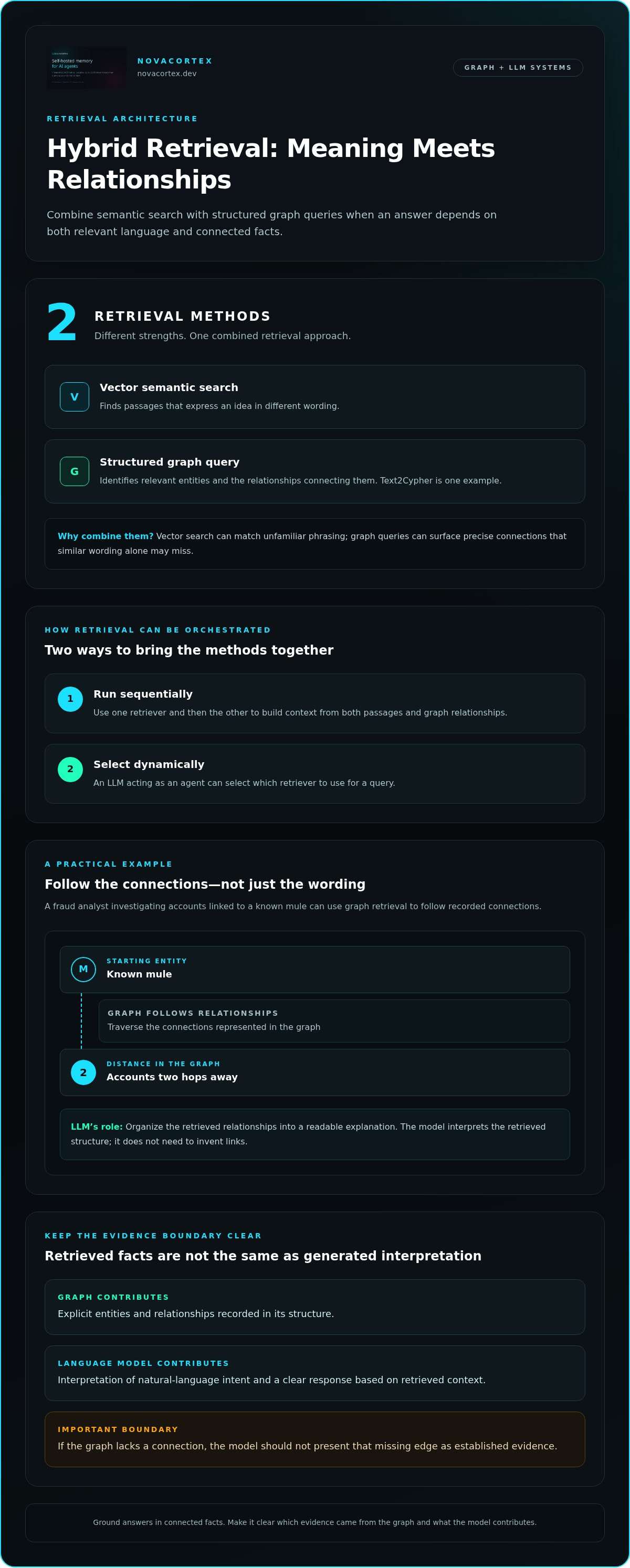
Hybrid retrieval combines vector-based semantic search with structured graph queries, such as Text2Cypher. Vector search can find passages that express an idea in different wording; a graph query can then identify the relevant entities and their connections. GraphRAG systems may run these retrievers sequentially or select one dynamically through an LLM acting as an agent. For a question containing both an unfamiliar phrase and a precise relationship, the combination can retrieve matching language and connected facts.
Combined LLM and knowledge graph systems
A combined system gives the language model and graph different jobs. The graph supplies domain relationships; the model interprets the request, selects relevant concepts, and expresses a response in natural language. This division matters when a recommendation depends on current, domain-specific facts rather than general patterns learned during training. It also makes the system easier to assess: identify which facts come from the graph and what reasoning the model contributes.
K-RagRec illustrates this design for recommendation tasks. The framework retrieves structural information from an external knowledge graph to support recommendation generation. The graph contributes relationships between entities, while the LLM aggregates and prioritizes concepts for the answer. In the described approach, the model does not modify the foundation graph. This keeps generated recommendations distinct from the source structure, making it easier to inspect whether a proposed result follows the retrieved relationships.
Consider a fraud analyst investigating accounts linked to a known mule. A graph query can identify accounts two hops from that entity by following the connections represented in the graph. The LLM can organize those retrieved relationships into a readable explanation. The model does not need to invent links; it interprets the retrieved structure. This pattern is useful when a task depends on a chain of connections that a passage-level answer might obscure.
The components can handle uncertainty differently. A graph provides explicit relationships recorded in its schema, while the model interprets natural-language intent and prioritizes relevant concepts. If the graph lacks a connection, the model should not present that missing edge as established evidence. Instead, the system can distinguish retrieved facts from generated interpretation. This boundary matters in recommendations, where a plausible explanation can sound convincing even when the underlying relationship is absent.
Knowledge graphs can also be organized around a domain or community. A proposed Community Language Model pattern builds on domain-specific and ecosystem-based Community Knowledge Graphs. The graph supplies shared domain structure, and the model turns questions about that structure into useful language. Kurt Cagle describes GRAGs as an entry point for knowledge graphs into the LLM ecosystem. For teams, the design question is which relationships must remain explicit and reusable across tasks.
When persistent, organized context is central to the architecture, graph-backed memory can provide a practical implementation reference. Explore graph-backed memory architecture as you assess how structured knowledge should connect with LLM workflows.
Graph-constrained generation and governance
Graph constraints limit which entities and relationships a language model can use during generation. Privacy, security, and data quality risks include exposing confidential graph facts, granting access beyond a user’s permissions, and retaining incorrect or irrelevant information.
Graph-Constrained Generation
Graph-constrained generation directs an LLM to produce answers using concepts and relationships allowed by a governed graph. A foundational ontology can define those boundaries and reduce unsupported connections in responses. For example, a compliance system can restrict answers to relationships represented in its approved graph. This constraint guides generation, but reviewers still need to distinguish retrieved facts from the model’s explanation.
Consider a compliance query tracing beneficial owners connected to an account across three jurisdictions. The graph can expose recorded ownership paths, while the model explains them in readable language. Governance rules should specify which entities and relationships the query may retrieve. This makes the answer’s permitted evidence clearer than giving the model unrestricted access to every connected record.
Privacy, Security, and Data Quality Risks
Graph data may contain sensitive information, and generated answers can expose private or confidential details. A user asking about an account could receive connected personal records if retrieval ignores access boundaries. Integrated graph and LLM systems should comply with applicable data privacy regulations and use privacy-preserving techniques, including differential privacy. Security design must cover both graph retrieval and the model’s generated response.
Data quality creates a separate failure path. An incorrect ownership edge can make a response confidently identify the wrong beneficial owner; an irrelevant node can lead generation off course. Governance therefore needs processes for identifying, correcting, or removing bad graph information. For a compliance graph, track the source and status of each material relationship, then review whether it remains relevant to the task.
Access policy should shape retrieval before generation begins. For example, a role authorized to view account relationships may not be authorized to receive every connected person’s private details. Apply permissions to the records and relationships returned to the model, then assess the final answer for leakage. This helps prevent a system from filtering source documents correctly but exposing sensitive information while summarizing graph connections.
Multi-hop reasoning also needs a cost boundary. Traversing intermediate entities can cause exponential computation cost, according to Springer Nature. A query that expands through several relationship types can retrieve a large, noisy neighborhood. Limit traversal to relevant relationship types and stop paths that do not support the task. These constraints help keep the evidence set useful and governable.
Governance must also cover information that changes or becomes outdated. A graph containing an old ownership relationship can produce a misleading answer even when retrieval follows the correct path. Define who can update each relationship, how corrections are recorded, and how downstream answers reflect revised data. For high-impact cases, preserve the graph evidence used for generation so reviewers can trace the response to its source facts.
Implementation and evaluation metrics
Implementation connects query handling, graph retrieval, ranking, and generation in one observable pipeline. Evaluate each stage separately, then test whether the final answer is grounded and useful.
Tools and Frameworks for Integration
Integration frameworks coordinate language models with graph queries, vector retrieval, and supporting sources. Text2Cypher can translate a natural-language request into a structured graph query. A hybrid design can run that query alongside semantic search, then merge results before generation. These components matter because retrieval quality depends on how well the query maps to the graph.
A retrieval pipeline can tokenize the initial prompt and send it through a bridge filter. The filter maps tokens to an initial query result, which the system caches. Retrieved nodes can then be ranked by source reliability or data recency. The system adds resources to the context until it reaches an iteration limit or finds no new nodes.
Use Cases and Benchmarks
Knowledge graph LLMs support tasks where answers depend on linked, domain-specific facts. A governed HR assistant using graph data can save HR teams hundreds of hours. In production, enterprises are scaling knowledge graph ingestion to handle millions of daily events, with solutions like Syntes AI helping unify complex data into structured, actionable formats. These use cases require evaluation beyond whether a response sounds fluent.
Build a benchmark from representative questions and verified answers. Measure whether retrieval returns the necessary entities, relationships, and source evidence. Then assess answer correctness, unsupported claims, and whether the response reflects current graph data. Compare vector-only, graph-only, and hybrid retrieval to see which queries benefit from each approach.
Cost and Performance Trade-Offs
Knowledge graph augmentation adds work in ingestion, retrieval, graph maintenance, and evaluation. In return, targeted retrieval can keep irrelevant context out of the prompt. The deciding factors include graph quality, query complexity, model use, and how much evidence each answer needs. Track these alongside latency and answer quality to understand the system’s operational trade-offs.
Multi-hop reasoning can become expensive as a query traverses relationships and intermediate entities. Springer Nature notes that this process could lead to exponential computation cost. Bound traversal by relevant relationship types, rank useful nodes early, and stop when additional evidence no longer improves the answer. These controls keep graph exploration from consuming resources without strengthening the response.
Output templates can shape retrieved data into consistent answers, while a locally retained concept ontology can support inference and context in future queries. Evaluate whether templates preserve key evidence and whether retained context remains relevant. A useful scorecard separates retrieval coverage, answer grounding, freshness, latency, and resource use. That separation helps identify whether a weak response stems from stale graph data, poor retrieval, or generation.
Benefits of integrating LLMs with knowledge graphs
The main benefit is not simply a more fluent answer. A graph gives language models structured relationships for connecting facts, while retrieval can bring in information newer than the model’s training snapshot. For a support assistant, that could mean answering a question about a subscription using linked plan, feature, and account records instead of relying on generic product knowledge.
Current information matters wherever facts change. A model’s learned knowledge reflects a snapshot, so its unaided response may be outdated. A graph-backed system can retrieve the current record for a policy or product status and use it as answer context. That shifts updates from retraining the model to maintaining the relevant knowledge source, while keeping retrieval dependent on the graph’s accuracy and freshness.
Relationships add another advantage: they make context more meaningful. In an internal support workflow, a question about a feature can connect it to documentation, product version, and known limitations. The model can use those linked records to form a more specific response. This is especially useful when the right answer depends on several related facts, not one isolated passage.
Recommendation systems can benefit from the same structure. A graph can connect a user’s stated requirements with product attributes and compatibility relationships. The language model can then summarize suitable options using the retrieved evidence. This makes a recommendation easier to inspect: teams can examine which attributes and connections informed it instead of treating a polished paragraph as proof of sound reasoning.
Graph retrieval can also improve access to knowledge across separate sources. Kurt Cagle describes GRAGs as addressing knowledge-management challenges involving federation and comparative accessibility. A federated view can help users find relationships across distinct knowledge collections while preserving each source’s structure. For teams, this can reduce the need to flatten every source into one undifferentiated text corpus before asking useful questions.
Persistent context is another practical gain. Information learned during a session can fall out of scope unless it is captured and added to the driving corpus. A maintained graph can preserve relevant entities and relationships for later queries, rather than making users restate context. This persistence is valuable in workflows where a decision spans multiple conversations, provided updates and corrections reach the knowledge base.
These benefits depend on fit. A graph adds the most value when answers require current facts, explicit relationships, or traceable context. For a simple request answered directly from a short, stable document, graph retrieval may add unnecessary complexity. Compare these query types before choosing an architecture, then assess answer grounding and retrieval quality against your actual use cases.
NovaCortex: NovaCortex Self-Hosted Edition
NovaCortex Self-Hosted Edition is a natural next step when you need a self-hosted approach to persistent knowledge for LLM workflows. Portable Memory Format (PMF), the MCP-Native Memory Server, and Knowledge Buckets provide related options for organizing and connecting that context. NovaCortex’s system reduces token usage by up to 98% compared with dumping entire knowledge bases, while offering fast retrieval and graph-native storage. These offerings are relevant when you’re shaping how knowledge should be stored and accessed alongside language models. Choose the architecture that fits your context and governance needs, then explore how it supports your retrieval design.
Contact NovaCortex or visit novacortex.dev to learn more.
Build the Next Layer of Your Knowledge Stack
The next step is to turn your architecture into a working decision, not another diagram. Choose a real workflow where current knowledge and connected context matter, then define what a useful answer must show: relevant evidence, clear provenance, and a response appropriate to the user’s access. This gives your team a concrete basis for assessing how augmenting LLMs with knowledge graphs fits its systems and governance model.
For persistent knowledge workflows, NovaCortex offers NovaCortex Self-Hosted Edition, Portable Memory Format (PMF), and MCP-Native Memory Server. These provide different ways to organize and connect memory with LLM workflows. Choose the entry point that aligns with your data architecture and implementation goals, then test it against your team’s requirements.
Start with a focused use case. Build from evidence, then let the results guide your next steps.
Frequently Asked Questions
What is GraphRAG in the LLM world?
GraphRAG is a retrieval-augmented generation approach that uses a knowledge graph to retrieve connected information for an LLM. For a question about a supplier, retrieval might return its parent company and associated products, not just matching text. Teams can use graph results alongside documents, then inspect which entities and relationships support the generated response. GraphRAG covers different implementations, so the retrieval and generation design matters.
What does augmenting LLMs with knowledge graphs mean?
It means pairing a language model with a graph that stores entities and their relationships, then using relevant graph information to help answer queries. For example, a maintenance assistant could connect a machine model to compatible parts and service records. The graph supplies structured domain context; the model interprets the request and presents the result in natural language. This approach adds retrievable knowledge without rewriting the model’s learned parameters.
How do knowledge graphs improve LLM accuracy and reduce hallucinations?
Knowledge graphs can ground responses in explicit facts and relationships retrieved for the current query. If a customer asks which replacement part fits a device, the system can use recorded compatibility links rather than rely on a plausible-sounding guess. Grounding gives the model better evidence, but it does not guarantee a correct response. Stale, incomplete, or incorrect graph records can still mislead.
What are the main architectures for integrating knowledge graphs with LLMs?
Common patterns include graph retrieval before generation, hybrid graph-and-vector retrieval, and graph-constrained generation. Another pattern uses an LLM to translate a question into a structured graph query, then explain the results. For a troubleshooting assistant, hybrid retrieval might find relevant manual passages and graph links between device models and components. Choose an approach based on whether the task depends most on textual similarity, explicit relationships, or both.
How does graph retrieval-augmented generation (GraphRAG) work?
GraphRAG maps a user’s question to relevant graph entities, retrieves connected facts, and gives that context to a language model to generate an answer. For instance, a question about a software feature could retrieve its dependencies and supported versions. The implementation may combine graph queries with document retrieval, then format the evidence for the model. Good system design preserves source details so reviewers can trace claims to retrieved records.
How do you build and maintain a knowledge graph for an LLM?
Start by defining the domain, entity types, and relationships needed to answer real questions. For a product-support graph, model products, versions, components, and compatibility links; then extract or import records and resolve duplicate entities. Track sources and update rules for each important relationship. Validate changes against known examples, and remove irrelevant or incorrect facts so retrieval does not feed them into later answers.
How do knowledge graphs compare with vector databases for LLM retrieval?
Vector databases retrieve content by semantic similarity, helping find passages worded differently from a query. Knowledge graphs retrieve explicit entities and relationships, helping answer questions about connections or paths. A service assistant might use vectors to find a troubleshooting passage and a graph to identify the device version it applies to. A hybrid design combines both retrieval signals when a question needs language matching and structured context.
What are the steps to implement a knowledge graph-augmented LLM?
Begin with a specific query type and define the evidence an acceptable answer needs. Then model relevant entities and relationships, connect trusted sources, and implement graph, vector, or hybrid retrieval. Add access controls and a response format that distinguishes evidence from explanation. Finally, test representative questions for retrieval coverage, factual grounding, freshness, and latency. Use failure cases to refine the graph and retrieval logic before expanding to other tasks.
FAQ
What is GraphRAG in the LLM world?
GraphRAG is a retrieval-augmented generation approach that uses a knowledge graph to retrieve connected information for an LLM. For a question about a supplier, retrieval might return its parent company and associated products, not just matching text. Teams can use graph results alongside documents, then inspect which entities and relationships support the generated response. GraphRAG covers different implementations, so the retrieval and generation design matters.
What does augmenting LLMs with knowledge graphs mean?
It means pairing a language model with a graph that stores entities and their relationships, then using relevant graph information to help answer queries. For example, a maintenance assistant could connect a machine model to compatible parts and service records. The graph supplies structured domain context; the model interprets the request and presents the result in natural language. This approach adds retrievable knowledge without rewriting the model’s learned parameters.
How do knowledge graphs improve LLM accuracy and reduce hallucinations?
Knowledge graphs can ground responses in explicit facts and relationships retrieved for the current query. If a customer asks which replacement part fits a device, the system can use recorded compatibility links rather than rely on a plausible-sounding guess. Grounding gives the model better evidence, but it does not guarantee a correct response. Stale, incomplete, or incorrect graph records can still mislead.
What are the main architectures for integrating knowledge graphs with LLMs?
Common patterns include graph retrieval before generation, hybrid graph-and-vector retrieval, and graph-constrained generation. Another pattern uses an LLM to translate a question into a structured graph query, then explain the results. For a troubleshooting assistant, hybrid retrieval might find relevant manual passages and graph links between device models and components. Choose an approach based on whether the task depends most on textual similarity, explicit relationships, or both.
How does graph retrieval-augmented generation (GraphRAG) work?
GraphRAG maps a user’s question to relevant graph entities, retrieves connected facts, and gives that context to a language model to generate an answer. For instance, a question about a software feature could retrieve its dependencies and supported versions. The implementation may combine graph queries with document retrieval, then format the evidence for the model. Good system design preserves source details so reviewers can trace claims to retrieved records.
How do you build and maintain a knowledge graph for an LLM?
Start by defining the domain, entity types, and relationships needed to answer real questions. For a product-support graph, model products, versions, components, and compatibility links; then extract or import records and resolve duplicate entities. Track sources and update rules for each important relationship. Validate changes against known examples, and remove irrelevant or incorrect facts so retrieval does not feed them into later answers.
How do knowledge graphs compare with vector databases for LLM retrieval?
Vector databases retrieve content by semantic similarity, helping find passages worded differently from a query. Knowledge graphs retrieve explicit entities and relationships, helping answer questions about connections or paths. A service assistant might use vectors to find a troubleshooting passage and a graph to identify the device version it applies to. A hybrid design combines both retrieval signals when a question needs language matching and structured context.
What are the steps to implement a knowledge graph-augmented LLM?
Begin with a specific query type and define the evidence an acceptable answer needs. Then model relevant entities and relationships, connect trusted sources, and implement graph, vector, or hybrid retrieval. Add access controls and a response format that distinguishes evidence from explanation. Finally, test representative questions for retrieval coverage, factual grounding, freshness, and latency. Use failure cases to refine the graph and retrieval logic before expanding to other tasks.