Autonomous Agent Memory Framework: Engineering Persistent Cognition

Most AI agents are effectively lobotomized every time the context window resets. They don't learn; they just repeat expensive mistakes. This amnesia problem isn't a limitation of the LLM itself but a failure of the underlying autonomous agent memory framework. You're likely watching your API budget evaporate into redundant context injections while your agents lose the thread of complex, multi-step tasks. It's a waste of compute and a sacrifice of digital sovereignty to managed vector clouds that can cost upwards of $1,400 a month for basic indexing.
You deserve a system that remembers. This guide provides the engineering blueprint to build a tiered memory architecture that slashes token waste and secures your knowledge base. We're moving beyond the strategy of dumping the entire database into every prompt. You'll learn to implement a graph-native, MCP-compliant structure using the Portable Memory Format (PMF) to ensure your data stays under your total control. We're building persistent cognition, not just another chatbot. It's time to engineer agents that actually grow more capable over time.
Key Takeaways
- Architect an autonomous agent memory framework to solve the stateless LLM trap. Transform standard chatbots into persistent, context-aware systems that learn from every interaction.
- Differentiate between sensory, working, and long-term memory tiers to handle high-frequency inputs and active reasoning without bloating context windows.
- Leverage graph-native storage to preserve complex relationships and the logic behind your data, surpassing the semantic limitations of simple vector similarity.
- Utilize the Model Context Protocol (MCP) and Portable Memory Format (PMF) to build interoperable infrastructure that rejects vendor lock-in.
- Deploy a self-hosted memory layer to maintain total data sovereignty while reducing LLM token overhead by up to 98%.
The Amnesia Problem: Why Agents Fail Without a Memory Framework
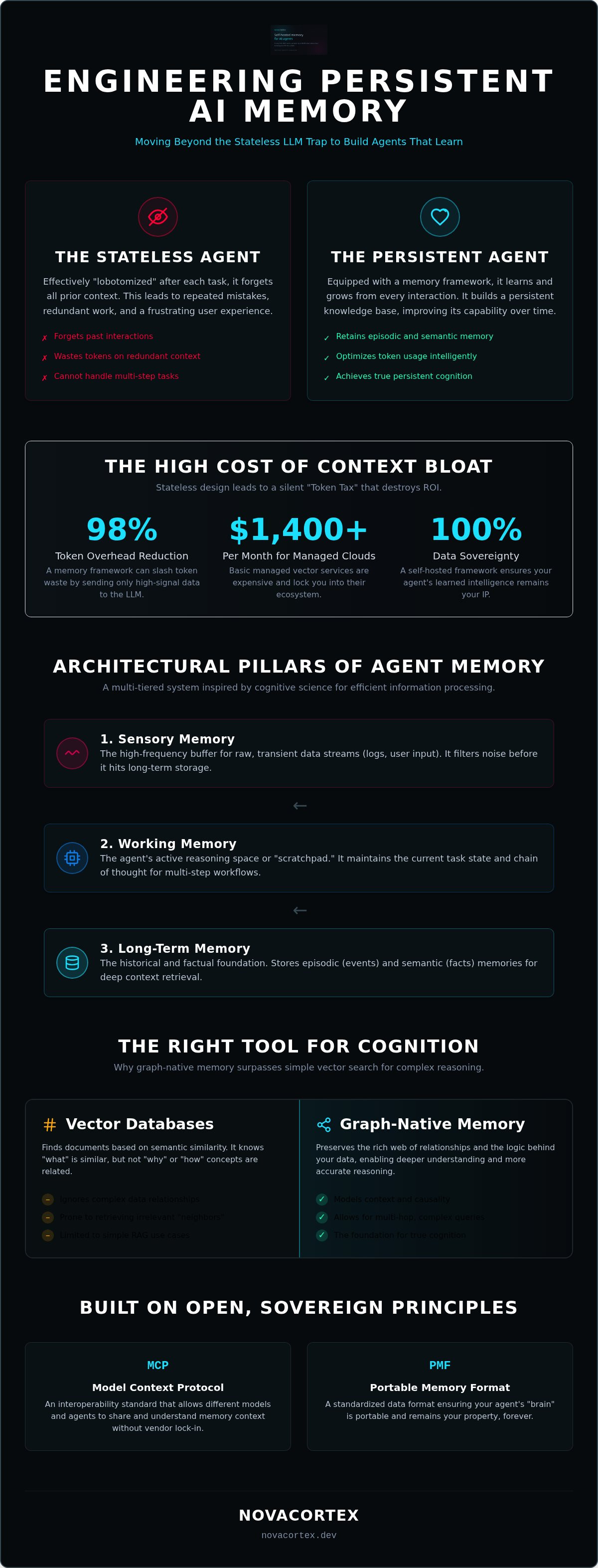
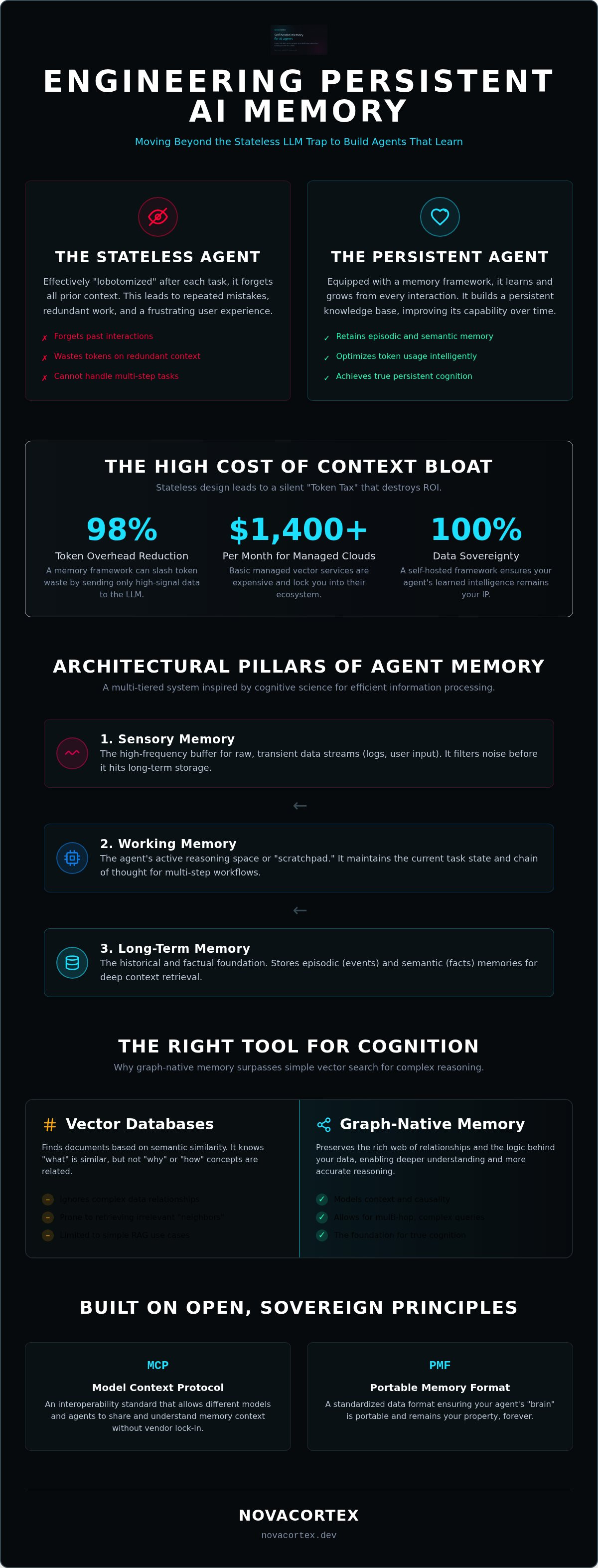
Language models are inherently stateless. Every API call is a blank slate; a fresh start with zero recollection of the previous turn. This is the "Stateless LLM" trap. Without a robust autonomous agent memory framework, your agents are doomed to repeat the same reasoning errors and ask the same clarifying questions. They don't learn. They simply execute static patterns on isolated data fragments. This isn't autonomy; it's just expensive automation.
Engineering persistent cognition requires moving beyond simple Retrieval-Augmented Generation (RAG). Standard RAG is a brute-force approach that searches for documents but ignores the agent's own history. A true memory framework acts as a dedicated state management layer. It preserves the "why" behind decisions and the "how" of previous successes. Without it, you're paying a heavy "Token Tax." You're forced to dump entire knowledge bases into every prompt just to keep the agent on track. This destroys project ROI and leads to brittle, low-context behavior that fails the moment a task spans more than a few steps.
Statelessness vs. Persistent Cognition
Standard session context is temporary and fragile. It vanishes the moment you clear a thread or exceed a token limit. Persistent cognition is different. It involves building a system that retains episodic memory of past events and semantic memory of learned facts. The choice between self-hosted vs managed AI memory determines who actually owns this cognitive history. Managed providers often lock your agent's "brain" into proprietary silos. Self-hosted frameworks ensure that as your agent learns from previous interactions, that intelligence remains your intellectual property. Agents must do more than just retrieve documents; they must synthesize past experiences to refine their future logic.
The Cost of Context Bloat
Context bloat is a silent killer of AI performance and profitability. As workflows grow complex, engineers often resort to "prompt stuffing," which leads to an exponential surge in LLM API costs. This is lazy architecture. The context window represents a fixed, hardware-bound bottleneck that restricts an agent's immediate intelligence by limiting the volume of data it can process in a single inference cycle. Like a human cognitive system with a limited capacity, an agent cannot hold everything in active focus at once.
Specialized memory layers solve this by pruning unnecessary noise before it hits the LLM. Instead of sending 50,000 tokens of raw data, a refined memory framework extracts only the high-signal entities and relationships required for the current task. This reduces overhead, increases reasoning speed, and ensures the agent stays focused on the objective rather than getting lost in the context window's clutter.
Architectural Pillars of Agent Memory: Sensory, Working, and Long-Term
A high-performance autonomous agent memory framework isn't a single database. It's a multi-tiered architecture that mimics biological cognitive systems to manage information flow with precision. You don't just dump data into a sink. You route it based on utility, decay, and the specific requirements of the task at hand. Engineering this hierarchy is what separates a toy chatbot from a persistent autonomous agent.
Sensory memory acts as the high-frequency buffer. It processes the raw, unweighted stream of incoming logs, sensor readings, or real-time user inputs. This data is transient. It exists to be filtered and converted into actionable insights rather than clogging up your long-term storage. If every raw log entry hit your main database, your retrieval latency would skyrocket within hours. Sensory memory provides the necessary abstraction layer to keep the system lean.
Working memory is the agent's active reasoning space. It maintains the current state of a task and the immediate chain of thought. Scientific consensus suggests that Working Memory Underpins Cognitive Development by enabling the mental manipulation of information. For your agent, this is the scratchpad that prevents logic loops and ensures it finishes what it started. It's the "active context" that guides the LLM through a multi-step workflow without losing the original objective.
Long-term memory provides the historical and factual foundation. Episodic memory stores the chronological log of past events, while semantic memory holds the structured knowledge graph of the world. This division allows an agent to recall what it did last Tuesday while also knowing the fundamental rules of the system it's operating within. Without this persistent layer, an agent has no way to improve its performance based on past failures.
Tiered Storage for AI Cognition
Efficient systems move data through a hierarchy. Hot data stays in high-speed caches for immediate access. Cold data migrates to graph-native storage for deep relationship queries. Using AI agent long term memory is the only way to maintain persona consistency over long durations. You must also implement consolidation protocols to "forget" noise. This prevents your memory layer from becoming a bloated digital junkyard that slows down inference and inflates costs.
Semantic Retrieval and Relationship Mapping
Keyword matching is insufficient for autonomous reasoning. It lacks the depth required for complex problem-solving. Modern enterprise AI memory layers use relationship-aware retrieval to find connected concepts rather than just similar words. Knowledge Buckets allow for modular state management. This isolation ensures the agent pulls only relevant domain expertise without contaminating the context window. If you want to see how these tiers integrate into a sovereign system, examine the NovaCortex core architecture for a production-ready implementation.
Vector Databases vs. Graph-Native Memory Layers
Vector databases are the industry's blunt instrument. They excel at semantic similarity, finding "things that look like other things," but they are fundamentally incapable of structured reasoning. For a truly robust autonomous agent memory framework, relying solely on vector embeddings is a recipe for architectural fragility. Vectors don't understand hierarchy. They don't understand cause and effect. They simply map points in a high-dimensional space and hope the most relevant data is nearby.
Graph-native memory layers solve this by preserving the "why" and "how" behind every data point. While vectors provide the "what," graphs provide the context. By mapping explicit relationships between entities, an agent can traverse logic chains rather than just performing keyword lookups. This shift in perspective was popularized by the Generative Agents architecture, which demonstrated that agents require a structured memory stream to synthesize reflections and plan complex behaviors. Precision retrieval requires more than just a distance calculation; it requires a map.
The Limits of Pure Vector RAG
Pure vector RAG often suffers from the "Lost in the Middle" phenomenon. When an agent retrieves ten similar snippets, the LLM frequently ignores the most critical information buried in the center of the context window. This leads to hallucinations where the agent confidently retrieves out-of-context data and forces it into a narrative where it doesn't belong. The debate over Redis vs graph memory for AI agents is the central engineering conflict of 2026. While Redis offers speed for simple caching, it lacks the relational depth needed to prevent these cognitive failures in autonomous workflows.
Graph-Native Precision for Agents
Graph-native storage allows agents to map entity relationships in real-time. This improves decision-making by providing a clear view of how different pieces of information interact. When an agent learns a new fact, it doesn't just store a string; it updates a node and creates new edges. This structure is essential for multi-agent synchronization, ensuring that every agent in a swarm operates from a single, consistent source of truth.
Implementing privacy-focused RAG ensures these knowledge graphs remain local and secure. By keeping the memory layer self-hosted, you eliminate the risk of sensitive relationship data leaking into managed cloud databases. The technical advantage is clear. Graphs offer superior token efficiency by allowing the agent to query specific sub-graphs rather than dumping entire document chunks into the prompt. This surgical approach to data retrieval can reduce token usage by up to 98% compared to traditional vector-only methods.
Engineering Context Persistence: Implementation and MCP
Context persistence isn't an accident. It's an engineered outcome. To build a resilient autonomous agent memory framework, you must decouple the agent's logic from its storage medium. Industry standards are shifting away from proprietary, black-box memory solutions toward open architectures that prioritize interoperability and speed. You're no longer just storing strings; you're managing the lifecycle of an agent's intelligence.
The Model Context Protocol (MCP) has emerged as the definitive standard for this decoupling. While some view MCP merely as a way to connect agents to external tools, its true power lies in its role as a standardized memory interface. An MCP-native architecture allows any compliant agent to read from and write to a centralized memory server without custom integration code for every new model. This creates a plug-and-play ecosystem. Your agent's history becomes independent of the LLM provider you use today, ensuring your infrastructure remains future-proof.
Data portability is the next critical frontier for sovereign builders. Utilizing a Portable Memory Format (PMF) ensures that your agent's cognitive state isn't trapped in a specific vendor's database schema. PMF allows for the seamless migration of knowledge buckets across different environments, from local development machines to enterprise-grade production clusters. It's the difference between owning your agent's brain and renting it from a SaaS provider.
Standardizing the Memory Interface with MCP
An MCP native memory server acts as the central nervous system for your AI operations. It standardizes how context is retrieved, indexed, and updated across your entire stack. Protocol implementation ensures low-latency context retrieval that scales with your agent's complexity. You aren't writing fragile glue code anymore. You're building a hardened, interoperable memory layer that treats context as a first-class citizen. This is the foundation for agents that can operate across different providers while maintaining a single, unified source of truth.
Data Sovereignty and Portable Formats
2026 is the year engineers reclaim their data. The rise of PMF signals a shift toward digital sovereignty where you own the weights, the graph, and the history. Self-hosting your memory layer eliminates the inherent privacy risks and unpredictable latency spikes associated with managed AI memory providers. When your data stays on your hardware, you control the security parameters and the retrieval speed. Self-hosting ensures that sensitive corporate knowledge never touches a third-party cloud, effectively neutralizing the primary security bottleneck in autonomous workflows. This isn't just a privacy play; it's a performance necessity for high-velocity engineering.
NovaCortex: The Reference Framework for Sovereign Agent Memory
Theoretical architectures require practical, hardened implementations. NovaCortex serves as the definitive autonomous agent memory framework for engineers who prioritize performance over convenience. While managed services offer a quick start, they often introduce hidden costs and data leakage risks. NovaCortex provides a specialized alternative for builders who refuse to compromise on architectural control. It translates the abstract pillars of sensory, working, and long-term memory into a deployable, high-velocity reality.
The framework is built on the principle of modularity. You don't need a monolithic database for every task. Instead, you scale your agent's intelligence using Knowledge Buckets. These buckets allow you to segment data by domain, project, or user, ensuring that the agent only retrieves the specific sub-graph required for its current reasoning step. This surgical precision is how NovaCortex achieves a reduction in token usage by up to 98% compared to standard RAG implementations. You're no longer paying for the LLM to read noise; you're paying for it to execute logic.
Privacy-First, Self-Hosted Architecture
NovaCortex is open source under the Apache-2.0 license. It's built for the edge and the enterprise alike. You can deploy the NovaCortex Self-Hosted Edition on everything from a Raspberry Pi for local automation to a high-performance Enterprise VPS for global agent swarms. By keeping your memory layer on your own hardware, you secure your knowledge graph against third-party observation. Local hosting also minimizes the latency between the agent's reasoning engine and its memory store. Fast, graph-native retrieval ensures your agent reacts in milliseconds, not seconds. It's a lean, aggressive approach to state management that treats your data as a sovereign asset.
Getting Started with NovaCortex
Integration is straightforward. The framework is MCP-native, meaning it communicates seamlessly with any agent framework that supports the Model Context Protocol. Whether you're using LangChain, CrewAI, or custom-built internal tools, the memory server acts as a standardized context provider. Setting up your first Knowledge Bucket takes minutes. Once initialized, your agent begins the process of persistent learning, moving from a stateless script to a cognitive entity that refines its own behavior based on historical outcomes.
The transition from a chatbot to an autonomous agent requires more than just a better prompt. It requires a hardened memory infrastructure that respects your budget and your privacy. Stop renting your agent's cognition from cloud providers who profit from your token waste. Build a system that remembers, learns, and scales on your terms.
Deploy your own sovereign memory layer with NovaCortex
Engineer Persistent Cognition Today
The transition from a stateless chatbot to a truly persistent entity requires more than just better prompts. It demands a hardened autonomous agent memory framework that prioritizes data sovereignty and architectural efficiency. You've seen how tiered storage and graph-native retrieval eliminate the "Token Tax" while preserving the complex relationships that vector databases ignore. By implementing an MCP-native architecture, you decouple your agent's reasoning from its storage, ensuring your infrastructure remains interoperable and future-proof. It's the difference between renting a brain and owning one.
NovaCortex provides the Apache-2.0 open-source foundation to reduce token usage by up to 98% through precise, graph-native retrieval logic. This isn't just about saving on API costs; it's about building agents that actually get smarter with every interaction without leaking sensitive data to managed cloud providers. Reclaim your digital sovereignty and start building on a framework designed for the next era of AI engineering. It's time to move beyond the limitations of bloated, cloud-only systems.
Your agents are only as capable as their history allows them to be. Start engineering a memory layer that lasts and watch your autonomous workflows reach a new level of technical maturity.
Frequently Asked Questions
What is an autonomous agent memory framework?
An autonomous agent memory framework is a dedicated architectural layer that manages an agent's state, context, and historical knowledge. It transforms a stateless LLM into a persistent cognitive entity by providing structured storage for sensory, working, and long-term memory tiers. Instead of relying on fragile session buffers, it ensures agents retain learned logic and task progress across multiple interactions without losing the objective.
How does a memory framework differ from a standard vector database?
Vector databases focus on semantic similarity, finding text snippets with similar mathematical embeddings. A memory framework like NovaCortex uses graph-native storage to preserve explicit relationships and hierarchical logic. While a vector database tells you what is similar, a memory framework explains how entities are connected. This enables complex reasoning and multi-step planning that simple similarity searches cannot support.
Why is self-hosting important for AI agent memory?
Self-hosting secures your knowledge base and eliminates the privacy risks of managed cloud databases. It ensures total data sovereignty, keeping sensitive relationship maps and proprietary workflows on your own hardware. Local hosting also reduces retrieval latency and removes the recurring costs associated with per-query fees in managed environments. You own the infrastructure; you own the intelligence.
What is the Model Context Protocol (MCP) and how does it relate to memory?
MCP is an open standard that decouples AI models from their tools and data sources. In this architecture, an MCP-native memory server allows agents to interact with a centralized knowledge store through a standardized interface. This prevents vendor lock-in. You can switch LLM providers without losing the agent's accumulated context or re-engineering the entire storage layer.
Can I use NovaCortex with any LLM provider like OpenAI or Anthropic?
Yes. NovaCortex is provider-agnostic. Because it utilizes an MCP-native architecture, it acts as a bridge between your chosen LLM and your persistent memory layer. You can integrate it with OpenAI, Anthropic, or local models running on Ollama. The intelligence stays in your self-hosted memory while the LLM handles the inference, ensuring your agent's "brain" remains independent.
How does a memory framework reduce LLM token costs?
It eliminates prompt stuffing by surgically retrieving only high-signal data. Instead of injecting massive document chunks into every prompt, the framework uses Knowledge Buckets and graph-native retrieval to send the minimum context required for a task. This precision reduces token usage by up to 98%. You stop paying for the LLM to read noise and start paying for execution.
What is the Portable Memory Format (PMF)?
PMF is a standardized data specification that ensures agent context is never trapped in a proprietary database schema. It allows you to migrate memory across different environments, from a local Raspberry Pi to an enterprise VPS, without losing state. It is the technical foundation for interoperable agent memory that rejects restrictive, vendor-locked systems and supports digital sovereignty.
Is NovaCortex open source?
Yes. NovaCortex is open source under the Apache-2.0 license. This allows developers to inspect, modify, and deploy the framework without restrictive licensing fees or commercial lock-in. It supports the spirit of independence by providing a transparent and community-driven tool for engineering persistent AI cognition. You have the freedom to build, scale, and secure your own agent infrastructure.
FAQ
What is an autonomous agent memory framework?
An autonomous agent memory framework is a dedicated architectural layer that manages an agent's state, context, and historical knowledge. It transforms a stateless LLM into a persistent cognitive entity by providing structured storage for sensory, working, and long-term memory tiers. Instead of relying on fragile session buffers, it ensures agents retain learned logic and task progress across multiple interactions without losing the objective.
How does a memory framework differ from a standard vector database?
Vector databases focus on semantic similarity, finding text snippets with similar mathematical embeddings. A memory framework like NovaCortex uses graph-native storage to preserve explicit relationships and hierarchical logic. While a vector database tells you what is similar, a memory framework explains how entities are connected. This enables complex reasoning and multi-step planning that simple similarity searches cannot support.
Why is self-hosting important for AI agent memory?
Self-hosting secures your knowledge base and eliminates the privacy risks of managed cloud databases. It ensures total data sovereignty, keeping sensitive relationship maps and proprietary workflows on your own hardware. Local hosting also reduces retrieval latency and removes the recurring costs associated with per-query fees in managed environments. You own the infrastructure; you own the intelligence.
What is the Model Context Protocol (MCP) and how does it relate to memory?
MCP is an open standard that decouples AI models from their tools and data sources. In this architecture, an MCP-native memory server allows agents to interact with a centralized knowledge store through a standardized interface. This prevents vendor lock-in. You can switch LLM providers without losing the agent's accumulated context or re-engineering the entire storage layer.
Can I use NovaCortex with any LLM provider like OpenAI or Anthropic?
Yes. NovaCortex is provider-agnostic. Because it utilizes an MCP-native architecture, it acts as a bridge between your chosen LLM and your persistent memory layer. You can integrate it with OpenAI, Anthropic, or local models running on Ollama. The intelligence stays in your self-hosted memory while the LLM handles the inference, ensuring your agent's "brain" remains independent.
How does a memory framework reduce LLM token costs?
It eliminates prompt stuffing by surgically retrieving only high-signal data. Instead of injecting massive document chunks into every prompt, the framework uses Knowledge Buckets and graph-native retrieval to send the minimum context required for a task. This precision reduces token usage by up to 98%. You stop paying for the LLM to read noise and start paying for execution.
What is the Portable Memory Format (PMF)?
PMF is a standardized data specification that ensures agent context is never trapped in a proprietary database schema. It allows you to migrate memory across different environments, from a local Raspberry Pi to an enterprise VPS, without losing state. It is the technical foundation for interoperable agent memory that rejects restrictive, vendor-locked systems and supports digital sovereignty.
Is NovaCortex open source?
Yes. NovaCortex is open source under the Apache-2.0 license. This allows developers to inspect, modify, and deploy the framework without restrictive licensing fees or commercial lock-in. It supports the spirit of independence by providing a transparent and community-driven tool for engineering persistent AI cognition. You have the freedom to build, scale, and secure your own agent infrastructure.