Avoiding AI Vendor Lock-in: Digital Sovereignty 2026

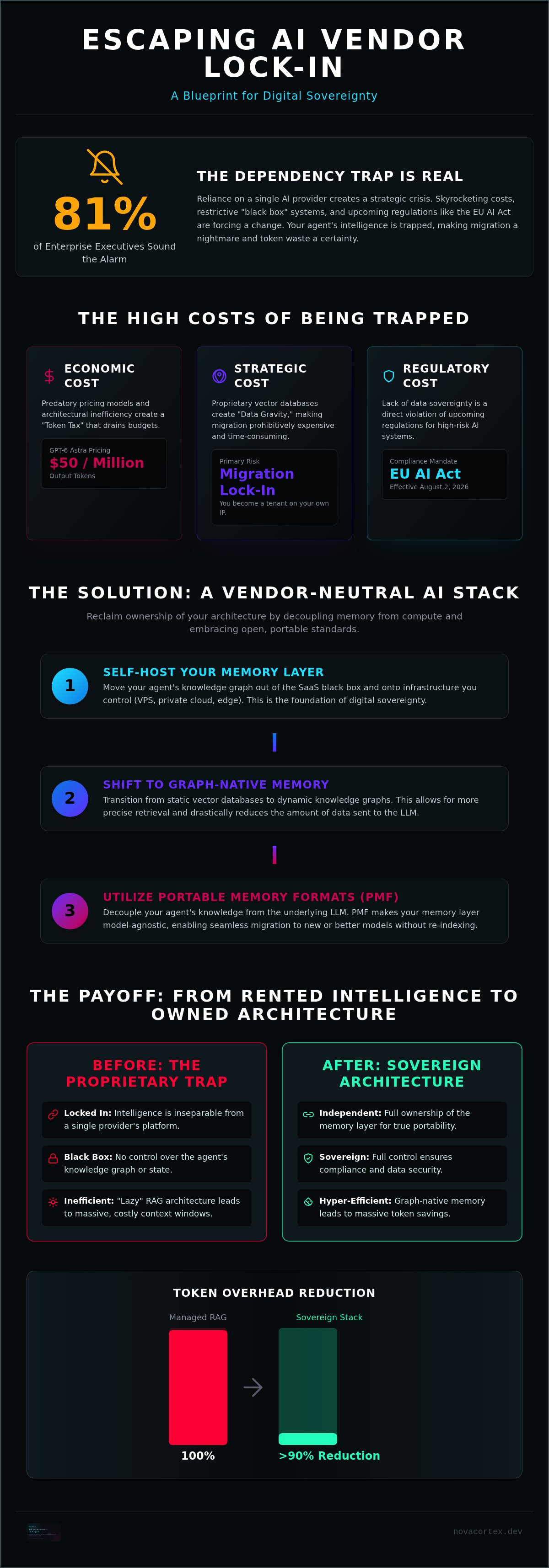
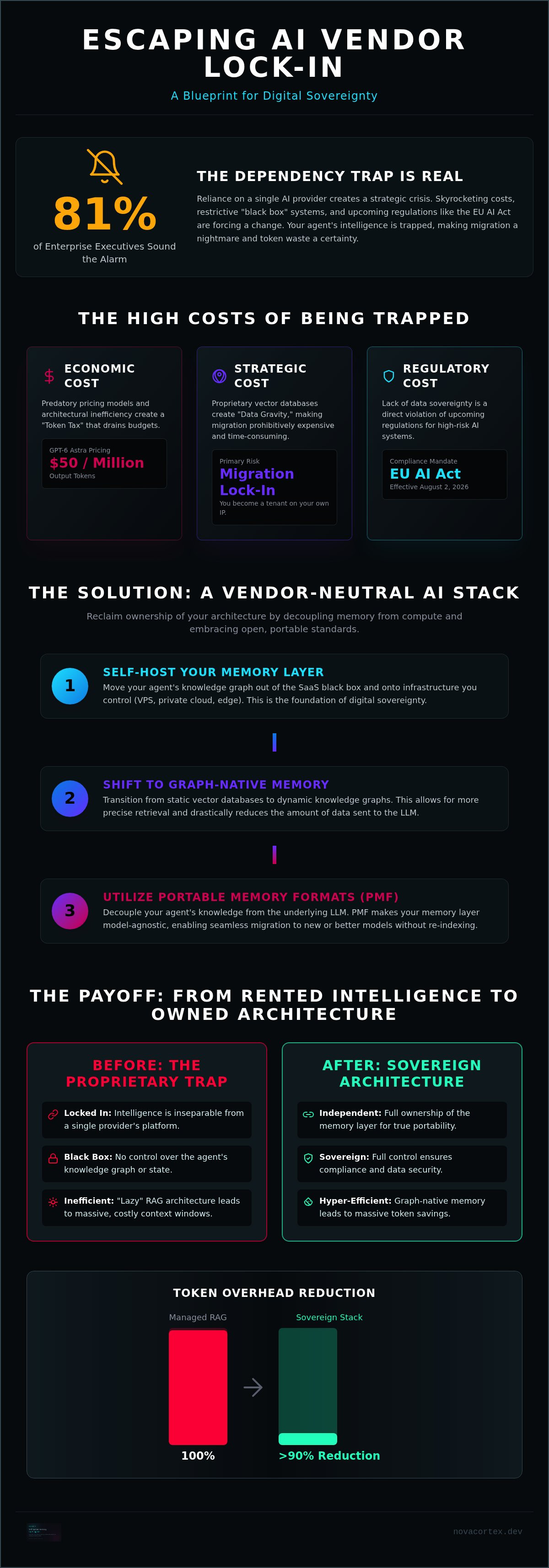
81% of enterprise executives are currently sounding the alarm on their dependency on a single AI provider. It's a justified fear. GPT-6 Astra costs have reached $50 per million output tokens. The EU AI Act now mandates strict sovereignty. The proprietary "black box" is a liability. You likely recognize the trap. Your agent's intelligence is currently inseparable from the platform hosting it, which makes migration a nightmare and token waste an inevitability.
True digital sovereignty requires a strategic shift toward avoiding AI vendor lock-in by decoupling your memory layer from proprietary compute. You don't have to remain a hostage to shifting API pricing or restrictive ecosystems. This article provides the technical blueprint for building a vendor-neutral AI stack using self-hosted infrastructure and Portable Memory Formats (PMF). We will examine how to implement an MCP-native memory server to achieve full ownership of your agent's knowledge graph while reducing token overhead by over 90%. It is time to stop renting your intelligence and start owning your architecture.
Key Takeaways
- Identify the "Data Gravity" trap where proprietary vector databases lock your agent's intelligence into specific cloud ecosystems.
- Explore how self-hosting your memory layer on private infrastructure ensures compliance with 2026 digital sovereignty regulations.
- Transition from static vector databases to graph-native memory for more precise retrieval and a 90%+ reduction in token waste.
- Utilize Portable Memory Formats (PMF) to decouple your agent's knowledge from the underlying LLM, making model migration seamless.
- Implement a comprehensive strategy for avoiding AI vendor lock-in by adopting the Model Context Protocol (MCP) as your primary communication standard.
The Proprietary Trap: Why AI Vendor Lock-in is a Strategic Risk
The era of "move fast and break things" has transitioned into an era of "move fast and get locked in." In 2026, the convenience of the API-first model is hitting a wall of economic reality and regulatory pressure. Organizations that built their entire AI strategy on proprietary clouds now face a calculated vendor lock-in that threatens their long-term agility. Storing sensitive agent states and knowledge graphs in third-party black boxes isn't just a security risk; it's a strategic failure. With the full obligations of the EU AI Act taking effect on August 2, 2026, the shift toward sovereign-first architecture is no longer a suggestion. It's a compliance mandate for any high-risk system.
The danger is systemic. Strategies for avoiding AI vendor lock-in are now the primary focus for technical leaders who realize that convenience has a compounding cost. When your agent's memory is tethered to a specific provider's infrastructure, you lose the ability to negotiate on price, performance, or privacy. You become a tenant on your own intellectual property. True digital sovereignty requires a fundamental rejection of these closed ecosystems in favor of architectures that prioritize portability and local control.
Data Gravity and Migration Costs
Proprietary vector databases create a digital vacuum. Once your enterprise data is embedded using a provider-specific model and stored in their managed index, you are effectively trapped. Data Gravity in the AI context is the phenomenon where the sheer volume and complexity of proprietary-formatted knowledge makes the cost of moving to a new provider prohibitively expensive. Switching models often requires a complete, energy-intensive re-indexing of your massive knowledge base. This isn't a technical limitation; it's a business model designed to ensure you never leave. The hidden costs of migration often exceed the initial implementation budget, leaving teams stuck with underperforming models because the "exit fee" in terms of compute and engineering time is too high.
The Token Efficiency Crisis
The current managed RAG paradigm is fundamentally wasteful. Cloud providers profit when you dump massive, unoptimized chunks of data into context windows. This "lazy" architecture fuels the "Token Tax" that drains enterprise budgets. With GPT-6 Astra output tokens priced at $50 per million, architectural inefficiency has become a liability. Managed services have zero incentive to optimize your retrieval. They thrive on your bloat. Avoiding AI vendor lock-in means moving toward a 98% token reduction paradigm. This isn't just about saving money; it's about reclaiming the precision required for high-velocity agent operations without feeding a predatory billing cycle.
Infrastructure Sovereignty: Why Self-Hosting is the Only Path
Managed cloud providers argue that self-hosting is too complex for modern AI teams. This is a defensive myth. In 2026, building on a foundation you don't own is the ultimate technical debt. True infrastructure sovereignty begins with moving your memory layer out of the SaaS black box and into environments you control. Whether you utilize a VPS, a private cloud, or even a local edge device, the goal remains the same: total control over the agent's cognition. Self-hosting is the only viable strategy for avoiding AI vendor lock-in while maintaining the performance levels required for production-grade agents.
Co-locating memory with the agent execution environment eliminates the network tax. Traditional managed RAG adds hundreds of milliseconds of latency for every retrieval call as data bounces between disparate data centers. By self-hosting, you reduce this to near-zero. High-velocity agents require high-velocity memory. This architectural shift also ensures long-term stability. Using an Apache-2.0 licensed framework means your stack won't vanish if a startup goes under or a corporate giant pivots their product roadmap. You own the code. You own the execution.
Deployment Flexibility for the Modern Builder
A memory layer should be as portable as a Docker container. Modern software architecture demands it. You can deploy a lean, graph-native memory server on a Raspberry Pi for edge operations or scale it across a high-end VPS for enterprise-grade workloads. This flexibility is the cornerstone of The Self-Hosted AI Memory Layer: Engineering Persistent Agent Cognition. It ensures your stack remains functional even if a primary cloud provider doubles their rates. Choosing self-hosted infrastructure is the first step in avoiding AI vendor lock-in by making your deployment environment a choice rather than a constraint.
The Privacy-First Mandate
2026 regulations favor on-premise knowledge storage for a simple reason: you cannot leak what you do not outsource. By eliminating the SaaS middleman, you remove a massive attack surface. Digital sovereignty for enterprise AI is the absolute technical right to execute, store, and manage intelligence without third-party oversight or data harvesting. It's the only way to satisfy the strict data residency requirements of the current year. If you're ready to reclaim your data, you can start by deploying a self-hosted memory node today. This move secures your agent's knowledge graph within your own perimeter, far from the reach of proprietary model providers.
Portable Memory Formats: Decoupling Knowledge from the LLM
Most developers mistakenly believe that vendor lock-in happens at the API level. It doesn't. It happens in the data layer. If your agent's memory is stored in a proprietary embedding format or tethered to a specific vector database cloud, you've already lost your autonomy. A Portable Memory Format (PMF) is the architectural solution for avoiding AI vendor lock-in by treating knowledge as a standalone, model-agnostic asset. It ensures that the intelligence your agent gathers today remains usable even if you swap your underlying LLM tomorrow.
The current industry standard relies on "Data Gravity." Providers want your data to be heavy and immobile. PMF makes it light and modular. By decoupling the memory layer from the compute provider, you gain the freedom to migrate between GPT-6 Astra, Claude 5, or Llama 4 without losing a single byte of context or needing to rebuild your entire knowledge graph from scratch.
The Technical Architecture of PMF
Vector databases are essentially high-dimensional spreadsheets. They excel at finding similar text but fail at understanding logical relationships. Graph-native memory is the superior alternative. It stores knowledge as a network of entities and edges, preserving the context that flat vector stores discard. This structural precision is why graph-native systems outperform traditional search for complex reasoning tasks. When you implement an interoperability layer between your memory and the LLM, you stop sending "noisy" data and start sending structured intelligence. For a deeper dive into these performance metrics, see Redis vs Graph Memory for AI Agents: Engineering Token-Efficient Context.
Ending the Re-indexing Cycle
In a traditional RAG stack, switching models often triggers a catastrophic re-indexing requirement. If your embeddings are tied to a proprietary provider's model, moving to a new LLM means re-processing your entire knowledge base. This is a massive waste of compute and time. PMF allows you to "bring your own memory" to any model. You maintain a persistent state that is independent of the model's specific embedding quirks. This approach is the focus of Portable Memory Format for AI: Breaking the Vendor Lock-in Cycle. It effectively ends the perpetual "re-embedding tax."
To further optimize this, we utilize Knowledge Buckets. These modular containers allow you to segment agent state by project, client, or domain. This modularity ensures high-velocity retrieval and prevents the "context pollution" that occurs when an agent is forced to sift through an undifferentiated data dump. Avoiding AI vendor lock-in is ultimately about maintaining this level of granular, portable control over your agent's cognitive history.
The MCP Standard: Building Interoperable Agent Architectures
The Model Context Protocol (MCP) has solidified its position as the universal interface for agent communication. In 2026, relying on custom API wrappers is a legacy mistake. These bespoke integrations create fragile dependencies that break every time a provider updates their schema. By contrast, an MCP-native architecture treats memory as a standardized resource. This is a critical component for avoiding AI vendor lock-in, as it allows your agent to switch between model providers without rewriting the underlying communication logic.
The MCP Standard is the open specification that allows AI agents to connect with external systems and data sources through a unified, provider-agnostic protocol. It functions as the "USB-C port for AI," removing the friction of proprietary middleware. When your memory layer is MCP-native, it becomes a plug-and-play asset. You can sync state across multi-agent environments effortlessly, ensuring that every agent in your swarm operates from the same source of truth regardless of which LLM powers it.
Why Your Middleware Should Be MCP-Native
The industry has shifted from bloated custom wrappers to lean, standardized protocol buffers. Custom middleware is a trap. It introduces a new layer of vendor control that sits between your data and your compute. An MCP-native memory server bypasses this entirely by using the 2025-11-25 specification to deliver context directly to the model. This ensures your stack remains future-proof and interoperable. For a detailed engineering breakdown, see MCP Native Memory Server: Engineering Persistent Context for AI Agents. Standardizing on MCP means you own the interface, not the vendor.
Low-Latency Context via MCP
Performance is the primary driver for protocol adoption. The MCP memory retrieval loop is designed for high-velocity operations, stripping away the overhead associated with traditional REST-based middleware. By utilizing standardized context schemas, you reduce the "Agent-to-Memory" communication path to its most efficient form. This isn't just about speed; it's about reliability. Standardized protocols eliminate the edge cases that plague custom integrations.
Standardizing your communication layer is the final step in avoiding AI vendor lock-in. It ensures that your infrastructure remains modular and replaceable. If a provider changes their pricing or degrades their performance, you simply point your MCP-native memory server at a new endpoint. No re-coding. No downtime. Just architectural sovereignty.
Future-Proofing with NovaCortex: A Blueprint for Independence
Independence isn't a passive state. It's a deliberate architectural choice. NovaCortex exists as the definitive exit strategy for organizations tired of the proprietary cloud treadmill. By providing a self-hosted, graph-native memory layer, we offer the tools necessary for avoiding AI vendor lock-in without sacrificing performance. Deploying the NovaCortex Self-Hosted Edition isn't just about software installation. It's about drawing a line in the sand against extractive API pricing and restrictive service terms. It's engineered for the 2026 landscape, where data residency and operational autonomy are the primary benchmarks of technical success.
The core architecture relies on a synergy between graph-native storage and our Portable Memory Format (PMF). Traditional vector stores provide proximity; NovaCortex provides relationship. This distinction is vital for agents that must execute complex, multi-step reasoning. Knowledge Buckets further refine this by allowing developers to modularize agent state with surgical precision. You can isolate project-specific data, preventing context bleed and ensuring your agent only retrieves exactly what it needs to function. The 98% token reduction benchmark isn't a theoretical goal. It's a documented reality for teams moving away from the wasteful "context dump" methodology toward high-velocity retrieval.
Why Builders Choose NovaCortex
Engineers value lean, high-velocity systems that don't come with hidden strings. NovaCortex delivers this through a stack that respects your hardware and your data sovereignty. Knowledge Buckets enable granular, context-aware state management that managed services simply can't match. This modularity ensures your agent remains sharp and efficient, even as its knowledge graph grows to enterprise scale. For a deep dive into the engineering behind these persistent cognitive layers, read AI Agent Long Term Memory: Engineering Persistent Cognition in 2026. It's about building for the long term, not just the next billing cycle.
Take Control of Your AI Infrastructure
The era of rented intelligence is ending. Sovereignty is the only path forward for builders who prioritize security and long-term cost-efficiency. By avoiding AI vendor lock-in, you reclaim the cognitive history of your agents. You stop being a tenant on a proprietary platform and start being the owner of your own cognitive ecosystem. This is a movement toward decentralized, high-performance AI that puts power back into the hands of the developer. Deploying the NovaCortex Self-Hosted Edition takes minutes, but the architectural freedom it provides lasts for years.
Reclaiming Architectural Sovereignty
Digital sovereignty in 2026 is no longer a theoretical ideal; it's a survival requirement for enterprise AI. By moving toward a graph-native memory architecture and adopting the Model Context Protocol, you effectively decouple your agent's intelligence from volatile API pricing and proprietary clouds. This shift ensures your data remains an asset rather than a liability held by a third party. Strategies for avoiding AI vendor lock-in must prioritize local execution and portable data formats to withstand the next inevitable industry pivot.
Building on an Apache-2.0 licensed foundation provides the stability needed for long-term operations. You can achieve the 98% token reduction benchmark by moving away from wasteful context-stuffing and toward precise, graph-native retrieval. This isn't just about cost savings. It's about owning the cognitive history of your agents and ensuring they remain functional across any model provider. The tools for independence are ready for deployment. Stop renting your intelligence and start building a stack that prioritizes ownership and high-velocity performance.
Take the first step toward a future where you own your cognition. The transition to sovereign-first AI starts with a single commit.
Frequently Asked Questions
What exactly is AI vendor lock-in?
It is a strategic trap where your agent's memory, data structures, and context are tethered to a single provider's proprietary cloud. This creates "Data Gravity," making migration cost-prohibitive due to incompatible embedding formats and high re-indexing fees. True sovereignty requires decoupling your memory layer from the compute provider. Avoiding AI vendor lock-in ensures you maintain the technical right to move your intelligence between LLMs without losing context or paying a predatory exit tax.
How does a self-hosted memory layer reduce token usage?
Traditional RAG often dumps massive, unoptimized chunks of text into a context window, leading to high token waste. NovaCortex uses a graph-native architecture to retrieve only the precise entities and relationships relevant to the query. This surgical precision results in a documented 98% reduction in token usage. By filtering noise at the local infrastructure level, you stop paying the "lazy architecture" tax to cloud providers and optimize your operational budget for enterprise-scale deployments.
Can I migrate my existing vector database to NovaCortex?
Yes, you can ingest existing data into NovaCortex to transition from static vector search to dynamic, graph-native memory. The process involves mapping your existing chunks into our Portable Memory Format (PMF). This migration breaks the cycle of proprietary dependency. Instead of being stuck in a managed cloud index, your data becomes a modular asset that you can host anywhere. It ensures your agent's cognitive history remains under your direct control, regardless of your storage provider.
Is NovaCortex compatible with all LLM providers?
NovaCortex is model-agnostic and functions as a universal memory layer for any LLM, including GPT-6 Astra, Claude 5, and Llama 4. It achieves this through the MCP-Native Memory Server, which standardizes communication between the memory layer and the model. This interoperability is the cornerstone of avoiding AI vendor lock-in. You can swap your compute provider in minutes without needing to re-index your entire knowledge base or modify your core memory architecture.
What are Knowledge Buckets and how do they prevent lock-in?
Knowledge Buckets are modular containers that segment agent state by project, domain, or client. This segmentation prevents context pollution and allows for granular data management. Because these buckets use the Portable Memory Format (PMF), they are inherently mobile. You can move individual buckets between different infrastructure environments or models. This modularity ensures that your agent's intelligence is never trapped in an undifferentiated, proprietary data dump, providing a clear path to long-term architectural independence.
Do I need a high-end server to run a self-hosted memory layer?
No, the NovaCortex Self-Hosted Edition is designed for high-velocity performance on lean hardware. You can run a fully functional memory node on a VPS, a private cloud instance, or even a Raspberry Pi for edge-based agents. The system is engineered to be resource-efficient, prioritizing low-latency retrieval over bloated background processes. This deployment flexibility ensures that infrastructure costs remain low while you maintain absolute sovereignty over your agent's cognitive execution environment and data residency.
What is the Model Context Protocol (MCP)?
MCP is an open standard, introduced in late 2024, that acts as a universal interface between AI agents and data sources. The 2025-11-25 specification is the current industry benchmark. It functions like a USB-C port for intelligence, allowing different systems to exchange context without custom, fragile API wrappers. By using an MCP-native server, you ensure your memory layer is future-proof. It allows your agents to access knowledge graphs across a standardized protocol, effectively eliminating proprietary middleware.
How does graph-native storage differ from vector search?
Vector search relies on mathematical proximity, often retrieving similar but irrelevant text. Graph-native storage maps actual entities and their logical relationships. It understands that "Company A" is "owned by Person B," rather than just finding documents where those names appear near each other. This structural awareness allows for more complex reasoning and precise retrieval. It replaces the noisy proximity of vectors with the high-fidelity clarity of a knowledge graph, significantly improving the performance of your agents.
FAQ
What exactly is AI vendor lock-in?
AI vendor lock-in occurs when an organization's AI infrastructure, data, and model context are tied to a specific provider's proprietary ecosystem. This dependency makes switching models or platforms prohibitively expensive due to non-portable data formats and specialized APIs. Avoiding AI vendor lock-in requires a sovereign stack where the memory layer is decoupled from the inference engine. Without this independence, you're at the mercy of a provider's pricing hikes and service availability.
How does a self-hosted memory layer reduce token usage?
A self-hosted memory layer reduces token usage by up to 98 percent through graph-native retrieval and precise context management. Instead of dumping massive knowledge bases into a context window, the system retrieves only the specific entities and relationships relevant to the current task. This architectural efficiency eliminates the "token tax" associated with managed RAG services. You stop paying for redundant context processing and start investing in high-velocity, targeted intelligence.
Can I migrate my existing vector database to NovaCortex?
You can migrate existing knowledge bases by exporting your raw data and re-indexing it into the NovaCortex graph-native format. While proprietary embeddings from third-party databases are often non-portable, NovaCortex uses a Portable Memory Format (PMF) to ensure long-term data ownership. This transition allows you to move away from vendor-specific latent spaces and into a structured knowledge graph that remains operational across any LLM provider you choose.
Is NovaCortex compatible with all LLM providers?
NovaCortex is model-agnostic and interfaces with any LLM provider that supports standard API calls or local inference. By using an MCP-Native Memory Server, the system acts as a standardized bridge between your private knowledge and the compute layer. Whether you're utilizing GPT-4, Claude 3.5, or local Llama 4 instances, the memory layer remains consistent. This interoperability is a foundational requirement for avoiding AI vendor lock-in at the intelligence level.
What are Knowledge Buckets and how do they prevent lock-in?
Knowledge Buckets are modular units of agent memory that allow for granular, context-aware state management. They prevent lock-in by organizing your agent's knowledge into discrete, portable packages that exist independently of any specific AI platform. This modularity enables you to load only the necessary context for a specific execution environment. It ensures your agent's learned experiences are structured as a sovereign asset rather than a monolithic, provider-hosted database.
Do I need a high-end server to run a self-hosted memory layer?
NovaCortex is engineered for deployment flexibility on a wide range of hardware. You can run the self-hosted edition on a Raspberry Pi for edge operations, a standard VPS, or private cloud infrastructure. The graph-native architecture is highly efficient, requiring significantly fewer resources than traditional, bloated vector search engines. This lean performance allows you to maintain a high-velocity memory layer without investing in expensive, specialized hardware.
What is the Model Context Protocol (MCP)?
The Model Context Protocol (MCP) is an open-source standard for connecting AI applications to external data sources and tools. Released as a definitive specification in 2026, it provides a unified JSON-RPC communication path between agents and memory servers. By adopting an MCP-native architecture, you eliminate the need for custom, brittle API wrappers. This creates a "plug-and-play" environment where memory layers and agent frameworks communicate through a standardized, vendor-neutral protocol.
How does graph-native storage differ from vector search?
Graph-native storage organizes information as structured entities and relationships, whereas vector search relies on mathematical proximity in a latent space. While vector search is useful for fuzzy matching, it often lacks the precision required for complex reasoning. Graph-native memory provides a deterministic way to traverse knowledge, allowing for 98 percent more efficient context retrieval. It offers a structured understanding of your data that remains human-readable and mathematically consistent across different models.