Benefits of Graph Databases for AI Applications and Agents
Vector search can find similar information, but it does not show how facts connect. The benefits of graph databases for AI are clearest when an application needs to trace relationships across people, events, documents, or systems. By representing entities as nodes and connections as relationships, a graph lets AI follow paths through data instead of relying only on similarity or query-time joins.
That distinction matters when an AI application must do more than retrieve a relevant passage. It may need to connect evidence, uncover indirect dependencies, or use factual structure to guide its next action. Vector databases are useful for finding semantically similar content; graphs add an explicit map of how that content relates.
This article explains how graph databases work with AI, where they reveal complex patterns, and how they support agentic systems. You’ll see when graph traversal complements vector search, what changes when an agent can reason over relationships, and why the underlying data layer matters for reliable AI workflows.
Key Takeaways
- Choose graphs when the task depends on tracing explicit relationships, not just finding similar content.
- Learn how graph traversal can expose indirect connections that flat records or isolated documents can obscure.
- See how agents can combine graph queries, vector search, and structured data to ground decisions in context.
- Understand why connected entities, constraints, and dependencies give agents a stronger basis for planning and adapting.
- Explore how a self-hosted memory layer can keep agent knowledge locally stored and portable across systems.
How do graph databases work with AI applications?
AI applications use databases to retrieve and connect information before a model generates an answer. A graph stores entities as nodes and their connections as relationships, giving the application a navigable structure for questions involving linked facts.
Database Model Comparisons
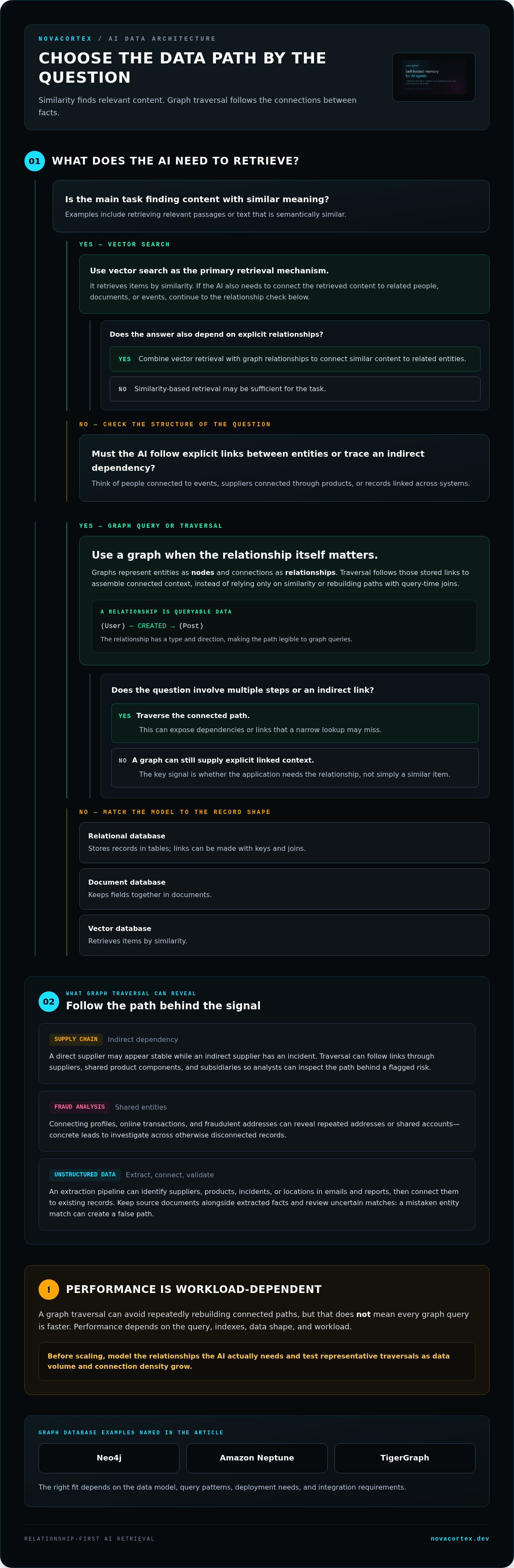
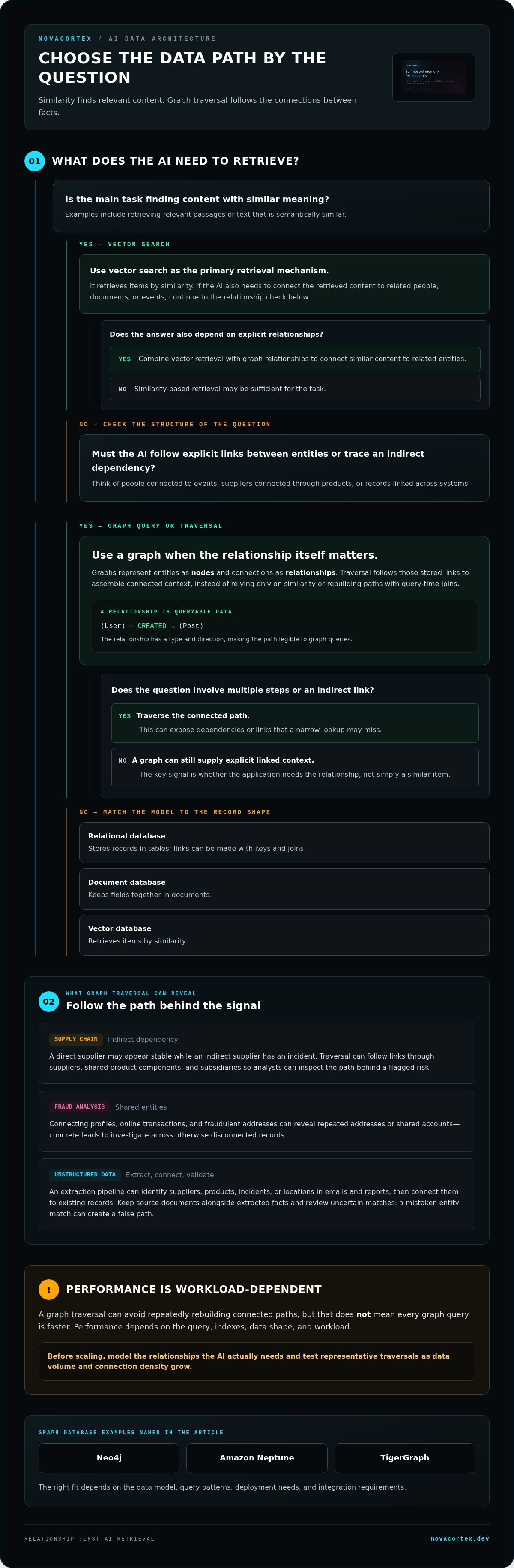
A database model determines how information is organized and retrieved. The choice matters when an AI task must combine different kinds of context. Relational databases store records in tables, document databases keep fields together in documents, graph databases make relationships explicit, and vector databases retrieve items by similarity.
Consider an enterprise application connecting a user, a post, and its author. A relational model can represent them in separate tables and use joins to connect records. A document model might keep related fields together, while vector search finds text with similar meaning. Neither approach alone provides the same direct, traversable path as a graph.
Relationship-Centered Data Modeling
Relationship modeling stores connections as data, so an application can query the connection itself. For example, a property graph can represent a user-created-post link as (User {id: 1})-[:CREATED]->(Post {id: 42}). The relationship has a type and direction, making the path legible to both developers and graph queries.
In a relational model, linking a user and a post may depend on keys across tables and a join at query time. That works well for structured records, but complex paths can require several joins. Graph models make it easier to add relationship types as a network changes; RDF, by contrast, expresses connections as subject-predicate-object triples.
Performance and Scalability for AI
Graph performance can benefit AI when queries follow connected data rather than repeatedly rebuilding paths. Relational joins can add development work and query cost, especially when a question spans multiple tables. A graph traversal follows stored relationships, such as from a customer to an order, product, and supplier, to assemble connected context.
That does not mean every graph query is faster. Performance depends on the query, indexes, data shape, and workload. For scalability, model the relationships the AI actually needs, then test representative traversals as data volume and connection density grow. A graph is most useful when new questions require following new paths, not simply scanning more isolated records.
Graph Databases Used in AI
Common graph database examples for AI applications include Neo4j, Amazon Neptune, and TigerGraph. Each can store connected data for queries that need explicit entities and relationships; the right fit depends on the data model, query patterns, deployment needs, and integration requirements.
For an AI feature that retrieves relevant passages, vector search may be the primary mechanism. For a feature tracing relationships among people, documents, and events, a graph query can supply structured context. An application can combine both: retrieve similar content, then use graph relationships to connect it to related entities.
Improving data analytics and uncovering complex patterns
Graph analytics connects records that separate systems leave isolated. Traversal queries follow paths through connected data, helping analysts find indirect links and uncover patterns a single table or document may hide. A knowledge graph can bring entities from different sources into one navigable structure, so an AI system can reason across relationships instead of analyzing each record alone.
Trace indirect connections
Consider supply-chain risk. A direct supplier may appear stable while an indirect supplier has an incident. Graph traversal can trace links through suppliers, shared product components, and subsidiaries, revealing dependencies a narrow lookup may miss. Analysts can inspect the path behind a flagged risk rather than relying on an isolated alert.
Fraud analysis benefits from the same approach. A fraud ring may span many data points, including fake social media profiles, online transactions, and fraudulent addresses. Connecting those entities can reveal repeated addresses or shared accounts, giving analysts concrete leads to investigate instead of a disconnected set of suspicious records.
Structure unstructured data
Emails, reports, and support conversations often contain useful facts without consistent fields. An extraction pipeline can identify entities such as a supplier, product, incident, or location, then categorize them and connect them to existing records. For example, a report naming a component can link that component to its supplier and affected products.
Extraction still needs validation. A mistaken entity match can create a false path and distort downstream analytics. Preserve the source document alongside extracted facts, then review uncertain matches before they enter a production knowledge graph. This keeps an analytical result traceable to its supporting evidence.
Map personal data
Connected data can help teams locate how personal information relates to people, accounts, transactions, and systems. For organizations assessing the General Data Protection Regulation (GDPR), the European Union identifies it as a relevant regulation. A graph can make data flows easier to inspect, but the model itself does not establish compliance.
For example, linking a person to an account and its downstream records can help teams investigate where related information resides. The result is a clearer map for compliance review, supported by source records and governance processes.
Manage change and quality
As an enterprise adds data sources, relationships and formats can change. Dynamic schema adaptation lets a graph structure evolve with the data, reducing the need to redesign every connected record. But flexibility does not remove data-quality work: inconsistent identifiers, duplicate entities, and stale links can weaken analytics as the network grows.
Integration also demands compatible data pipelines and careful mapping between existing systems and graph entities. Teams need expertise in both AI and graph databases, so training current staff or hiring skilled professionals can address capability gaps. For agent memory organized around distinct knowledge areas, Knowledge Buckets offer a relevant structure to explore.
How do graph databases support Agentic AI?
An AI agent needs more than relevant text: it needs context to choose its next action. Vector retrieval finds semantic matches, while graph queries expose explicit connections between data.
Graph Queries and Vector Similarity Search
Vector similarity search ranks items by how closely their encoded meaning matches a query; graph queries follow stored relationships. That difference matters when an agent must move from a useful passage to connected evidence. For example, vector search can retrieve a report about a delayed component, while a graph query traces its supplier, affected products, and related incidents.
Neither method replaces the other. Similarity is useful when someone asks, “Which documents discuss delivery delays?” A graph is useful when the next question is, “Which products depend on the supplier named in those documents?” The agent can use both results to form a more grounded response.
Semantic Search and Natural Language Processing
Natural language processing turns a request such as “find alternatives affected by this outage” into terms and intent an application can process. Semantic search then finds passages with matching meaning, even when they use different wording, such as “service interruption” instead of “outage.”
That retrieval supplies candidate context, not a complete map of facts. If the agent finds a report mentioning a supplier, a graph can connect that supplier to components and products. This helps the system distinguish language-level similarity from explicit relationships and gives it better evidence for its next decision.
Combining Vector Search with Graph Queries
A hybrid retrieval flow uses vector search to find relevant starting points, then graph queries to expand their context. For example, a support agent can retrieve a troubleshooting note matching a user’s description, identify the device model, and follow links to compatible parts and known service procedures.
Keep the sequence explicit: retrieve passages, extract their entity identifiers, query connected records, then pass both results to the model. Identifiers provide a stable link between unstructured text and structured data. This helps prevent a model from treating a similar-sounding entity as the right one without checking its connected records.
GraphRAG and Hybrid Vector Search
GraphRAG combines retrieval-augmented generation with graph context, using connected entities and relationships to help a model answer questions. It is useful for agent tasks that need evidence across several records, not just one semantically similar paragraph. A question about a product issue, for instance, may require tracing reports to a component and its supplier.
Hybrid vector search can identify relevant passages, while graph retrieval expands the evidence through linked entities. The model can then summarize the resulting paths and cite retrieved material in its response. This architecture supports better-informed answers, but the output still depends on accurate source records and correctly modeled relationships.
For an agent, match each operation to the right data structure. Use vector queries to find meaning, graph queries to follow relationships, and combine their outputs when a task needs both. This gives the agent a clear path from a natural-language request to evidence it can use for its next action.
Graph databases as a foundation for Agentic AI
An agent needs a working model of its environment to plan, act, and adjust. Graph technology can represent entities, relationships, constraints, and dependencies in one connected structure. That gives an agent more than retrieved passages: it can inspect how a service depends on another service, which team owns it, and what actions fit the current state.
Consider an IT operations agent responding to an outage report. A graph can connect the affected application to its services, infrastructure, owners, and operational procedures. The agent can query those links to identify dependencies, retrieve the relevant procedure, and plan an investigation around the systems involved. The graph supplies context; the agent’s reasoning engine decides how to use it.
That distinction matters. A graph does not make an agent autonomous or correct on its own. The workflow still needs a model to interpret the request, algorithms or rules to support decisions, and controlled system calls to execute approved operations. For example, an agent might inspect a dependency path before proposing a restart, then request authorization before making a change. The graph makes relevant relationships inspectable; the workflow defines which actions are permitted.
Agentic workflows also need to adapt as conditions change. An agent can perceive new system data, revise its plan, execute the next step, and learn from the outcome. If an initial service check shows a dependency is healthy, the agent can investigate another connected branch. Updating the graph with verified status changes helps keep later queries aligned with current conditions.
This pattern applies beyond operations. A procurement agent can connect a purchase request to a product, supplier, contract, and approval path. A research agent can link claims to documents, authors, and related evidence. In each case, graph queries expose the entities and dependencies that shape the task, while the agent handles planning and synthesis. The key design question is which relationships must be explicit for the agent to do its work.
Start by mapping the task’s critical entities, such as requests, resources, owners, and constraints. Define which relationships an agent may query and which system calls it may make. Keep action permissions separate from the data model, and record outcomes as new evidence rather than assumed truth. This creates a traceable cycle: the agent observes, reasons over connected context, acts within its workflow, and adjusts when new information changes the plan.
Graph databases versus vector databases for complex agent tasks
For complex agent tasks, the choice is not automatically graph or vector. A procurement agent replacing a delayed component needs semantic context and explicit dependencies. Vector retrieval can find documents describing equivalent parts, even when their wording differs. A graph can then connect each candidate to suppliers, products, contracts, and approval paths.
That distinction shapes the agent’s reasoning. Similarity identifies useful candidates; it does not establish that a candidate fits a product or contract. A graph query can test those relationships and surface relevant constraints. In a parts network, the agent can retrieve an alternative, trace its supplier, and inspect which products depend on the original component.
Tables can still hold structured records such as inventory, purchase orders, or contract fields. The challenge comes when a task must cross tables and systems to rebuild a chain of relationships. A graph makes those connections directly queryable. The agent can follow a path from a component to its supplier and affected product, then use tabular records for exact quantities or order status.
Design the retrieval sequence around the decision, not the database trend. For a request like “find a compatible substitute with an active contract,” the agent can:
- Use vector retrieval to identify documents describing compatible parts.
- Resolve each result to a specific component entity.
- Traverse graph links to suppliers, products, and contract records.
- Check structured fields before presenting a candidate.
Each step has a distinct job. The sequence turns a loose match into a candidate supported by connected context.
Graph-first retrieval is also useful when a task starts with a known entity. An operations agent given a service name can follow its dependencies to identify related systems and owners. Vector retrieval can then find runbooks or incident notes describing those systems. The graph establishes which systems are connected; semantic search finds relevant language in their documentation.
Vector-first retrieval suits requests that begin with ambiguous language, such as a user describing a symptom without naming a product. The agent can retrieve likely documents, identify named entities, and query the network for linked records. If an entity match is uncertain, it should preserve that uncertainty rather than treat similar wording as proof of identity.
The practical rule is simple: use vectors to find likely meaning, graphs to verify explicit relationships, and tables for precise records. Combine them when an agent must move from an open-ended request to a decision grounded in patterns and structured facts. Keep the path from query to evidence visible, so each result can be inspected before it drives an action.
NovaCortex: NovaCortex Self-Hosted Edition
NovaCortex Self-Hosted Edition gives AI agents a privacy-first memory layer stored on your infrastructure. Its graph-native storage supports connected knowledge, while Portable Memory Format (PMF) keeps memory portable and avoids vendor lock-in. The system reduces token usage by up to 98% compared with dumping entire knowledge bases, with fast retrieval for agent workflows.
Turn to NovaCortex when your agents need persistent, locally stored context instead of repeated prompts containing large knowledge bases. Its MCP-Native Memory Server and Knowledge Buckets support the memory layer for agent applications.
To explore a self-hosted memory layer for your AI workflows, visit novacortex.dev.
Turn the architecture into a focused experiment
Choose one agent workflow where a decision depends on evidence spread across connected records. Define what a successful result looks like, then trace how the agent finds, evaluates, and uses its evidence. This shifts architecture discussions from abstract preferences to observable behavior in a real task.
The benefits of graph databases for AI matter when relationships help an agent reach a sound decision. Test that premise against your workflow: identify where context breaks down, which connections matter, and how the system should handle incomplete or conflicting information. Keep the evaluation tied to the task, not the novelty of the technology.
NovaCortex can support your next architecture conversation as you shape an AI memory layer around your requirements.
Start with one clear use case, learn from the results, and build forward with confidence.
Frequently Asked Questions
How do graph databases support AI and machine learning?
They give AI systems structured context for queries involving connected entities. A recommendation model, for example, can use links between a customer, viewed items, and product categories as features for ranking suggestions. The graph stores the connections; the model makes the prediction. This separation helps teams distinguish source relationships from algorithmic outputs and inspect which connected records informed a result.
What are the main benefits of graph databases for AI applications?
The main benefits of graph databases for AI applications include direct access to connected context, flexible relationship modeling, and clearer paths through linked evidence. A customer-support system can connect a device model to its components, manuals, and known issues, helping AI retrieve related material together. The value is greatest when a task depends on how facts relate, rather than on isolated records or text similarity alone.
How do graph databases improve knowledge representation and reasoning?
They represent facts as entities and typed connections, allowing an AI system to query relationships as part of its reasoning process. A policy assistant, for example, could connect a policy clause to the department, process, and exception it governs. The agent can inspect those links before composing an answer. This provides explicit context for reasoning, while the model remains responsible for interpreting evidence and generating language.
How do graph databases help AI discover relationships and hidden patterns?
Graph queries can find repeated paths, shared connections, or unexpected links across records. In cybersecurity, an analyst might connect accounts, devices, and login events to find several accounts accessing a resource through the same device. That pattern can direct investigation toward a common access point. Analysts still need to assess the underlying records: a connected pattern is evidence to examine, not proof of intent.
How do graph databases support retrieval-augmented generation and LLMs?
In retrieval-augmented generation, a graph can provide linked evidence for an LLM to use alongside retrieved text. A technical assistant could retrieve a passage about an API, then query related version notes, dependencies, and migration guidance. The application supplies this focused context to the model, which synthesizes a response. Keeping retrieved records identifiable helps developers trace an answer to the material used to produce it.
How do graph databases compare with relational and vector databases for AI?
Relational databases organize structured records into tables and suit precise fields, such as invoice status. Vector databases retrieve content by semantic similarity, making them useful for matching a question to relevant passages. Graph databases query explicit connections, such as which invoices belong to a supplier linked to a flagged account. An AI system can combine these database types when a task needs structured values, relevant text, and relationship paths.
What AI use cases benefit most from graph databases?
Tasks with multi-step dependencies are strong candidates: fraud investigation, product recommendations, cybersecurity analysis, and enterprise knowledge assistants. For example, a recommendation system can connect a user’s activity to products, categories, and related items, then use those links to inform ranking. Graphs are less central when an application only classifies independent records or retrieves similar passages without needing to inspect their relationships.
What are the costs and limitations of using graph databases for AI?
Costs include database deployment, data integration, ongoing operations, and the expertise needed to maintain a useful graph model. A team may need to reconcile identifiers across source systems and keep relationships current as records change. Graphs add little value to tasks that rely on simple lookups or standalone text retrieval. Evaluate the workload, data quality, query patterns, and integration effort before choosing the architecture.
FAQ
How do graph databases support AI and machine learning?
They give AI systems structured context for queries involving connected entities. A recommendation model, for example, can use links between a customer, viewed items, and product categories as features for ranking suggestions. The graph stores the connections; the model makes the prediction. This separation helps teams distinguish source relationships from algorithmic outputs and inspect which connected records informed a result.
What are the main benefits of graph databases for AI applications?
The main benefits of graph databases for AI applications include direct access to connected context, flexible relationship modeling, and clearer paths through linked evidence. A customer-support system can connect a device model to its components, manuals, and known issues, helping AI retrieve related material together. The value is greatest when a task depends on how facts relate, rather than on isolated records or text similarity alone.
How do graph databases improve knowledge representation and reasoning?
They represent facts as entities and typed connections, allowing an AI system to query relationships as part of its reasoning process. A policy assistant, for example, could connect a policy clause to the department, process, and exception it governs. The agent can inspect those links before composing an answer. This provides explicit context for reasoning, while the model remains responsible for interpreting evidence and generating language.
How do graph databases help AI discover relationships and hidden patterns?
Graph queries can find repeated paths, shared connections, or unexpected links across records. In cybersecurity, an analyst might connect accounts, devices, and login events to find several accounts accessing a resource through the same device. That pattern can direct investigation toward a common access point. Analysts still need to assess the underlying records: a connected pattern is evidence to examine, not proof of intent.
How do graph databases support retrieval-augmented generation and LLMs?
In retrieval-augmented generation, a graph can provide linked evidence for an LLM to use alongside retrieved text. A technical assistant could retrieve a passage about an API, then query related version notes, dependencies, and migration guidance. The application supplies this focused context to the model, which synthesizes a response. Keeping retrieved records identifiable helps developers trace an answer to the material used to produce it.
How do graph databases compare with relational and vector databases for AI?
Relational databases organize structured records into tables and suit precise fields, such as invoice status. Vector databases retrieve content by semantic similarity, making them useful for matching a question to relevant passages. Graph databases query explicit connections, such as which invoices belong to a supplier linked to a flagged account. An AI system can combine these database types when a task needs structured values, relevant text, and relationship paths.
What AI use cases benefit most from graph databases?
Tasks with multi-step dependencies are strong candidates: fraud investigation, product recommendations, cybersecurity analysis, and enterprise knowledge assistants. For example, a recommendation system can connect a user’s activity to products, categories, and related items, then use those links to inform ranking. Graphs are less central when an application only classifies independent records or retrieves similar passages without needing to inspect their relationships.
What are the costs and limitations of using graph databases for AI?
Costs include database deployment, data integration, ongoing operations, and the expertise needed to maintain a useful graph model. A team may need to reconcile identifiers across source systems and keep relationships current as records change. Graphs add little value to tasks that rely on simple lookups or standalone text retrieval. Evaluate the workload, data quality, query patterns, and integration effort before choosing the architecture.