Best Mem0 Alternatives: Top AI Agent Memory Frameworks for 2026

Building intelligent agents shouldn't feel like paying a monthly ransom for your own data structures. Right now, Mem0 gates its most powerful graph-native features behind a $249 monthly paywall, forcing developers into a choice between architectural excellence and fiscal sanity. If you're tired of managed cloud layers siphoning your margins and your privacy, it's time to find a high-performance Mem0 alternative that prioritizes engineering over extraction. You need a system that offers full data sovereignty without the proprietary lock-in.
We understand the frustration of dumping expensive context into LLMs just to maintain basic continuity. It's inefficient. It's wasteful. This guide evaluates the leading AI agent memory frameworks for 2026, focusing on self-hosted, graph-native solutions that slash token usage by up to 98%. You'll discover how to implement long-term memory using open-source protocols like the Portable Memory Format (PMF) and MCP-native servers. We're moving past the "graph paywall" to explore infrastructure that gives you total control over your agent's cognitive layer.
Key Takeaways
- Bypass the graph paywall. Understand why restrictive pricing models often gate essential architectural features like graph-native storage.
- Master multi-hop reasoning. Learn how graph-native memory layers provide deeper, more relevant context than standard vector similarity searches.
- Reclaim data sovereignty. Discover a high-performance Mem0 alternative that deploys on local hardware to ensure total privacy and control.
- Optimize token efficiency. Leverage engineering-first architectures designed to reduce LLM API bills by 98% through precision context retrieval.
- Eradicate vendor lock-in. Use the Portable Memory Format (PMF) to maintain control over your data across different AI frameworks and environments.
Why Developers Seek a Mem0 Alternative in 2026
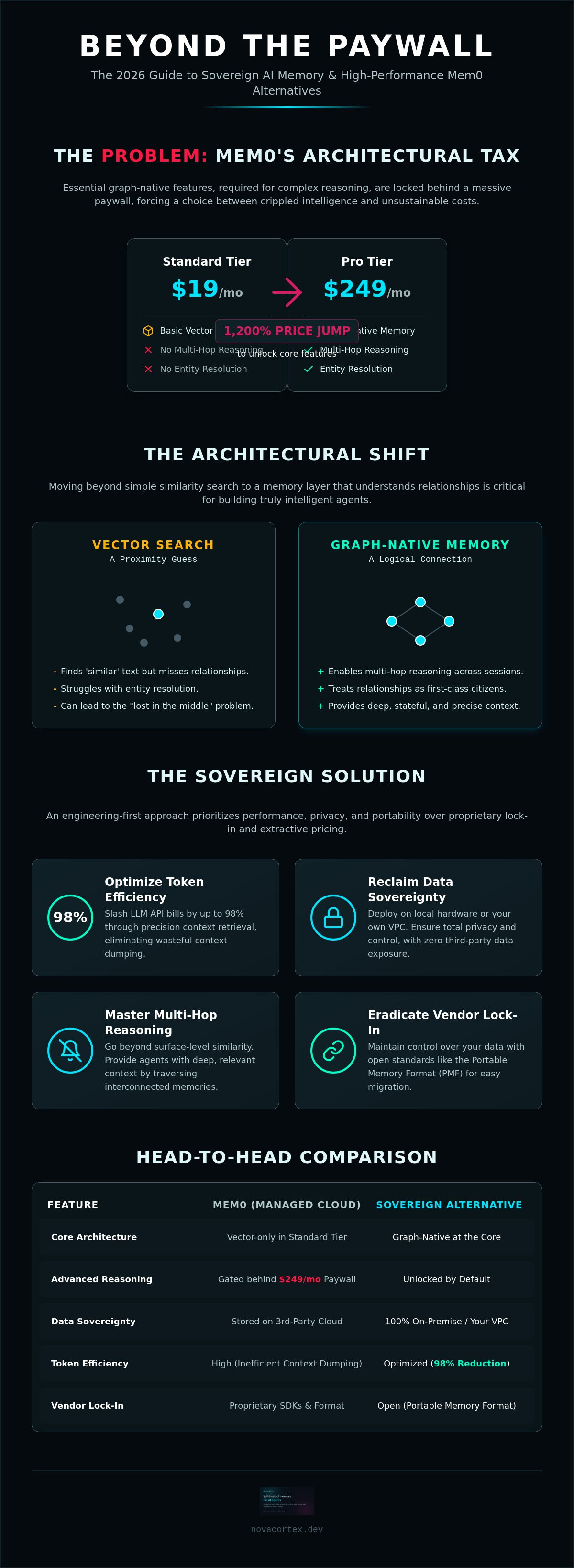
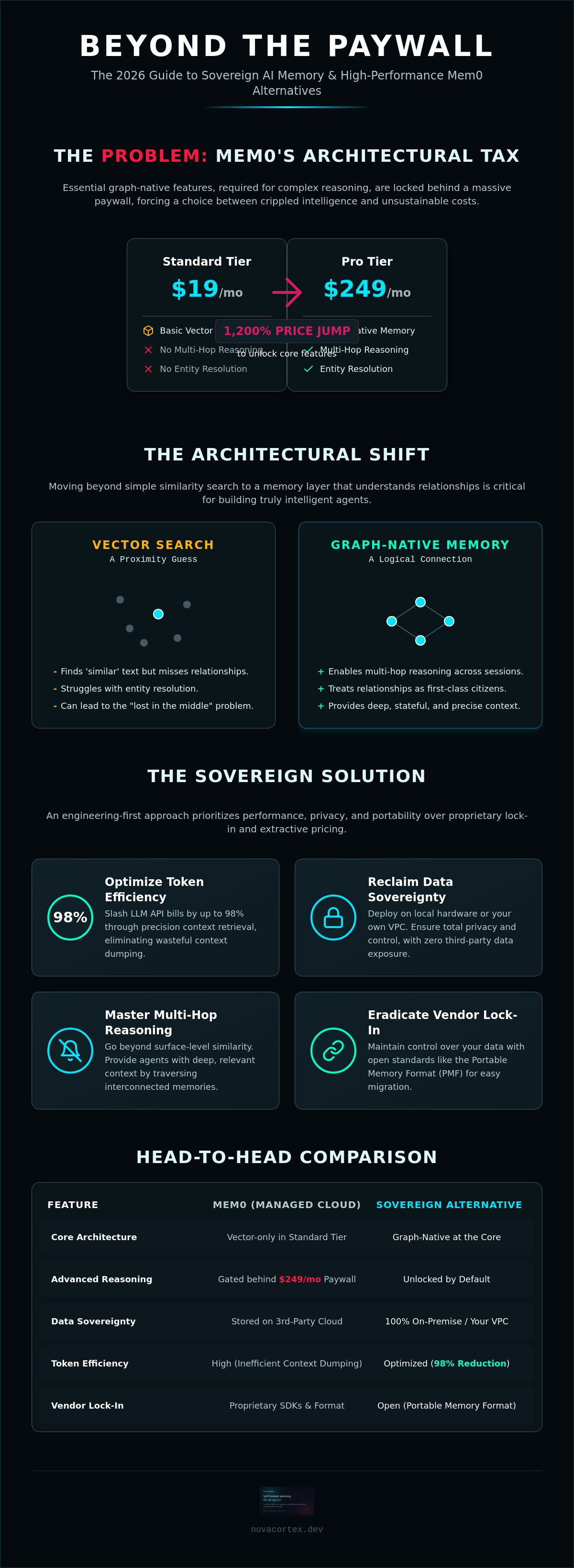
Architecture matters more than marketing. While Mem0 has secured its place as a popular entry point for agentic memory, its current trajectory has created significant friction for serious engineering teams. The most glaring issue is the "Graph Paywall." In 2026, Mem0 limits its Standard tier users ($19/mo) to basic vector search, which is essentially just a glorified similarity lookup. To unlock the graph-native features required for complex reasoning, the price tag skyrockets to $249 per month. This massive delta forces developers to choose between crippled intelligence and unsustainable overhead.
Building high-performance intelligent agents requires a memory layer that understands relationships, not just word clusters. When you're forced to pay a 1,200% premium just to access entity resolution and multi-hop retrieval, the ROI on your AI stack begins to crumble. This pricing model has turned a once-promising tool into a bottleneck, driving the search for a more equitable Mem0 alternative that doesn't gatekeep essential data structures.
The Cost of "Smart" Memory
The pricing jump from vector-only to graph-native tiers isn't just a financial burden; it's an architectural tax. Vector search is a commodity. It finds "similar" text but lacks the cognitive depth to understand how facts evolve over time. Graph features like temporal reasoning and entity linking are foundational requirements for autonomous agents, not "pro" extras. When subscription fees for the memory layer exceed the cost of the LLM inference itself, the system is fundamentally broken. Engineers need lean, graph-native solutions that scale with their usage, not their features.
Sovereignty and Privacy Concerns
Sending user-specific interaction data to a managed cloud is a non-starter for enterprise security. Storing long-term agent state in a proprietary third-party environment creates massive legal and security liabilities. If a managed memory provider suffers a breach, your agent's entire history, including sensitive user preferences and internal workflows, is exposed. In the 2026 developer ecosystem, the trend has shifted decisively toward "Local-First" memory. Developers are reclaiming their data sovereignty by deploying memory layers on their own infrastructure, ensuring that sensitive context never leaves their VPC or local hardware.
Beyond privacy, proprietary SDKs introduce a rigid layer of vendor lock-in. When your agent's long-term memory is trapped in a specific cloud format, migrating to a more efficient framework becomes a nightmare. This architectural rigidity, combined with the hidden cost of token inflation from inefficient context dumping, makes the case for a sovereign, engineering-first memory layer undeniable. The goal is simple: full data ownership, graph-native performance, and a complete rejection of the bloated SaaS subscription model.
Beyond Vector Search: The Architectural Shift to Graph-Native Memory
Vector similarity is a proximity guess. It isn't a logical connection. In the race to build autonomous agents, many developers have hit a wall with standard vector-based RAG. These systems find "similar" text chunks, but similarity doesn't guarantee relevance. A vector database might retrieve a conversation about "security" when an agent asks about "encryption," but it lacks the structural framework to understand the hierarchical or temporal relationship between those concepts. This is why a high-performance Mem0 alternative must move beyond flat vector stores toward a more sophisticated knowledge representation.
Graph-native memory enables multi-hop reasoning. It allows an agent to traverse relationships: Person A works for Company B, which uses Tool C, which has Vulnerability D. A vector store would likely miss these connections across disparate sessions because it views data as isolated points in space. By treating relationships as first-class citizens, graph memory provides a level of precision that vector similarity simply cannot replicate. This architectural shift is critical when building Cognitive Architectures for Language Agents that require deep, stateful understanding of their environment. It isn't just about what the agent remembers; it's about how those memories are interconnected.
The Limits of Vector-Only RAG
Standard RAG suffers from the "lost in the middle" phenomenon. When you dump massive amounts of "similar" context into a prompt, the LLM loses focus on the most critical details. Vector databases also struggle with entity resolution. They can't easily distinguish between "John Doe the developer" and "John Doe the client" if their semantic embeddings are too close. Graph-native memory is a system where relationships are first-class citizens. It provides the structured scaffolding needed to maintain a clean, high-fidelity state across thousands of agent interactions without the noise of irrelevant semantic neighbors.
Engineering for Token Efficiency
Bloated context is a silent killer of AI margins. Every unnecessary token sent to an LLM is wasted capital. Graph-based retrieval acts as a high-signal filter. Instead of spraying the model with every "similar" paragraph, it extracts only the specific nodes and edges required for the current task. This precision can lead to a 90% reduction in token overhead compared to traditional context dumping. For a deeper dive into the technical trade-offs, see our analysis on Redis vs Graph Memory for AI Agents: Engineering Token-Efficient Context.
If you're ready to stop paying the "vector tax" and start building with a more efficient Mem0 alternative, you can examine the NovaCortex source code to see how graph-native structures handle complex entity tracking. Speed and precision aren't optional; they're the standard for the next generation of AI infrastructure.
Top 3 Mem0 Alternatives Compared: 2026 Edition
The market for agentic memory has matured beyond simple key-value stores. To find a viable Mem0 alternative, engineers must evaluate frameworks based on four critical criteria: license flexibility, infrastructure requirements, graph-native support, and data portability. Modern agents require more than just a place to dump text; they need a structured cognitive layer. This shift follows the principles outlined in the foundational research on Cognitive Architectures for Language Agents, which advocates for modular, stateful memory components that allow agents to reason across time and context.
In 2026, three frameworks dominate the conversation. Each addresses the limitations of vector-only retrieval with distinct architectural philosophies:
- Letta (v0.16.8): An "OS-inspired" framework that treats memory like a tiered operating system. It manages core, archival, and tool memory to maintain agent state across long-duration tasks.
- Zep (Graphiti): A managed platform focusing on temporal knowledge graphs. It excels at tracking how facts change over time, ensuring agents don't rely on stale information.
- NovaCortex: The sovereign, self-hosted powerhouse. Built on Apache-2.0, it provides graph-native storage and MCP-native connectivity without the restrictive "pro-tier" gatekeeping found in managed alternatives.
Letta vs. Zep: Managed Cloud Leaders
Letta and Zep offer streamlined paths for developers who prefer managed infrastructure over local deployment. Letta’s tiered model is excellent for autonomous agents that need to manage their own internal state. However, its Pro plan ($20/month) and API usage fees can scale rapidly. Zep takes a different route, utilizing its Graphiti engine to prioritize temporal relationships. While Zep achieved 94.8% on the Deep Memory Retrieval benchmark, its "Flex" plan starts at approximately $104/month. Both frameworks provide ease of use but introduce "lock-in" points through proprietary APIs and managed cloud dependencies that can complicate long-term data sovereignty.
The Case for MCP-Native Architecture
Standardized communication is replacing SDK-heavy integrations. The Model Context Protocol (MCP) has emerged as the 2026 standard for how agents interact with their memory layers. Relying on a proprietary SDK creates a brittle dependency; using an MCP-native server ensures that your memory layer is interoperable with any agent framework. This architectural choice eliminates the need for custom "glue code" and allows for a more modular, resilient AI stack. For a deep dive into why this matters, read our technical briefing on the MCP Native Memory Server: Engineering Persistent Context for AI Agents.
Choosing between these frameworks comes down to your infrastructure philosophy. If you value a managed "hands-off" experience, Letta or Zep are strong contenders. If your priority is building on a sovereign, engineering-first foundation that rejects the "graph paywall," NovaCortex stands as the primary alternative. It's about choosing between a service you rent and an infrastructure you own.
Choosing Your Memory Layer: Self-Hosted vs. Managed Cloud
Managed services sell the illusion of simplicity. In reality, they often trade your architectural autonomy for a recurring monthly bill. When evaluating a Mem0 alternative, the decision between self-hosting and a managed cloud environment hinges on one factor: scale. Managed memory providers frequently impose a success tax. As your agent's interaction frequency increases, API costs and rate limits begin to cannibalize your margins. Self-hosting on your own infrastructure eliminates these artificial ceilings.
In 2026, the operational complexity of self-hosting a Mem0 alternative has collapsed. Containerized deployments and standardized protocols mean an engineer can spin up a dedicated memory server in minutes. Beyond cost, latency is the primary performance killer. Cross-region API calls to a managed memory layer can add 200ms or more to every agent thought cycle. Local retrieval on a VPS or even a dedicated edge device reduces this to sub-10ms. This speed is non-negotiable for high-velocity autonomous systems.
The most critical requirement for any modern memory layer is the Portable Memory Format (PMF). Most managed providers lock your agent's long-term state into proprietary schemas. If that provider pivots or raises prices, your data is trapped. PMF ensures that your knowledge graphs remain interoperable. You own the format; you own the future of your agent. This independence is foundational to building a resilient AI stack that survives market shifts.
Infrastructure Requirements for Local Memory
Local memory isn't just for enterprise clusters. You can deploy a high-performance memory layer on anything from a Raspberry Pi at the edge to a high-memory VPS. The key is structural organization. Using Knowledge Buckets allows you to partition agent state by task or user, preventing context pollution and ensuring that retrieval remains surgical. For a complete breakdown of the operational trade-offs, read our guide on Self-Hosted vs Managed AI Memory: Solving Agent Amnesia in 2026.
The Hidden Costs of Managed Memory
Managed memory is a bet on someone else's uptime. When a third-party API goes down, your agents lose their history, effectively suffering from instant amnesia. There is also the privacy factor. Privacy-First is a hollow marketing claim if your data lives on a shared cloud. True privacy requires physical and digital sovereignty. Infrastructure-local memory is the only way to ensure that sensitive interaction data stays within your security perimeter and never crosses into a vendor's training set.
NovaCortex: The Sovereign Alternative to Mem0
Engineering efficiency is the ultimate competitive advantage. While other platforms gatekeep graph-native storage behind massive subscriptions, NovaCortex delivers it as a foundational standard. It stands as the primary Mem0 alternative for developers who refuse to compromise on performance or privacy. By utilizing a graph-native architecture, NovaCortex achieves a 98% token usage reduction compared to standard context dumping. This isn't just a minor optimization; it's a fundamental shift that slashes LLM API bills and eliminates the noise that cripples agent reasoning.
Digital sovereignty is a core requirement, not a feature. NovaCortex is released under the Apache-2.0 license, providing real open-source freedom without the "Pro Tier" gatekeeping that plagues the 2026 market. There are no artificial limits on your knowledge structures. You own the code, you own the infrastructure, and through the Portable Memory Format (PMF), you own the data. This format ensures you aren't trapped in a vendor lock-in cycle. If your infrastructure needs change, your agent's memory moves with you. It's a system built for engineers, by engineers.
Engineering Persistent Cognition
NovaCortex utilizes Knowledge Buckets to provide modular, graph-native storage for agents. This allows you to partition memories by user, project, or specific task, ensuring that retrieval remains surgical and relevant. The Portable Memory Format (PMF) allows for seamless memory migration between server environments, ensuring your agent's history isn't trapped in a single instance. This modularity is essential for building Privacy-Focused RAG: Engineering Secure, Self-Hosted AI Memory. It ensures that your agent's cognitive layer is as flexible as your deployment strategy.
Deploying NovaCortex in 5 Minutes
Setup is direct and high-velocity. You can deploy the NovaCortex Self-Hosted Edition on any private infrastructure, from a local Raspberry Pi to an enterprise-grade VPS. The system is MCP-native by design, meaning it integrates instantly with the 2026 agent ecosystem. Whether you're building with LangGraph, CrewAI, or custom frameworks, the MCP-Native Memory Server provides a standardized, persistent context layer. You don't need to write complex glue code. You just need to point your agent to the server and start building.
Deploy NovaCortex Self-Hosted Edition
Reclaim Your Cognitive Infrastructure
The era of gated AI intelligence is ending. As agentic workflows become more complex, the limitations of managed cloud layers become impossible to ignore. Developers are moving away from restrictive pricing models toward sovereign, graph-native solutions that prioritize engineering over extraction. Choosing a high-performance Mem0 alternative is no longer just about saving on monthly subscriptions; it's about securing your data sovereignty and ensuring your agents have the depth of memory required for real-world autonomy.
NovaCortex provides the technical correction the industry needs. By leveraging a 98% token reduction through graph-native storage and the total freedom of an Apache-2.0 license, you can build without artificial bottlenecks. The Portable Memory Format (PMF) ensures that your knowledge graphs stay interoperable, effectively ending the cycle of vendor lock-in for good. It's time to stop renting your agent's brain and start owning your infrastructure.
The tools for digital sovereignty are ready for implementation. We look forward to seeing the high-velocity, independent systems you'll build on this foundation.
Frequently Asked Questions
Why is Mem0 so expensive for graph features?
Pricing structures in managed memory layers are designed to gate architectural complexity. Mem0 limits its lower tiers to basic vector search, requiring a $249 monthly subscription to unlock graph-native features like entity resolution. This "graph paywall" forces a choice between high costs and crippled agent intelligence. Developers seeking a more equitable Mem0 alternative often move toward self-hosted solutions that provide these features as a baseline standard rather than a premium add-on.
What is the best open-source alternative to Mem0?
NovaCortex is the primary engineering-first Mem0 alternative for developers prioritizing data sovereignty. It's licensed under Apache-2.0 and provides full graph-native storage without the tiered gatekeeping found in managed services. While other frameworks lock essential reasoning tools behind subscriptions, NovaCortex focuses on high-performance, local-first infrastructure. It eliminates the "success tax" by allowing you to scale your agent's memory without increasing your monthly overhead.
Can I host my own AI agent memory layer?
Self-hosting is the standard for privacy-conscious enterprises in 2026. You can deploy a dedicated memory layer on your own VPS or local hardware to ensure full data sovereignty. Hosting your own cognitive layer eliminates the risk of third-party service outages and prevents sensitive interaction data from leaving your security perimeter. It also slashes latency by removing the need for cross-region API calls during every agent thought cycle.
How does graph-native memory reduce token usage?
Graph-native memory filters out noise by retrieving only high-signal relationships. Instead of dumping large, "similar" text chunks into an LLM prompt, these systems extract specific nodes and edges relevant to the query. This surgical precision results in a 98% token usage reduction compared to standard vector-based context dumping. You're sending the model exactly what it needs to know, not a bloated collection of semantic neighbors that waste your API budget.
What is the Model Context Protocol (MCP) and why does it matter for memory?
MCP is an open standard that decouples AI agents from their underlying data sources. It allows any agent framework to communicate with an MCP-Native Memory Server through a unified, interoperable protocol. This matters because it eliminates the need for proprietary SDKs and prevents vendor lock-in. By using an MCP-native architecture, you ensure your memory layer remains compatible with the entire 2026 ecosystem of agents and tools without writing custom glue code.
How do I migrate my agent memory from Mem0 to NovaCortex?
Migration involves exporting your existing interaction data and re-indexing it into Knowledge Buckets. Because NovaCortex utilizes the Portable Memory Format (PMF), you can ingest structured data without being trapped in proprietary cloud schemas. This process ensures your agent's long-term history remains portable and accessible. You aren't just moving data; you're transitioning it into a more efficient, graph-native structure that's optimized for multi-hop reasoning and entity tracking.
Is NovaCortex compatible with LangChain and CrewAI?
NovaCortex integrates with any major agent framework through standardized MCP connections or direct API calls. It functions as a modular cognitive layer that replaces inefficient, internal memory handlers with a high-performance graph structure. Whether you're building with LangChain, CrewAI, or LangGraph, you can point your agents to a NovaCortex server to maintain a clean, persistent state. This compatibility ensures that your agents stay focused and efficient across thousands of unique sessions.
What hardware do I need to self-host an AI memory server?
Hardware requirements are remarkably lean for modern memory servers. You can run a high-performance instance on a basic VPS or even edge hardware like a Raspberry Pi. The architecture is designed for high-velocity retrieval rather than resource-heavy processing. This efficiency allows you to maintain a massive knowledge graph on local infrastructure without the need for specialized AI accelerators or high-cost enterprise clusters. It's built to run wherever your agents live.
FAQ
Why is Mem0 so expensive for graph features?
Pricing structures in managed memory layers are designed to gate architectural complexity. Mem0 limits its lower tiers to basic vector search, requiring a $249 monthly subscription to unlock graph-native features like entity resolution. This "graph paywall" forces a choice between high costs and crippled agent intelligence. Developers seeking a more equitable Mem0 alternative often move toward self-hosted solutions that provide these features as a baseline standard rather than a premium add-on.
What is the best open-source alternative to Mem0?
NovaCortex is the primary engineering-first Mem0 alternative for developers prioritizing data sovereignty. It's licensed under Apache-2.0 and provides full graph-native storage without the tiered gatekeeping found in managed services. While other frameworks lock essential reasoning tools behind subscriptions, NovaCortex focuses on high-performance, local-first infrastructure. It eliminates the "success tax" by allowing you to scale your agent's memory without increasing your monthly overhead.
Can I host my own AI agent memory layer?
Self-hosting is the standard for privacy-conscious enterprises in 2026. You can deploy a dedicated memory layer on your own VPS or local hardware to ensure full data sovereignty. Hosting your own cognitive layer eliminates the risk of third-party service outages and prevents sensitive interaction data from leaving your security perimeter. It also slashes latency by removing the need for cross-region API calls during every agent thought cycle.
How does graph-native memory reduce token usage?
Graph-native memory filters out noise by retrieving only high-signal relationships. Instead of dumping large, "similar" text chunks into an LLM prompt, these systems extract specific nodes and edges relevant to the query. This surgical precision results in a 98% token usage reduction compared to standard vector-based context dumping. You're sending the model exactly what it needs to know, not a bloated collection of semantic neighbors that waste your API budget.
What is the Model Context Protocol (MCP) and why does it matter for memory?
MCP is an open standard that decouples AI agents from their underlying data sources. It allows any agent framework to communicate with an MCP-Native Memory Server through a unified, interoperable protocol. This matters because it eliminates the need for proprietary SDKs and prevents vendor lock-in. By using an MCP-native architecture, you ensure your memory layer remains compatible with the entire 2026 ecosystem of agents and tools without writing custom glue code.
How do I migrate my agent memory from Mem0 to NovaCortex?
Migration involves exporting your existing interaction data and re-indexing it into Knowledge Buckets. Because NovaCortex utilizes the Portable Memory Format (PMF), you can ingest structured data without being trapped in proprietary cloud schemas. This process ensures your agent's long-term history remains portable and accessible. You aren't just moving data; you're transitioning it into a more efficient, graph-native structure that's optimized for multi-hop reasoning and entity tracking.
Is NovaCortex compatible with LangChain and CrewAI?
NovaCortex integrates with any major agent framework through standardized MCP connections or direct API calls. It functions as a modular cognitive layer that replaces inefficient, internal memory handlers with a high-performance graph structure. Whether you're building with LangChain, CrewAI, or LangGraph, you can point your agents to a NovaCortex server to maintain a clean, persistent state. This compatibility ensures that your agents stay focused and efficient across thousands of unique sessions.
What hardware do I need to self-host an AI memory server?
Hardware requirements are remarkably lean for modern memory servers. You can run a high-performance instance on a basic VPS or even edge hardware like a Raspberry Pi. The architecture is designed for high-velocity retrieval rather than resource-heavy processing. This efficiency allows you to maintain a massive knowledge graph on local infrastructure without the need for specialized AI accelerators or high-cost enterprise clusters. It's built to run wherever your agents live.