Best Open Source AI Memory Frameworks for Persistent Agent Context in 2026

Dumping your entire conversation history into a context window isn't engineering. It's a voluntary tax on your technical debt. Most developers accept astronomical token bills and forgetful agents as the inevitable cost of doing business. You're likely tired of seeing your agent lose its mind every time a session resets or a vendor changes their API schema. Choosing a robust open source AI memory framework is the only way to reclaim digital sovereignty and stop the bleed.
You deserve a system that actually learns. This article identifies the top-tier frameworks that enable persistent agent context without the bloat of proprietary vector databases. We'll explore how graph-native storage engines, like NovaCortex, can reduce token usage by up to 98 percent while maintaining strict privacy. You'll learn to implement a modular, self-hosted memory layer that turns your agents from ephemeral scripts into sovereign entities. From MCP-native servers to portable memory formats, we're cutting through the marketing noise to find tools that respect your architecture and your budget.
Key Takeaways
- Move beyond the "Amnesia Gap" of vector-only retrieval. Understand why graph-native architecture is required for true agent cognition and complex relationship mapping.
- Evaluate the top open source AI memory framework options for 2026, focusing on self-hosting capabilities and long-term data sovereignty.
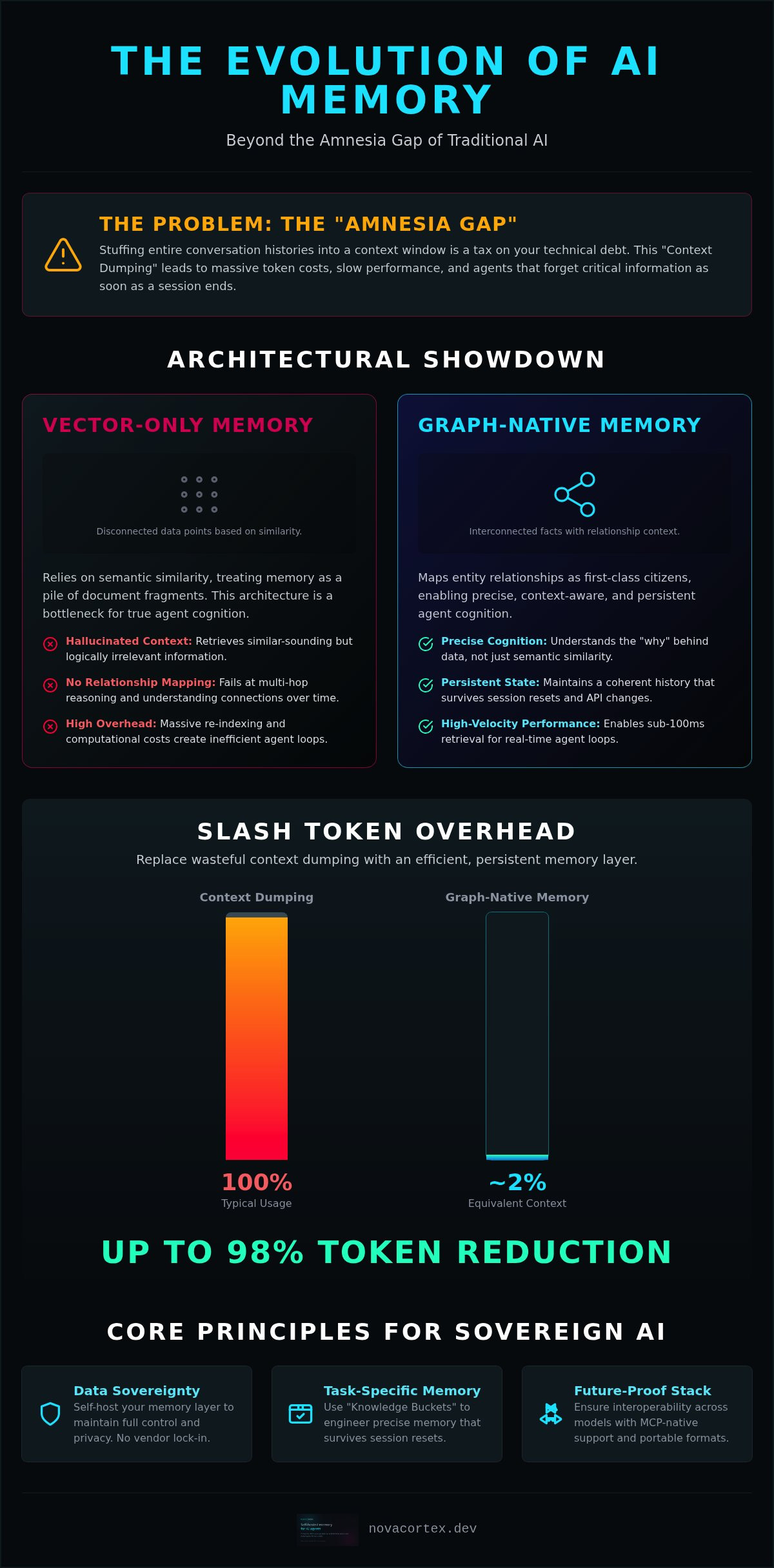
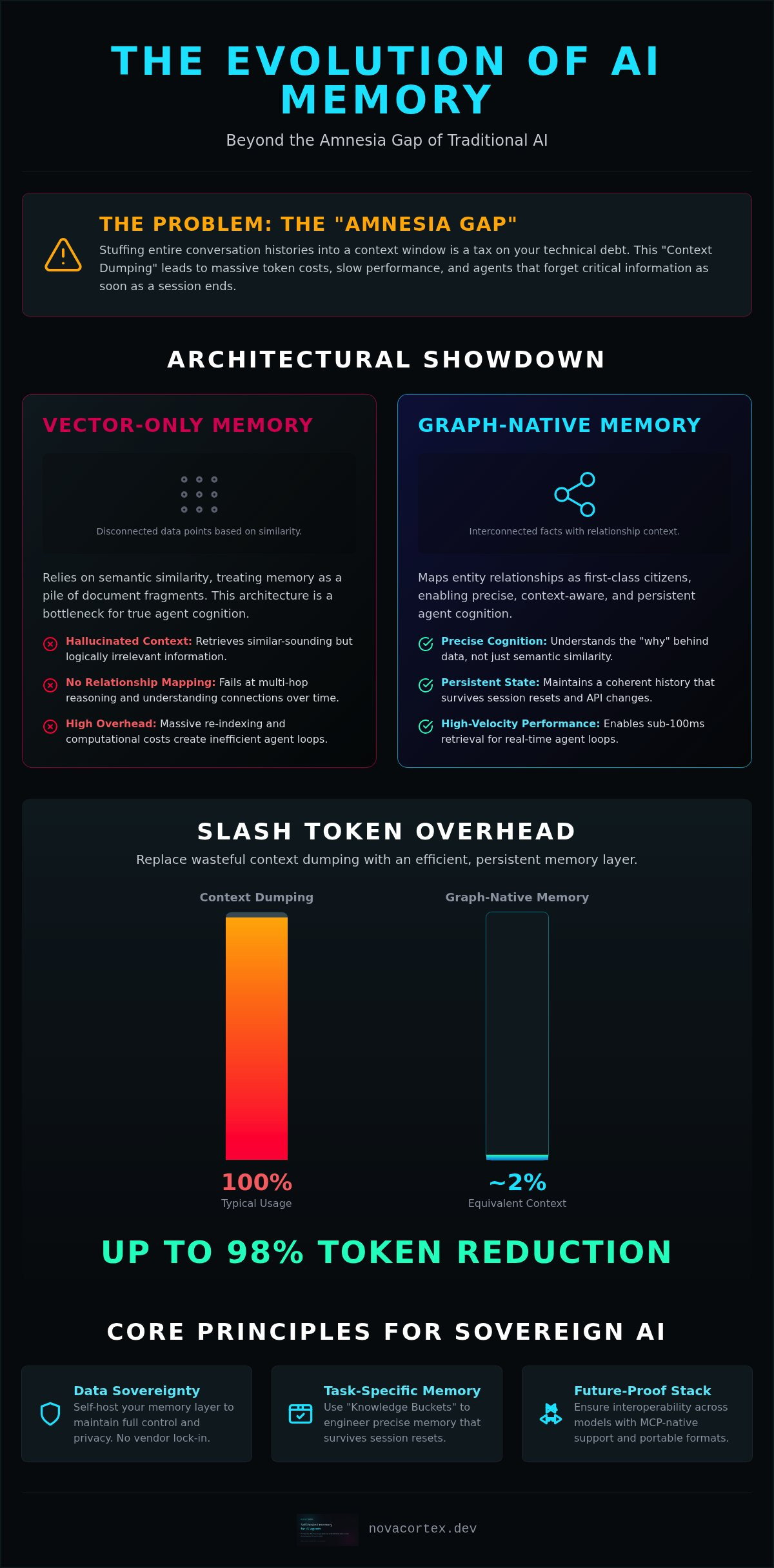
- Slash token overhead by up to 98 percent. Learn to replace wasteful context dumping with efficient, persistent memory layers that respect your infrastructure limits.
- Future-proof your stack with MCP-native support. Ensure your memory layer remains interoperable across different models while maintaining a lean, high-velocity performance profile.
- Implement task-specific Knowledge Buckets. Engineer precise memory storage that survives session resets and eliminates the risk of proprietary database lock-in.
The Evolution of AI Memory: Beyond Simple Vector Retrieval
Context windows are expanding, yet agents remain fundamentally forgetful. Most developers solve this by stuffing the prompt with every historical interaction. It's an expensive, inefficient hack. This "Amnesia Gap" occurs because vector databases are designed for similarity, not relationship persistence. They can find a relevant document, but they can't remember why that document mattered to a specific user three weeks ago. Traditional Retrieval-Augmented Generation (RAG) is a search tool; it's not a cognition engine.
To achieve persistent cognition, we need a specialized middleware layer. An open source AI memory framework provides this by abstracting the storage logic away from the model. It's the functional equivalent of computer memory for an autonomous system. While traditional RAG retrieves static data, a memory framework manages an evolving state. It turns a stateless LLM into a stateful agent capable of long-term reasoning and personalized interaction.
The Failure of Context Dumping
Token bloat is the most visceral symptom of poor architecture. Shoving 100,000 tokens into a prompt to "remind" an agent of a user's preference is technical malpractice. It's also ineffective. LLMs frequently suffer from "lost in the middle" phenomena, where they ignore critical information buried in large context windows. We're moving from stateless chatbots that treat every prompt as a new beginning to stateful autonomous agents. These agents require a lean, persistent record of history that doesn't bankrupt the developer on every API call. Relying on massive context windows is a brittle strategy that fails as soon as the session ends or the token limit is reached.
Defining High-Performance Memory Layers
Engineering a memory layer for 2026 requires more than just a vector index. Real-time agent loops demand sub-100ms retrieval. This isn't possible when you're querying bloated, remote databases for every step of an agent's reasoning chain. Graph-native storage is the superior alternative. It maintains the connective tissue between disparate data points, ensuring the agent understands the relationships between entities rather than just their semantic similarity.
Digital sovereignty is no longer optional. An open source AI memory framework like NovaCortex allows you to host this memory layer on your own infrastructure, from a Raspberry Pi to a private VPS. By using Knowledge Buckets and the Portable Memory Format (PMF), you maintain control over your data while reducing token consumption by up to 98 percent. This architectural shift ensures your agent remains fast, private, and actually intelligent. It replaces the "company brain" approach of competitors like Cognee with a developer-centric toolkit designed for flexibility and high-velocity performance.
Architectural Comparison: Graph-Native vs. Vector-Only Memory
Vector databases are the industry's default. They are also its bottleneck. While semantic similarity helps find related text, it fails to capture the structural logic required for complex AI agent memory. An effective open source AI memory framework must move beyond simple embeddings. It needs to understand how data points relate to one another over time. Reliance on vector-only architectures leads to "hallucinated context" where the agent retrieves similar sounding but logically irrelevant information. This architectural flaw is the primary driver of agent failure in production environments.
Vector Search Limitations
Semantic search has a ceiling. When "similar" isn't "correct", your agent breaks. Vector databases struggle with multi-hop reasoning because they lack a native traversal mechanism. If an agent needs to link a user's preference from session A to a constraint mentioned in session B, a vector search might return both chunks but fail to synthesize the connection. Re-indexing massive datasets also creates significant computational overhead. This "brute force" approach to context is neither scalable nor efficient for high-velocity agent loops. It treats memory as a pile of fragments rather than a coherent history.
The Graph-Native Advantage
Graph-native memory maps entity relationships as first-class citizens. Instead of retrieving "Top K" chunks based on a similarity score, the system navigates a web of connected facts. This allows for AI agent long term memory that is both precise and contextually aware. NovaCortex prioritizes this graph foundation to achieve a documented 98 percent reduction in token usage. By retrieving only the "Relevant Graph" instead of massive text blocks, you feed the LLM exactly what it needs. This precision eliminates the noise that causes model confusion and context window saturation.
Most frameworks trap your data in proprietary schemas. This creates a new form of vendor lock-in that limits your architectural freedom. Our approach utilizes the Portable Memory Format (PMF) to ensure your knowledge remains yours. Whether you are running on a Raspberry Pi or a high-end VPS, your memory layer should be as modular as your code. Digital sovereignty starts with owning the structure of your data, not just the raw text. If you're ready to stop wasting tokens on inefficient retrieval, explore the NovaCortex repository to see graph-native memory in action.
Hybrid models attempt a "Company Brain" approach, mixing vector and relational data. While useful for enterprise search, they often lack the lean performance required for autonomous agents. NovaCortex is an open source AI memory framework built for speed. It treats memory as a dynamic protocol rather than a static archive. This ensures your agents maintain persistent cognition without the weight of bloated, restrictive systems.
Top 4 Open Source AI Memory Frameworks for 2026
Selecting an open source AI memory framework in 2026 requires looking past surface-level popularity. You need architectural durability. The market has moved toward specialized tools that prioritize context management over simple data storage. These four frameworks represent the elite tier for building reliable memory systems for AI agents while maintaining total data sovereignty. Each serves a distinct engineering philosophy, ranging from enterprise integration to high-precision temporal logic.
NovaCortex: Engineering Digital Sovereignty
NovaCortex stands as the standard-setter for digital sovereignty and engineering efficiency. It is built on a graph-native engine that prioritizes the Portable Memory Format (PMF). This prevents your data from being trapped in a specific database schema. As an MCP-native memory server, it interfaces directly with any tool compatible with the Model Context Protocol. Developers using NovaCortex report up to a 98 percent reduction in token overhead. This is achieved through Knowledge Buckets, which allow for modular, task-specific state management. It is the definitive choice for builders who demand local deployment on anything from a Raspberry Pi to a VPS.
Cognee and Vectorize: Enterprise vs. Learning
Cognee focuses on the "company brain" use case. It utilizes a hybrid retrieval model combining graph, vector, and relational data. It excels at connecting fragmented data sources like Slack, GitHub, and Linear into a unified context. It processes around 6 million memories every month for over 100 companies. Vectorize, specifically through its Hindsight feature, targets agents that must learn from past execution errors. It specializes in agents that self-correct based on historical failures. While Cognee centralizes knowledge across an organization, Vectorize optimizes the agent's internal reasoning path through iterative feedback loops.
Evermind EverOS: High-Performance Benchmarking
Evermind EverOS is a specialized core for developers who prioritize raw performance and self-evolving memory. It reports impressive benchmarks, including 93.05 percent on LoCoMo and 83.00 percent on LongMemEval. This framework is designed for high-precision environments where the agent must refine its own understanding without manual intervention. It offers an open-source core under the Apache 2.0 license, making it a strong candidate for self-hosted deployments that require standardized, high-performance metrics. It is particularly effective for long-form memory evaluation where traditional RAG models typically fail.
Licensing matters for long-term project health. While some tools use restrictive terms, the Apache-2.0 license used by NovaCortex, Cognee, and Evermind EverOS provides explicit patent grants. This is a critical consideration for enterprise deployments. Most of these frameworks offer a free self-hosted core, but the real value lies in data portability. Don't let your agent's memory become a proprietary silo. Choose an open source AI memory framework that respects your stack and your sovereignty.
Evaluation Framework: Choosing Your Memory Layer
Engineering a persistent agent requires more than just a place to dump text. You need an evaluation framework that prioritizes architectural integrity. Choosing an open source AI memory framework involves balancing infrastructure costs against the need for total data sovereignty. If you can't migrate your memory from one cloud provider to another without a complete rewrite, you've already lost. Performance must be measured in milliseconds, not seconds. A memory layer that causes latency spikes during high-concurrency loops will throttle your agent's reasoning capability.
Infrastructure requirements vary based on your deployment strategy. Managed cloud solutions offer rapid prototyping but often lead to token bankruptcy and privacy compromises. Local servers, ranging from a Raspberry Pi to private VPS clusters, provide the only true path to digital sovereignty. Your chosen framework must be lean enough to operate on edge hardware while remaining robust enough to handle millions of context points. Scalability shouldn't be a future problem; it's a day-one engineering requirement.
The MCP-Native Requirement
Interoperability is the only antidote to vendor lock-in. Using MCP native memory servers is the essential strategy for building multi-agent ecosystems. The Model Context Protocol (MCP) provides a standardized way for tools like Claude Code or Hermes to interact with your memory layer. Without this protocol, your context is trapped in a proprietary silo. By adopting an MCP-native architecture, you ensure that your knowledge base remains accessible across different models and tools. It turns your memory from a static archive into a dynamic, cross-compatible resource that respects your architectural freedom.
Self-Hosting vs. Managed Services
The choice between self-hosted vs managed AI memory often comes down to the cost-benefit ratio of privacy. Managed services introduce unpredictable usage fees and significant security risks for private AI knowledge bases. Self-hosting NovaCortex on your own infrastructure eliminates these vulnerabilities. Using the Portable Memory Format (PMF) ensures your data remains portable and structured, rather than being locked behind a specific database schema. This approach allows you to maintain a high-velocity performance profile while reducing token usage by up to 98 percent.
Security considerations are paramount when dealing with persistent context. By hosting your memory layer locally, you ensure that sensitive user preferences and corporate data never leave your controlled environment. This setup supports lean operations and high-velocity performance without the bloat of restrictive, third-party systems. Stop outsourcing your agent's brain. Build a sovereign memory layer that you own entirely.
Implementing NovaCortex: Engineering Token-Efficient Context
Implementation is the final step toward digital sovereignty. Deploying a robust open source AI memory framework shouldn't feel like a compromise between ease of use and architectural control. NovaCortex Self-Hosted Edition is designed for private infrastructure, allowing you to reclaim your data from the black box of managed cloud services. By moving the memory layer to your own VPS or local server, you eliminate the latency and security risks associated with third-party providers. This isn't just about running a container; it's about building a persistent cognition engine that you own entirely.
Deployment and Configuration
Setting up NovaCortex on a local VPS is a high-velocity operation. The framework is lean, requiring minimal resources to manage complex graph structures. Once the memory server is live, the focus shifts to Knowledge Buckets. These allow you to partition memory into modular, task-specific states. Instead of an agent wading through a global history of every user interaction, it accesses the specific bucket required for the current objective. This granular control ensures domain-specific precision and prevents context contamination.
Data portability is a core requirement for any modern stack. You should never be punished for wanting to migrate your infrastructure. By leveraging the portable memory format for AI, you ensure that your knowledge base remains independent of the underlying database schema. This format preserves the complex relationship links within your graph, allowing for seamless transitions between different hosting environments without losing a single byte of context.
Maximizing Efficiency
Traditional RAG is a blunt instrument. It retrieves "Top K" text chunks based on semantic similarity, often dragging along irrelevant noise that confuses the LLM. NovaCortex is surgical. It retrieves the "Relevant Graph" of connected facts, which allows for a documented 98 percent reduction in token usage. You stop paying for the LLM to read through redundant paragraphs and start paying for actual reasoning. Benchmarking your retrieval speed will show sub-100ms response times, essential for maintaining high-velocity agent loops.
Monitoring your agent's state is simplified through the management UI. You can watch the graph grow in real-time, identifying which Knowledge Buckets are providing the most utility. Integration with your existing LLM workflow is handled via our MCP-native server, ensuring compatibility with any tool that speaks the Model Context Protocol. This architecture turns your agents into sovereign entities that learn, remember, and evolve without the bloat of restrictive systems. Ready to start? Deploy NovaCortex on GitHub and begin engineering your persistent context today.
Own Your Agent's History
Stateless agents are a relic of inefficient design. You've seen how a graph-native open source AI memory framework transforms ephemeral scripts into persistent, sovereign entities. By moving away from wasteful context dumping and embracing a lean, self-hosted architecture, you reclaim control over your data and your budget. Digital sovereignty is the only sustainable path forward for autonomous systems in 2026.
NovaCortex provides the necessary correction to current market bloat. It delivers a 98 percent reduction in token overhead through its specialized graph-native storage engine. This is an Apache-2.0 licensed solution built for engineers who value architectural superiority over proprietary lock-in. Stop accepting agent amnesia as an inevitable cost of doing business. Your agents deserve a persistent cognition engine that respects your infrastructure and your independence.
The transition from simple retrieval to true cognitive persistence starts with your next deployment. Take the lead in engineering better technical practices and build agents that actually remember.
Frequently Asked Questions
What is an open source AI memory framework?
An open source AI memory framework is a specialized middleware layer that provides long-term, persistent cognition for autonomous agents. Unlike stateless chatbots that reset every session, these frameworks maintain an evolving record of user preferences and historical context. They abstract the storage logic away from the LLM; this allows agents to remember across different sessions and models. This architecture is essential for building sovereign systems that don't rely on proprietary cloud silos.
How does NovaCortex reduce token usage by 98%?
NovaCortex achieves a 98 percent reduction in token usage by abandoning the "Top K" retrieval method used in traditional RAG. Instead of dumping massive text chunks into the prompt, our graph-native engine retrieves only the "Relevant Graph" of connected facts. This surgical precision ensures the model receives exactly what it needs for reasoning. You stop paying for the LLM to process redundant noise. It's a fundamental shift from brute-force search to structured cognitive retrieval.
Can I run NovaCortex on a local Raspberry Pi?
You can absolutely run the NovaCortex Self-Hosted Edition on a Raspberry Pi or any similar edge hardware. The framework is engineered for lean operations and high-velocity performance; it doesn't require the massive compute overhead of a managed cloud database. This makes it ideal for developers building local, private AI systems. Whether you're using a VPS or home hardware, you maintain total control over your agent's memory without sacrificing speed or reliability.
What is the difference between a vector database and a memory framework?
A vector database is a search tool designed for semantic similarity; a memory framework is a cognition layer designed for relationship persistence. Vector databases find similar text but often fail at multi-hop reasoning or understanding entity links. An open source AI memory framework like NovaCortex uses graph-native storage to map these connections. It manages the agent's state over time rather than just providing a static archive of searchable fragments.
Does NovaCortex support the Model Context Protocol (MCP)?
NovaCortex is a fully MCP-Native Memory Server. It implements the Model Context Protocol to ensure seamless interoperability across the entire AI ecosystem. This allows tools like Claude Code or Hermes to interface directly with your persistent context. By using a standardized protocol, you eliminate the need for custom integration code. It ensures your memory layer remains a dynamic resource that's accessible to any MCP-aware model or agent framework you deploy.
Is NovaCortex compatible with LangChain or AutoGPT?
NovaCortex is compatible with LangChain, AutoGPT, and other major agentic frameworks. It functions as a modular storage layer that plugs into your existing workflows via standard APIs or the Model Context Protocol. While those frameworks handle the agent's reasoning loop, NovaCortex manages the underlying knowledge base. This separation of concerns allows you to build more robust systems. You can swap models or reasoning engines while keeping your agent's memory perfectly intact.
How does the Portable Memory Format prevent vendor lock-in?
The Portable Memory Format (PMF) prevents vendor lock-in by using a schema-agnostic data structure. Most frameworks trap your context in a proprietary database schema that's impossible to migrate. PMF ensures your knowledge remains your own; it allows you to move your memory layer between different hosting environments or database engines. This is the foundation of digital sovereignty. It breaks the cycle of being forced into a specific vendor's ecosystem just to keep your data.
Is self-hosting an AI memory layer more secure than using Pinecone?
Self-hosting a memory layer is inherently more secure than using managed services like Pinecone. When you use a cloud provider, your sensitive user data and corporate knowledge leave your controlled environment. Hosting NovaCortex on your own infrastructure ensures that your data never touches a third-party server. This eliminates the risk of API breaches or unauthorized access by the provider. It's the only way to maintain strict privacy-first knowledge storage for your agents.
FAQ
What is an open source AI memory framework?
An open source AI memory framework is a specialized middleware layer that provides long-term, persistent cognition for autonomous agents. Unlike stateless chatbots that reset every session, these frameworks maintain an evolving record of user preferences and historical context. They abstract the storage logic away from the LLM; this allows agents to remember across different sessions and models. This architecture is essential for building sovereign systems that don't rely on proprietary cloud silos.
How does NovaCortex reduce token usage by 98%?
NovaCortex achieves a 98 percent reduction in token usage by abandoning the "Top K" retrieval method used in traditional RAG. Instead of dumping massive text chunks into the prompt, our graph-native engine retrieves only the "Relevant Graph" of connected facts. This surgical precision ensures the model receives exactly what it needs for reasoning. You stop paying for the LLM to process redundant noise. It's a fundamental shift from brute-force search to structured cognitive retrieval.
Can I run NovaCortex on a local Raspberry Pi?
You can absolutely run the NovaCortex Self-Hosted Edition on a Raspberry Pi or any similar edge hardware. The framework is engineered for lean operations and high-velocity performance; it doesn't require the massive compute overhead of a managed cloud database. This makes it ideal for developers building local, private AI systems. Whether you're using a VPS or home hardware, you maintain total control over your agent's memory without sacrificing speed or reliability.
What is the difference between a vector database and a memory framework?
A vector database is a search tool designed for semantic similarity; a memory framework is a cognition layer designed for relationship persistence. Vector databases find similar text but often fail at multi-hop reasoning or understanding entity links. An open source AI memory framework like NovaCortex uses graph-native storage to map these connections. It manages the agent's state over time rather than just providing a static archive of searchable fragments.
Does NovaCortex support the Model Context Protocol (MCP)?
NovaCortex is a fully MCP-Native Memory Server. It implements the Model Context Protocol to ensure seamless interoperability across the entire AI ecosystem. This allows tools like Claude Code or Hermes to interface directly with your persistent context. By using a standardized protocol, you eliminate the need for custom integration code. It ensures your memory layer remains a dynamic resource that's accessible to any MCP-aware model or agent framework you deploy.
Is NovaCortex compatible with LangChain or AutoGPT?
NovaCortex is compatible with LangChain, AutoGPT, and other major agentic frameworks. It functions as a modular storage layer that plugs into your existing workflows via standard APIs or the Model Context Protocol. While those frameworks handle the agent's reasoning loop, NovaCortex manages the underlying knowledge base. This separation of concerns allows you to build more robust systems. You can swap models or reasoning engines while keeping your agent's memory perfectly intact.
How does the Portable Memory Format prevent vendor lock-in?
The Portable Memory Format (PMF) prevents vendor lock-in by using a schema-agnostic data structure. Most frameworks trap your context in a proprietary database schema that's impossible to migrate. PMF ensures your knowledge remains your own; it allows you to move your memory layer between different hosting environments or database engines. This is the foundation of digital sovereignty. It breaks the cycle of being forced into a specific vendor's ecosystem just to keep your data.
Is self-hosting an AI memory layer more secure than using Pinecone?
Self-hosting a memory layer is inherently more secure than using managed services like Pinecone. When you use a cloud provider, your sensitive user data and corporate knowledge leave your controlled environment. Hosting NovaCortex on your own infrastructure ensures that your data never touches a third-party server. This eliminates the risk of API breaches or unauthorized access by the provider. It's the only way to maintain strict privacy-first knowledge storage for your agents.