Beyond Vector Search: The Engineering Case for Graph-Native AI Memory

Vector databases are flat. They are expensive. They are structurally incapable of true reasoning. While the industry chases similarity scores, engineers are hitting a wall where context window bloat and hallucinations make agents unusable at scale. You've likely felt the sting of paying a "token tax" every time your LLM fails to connect basic dots across your datasets. Relying on third-party memory clouds only adds a layer of privacy risk that modern engineering standards shouldn't tolerate. It's time to stop treating memory as a list of embeddings and start treating it as a structured, graph-native AI memory system.
You already know that similarity is not the same as understanding. This article demonstrates why graph-native architecture is the only way to build persistent, sovereign agents that actually scale. We will explore how moving beyond vector-only retrieval enables complex multi-hop reasoning and reduces token usage by up to 98%. You will see how a self-hosted, MCP-native approach ensures total data ownership while delivering the long-term memory your agents require. We are moving from bloated context to lean, high-velocity knowledge buckets.
Key Takeaways
- Understand why flat vector databases fail at multi-hop reasoning and how structural context prevents the similarity trap.
- Discover how graph-native AI memory eliminates context window waste to reduce token usage and API costs by up to 98%.
- Learn to architect agents with semantic, episodic, and procedural memory layers for true long-term persistence and world-fact accuracy.
- Secure your digital sovereignty with self-hosted memory layers that provide 100% data ownership and bypass third-party cloud risks.
- Implement the Portable Memory Format (PMF) and MCP-native servers to build modular, interoperable agent systems that scale.
Why Vector Databases Fail: The Structural Limits of Flat Context
Vector databases are flat. They rely on high-dimensional embeddings to perform a "vibe check" on your data. This is the similarity trap. If you ask an agent to find a specific relationship between two distant entities, a vector search returns chunks that share keywords but lack the structural link. It's a nearest-neighbor search, not a reasoning path. When your agent needs to connect "Project A" to "Vendor B" through a series of meeting transcripts, similarity search often fails to bridge the gap. It misses the multi-hop relationships that define complex logic.
This structural failure leads directly to context window bloat. Because vector retrieval is imprecise, engineers often dump the "top 10" or "top 20" chunks into the prompt, hoping the LLM will extract the signal from the noise. It's a blunt force approach. It drives up API costs and slows down inference. Most of that data is irrelevant filler. RAG is a band-aid for statelessness, not a true memory system. To build agents that actually learn and persist, we need a graph-native AI memory architecture that understands how data points relate to one another.
The Breakdown of RAG at Scale
As your data grows, vector indices become increasingly noisy. High-dimensional search is computationally expensive; more importantly, it lacks the precision required for long-running episodic interactions. Agents lose the "thread" when they can't link a user's current request to a specific fact established three weeks ago. Without a structural way to connect episodic events to semantic facts, the agent starts to hallucinate. It treats every query as an isolated event, even when the answer is buried three hops away in a different knowledge bucket. This isn't just a retrieval problem. It's a cognitive bottleneck that limits the utility of autonomous agents.
Structural Relevance vs. Semantic Similarity
A Knowledge Graph provides the missing link for agentic reasoning. Unlike flat vector indices, graph-native AI memory uses traversal-based retrieval to find the "why" and "how" behind the "what." It follows explicit relationships to pull only the most relevant nodes into the context window. This preserves the ontology of your data without the rigidity of a traditional SQL schema. When an agent can traverse a graph, its reasoning accuracy improves because it's following a logical map, not just guessing based on word proximity. This structural approach eliminates context waste and ensures the LLM receives only the specific facts required for the task at hand.
Engineering Persistent Cognition: Semantic, Episodic, and Procedural Memory
Flat context is a liability. To build an agent that actually functions over time, you need a multi-layered cognitive architecture. We aren't just talking about a cache of recent messages. We're talking about a graph-native AI memory system that separates knowledge into three distinct categories: semantic, episodic, and procedural. This isn't just an academic distinction; it's an engineering requirement for high-reliability agents.
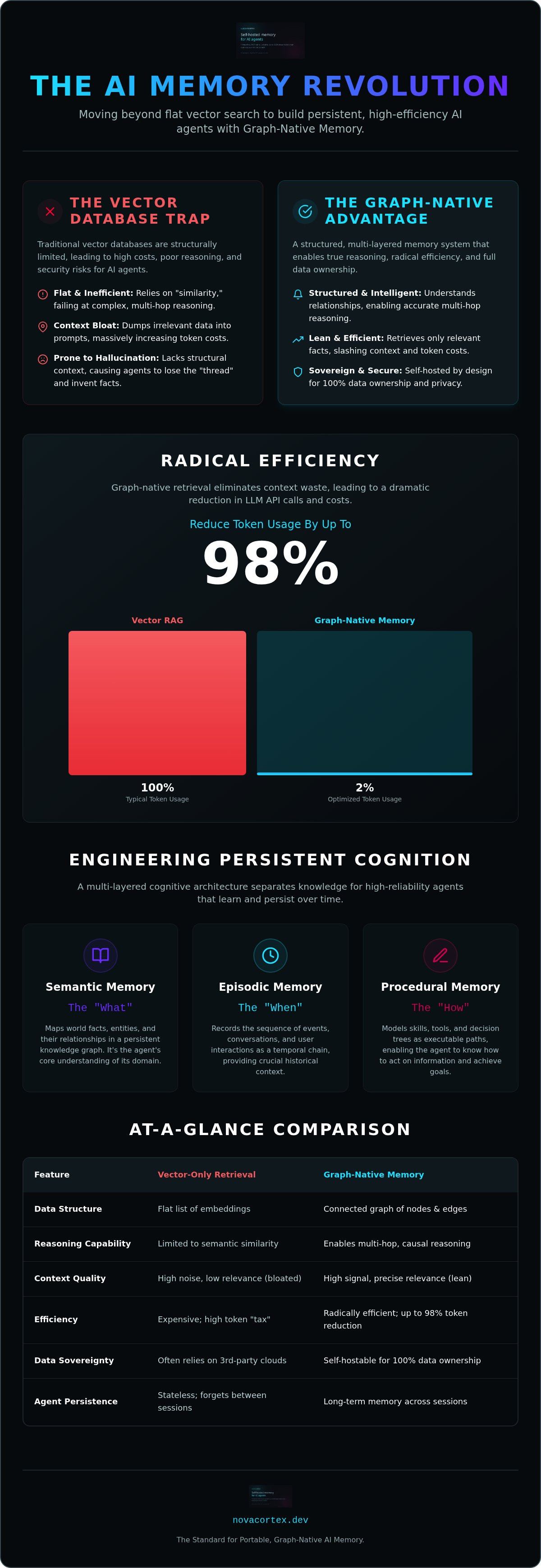
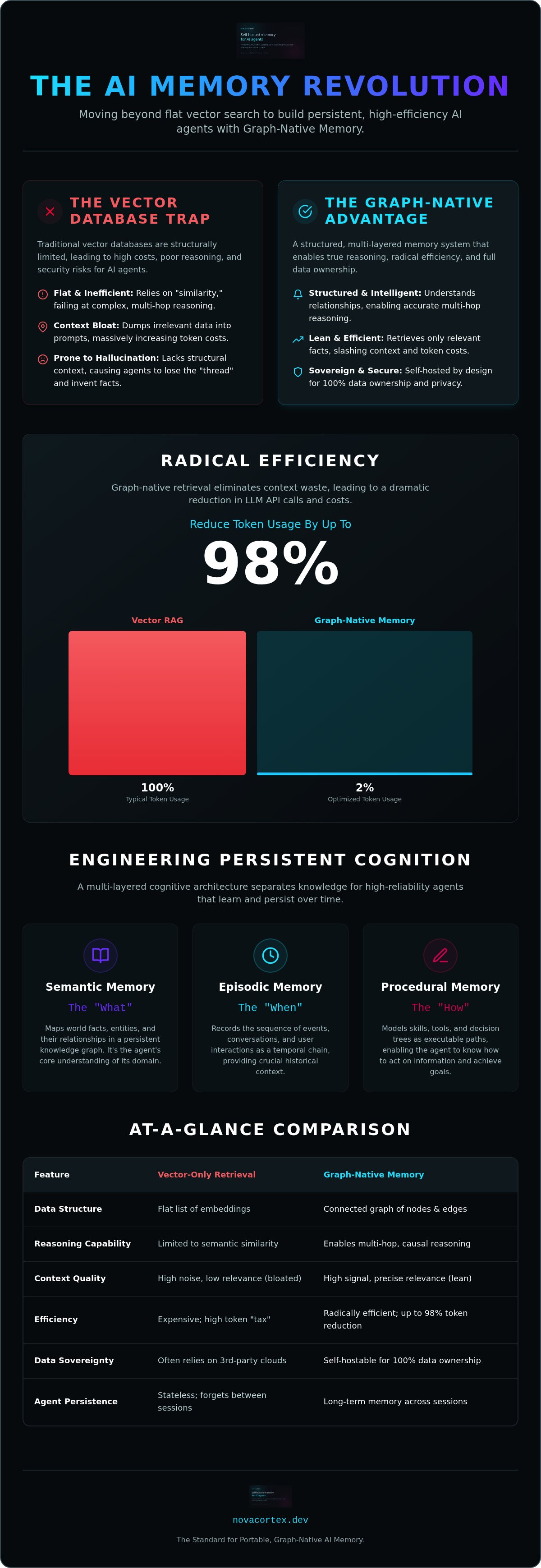
Semantic memory handles the "what." It maps world facts and entity relationships as a persistent knowledge graph. Episodic memory handles the "when." It records the sequence of events and user interactions as a temporal chain. Procedural memory models the "how." It treats skills and decision trees as executable paths. By interconnecting these three layers, an agent can recall a specific fact, remember when it was last discussed, and know which tool to use to act on it. This cross-type interconnection is what enables complex reasoning that survives beyond a single session.
Building the Agentic Ontology
Ontology isn't just a buzzword. It's the blueprint of your agent's world. In a graph-native system, entities are nodes and their relationships are edges. This structure evolves as the agent learns. You can use Knowledge Buckets to isolate and manage distinct data domains, ensuring that an agent's knowledge of "Legal Compliance" doesn't pollute its "Marketing Strategy" logic. Procedural memory is the representation of operational workflows and autonomous skills as structured graph edges that define how an agent transitions between states. For developers interested in the intersection of these structures, this guide on GraphRAG and AI Agent Memory provides a strong technical foundation for implementation.
Episodic Retrieval for Long-Term Context
Standard LLM wrappers rely on a "last five messages" sliding window. This is brittle and inefficient. If the critical context happened 50 messages ago, the agent is blind. Graph-based episodic retrieval uses temporal nodes to index history by time, project, or intent. This allows for multi-hop lookups that find the exact "chain of facts" needed for a current query. Instead of guessing based on similarity, the agent traverses the graph to find the specific interaction that matters. This precision is the best defense against hallucination. It provides a verifiable trail of evidence for every decision the agent makes. Unlike restrictive cloud platforms, an MCP-native architecture allows these memory types to remain interoperable and local. To start building these persistent cognitive layers on your own infrastructure, you can explore the NovaCortex self-hosted repository.
Radical Efficiency: Reducing Token Usage by 98% via Graph Retrieval
The Token Tax is the silent killer of AI scalability. Most developers overlook the financial drain of "vibe-based" retrieval until their API bills spiral. In a standard vector-based RAG setup, you're often forced to inject twenty or thirty context chunks into a prompt just to ensure the LLM has enough "signal" to answer a query. This is a spray and pray strategy. It's expensive. It's slow. By shifting to a graph-native AI memory architecture, you replace this blunt force approach with surgical precision. You stop paying for noise and start paying for answers.
Precise traversal eliminates the need for massive context windows. When an agent can follow explicit edges between entities, it retrieves only the exact nodes required for the task. This isn't just a marginal gain. Benchmarking NovaCortex against standard vector-based architectures shows that structural retrieval can reduce token usage by up to 98%. You're no longer dumping entire documents into the model; you're providing a lean, high-fidelity knowledge subgraph. This efficiency is what allows agents to remain performant during long-running interactions without hitting context limits or breaking the bank.
The Architecture of Token Efficiency
The difference between context injection and graph-native retrieval comes down to pruning. Vector databases return everything within a semantic radius, regardless of its logical relevance. Knowledge Buckets solve this by isolating data domains. Instead of searching your entire corporate history for a specific invoice detail, the agent targets the "Finance" bucket. This modular state management prevents the "everything everywhere" token dump. By retrieving only the specific path through the graph that answers the user's intent, the system maintains a high signal-to-noise ratio. This technical precision is the foundation of the 98% reduction claim; it's the result of moving from broad semantic guesses to structured logical hits.
Portable Memory and Sovereign Data
Proprietary cloud memory formats are a strategic risk. If your agent's "brain" is trapped in a third-party vendor's black box, you don't own your intelligence. You're locked into their pricing and their privacy policies. This is why the Portable Memory Format (PMF) is essential for sovereign AI infrastructure. PMF ensures your graph-native data remains interoperable between different LLMs and hosting environments. You can move your memory from a local instance to a private VPS without losing the structural integrity of your agent's cognition. Adopting a portable memory format for AI is the only way to end the cycle of vendor lock-in and maintain 100% data ownership. It turns memory into a portable asset rather than a leased liability.
Digital Sovereignty: Deploying Self-Hosted Memory on Private Infrastructure
Digital sovereignty is not a marketing slogan. It is a technical necessity. When you send your agent's memory to a third-party cloud, you are handing over the keys to your proprietary logic. Every interaction, every episodic detail, and every semantic fact leaves your perimeter. This creates a massive data transit risk that most enterprises cannot accept. By deploying graph-native AI memory on your own infrastructure, you close that loop. You move from a model of rented intelligence to one of true ownership.
The performance gains are equally undeniable. Local deployments on private hardware or a dedicated VPS enable sub-millisecond read speeds. You aren't waiting for a round-trip to a third-party memory cloud. Whether you are running on a Raspberry Pi for edge applications or a multi-node enterprise cluster, the latency remains under your control. This is the only way to achieve the high-velocity performance required for autonomous agents that act in real-time. You eliminate the network bottlenecks that plague cloud-only architectures.
The Self-Hosted Advantage
Self-hosting eliminates the fragility of external API availability. If a cloud provider goes down, your agent's cognitive history goes with it. By managing your own self-hosted AI memory layer, you ensure 100% uptime and total data residency. You define the security protocols. You control the backup cycles. This is the antidote to the zero infrastructure trap that prioritizes short-term convenience over long-term security and reliability. From a developer's perspective, the flexibility is a major architectural win. You can containerize the memory server using Docker and deploy it alongside your existing microservices to simplify the authentication handshake.
MCP-Native Interoperability
Standardization is the bridge to agentic scaling. The Model Context Protocol (MCP) has emerged as the industry standard for connecting AI models to data sources. NovaCortex is an MCP native memory server, meaning it acts as a plug-and-play context provider for any MCP-compatible agent. This removes the friction of building custom connectors for every new model. You maintain a unified, graph-native AI memory that remains interoperable across your entire stack. It allows your agents to share Knowledge Buckets without compromising the privacy of the underlying data. This modularity ensures your infrastructure remains future-proof as model architectures evolve.
NovaCortex: The Standard for Portable, Graph-Native AI Memory
NovaCortex is the specialized solution for agent memory. It isn't a general-purpose graph database trying to fit into an AI stack. It is a purpose-built graph-native AI memory layer. It solves the structural failures of vector search by providing a logical framework for persistent cognition. While other systems focus on broad data storage, NovaCortex focuses on the specific retrieval needs of autonomous agents. It treats memory as a dynamic asset rather than a static archive. This specialization ensures your agents don't just find data; they understand the context behind it.
Why NovaCortex Wins for Builders
Open source under the Apache-2.0 license, NovaCortex provides full freedom to build, modify, and scale without restrictive overhead. It's a no-nonsense architecture designed by engineers who understand the friction of context window bloat. Unlike general-purpose graph databases that require complex setup for AI use cases, NovaCortex is optimized for the agentic lifecycle from day one. It prioritizes digital sovereignty through its self-hosted model. When evaluating self-hosted vs managed AI memory, the choice for privacy-conscious teams is clear. You eliminate third-party risks and maintain total control over your data residency.
Implementation and Next Steps
The path from local install to production is designed for speed. You start by cloning the repository and spinning up a local instance. Setting up your first Knowledge Bucket is the next step. This allows you to partition memory for specific domains or interaction types. Connecting your LLM is handled via the MCP-native interface, which acts as a standardized context provider. This ensures your memory layer is interoperable with any agent built on the Model Context Protocol. It's a plug-and-play solution for long-term context that doesn't sacrifice performance or privacy.
The roadmap for NovaCortex focuses on deepening this interoperability. We're moving toward a future where context persistence is a standard feature of every AI stack. You've already seen how this approach cuts token costs by 98% and enables multi-hop reasoning. Now it's time to build. This isn't just about storage. It's about giving your agents a structural understanding of the world. The transition to graph-native AI memory is the final step in moving away from brittle, similarity-based RAG toward high-fidelity, sovereign intelligence. You can start today by deploying the NovaCortex Self-Hosted Edition on your own private infrastructure.
Architecting Sovereign Intelligence
Flat vector databases are a relic of the early AI rush. They served their purpose as a starting point, but they cannot support the complex, multi-hop reasoning required for next-generation agents. Transitioning to graph-native AI memory is a fundamental architectural shift. It replaces semantic guesswork with structural precision. This move allows you to slash token usage by up to 98% while maintaining a verifiable chain of facts across every episodic interaction.
The engineering case is absolute. By adopting a privacy-first, self-hosted architecture, you reclaim digital sovereignty and eliminate third-party data risks. You aren't just storing text chunks; you are building a persistent cognitive layer that grows with your agent. With the Apache-2.0 open-source license, you have the total freedom to scale without the weight of proprietary lock-in. It's time to move beyond similarity search and start building with structural integrity.
The tools for persistent, sovereign AI are ready. Take control of your agent's memory and build a system that actually remembers.
Frequently Asked Questions
What is graph-native AI memory and how does it differ from a vector database?
Graph-native memory stores information as nodes and edges to preserve structural relationships, while vector databases store data as flat embeddings. Vectors rely on semantic similarity search, which is essentially a "vibe check" on high-dimensional data. Graph-native AI memory enables multi-hop traversal to find logical connections that flat indices miss. It represents the difference between a list of related sentences and a structured map of knowledge.
Can I use graph-native memory with existing RAG pipelines?
Yes, it acts as a more precise retrieval layer for your current architecture. You can augment or replace your existing vector search with graph-based lookups to improve agent reasoning. It integrates into your stack as a standardized context provider. This allows your LLM to access structured facts and episodic history without rewriting your entire agent logic from scratch.
How does graph-native memory reduce LLM token usage?
It eliminates context window waste by retrieving only logically relevant nodes instead of massive chunks of surrounding text. Standard RAG often dumps irrelevant "filler" into the prompt to ensure the model has enough signal. Benchmarks show that this surgical precision can reduce token usage by up to 98% compared to standard vector-based architectures. You stop paying for noise and only pay for the exact facts required for the task.
Is NovaCortex compatible with the Model Context Protocol (MCP)?
NovaCortex is an MCP-native memory server. This architecture allows it to act as a plug-and-play context provider for any agent or model that supports the protocol. It removes the friction of building custom connectors for every new model you deploy. You maintain a unified, interoperable memory layer that remains consistent across your entire AI stack.
What are the hardware requirements for self-hosting NovaCortex?
The system is designed for high-velocity performance on a range of infrastructure. You can deploy the Self-Hosted Edition on everything from a Raspberry Pi for edge applications to a high-end Enterprise VPS for massive datasets. Because it is self-hosted, you control the resource allocation based on your agent's specific load. It delivers sub-millisecond read speeds on local hardware by eliminating network round-trips to third-party clouds.
How does the Portable Memory Format (PMF) prevent vendor lock-in?
PMF ensures your agent's memory is interoperable and not trapped in a proprietary cloud black box. It allows you to move your memory data between different hosting environments or LLMs without losing the structural integrity of your data. You own the cognition rather than leasing it from a service provider. This format turns your agent's memory into a portable asset that stays with your infrastructure.
Is graph-native memory more complex to implement than vector search?
While the underlying data structure is more sophisticated, NovaCortex is designed for builder-to-builder efficiency. It uses Knowledge Buckets to simplify state management and modularize distinct data domains. This moves the complexity from your prompt engineering to the database architecture where it belongs. You spend less time cleaning noisy context and more time building agents that actually reason.
How does NovaCortex handle privacy and data sovereignty?
It adopts a local-first, self-hosted approach where every semantic and episodic fact stays on your own infrastructure. You eliminate third-party data transit risks and ensure 100% data residency. This is critical for meeting the enforcement requirements of the EU AI Act as of August 2026. By self-hosting your graph-native AI memory, you maintain total control over your security protocols and backup cycles.
FAQ
What is graph-native AI memory and how does it differ from a vector database?
Graph-native memory stores information as nodes and edges to preserve structural relationships, while vector databases store data as flat embeddings. Vectors rely on semantic similarity search, which is essentially a "vibe check" on high-dimensional data. Graph-native AI memory enables multi-hop traversal to find logical connections that flat indices miss. It represents the difference between a list of related sentences and a structured map of knowledge.
Can I use graph-native memory with existing RAG pipelines?
Yes, it acts as a more precise retrieval layer for your current architecture. You can augment or replace your existing vector search with graph-based lookups to improve agent reasoning. It integrates into your stack as a standardized context provider. This allows your LLM to access structured facts and episodic history without rewriting your entire agent logic from scratch.
How does graph-native memory reduce LLM token usage?
It eliminates context window waste by retrieving only logically relevant nodes instead of massive chunks of surrounding text. Standard RAG often dumps irrelevant "filler" into the prompt to ensure the model has enough signal. Benchmarks show that this surgical precision can reduce token usage by up to 98% compared to standard vector-based architectures. You stop paying for noise and only pay for the exact facts required for the task.
Is NovaCortex compatible with the Model Context Protocol (MCP)?
NovaCortex is an MCP-native memory server. This architecture allows it to act as a plug-and-play context provider for any agent or model that supports the protocol. It removes the friction of building custom connectors for every new model you deploy. You maintain a unified, interoperable memory layer that remains consistent across your entire AI stack.
What are the hardware requirements for self-hosting NovaCortex?
The system is designed for high-velocity performance on a range of infrastructure. You can deploy the Self-Hosted Edition on everything from a Raspberry Pi for edge applications to a high-end Enterprise VPS for massive datasets. Because it is self-hosted, you control the resource allocation based on your agent's specific load. It delivers sub-millisecond read speeds on local hardware by eliminating network round-trips to third-party clouds.
How does the Portable Memory Format (PMF) prevent vendor lock-in?
PMF ensures your agent's memory is interoperable and not trapped in a proprietary cloud black box. It allows you to move your memory data between different hosting environments or LLMs without losing the structural integrity of your data. You own the cognition rather than leasing it from a service provider. This format turns your agent's memory into a portable asset that stays with your infrastructure.
Is graph-native memory more complex to implement than vector search?
While the underlying data structure is more sophisticated, NovaCortex is designed for builder-to-builder efficiency. It uses Knowledge Buckets to simplify state management and modularize distinct data domains. This moves the complexity from your prompt engineering to the database architecture where it belongs. You spend less time cleaning noisy context and more time building agents that actually reason.
How does NovaCortex handle privacy and data sovereignty?
It adopts a local-first, self-hosted approach where every semantic and episodic fact stays on your own infrastructure. You eliminate third-party data transit risks and ensure 100% data residency. This is critical for meeting the enforcement requirements of the EU AI Act as of August 2026. By self-hosting your graph-native AI memory, you maintain total control over your security protocols and backup cycles.