Build vs. Buy AI Infrastructure: A Practical Decision Framework for 2026

What if the most expensive AI infrastructure decision is building something your competitors can already adopt? The build vs buy AI infrastructure question isn’t a vote for control or convenience. It’s about identifying which layers create durable advantage and which quietly turn engineers into operators.
A quick prototype can make a custom stack look lean. Production brings integration work, monitoring, upgrades, and ongoing ownership. Buying can reduce some of that work, but it may also limit data control, portability, or architectural choice. The right answer depends on the layer, your team’s capacity, and what genuinely differentiates your product.
This article offers a practical framework for choosing what to build, buy, or combine. We’ll compare infrastructure layers by operating burden, lifecycle costs, strategic value, and control, then show how a hybrid architecture can preserve flexibility without rebuilding commodity capabilities. That can include a focused component such as a self-hosted memory layer: an adoptable part of the stack, not a reason to build the entire stack from scratch.
Key Takeaways
- Use strategic differentiation to decide what deserves custom engineering, and adopt standardized capabilities that don’t set your product apart.
- Evaluate build vs buy AI infrastructure one layer at a time, weighing control and portability against integration and maintenance ownership.
- Before committing, define a representative workload, data boundary, quality measure, and operating burden your team can sustain.
- A hybrid approach can preserve control over important data and workflows without requiring your team to recreate every infrastructure component.
- NovaCortex is a focused, self-hosted memory-layer option with Apache-2.0 licensing, graph-native storage, and a Portable Memory Format, not a complete AI stack.
Build vs. Buy AI Infrastructure: What Are You Actually Deciding?
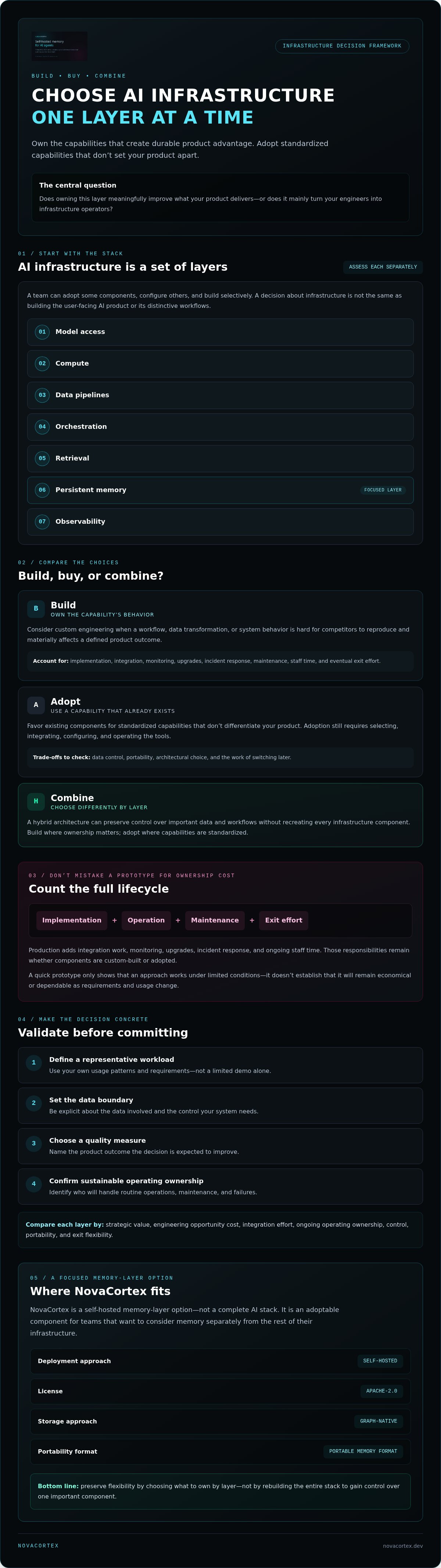
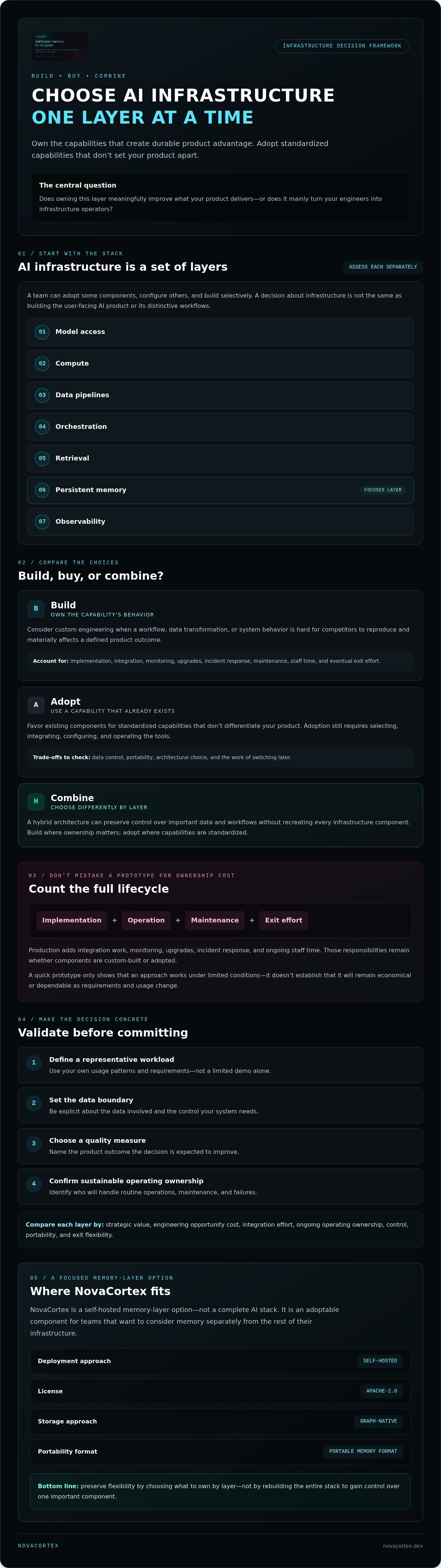
The build vs buy AI infrastructure decision is rarely about creating an entire stack from scratch or outsourcing every technical choice. It’s about deciding, layer by layer, what your team needs to own. AI infrastructure supports Artificial intelligence (AI) applications through components such as model access, compute, data pipelines, orchestration, retrieval, persistent memory, and observability.
Building a capability means engineering and owning its behavior. Adopting existing components means selecting, integrating, configuring, and operating tools that already provide some or all of that capability. Neither option eliminates engineering work. The difference is where the work sits, how much control it provides, and whether the result creates product advantage. This is an infrastructure decision, not the same as building the user-facing AI product, its interface, or its distinctive workflows.
Which layers belong in an AI infrastructure decision?
Assess each layer separately. A team might buy model access, configure existing orchestration components, build a proprietary data pipeline, adopt a retrieval system, and choose a memory component it can move between environments. Observability also needs an explicit owner, whether you assemble it from existing tools or develop capabilities for your system’s specific needs.
This layer-by-layer view prevents an all-or-nothing choice. A standard capability may be straightforward to adopt, while a data workflow that directly shapes product quality may justify deeper ownership. For each layer, ask what outcome it affects, what integration it requires, and who will maintain it. Then decide whether to build, buy, or assemble based on strategic value and the work required to keep it reliable.
Why prototype cost is not total ownership
A prototype shows that an approach can work under a limited set of conditions. It doesn’t prove the system will remain economical or dependable as traffic, data volumes, models, dependencies, and product requirements change. Production adds integration, monitoring, upgrades, incident response, and staff time. Those responsibilities persist whether the underlying components are custom-built or adopted.
Total ownership is implementation plus operation, maintenance, and exit effort. Include the work required to connect components, track system behavior, respond when something fails, keep dependencies current, and migrate if a choice no longer fits. Exit effort matters because a low-friction prototype can still leave data or workflows difficult to move later.
Skip universal cost estimates. Instead, assess a representative workload using your own usage patterns, engineering time, reliability needs, and data boundaries. Write down the assumptions behind each estimate, including which roles will handle routine operations. That gives you a grounded comparison without mistaking a fast demo for a sustainable system.
When Should You Build AI Infrastructure, and When Should You Buy?
The practical test is simple: build only when owning a capability creates measurable product value that an off-the-shelf component can’t provide. Adopt an existing capability when it’s standardized and customers won’t choose your product because you engineered it yourself. That boundary keeps custom work focused on product advantage rather than infrastructure for its own sake.
For each layer, compare four factors: engineering opportunity cost, integration effort, ongoing operating ownership, and exit flexibility. Ask what product outcome improves if you build, who will maintain the result, and how difficult it would be to switch approaches later. Public procurement analysis, including the Center for Strategic and International Studies’ U.S. Government AI Spending Trends, can provide a broader view of how organizations evaluate purchased AI capabilities. It doesn’t replace your team’s workload-specific assessment.
Signals that building may be justified
Consider building when a workflow, data transformation, or system behavior is difficult for competitors to reproduce and materially affects a defined outcome, such as task quality or product responsiveness. State the outcome you expect to improve and how you’ll assess it. A general preference for customization isn’t evidence of an advantage. Control alone isn’t a business case unless it changes what you can deliver or how reliably you can deliver it.
Then test whether the team can own the full lifecycle. Name the people responsible for upgrades, reliability, documentation, and operational support. If the capability depends on knowledge held by one engineer, or maintenance competes with higher-value product work, the apparent advantage may not hold up in production.
Signals that buying or adopting may be smarter
Prefer existing components for capabilities that are well-understood and don’t differentiate your product. But don’t stop at a successful integration test. Check how the component handles your data, how it fits your architecture, what support and maintenance boundaries apply, and whether you can export data or replace it without a costly redesign. Review the actual interfaces and data formats you’ll rely on, rather than assuming they match your needs.
Security, compliance, and data residency are requirements to validate against your own policies and deployment context, not assumptions to make from a vendor’s label or a self-hosted design. Confirm where data moves, what controls you need, and whether the chosen approach meets those requirements. Apply the same scrutiny to upgrade paths and interface compatibility.
A hybrid choice often provides the clearest boundary: adopt commodity infrastructure, then invest engineering effort in the workflows and data that make your product distinct. If persistent agent memory is one layer you’re evaluating, you can evaluate NovaCortex as an open-source memory-layer option. Review its repository against your integration, data-control, portability, and ownership criteria before deciding whether it fits.
Compare Build, Buy, and Hybrid AI Infrastructure by Layer
Build-versus-buy decisions can vary across layers within one system. A team might use an existing model endpoint, assemble its own orchestration, and keep product-specific data transformations in-house. The useful comparison isn’t a single verdict for the whole stack. Assess each layer against the same criteria: control, integration effort, maintenance ownership, portability, and strategic value.
| Layer | Build | Buy or adopt | Hybrid |
|---|---|---|---|
| Model access | More control over routing and integration, but your team owns the interface and changes. Most valuable when model selection or routing differentiates the product. | Faster access to established models; check provider dependence, data handling, and migration options. | Use external model access while keeping routing logic and provider-switching interfaces under your control. |
| Orchestration | Tailor workflows closely, with greater integration and upgrade responsibility. | Adopt common workflow capabilities; validate interfaces and limits before relying on them. | Use existing components, then build only the product-specific workflow logic. |
| Retrieval | Control data processing and retrieval behavior, at the cost of maintaining indexing and integrations. | Reduce custom implementation; assess data boundaries, portability, and fit with your sources. | Adopt retrieval components while owning domain-specific ranking or transformations where they matter. |
| Persistent memory | Shape storage and behavior around the application, while owning reliability and ongoing changes. | Adopt a focused memory capability; examine its data model, interfaces, and exit path. | Keep agent logic in-house and use a portable memory layer that fits your deployment and data-control needs. |
| Observability | Customize signals to your system, but own instrumentation and maintenance. | Use established monitoring tools; verify coverage across the components you depend on. | Adopt baseline tooling and add product-specific signals for quality, failures, or workflow behavior. |
What should the comparison measure?
Score strategic differentiation separately from technical feasibility and operational readiness. For each option, record who controls the data, which interfaces connect the layer, where it can run, how portable its data and configuration are, and what happens if a dependency fails. Assign named owners for monitoring, upgrades, incident response, and long-term maintenance. A high-value layer still isn’t a sensible build if the team can’t operate it.
Where does a hybrid architecture make sense?
Hybrid works when proprietary application logic creates value but commodity infrastructure doesn’t. Keep distinctive workflows in-house, adopt suitable components, and avoid coupling agents to one provider-specific data model or interface where practical. For more detail on the self-hosted AI memory layer, explore how that component fits the wider stack. A portable format can also help preserve choice; see vendor-neutral AI memory design.
How to Validate an AI Infrastructure Decision Before You Commit
A useful build vs buy AI infrastructure evaluation tests more than whether a component works. It checks whether the option fits your real workload, can be operated by your team, and leaves a viable path if requirements change. Use the same acceptance criteria for build, buy, and hybrid options so that the comparison is fair.
A five-step build-versus-buy evaluation
- Define the use case. Describe the user task, representative inputs, expected outputs, and constraints. Set a quality measure your team can assess, such as whether results meet the requirements for that task. Document non-negotiables, including data boundaries and deployment needs.
- Map the decision by layer. Identify which components the workload depends on, such as model access, retrieval, or persistent memory. Compare build, buy, and hybrid approaches for each relevant layer rather than forcing one choice across the stack.
- Estimate ownership. Capture team effort for implementation, integration, security review, monitoring, upgrades, incident response, and routine operations. Name the roles responsible, and include the skills and capacity needed to sustain the choice.
- Run a bounded pilot. Test each viable option against the same representative workload and acceptance criteria. Record integration behavior, quality, failure modes, and the operational effort required. Keep the scope controlled so a promising demo doesn’t silently become a production commitment.
- Test the exit path. Verify data export and migration, identify interface or provider dependencies, and walk through a failure recovery scenario. Don’t assume portability from documentation alone; confirm that your team can retrieve what it needs and understand how to restore service.
A pilot should test operational fit and exit options, not just feature performance. A component that produces acceptable results in a demo may still be a poor fit if integration is brittle, recovery procedures are unclear, or no one owns upgrades. Treat unresolved questions as decision inputs, not details to defer until after rollout.
Check ownership and readiness
Before expanding beyond the pilot, assign named owners for updates, incidents, access controls, and lifecycle decisions. Document recovery procedures and review how interfaces, data formats, and dependencies affect migration. Record open questions about security, compliance, performance, or support boundaries for the appropriate technical review. The goal is a decision the team can operate, not merely approve.
For a focused memory-layer decision, use this self-hosted versus managed AI memory comparison to examine that specific trade-off.
Where NovaCortex Fits: Adopt a Memory Layer, Keep Infrastructure Control
NovaCortex is a focused option for one part of the AI stack: persistent memory for agents. It isn’t a replacement for model access, compute hardware, or agent development. In a build vs buy AI infrastructure decision, it offers another path between building a memory component from scratch and handing that layer to a provider: adopt a self-hosted component while keeping its data on infrastructure you control.
The project is open source under the Apache-2.0 license and uses graph-native storage with the Portable Memory Format (PMF). PMF is designed to support portability and reduce dependence on a single vendor’s data model. These characteristics may matter if your architecture requires persistent agent knowledge, infrastructure control, or a clearer path to move memory data. They don’t remove the need to assess integration, access controls, security, recovery, and day-to-day operations in your environment.
When a self-hosted memory component may fit
Consider evaluating it when persistent knowledge is a defined application requirement and your team wants to operate the memory layer on user-controlled infrastructure. Check the current deployment instructions and interfaces against your environment, then assess the operational work your team would own. Self-hosting changes where control sits; it doesn’t make integration or maintenance disappear.
If you want the memory layer without maintaining your own VPS or local server hardware, NovaCortex also offers a managed cloud environment. Compare that option with self-hosting against your infrastructure requirements and the operational responsibilities your team wants to retain.
Keep the boundary clear. NovaCortex doesn’t provide LLM APIs, hardware, or custom-built agents. It is a memory-layer option to assess within a broader architecture, not a complete AI infrastructure stack.
Review the project before adopting it
Inspect the current repository documentation for deployment guidance, supported interfaces, and edition boundaries. Review the Apache-2.0 license terms and determine how the project fits your integration and operational requirements. Don’t assume every capability associated with a subscription or managed offering is included in the open-source project. Confirm the scope of the edition you’re evaluating.
NovaCortex materials describe token-use reduction of up to 98% compared with sending an entire knowledge base. Treat this as a claim to validate, not a guaranteed result: review its supporting methodology and conditions, then test against your own workload and a defined baseline. Results depend on what you compare and how your system uses memory.
Inspect the source, deployment guidance, and edition details before deciding whether this component belongs in your stack.
Build an AI Stack Your Team Can Sustain
The right build vs buy AI infrastructure strategy isn’t an all-or-nothing choice. Decide by layer: adopt commodity capabilities where they don’t differentiate your product, and build only where ownership creates measurable value. Compare options against real workloads, integration effort, ongoing team responsibilities, data control, and a practical exit path.
A pilot should prove more than feature performance. Test whether the system fits your operating capacity, handles failures, and gives you a workable way to migrate if needs change. That discipline helps teams avoid trading a quick prototype for an infrastructure burden they can’t sustain.
If persistent agent memory is one of the layers you’re assessing, NovaCortex offers an open-source option under Apache-2.0, designed to run on user-controlled infrastructure and use Portable Memory Format to support portability and reduce vendor lock-in. Review the project’s documentation and verify fit against your own requirements.
Choose deliberately, keep the architecture adaptable, and give your engineers room to build what truly sets your product apart.
Frequently Asked Questions
Is it cheaper to build or buy AI infrastructure?
Neither option is automatically cheaper; compare the full lifecycle for each infrastructure layer you need. Include implementation, integration, staffing, maintenance, security review, and future migration. A custom build can hide ongoing engineering work, while an adopted component may introduce recurring fees or constraints. Use a representative workload and your team’s estimates to model the trade-offs. A prototype budget is not a reliable measure of total ownership.
When should a company build AI infrastructure instead of buying it?
Build when a capability creates measurable product differentiation, depends on proprietary workflows, or requires control that available components can’t provide. Before committing, define the outcome that custom ownership should improve and confirm your team can operate and maintain the result. If the capability is standardized and doesn’t set your product apart, buying or adopting an existing component may preserve engineering time for work with greater strategic value.
Can companies use both built and purchased AI infrastructure?
Yes. A hybrid architecture can pair in-house product logic with adopted components for suitable infrastructure layers. Make separate decisions for model access, orchestration, retrieval, memory, and monitoring. Then document integration boundaries, data movement, and portability so the combination doesn’t create hidden dependencies. Each component needs a clear operational owner and must fit the same security and operating requirements. Hybrid is a deliberate architecture, not a shortcut around integration work.
What is included in the total cost of building AI infrastructure?
Total cost includes more than initial development. Estimate integration, compute and service usage, testing, deployment, monitoring, security work, upgrades, incident response, and engineering time. Include the effort and disruption involved in replacing components or migrating data later. The relevant categories depend on your architecture and organization, so build the estimate from actual workloads, assigned responsibilities, and expected operating needs rather than generic industry averages.
How do you avoid vendor lock-in when buying AI infrastructure?
Review data export, interface dependencies, storage formats, migration procedures, and contract or license boundaries before adoption. Test whether a representative dataset can be exported and reconstructed in another environment. Prefer documented interfaces and portable data structures when they meet your requirements. A label such as open source or cloud agnostic doesn’t prove that switching will be straightforward. Verify the practical exit steps and identify who owns them.
Is open-source AI infrastructure always safe to self-host?
No. An open-source license doesn’t guarantee secure configuration, maintained dependencies, or operational readiness. Review the project’s documentation, deployment instructions, access controls, update process, and recovery plan. Identify who will monitor and maintain the system. NovaCortex, for example, is open source under Apache-2.0, but teams should still assess its documentation and operational fit for their environment. Self-hosting offers control alongside responsibility for safeguards and ongoing ownership.
What should an AI infrastructure pilot prove before rollout?
A pilot should test a representative workload against agreed quality, integration, latency, security, and operating criteria. It should reveal who owns updates and incidents, what ongoing effort the system requires, and how data or workloads can be moved if the decision changes. Test failure recovery and integration, not just feature behavior. A successful demonstration shows that something works; a useful pilot shows whether the architecture is sustainable.
If persistent agent memory is part of your infrastructure decision, review NovaCortex Self-Hosted Edition on GitHub and assess its fit against your workload, deployment, and ownership requirements.
FAQ
Which layers belong in an AI infrastructure decision?
Assess each layer separately. A team might buy model access, configure existing orchestration components, build a proprietary data pipeline, adopt a retrieval system, and choose a memory component it can move between environments. Observability also needs an explicit owner, whether you assemble it from existing tools or develop capabilities for your system’s specific needs. This layer-by-layer view prevents an all-or-nothing choice. A standard capability may be straightforward to adopt, while a data workflow that directly shapes product quality may justify deeper ownership. For each layer, ask what outcome it affects, what integration it requires, and who will maintain it. Then decide whether to build, buy, or assemble based on strategic value and the work required to keep it reliable.
What should the comparison measure?
Score strategic differentiation separately from technical feasibility and operational readiness. For each option, record who controls the data, which interfaces connect the layer, where it can run, how portable its data and configuration are, and what happens if a dependency fails. Assign named owners for monitoring, upgrades, incident response, and long-term maintenance. A high-value layer still isn’t a sensible build if the team can’t operate it.
Where does a hybrid architecture make sense?
Hybrid works when proprietary application logic creates value but commodity infrastructure doesn’t. Keep distinctive workflows in-house, adopt suitable components, and avoid coupling agents to one provider-specific data model or interface where practical. For more detail on the self-hosted AI memory layer, explore how that component fits the wider stack. A portable format can also help preserve choice; see vendor-neutral AI memory design. A useful build vs buy AI infrastructure evaluation tests more than whether a component works. It checks whether the option fits your real workload, can be operated by your team, and leaves a viable path if requirements change. Use the same acceptance criteria for build, buy, and hybrid options so that the comparison is fair.
Is it cheaper to build or buy AI infrastructure?
Neither option is automatically cheaper; compare the full lifecycle for each infrastructure layer you need. Include implementation, integration, staffing, maintenance, security review, and future migration. A custom build can hide ongoing engineering work, while an adopted component may introduce recurring fees or constraints. Use a representative workload and your team’s estimates to model the trade-offs. A prototype budget is not a reliable measure of total ownership.
When should a company build AI infrastructure instead of buying it?
Build when a capability creates measurable product differentiation, depends on proprietary workflows, or requires control that available components can’t provide. Before committing, define the outcome that custom ownership should improve and confirm your team can operate and maintain the result. If the capability is standardized and doesn’t set your product apart, buying or adopting an existing component may preserve engineering time for work with greater strategic value.
Can companies use both built and purchased AI infrastructure?
Yes. A hybrid architecture can pair in-house product logic with adopted components for suitable infrastructure layers. Make separate decisions for model access, orchestration, retrieval, memory, and monitoring. Then document integration boundaries, data movement, and portability so the combination doesn’t create hidden dependencies. Each component needs a clear operational owner and must fit the same security and operating requirements. Hybrid is a deliberate architecture, not a shortcut around integration work.
What is included in the total cost of building AI infrastructure?
Total cost includes more than initial development. Estimate integration, compute and service usage, testing, deployment, monitoring, security work, upgrades, incident response, and engineering time. Include the effort and disruption involved in replacing components or migrating data later. The relevant categories depend on your architecture and organization, so build the estimate from actual workloads, assigned responsibilities, and expected operating needs rather than generic industry averages.
How do you avoid vendor lock-in when buying AI infrastructure?
Review data export, interface dependencies, storage formats, migration procedures, and contract or license boundaries before adoption. Test whether a representative dataset can be exported and reconstructed in another environment. Prefer documented interfaces and portable data structures when they meet your requirements. A label such as open source or cloud agnostic doesn’t prove that switching will be straightforward. Verify the practical exit steps and identify who owns them.
Is open-source AI infrastructure always safe to self-host?
No. An open-source license doesn’t guarantee secure configuration, maintained dependencies, or operational readiness. Review the project’s documentation, deployment instructions, access controls, update process, and recovery plan. Identify who will monitor and maintain the system. NovaCortex, for example, is open source under Apache-2.0, but teams should still assess its documentation and operational fit for their environment. Self-hosting offers control alongside responsibility for safeguards and ongoing ownership.
What should an AI infrastructure pilot prove before rollout?
A pilot should test a representative workload against agreed quality, integration, latency, security, and operating criteria. It should reveal who owns updates and incidents, what ongoing effort the system requires, and how data or workloads can be moved if the decision changes. Test failure recovery and integration, not just feature behavior. A successful demonstration shows that something works; a useful pilot shows whether the architecture is sustainable. If persistent agent memory is part of your infrastructure decision, review NovaCortex Self-Hosted Edition on GitHub and assess its fit against your workload, deployment, and ownership requirements.