Building Stateful LLM Applications: A Practical Engineering Guide

A longer prompt isn’t a memory strategy. Building stateful LLM applications means deciding what the system should retain, where it belongs, and when it should change. If conversation history keeps growing while useful context disappears between sessions or workflow steps, the problem isn’t the model. It’s the state lifecycle.
That distinction matters. Conversation history records what was said; application state tracks what the system needs to do; durable memory preserves selected knowledge for later use. Treating all three as one growing transcript wastes context and makes behavior harder to control. LLMs don’t retain past requests on their own, so the application must manage state explicitly.
This guide explains how to separate transient context from durable state, define how state is written and retrieved, and update it as workflows progress. It also covers how to test state behavior and choose a persistence approach based on lifespan, access patterns, and sharing needs. The goal is a coherent system across requests and sessions, without sending the entire conversation back to the model.
Key Takeaways
- Building stateful LLM applications starts with defining what the system must retain, how long it should persist, and when it should be retired.
- Separate conversation history, application-managed workflow state, and durable memory so each has a clear purpose and retrieval path.
- Use a deliberate state lifecycle: identify, validate, persist, retrieve, reconcile, and retire information instead of replaying entire transcripts.
- Implement state in six steps: define it, design its schema, persist it, retrieve it, update it, and test behavior across requests and workflow steps.
- Add a memory layer only after application state boundaries are clear. NovaCortex provides self-hosted persistent memory without replacing workflow logic.
Building Stateful LLM Applications Starts With Defining State
A customer explains a problem, the support agent responds, and the next request arrives with no record of the open ticket. Meanwhile, the prompt grows with old replies, tool outputs, and intermediate notes that no longer matter. This happens when history accumulates without a state model. Building stateful LLM applications starts by deciding what information should influence later behavior and how the application will use it.
A stateful LLM application persists and deliberately reuses selected information across interactions. In computer science, state describes information about a system that affects its behavior; this Defining State reference provides the foundation. For an LLM system, the application, not the model, controls what is preserved and supplied again.
Persistence alone does not make state useful. Information must be relevant, retrievable, and governed by clear rules for updating or removing it. A stored transcript that is never used is just an archive. A stale preference that overrides a customer’s current request is worse than no memory.
What counts as state in an LLM application?
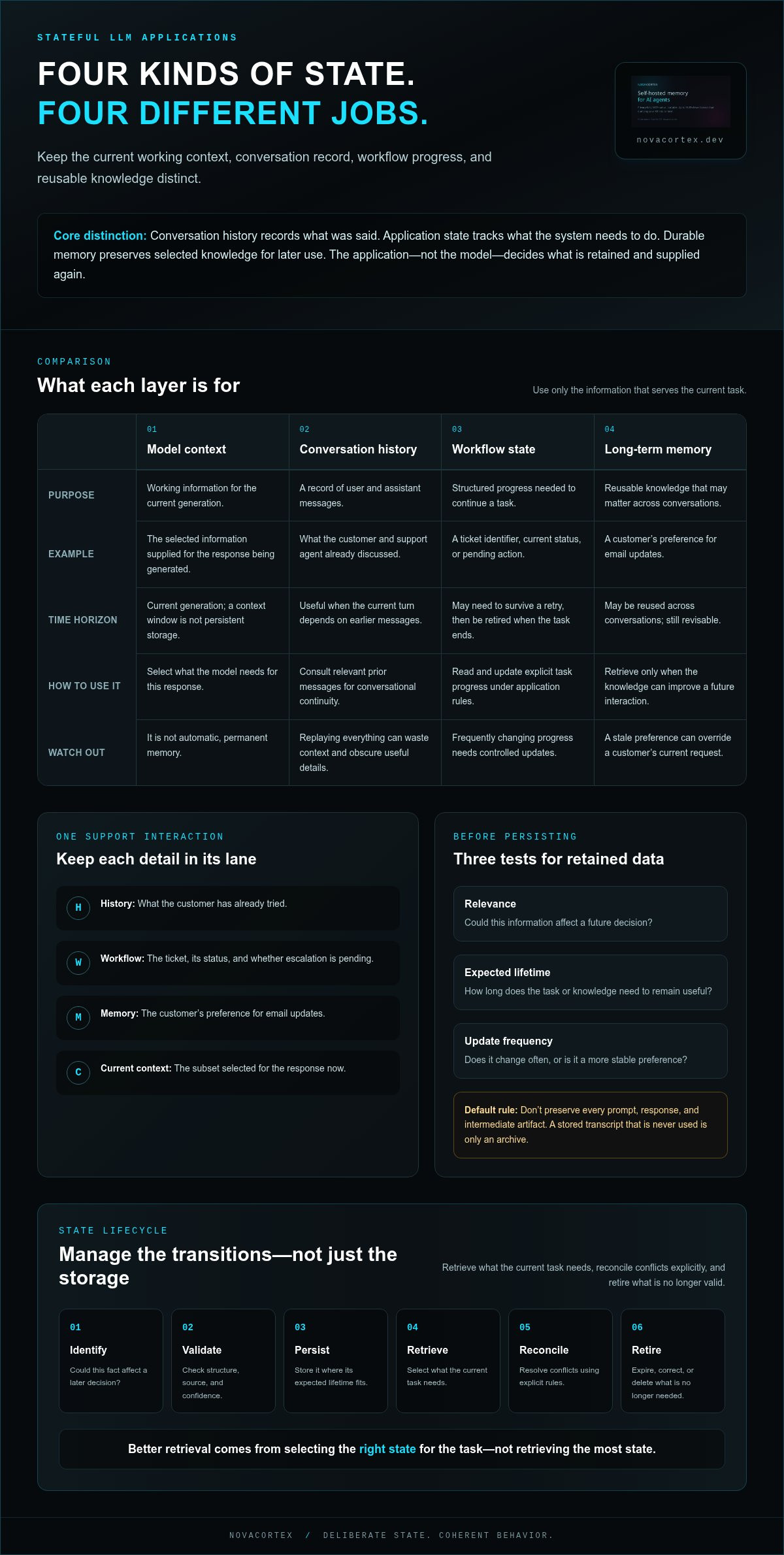
State is information the application preserves to influence a later decision or output. Keep four concepts distinct:
- Model context: The working information provided to the model for the current generation. A context window is not persistent storage.
- Conversation history: The record of user and assistant messages, useful when the current turn depends on what was said earlier.
- Workflow state: Structured progress the application needs to continue a task, such as a ticket identifier, current status, or pending action.
- Long-term memory: Reusable knowledge that may matter across conversations, such as a customer’s preference for email updates.
For example, a support agent may receive a current-turn request to check a delayed order. Conversation history explains what the customer has already tried. Workflow state records the ticket and whether an escalation is pending. Long-term memory may hold the customer’s preference for email. The model sees only the context selected for its current response, not an automatic, permanent record of all four.
Which information should persist between requests?
Classify data by its purpose and lifespan. A temporary workflow checkpoint may need to survive a retry, then be retired when the task ends. Conversation history may be retained for continuity within a session. Reusable knowledge belongs in memory only when it can improve future interactions.
Use three tests: relevance to future decisions, expected lifetime, and update frequency. Frequently changing task progress needs controlled updates. Stable preferences may last longer, but should still be revisable. Don’t preserve every prompt, response, and intermediate artifact by default. That turns storage into a dumping ground and retrieval into guesswork. Define these boundaries first, then design the lifecycle that enforces them.
Design the State Lifecycle: Capture, Persist, Retrieve, Update
State needs a lifecycle, not just a storage location. A stateless request handles each interaction independently; a stateful application carries selected information forward, as Red Hat explains in its overview of stateful vs stateless applications. The application should control every transition. Replaying an entire transcript and hoping the model finds the right detail is not state management.
Use this sequence:
- Identify: Decide which event or fact could affect a later decision.
- Validate: Check its structure, source, and confidence before accepting it.
- Persist: Store it in the right location for its expected lifetime.
- Retrieve: Select information relevant to the current task.
- Reconcile: Resolve conflicts and apply updates under explicit rules.
- Retire: Expire, correct, or delete information when it’s no longer valid or needed.
Retrieval quality depends on selecting the right state for the task, not retrieving the most state.
Capture and persist state deliberately
Capture state at defined application boundaries, such as after a user confirms a preference or a workflow completes a verified step. Validate extracted values before writing them. Keep observed facts separate from model inferences: “customer requested email updates” is not the same as “customer probably prefers email.” Record provenance so later processes can assess the source. Set persistence duration according to task needs, sensitivity, and expected reuse, rather than defaulting every item to permanent storage.
Retrieve, reconcile, and retire state
Retrieve only what the current task needs and what the available context budget can support. If two records conflict, apply a known rule: prefer a newer timestamp, prioritize a trusted source, or have the application resolve the discrepancy. Don’t silently blend incompatible values. Define expiration and deletion behavior alongside write behavior, so outdated preferences and completed workflow data don’t linger indefinitely. Corrections should update the authoritative record and, where needed, invalidate derived copies.
Make the schema inspectable. A state record might include a subject, value, owner, creation and update timestamps, provenance, expiration policy, and permitted update behavior. These fields help trace who or what produced a value, determine which record takes precedence, and test lifecycle rules without relying on prompt text. In building stateful LLM applications, explicit transitions are the control plane; the transcript is only one possible input.
A self-hosted memory layer can complement this lifecycle when the application needs durable, retrievable knowledge, while workflow state remains under application control. Explore the NovaCortex open-source memory layer as one example of that separation.
Choose Between Conversation History, Application State, and Memory
These three patterns solve different problems. Conversation history supplies the recent exchange, application-managed state tracks what the software must control, and a dedicated memory layer makes selected knowledge available beyond a single interaction. They can coexist. Choose the boundary based on how long information matters, who must update it, and how the application needs to retrieve it.
| Pattern | Persistence lifetime | Update control | Retrieval method | Portability | Operational responsibility |
|---|---|---|---|---|---|
| Conversation history | Usually a session or retained transcript | Append, truncate, or summarize under application rules | Replay selected recent turns or a summary | Depends on where transcripts are stored | Application manages retention and context selection |
| Application state | For the duration of a task or as long as the application requires | Explicit schema and application-controlled transitions | Read by task, user, workflow, or record key | Depends on storage design and schema | Application owns correctness, persistence, and lifecycle |
| Dedicated memory layer | Across sessions or workflows, according to retention rules | Application or memory system governs writes and corrections | Retrieve relevant stored knowledge for the task | Depends on format and deployment choices | Team operates the memory layer and defines its integration boundaries |
When conversation history is enough
For a short, self-contained interaction, recent turns may provide all the context the model needs. Replaying an entire history can drag irrelevant material into the prompt and consume context that should be reserved for the current task. A summary reduces volume, but it isn’t automatically durable memory. The application still needs to define who owns it, how it changes, and when it expires.
When persistent memory belongs in the architecture
Use a dedicated memory layer when selected knowledge must remain useful beyond one conversation or workflow. Keep structured workflow progress in application-managed state; use memory for reusable knowledge that benefits retrieval across interactions. Graph-native retrieval can help represent and retrieve connected information, while a portable format can support moving stored knowledge between compatible environments. Neither removes the need for application rules about what to save or trust.
NovaCortex is an open-source, self-hosted AI memory layer designed to complement application-managed state, not replace workflow logic. Its Portable Memory Format supports portability as an architectural consideration. Choose this pattern when durable memory is a real requirement; building stateful LLM applications doesn’t mean adding another storage layer by default.
Implement Stateful LLM Applications in Six Practical Steps
Turn the state model into an explicit path through your application. The sequence below works with a database, a file store, or a dedicated memory layer; the important part is controlling what changes and when. This is the practical core of building stateful LLM applications.
- Define state. List the facts or workflow progress that must survive a request. Specify who or what owns each item, its purpose, and when it should expire.
- Design the schema. Give each record an identifier, value, timestamp, source or provenance, and relevant ownership or expiration metadata. Use typed fields where possible, so application logic can inspect state instead of parsing prose.
- Persist validated changes. Check proposed values against application rules, then write at explicit workflow boundaries, such as after a confirmed preference or completed task step. Don’t write after every token or treat every model claim as fact.
- Retrieve relevant state. Before constructing the model request, fetch a bounded bundle selected for the current task. Include only records that are useful and authorized for that request.
- Update deliberately. Apply corrections, conflict resolution, expiration, and deletion through defined rules. Preserve provenance and timestamps so the application can distinguish a newer confirmed value from an older record or an inference.
- Test behavior. Verify the lifecycle with empty state, stale facts, conflicting updates, retrieval misses, and session boundaries. Test corrections, contradictory facts, deletion, and expired records as separate cases.
A language-neutral flow is: receive event → identify candidate state → validate → persist at a workflow boundary → retrieve a task-relevant bundle → build model request → apply and validate proposed updates. Storing state records a value; validating state transitions checks whether that value is authorized, current, correctly sourced, and safe to apply.
Build the persistence and retrieval path
Start with a minimal record such as identifier, value, created_at, updated_at, source, adding ownership and expiration fields where the application requires them. Persist after a meaningful event, not during token generation. At retrieval time, filter by task and scope, select relevant records, and cap the bundle before adding it to the model context. Define what happens when storage is unavailable or retrieval returns nothing.
Test state behavior across sessions
Open a fresh session and confirm it receives only information relevant to its task, not an indiscriminate dump. Compare retrieval usefulness, latency, context size, and failure behavior against a baseline without persisted state. Include cases where a correction supersedes an old value, a conflict follows application rules, a deleted fact stays absent, and an expired record is not returned.
Add a Memory Layer Without Losing Control of Application State
A memory layer should extend a state architecture, not become its new center of gravity. Make the application’s core state boundaries explicit first. Then add persistent memory where useful knowledge needs to inform later interactions. This separation keeps task execution predictable while allowing an LLM system to reuse context beyond one workflow.
Keep the source of truth explicit
Transactional workflow status belongs in the system responsible for that workflow. If an order is shipped or a support case is closed, the relevant application record remains authoritative. Agent memory can hold reusable knowledge, such as a confirmed communication preference, but it shouldn’t silently replace the system of record.
Define ownership across both layers. Specify which system writes each fact, how corrections propagate, and what deletion means for copies or derived memories. Without those rules, conflicting records can turn persistence into a source of errors. Treat memory as a retrieval aid, not as proof that a business event occurred.
Evaluate NovaCortex as a self-hosted memory component
NovaCortex is an open-source memory layer for AI agents, licensed under Apache-2.0. Its self-hosted design supports deployment on user-controlled infrastructure, including a server, VPS, Raspberry Pi, or similar environment. This gives teams an option for keeping memory infrastructure on their own infrastructure, while access, retention, and lifecycle policies remain part of the application design.
The project supports graph-native storage and retrieval, a Portable Memory Format designed to avoid vendor lock-in, and an MCP-native memory server. These capabilities make NovaCortex a persistent-memory component for applications that need to store and retrieve reusable knowledge. It is not an LLM or a replacement for application workflow logic. Map its role to your data ownership, retrieval, and operational requirements before integrating it.
For teams building stateful LLM applications, the boundary is the design decision: keep authoritative workflow changes in their owning application systems, and use memory to surface relevant knowledge across interactions. Add a memory component where that separation delivers practical value.
Build State With Clear Boundaries
Reliable LLM applications don’t come from feeding the model an ever-growing transcript. They come from defining what deserves to persist, assigning each piece of state a clear owner, and controlling how it’s retrieved, updated, and retired. That’s the engineering foundation for building stateful LLM applications that stay coherent across requests without confusing workflow status with reusable memory.
Start with application-managed state for authoritative workflow changes. Add persistent memory only when useful knowledge needs to carry across interactions. NovaCortex is an Apache-2.0 open-source project with a Portable Memory Format and graph-native storage, designed for self-hosted deployment. Explore the project to see how its memory layer can complement your application architecture.
Keep the boundaries explicit, test state transitions across sessions, and expand the architecture only when your application has a clear need. A deliberate state model gives your system room to grow without letting context sprawl take control.
Frequently Asked Questions
What does stateful mean in an LLM application?
An LLM application is stateful when its software preserves selected information and uses it to shape later requests or actions. The model itself doesn’t automatically remember prior calls. For example, an application can retain a task’s approval status in workflow state and pass that value into a later model request. Building stateful LLM applications means defining what persists, who owns it, and when it’s retrieved or updated.
How do you add persistent state to an LLM application?
Define which facts or workflow details need to survive a request, then give them a structured schema and a persistence layer. Validate information before writing it, including its source and whether it’s confirmed or inferred. Save updates at relevant workflow boundaries. Before a later model call, retrieve only state useful to that task. Test corrections, expiration, missing records, and behavior across sessions.
What is the difference between conversation history and LLM memory?
Conversation history is a record of messages exchanged in a conversation; memory is selected information preserved for future use. History can help resolve a reference such as “that option you mentioned earlier.” Memory might retain a confirmed preference that remains relevant in a later session. A summary of history can reduce prompt size, but it still needs clear ownership, update rules, and retention limits to function as reliable persistent information.
Can an LLM application retain state across separate sessions?
Yes. The application can write selected state to persistent storage and retrieve it when the same user or workflow returns. Use identifiers and access controls appropriate to the application so records are associated with the intended context. A new session should retrieve only relevant, current information, not automatically replay every earlier message. Test session boundaries to confirm that useful state carries forward without leaking unrelated context.
Where should state be stored in a stateful LLM application?
Store state according to its purpose, lifetime, and access needs. A short-lived task may use temporary storage, while durable workflow records belong in the application’s authoritative data store. Reusable knowledge can live in a dedicated memory layer when cross-session retrieval is needed. Consider persistence, ownership, portability, and operational responsibility. Keep the system of record clear, and don’t make a model prompt the only copy of important state.
How do you prevent stale or conflicting information in LLM memory?
Attach timestamps and source information to stored records, then define how the application handles corrections and conflicts. For example, it can prefer a newer confirmed value over an older one, or apply a trusted-source rule. Set expiration and deletion behavior so obsolete information stops appearing in retrieval results. Test stale records, contradictory updates, corrections, and deletions separately, and verify that each change affects the intended record.
Does a stateful LLM application need a separate memory layer?
No. An application can manage persistent state in its existing storage if that meets its retrieval and lifecycle needs. A separate memory layer is useful when selected knowledge must be retrieved across sessions or workflows without replacing application-managed workflow logic. NovaCortex is an open-source, Apache-2.0 self-hosted memory layer with a Portable Memory Format and graph-native storage. Explore NovaCortex on GitHub to learn more about its memory layer.
FAQ
What counts as state in an LLM application?
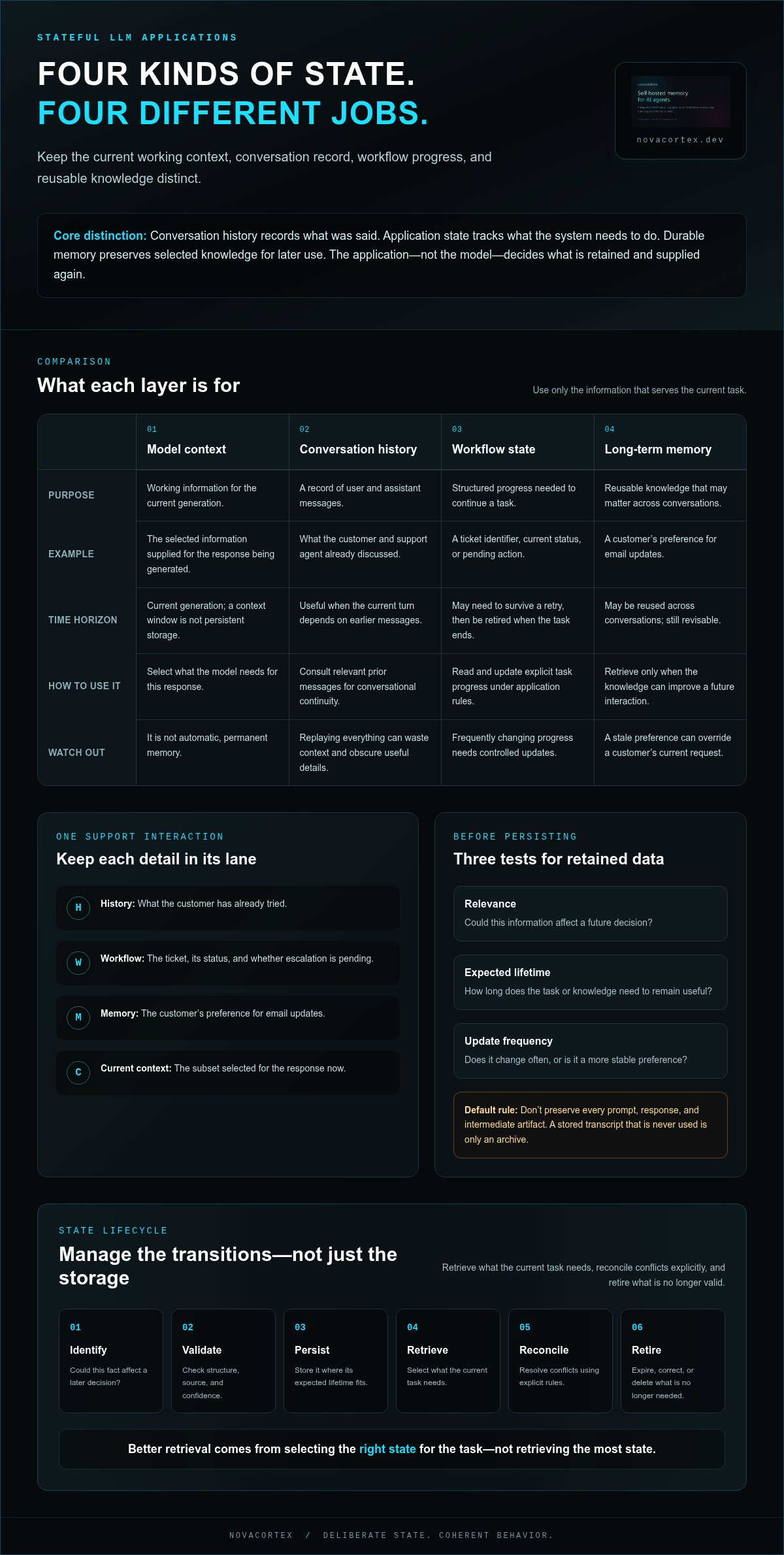
State is information the application preserves to influence a later decision or output. Keep four concepts distinct: For example, a support agent may receive a current-turn request to check a delayed order. Conversation history explains what the customer has already tried. Workflow state records the ticket and whether an escalation is pending. Long-term memory may hold the customer’s preference for email. The model sees only the context selected for its current response, not an automatic, permanent record of all four.
Which information should persist between requests?
Classify data by its purpose and lifespan. A temporary workflow checkpoint may need to survive a retry, then be retired when the task ends. Conversation history may be retained for continuity within a session. Reusable knowledge belongs in memory only when it can improve future interactions. Use three tests: relevance to future decisions, expected lifetime, and update frequency. Frequently changing task progress needs controlled updates. Stable preferences may last longer, but should still be revisable. Don’t preserve every prompt, response, and intermediate artifact by default. That turns storage into a dumping ground and retrieval into guesswork. Define these boundaries first, then design the lifecycle that enforces them. State needs a lifecycle, not just a storage location. A stateless request handles each interaction independently; a stateful application carries selected information forward, as Red Hat explains in its overview of stateful vs stateless applications. The application should control every transition. Replaying an entire transcript and hoping the model finds the right detail is not state management. Use this sequence: Retrieval quality depends on selecting the right state for the task, not retrieving the most state.
What does stateful mean in an LLM application?
An LLM application is stateful when its software preserves selected information and uses it to shape later requests or actions. The model itself doesn’t automatically remember prior calls. For example, an application can retain a task’s approval status in workflow state and pass that value into a later model request. Building stateful LLM applications means defining what persists, who owns it, and when it’s retrieved or updated.
How do you add persistent state to an LLM application?
Define which facts or workflow details need to survive a request, then give them a structured schema and a persistence layer. Validate information before writing it, including its source and whether it’s confirmed or inferred. Save updates at relevant workflow boundaries. Before a later model call, retrieve only state useful to that task. Test corrections, expiration, missing records, and behavior across sessions.
What is the difference between conversation history and LLM memory?
Conversation history is a record of messages exchanged in a conversation; memory is selected information preserved for future use. History can help resolve a reference such as “that option you mentioned earlier.” Memory might retain a confirmed preference that remains relevant in a later session. A summary of history can reduce prompt size, but it still needs clear ownership, update rules, and retention limits to function as reliable persistent information.
Can an LLM application retain state across separate sessions?
Yes. The application can write selected state to persistent storage and retrieve it when the same user or workflow returns. Use identifiers and access controls appropriate to the application so records are associated with the intended context. A new session should retrieve only relevant, current information, not automatically replay every earlier message. Test session boundaries to confirm that useful state carries forward without leaking unrelated context.
Where should state be stored in a stateful LLM application?
Store state according to its purpose, lifetime, and access needs. A short-lived task may use temporary storage, while durable workflow records belong in the application’s authoritative data store. Reusable knowledge can live in a dedicated memory layer when cross-session retrieval is needed. Consider persistence, ownership, portability, and operational responsibility. Keep the system of record clear, and don’t make a model prompt the only copy of important state.
How do you prevent stale or conflicting information in LLM memory?
Attach timestamps and source information to stored records, then define how the application handles corrections and conflicts. For example, it can prefer a newer confirmed value over an older one, or apply a trusted-source rule. Set expiration and deletion behavior so obsolete information stops appearing in retrieval results. Test stale records, contradictory updates, corrections, and deletions separately, and verify that each change affects the intended record.
Does a stateful LLM application need a separate memory layer?
No. An application can manage persistent state in its existing storage if that meets its retrieval and lifecycle needs. A separate memory layer is useful when selected knowledge must be retrieved across sessions or workflows without replacing application-managed workflow logic. NovaCortex is an open-source, Apache-2.0 self-hosted memory layer with a Portable Memory Format and graph-native storage. Explore NovaCortex on GitHub to learn more about its memory layer.