Calculating AI Infrastructure TCO: A Practical 2026 Guide

AI infrastructure TCO is a workload model, not a server-price comparison. If you’re calculating TCO for AI infrastructure, GPU and model charges are only part of the bill. Utilization, engineering time, data movement, storage, and operations all affect the result, so a cloud quote and a self-hosted estimate can be difficult to compare fairly.
Rather than choosing the lowest headline rate, model what your workload needs and document the assumptions. A repeatable cost model makes hidden expenses visible and shows which variables your team can influence as usage changes.
This guide explains how to compare cloud, managed, and self-hosted deployment scenarios. You’ll map workload demand to compute, include supporting infrastructure and labor, and test how utilization and data movement affect total cost. You’ll also learn how measuring retrieved context and token usage can reveal memory-related optimization opportunities, including where a self-hosted memory layer such as NovaCortex may fit.
Key Takeaways
- Define the workload, deployment option, time horizon, and service level before comparing costs.
- Use a repeatable formula for calculating TCO for AI infrastructure, including one-time, recurring, and lifecycle costs.
- Compare cloud, managed, and self-hosted options across the same cost categories instead of assuming one is always cheapest.
- Build low, expected, and high scenarios to see how demand, utilization, and growth can change the result.
- Track each major assumption, its owner, evidence, and review date so your decision reflects current inputs.
What Does AI Infrastructure TCO Include? Define the Cost Boundary First
Total cost of ownership (TCO) is the full cost of operating a defined workload over a stated period. The broader Total cost of ownership (TCO) framework accounts for acquisition and operating costs. For AI infrastructure, define the workload boundary too: what the system does, where it runs, what service level it must meet, and which teams support it.
Set the boundaries before gathering prices. Specify the deployment option, analysis period, availability and performance targets, and teams included. Group costs into three buckets: one-time implementation and migration; recurring operating expenses; and lifecycle costs such as upgrades, replacement, or migration out. Infrastructure TCO is the cost of delivering a defined AI workload over time, not a single cloud invoice or hardware quote.
Which AI infrastructure costs belong in the model?
Include every resource and activity needed to deliver the workload, not just the accelerator. Depending on the deployment, account for:
- Infrastructure: compute, accelerators, storage, networking, power, and data transfer.
- Software and safeguards: software and license fees, observability, security, backup, support, and maintenance.
- People and change: implementation, migration, engineering operations, and ongoing platform labor.
Classify each input as one-time, recurring, or lifecycle. A migration project, for example, belongs in the initial cost boundary, while staff time spent operating the platform recurs. If a component is shared with other workloads, allocate it consistently and document the method instead of leaving it out.
How should the comparison period and workload be defined?
Use the same analysis period and service expectations for every deployment option. Describe request volume, input and output sizes, peak concurrency, data retention, and availability targets. Compare equivalent workloads: a production service with backups and operational coverage cannot be fairly compared with a prototype that excludes those requirements.
Choose a workload-normalized measure alongside total spend, such as cost per successful task or per thousand requests. Define “successful” consistently, including quality and completion criteria, and count retries or failed requests by the same rules across options. This makes calculating TCO for AI infrastructure useful for architecture decisions, not just budget reporting. If a memory layer changes the context sent to a model, measure retrieved context and token usage as workload inputs. Don’t assume that change alone determines total infrastructure cost.
How to Calculate TCO for AI Infrastructure: Build the Cost Model
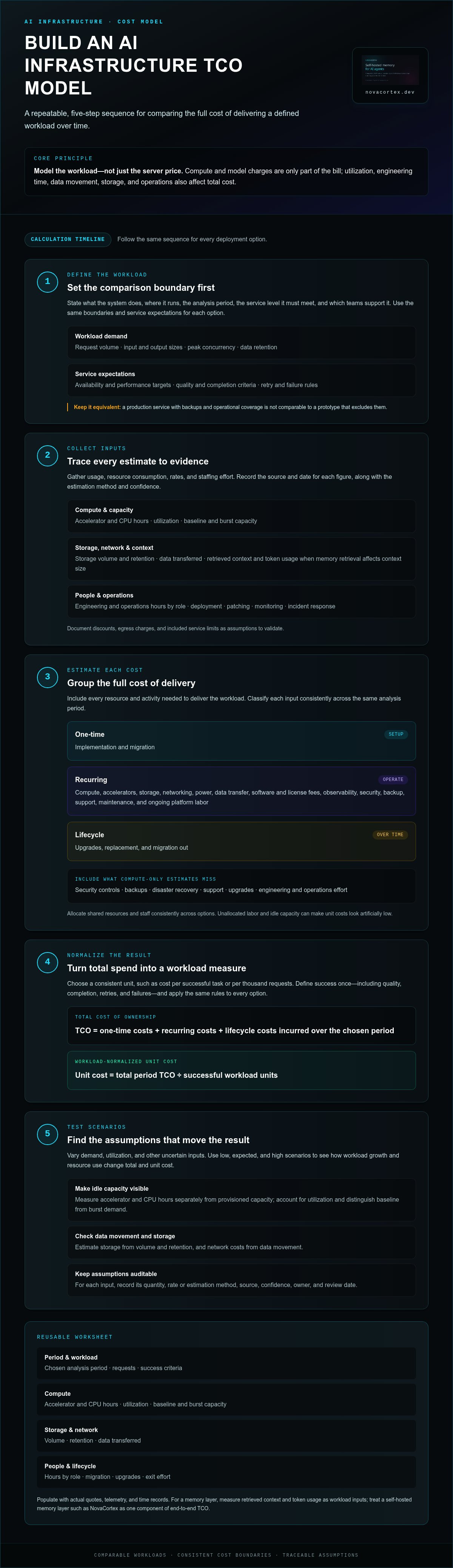
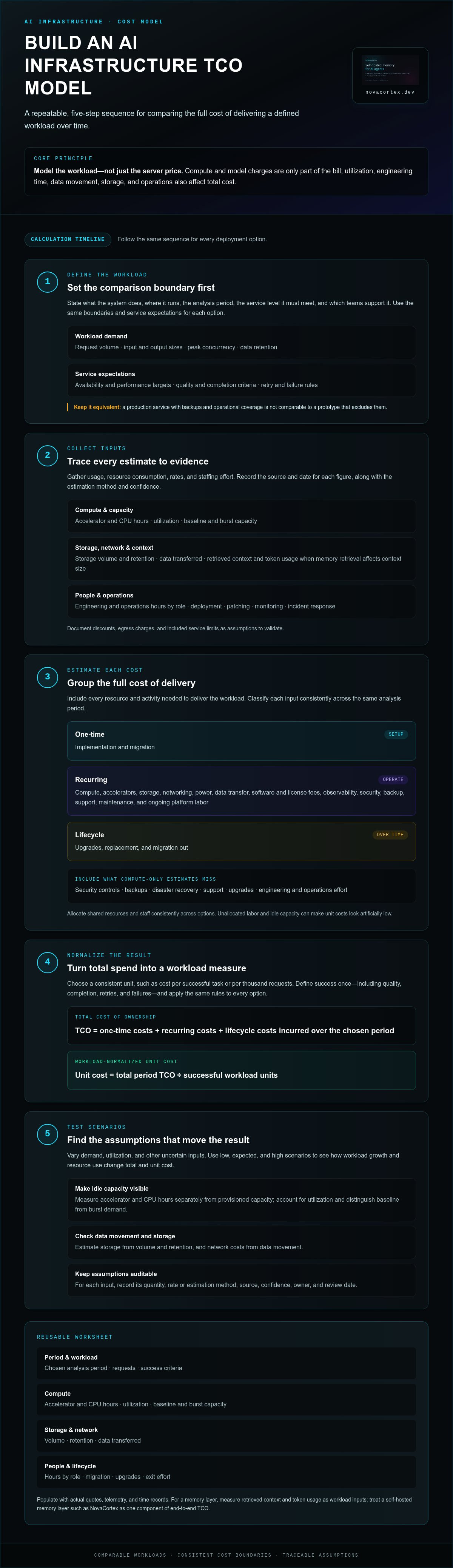
A useful TCO model is repeatable: another team should be able to trace every estimate to an input, source, and assumption. Use this sequence when calculating TCO for AI infrastructure:
- 1. Define the workload. Set request volume, input and output sizes, concurrency, success criteria, and service targets.
- 2. Collect inputs. Record usage, resource consumption, rates, staffing effort, and the source and date for each figure.
- 3. Estimate each cost. Group expenses into one-time, recurring, and lifecycle categories for the same analysis period.
- 4. Normalize the result. Divide total period cost by successful workload units, such as completed tasks or requests that meet the defined quality threshold.
- 5. Test scenarios. Change demand, utilization, and other uncertain assumptions to identify which inputs move the result.
TCO = one-time costs + recurring costs + lifecycle costs incurred over the chosen period. Then calculate unit cost = total period TCO ÷ successful workload units. Define “successful” once and use that definition consistently, including how retries and failures count.
Illustrative worksheet, not a price estimate: Period: [chosen months]; workload: [requests and success criteria]; compute: [accelerator and CPU hours, utilization, baseline and burst capacity]; storage and network: [volume, retention, data transferred]; people and operations: [hours by role]; lifecycle: [migration, upgrades, exit effort]. For each entry, record the quantity, rate or estimation method, source, and confidence. Populate the fields with actual quotes, telemetry, and time records.
Estimate resources and operations
Measure accelerator and CPU hours separately from provisioned capacity, then account for utilization so idle resources remain visible in the model. Estimate storage from volume and retention, and network costs from data movement. Separate baseline capacity from burst demand. Record the source for each estimate, along with discounts, egress charges, and included service limits as assumptions to validate.
Include engineering and operations effort for deployment, patching, monitoring, and incident response. Add required security controls, backups, disaster recovery, support, and upgrades. Risk analysis can reveal work a compute-only estimate misses; the NIST AI Risk Management Framework offers a structured reference for identifying and managing AI risks.
Unallocated labor and idle capacity can make unit costs look artificially low. Assign shared staff and resources through a consistent method, and apply it to every option. If memory retrieval affects context size, track token usage as a workload input. The NovaCortex self-hosted memory layer can be evaluated as one component of that model, not as a substitute for calculating end-to-end TCO.
How Do Cloud, Managed, and Self-Hosted AI Costs Compare?
No deployment model is cheapest by default. Cloud shifts more spending toward metered services and usage; managed infrastructure bundles some operating work into service charges; self-hosting puts more responsibility for capacity and operations on your team. Compare the same workload, service targets, and period, assigning each cost to the option that incurs it.
| Cost category | Cloud | Managed infrastructure | Self-hosted |
|---|---|---|---|
| Compute and scaling | Usage-based charges; idle or reserved capacity can affect utilization. | Service charges may bundle capacity; check scaling behavior and limits. | Infrastructure capacity is owned and maintained; utilization shapes unit cost. |
| Storage and data movement | Storage and transfer may be billed separately. | Included amounts and transfer boundaries depend on the service. | Storage, networking, and power sit within the operating footprint. |
| Software and support | Platform tools and support can add charges. | Some operational support may be included, with defined boundaries. | Your team manages software, support arrangements, and maintenance. |
| Labor and reliability | Internal teams still handle integration, monitoring, and application operations. | Provider handles agreed tasks; customer-side oversight remains. | Internal staff own deployment, patching, security, backups, and response. |
| Risk and exit | Account for dependencies, data transfer, and migration effort. | Include contract scope, service dependencies, and transition effort. | Include lifecycle maintenance, replacement, and migration effort. |
Keep cash expenditure separate from internal engineering capacity. A lower invoice can still require more staff time or leave operational risks with your team. Record who owns each task, which support boundaries apply, and what data-transfer assumptions underpin the estimate. Calculating TCO for AI infrastructure means comparing responsibilities alongside direct charges, not treating a provider quote as the complete cost.
When can cloud or managed infrastructure make financial sense?
Variable demand can favor cloud resources when capacity needs rise and fall. Managed services can make sense when their scope covers work your team would otherwise operate. Model service charges, scaling behavior, support boundaries, and data transfer explicitly. Include your team’s integration and oversight effort, as well as dependencies that remain outside the service. NovaCortex also offers managed infrastructure for its memory layer, eliminating the need to maintain your own VPS or local server hardware.
For a focused comparison of memory-layer deployment choices, see self-hosted versus managed AI memory.
When can self-hosting change the cost profile?
Self-hosting shifts responsibility toward infrastructure, maintenance, security, and staff time. Stable utilization can make owned capacity easier to use consistently, while existing operational capability can reduce the additional labor burden. Low utilization or missing expertise can reverse that advantage. NovaCortex Self-Hosted Edition is a memory-layer input, not a managed infrastructure service; the self-hosted AI memory layer explains the architecture context.
How to Stress-Test Assumptions and Find the Real Cost Drivers
A single forecast can hide uncertainty. Build low, expected, and high cases using the same workload definition, then vary the assumptions most likely to change the result. The figures below are illustrative inputs, not benchmarks or forecasts.
| Scenario | Monthly demand assumption | Accelerator utilization assumption | Annual demand growth assumption |
|---|---|---|---|
| Low | 80,000 requests | 45% | 5% |
| Expected | 100,000 requests | 65% | 15% |
| High | 130,000 requests | 80% | 30% |
Replace these illustrative values with measured usage or a documented forecast. Test the impact of each input separately. A sensitivity table helps identify cost drivers instead of hiding them inside a blended estimate.
| Variable to test | Cost or outcome affected |
|---|---|
| Request volume and concurrency | Compute capacity, scaling, latency, and cost per successful task |
| Context size and retention | Token use, storage, retrieval work, and data movement |
| Utilization and growth | Fixed-cost allocation per task and future capacity needs |
| Staffing, service level, and transfer volume | Operational workload, support needs, reliability, and network costs |
As utilization falls, fixed costs are divided across fewer successful workload units, raising the cost allocated to each one. Compare unit cost alongside latency, reliability, privacy requirements, and operational effort. A cheaper task is not a better outcome if it misses the service target or shifts unacceptable risk to the team.
Validate the assumptions
Label every input as measured, quoted, or assumed. Validate the assumptions that move the sensitivity table most. These models are decision aids, not precise forecasts. Refresh them as telemetry, workload mix, and observed utilization change.
To test a memory architecture, run the same representative tasks before and after changing retrieval. Record retrieved context, input tokens, output tokens, task success, latency, and retries. NovaCortex reduces token usage by up to 98% compared with dumping entire knowledge bases, though the result depends on workload and comparison conditions. Measure the change on your own tasks. See AI token usage reduction methods for more context.
Turn the TCO Analysis into an Infrastructure Decision
A model supports a decision only when the alternatives meet the same workload and service expectations. Before approving a deployment, use a checklist to uncover mismatched assumptions and unresolved ownership:
- Cost: Are recurring, one-time, and lifecycle costs included for the same analysis period?
- Workload fit: Does each option handle equivalent demand, concurrency, latency, and successful-task requirements?
- Control and security: Where does data reside, who controls access, and which security responsibilities stay with your team?
- Reliability: Does the design meet availability, backup, and recovery expectations?
- Operations: Are staffing ownership, support boundaries, maintenance, and incident response accounted for?
- Change over time: Are migration effort, exit portability, and likely workload growth represented?
For every material input, record its value, owner, evidence, and review date. Mark whether it is measured, quoted, or assumed. That record makes calculating TCO for AI infrastructure repeatable: reviewers can see what drives the comparison and which estimates need validation.
Validate with a pilot
Choose a representative workload with observable demand and a clear success criterion. Capture a baseline, then run the candidate configuration against the same task mix and service targets. Compare forecast with measured results, including cost per successful task, latency, reliability, context and token usage, and operational effort. Investigate material gaps before scaling. A pilot won’t predict every future condition, but it can replace consequential assumptions with evidence.
Evaluate the memory layer
When retrieved context contributes to model usage or system load, treat it as a cost input. Measure what the system retrieves and how much context reaches the model before and after a retrieval change. NovaCortex Self-Hosted Edition is an AI-agent memory layer, not a complete infrastructure stack. It stores knowledge locally in the Portable Memory Format and supports graph-native retrieval. Its place in a TCO model depends on the workload, surrounding infrastructure, and operational effort.
Evaluate it against the same tasks and success criteria as other memory approaches. Compare token usage, retrieval behavior, reliability, and the work required to operate the layer. A memory optimization can change one cost driver, but it doesn’t establish total infrastructure savings by itself.
Make Your Next Infrastructure Decision Evidence-Led
Reliable infrastructure decisions start with a defined workload, a consistent comparison period, and a cost model that includes operating effort as well as direct charges. When calculating TCO for AI infrastructure, compare equivalent service expectations across deployment options, then stress-test demand and utilization instead of relying on one fixed estimate.
Use measured results to refine the model. A representative pilot can show whether the forecast holds and which changes affect cost per successful task. Memory architecture is one variable to test: track retrieved context and token use alongside reliability, latency, and the work required to operate the system.
NovaCortex Self-Hosted Edition is an open-source memory layer under Apache-2.0. Local deployment and the Portable Memory Format support infrastructure control and portability. NovaCortex reduces token usage by up to 98% compared with dumping entire knowledge bases, but results depend on workload and comparison conditions. Measure your own tasks before drawing conclusions about total TCO.
Build the model, test the assumptions, and let workload evidence guide the next step. Explore NovaCortex Self-Hosted Edition on GitHub to evaluate its memory layer in your AI infrastructure model.
Frequently Asked Questions
What is TCO in AI infrastructure?
AI infrastructure total cost of ownership is the full cost of running a defined AI workload over a stated period. It includes more than compute charges or a hardware purchase: account for software, storage, networking, data transfer, power where applicable, staffing, security, maintenance, and lifecycle work. Define the workload and service expectations first, then compare total cost and cost per successful task to understand what it takes to deliver the required result.
How do you calculate TCO for AI infrastructure?
To calculate TCO for AI infrastructure, add one-time costs, recurring operating costs, and lifecycle costs over a consistent analysis period. Define the workload, collect resource and staffing inputs, estimate each cost, and divide period TCO by successful workload units. Define success consistently, including how retries or failed requests count. Build low, expected, and high scenarios for uncertain inputs such as demand, utilization, and growth so one estimate doesn’t hide sensitivity.
What costs are often missed in an AI infrastructure TCO calculation?
Commonly missed costs include engineering and platform labor, idle capacity, data transfer, backups, observability, security, support, and migration or exit work. Teams may also overlook ongoing patching, maintenance, incident response, and the effort required to meet reliability targets. Shared staff and infrastructure still consume capacity, even when they don’t appear on a provider invoice. Document how those costs are allocated and apply the same method to every deployment option.
Is self-hosted AI infrastructure always cheaper than cloud?
No. Self-hosting can shift spending from usage-based services toward infrastructure, maintenance, security, and internal staff time. Its economics depend on factors such as utilization, workload stability, scaling needs, and the team’s operational capacity. Cloud or managed infrastructure may suit variable demand or teams with limited operations resources. Compare both options against the same workload and service targets, including lifecycle and labor costs, rather than assuming any deployment model is automatically cheaper.
How do you compare cloud and self-hosted AI infrastructure fairly?
Use the same workload, analysis period, service-level expectations, and success criteria for both options. Include compute, storage, networking, data movement, software, support, staffing, security, backup, and lifecycle effort. Separate direct cash expenditure from internal engineering time, then normalize totals by successful tasks or requests. Document quotes, measured usage, and assumptions for each input. A provider invoice alone isn’t a full comparison if integration, oversight, or exit costs remain outside it.
How does AI token usage affect infrastructure TCO?
Token usage can affect model charges and workload efficiency, so measure input and output tokens alongside task success, latency, and retries. Memory retrieval may change how much context reaches a model. NovaCortex reduces token usage by up to 98% compared with dumping entire knowledge bases, but results depend on the workload and comparison conditions. Measure representative tasks; lower token use alone doesn’t establish equivalent total infrastructure savings.
How often should an AI infrastructure TCO model be updated?
Refresh the model when measured demand, utilization, architecture, service requirements, or applicable pricing assumptions change. Update it after a pilot or material software change, and review the inputs on a regular cadence your team can maintain. Keep an owner, evidence source, and review date beside each important assumption. Compare actual usage and operating effort with the forecast, and revise estimates when observed behavior diverges instead of carrying stale inputs into the next decision.
FAQ
Which AI infrastructure costs belong in the model?
Include every resource and activity needed to deliver the workload, not just the accelerator. Depending on the deployment, account for: Classify each input as one-time, recurring, or lifecycle. A migration project, for example, belongs in the initial cost boundary, while staff time spent operating the platform recurs. If a component is shared with other workloads, allocate it consistently and document the method instead of leaving it out.
How should the comparison period and workload be defined?
Use the same analysis period and service expectations for every deployment option. Describe request volume, input and output sizes, peak concurrency, data retention, and availability targets. Compare equivalent workloads: a production service with backups and operational coverage cannot be fairly compared with a prototype that excludes those requirements. Choose a workload-normalized measure alongside total spend, such as cost per successful task or per thousand requests. Define “successful” consistently, including quality and completion criteria, and count retries or failed requests by the same rules across options. This makes calculating TCO for AI infrastructure useful for architecture decisions, not just budget reporting. If a memory layer changes the context sent to a model, measure retrieved context and token usage as workload inputs. Don’t assume that change alone determines total infrastructure cost. A useful TCO model is repeatable: another team should be able to trace every estimate to an input, source, and assumption. Use this sequence when calculating TCO for AI infrastructure: TCO = one-time costs + recurring costs + lifecycle costs incurred over the chosen period. Then calculate unit cost = total period TCO ÷ successful workload units. Define “successful” once and use that definition consistently, including how retries and failures count. Illustrative worksheet, not a price estimate: Period: [chosen months]; workload: [requests and success criteria]; compute: [accelerator and CPU hours, utilization, baseline and burst capacity]; storage and network: [volume, retention, data transferred]; people and operations: [hours by role]; lifecycle: [migration, upgrades, exit effort]. For each entry, record the quantity, rate or estimation method, source, and confidence. Populate the fields with actual quotes, telemetry, and time records.
When can cloud or managed infrastructure make financial sense?
Variable demand can favor cloud resources when capacity needs rise and fall. Managed services can make sense when their scope covers work your team would otherwise operate. Model service charges, scaling behavior, support boundaries, and data transfer explicitly. Include your team’s integration and oversight effort, as well as dependencies that remain outside the service. NovaCortex also offers managed infrastructure for its memory layer, eliminating the need to maintain your own VPS or local server hardware. For a focused comparison of memory-layer deployment choices, see self-hosted versus managed AI memory.
When can self-hosting change the cost profile?
Self-hosting shifts responsibility toward infrastructure, maintenance, security, and staff time. Stable utilization can make owned capacity easier to use consistently, while existing operational capability can reduce the additional labor burden. Low utilization or missing expertise can reverse that advantage. NovaCortex Self-Hosted Edition is a memory-layer input, not a managed infrastructure service; the self-hosted AI memory layer explains the architecture context. A single forecast can hide uncertainty. Build low, expected, and high cases using the same workload definition, then vary the assumptions most likely to change the result. The figures below are illustrative inputs, not benchmarks or forecasts. Replace these illustrative values with measured usage or a documented forecast. Test the impact of each input separately. A sensitivity table helps identify cost drivers instead of hiding them inside a blended estimate. As utilization falls, fixed costs are divided across fewer successful workload units, raising the cost allocated to each one. Compare unit cost alongside latency, reliability, privacy requirements, and operational effort. A cheaper task is not a better outcome if it misses the service target or shifts unacceptable risk to the team.
What is TCO in AI infrastructure?
AI infrastructure total cost of ownership is the full cost of running a defined AI workload over a stated period. It includes more than compute charges or a hardware purchase: account for software, storage, networking, data transfer, power where applicable, staffing, security, maintenance, and lifecycle work. Define the workload and service expectations first, then compare total cost and cost per successful task to understand what it takes to deliver the required result.
How do you calculate TCO for AI infrastructure?
To calculate TCO for AI infrastructure, add one-time costs, recurring operating costs, and lifecycle costs over a consistent analysis period. Define the workload, collect resource and staffing inputs, estimate each cost, and divide period TCO by successful workload units. Define success consistently, including how retries or failed requests count. Build low, expected, and high scenarios for uncertain inputs such as demand, utilization, and growth so one estimate doesn’t hide sensitivity.
What costs are often missed in an AI infrastructure TCO calculation?
Commonly missed costs include engineering and platform labor, idle capacity, data transfer, backups, observability, security, support, and migration or exit work. Teams may also overlook ongoing patching, maintenance, incident response, and the effort required to meet reliability targets. Shared staff and infrastructure still consume capacity, even when they don’t appear on a provider invoice. Document how those costs are allocated and apply the same method to every deployment option.
Is self-hosted AI infrastructure always cheaper than cloud?
No. Self-hosting can shift spending from usage-based services toward infrastructure, maintenance, security, and internal staff time. Its economics depend on factors such as utilization, workload stability, scaling needs, and the team’s operational capacity. Cloud or managed infrastructure may suit variable demand or teams with limited operations resources. Compare both options against the same workload and service targets, including lifecycle and labor costs, rather than assuming any deployment model is automatically cheaper.
How do you compare cloud and self-hosted AI infrastructure fairly?
Use the same workload, analysis period, service-level expectations, and success criteria for both options. Include compute, storage, networking, data movement, software, support, staffing, security, backup, and lifecycle effort. Separate direct cash expenditure from internal engineering time, then normalize totals by successful tasks or requests. Document quotes, measured usage, and assumptions for each input. A provider invoice alone isn’t a full comparison if integration, oversight, or exit costs remain outside it.
How does AI token usage affect infrastructure TCO?
Token usage can affect model charges and workload efficiency, so measure input and output tokens alongside task success, latency, and retries. Memory retrieval may change how much context reaches a model. NovaCortex reduces token usage by up to 98% compared with dumping entire knowledge bases, but results depend on the workload and comparison conditions. Measure representative tasks; lower token use alone doesn’t establish equivalent total infrastructure savings.
How often should an AI infrastructure TCO model be updated?
Refresh the model when measured demand, utilization, architecture, service requirements, or applicable pricing assumptions change. Update it after a pilot or material software change, and review the inputs on a regular cadence your team can maintain. Keep an owner, evidence source, and review date beside each important assumption. Compare actual usage and operating effort with the forecast, and revise estimates when observed behavior diverges instead of carrying stale inputs into the next decision.