Context Management for AI Agents: Engineering Persistent Memory in 2026

Paying $30 per million output tokens for an agent that forgets its instructions halfway through a task isn't an AI failure; it's an architectural one. Most developers are currently suffocating their systems with massive context windows that drive costs to the moon while performance plateaus. Effective context management for AI agents has moved beyond simple RAG or long-context prompting. You're likely feeling the burn of exponential API bills and the frustration of vendor lock-in with managed vector databases that charge $800 a month for basic scalability. It's a wasteful, bloated approach that ignores the reality of engineering efficiency.
You know that throwing more tokens at the problem is a losing game. This article demonstrates how to master the architectural shift from simple prompting to sophisticated, tiered memory systems. We'll explore how to implement graph-native storage and the Model Context Protocol (MCP) to reduce token waste by up to 98%. You'll learn to maintain data sovereignty via self-hosted infrastructure and build agents that remember what matters without sacrificing privacy or performance.
Key Takeaways
- Understand why vector search fails at deep relational context and how graph-native storage provides superior agent state representation.
- Implement high-performance context management for AI agents to slash token overhead by up to 98% while maintaining persistent memory.
- Standardize your memory architecture using the Model Context Protocol (MCP) and modular Knowledge Buckets for seamless tool interoperability.
- Eliminate vendor lock-in and ensure data sovereignty by deploying self-hosted memory layers using the Portable Memory Format (PMF).
From Prompt Engineering to Context Management: The Agentic Shift
Prompt engineering is a legacy skill. In the early days of LLMs, we treated prompts as the primary lever for performance. We were wrong. As we shift from stateless chat interfaces to autonomous, stateful systems, the bottleneck has moved from how we ask to what the agent knows at the moment of inference. This is the agentic shift. It's the transition from reactive text generation to proactive, long-horizon task execution. Stateless systems are fine for one-off queries, but they fail when a task requires memory, logic, and multi-step reasoning over days or weeks.
Traditional prompt engineering focuses on static instructions. Modern context management for AI agents focuses on the dynamic curation of state. It's the difference between giving an employee a manual and giving them a memory. Without a structured memory layer, agents remain trapped in a loop of forgetting and redundancy. They lose the thread of complex instructions. They repeat mistakes. They become expensive, hallucinating paperweights.
The Limits of the Context Window
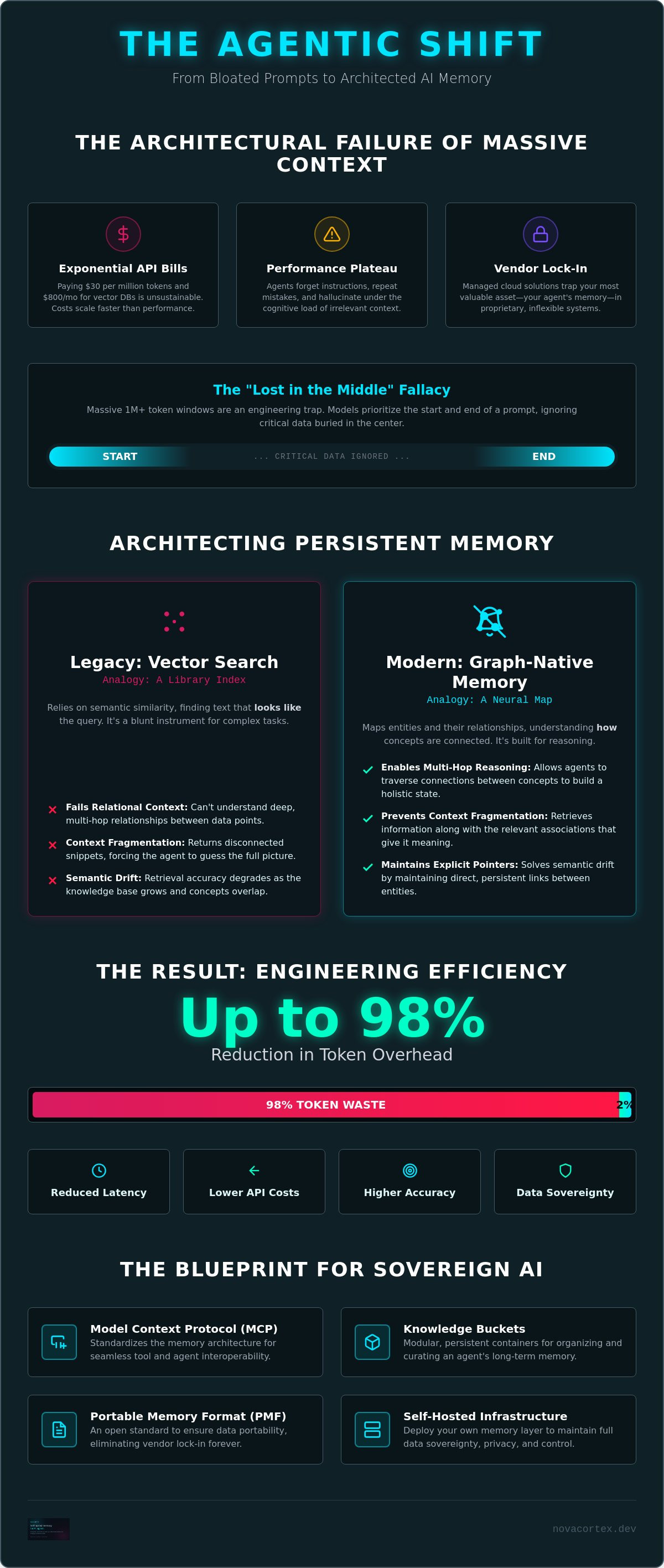
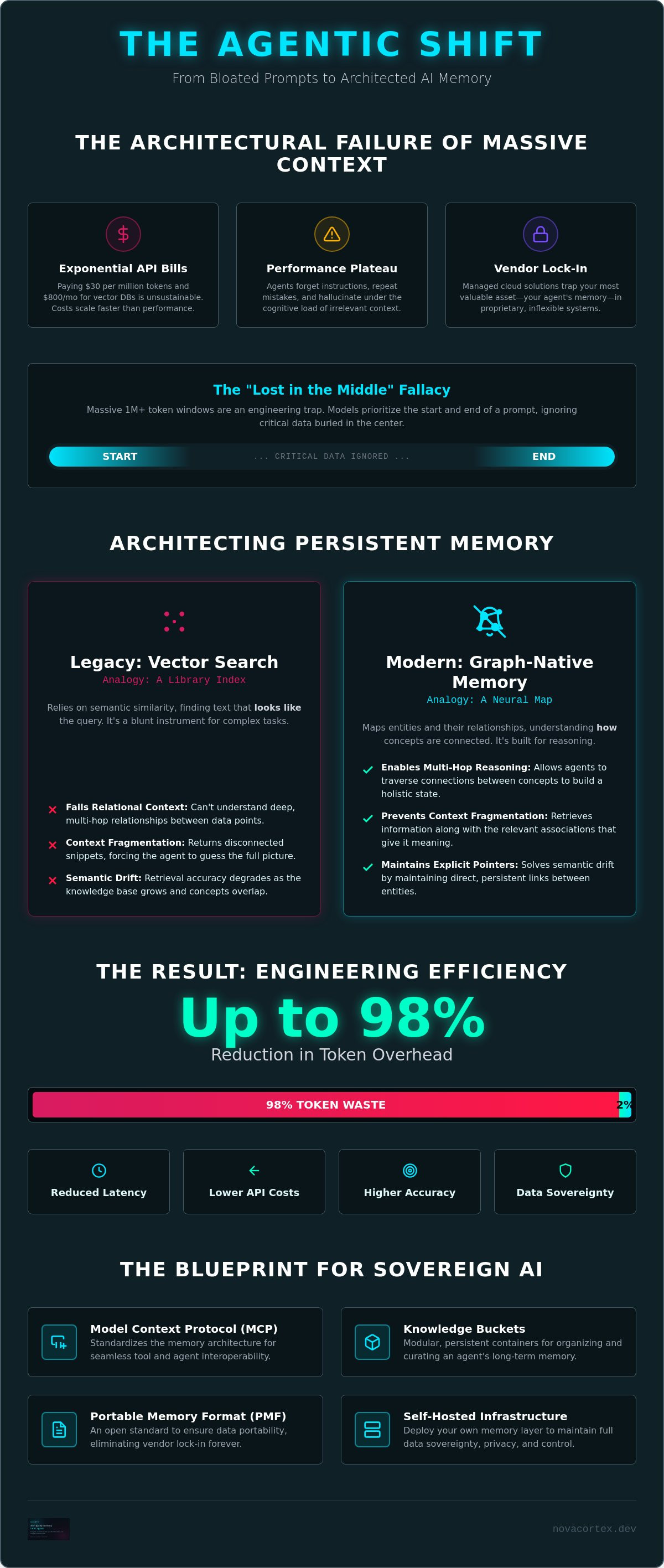
The industry is currently obsessed with context window size. It's a fallacy. While 1M+ token windows look impressive on a spec sheet, they are an engineering nightmare in production. The "Lost in the Middle" phenomenon is a documented reality; models prioritize the start and end of a prompt, often hallucinating or ignoring critical data buried in the center. If your agent needs to recall a specific variable from 50,000 tokens ago, the probability of failure increases with every additional token you cram into the window.
Processing massive windows isn't just a performance risk; it's a financial drain. Every token processed incurs latency and cost. Loading 100k tokens for a simple query is architectural bloat. Context management for AI agents is the active curation of an agent's holistic state. It ensures the model only sees what is relevant to the current step of the task. By filtering noise at the infrastructure level, you protect the model's reasoning capabilities from being diluted by irrelevant data.
Context as an Engineering Resource
Tokens are an expensive, finite resource. Treating them as a dumping ground for raw data is a mark of poor architecture. Engineering persistent memory requires moving from "data dumping" to "architecting knowledge." You must optimize for token utility. This means filtering irrelevant history, summarizing past actions, and retrieving only the most pertinent relational data. You aren't just storing text; you're managing the agent's cognitive load.
This shift requires a dedicated infrastructure. Implementing self-hosted AI memory layers allows developers to maintain this state outside the model's transient window. By managing memory as a tiered resource, you achieve three things: reduced latency by minimizing input size, lower API costs by eliminating redundant token processing, and higher accuracy by removing noisy, irrelevant context. Stop relying on the model to sort through the noise. Build a system that provides the signal.
Architecting Persistent Memory: Graph-Native vs. Vector Storage
Vector databases are the industry's default, but for complex agents, they are a blunt instrument. Traditional RAG relies on semantic similarity. It finds pieces of text that look like the query. This works for simple Q&A, but it fails for deep relational reasoning. If your agent needs to understand how a specific code change in a microservice affects a database schema across three different repositories, vector search will likely hallucinate or return fragmented results. It lacks the connective tissue required for high-stakes context management for AI agents. It's the difference between a library index and a neural map.
Graph-native storage is the necessary correction. Instead of flat lists of embeddings, graph memory maps entities and their relationships as first-class citizens. It allows for multi-hop reasoning, where the agent can traverse links between concepts to reconstruct a holistic state. This architecture prevents context fragmentation, ensuring that when an agent retrieves information, it also retrieves the relevant associations that give that information meaning. You can explore the technical trade-offs of this approach in our comparison of Redis vs Graph Memory for AI Agents.
Why Graph-Native Memory Wins
Semantic drift is the enemy of persistent memory. In vector-only systems, as the knowledge base grows, the "distance" between relevant but non-similar concepts increases, leading to retrieval failure. Graph structures solve this by maintaining explicit pointers. If Component A depends on Library B, that relationship is hardcoded, not guessed via vector math. This precision is vital for agents performing multi-step engineering tasks where a single missed dependency causes a system-wide failure. For developers building these systems, auditing an open-source graph memory implementation is the fastest way to understand these relational advantages.
Tiered Storage Strategies
Efficient memory isn't a monolith. It's a hierarchy designed to balance latency, cost, and recall. We categorize this into three distinct layers:
- Hot Memory: The immediate, ephemeral context of the current turn. This lives in the active window and is pruned ruthlessly to maintain reasoning speed.
- Warm Memory: Relevant history and state retrieved via graph-based RAG. This is stored in modular Knowledge Buckets, allowing agents to swap context dynamically based on the current task.
- Cold Storage: The comprehensive knowledge base. To avoid vendor lock-in, this should be maintained in a Portable Memory Format (PMF).
Using a Portable Memory Format (PMF) ensures your agent's brain isn't trapped in a proprietary managed database. Data sovereignty is an architectural requirement, not a feature. By decoupling the storage format from the retrieval engine, you ensure that your agent's persistent memory remains an asset you own, rather than a liability you rent. This approach eliminates the "vector database lock-in" trap that currently plagues enterprise AI deployments.
The Token Economics of Context: Reducing LLM Overhead
Every token is a tax on your engineering budget. In the current market, frontier models like GPT-5.5 or Claude 4.8 command prices as high as $30 per million output tokens. For an agentic system performing autonomous tasks, these costs compound rapidly. If your architecture relies on "context dumping"—sending the entire conversation history and every available document for every turn—you aren't just wasting money. You're building a system with a built-in expiration date. Enterprise-grade context management for AI agents requires a ruthless approach to token utility. You must treat the context window as a high-cost, low-latency cache, not a landfill for raw data.
Selective retrieval is the only path to a sustainable ROI. By shifting from wholesale history to a tiered memory architecture, developers can achieve a 98% reduction in token usage. This isn't a theoretical optimization. It's the result of isolating the specific relational nodes and Knowledge Buckets required for a single inference step. Reducing the input size doesn't just lower your API bill; it fundamentally changes the performance profile of your agent. Smaller, curated contexts result in lower Time to First Token (TTFT) and more reliable reasoning, as the model isn't forced to navigate thousands of irrelevant distractors.
The Context Window Fallacy
The industry is currently obsessed with "window wars," but bigger isn't always better. Massive context windows suffer from attention dilution. When you saturate a model with 100k tokens, the attention mechanism's ability to weight critical information degrades. This leads to the "needle in a haystack" failure where the agent misses a vital instruction buried in the middle of a bloated prompt. You can find more on debunking these myths and specific cost reduction strategies in our guide on The Context Window Fallacy. Relying on a model's long-context capabilities is often a lazy substitute for proper infrastructure.
Engineering for Efficiency
Sophisticated context management requires active compaction. This involves more than just truncation; it requires semantic extraction and summarization of past turns to preserve the "gist" without the overhead. When an agent completes a sub-task, the system should prune the intermediate reasoning steps and store only the final state and relevant entities. Graph-native retrieval isolates only the necessary tokens for a specific query by following explicit relational paths rather than scanning massive semantic neighborhoods. This precision enables sub-second inference even in complex, multi-step workflows. By architecting for efficiency at the memory layer, you transform context management for AI agents from a cost center into a competitive advantage.
Technical Implementation: Knowledge Buckets and MCP Standards
Architecture is destiny. To scale context management for AI agents beyond simple prototypes, you must move away from monolithic memory stores. In a production environment, an agent shouldn't have to parse its entire history to find a single configuration key. It needs modularity. This is where Knowledge Buckets become essential. By partitioning state into isolated, task-specific containers, you prevent context pollution and ensure that the agent only interacts with the data relevant to its current execution branch. This modular approach is the only way to maintain performance as your agentic workflows grow in complexity.
The transition to stateful agents also requires a standardized communication layer. The Model Context Protocol (MCP) has emerged as the industry standard for this exact purpose. It decouples the model from the data source, providing a uniform interface for agents to query external memory servers. Without MCP, you're stuck building custom, brittle integrations for every new tool or database. Standardizing on an MCP-native architecture allows for seamless memory synchronization across multi-agent swarms, where different agents can contribute to and pull from a shared, structured state without creating a giant, unmanageable token blob.
Modularizing Context with Knowledge Buckets
Knowledge Buckets act as specialized memory modules. You should separate project-specific data, such as API schemas or codebase structures, from general agent instructions and user preferences. This allows for dynamic bucket switching. If an agent moves from a coding task to a deployment task, the system swaps the "Development" bucket for the "Infrastructure" bucket. This keeps the active context window lean and focused. Managing state persistence across distributed environments becomes a matter of bucket synchronization rather than full-database replication. It's a surgical approach to memory that prioritizes relevance over volume.
The MCP-Native Advantage
Every AI middleware component should be MCP-native by now. The protocol simplifies the handshake between LLMs and local memory servers, eliminating the need for complex middleware logic to handle retrieval. When your memory layer speaks the same language as your agent's tools, integration time drops from weeks to hours. It also ensures that your memory remains interoperable. By using a vendor-neutral format like the Portable Memory Format (PMF) within an MCP-native server, you protect your system against the shifting sands of the LLM provider market. For a deep dive into implementation, consult our MCP Native Memory Server guide.
Building this level of precision requires the right foundation. If you're ready to move past bloated, stateless prompts, you can deploy an MCP-native memory server today and start architecting for persistent, sovereign cognition.
Engineering Sovereign Context with NovaCortex Self-Hosted
Sovereignty is the final frontier of the agentic shift. While cloud-managed memory services offer convenience, they introduce unacceptable risks regarding data ownership and security. NovaCortex Self-Hosted Edition provides a privacy-first, graph-native memory layer designed for engineers who refuse to trade control for managed services. It's the necessary infrastructure for building persistent cognition without leaking sensitive intellectual property to third-party providers. By deploying on your own hardware, you transform context management for AI agents from a vulnerable cloud dependency into a secure, internal asset.
The transition to autonomous agents in 2026 requires more than just performance. It requires compliance. With the EU AI Act now enforcing transparency and data handling obligations, the ability to audit and control every byte of an agent's memory is a legal necessity. NovaCortex utilizes a Portable Memory Format (PMF) to ensure that your knowledge base remains independent of the underlying storage engine or model provider. This architecture future-proofs your stack, allowing you to swap LLMs or upgrade infrastructure without losing years of accumulated agent state.
Privacy-First Architecture
Keeping local knowledge local is no longer optional. For regulated industries like legal, medicine, and finance, cloud-based RAG is often a non-starter due to strict data residency requirements. NovaCortex eliminates third-party data leakage by running entirely within your perimeter. Whether you deploy on local servers, a private VPS, or enterprise-grade hardware, the memory remains under your direct supervision. This self-hosted approach ensures that sensitive Knowledge Buckets are never used to train external models. Because NovaCortex uses the PMF, you maintain absolute data sovereignty, effectively ending the era of vendor lock-in.
Performance and Scalability
Self-hosting doesn't mean sacrificing speed. NovaCortex delivers low-latency retrieval through graph-native indexing that outperforms traditional vector-only systems in relational tasks. The architecture scales horizontally, moving seamlessly from a single developer's local environment to multi-user enterprise swarms. As your agentic workforce expands, the memory layer stays responsive, providing the sub-second inference required for high-velocity operations. You don't have to choose between the privacy of a local setup and the power of a global system. You can deploy NovaCortex Self-Hosted Edition today to start building a high-performance, sovereign memory layer that grows with your needs.
Architecting Sovereign Cognition
Engineering persistent memory is no longer a luxury for experimental agents. It's the foundational requirement for production-grade systems in 2026. We've moved past the era of bloated context windows and stateless chat. High-performance context management for AI agents demands a shift toward graph-native architectures and standardized protocols like MCP. By modularizing state through Knowledge Buckets and maintaining data sovereignty on your own infrastructure, you eliminate the "serverless scale cliff" and the privacy risks of third-party managed databases. You're building for reliability, not just novelty.
Efficiency is the primary ROI driver. Reducing token waste by 98% isn't just about cutting costs; it's about reclaiming the model's reasoning capacity from the noise of irrelevant context. Your agent's memory should be a strategic asset you own, not a restrictive service you rent. This architectural shift ensures that your systems remain lean, fast, and fully compliant with emerging transparency regulations. The transition from simple prompts to sophisticated memory layers is the only way to achieve long-horizon task execution at scale.
The infrastructure is ready. You can start building with NovaCortex Self-Hosted Edition to deploy an Apache-2.0 open-source, privacy-first graph memory layer. Take control of your agent's cognition and start engineering for the future today.
Frequently Asked Questions
What is context management for AI agents?
Context management is the architectural curation of an agent's state at the moment of inference. It moves memory from the transient, expensive model window into a dedicated infrastructure layer. This ensures the agent only processes information relevant to the current task rather than navigating a bloated history of irrelevant tokens. Effective context management for AI agents transforms stateless chat into a persistent, autonomous system capable of long-horizon reasoning.
How does context management differ from prompt engineering?
Prompt engineering focuses on static instructions and manual formatting within the active window. Context management is a dynamic infrastructure problem. While prompt engineering tries to "trick" a model into better performance, context management provides the model with a structured memory. It's the difference between giving an employee a set of rules and giving them access to a searchable, relational database of past experiences.
Why should I use graph-native memory instead of a vector database?
Vector databases rely on semantic similarity, which fails when tasks require deep relational logic. If your agent needs to understand complex dependencies or multi-hop connections, vector search often returns fragmented or irrelevant results. Graph-native memory maps entities and their relationships as first-class citizens. This prevents context fragmentation and allows agents to traverse explicit links between concepts with surgical precision.
Can context management really reduce token costs by 98%?
Yes. This reduction is achieved by shifting from wholesale history dumping to selective retrieval. Instead of sending 100,000 tokens of raw chat history for every turn, a managed memory layer isolates only the specific nodes and Knowledge Buckets required for that inference step. High-load benchmarks confirm that isolating the signal from the noise can slash input token overhead by 98% without degrading reasoning quality.
What is the Model Context Protocol (MCP) and why does it matter for memory?
The Model Context Protocol (MCP) is an open standard that decouples LLMs from their data sources. It provides a uniform interface for agents to query external memory servers without custom, brittle integrations. For developers, this means you can swap models or tools without rebuilding your memory logic. It's the essential protocol for synchronizing state across multi-agent swarms and maintaining a standardized memory interface.
How do I prevent my AI agent from forgetting information in long sessions?
Implement a tiered memory architecture using Knowledge Buckets. By storing persistent state outside the active window, you protect the agent from the "Lost in the Middle" phenomenon where models ignore data buried in long prompts. When an agent needs specific information from 1,000 turns ago, the system retrieves it from the graph-native layer and injects it into the hot context only for that specific turn.
Is self-hosting an AI memory layer more secure than using a cloud service?
Self-hosting is the only way to ensure absolute data sovereignty. Cloud-managed memory services introduce third-party leakage risks and potential vendor lock-in. For regulated industries like legal or finance, keeping the memory layer within your own infrastructure is an architectural requirement. It ensures that sensitive intellectual property is never used for external model training and stays entirely within your perimeter.
What is the Portable Memory Format (PMF) used by NovaCortex?
The Portable Memory Format (PMF) is a vendor-neutral standard for storing agent knowledge. It decouples your agent's brain from the underlying storage engine. This prevents the "vector database lock-in" trap, allowing you to export and migrate your knowledge base across different environments or model providers. PMF ensures that your agent's persistent memory remains a sovereign asset you own rather than a liability you rent.
FAQ
What is context management for AI agents?
Context management is the architectural curation of an agent's state at the moment of inference. It moves memory from the transient, expensive model window into a dedicated infrastructure layer. This ensures the agent only processes information relevant to the current task rather than navigating a bloated history of irrelevant tokens. Effective context management for AI agents transforms stateless chat into a persistent, autonomous system capable of long-horizon reasoning.
How does context management differ from prompt engineering?
Prompt engineering focuses on static instructions and manual formatting within the active window. Context management is a dynamic infrastructure problem. While prompt engineering tries to "trick" a model into better performance, context management provides the model with a structured memory. It's the difference between giving an employee a set of rules and giving them access to a searchable, relational database of past experiences.
Why should I use graph-native memory instead of a vector database?
Vector databases rely on semantic similarity, which fails when tasks require deep relational logic. If your agent needs to understand complex dependencies or multi-hop connections, vector search often returns fragmented or irrelevant results. Graph-native memory maps entities and their relationships as first-class citizens. This prevents context fragmentation and allows agents to traverse explicit links between concepts with surgical precision.
Can context management really reduce token costs by 98%?
Yes. This reduction is achieved by shifting from wholesale history dumping to selective retrieval. Instead of sending 100,000 tokens of raw chat history for every turn, a managed memory layer isolates only the specific nodes and Knowledge Buckets required for that inference step. High-load benchmarks confirm that isolating the signal from the noise can slash input token overhead by 98% without degrading reasoning quality.
What is the Model Context Protocol (MCP) and why does it matter for memory?
The Model Context Protocol (MCP) is an open standard that decouples LLMs from their data sources. It provides a uniform interface for agents to query external memory servers without custom, brittle integrations. For developers, this means you can swap models or tools without rebuilding your memory logic. It's the essential protocol for synchronizing state across multi-agent swarms and maintaining a standardized memory interface.
How do I prevent my AI agent from forgetting information in long sessions?
Implement a tiered memory architecture using Knowledge Buckets. By storing persistent state outside the active window, you protect the agent from the "Lost in the Middle" phenomenon where models ignore data buried in long prompts. When an agent needs specific information from 1,000 turns ago, the system retrieves it from the graph-native layer and injects it into the hot context only for that specific turn.
Is self-hosting an AI memory layer more secure than using a cloud service?
Self-hosting is the only way to ensure absolute data sovereignty. Cloud-managed memory services introduce third-party leakage risks and potential vendor lock-in. For regulated industries like legal or finance, keeping the memory layer within your own infrastructure is an architectural requirement. It ensures that sensitive intellectual property is never used for external model training and stays entirely within your perimeter.
What is the Portable Memory Format (PMF) used by NovaCortex?
The Portable Memory Format (PMF) is a vendor-neutral standard for storing agent knowledge. It decouples your agent's brain from the underlying storage engine. This prevents the "vector database lock-in" trap, allowing you to export and migrate your knowledge base across different environments or model providers. PMF ensures that your agent's persistent memory remains a sovereign asset you own rather than a liability you rent.