Cost of Self-Hosted AI Memory: A Practical 2026 Buying Guide

What if the server is the least misleading part of your AI memory budget? The cost of self-hosted AI memory includes more than infrastructure: engineering time, maintenance, and usage all shape what you’ll actually spend.
The hardware bill is easy to spot. The harder costs are the hours spent on upgrades, backups, security, and incident response, plus the challenge of comparing fixed infrastructure with usage-based managed services. Lower token use also doesn’t automatically mean lower total cost.
This guide shows you how to model total cost of ownership and compare self-hosted and managed approaches for the same workload. We’ll break down infrastructure, operations, and usage, then explain which workload conditions can make self-hosting practical. You’ll also see where NovaCortex Self-Hosted Edition fits, without mistaking open-source software access for a cost-free production system.
Key Takeaways
- Build a total-cost model that counts infrastructure, engineering, operations, and exit costs. Keep memory-layer expenses separate from model inference and application hosting.
- Estimate how agent concurrency, retrieval frequency, writes, and retained history affect resource needs, including capacity for peak load.
- Compare self-hosted and managed options against the same workload and service expectations, not just their headline prices.
- Use a five-step estimate to define workload, measure usage, size resources, price operations, and compare alternatives using your own provider rates and labor assumptions.
- Assess the cost of self-hosted AI memory only after modeling your workload and operational responsibilities. Open-source access doesn’t eliminate production costs.
What Does Self-Hosted AI Memory Cost, and What Belongs in the Calculation?
The cost of self-hosted AI memory is the full cost of operating the memory layer, not just the server it runs on. A useful total cost of ownership (TCO) includes infrastructure, software, engineering time, ongoing operations, and the work required to leave or migrate the system. Self-hosting changes who owns those responsibilities. It doesn’t make them disappear.
Quotable definition: Server expense is the price of compute and storage; the complete cost of AI memory also includes the people, processes, and resources needed to deploy, secure, maintain, and eventually move it.
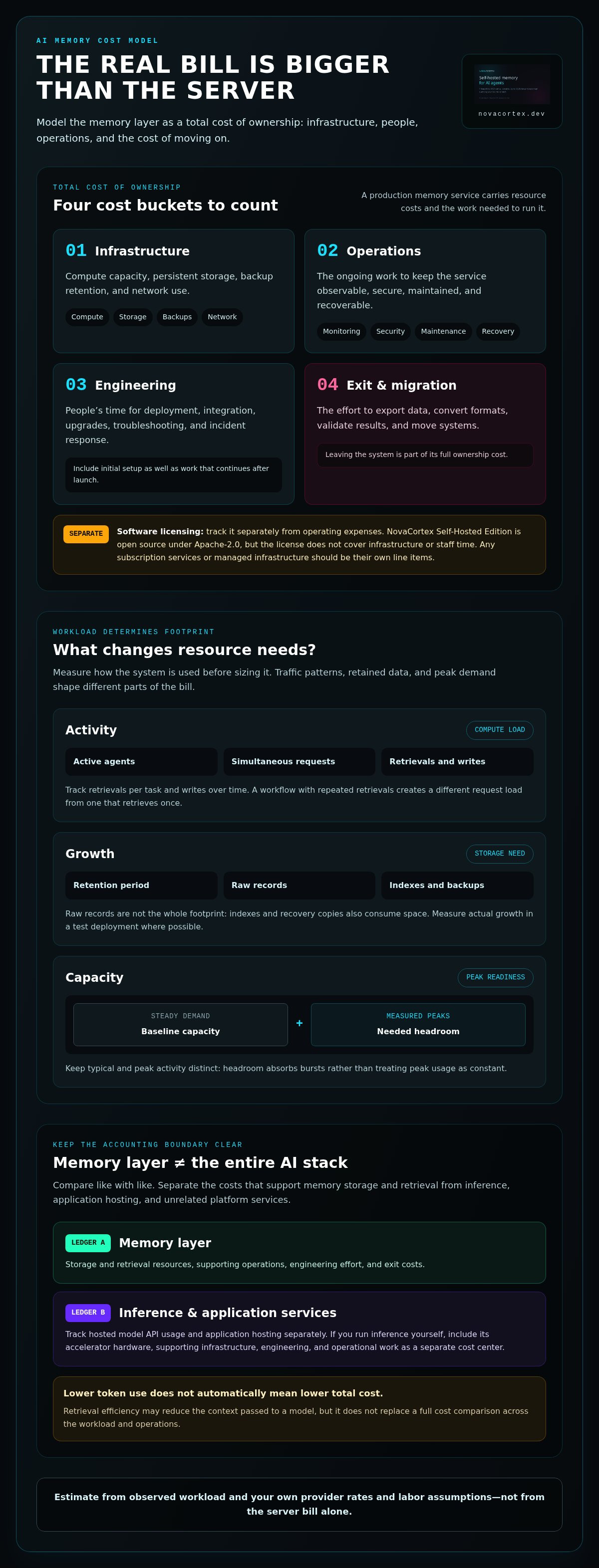
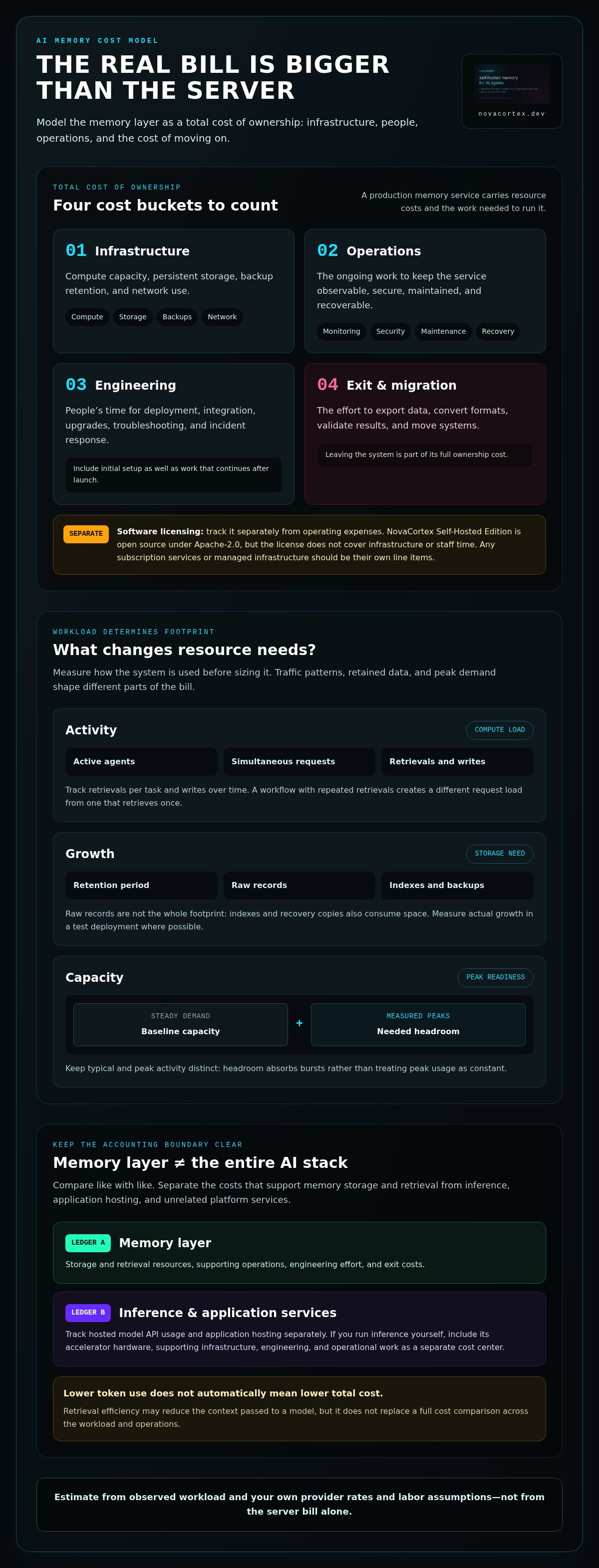
Set a clear accounting boundary. Include resources and labor that support memory storage and retrieval. Track model inference, application hosting, and unrelated AI platform services separately, even if they appear on the same cloud bill. Otherwise, you’re comparing unlike workloads and may mistake one component’s cost for another’s.
Which costs belong to an AI memory layer?
Count the resources that change with your deployment and workload: compute, storage, backups, network traffic, monitoring, and security controls. Add engineering time for initial deployment, upgrades, maintenance, and incident response. A small test instance and a production service with recovery requirements have different operational needs, so model the setup you intend to run.
- Infrastructure: Compute capacity, persistent storage, backup retention, and network use.
- Operations: Monitoring, security work, maintenance, incident handling, and recovery testing.
- Engineering: Deployment, integration, upgrades, and ongoing troubleshooting.
- Exit costs: Data export, format conversion, validation, and migration effort if you change systems.
Separate software licensing from operating expenses. NovaCortex Self-Hosted Edition is open source under Apache-2.0, but the license doesn’t cover your infrastructure or staff time. NovaCortex also offers subscription plans for advanced management features, enhanced security, multi-user controls, commercial licensing, and dedicated support, as well as managed infrastructure. Put any services you use in separate line items rather than treating them as part of the open-source license.
When does on-premise LLM hosting enter the comparison?
Include model-serving costs only if you also choose to run inference yourself. That decision adds a separate cost center: accelerator hardware, supporting infrastructure, and the engineering and operational work of keeping inference available. If your application calls a hosted model API, record those usage charges separately instead of assigning them to the memory layer.
This boundary matters because a memory system can be self-hosted while model inference remains managed, or both can run on infrastructure you control. Compare like with like, and identify which service each cost supports. For a deeper look at how memory components fit together, the self-hosted AI memory layer architecture explains the system boundary behind the calculation.
Start with two ledgers: one for memory-layer costs and another for inference and application services. That separation makes it easier to see the effect of changing one part of the stack. It also gives the next sizing step a clean baseline: the memory workload, its supporting operations, and nothing unrelated.
The Main Cost Drivers: Workload, Storage, Retrieval, and Operations
A memory service’s footprint follows its traffic pattern, not just the number of records it holds. Concurrent agents influence how much work must happen at once. Retrieval frequency and writes determine how often the system processes requests and updates data, while retained history drives storage growth. Measure these behaviors before estimating capacity. A quiet system with a large archive can have a different profile from a smaller one serving frequent, simultaneous requests.
Quotable rule: Agent activity determines when memory needs compute, while retained history, indexes, and recovery copies determine how much storage the system must carry.
How agent activity changes compute and storage needs
Track active agents and simultaneous requests, then measure retrievals and memory writes per task. An agent that retrieves context several times during a workflow creates a different request load from one that retrieves once. Record typical and peak activity separately: baseline capacity handles steady demand, while headroom absorbs bursts without treating peak usage as constant.
For storage, estimate how much data each write adds and how long it remains. Raw records aren’t the whole footprint. Indexes used to find relevant memories and backups kept for recovery also consume space. Measure actual growth in a test deployment where possible. Don’t apply a universal multiplier or assume every workload needs the same server size. The cost of self-hosted AI memory depends on these observed patterns.
- Activity: Active agents, concurrent requests, retrievals per task, and writes over time.
- Growth: Retention period and the size of raw records, indexes, and backups.
- Capacity: Steady-state demand plus the headroom needed for measured traffic peaks.
Retrieval efficiency can also affect model-token usage. Returning relevant context instead of repeatedly sending a full knowledge base may reduce the context passed to a model. But token reduction isn’t an equivalent reduction in total cost: infrastructure, storage, operations, and model pricing all shape the final result. Measure tokens and system resource use for the same tasks before projecting savings.
What ongoing operations add to the bill
Capacity is only part of the run cost. Production operation also takes time for monitoring, patching, backup tests, access-control reviews, and recovery planning. Estimate the engineering hours these tasks consume over a representative period, then compare that labor with managed infrastructure or support fees in the alternative model. The self-hosted versus managed AI memory trade-offs help frame which responsibilities shift between those operating models.
Don’t treat a backup as proof of recoverability. Include time to test restores and confirm that the service can return to an acceptable state. Also count the effort to patch dependencies and investigate alerts, even if those tasks don’t happen every day. A low-traffic deployment can still carry a meaningful labor burden because the system needs an owner even when requests are sparse.
To ground the estimate, use a representative test workload and log requests, latency, storage growth, and operational tasks. Then evaluate the NovaCortex self-hosted memory implementation against the requirements you measured, rather than sizing from a generic server recipe.
Self-Hosted vs Managed AI Memory: Compare the Full Cost, Not the Sticker Price
A fair comparison starts with the same workload and service expectations. Match request volume, retention, peak capacity, recovery needs, and support coverage before comparing costs. A low-priced managed plan that doesn’t meet your requirements isn’t equivalent to a self-hosted deployment sized for production.
The cost of self-hosted AI memory depends on workload, existing engineering skills, and your team’s capacity to operate the system. Self-hosting can reduce dependence on a provider, but it transfers more infrastructure and maintenance responsibility to your team.
Infrastructure: With self-hosting, you provision and pay for compute, storage, backups, and networking. Managed memory typically bundles or meters infrastructure through a recurring service charge.
Engineering ownership: Your team deploys, upgrades, monitors, and troubleshoots a self-hosted system. A managed service takes on some platform operations, though integration and application work remain yours.
Control: Self-hosting gives you direct control over deployment and where memory data resides. Managed services reduce infrastructure ownership in exchange for operating within the provider’s environment and controls.
Scaling: You plan and provision capacity for self-hosted growth and peak demand. Managed services handle more of the scaling mechanics, while usage limits, configuration, and billing still matter.
Support: Self-hosted support depends on your internal ownership and any separately purchased support. Managed offerings vary in the assistance and operational responsibility included in their recurring charges.
Keep fixed and variable costs distinct. Better retrieval can reduce how much context gets sent to a model, potentially lowering variable token use. It doesn’t remove fixed hosting, monitoring, or engineering work. Explore AI token-usage reduction techniques as a separate lever, then assess their effect against your actual usage and total operating costs.
When self-hosting can make financial sense
Self-hosting is worth modeling when you already have suitable infrastructure, experienced operators, and a predictable workload. Existing capacity may change the incremental cost, but it isn’t automatically free: account for the resources the memory service consumes and the effort needed to run it reliably. Compare those costs with a managed option serving the same workload.
Data control can also drive the decision. Keeping memory on infrastructure you control may be valuable for architectural or organizational reasons, but that value isn’t a guaranteed financial saving. Treat it as a separate decision factor rather than using it to make an incomplete cost comparison look favorable.
When managed memory may reduce total effort
A managed service can shift platform maintenance and infrastructure tasks away from your team. That can reduce internal labor, especially if you’d otherwise need to build operational capability for a limited workload. The trade-off is less direct infrastructure control and a recurring service charge, so compare staffing needs and support expectations alongside the fee.
Make the decision with measured workload data, not a universal rule. If your operators already maintain similar systems, self-hosting may fit. If that work would displace higher-priority engineering, managed operations may be more efficient. Price both models using equivalent capacity, retention, recovery, and support requirements.
How to Estimate Your Self-Hosted AI Memory Cost
A useful estimate starts with measured workload data and your own rates, not a generic server quote. Build a monthly view first, then include annual and one-time work so the cost of self-hosted AI memory reflects what your team will actually operate.
Build a workload profile before estimating spend
Record the workload the memory layer will serve: agents and users, concurrent tasks, retrievals per task, memory writes, and retention period. Where possible, measure current token use and separate memory context from other model inputs such as system instructions and user prompts. Mark unknowns as assumptions. Model low, expected, and high usage rather than treating one estimate as certain.
Then work through five steps:
- Define workload: Document users, agents, concurrency, retention, and expected service needs.
- Measure usage: Track retrievals, writes, storage growth, and memory-related token use.
- Size resources: Estimate compute, storage, backups, and network capacity from observed demand, including peak headroom.
- Price operations: Add monitoring, maintenance, backup testing, and engineering time using your own rates.
- Compare alternatives: Apply the same workload and service expectations to managed options.
Keep model inference and application hosting outside the memory-layer estimate unless they’re part of the deployment being priced. Otherwise, unrelated charges can distort the comparison.
Compare scenarios without hiding engineering time
Use current provider quotes or internal resource rates for infrastructure and storage. Estimate operational hours separately, then apply your organization’s labor assumptions. Include migration or exit work when relevant, along with backup storage, monitoring, and the time required to test recovery. Don’t silently treat existing staff capacity as free.
Use a worksheet with the same categories each month. For example:
- Monthly recurring: Baseline compute and storage + usage-driven growth + backup and network costs + monitoring or support + operational hours multiplied by your labor rate.
- Annual total: Monthly recurring total multiplied by 12 + annual maintenance or recovery work + any one-time setup or migration costs included in that year.
Write down the assumptions beside each line: retained-data growth, backup retention, expected concurrency, and maintenance hours. This makes the estimate auditable and easier to update as measured usage replaces guesses.
Finally, run sensitivity checks. Increase concurrency, extend history retention, and vary retrieval volume one at a time, then together. Compare the resulting monthly and annual totals with a managed alternative under the same scenarios. If a small change in one assumption sharply changes the result, measure that input before committing to a capacity plan.
Where NovaCortex Fits in a Self-Hosted AI Memory Cost Model
Evaluate NovaCortex Self-Hosted Edition after you’ve defined the workload and priced the work required to operate it. It’s an open-source, privacy-first memory layer under the Apache-2.0 license, designed to store knowledge locally on infrastructure you control. That makes it an option for teams weighing data ownership and portability, not a shortcut around infrastructure, maintenance, or production responsibility.
Keep the software choice distinct from the deployment choice. The license doesn’t price your server, storage, backups, or engineering time. NovaCortex also offers paid subscriptions for advanced management features, enhanced security, multi-user controls, commercial licensing, and dedicated support, as well as managed infrastructure. Include these services separately in your model when they’re part of your setup. The cost of self-hosted AI memory still depends on your environment and workload.
Map NovaCortex capabilities to the cost model
Local deployment lets you choose where the memory layer runs, such as on a server, VPS, or Raspberry Pi. That control can support specific infrastructure and data-location preferences, but the resources and operations remain part of your estimate. Portability matters too: Portable Memory Format (PMF) is designed to reduce vendor lock-in, which is relevant when evaluating future migration effort. It doesn’t make migration cost-free.
NovaCortex reduces token usage by up to 98% compared with sending entire knowledge bases. Treat that figure as a comparison with that specific approach, not as a forecast of total-cost reduction. Measure model usage separately from hosting and operational costs, and test the effect against your own retrieval patterns.
- Infrastructure: Price the environment you intend to operate.
- Operations: Include deployment, monitoring, updates, and recovery work.
- Portability: Assess how data format and export affect a potential move.
- Usage: Measure token impact for your workload instead of applying it directly to total spend.
Decide whether the architecture fits your workload
Use your cost model to test fit across four dimensions. First, does measured demand justify the baseline and peak capacity you’d operate? Second, does your team have the time and skills to maintain the system? Third, does keeping memory on infrastructure you control matter to your architecture? Finally, would a portable format meaningfully support plans to change systems or deployment environments?
These are separate criteria, not a single savings calculation. A strong match on data control may justify self-hosting even if it doesn’t minimize spend. Conversely, a small or variable workload combined with limited operations capacity may make the maintenance burden outweigh the value of owning the deployment. Compare those trade-offs using measured workload and the service expectations you actually need.
Review the project against your requirements, then include its operational footprint in your comparison with managed alternatives. That keeps the decision grounded in architecture and evidence, rather than treating open-source access or token efficiency as a proxy for total cost.
Turn Your Cost Model Into a Deployment Decision
A cost model becomes useful when it guides a concrete next move. Use your estimates to decide what to validate in a small deployment, which workload assumptions need better measurements, and what operational work your team is prepared to own. The cost of self-hosted AI memory isn’t a fixed benchmark; it depends on your architecture, usage, and capacity to operate it.
If control and portability matter alongside spend, evaluate NovaCortex Self-Hosted Edition against those requirements. The project is open source under Apache-2.0, designed for user-controlled infrastructure, and includes a Portable Memory Format intended to reduce vendor lock-in. Treat these as architectural properties to assess, not as a promise of lower total cost. Compare the project with your workload and operating model before making a broader commitment.
Start with evidence, refine the model as you learn, and choose the deployment path that gives your team the right balance of control and operational load.
Frequently Asked Questions
Is self-hosted AI memory cheaper than a managed service?
Not automatically. The cost of self-hosted AI memory can be lower when demand is steady, infrastructure is already available, and an experienced team can operate it without substantial added labor. A managed service may cost less overall for modest or irregular usage if it avoids dedicated capacity and maintenance work. Compare the same retention, peak concurrency, recovery expectations, and support scope, then include recurring fees and internal engineering time.
Does open-source AI memory mean there are no operating costs?
No. An Apache-2.0 license covers software use, not the infrastructure or staff time needed to run it. Operators still need to account for compute, storage, networking, upgrades, security work, monitoring, and recovery tests. NovaCortex offers subscription plans and managed infrastructure, which should be priced separately if they’re part of your setup. Keep software access, self-managed operations, and paid services distinct in your budget.
How much server capacity does self-hosted AI memory need?
There’s no universal server size. Estimate capacity from simultaneous tasks, retrievals per task, write rate, retained history, and latency targets. Run a representative workload test and monitor resource use during normal and peak activity; include growth headroom and backup capacity. A pilot serving one agent won’t necessarily size a system expected to handle concurrent agents. Revisit the estimate as traffic and retention change, rather than relying on record count alone.
Can self-hosted AI memory run on a Raspberry Pi?
Yes. NovaCortex can be deployed on a Raspberry Pi, as well as on servers and VPS environments. That makes the device a deployment option, not a blanket production recommendation. Test with your own memory volume, simultaneous requests, retrieval latency, write behavior, and recovery process. A setup that works for development or low demand may not meet production expectations, so validate performance under representative load before relying on it.
Does reducing LLM token usage reduce total AI memory costs by the same amount?
No. Lower token usage may reduce variable model-call charges, but it doesn’t automatically lower fixed hosting, backup, monitoring, or labor costs. The overall change depends on what share of spending comes from model usage and whether retrieval patterns also affect infrastructure demand. Compare before-and-after measurements for the same tasks, and calculate token costs separately from memory-layer infrastructure and operating effort.
Do you need a GPU to run an AI memory layer?
Not necessarily. A memory layer stores and retrieves context; hosting the language model that uses that context is a separate architecture choice. If inference uses a hosted model, GPU costs belong to that provider’s usage rather than automatically to memory hosting. If you also run inference locally, include accelerator capacity and its operating overhead in a separate estimate. Size memory resources against the memory service’s own measured workload.
What costs are easy to overlook when self-hosting AI memory?
Engineering time is easy to omit. Count deployment and upgrade work, plus recurring effort for monitoring, security patches, access reviews, backup restore tests, and incident handling. Consider data export, format conversion, and validation if you later migrate. Since these tasks may be intermittent, estimate hours over a month or year instead of assuming they happen daily. Apply your organization’s labor rate to make the effort visible in the budget.
FAQ
Which costs belong to an AI memory layer?
Count the resources that change with your deployment and workload: compute, storage, backups, network traffic, monitoring, and security controls. Add engineering time for initial deployment, upgrades, maintenance, and incident response. A small test instance and a production service with recovery requirements have different operational needs, so model the setup you intend to run. Separate software licensing from operating expenses. NovaCortex Self-Hosted Edition is open source under Apache-2.0, but the license doesn’t cover your infrastructure or staff time. NovaCortex also offers subscription plans for advanced management features, enhanced security, multi-user controls, commercial licensing, and dedicated support, as well as managed infrastructure. Put any services you use in separate line items rather than treating them as part of the open-source license.
When does on-premise LLM hosting enter the comparison?
Include model-serving costs only if you also choose to run inference yourself. That decision adds a separate cost center: accelerator hardware, supporting infrastructure, and the engineering and operational work of keeping inference available. If your application calls a hosted model API, record those usage charges separately instead of assigning them to the memory layer. This boundary matters because a memory system can be self-hosted while model inference remains managed, or both can run on infrastructure you control. Compare like with like, and identify which service each cost supports. For a deeper look at how memory components fit together, the self-hosted AI memory layer architecture explains the system boundary behind the calculation. Start with two ledgers: one for memory-layer costs and another for inference and application services. That separation makes it easier to see the effect of changing one part of the stack. It also gives the next sizing step a clean baseline: the memory workload, its supporting operations, and nothing unrelated. A memory service’s footprint follows its traffic pattern, not just the number of records it holds. Concurrent agents influence how much work must happen at once. Retrieval frequency and writes determine how often the system processes requests and updates data, while retained history drives storage growth. Measure these behaviors before estimating capacity. A quiet system with a large archive can have a different profile from a smaller one serving frequent, simultaneous requests. Quotable rule: Agent activity determines when memory needs compute, while retained history, indexes, and recovery copies determine how much storage the system must carry.
Is self-hosted AI memory cheaper than a managed service?
Not automatically. The cost of self-hosted AI memory can be lower when demand is steady, infrastructure is already available, and an experienced team can operate it without substantial added labor. A managed service may cost less overall for modest or irregular usage if it avoids dedicated capacity and maintenance work. Compare the same retention, peak concurrency, recovery expectations, and support scope, then include recurring fees and internal engineering time.
Does open-source AI memory mean there are no operating costs?
No. An Apache-2.0 license covers software use, not the infrastructure or staff time needed to run it. Operators still need to account for compute, storage, networking, upgrades, security work, monitoring, and recovery tests. NovaCortex offers subscription plans and managed infrastructure, which should be priced separately if they’re part of your setup. Keep software access, self-managed operations, and paid services distinct in your budget.
How much server capacity does self-hosted AI memory need?
There’s no universal server size. Estimate capacity from simultaneous tasks, retrievals per task, write rate, retained history, and latency targets. Run a representative workload test and monitor resource use during normal and peak activity; include growth headroom and backup capacity. A pilot serving one agent won’t necessarily size a system expected to handle concurrent agents. Revisit the estimate as traffic and retention change, rather than relying on record count alone.
Can self-hosted AI memory run on a Raspberry Pi?
Yes. NovaCortex can be deployed on a Raspberry Pi, as well as on servers and VPS environments. That makes the device a deployment option, not a blanket production recommendation. Test with your own memory volume, simultaneous requests, retrieval latency, write behavior, and recovery process. A setup that works for development or low demand may not meet production expectations, so validate performance under representative load before relying on it.
Does reducing LLM token usage reduce total AI memory costs by the same amount?
No. Lower token usage may reduce variable model-call charges, but it doesn’t automatically lower fixed hosting, backup, monitoring, or labor costs. The overall change depends on what share of spending comes from model usage and whether retrieval patterns also affect infrastructure demand. Compare before-and-after measurements for the same tasks, and calculate token costs separately from memory-layer infrastructure and operating effort.
Do you need a GPU to run an AI memory layer?
Not necessarily. A memory layer stores and retrieves context; hosting the language model that uses that context is a separate architecture choice. If inference uses a hosted model, GPU costs belong to that provider’s usage rather than automatically to memory hosting. If you also run inference locally, include accelerator capacity and its operating overhead in a separate estimate. Size memory resources against the memory service’s own measured workload.
What costs are easy to overlook when self-hosting AI memory?
Engineering time is easy to omit. Count deployment and upgrade work, plus recurring effort for monitoring, security patches, access reviews, backup restore tests, and incident handling. Consider data export, format conversion, and validation if you later migrate. Since these tasks may be intermittent, estimate hours over a month or year instead of assuming they happen daily. Apply your organization’s labor rate to make the effort visible in the budget.