Cross-Agent Knowledge Sharing: Architectures, Trade-Offs, and Implementation

What if your agents could reuse a proven finding without inheriting an entire conversation? That’s the problem cross-agent knowledge sharing needs to solve. When useful discoveries stay trapped in one agent’s context, other agents repeat the work. Copying full histories is no fix: it uses context and can expose irrelevant information.
Shared knowledge should be useful, controlled, and current. Treat it as retrievable memory, not a transcript passed from agent to agent. Decide who can read or update each item, who owns it, and how to handle information that may become stale.
This article compares the main sharing patterns, including shared memory, handoffs, and federation. It explains how to choose an approach and build a practical path to reusable agent knowledge without giving up control of your data. You’ll also see how a self-hosted memory layer, a Portable Memory Format, and an MCP-Native Memory Server can fit into that architecture.
Key Takeaways
- Cross-agent knowledge sharing works best when agents retrieve approved, relevant knowledge instead of inheriting full conversation histories.
- Choose between handoffs, shared memory, and federation based on the level of reuse, control, and operational simplicity your workflow needs.
- Set clear rules for what agents can contribute and access, and how shared knowledge stays fresh.
- Separate agent-specific context from information approved for reuse, then evaluate whether sharing reduces duplicated work.
- Self-hosted memory, graph-native storage, and a portable format can support controlled knowledge reuse.
Cross-Agent Knowledge Sharing: Why Isolated Agents Repeat Work
A research agent verifies a configuration detail, then finishes its session. Later, a troubleshooting agent investigates the same issue from scratch because the result never left the first agent’s context. A third agent may reach a different conclusion because it sees different evidence. The system has capable workers, but no reliable way to reuse what they’ve learned.
Cross-agent knowledge sharing is the controlled reuse of relevant, interpretable information across distinct agents, without requiring them to share every message or private context. The goal isn’t to merge agents into one undifferentiated conversation. It’s to make selected knowledge available where it can help another task. A multi-agent system can coordinate agents through agreed communication methods, but effective coordination also depends on deciding what information should travel between them.
What counts as shared agent knowledge?
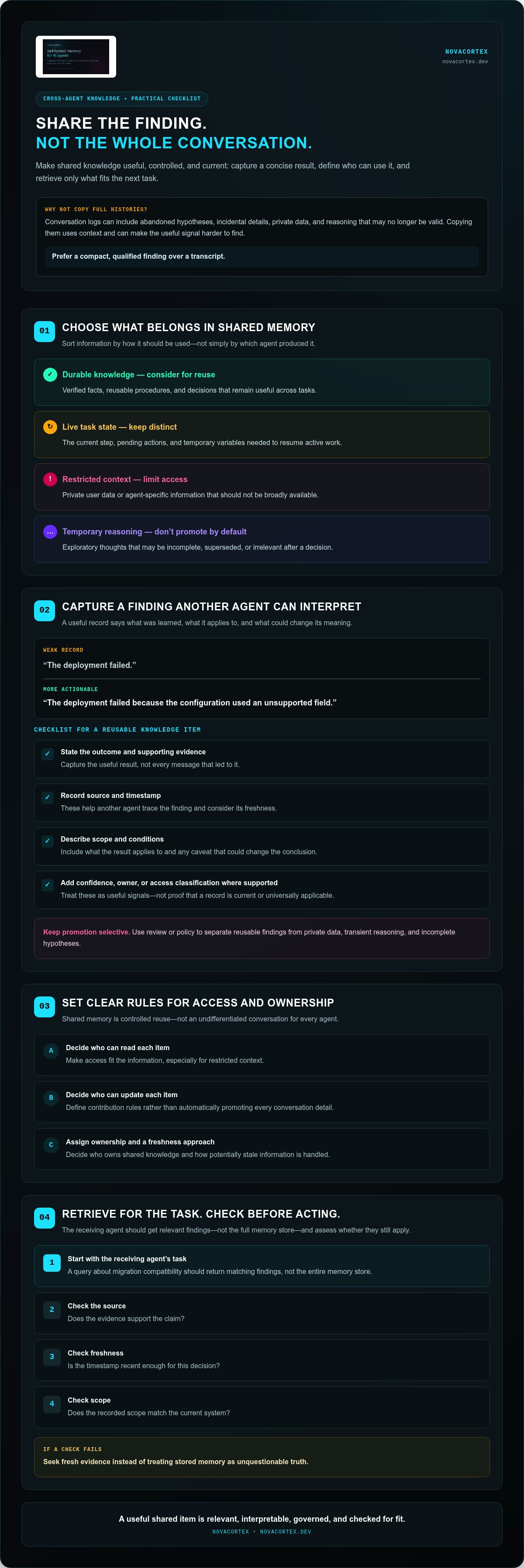
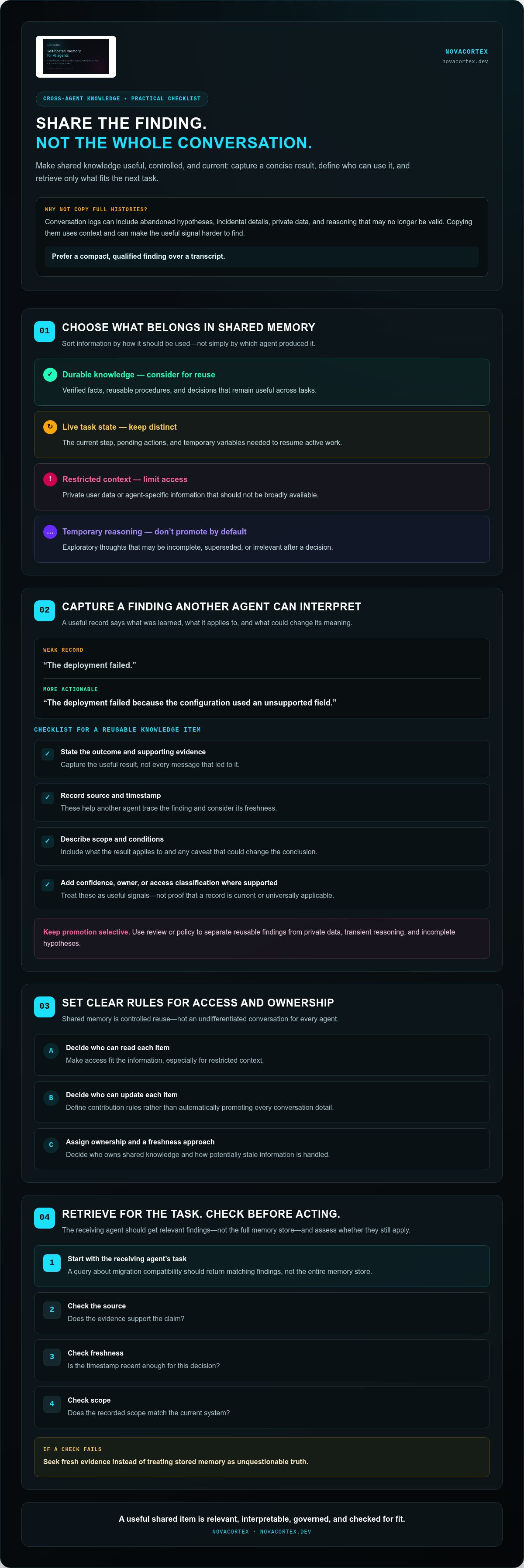
Shared knowledge is information likely to help another agent beyond the immediate exchange that produced it. For example, an agent might record a verified fact with its source, a completed task outcome, a procedure that worked, or a project decision and the reason behind it. “The deployment failed” is a weak record. “The deployment failed because the configuration used an unsupported field” gives the next agent something actionable.
Not every piece of context belongs in a shared store. Keep these categories distinct:
- Durable knowledge: verified facts, reusable procedures, and decisions that remain useful across tasks.
- Live task state: the current step, pending actions, and temporary variables needed to resume active work.
- Restricted context: private user data or agent-specific information that shouldn’t be broadly available.
- Temporary reasoning: exploratory thoughts that may be incomplete, superseded, or irrelevant once a decision is made.
Include enough context to explain what a result applies to, when it was established, and any conditions that affect its use. A bare statement can become a misleading rule when another agent applies it to a different system or task.
Why isolated agents lose useful context
Separate sessions create a clean boundary, but they also create a memory gap. If a researcher has compared options and a planner can’t access the conclusion, the planner may repeat the comparison. If neither agent can see the other’s verified evidence, their outputs can conflict. Repetition is especially costly when tasks recur or pass between specialized agents.
Copying the complete history doesn’t solve the underlying problem. Conversation logs contain abandoned hypotheses, incidental details, private data, and reasoning that may no longer be valid. Sending all of it uses more context and makes the useful signal harder to find. A compact, qualified finding is often more valuable than a transcript.
Shared memory isn’t necessary for every agent system. If agents handle isolated, one-off tasks, separate contexts may be simpler. The case for sharing grows when agents repeatedly investigate the same domain, depend on prior decisions, or need consistent answers. Start with the specific friction, then share only knowledge that can prevent duplicated work.
How Cross-Agent Knowledge Sharing Works: From Capture to Retrieval
Useful information needs a lifecycle. One agent produces a result, the system turns it into a structured knowledge item, access rules determine who can use it, and another agent retrieves it when a task calls for it. This is the operating loop behind practical cross-agent knowledge sharing. The design principle is simple: move a small, relevant signal, not an entire archive.
This pattern fits distributed work, where agents exchange knowledge, resources, or responsibilities to solve problems. Hewlett Packard Enterprise describes that broader model as Distributed Artificial Intelligence (DAI). For implementation, focus on what gets retained, how it is described, who may access it, and how the next agent decides whether it still applies.
Capture and structure knowledge for reuse
Capture should be selective. When an agent completes a task, it can propose a concise record of the outcome rather than promoting every message it saw. After checking a migration, for example, it might store the verified compatibility result, the systems and version range it applies to, the evidence source, and any caveat that could change the conclusion.
Useful metadata makes an item traceable and governable. Record its source, timestamp, scope, and confidence, along with an owner or access classification where the system supports those controls. These are signals, not proof: a high-confidence record can still be out of date, and a recent result can still apply only to a narrow environment. Automatically promoting every conversation detail is not a safe default. Use review or policy to separate reusable findings from private data, transient reasoning, and incomplete hypotheses.
Retrieve context for the receiving agent
Retrieval should start with the receiving agent’s task. A query about migration compatibility should return matching findings, not the full memory store. The agent can then assess the result before acting: Does its source support the claim? Is the timestamp recent enough for this decision? Does the recorded scope match the current system? If those checks fail, the agent should seek fresh evidence instead of treating stored memory as unquestionable truth.
A practical flow looks like this:
- Capture a useful outcome and its supporting evidence.
- Structure it with scope and metadata so another agent can interpret it.
- Apply access rules before the item becomes available for reuse.
- Retrieve selectively when a later task matches its subject and permissions.
MCP can provide a standardized way for an agent to access a memory server when the system is configured to do so. It doesn’t mean every agent automatically shares or synchronizes knowledge. The dedicated MCP-Native Memory Server article covers protocol-specific details. A self-hosted memory layer can keep stored knowledge on your infrastructure, while a portable format can support moving it between compatible environments. Explore NovaCortex’s open-source memory infrastructure.
Shared Memory, Handoffs, or Federation: Compare the Main Patterns
There’s no single architecture for every workflow. A bounded task may need a direct handoff; recurring collaboration may justify a shared knowledge store; teams with separate data owners may need federated retrieval. Compare the patterns by coupling, control, freshness, operational effort, and reuse. Choose the approach that meets the workflow’s needs without creating more governance work than the problem warrants.
| Pattern | Coupling | Access and freshness | Operational effort | Best fit |
|---|---|---|---|---|
| Direct handoff | Agents are linked for a specific task or workflow. | The sender chooses what to pass; updates usually require another handoff. | Low for simple flows, higher as handoffs multiply. | Bounded tasks where one agent’s output is the next agent’s input. |
| Shared store | Agents depend on a common retrieval layer. | Central policies can govern access and updates; stale records still need review. | Requires storage, retrieval, permissions, and lifecycle rules. | Durable knowledge that multiple agents use repeatedly. |
| Federated retrieval | Agents connect to separate sources through coordinated queries. | Source-level controls remain possible; freshness depends on each source and retrieval path. | Higher coordination effort across sources and permissions. | Distributed knowledge that shouldn’t be consolidated in one store. |
Direct handoffs versus shared memory
A handoff is a focused transfer. A research agent can send its findings and evidence to a planner for the next step, without making those findings permanent or available to every agent. This keeps the path simple when tasks have clear boundaries. But when different workflows repeatedly need the same durable information, passing it along each time can create duplication and inconsistent versions.
A shared store supports recurring retrieval, but common storage alone isn’t a sharing architecture. Agents need a way to find relevant records, and policies must define who can read, add, revise, or retire them. Without those controls, one agent’s outdated or sensitive record can become another agent’s confident mistake.
Centralized and federated access trade-offs
A centralized store gives the system one place to apply shared governance and organize reusable knowledge. It can simplify operations when a team has authority to manage that information centrally. It also concentrates responsibility: permissions, freshness checks, and corrections must work across the store.
Federation keeps knowledge in separate systems and retrieves it across those boundaries when needed. That can preserve local ownership, but queries must coordinate across sources, each with its own access rules and update patterns. Portability matters too. A Portable Memory Format can help reduce dependence on one storage implementation, but it doesn’t by itself solve authorization or freshness. For cross-agent knowledge sharing, choose handoffs for bounded transfers, shared storage for governed reuse, and federation when knowledge must remain distributed.
Design Cross-Agent Sharing with Clear Access, Freshness, and Evaluation Rules
Shared knowledge needs operating rules before it needs scale. Without them, an agent can retrieve a finding that’s stale, outside its scope, or meant for another user. A staged design keeps cross-agent knowledge sharing useful without turning a shared memory layer into an uncontrolled data pool.
Set boundaries before agents share
Start by classifying what agents may contribute and retrieve. Keep agent-specific working context separate from information approved for wider reuse. A project decision might be shareable across a project team, while private user data or a task’s temporary state remains restricted to its original context.
Define ownership, too. Someone or some process must be responsible for correcting a record, marking it expired, or withdrawing it when its basis changes. Apply least-privilege access: an agent should receive only the information and actions required for its task, not broad access simply because it can query the same system.
Build a staged operating checklist
Use this sequence to turn policy into an implementable design:
- Define shared knowledge. Identify which facts, decisions, outcomes, or procedures have value beyond one task. Exclude sensitive or temporary material unless there’s a clear, authorized reason to retain it.
- Set boundaries. Label knowledge by scope and audience, and define who can create, read, revise, expire, or remove it. Include an owner or review path for records that can become obsolete.
- Choose retrieval. Match the access pattern to the task. Retrieve narrowly by relevance and permission rather than exposing a complete store to every agent. Long-term memory is an adjacent persistence concern: it helps preserve useful information over time, while sharing rules determine which agents can use it.
- Evaluate outcomes. Compare similar tasks with and without retrieved knowledge. Check whether sharing reduces repeated work without degrading answer quality or crossing access boundaries.
Evaluation needs more than a success score. Track retrieval relevance, duplicate investigations, outdated results, and access-policy failures. Review cases where an agent retrieved information but ignored it, or used a record outside its intended scope. These examples can show whether the issue lies in search, metadata, policy, or the knowledge itself. Also watch for unwanted disclosure, even if the receiving agent produced a correct answer.
Persistence and sharing solve related but distinct problems. An AI agent long-term memory design concerns what information remains available across sessions; cross-agent policy adds the question of which other agents may use it. Keep those controls explicit rather than assuming persistence implies permission.
Run a small evaluation before widening access. Use representative recurring tasks, record a baseline, then compare outcomes after retrieval is enabled. If duplicated work falls but stale answers or irrelevant retrievals rise, adjust scope, review rules, or retrieval criteria before expanding the shared set.
Where NovaCortex Fits in a Cross-Agent Knowledge Architecture
NovaCortex fits at the memory layer of an agent system. It provides infrastructure for storing and retrieving reusable knowledge. Your agents and orchestration logic determine what to capture, when to retrieve it, and which agent is allowed to use it.
That separation matters. A memory layer can make knowledge available without deciding that every agent should see every record. Cross-agent knowledge sharing remains an architectural choice built around retrieval and governance, not an automatic side effect of connecting agents to common storage.
Map NovaCortex components to the sharing design
With the NovaCortex Self-Hosted Edition, knowledge is stored on your infrastructure. This gives your system a locally controlled foundation for reusable memory. NovaCortex also uses graph-native storage to represent connected knowledge for retrieval. Your architecture still needs explicit rules for what agents can access and how records are reviewed as they age.
The Portable Memory Format (PMF) addresses portability at the memory-format level and is designed to reduce vendor lock-in. Portability is not universal compatibility: the receiving environment must support the format and its data. The MCP-Native Memory Server provides an integration component for agent systems using MCP. Agents don’t automatically synchronize; the application’s configured retrieval and governance determine how shared knowledge moves.
Knowledge Buckets are another component in the NovaCortex offering. Include them in your design alongside your knowledge boundaries and access policies. A component’s name alone doesn’t define authorization behavior.
Choose a practical next step
Assess the memory layer against your existing architecture before expanding access. Identify where knowledge will live, which agents need to retrieve it, and how your system will manage permissions, updates, and removal. Review the MCP-Native Memory Server and PMF documentation so integration and portability decisions fit your intended workflow.
NovaCortex is open source under the Apache-2.0 license. That license applies to the open-source software and is distinct from separately offered commercial terms. Its self-hosted approach and portable format make NovaCortex an option to evaluate when data control and reduced dependence on a single memory platform are architectural requirements.
Start with a narrow use case, such as a recurring workflow where agents need access to the same approved findings. Test retrieval and permissions against that workflow before broadening the knowledge available. This grounds implementation in an observable need rather than adding shared memory simply because multiple agents exist.
Build a Memory Layer That Stays Yours
Your next step doesn’t need to be a platform-wide rollout. Pick one recurring workflow, define what knowledge agents may reuse, and test whether carefully retrieved context reduces repeated effort without weakening access controls. That gives your team evidence for expanding cross-agent knowledge sharing, or a clear signal to revise the design first.
For teams assessing the memory layer itself, NovaCortex offers self-hosted memory stored on user infrastructure, open-source software under Apache-2.0, and a Portable Memory Format designed to reduce vendor lock-in. These choices support a practical goal: keep the knowledge layer under your control while building a reusable foundation for agent workflows.
Start small. Make the boundaries explicit, measure the results, and expand only when the system earns it. A controlled pilot can turn isolated agent findings into dependable shared capability.
Build on what works, keep ownership clear, and let useful knowledge travel only where it belongs.
Frequently Asked Questions
Can AI agents share knowledge without sharing their full conversation histories?
Yes. Agents can exchange a compact record such as a validated result, its source, and the conditions under which it applies. For example, a support agent could retrieve an approved product limitation without receiving the customer’s full support transcript. Keep the record focused on the receiving task, and exclude unrelated messages, personal details, and intermediate reasoning. This reduces context clutter while preserving information another agent can act on.
Is cross-agent knowledge sharing the same as multi-agent communication?
No. Multi-agent communication is the broader exchange of messages or task instructions between agents. Cross-agent knowledge sharing concerns making selected information reusable beyond a single exchange. An orchestrator might tell an agent to summarize a report, which is communication; saving the report’s verified conclusion for another workflow to retrieve later is knowledge reuse. A system may support communication without retaining shared knowledge, or provide shared memory alongside its messaging layer.
What happens when two agents store conflicting information?
Don’t silently treat the newest record as correct. Compare the claims’ sources, timestamps, scope, and evidence, then mark the conflict for resolution or retrieve authoritative source material. For instance, two agents may record different configuration requirements because they examined different software versions. Preserve that version context, flag incompatible claims, and prevent unresolved records from being presented as settled guidance. A designated owner or review process should determine which record remains active.
How can teams limit sensitive information in shared agent memory?
Classify information before it enters shared memory, and make access depend on the receiving agent’s role and task. A useful control is to store a redacted finding, not the underlying customer record, when the detail itself isn’t needed. Separate user-specific memory from team-wide knowledge, restrict write access as well as read access, and test that a query from an unauthorized agent returns no protected content.
Can agents built with different frameworks use the same shared knowledge layer?
Potentially, if each framework can connect through a supported interface and interpret the stored representation. A portable format can reduce dependence on one memory implementation, but it doesn’t guarantee that every framework can read or use every record without adaptation. Test a small exchange end to end: write a sample item, retrieve it from the other agent, and verify its meaning, metadata, and access behavior survive the handoff.
How do you know whether cross-agent knowledge sharing is working?
Measure whether it improves real task performance, not just how many records the system stores. Compare similar tasks with and without shared retrieval, then track repeated research, answer quality, irrelevant results, outdated claims, and permission failures. Review examples where an agent retrieved a useful record but ignored it, or relied on one that no longer applied. Those outcomes help distinguish retrieval problems from weak knowledge or unclear policies.
Does shared agent memory have to be centralized?
No. A central store can simplify discovery and shared policy, while a federated design can leave records in their originating systems and retrieve them across boundaries. The latter may suit teams with separate data owners, but it requires coordination among sources and their access rules. A hybrid approach is also possible: centralize approved, reusable summaries while keeping sensitive or system-specific records under local control.
FAQ
What counts as shared agent knowledge?
Shared knowledge is information likely to help another agent beyond the immediate exchange that produced it. For example, an agent might record a verified fact with its source, a completed task outcome, a procedure that worked, or a project decision and the reason behind it. “The deployment failed” is a weak record. “The deployment failed because the configuration used an unsupported field” gives the next agent something actionable. Not every piece of context belongs in a shared store. Keep these categories distinct: Include enough context to explain what a result applies to, when it was established, and any conditions that affect its use. A bare statement can become a misleading rule when another agent applies it to a different system or task.
Can AI agents share knowledge without sharing their full conversation histories?
Yes. Agents can exchange a compact record such as a validated result, its source, and the conditions under which it applies. For example, a support agent could retrieve an approved product limitation without receiving the customer’s full support transcript. Keep the record focused on the receiving task, and exclude unrelated messages, personal details, and intermediate reasoning. This reduces context clutter while preserving information another agent can act on.
Is cross-agent knowledge sharing the same as multi-agent communication?
No. Multi-agent communication is the broader exchange of messages or task instructions between agents. Cross-agent knowledge sharing concerns making selected information reusable beyond a single exchange. An orchestrator might tell an agent to summarize a report, which is communication; saving the report’s verified conclusion for another workflow to retrieve later is knowledge reuse. A system may support communication without retaining shared knowledge, or provide shared memory alongside its messaging layer.
What happens when two agents store conflicting information?
Don’t silently treat the newest record as correct. Compare the claims’ sources, timestamps, scope, and evidence, then mark the conflict for resolution or retrieve authoritative source material. For instance, two agents may record different configuration requirements because they examined different software versions. Preserve that version context, flag incompatible claims, and prevent unresolved records from being presented as settled guidance. A designated owner or review process should determine which record remains active.
How can teams limit sensitive information in shared agent memory?
Classify information before it enters shared memory, and make access depend on the receiving agent’s role and task. A useful control is to store a redacted finding, not the underlying customer record, when the detail itself isn’t needed. Separate user-specific memory from team-wide knowledge, restrict write access as well as read access, and test that a query from an unauthorized agent returns no protected content.
Can agents built with different frameworks use the same shared knowledge layer?
Potentially, if each framework can connect through a supported interface and interpret the stored representation. A portable format can reduce dependence on one memory implementation, but it doesn’t guarantee that every framework can read or use every record without adaptation. Test a small exchange end to end: write a sample item, retrieve it from the other agent, and verify its meaning, metadata, and access behavior survive the handoff.
How do you know whether cross-agent knowledge sharing is working?
Measure whether it improves real task performance, not just how many records the system stores. Compare similar tasks with and without shared retrieval, then track repeated research, answer quality, irrelevant results, outdated claims, and permission failures. Review examples where an agent retrieved a useful record but ignored it, or relied on one that no longer applied. Those outcomes help distinguish retrieval problems from weak knowledge or unclear policies.
Does shared agent memory have to be centralized?
No. A central store can simplify discovery and shared policy, while a federated design can leave records in their originating systems and retrieve them across boundaries. The latter may suit teams with separate data owners, but it requires coordination among sources and their access rules. A hybrid approach is also possible: centralize approved, reusable summaries while keeping sensitive or system-specific records under local control.