Cross-Platform AI Memory: Engineering Persistent Context Across the Agentic Stack

Your AI agents are suffering from expensive, systemic amnesia. Every time you switch LLM providers or spin up a new instance, you're forced to dump the same massive knowledge bases into the prompt window just to maintain basic coherence. This isn't just inefficient. It's an architectural failure that tethers your data to proprietary silos. Engineering a robust cross-platform AI memory layer is no longer a luxury for experimental labs. It's a requirement for any developer who refuses to pay a perpetual "Context Repetition Tax" to model providers.
You already know that standard RAG pipelines often fail to capture the complex, long-term relationships your agents need to stay relevant across different environments. This article will show you how to architect a sovereign, portable memory layer that ends agent amnesia and slashes token waste by 98%. We'll explore how to implement the NovaCortex Self-Hosted Edition and utilize the Portable Memory Format (PMF) to ensure your context remains yours. You'll learn to deploy an MCP-Native Memory Server and use Knowledge Buckets to build a unified, graph-native context layer that follows your agents anywhere.
Key Takeaways
- Decouple agent cognition from specific LLM providers to build a permanent, model-agnostic knowledge base that persists across any stack.
- Implement cross-platform AI memory using the Portable Memory Format (PMF) to ensure your data remains portable and independent of proprietary vector silos.
- Reduce API costs and token waste by 98% using Knowledge Buckets for surgical context retrieval instead of inefficient context dumping.
- Reclaim digital sovereignty by self-hosting your memory layer on private infrastructure, providing total control over sensitive organizational data.
- Integrate persistent context into frameworks like LangChain and CrewAI using the NovaCortex Self-Hosted Edition for immediate architectural upgrades.
Beyond Fragmented Context: The Architecture of Cross-Platform AI Memory
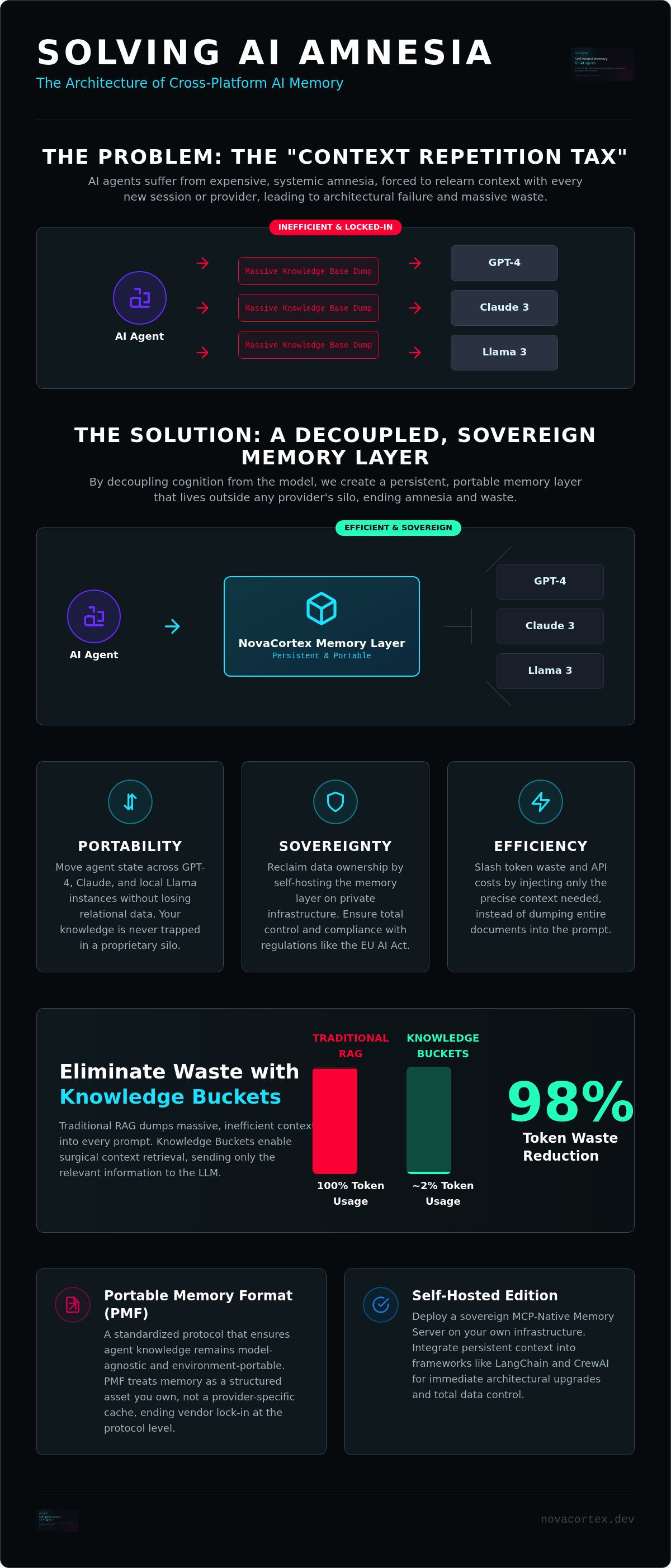
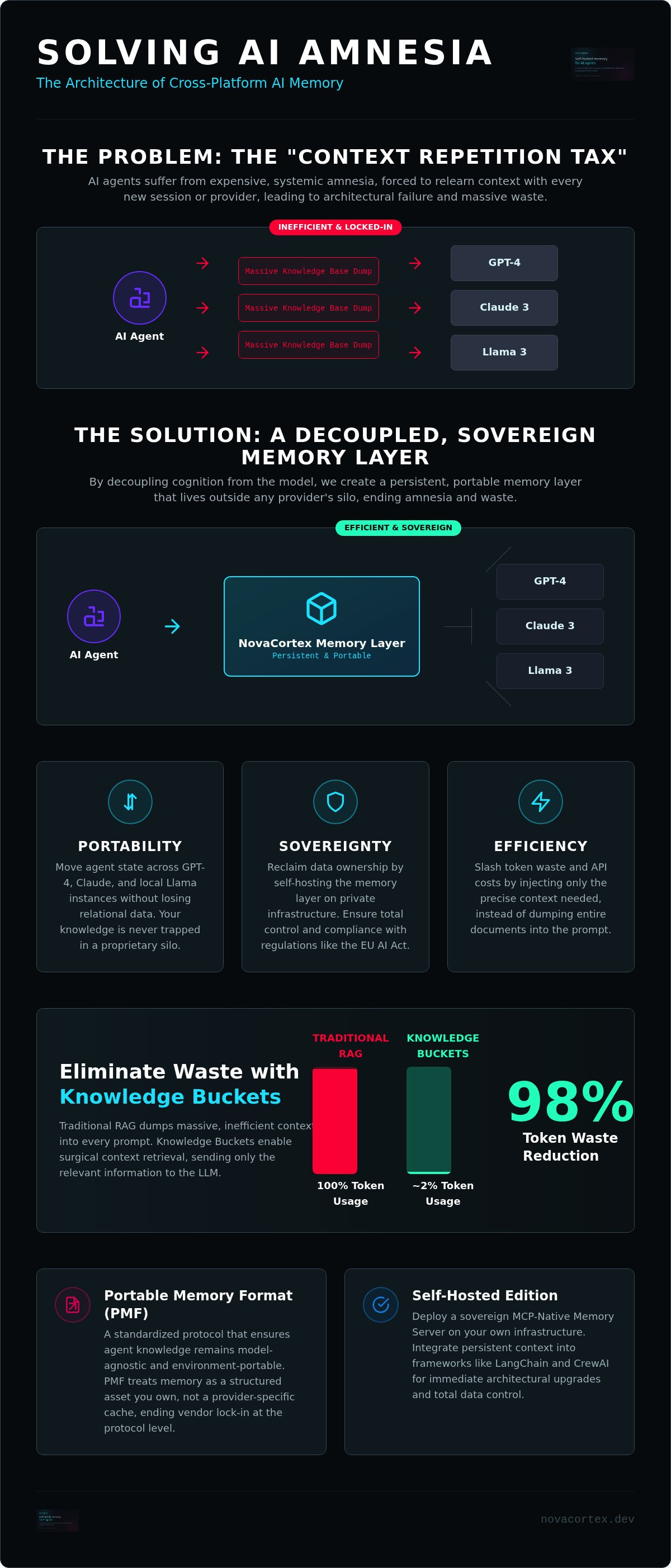
Current AI architectures treat context as a disposable resource. Every time you initialize a session with a new LLM provider, you're essentially lobotomizing your system and forcing it to relearn your business logic from scratch. This isn't just a minor friction point. It's an engineering failure known as the "Context Repetition Tax." Cross-platform AI memory solves this by decoupling cognition from the model, creating a persistent, portable layer that lives outside the provider's silo. By 2026, the industry is shifting away from ephemeral "Context Clouds" toward sovereign memory layers that allow AI agents to maintain a continuous state, regardless of the underlying hardware or model provider.
Transitioning from simple chatbots to truly autonomous agents requires more than just better prompts. It requires a stable foundation of persistent state. When memory is decoupled from the compute layer, your agents stop being reactive and start becoming proactive. They remember past interactions, maintain long-term goals, and evolve their knowledge base without manual intervention. This shift is foundational for developers who want to build systems that actually scale without exploding their API budgets or sacrificing data privacy.
The Three Pillars of Persistent Cognition
- Portability: Your agent's state shouldn't be trapped in a single thread or proprietary database. True portability means moving state across GPT-4, Claude, and local Llama instances without losing a single byte of relational data.
- Sovereignty: Data ownership is a technical requirement, not a suggestion. As global regulations like the EU AI Act and Australia's Privacy Act 1988 evolve, hosting memory on user-controlled infrastructure becomes the only way to ensure compliance and security.
- Efficiency: Stop dumping entire PDFs into the prompt. Modern memory architectures use Knowledge Buckets to inject only the surgical context needed, slashing token waste by up to 98% compared to naive RAG implementations.
Why Traditional RAG Fails the Cross-Platform Test
Standard Retrieval-Augmented Generation (RAG) was never built for multi-agent, multi-platform workflows. Centralized vector databases introduce a massive latency bottleneck that kills real-time performance. Even worse, switching between embedding models creates "semantic drift," where your agent loses the ability to accurately retrieve facts because the vector space has shifted. This instability is why a self-hosted AI memory layer is mandatory for serious builders. It provides a stable, graph-native anchor that remains consistent even when you swap out your LLM or embedding provider. Without a decoupled state, your agents are just chatbots with better prompts. With it, they become autonomous systems capable of long-term reasoning across the entire agentic stack.
Engineering Portability: PMF and the End of Vendor Lock-in
Vendor lock-in is an architectural choice. If your agent's knowledge is trapped in a proprietary vector database tied to a specific LLM's embedding space, you don't own your context; you're just renting it. Breaking this cycle requires a standardized protocol for cross-platform AI memory. This is where the Portable Memory Format for AI (PMF) becomes essential. PMF ensures that knowledge remains model-agnostic and environment-portable, allowing you to move state from Claude to a local Llama instance without re-indexing your entire knowledge base. It treats memory as a structured asset rather than a provider-specific cache.
Enforcing data ownership at the protocol level allows engineers to build systems that resist the "Context Repetition Tax." This isn't just about convenience. It's about future-proofing against shifting regulations, such as the EU AI Act's 2027 compliance deadlines for high-risk systems. Implementing privacy-preserving memory management ensures that sensitive agent states remain under your control. By decoupling the memory format from the application layer, you eliminate the risk of your agent's "brain" being held hostage by a single SaaS provider's pricing whims or API changes.
Graph-Native vs. Vector Databases
The Redis vs graph memory for AI agents debate highlights a fundamental shift in how we handle state. Vector databases excel at similarity search, but they are often insufficient for multi-step reasoning. They provide blurry snapshots of data. In contrast, graph-native storage maps complex relationships as explicit nodes and edges. This enables Graph-based RAG, which provides the precision-engineered retrieval necessary for autonomous tasks. When an agent needs to understand the "why" behind a decision, a graph provides the audit trail that a flat vector space cannot reconstruct.
The Model Context Protocol (MCP) Advantage
Standardizing how context is served is the final piece of the portability puzzle. An MCP native memory server creates a unified interface that any agent framework can consume. This eliminates the need for fragile API wrappers and custom connectors for every new tool you add to your stack. By using cross-platform AI memory standards like MCP, you achieve low-latency state synchronization across disparate frameworks. It turns memory into a shared utility rather than a siloed feature. If you're ready to stop re-explaining intent to every model, you can explore the open-source implementation of these protocols to start building sovereign systems today.
Sovereign Deployment: Hosting Memory on Private Infrastructure
Trusting a third-party API with your entire organizational knowledge base isn't just risky. It's an architectural vulnerability. For enterprises, managed "Memory-as-a-Service" models create a single point of failure and a massive compliance headache. With Gartner projecting that over 50% of large enterprises will face mandatory AI compliance audits by 2026, the case for self-hosting is non-negotiable. Building a cross-platform AI memory layer on private infrastructure ensures that your data never leaves your security perimeter. NovaCortex Self-Hosted Edition is engineered for these zero-trust environments, providing an Apache-2.0 licensed foundation that prioritizes digital sovereignty over vendor convenience. You shouldn't have to choose between advanced cognition and data safety.
Deployment flexibility is the hallmark of a mature engineering stack. You can run your memory layer on everything from a Raspberry Pi at the network edge to private VPS nodes in a secure cloud. By utilizing an open-source license, you ensure that your infrastructure isn't a black box. You have the freedom to audit, modify, and scale your memory servers without waiting for a provider's roadmap. This independence is foundational for developers who need to maintain persistent state across disparate agent frameworks while adhering to strict internal security protocols.
Hardware Requirements for Local Memory Layers
- Optimized Resource Allocation: Unlike bloated enterprise databases, a lean memory layer can run efficiently on low-resource VPS or edge devices by prioritizing memory-native storage over disk-heavy configurations.
- Latency Reduction: Keeping context local eliminates the round-trip latency of cloud APIs, which is critical for real-time agentic reasoning.
- Horizontal Scalability: Start with a single local instance and move to a distributed private cluster as your knowledge base expands, ensuring your infrastructure grows with your needs.
The Cost of Privacy: Self-Hosted vs. Managed
Managed memory providers hide their true long-term costs behind tiered pricing and retrieval fees. Over time, these "convenience" charges dwarf the operational expense of self-hosting your own stack. Beyond the balance sheet, data sovereignty is a massive competitive advantage in the 2026 AI market. Regulations like the Australia Privacy Act 1988 and the Connecticut Data Privacy Act now demand absolute transparency in how automated systems handle personal data. When you evaluate self-hosted vs managed AI memory, the long-term ROI is clear. Owning your infrastructure means you aren't just protecting your data; you're protecting your margins from the inevitable price hikes of proprietary SaaS platforms.
Eliminating Waste: Slashing Token Usage via Knowledge Buckets
Context dumping is lazy engineering. Shoving a 500-page technical manual into a 128k context window every time an agent needs to check a single function signature is a recipe for architectural bankruptcy. This "spray and pray" approach to RAG doesn't just inflate your API bill; it degrades model performance through context dilution. Building a cross-platform AI memory stack isn't just about persistence. It's about pruning. By implementing Knowledge Buckets, you can achieve a verified 98% reduction in token waste. You stop paying for redundant data and start paying for utility.
The core of this efficiency lies in surgical context injection. Instead of treating your agent's knowledge as a monolithic blob, Knowledge Buckets modularize state. You retrieve only the specific nodes required for the current task. This high-precision approach is the only way to scale complex systems without hitting the economic ceiling of LLM provider pricing. Intelligent AI agent long term memory management transforms context from a liability into a lean, high-velocity asset.
How Knowledge Buckets Organize Agent Intelligence
Knowledge Buckets act as specialized containers for different data types. You categorize information by utility, frequency of access, and sensitivity. This structure allows for sophisticated multi-agent synchronization. One agent can access a "Technical Docs" bucket while another pulls from a "User Preferences" bucket. They share what's necessary without leaking the full context. This isolation also prevents "context poisoning," where irrelevant or outdated information from one session corrupts the reasoning of another. It's clean, modular, and engineered for high-stakes environments.
Benchmarking Efficiency
The metrics don't lie. Standard RAG relies on vector similarity search, which is fundamentally a "fuzzy" retrieval method. It often pulls in "neighboring" data that has no actual utility for the prompt. NovaCortex graph-native retrieval identifies explicit relationships, delivering higher precision with fewer tokens. In local environments, the latency difference is stark. Local graph lookups bypass the network overhead of cloud-based vector databases entirely. Token Efficiency is the ratio of retrieved utility to total context window consumed. When you optimize this ratio, you aren't just saving money. You're increasing the "intelligence density" of every prompt you send.
Implementing NovaCortex: The Path to Sovereign AI Agency
Transitioning from architectural theory to production deployment requires a shift in focus from model capabilities to infrastructure reliability. Implementing cross-platform AI memory starts with the NovaCortex Self-Hosted Edition. Unlike managed services that lock you into a proprietary API, this stack is designed to be pulled via Docker or built from source, giving you immediate control over the memory server and the underlying graph-native storage. Initial configuration involves defining your Knowledge Buckets and setting up the MCP-native integration. This ensures that your memory layer is ready to serve context to any agent framework in your stack from day one.
Integration is where the value of a decoupled memory layer becomes visible. NovaCortex provides standardized hooks for existing frameworks like LangChain, AutoGPT, and CrewAI. By using the MCP-Native Memory Server, you stop writing custom data loaders for every new agent. Instead, you connect your agents to a unified context stream. This setup allows an agent built in LangChain to inherit the state and history of an agent running on a different framework. It effectively ends the siloed existence of your AI tools and creates a cohesive, multi-agent ecosystem that shares a single, persistent intelligence layer.
Migrating your legacy data is the next critical step. Most developers start with flat vector databases that suffer from semantic drift and high retrieval costs. Migrating this data into the Portable Memory Format (PMF) allows you to convert ephemeral embeddings into permanent, relational nodes. This process preserves the context of your data while making it model-agnostic. You are no longer tethered to a specific embedding model or provider. You own the format; you own the knowledge.
From Prototype to Production
Scaling a memory layer requires more than just storage. The Self-Hosted Edition includes multi-user controls and secure access protocols to manage how different agents or team members interact with specific Knowledge Buckets. For organizations requiring enterprise-grade security and dedicated support, leveraging commercial licenses provides the necessary guardrails for high-stakes environments. Production environments also benefit from the "Memory Loop," a continuous refinement process where agent interactions are processed, structured, and re-indexed into the graph, ensuring your cross-platform AI memory stays relevant as your data evolves.
The Future of Cross-Platform Memory
The roadmap for PMF is focused on establishing an industry-standard interoperability layer for agentic cognition. As more developers reject the "Context Repetition Tax," sovereign memory will become the default architecture for serious AI engineering. NovaCortex is setting the standard for digital sovereignty by proving that you don't have to sacrifice performance for privacy. The goal is a future where your agent's mind is as portable as your code. It's time to stop renting context and start building a permanent cognitive foundation.
Deploy your own sovereign memory layer with NovaCortex
Reclaiming Architectural Sovereignty
Context is the lifeblood of autonomous agency. Allowing it to be siloed by proprietary model providers is a strategic error that compromises your long-term roadmap. We've established that the "Context Repetition Tax" is an avoidable inefficiency, not a cost of doing business. By implementing cross-platform AI memory, you ensure your agents maintain a permanent cognitive state that survives provider migrations, API changes, and hardware shifts.
The transition to persistent cognition doesn't require a compromise on performance or privacy. With an MCP-native architecture and the 98% token reduction provided by Knowledge Buckets, you can scale your agentic stack while maintaining absolute data ownership. This is the Apache-2.0 licensed foundation required for the next generation of sovereign autonomous systems. It's time to move beyond ephemeral chatbots and build agents that actually learn.
Stop renting your agent's brain. Build a foundation that remains under your control and evolves with your data.
Frequently Asked Questions
What is cross-platform AI memory and how does it differ from standard RAG?
Cross-platform AI memory is a standalone infrastructure layer that decouples an agent's knowledge from the specific application or LLM provider. Unlike standard RAG, which typically functions as a rigid pipeline within a single app, this architecture creates a portable state that follows your agent across different models. It treats context as a persistent asset rather than an ephemeral session variable, allowing for continuous cognition across the entire agentic stack.
Can I host NovaCortex on a Raspberry Pi or other low-power devices?
Yes, NovaCortex is engineered to run on low-resource environments like a Raspberry Pi or edge VPS. By prioritizing memory-native storage over disk-heavy database configurations, the system maintains high performance without requiring enterprise-grade hardware. This efficiency makes it ideal for developers building local-first or privacy-centric agent systems that need to operate outside of bloated cloud infrastructures.
How does the Portable Memory Format (PMF) prevent vendor lock-in?
PMF standardizes the data structure of an agent's knowledge base at the protocol level. By making context model-agnostic, it ensures you don't have to re-index your data every time you switch embedding models or LLM providers. This architectural independence eliminates the risk of your agent's brain being trapped in a proprietary vector silo, ensuring complete data ownership and long-term portability.
Is NovaCortex compatible with all major LLMs like GPT-4, Claude, and Llama 3?
Yes, the MCP-native architecture ensures that NovaCortex works with GPT-4, Claude, Llama 3, and any other major model. Because the memory layer is decoupled from the compute layer, it acts as a universal context provider. Whether you're using a cloud-based API or a local instance, the system provides a standardized interface for injecting persistent cross-platform AI memory into any prompt window.
How does graph-native storage reduce token usage compared to vector databases?
Graph-native storage maps explicit relationships between nodes, allowing for surgical retrieval of facts. Vector databases rely on fuzzy similarity, which often retrieves irrelevant neighboring data that bloats the prompt. By identifying the exact relational path needed for a query, NovaCortex can slash token usage by 98% compared to naive RAG implementations. It's the difference between finding a needle and dumping the entire haystack.
What are Knowledge Buckets and how do they improve agent performance?
Knowledge Buckets are modular containers that isolate specific sets of data by utility or sensitivity. They improve performance by allowing agents to query only the relevant bucket instead of searching the entire knowledge base. This structure prevents context poisoning from irrelevant data and enables multi-agent systems to share specific intelligence without leaking the full organizational state.
Is NovaCortex truly open source?
Yes, the NovaCortex Self-Hosted Edition is released under the Apache-2.0 license. This is a true open-source license that grants you the freedom to use, modify, and distribute the software without restrictive proprietary hooks. This commitment to open standards is foundational to our philosophy of digital sovereignty, ensuring that your core memory infrastructure remains transparent and fully under your control.
What happens to my data if I move from a self-hosted instance to a managed one?
Your data remains fully portable thanks to the Portable Memory Format (PMF). If you decide to transition from a self-hosted instance to a managed environment, you can export your graph-native data and re-import it without losing relational integrity. This ensures that your agent's learned experiences and long-term context stay intact, regardless of where you choose to host the underlying infrastructure.
FAQ
What is cross-platform AI memory and how does it differ from standard RAG?
Cross-platform AI memory is a standalone infrastructure layer that decouples an agent's knowledge from the specific application or LLM provider. Unlike standard RAG, which typically functions as a rigid pipeline within a single app, this architecture creates a portable state that follows your agent across different models. It treats context as a persistent asset rather than an ephemeral session variable, allowing for continuous cognition across the entire agentic stack.
Can I host NovaCortex on a Raspberry Pi or other low-power devices?
Yes, NovaCortex is engineered to run on low-resource environments like a Raspberry Pi or edge VPS. By prioritizing memory-native storage over disk-heavy database configurations, the system maintains high performance without requiring enterprise-grade hardware. This efficiency makes it ideal for developers building local-first or privacy-centric agent systems that need to operate outside of bloated cloud infrastructures.
How does the Portable Memory Format (PMF) prevent vendor lock-in?
PMF standardizes the data structure of an agent's knowledge base at the protocol level. By making context model-agnostic, it ensures you don't have to re-index your data every time you switch embedding models or LLM providers. This architectural independence eliminates the risk of your agent's brain being trapped in a proprietary vector silo, ensuring complete data ownership and long-term portability.
Is NovaCortex compatible with all major LLMs like GPT-4, Claude, and Llama 3?
Yes, the MCP-native architecture ensures that NovaCortex works with GPT-4, Claude, Llama 3, and any other major model. Because the memory layer is decoupled from the compute layer, it acts as a universal context provider. Whether you're using a cloud-based API or a local instance, the system provides a standardized interface for injecting persistent cross-platform AI memory into any prompt window.
How does graph-native storage reduce token usage compared to vector databases?
Graph-native storage maps explicit relationships between nodes, allowing for surgical retrieval of facts. Vector databases rely on fuzzy similarity, which often retrieves irrelevant neighboring data that bloats the prompt. By identifying the exact relational path needed for a query, NovaCortex can slash token usage by 98% compared to naive RAG implementations. It's the difference between finding a needle and dumping the entire haystack.
What are Knowledge Buckets and how do they improve agent performance?
Knowledge Buckets are modular containers that isolate specific sets of data by utility or sensitivity. They improve performance by allowing agents to query only the relevant bucket instead of searching the entire knowledge base. This structure prevents context poisoning from irrelevant data and enables multi-agent systems to share specific intelligence without leaking the full organizational state.
Is NovaCortex truly open source?
Yes, the NovaCortex Self-Hosted Edition is released under the Apache-2.0 license. This is a true open-source license that grants you the freedom to use, modify, and distribute the software without restrictive proprietary hooks. This commitment to open standards is foundational to our philosophy of digital sovereignty, ensuring that your core memory infrastructure remains transparent and fully under your control.
What happens to my data if I move from a self-hosted instance to a managed one?
Your data remains fully portable thanks to the Portable Memory Format (PMF). If you decide to transition from a self-hosted instance to a managed environment, you can export your graph-native data and re-import it without losing relational integrity. This ensures that your agent's learned experiences and long-term context stay intact, regardless of where you choose to host the underlying infrastructure.