Decentralized AI Memory: Engineering Sovereign Context for Agents in 2026

Your million-token context window isn't a memory. It's a high-priced, leaky bucket that drains your engineering budget every time an agent attempts to "think." Implementing decentralized AI memory is no longer a theoretical preference. It's a necessary architectural correction for builders who refuse to accept "lost-in-the-middle" retrieval failures or massive token bloat. You've likely watched an agent lose its way during a complex task or felt the anxiety of locking your most valuable corporate knowledge into a proprietary vendor vault. The current paradigm of centralized amnesia is a systemic flaw that demands a direct, engineering-led solution.
This article demonstrates how to engineer sovereign context to achieve total architectural independence and a 90% reduction in token waste. By leveraging graph-native storage and the Portable Memory Format (PMF), you'll learn to eliminate agent amnesia while maintaining absolute data control. We'll break down the transition from flat vector search to high-performance, MCP-native memory layers that run on your own infrastructure. Discover how to build a private context engine that ensures your agents retain a permanent, portable identity across any model or platform without the risk of vendor lock-in.
Key Takeaways
- Identify why centralized "black box" memory creates systemic amnesia and discover how to transition toward a sovereign memory-as-infrastructure model.
- Learn why graph-native storage outperforms flat vector search by eliminating the "lost-in-the-middle" phenomenon and slashing token overhead by up to 98%.
- Master the deployment of decentralized AI memory using Docker and self-hosted binaries to maintain total control over sensitive agent knowledge.
- Eliminate vendor lock-in by implementing the Portable Memory Format (PMF) to keep agent context portable across different LLM providers.
- Configure high-performance, MCP-native memory servers on independent hardware to ensure sub-millisecond retrieval without relying on third-party APIs.
The Architecture of Amnesia: Why Centralized AI Memory Fails
Centralized AI memory isn't just inefficient; it's a structural bottleneck. When you delegate agent context to a third-party cloud provider, you're building on borrowed ground. This "black box" approach hides how sensitive knowledge is indexed, retrieved, or potentially leaked. You lose visibility. You lose control. The result is a fragile system where your agent's identity is tied to a vendor's API uptime and policy whims. It turns your institutional knowledge into a subscription service you can never truly own.
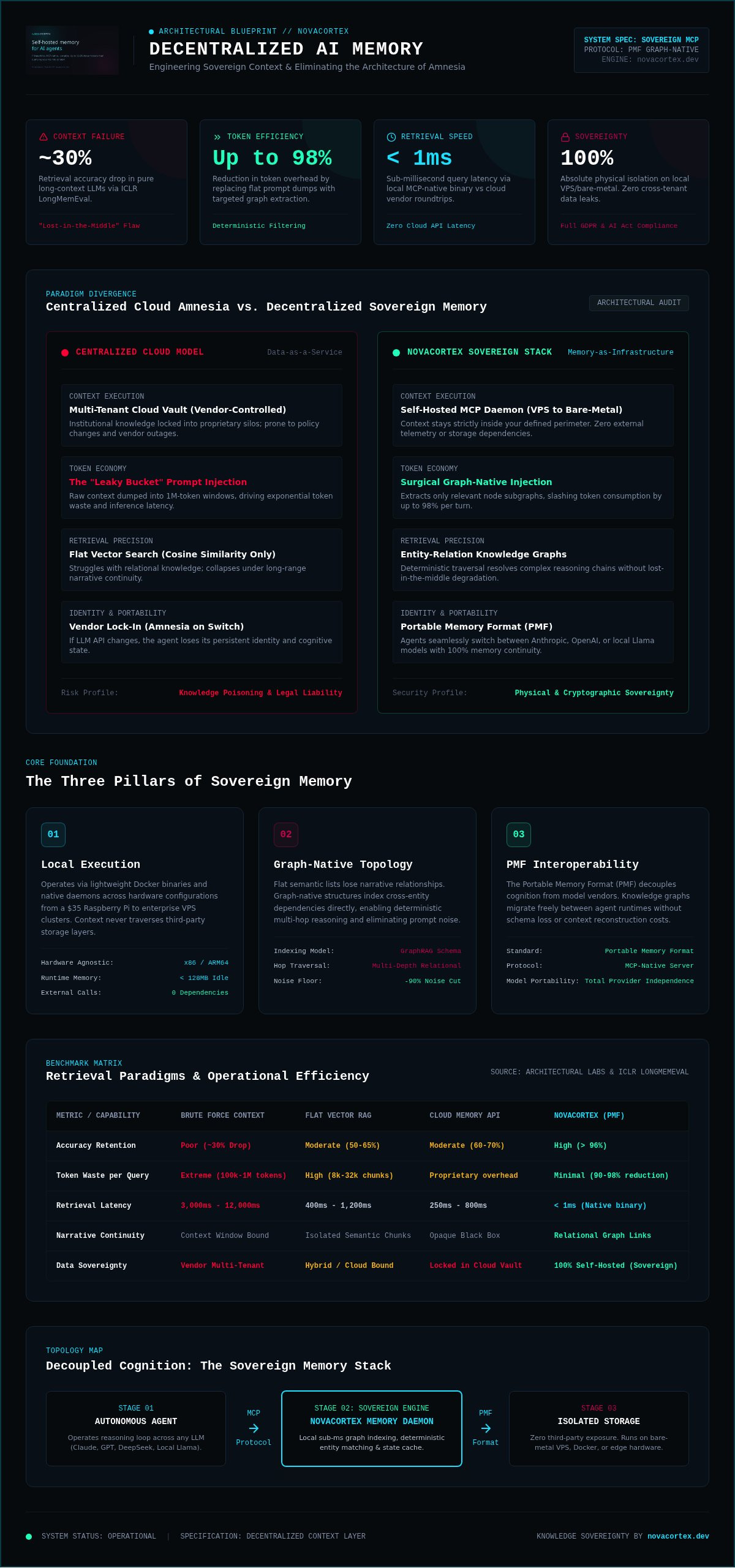
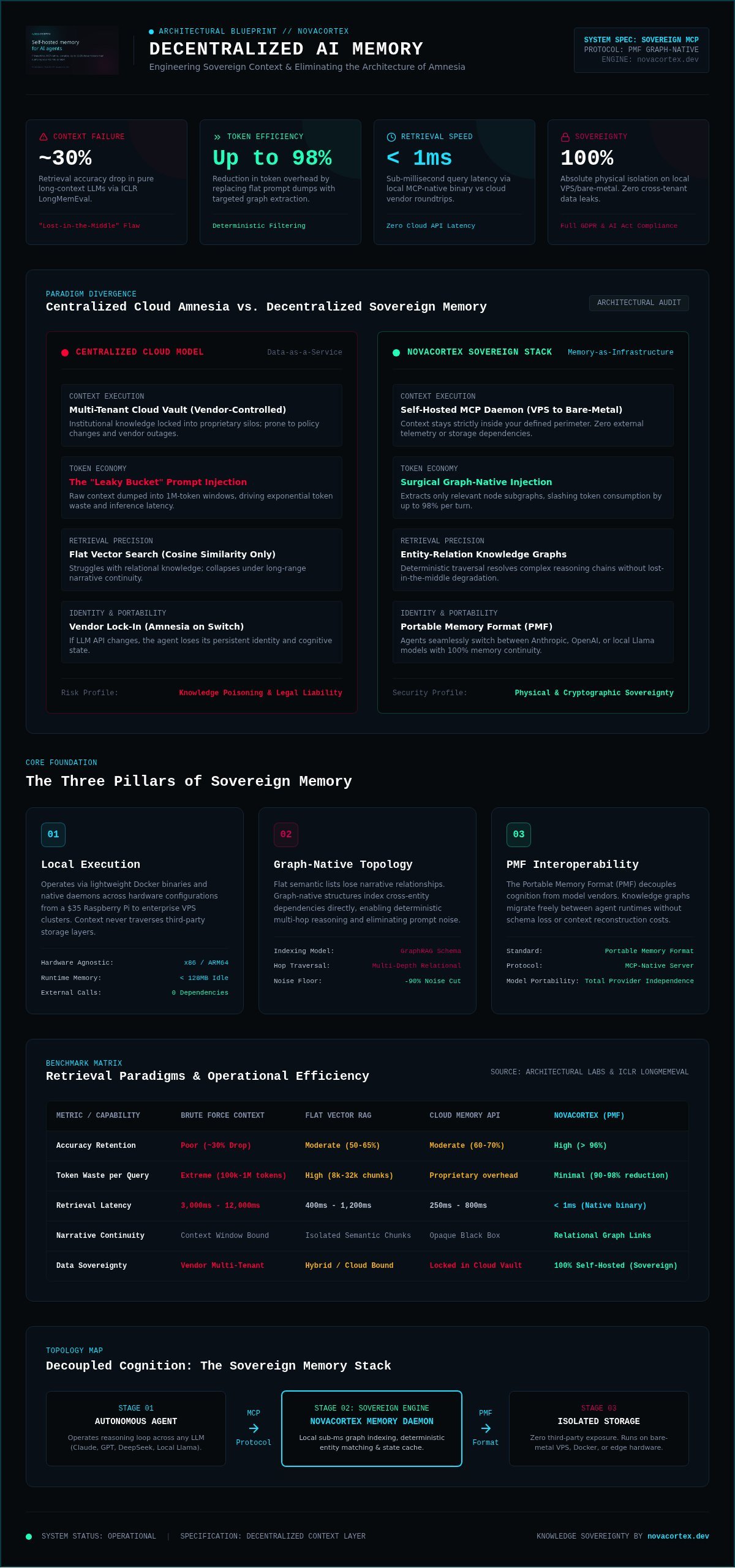
The industry's obsession with expanding context windows is a distraction. Throwing a million tokens at a reasoning task doesn't fix amnesia. It just hides it behind a massive bill. Research from ICLR LongMemEval indicates a ~30% drop in retrieval accuracy when LLMs rely purely on long context instead of structured stores. You're paying for silence in the middle of the window. This "Context Window Crisis" proves that bigger is not smarter; it is simply more expensive. It creates a cycle of diminishing returns where increased spending fails to yield better reasoning.
The Token Waste Problem in Standard RAG
Standard Retrieval-augmented generation (RAG) often relies on brute-force context injection. Engineers dump raw data into prompts, hoping the model finds the signal. It's an engineering failure. Every redundant turn re-processes the same context, driving up token costs and latency. Centralized APIs monetize this waste. They profit from your inability to manage state locally. Shifting to decentralized AI memory allows for surgical context retrieval, cutting the noise before it hits the inference engine. It replaces the "dump and pray" method with deterministic, high-velocity retrieval that respects your budget.
Privacy Leaks in Managed Memory Layers
Storing PII in multi-tenant cloud vaults is a compliance disaster. Enterprise data sovereignty is incompatible with shared AI storage. In a managed environment, your data is one configuration error away from exposure. With the EU AI Act and GDPR tightening, the "black box" model is a legal liability. Shared infrastructures risk "knowledge poisoning," where cross-tenant data might influence model behavior in ways you can't trace. True privacy requires physical and architectural isolation. You cannot secure what you do not host. This privacy paradox forces a choice: settle for stunted agent intelligence or risk your data security on a third-party server. For organizations with strict privacy requirements, the only path forward is a self-hosted, sovereign layer.
Defining Decentralized AI Memory: Architectural Sovereignty
Forget the noise surrounding Web3. In the context of high-performance agentic systems, decentralized AI memory refers to the physical and architectural decoupling of an agent's cognition from the model provider. It marks a fundamental shift from "Data-as-a-Service," where your history lives in a vendor's silo, to "Memory-as-Infrastructure," where context is a utility you own and operate. This is about architectural sovereignty. You control the hardware, the database, and the retrieval logic. When you own the memory layer, your agent's identity survives even if you switch LLM providers or a specific API goes dark.
True decentralization requires more than just a local database. It demands a Portable Memory Format (PMF) that ensures knowledge assets are interoperable. Without a standardized format, you're simply swapping one proprietary lock-in for another. Sovereign memory allows agents to traverse different knowledge buckets while maintaining a consistent world model. It's the difference between a temporary session and a persistent digital consciousness that grows with your organization.
The Three Pillars of Sovereign Memory
- Local Execution: Running memory servers on your own VPS or bare-metal hardware ensures that sensitive context never leaves your security perimeter.
- Graph-Native Storage: Traditional RAG often relies on flat, semantic lists. As demonstrated by Microsoft Research's GraphRAG framework, relational indexing is essential for reasoning over interconnected, narrative data.
- Interoperability: Using a Portable Memory Format (PMF) means your agent's context can be backed up, migrated, and consumed by any model without the need for expensive re-indexing.
MCP-Native Architecture: The New Standard
The Model Context Protocol (MCP) has emerged as the unified interface for agentic cognition. With 78% of enterprise AI engineering teams reporting at least one MCP-backed agent in production as of mid-2026, the protocol is no longer optional. By deploying MCP native memory servers, you decouple the LLM from the memory layer entirely. This allows you to swap a Claude instance for a local Llama deployment without losing a single byte of historical context. It's a plug-and-play architecture for cognition that integrates directly with frameworks like LangGraph or AutoGPT. Builders looking to implement this level of control can examine the open-source codebase to understand how these layers interact in a production environment. This architectural independence is the only way to ensure your agent remains intelligent, private, and cost-effective as the model landscape evolves.
Graph-Native vs. Vector Search: The Retrieval Efficiency Gap
The engineering debate for 2026 isn't about whether to use RAG, but how to structure the underlying engine. Choosing Redis vs graph memory for AI agents determines whether your system scales or suffocates under its own data weight. Flat vector databases rely on mathematical proximity. They're great for finding "similar" things but terrible at understanding "why" things are connected. In long-running tasks, this leads to the "Lost in the Middle" phenomenon. The agent sees a wall of semantically relevant text but misses the specific causal link required for a correct decision. Decentralized AI memory replaces this brute-force similarity with deterministic graph traversal.
Standardization is finally catching up to this architectural reality. The NIST AI Agent Standards Initiative emphasizes the need for reliable context handling and interoperability across autonomous systems. Without a relationship-aware layer, you're just guessing. Knowledge Buckets allow you to segment memory into high-precision clusters, ensuring the agent only "hears" what's relevant to the current sub-task. This segmentation is the key to achieving a 98% token reduction through relationship-aware context, turning a massive knowledge base into a lean, actionable stream of facts.
How Graph-Native Storage Solves Agent Amnesia
Graph-native storage maps entities and relationships to mimic human-like cognitive recall. Instead of retrieving thousands of irrelevant tokens, the system performs context pruning to extract only the 2% of data that actually matters. This surgical precision is why graph-native memory reduces hallucinations by providing explicit relationship data rather than probabilistic guesses. It grounds the agent in a verifiable knowledge graph where every fact has a directed edge to its context. You aren't just storing data; you're engineering a world model that the agent can navigate with mathematical certainty.
Benchmarking Performance: NovaCortex vs. Traditional RAG
Performance isn't just about speed; it's about unit economics. Local graph traversals on NVMe-backed edge devices execute in sub-millisecond windows, while cloud vector lookups over the WAN add hundreds of milliseconds of overhead. This latency gap compounds in multi-agent reasoning loops. Scaling AI agent long term memory without linear cost increases is only possible when you move away from managed vector stores. By slashing redundant token processing, builders can drastically reduce monthly API spend while maintaining a high-performance, private memory layer that grows with the organization. It's the difference between a system that becomes more expensive as it learns and one that becomes more efficient.
Implementing Sovereign Memory: From VPS to Raspberry Pi
Selecting the right infrastructure for decentralized AI memory is a calculation of latency and data gravity. For high-velocity agent fleets, local edge hardware like the Raspberry Pi 5 provides the ultimate sovereignty. This board features a quad-core Arm Cortex-A76 processor and a dedicated PCIe 2.0 interface. This hardware configuration allows for NVMe-backed storage that handles graph reads at hundreds of megabytes per second. If your workload requires horizontal scaling across a global team, a private VPS or on-prem bare-metal server using Docker is the standard path. Physical isolation is the bedrock of digital sovereignty. It ensures your agent's cognitive state remains under your exclusive jurisdiction.
Deploying a self-hosted memory layer using Apache-2.0 binaries eliminates the risk of sudden licensing shifts or vendor outages. By running your own MCP-native memory server, you create a stateless, high-performance bridge between reasoning and recall. This architecture allows you to synchronize memory across distributed agent fleets, ensuring that an agent in a staging environment shares the same world model as a production unit. It transforms a scattered collection of tools into a unified, intelligent system.
Deployment Roadmap for Engineering Teams
- Step 1: Environment setup. Ensure your host supports Docker and has sufficient I/O throughput. Standard micro-SD cards are a bottleneck; use NVMe for sub-millisecond retrieval.
- Step 2: Initializing the self-hosted AI memory layer. Pull the official binaries to begin local execution within your security perimeter.
- Step 3: Indexing knowledge using the Portable Memory Format (PMF). This step decouples your institutional data from the ingestion engine, ensuring long-term portability.
- Step 4: Connecting your agent via MCP-native protocols. This finalizes the bridge, allowing your agent to query its history with mathematical certainty.
Securing the Local Memory Layer
Sovereignty without security is a liability. You must implement multi-user access controls and encrypted Knowledge Buckets to isolate sensitive agent states. Automated backups are non-negotiable. If your hardware fails, your agent's historical identity must be recoverable from a PMF snapshot. Monitoring retrieval performance is equally critical. Watch for I/O bottlenecks that could spike reasoning latency. A healthy memory server is a silent one, delivering context in the background without bloating your compute budget or exposing your data to the public web.
NovaCortex: The Open-Source Standard for Decentralized Context
Decentralized AI memory is a requirement for any organization that treats its data as a strategic asset. NovaCortex Self-Hosted Edition provides the infrastructure to enforce this requirement. It replaces the ephemeral nature of cloud-based sessions with a persistent, graph-native memory layer that you own entirely. By moving context from a third-party vault to your own bare-metal or private cloud, you eliminate the single point of failure inherent in managed AI ecosystems. This is the definitive correction to a market currently dominated by restrictive, multi-tenant silos. The code is the contract. Your agents deserve a memory that doesn't expire when a vendor changes its terms of service.
Architectural independence depends on the ability to move state between models without friction. NovaCortex achieves this by ending vendor lock-in with the portable memory format for AI. PMF ensures that your agent's historical identity is not a prisoner of a specific LLM provider's embedding space. If a model provider spikes its pricing or its performance degrades, you can migrate your entire knowledge graph to a new provider in minutes. It turns memory from a proprietary black box into a portable, standard-compliant utility that remains under your control.
Why NovaCortex is the Architect's Choice
Engineering teams choose NovaCortex for its no-nonsense, builder-first design. We've stripped away the architectural bloat that plagues traditional enterprise software. The system is optimized for high-velocity performance on local infrastructure, ensuring that your reasoning loops aren't delayed by network jitter or API throttles. It provides a vendor-neutral memory server that future-proofs your agents against the volatility of the AI market. You aren't just building a tool; you're establishing a permanent foundation for sovereign cognition. It is a lean, high-performance engine for complex agent reasoning tasks.
Getting Started with NovaCortex Self-Hosted
The path to digital sovereignty starts with the repository. You can access the open-source code and community documentation to begin your deployment today. For teams operating at global scale, NovaCortex offers a path to upgrade to managed infrastructure that retains the same privacy and performance benefits of the self-hosted edition. This flexibility allows you to start lean on edge hardware and scale without compromising your commitment to data ownership. It's time to stop renting your agent's brain and start owning your stack.
Deploy NovaCortex Self-Hosted Edition Today
Owning the Agentic Future: Sovereignty by Design
The era of renting your agent's cognition is over. Centralized memory models have proven to be a structural bottleneck for performance and a significant risk for data security. You've seen how graph-native architectures eliminate amnesia while providing a 98% token usage reduction compared to brute-force context injection. By implementing decentralized AI memory, you secure your institutional knowledge against vendor volatility and ensure your agentic fleets operate with surgical precision. This shift from managed black boxes to sovereign infrastructure is the only way to maintain a competitive edge in 2026.
Digital sovereignty isn't a luxury; it's a foundational engineering requirement. NovaCortex Self-Hosted Edition gives you the tools to build a private, high-performance context layer on your own infrastructure. With an Apache-2.0 license and a commitment to the Portable Memory Format, you're not just deploying a tool; you're setting a new standard for architectural independence. It's time to stop settling for leaky buckets and start building resilient, intelligent systems that you own entirely.
Build for independence. Build for scale. Your agents are ready for a permanent identity, and the infrastructure to support them is officially within your reach.
Frequently Asked Questions
What is decentralized AI memory and how does it differ from a vector database?
Decentralized AI memory is a self-hosted, graph-native layer that decouples context from model providers. Unlike a flat vector database that relies on semantic similarity, this architecture uses relational graphs to model entity connections. It moves context from "Data-as-a-Service" to "Memory-as-Infrastructure." This ensures that your agent's history remains portable and private rather than locked in a vendor's proprietary cloud vault.
How does a self-hosted memory layer reduce AI token costs?
A self-hosted layer reduces costs by performing surgical context retrieval instead of brute-force prompt stuffing. Traditional RAG often dumps entire documents into the context window, leading to massive token waste. NovaCortex uses graph-native storage to extract only the 2% of data relevant to the task. This precision can reduce token usage by up to 98%, cutting monthly API bills while maintaining high reasoning accuracy.
Can I run NovaCortex on a Raspberry Pi or low-power server?
Yes, NovaCortex is designed for high-velocity performance on edge hardware like the Raspberry Pi 5. Because the engine is lean and optimized for local infrastructure, it handles complex graph traversals with sub-millisecond latency. Using an NVMe-backed SSD via the PCIe 2.0 interface is recommended to prevent I/O bottlenecks. This setup allows you to maintain a sovereign memory layer without the overhead or privacy risks of expensive cloud GPU clusters.
What is the Portable Memory Format (PMF) and why is it important?
The Portable Memory Format (PMF) is an open standard that decouples an agent's memory state from specific LLM vendors. It's critical because it prevents vendor lock-in. If you decide to switch from a proprietary model to a local Llama deployment, PMF allows you to migrate the entire knowledge graph without re-indexing. It ensures that your agent's historical identity and context remain portable across any model, client, or platform.
Is NovaCortex compatible with Model Context Protocol (MCP)?
NovaCortex includes an MCP-Native Memory Server as a core offering. This integration allows your agents to query context through a standardized, stateless protocol that is widely adopted by engineering teams. By using MCP, you decouple the reasoning engine from the storage layer entirely. This enables plug-and-play interoperability with agent frameworks like LangGraph and Claude Code, ensuring persistent context is available across all your disparate knowledge sources.
How does graph-native storage prevent AI agents from forgetting context?
Graph-native storage prevents amnesia by mapping explicit relationships between entities. Traditional vector search often returns contradictory or irrelevant results because it lacks causal logic. A graph-native approach allows the agent to traverse directed edges to find the exact context needed for multi-hop reasoning. It grounds the agent in a verifiable world model where facts have temporal and relational metadata, effectively eliminating the "lost-in-the-middle" retrieval failures seen in flat lists.
What are the security benefits of self-hosting my agent's memory layer?
Self-hosting ensures that sensitive context and PII never leave your security perimeter. Managed cloud memory layers are multi-tenant environments where your data is one configuration error away from exposure. By running a local memory server, you maintain physical and architectural isolation. This satisfies strict requirements for GDPR and the EU AI Act while providing full control over Knowledge Buckets. You own the hardware, the database, and the access permissions for every byte.
Is NovaCortex open source and can I use it for commercial projects?
NovaCortex is open source under the Apache-2.0 license. This means you can build, modify, and deploy the self-hosted edition for both personal and commercial projects without restrictive licensing fees. For organizations requiring advanced multi-user controls, dedicated support, or managed infrastructure, commercial licenses and tiered subscription fees are available. The open-source core ensures that your decentralized AI memory stack remains a permanent, sovereign asset for your engineering team.
FAQ
What is decentralized AI memory and how does it differ from a vector database?
Decentralized AI memory is a self-hosted, graph-native layer that decouples context from model providers. Unlike a flat vector database that relies on semantic similarity, this architecture uses relational graphs to model entity connections. It moves context from "Data-as-a-Service" to "Memory-as-Infrastructure." This ensures that your agent's history remains portable and private rather than locked in a vendor's proprietary cloud vault.
How does a self-hosted memory layer reduce AI token costs?
A self-hosted layer reduces costs by performing surgical context retrieval instead of brute-force prompt stuffing. Traditional RAG often dumps entire documents into the context window, leading to massive token waste. NovaCortex uses graph-native storage to extract only the 2% of data relevant to the task. This precision can reduce token usage by up to 98%, cutting monthly API bills while maintaining high reasoning accuracy.
Can I run NovaCortex on a Raspberry Pi or low-power server?
Yes, NovaCortex is designed for high-velocity performance on edge hardware like the Raspberry Pi 5. Because the engine is lean and optimized for local infrastructure, it handles complex graph traversals with sub-millisecond latency. Using an NVMe-backed SSD via the PCIe 2.0 interface is recommended to prevent I/O bottlenecks. This setup allows you to maintain a sovereign memory layer without the overhead or privacy risks of expensive cloud GPU clusters.
What is the Portable Memory Format (PMF) and why is it important?
The Portable Memory Format (PMF) is an open standard that decouples an agent's memory state from specific LLM vendors. It's critical because it prevents vendor lock-in. If you decide to switch from a proprietary model to a local Llama deployment, PMF allows you to migrate the entire knowledge graph without re-indexing. It ensures that your agent's historical identity and context remain portable across any model, client, or platform.
Is NovaCortex compatible with Model Context Protocol (MCP)?
NovaCortex includes an MCP-Native Memory Server as a core offering. This integration allows your agents to query context through a standardized, stateless protocol that is widely adopted by engineering teams. By using MCP, you decouple the reasoning engine from the storage layer entirely. This enables plug-and-play interoperability with agent frameworks like LangGraph and Claude Code, ensuring persistent context is available across all your disparate knowledge sources.
How does graph-native storage prevent AI agents from forgetting context?
Graph-native storage prevents amnesia by mapping explicit relationships between entities. Traditional vector search often returns contradictory or irrelevant results because it lacks causal logic. A graph-native approach allows the agent to traverse directed edges to find the exact context needed for multi-hop reasoning. It grounds the agent in a verifiable world model where facts have temporal and relational metadata, effectively eliminating the "lost-in-the-middle" retrieval failures seen in flat lists.
What are the security benefits of self-hosting my agent's memory layer?
Self-hosting ensures that sensitive context and PII never leave your security perimeter. Managed cloud memory layers are multi-tenant environments where your data is one configuration error away from exposure. By running a local memory server, you maintain physical and architectural isolation. This satisfies strict requirements for GDPR and the EU AI Act while providing full control over Knowledge Buckets. You own the hardware, the database, and the access permissions for every byte.
Is NovaCortex open source and can I use it for commercial projects?
NovaCortex is open source under the Apache-2.0 license. This means you can build, modify, and deploy the self-hosted edition for both personal and commercial projects without restrictive licensing fees. For organizations requiring advanced multi-user controls, dedicated support, or managed infrastructure, commercial licenses and tiered subscription fees are available. The open-source core ensures that your decentralized AI memory stack remains a permanent, sovereign asset for your engineering team.