Engineering Vendor-Neutral AI Storage: The Architect’s Guide to Data Sovereignty in 2026

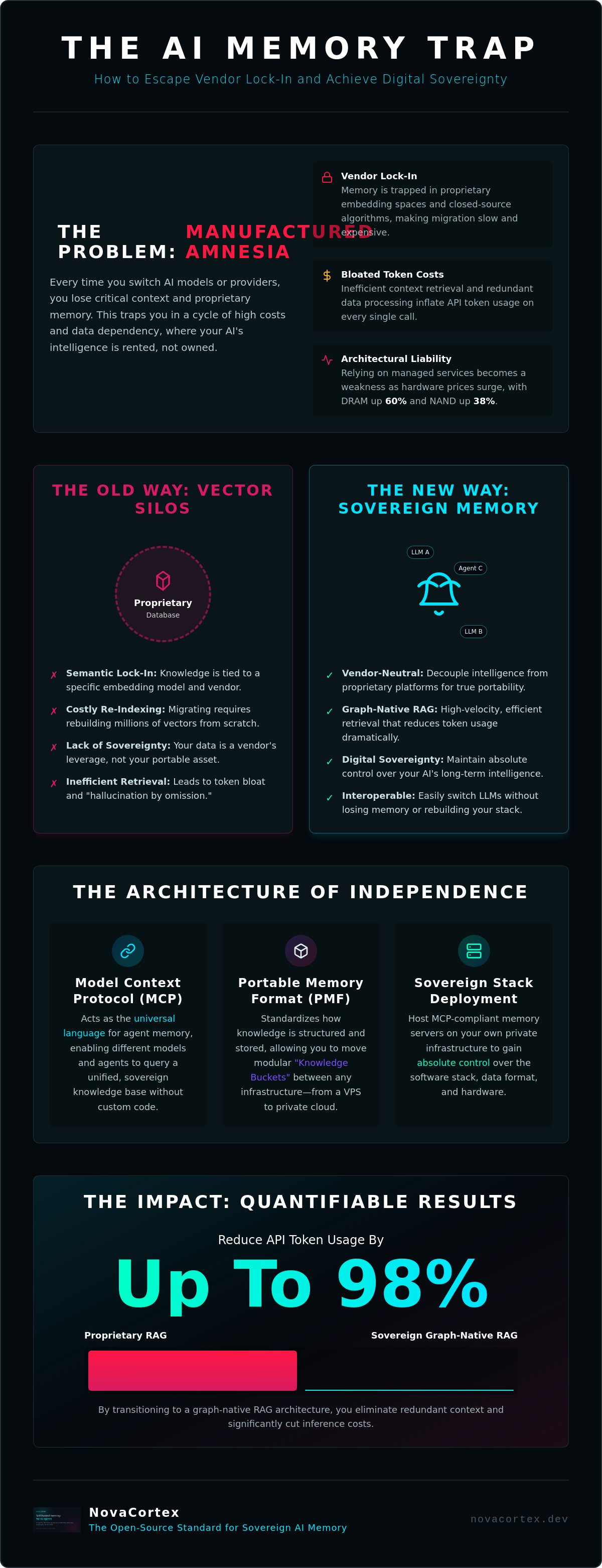
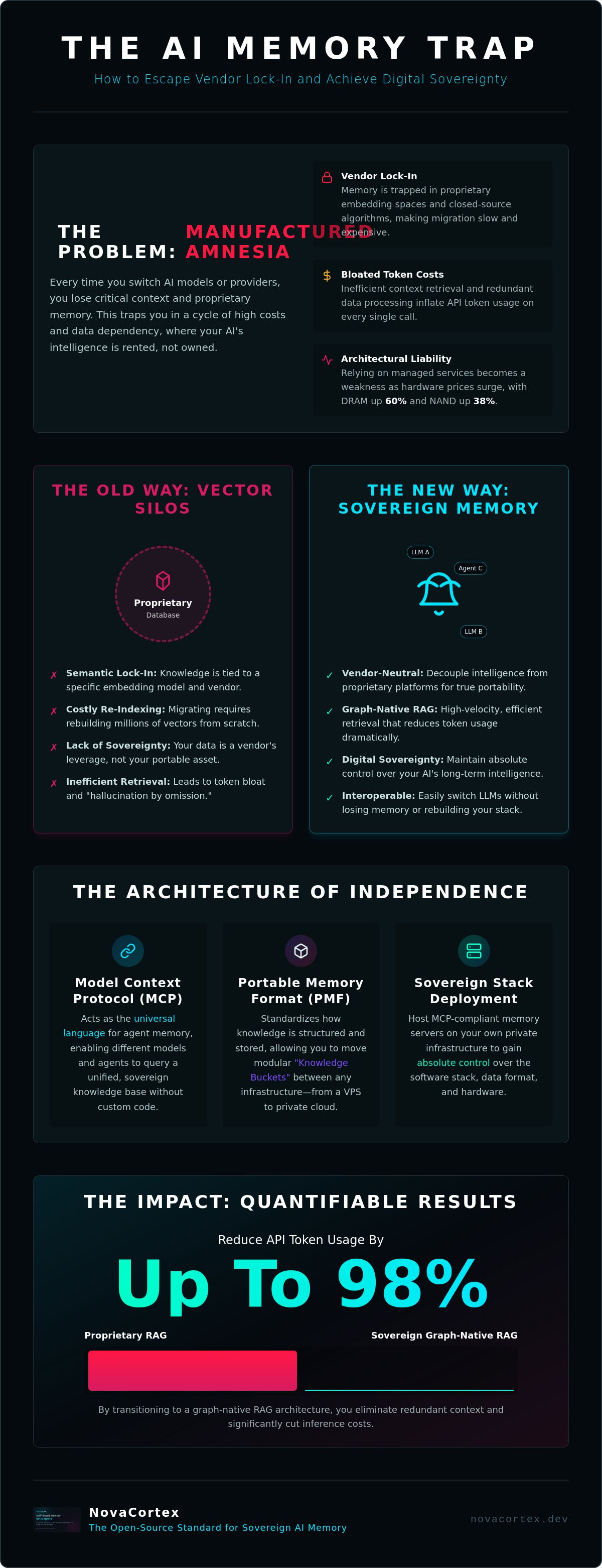
Your AI is currently suffering from a manufactured form of amnesia. Every time you switch models or providers, you lose the context and proprietary memory that makes your agent actually functional. You're trapped in a cycle of high token costs from inefficient context retrieval and the fear that your data is locked in a proprietary cage. To solve this, you need vendor-neutral AI storage that prioritizes digital sovereignty over convenience. In a market where DRAM prices have surged 60 percent, relying on bloated, managed services is an architectural liability.
Digital sovereignty is no longer optional. It's mandatory. We agree that your data should be a portable asset, not a vendor's leverage. This guide teaches you how to architect a future-proof memory layer that eliminates lock-in and secures your data against shifting regulations like the 2026 European Technological Sovereignty Package. You'll learn to deploy self-hosted infrastructure using a Portable Memory Format (PMF) and MCP-native servers, reducing API token usage by up to 98 percent while maintaining absolute control over your AI's long-term intelligence.
Key Takeaways
- Understand the shift from static data lakes to dynamic agent memory layers to prevent the semantic silos that plague traditional vector databases.
- Architect vendor-neutral AI storage using the Model Context Protocol (MCP) and Portable Memory Format (PMF) to decouple your intelligence from proprietary platforms.
- Eliminate hallucination by omission and significantly reduce token bloat by transitioning to a graph-native RAG architecture for high-velocity retrieval.
- Execute a sovereign stack deployment by auditing embedding dependencies and hosting MCP-compliant memory servers on your own private infrastructure.
- Utilize Knowledge Buckets for modular agent state management, ensuring your AI’s long-term memory remains portable and interoperable across different LLM providers.
Defining Vendor-Neutral AI Storage in the Agentic Era
AI architecture is moving past the era of the passive data lake. In 2026, we are building agentic systems that require a high-velocity memory layer, not just a cold repository for logs. True vendor-neutral AI storage isn't defined by the hardware under the rack; it's defined by the portability of the data schema and the protocols used for retrieval. If your agent's memory is trapped in a provider's proprietary embedding space, you don't own your intelligence. You're just renting it. Proprietary storage models inflate token usage by forcing redundant context windows and inefficient retrieval patterns, creating a massive tax on every inference call. This architectural waste is no longer sustainable in a market where DRAM contract prices have surged by 60 percent.
The Semantic Silo Problem
Vector databases were supposed to be the solution. Instead, many have become high-priced silos. When you use a managed RAG service, your knowledge is often tied to a specific embedding model and a closed-source indexing algorithm. Migrating that context to a new provider requires re-indexing millions of vectors. This is both slow and expensive. In the first quarter of 2026, NAND contract prices rose by up to 38 percent, making massive re-indexing projects a budgetary disaster. Semantic lock-in is the primary barrier to AI agility. It prevents you from hot-swapping models when a superior or more cost-effective LLM hits the market. You need a way to decouple the knowledge from the database to maintain performance at scale.
Sovereignty vs. Managed Convenience
Managed AI memory services offer a fast start but lead to a dead end. As the 2026 European Technological Sovereignty Package takes effect, enterprise architects are realizing that residency isn't sovereignty. You need structural independence. This is why 77 percent of European IT decision-makers now advocate for open-source mandates to prevent vendor lock-in. Digital sovereignty is now a hard requirement for enterprise AI. It demands that you control the software stack, the data format, and the physical infrastructure. Relying on a third-party black box for your agent's long-term memory is a strategic failure that compromises your competitive edge.
Achieving this independence requires an architectural correction. We use the Portable Memory Format (PMF) to ensure that data remains readable across different systems. By organizing data into Knowledge Buckets, architects can manage modular agent states without being tethered to a single cloud provider's API. Using NovaCortex Self-Hosted Edition allows you to deploy this stack on any infrastructure, from a VPS to a Raspberry Pi. This approach ensures your memory layer survives the inevitable consolidation of the AI market while keeping your operational costs lean.
The Architecture of Independence: MCP and Portable Memory
Modern storage architecture often focuses on the physical layer. This is a mistake. In 2026, the real bottleneck isn't disk speed; it's the protocol that governs how an agent accesses its history. To build true vendor-neutral AI storage, you must architect at the memory layer. This requires decoupling the intelligence from the database provider. It ensures that your agent's context remains an asset you control, not a liability you rent. When you control the protocol, you control the data life cycle.
The Role of MCP in Interoperability
The Model Context Protocol (MCP) serves as the backbone of this strategy. It acts as the universal language for agent memory, allowing different models to query a unified knowledge base without custom integration code. By deploying an MCP native memory server, you bridge the gap between disparate agents. This standardization eliminates the need for brittle API wrappers. It creates a shared context environment where a coding agent, a research agent, and a project management agent can all pull from the same sovereign source. Standardization is the only path to a multi-agent future that doesn't collapse under the weight of custom technical debt.
Portable Memory Format (PMF) Explained
Knowledge is useless if it's trapped in a proprietary format. The portable memory format for AI (PMF) solves this by standardizing how knowledge is structured and stored. PMF allows you to move Knowledge Buckets between a local VPS and a private cloud with zero data loss. This ensures long-term readability across different LLM generations. If a model provider changes their embedding logic or deprecates a service, your PMF-encoded data remains intact. You simply point your new model at the existing bucket. This level of mobility is essential for maintaining vendor-neutral AI storage in a volatile market.
Flat vector lists are insufficient for complex reasoning. They provide similarity but lack relationship. Graph-native storage outperforms vector-only systems by maintaining the links between concepts. This structural depth allows an agent to perform multi-hop reasoning without losing the thread of the conversation. When combined with a self-hosted infrastructure, this architecture provides a level of privacy that managed services cannot match. For architects building for the 2026 regulatory environment, exploring the NovaCortex open-source repository is the first step toward reclaiming data sovereignty. Independence isn't just about where you store the data. It's about how you ensure it stays yours.
Evaluating Storage Models: Vector Silos vs. Graph-Native Mobility
Vector databases are the new legacy systems. While they excel at basic similarity search, they fail at complex reasoning because they treat your data as a flat list of coordinates. This architectural limitation leads to hallucination by omission. Your agent misses critical context simply because it wasn't semantically similar enough to the query, even if it was logically essential. To build vendor-neutral AI storage that actually scales, you must move beyond the vector silo and embrace graph-native mobility. This shift ensures that your data remains an interconnected web of knowledge rather than a fragmented collection of embeddings.
The efficiency of your retrieval strategy directly impacts your bottom line. Managed vector services often encourage a "dump and search" approach that results in massive token bloat. You end up paying for thousands of irrelevant tokens just to ensure the model sees the right context. Transitioning to a graph-native RAG architecture allows for precise context pruning. This results in a significant reduction in API costs and a more responsive agent. When comparing high-performance AI memory against standard databases, the difference in latency and precision becomes the deciding factor for production-grade deployments.
The Limits of Traditional Vector Databases
Flat vector search is a blunt instrument. It strips away the relational context that humans use to organize information. When you query a standard vector DB, you get back the "closest" matches, but you lose the "why" and the "how" behind those matches. This is the token tax. It's the cost of dumping irrelevant data chunks into the context window because your database couldn't filter for logic. The Redis vs graph memory for AI agents debate highlights this perfectly. While key-value stores are fast, they lack the structural depth required for sovereign AI memory.
Graph-Native Memory Advantages
Graph-native memory structures information as nodes and edges. This allows agents to navigate knowledge via relationships rather than just keyword similarity. It's the difference between searching a dictionary and following a map. This structured approach enables a 98 percent token reduction in long-term tasks by providing only the exact nodes required for the current reasoning step. Graph-native retrieval maps the topology of your data, allowing agents to jump between related concepts with zero semantic drift. This precision is the foundation of vendor-neutral AI storage, as it makes your data more useful across any model you choose to deploy.
A Total Cost of Ownership (TCO) analysis reveals the hidden drain of managed AI storage. Beyond the rising costs of NAND and DRAM components, managed providers charge a premium for "convenience" that ultimately locks you into their ecosystem. Self-hosting your memory layer using NovaCortex Self-Hosted Edition on private infrastructure provides a leaner, more secure alternative. You eliminate the per-query markup and reclaim control over your data lifecycle. In an era of shifting regulations and hardware shortages, architectural independence is the only way to protect your margins.
How to Build a Vendor-Neutral AI Stack Step-by-Step
Stop managing vendor contracts and start managing protocols. Building vendor-neutral AI storage is an engineering task, not a procurement one. It requires a systematic decoupling of the data layer from the inference engine. If your memory is trapped in a provider's latent space, you don't own your intelligence. You're just renting it. Follow these five steps to reclaim structural independence and eliminate the architectural waste of proprietary silos.
- Step 1: Audit proprietary embedding dependencies. Identify every vector tied to a single provider's API. If you cannot move your embeddings without re-indexing, you are locked in.
- Step 2: Deploy an MCP-compliant memory server. Use a standardized interface to ensure any model can query your knowledge base. This creates a universal language for agent memory.
- Step 3: Implement a graph-native RAG pipeline. Move beyond flat similarity search. Use relationships to prune context and stop paying the "token tax" on irrelevant data chunks.
- Step 4: Standardize on a Portable Memory Format (PMF). Ensure every agent writes and reads from a cross-compatible schema. This makes your agent state a mobile asset.
- Step 5: Configure decentralized backups. Sync your Knowledge Buckets across multiple private nodes. With enterprise GPU lead times reaching 52 weeks, you cannot rely on a single cloud provider for availability.
Deploying the Memory Server
Setting up a self-hosted AI memory layer requires infrastructure that matches your specific latency needs. A Raspberry Pi can handle personal agent state, but a dedicated VPS is necessary for enterprise-scale graph traversal. Configuring MCP endpoints is the critical step. It allows your agents to treat the memory server as a native tool rather than an external API. Establish granular access controls immediately. Multi-user environments demand that Knowledge Buckets remain isolated to prevent context leakage between sensitive projects. This is the foundation of a sovereign stack.
Optimizing Context Retrieval
Efficiency is won or lost at the retrieval stage. Tune your Knowledge Buckets based on specific agent tasks. A research agent needs deep graph traversal, while a customer support agent might only need high-speed ephemeral cache. Implementing tiered memory ensures you aren't paying the "graph tax" for simple lookups. Test for retrieval precision and token efficiency regularly. Achieving a 98 percent token reduction requires aggressive pruning of irrelevant nodes. Use the graph topology to provide the model with only the exact context required for the current reasoning step. This keeps your inference costs lean and your responses fast.
NovaCortex: The Open-Source Standard for Sovereign AI Memory
NovaCortex serves as the architectural correction to proprietary AI amnesia. It provides a graph-native memory layer that ensures zero vendor lock-in. By deploying the NovaCortex Self-Hosted Edition, you aren't just storing data; you're engineering a persistent context that belongs to you. This is the definitive standard for vendor-neutral AI storage in 2026. It rejects the bloated, restrictive systems of the past in favor of a lean, high-velocity memory server. When you control the memory layer, you control the intelligence. You no longer have to worry about a provider's API change wiping out your agent's long-term history.
Knowledge Buckets provide the modularity required for modern agentic workflows. Instead of one massive, unmanageable database, you organize agent state into discrete, portable units. This structure allows for the 98 percent token reduction required for high-scale operations. You only feed the model what it needs; you stop paying for the noise. The MCP-Native Memory Server handles the heavy lifting of context retrieval, ensuring your agents remain fast and precise regardless of the underlying LLM. This decoupling allows you to hot-swap models in minutes, not months. Your data remains an asset, not a liability trapped in a proprietary cage.
Engineered for Builders, Not Buyers
NovaCortex prioritizes engineering reality over marketing fluff. We don't sell hardware-bound ecosystems or closed-source black boxes. Our code is open-source under the Apache-2.0 license. This ensures you maintain long-term infrastructure control without being tethered to a single vendor's roadmap. A locally-hosted memory layer is the only way to achieve true privacy-first AI in a regulatory environment that demands data residency. Community-driven development means the platform evolves with the needs of builders, not the profit margins of cloud giants. It is a pragmatic response to a market that has become increasingly restrictive and expensive.
Scaling with NovaCortex
Deployment is flexible by design. You can run a sovereign stack on a Raspberry Pi for personal context or scale to enterprise VPS clusters for global agent fleets. Managed infrastructure options exist for teams that need speed but refuse to accept lock-in. These options maintain the integrity of the Portable Memory Format (PMF), ensuring your data remains mobile across any environment. With enterprise GPU lead times reaching 52 weeks, having a portable, efficient memory layer is your only insurance policy against hardware shortages. Digital sovereignty is a choice. You can continue to rent your AI's memory; or you can deploy NovaCortex today and own it forever.
Architecting for Digital Sovereignty
The era of renting your AI’s intelligence is over. By implementing vendor-neutral AI storage, you move beyond the fragile dependencies of managed vector silos. You have the blueprint to decouple context from the model, ensuring that your agent’s memory remains a portable asset. This architecture doesn't just protect your data sovereignty; it radically optimizes your operational costs. It turns your intelligence into a structural advantage that survives any market shift.
Standardizing on the Model Context Protocol (MCP) and Portable Memory Format (PMF) establishes a universal language for AI memory. You've seen how graph-native retrieval drives a 98 percent reduction in token usage, transforming technical waste into high-velocity performance. This is the necessary correction to a market that prioritizes lock-in over engineering excellence. You now possess the tools to build a stack that is truly independent.
The infrastructure for independence is ready for deployment. Your data is yours to own, and your agents are ready to remember. Build for the future.
Technical Briefing: Frequently Asked Questions
What exactly makes AI storage vendor-neutral?
True vendor-neutral AI storage is defined by the complete decoupling of the data layer from the provider's proprietary stack. It requires the use of open protocols like MCP and portable formats that ensure you can migrate your agent's memory without re-indexing your entire knowledge base. If you can't move your embeddings to a new provider without a total system rebuild, your storage isn't neutral; it's a cage.
How does a portable memory format prevent lock-in?
The Portable Memory Format (PMF) decouples context from the underlying database engine. It ensures that your Knowledge Buckets remain readable and actionable across different LLM generations and providers. This architectural choice prevents the semantic lock-in that occurs when data is permanently tied to a specific vendor's embedding logic or closed-source indexing algorithm.
Can I use NovaCortex with proprietary models like GPT-4o?
Yes. NovaCortex acts as the sovereign memory layer that feeds context to any inference engine you choose. By using an MCP-Native Memory Server, you can route your private knowledge to proprietary models via standardized endpoints. You maintain control over the long-term memory while utilizing the best available model for the current task.
What is the performance overhead of self-hosting an AI memory layer?
Self-hosting often improves performance by eliminating the network latency inherent in managed cloud services. While managed providers claim superior scale, they introduce significant delays during complex retrieval tasks. A graph-native architecture on private infrastructure provides faster multi-hop reasoning because the traversal happens local to your application logic, not behind a third-party API.
How does graph-native storage reduce token usage compared to vector DBs?
Graph-native storage maps relationships between data points, whereas vector DBs rely on blunt similarity. Traditional vector searches often dump irrelevant text chunks into the context window, forcing you to pay for useless tokens. NovaCortex identifies the exact nodes required for a specific reasoning step, which results in a 98 percent reduction in token bloat for long-term tasks.
Is MCP (Model Context Protocol) ready for production use in 2026?
MCP is the production standard for agentic interoperability in 2026. It has matured from an experimental proposal into the foundational protocol that bridges the gap between models and memory. Every major sovereign AI project now utilizes MCP to ensure that different agents can share a unified, portable context without custom technical debt.
Do I need specialized hardware to run a vendor-neutral memory server?
Specialized hardware is optional. You can deploy vendor-neutral AI storage on any infrastructure, from a standard VPS to a Raspberry Pi for smaller workloads. The efficiency of the stack comes from the graph-native software architecture rather than high-cost proprietary silicon, allowing you to scale without being trapped by hardware lead times.
How does NovaCortex handle data privacy and security?
Privacy is enforced through physical and logical isolation. Since NovaCortex is a self-hosted edition, your proprietary data never leaves your infrastructure for "optimization" by a third party. Knowledge Buckets provide granular access controls, ensuring that sensitive context remains isolated and secure even in complex, multi-user enterprise environments.
FAQ
What exactly makes AI storage vendor-neutral?
True vendor-neutral AI storage is defined by the complete decoupling of the data layer from the provider's proprietary stack. It requires the use of open protocols like MCP and portable formats that ensure you can migrate your agent's memory without re-indexing your entire knowledge base. If you can't move your embeddings to a new provider without a total system rebuild, your storage isn't neutral; it's a cage.
How does a portable memory format prevent lock-in?
The Portable Memory Format (PMF) decouples context from the underlying database engine. It ensures that your Knowledge Buckets remain readable and actionable across different LLM generations and providers. This architectural choice prevents the semantic lock-in that occurs when data is permanently tied to a specific vendor's embedding logic or closed-source indexing algorithm.
Can I use NovaCortex with proprietary models like GPT-4o?
Yes. NovaCortex acts as the sovereign memory layer that feeds context to any inference engine you choose. By using an MCP-Native Memory Server, you can route your private knowledge to proprietary models via standardized endpoints. You maintain control over the long-term memory while utilizing the best available model for the current task.
What is the performance overhead of self-hosting an AI memory layer?
Self-hosting often improves performance by eliminating the network latency inherent in managed cloud services. While managed providers claim superior scale, they introduce significant delays during complex retrieval tasks. A graph-native architecture on private infrastructure provides faster multi-hop reasoning because the traversal happens local to your application logic, not behind a third-party API.
How does graph-native storage reduce token usage compared to vector DBs?
Graph-native storage maps relationships between data points, whereas vector DBs rely on blunt similarity. Traditional vector searches often dump irrelevant text chunks into the context window, forcing you to pay for useless tokens. NovaCortex identifies the exact nodes required for a specific reasoning step, which results in a 98 percent reduction in token bloat for long-term tasks.
Is MCP (Model Context Protocol) ready for production use in 2026?
MCP is the production standard for agentic interoperability in 2026. It has matured from an experimental proposal into the foundational protocol that bridges the gap between models and memory. Every major sovereign AI project now utilizes MCP to ensure that different agents can share a unified, portable context without custom technical debt.
Do I need specialized hardware to run a vendor-neutral memory server?
Specialized hardware is optional. You can deploy vendor-neutral AI storage on any infrastructure, from a standard VPS to a Raspberry Pi for smaller workloads. The efficiency of the stack comes from the graph-native software architecture rather than high-cost proprietary silicon, allowing you to scale without being trapped by hardware lead times.
How does NovaCortex handle data privacy and security?
Privacy is enforced through physical and logical isolation. Since NovaCortex is a self-hosted edition, your proprietary data never leaves your infrastructure for "optimization" by a third party. Knowledge Buckets provide granular access controls, ensuring that sensitive context remains isolated and secure even in complex, multi-user enterprise environments.