Enterprise AI Data Sovereignty: A Practical Guide to De-Risking Adoption

A data center location is not a sovereignty strategy. Enterprise AI data sovereignty depends on enforceable control over where information moves, who can access it, and how each system handles it. A prompt may pass through an agent, a model provider, retrieval storage, and vendor logs before a team can trace its path.
Keeping data in one region doesn’t automatically control every model, service, or jurisdiction involved in an AI workflow. Rather than blocking useful AI, map the control boundaries and make them explicit. Start with one real workflow, such as an agent summarizing an internal document, and trace every system that handles its source material, retrieved passages, prompt, response, memory, and logs.
This guide provides a framework for assessing data flows across models, agents, vendors, and storage, then comparing managed, hybrid, and self-hosted components by the controls they actually provide. You’ll learn how to match safeguards to risk, reduce dependence on a single vendor’s storage format, and assess where user-controlled memory can help. Memory is one boundary in a broader architecture, not a complete governance solution. The goal is to adopt AI with clearer ownership and fewer blind spots.
Key Takeaways
- Assess enterprise AI data sovereignty through control over access, processing, retention, and movement, not storage location alone.
- Map each data flow from source systems through retrieval, inference, memory, and logs so you can identify where sensitive information travels.
- Compare managed, hybrid, and self-hosted architectures against consistent criteria, including data custody, administrative access, and portability.
- Use a repeatable process to classify data, assign safeguards, test controls, and set measurable acceptance criteria.
- Review agent memory as a distinct sovereignty boundary. Self-hosted, portable memory can support control without replacing broader AI governance.
Enterprise AI data sovereignty starts with control, not location
Enterprises want AI to make knowledge easier to use, decisions faster, and workflows less repetitive. They also need to keep sensitive data within defined boundaries. Those goals can collide when a task sends information through internal systems, an external model, and services that retain prompts or outputs. Enterprise AI data sovereignty is a control problem, not a storage setting.
A practical definition is: Data residency identifies where data is stored; data sovereignty is the verifiable ability to govern where it goes, who can access it, how it is processed, how long it is retained, and whether it can be moved or deleted. Location is one attribute. On its own, it doesn’t establish who can administer a system or what happens to data during inference.
This distinction sits within the broader idea of AI sovereignty. As AI sovereignty encompasses control over AI technology, including data and infrastructure. For enterprise teams, the useful test is concrete: can you trace each data path, assign an accountable owner, and verify that the system behaves according to policy?
What does data sovereignty mean in enterprise AI?
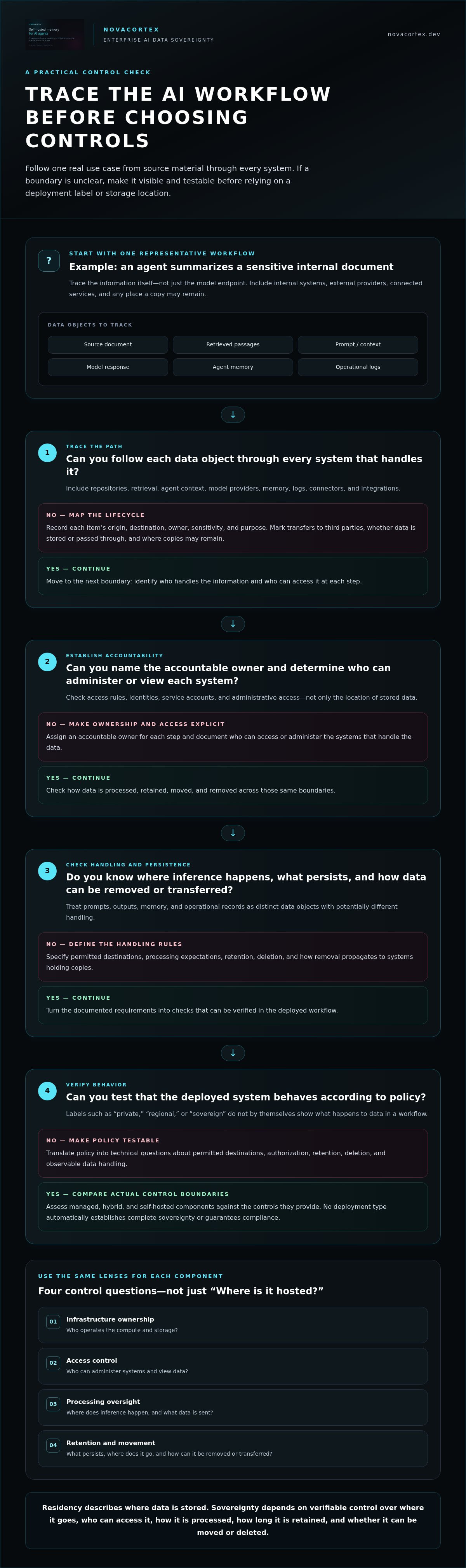
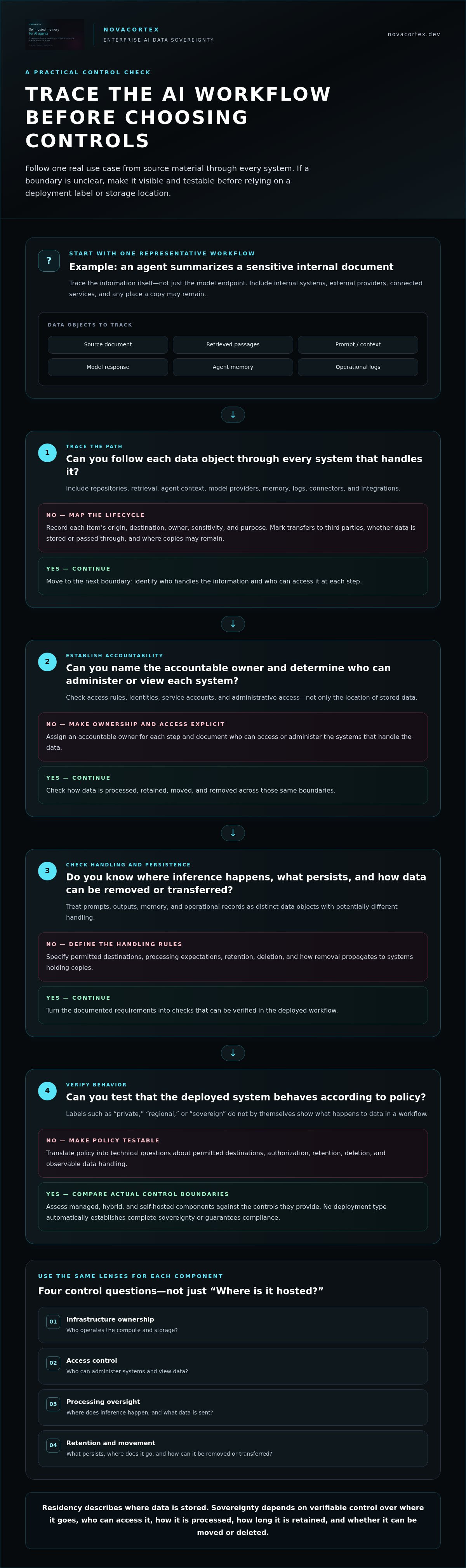
AI workflows handle more than source records. Prompts, retrieved context, generated outputs, agent memory, and operational logs can each be stored or processed by different components. Treat them as separate data objects, not as one conversation moving through a single black box.
Consider an employee asking an agent to summarize a sensitive internal document. The source sits in a company repository. The agent retrieves relevant passages and assembles context. A model receives a request and returns an answer. The agent or supporting services may also retain memory or logs. For each step, ask: what information crossed the boundary, which system handled it, who can access it, and what remains afterward?
Labels such as “private,” “regional,” or “sovereign” don’t answer those questions by themselves. Sovereignty depends on accountable policies translated into system behavior: permitted destinations, access rules, retention settings, and observable handling of data. Teams should be able to test what those terms mean in the deployed workflow.
Why sovereignty is not a hosting checkbox
A local database can keep stored records on infrastructure an organization controls while the application sends prompts or retrieved passages to an externally managed model. The database location describes one segment of the path, not the full control boundary. The same gap can appear in logging, monitoring, agent memory, or other managed services connected to the workflow.
Evaluate separate dimensions rather than relying on a deployment label:
- Infrastructure ownership: Who operates the compute and storage?
- Access control: Who can administer systems and view data?
- Processing oversight: Where does inference happen, and what data is sent?
- Retention and movement: What persists, where does it go, and how can it be removed or transferred?
Self-hosting can give an organization more direct control over a component, while managed services can shift operational responsibilities. Hybrid designs combine boundaries. None automatically establishes complete sovereignty or guarantees compliance. Make each boundary visible, assign responsibility, and verify controls across the full AI workflow.
Map enterprise AI data flows before choosing controls
Controls chosen before the data path is known are guesswork. A model endpoint may be the most visible component, while retrieval, agent state, observability tools, and downstream integrations create less obvious routes for sensitive information. Map the workflow first, then apply safeguards to the actual transfer and storage points.
A data-flow map turns sovereignty from a claim about architecture into a testable record of where information travels, who governs each step, and what happens to it. It gives security, legal, data, and engineering teams a shared view of the system, including boundaries introduced by external models and managed services.
Inventory the AI data lifecycle
Start with one representative use case and follow its information end to end. Inventory source repositories, prompts, retrieved passages, agent state, outputs, and observability records. For each item, identify its system of origin, destination, owner, sensitivity, and processing purpose. Record whether it is stored, held temporarily, or passed through without persistence.
Mark every transfer between internal infrastructure and a third party. Include connectors and integrations, not just the model call. A simple flow might show an internal document repository feeding retrieval, selected passages entering an agent context, a request reaching a managed model, and prompts or responses appearing in logs. Add the deletion path too: which systems hold copies, and how does removal propagate?
Turn governance requirements into technical questions
Classify each flow by sensitivity and business owner, then define its permitted destinations. Translate policy language into questions an engineer can test: which identities can read this data, what authorization applies, and can a service account retrieve more than the workflow requires? Specify retention, deletion, audit, and incident-response expectations for every system that stores or processes the information.
GDPR and the EU AI Act may be relevant frameworks, depending on the use case, data, and organizational role. Their application is fact-specific, so involve qualified counsel rather than treating a data map as a legal determination.
Use a consistent inventory record for each flow:
- Data object: Source record, prompt, retrieved context, agent state, output, or log.
- Purpose and owner: Why the information is processed and which business function is accountable.
- Boundary: Systems and services it passes through, including external endpoints.
- Handling: Access identities, persistence, retention, deletion, and audit evidence.
- Destination rule: Where the data may go, and what must be blocked or minimized.
Keep the map operational. Assign an owner to each system boundary, record unknowns as unresolved risks, and update the inventory when a model, connector, logging service, or retention setting changes. This makes enterprise AI data sovereignty assessable where controls can be verified, not just declared. If you’re evaluating where agent knowledge resides, include the NovaCortex open-source memory layer in the flow map alongside the model and surrounding services.
Compare enterprise AI sovereignty architectures by control boundary
Once data flows are mapped, compare architectures against the same criteria. “Self-hosted,” “managed,” and “hybrid” describe where responsibilities sit, not a guarantee of sovereignty. Ask which controls your organization can enforce at each boundary and which depend on another party or system.
Self-hosted, managed, and hybrid models
A self-hosted component runs in an environment the organization operates and controls, such as its own servers or a chosen VPS. This can place data custody and operational decisions closer to the organization, but the organization also takes on responsibility for running that component. Any external model, logging service, or integration remains a separate boundary to assess.
With a managed service, the provider operates some of the infrastructure or software. This can reduce internal operational workload while moving parts of administration and processing into the provider’s domain. A hybrid design deliberately splits functions: sensitive data or agent memory may stay on controlled infrastructure, while selected processing uses an external service under defined rules. That split only works if transfers and access paths are governed.
| Architecture | Potentially under organizational control | What may remain external |
|---|---|---|
| Self-hosted | Deployment environment, data custody, and component operations | External models, integrations, or services connected to the system |
| Managed | Data policies, configured access, and use of the service | Infrastructure operations and some administrative or processing functions |
| Hybrid | Selected storage, workloads, and data boundaries | Chosen model inference, managed components, and transfers between environments |
Evaluate trade-offs beyond data residency
For each design, assess data custody, administrative access, model processing, portability, and operational responsibility. Then compare practical trade-offs: who maintains the system, whether it can scale with demand, how access is governed, and how much the workflow depends on external services. Don’t assume that a local database also keeps prompts, retrieved context, or records local.
Test portability separately. Can data and agent memory be exported in a usable format, moved to another environment, and brought back into the workflow without rebuilding everything around one vendor’s storage model? NovaCortex’s Portable Memory Format is designed to reduce dependence on a single vendor’s format. It doesn’t control model processing or other parts of the AI stack. For a closer look at memory trade-offs, compare self-hosted vs managed AI memory.
There’s no universally sovereign architecture. Match deployment choices to data classification and policy: keep tighter control around higher-sensitivity flows, and use managed components where their responsibilities and boundaries are acceptable. Enterprise AI data sovereignty comes from verifying those boundaries, not selecting a deployment label.
Use a practical checklist to de-risk enterprise AI adoption
A sovereignty review should produce evidence, not just an approval note. Before a pilot touches sensitive information, define who owns the data, which systems may process it, and what observable result proves each safeguard works. Keep the pilot bounded: choose one workflow, representative data, a defined set of model endpoints, and failure scenarios the team can safely test.
Run a sovereignty review before the pilot
Name a business data owner and security reviewer for every sensitive dataset and AI workflow. Document approved model endpoints, service dependencies, storage locations, and identities with access. Include retrieval, memory, logging, and integrations in the review. The workflow diagram is useful, but the configuration and observed behavior must match it.
Use this sequence to move from scope to ongoing review:
- Classify. Label the pilot’s data by sensitivity, business owner, purpose, and permitted use.
- Map. Record the systems, endpoints, identities, and transfer paths involved, including storage and deletion.
- Assign controls. Set access rules, allowed destinations, retention periods, and accountable owners for each boundary.
- Test. Use representative data to check authorized retrieval, blocked destinations, and expected behavior when a service is unavailable or access is denied.
- Monitor. Review access logs, data transfers, retention behavior, deletion outcomes, and configuration changes during the pilot.
- Review. Reassess controls when the workflow, model, service dependency, or data classification changes.
Measure controls in operation
Set acceptance criteria before testing. For access, specify which roles and service identities may retrieve each data class, then test both permitted and denied requests. For data movement, define approved destinations and verify that an unapproved endpoint cannot receive the request or context. For retention, document the allowed period and test what remains after deletion. For recovery, define what data must be recoverable and verify that the procedure restores it in a usable form.
Record results as pass, fail, or unresolved, with an owner and remediation step. Test failure scenarios such as a misconfigured endpoint, an over-permissioned identity, deletion that leaves records in a connected system, or an export that cannot be re-imported. Portability matters in practice: export representative data and confirm that its structure and meaning survive transfer between environments.
Sovereignty is not a one-time sign-off; it is a set of controls the team can test, evidence, and repeat. Persistent agent memory deserves the same scrutiny as other data stores. For design considerations specific to that layer, explore the self-hosted AI memory layer architecture.
Use the NovaCortex open-source memory layer as a reference point when assessing where agent knowledge can reside.
Place AI memory inside the enterprise sovereignty boundary
Prompts and logs are visible in an AI workflow. Persistent memory can be less obvious, but it may shape future responses by retaining facts, preferences, or context from earlier interactions. That makes memory a distinct data store to assess, with its own owner, access path, retention expectations, and deletion behavior. Treat it as part of the data lifecycle, not as a harmless extension of the agent.
For a bounded evaluation, identify exactly what the agent is permitted to remember, where that knowledge resides, which agent identities can retrieve it, and how the organization will inspect, export, or remove it. Then trace how memory interacts with retrieval and model inference. Local storage can narrow one control boundary, but it doesn’t determine what happens when an agent sends context to an external model.
What a self-hosted memory layer can control
NovaCortex provides a self-hosted memory layer that stores agent knowledge on user-controlled infrastructure. Its Portable Memory Format is designed to reduce dependence on one vendor’s storage format, making portability a concrete design question rather than a promise of complete independence. The portable memory format for AI guide explores how that portability can fit into an AI system.
Self-hosting shifts responsibility as well as control. The organization needs an operating model for deployment and ongoing maintenance, including ownership of the environment and policies governing access to stored knowledge. Those duties sit alongside model-provider and integration decisions. A self-hosted memory component cannot govern the rest of the stack.
Evaluate NovaCortex within a broader architecture
Include memory in the pilot’s control review. Define which knowledge may persist, who or what can access it, how it is used in context, and what the lifecycle requires when information changes or should no longer be retained. Test whether representative data can be exported and remains usable in another environment. Check the result against your own requirements, not just the format’s portability goals.
NovaCortex is open source under the Apache-2.0 license. That describes its licensing, not a security certification or a guarantee of legal compliance. Assess the deployment, surrounding infrastructure, model requests, identity controls, and operational procedures as separate parts of the architecture. The goal is a clear account of what the memory layer controls and what remains the responsibility of other components and teams.
Start with a narrow use case and a low-risk, representative dataset. Define permitted memory contents, access roles, expected retention and removal behavior, and an export test before connecting the component to a wider workflow. This gives you a practical basis for deciding whether its storage boundary fits your enterprise AI data sovereignty requirements.
Make sovereignty part of the operating model
Turn your evaluation into a repeatable decision process. Set a review trigger for every material change: a new model endpoint, a different data source, a revised retention rule, or a new agent capability. This helps prevent controls from eroding quietly as the system evolves.
For your first use case, define a clear boundary, name the people accountable for it, and record what evidence will justify expansion. Keep unresolved risks visible. If a safeguard fails, pause that workflow, correct the design, and test again before widening access. This creates room to gain AI utility without treating enterprise AI data sovereignty as a one-time architecture decision.
A focused technical evaluation can make the next decision concrete. NovaCortex is open source under Apache-2.0, with self-hosted memory and a Portable Memory Format designed to reduce dependence on one vendor’s storage format. Assess those capabilities within your own architecture and operating requirements.
Build the boundary deliberately, test it in practice, and expand when the evidence supports it. Explore NovaCortex on GitHub to evaluate its self-hosted memory layer and Portable Memory Format in your architecture.
Frequently Asked Questions
What does enterprise AI data sovereignty mean?
Enterprise AI data sovereignty means an organization can set and enforce who controls data used by AI, including how connected systems handle it. In practice, that authority should cover not just source records but also derived artifacts, such as summaries or classifications created during a workflow. Teams can use this concept to decide which AI tasks are acceptable for a data class and which require tighter restrictions.
Is data residency the same as data sovereignty?
No. Data residency concerns where data is stored; sovereignty also concerns who can access or administer it and how it is handled. A company might select storage in a particular region while using a separate service to process information. The storage location alone doesn’t reveal who operates that service or what access paths exist. Assess storage and processing separately before treating a location requirement as sufficient control.
Can enterprise AI be sovereign if it uses an external LLM?
An organization can preserve meaningful control while using an external LLM, but the model connection becomes a boundary to govern. A practical design might send only the minimum context needed for a task, restrict which workflows can call the endpoint, and record what information is transmitted. Understand the provider’s data handling terms and test the configured workflow rather than assuming the model’s location settles the issue.
How do organizations assess sovereignty across AI data flows?
Start with one use case, such as an assistant that answers questions about internal procedures. Identify the data and systems involved, assign an owner to each boundary, and record the expected handling. Test a normal request and a denied request, inspect the resulting records, and verify that changes to access or routing produce the intended effect. Repeat the assessment when a connector or model endpoint changes.
What is the difference between self-hosted and managed AI infrastructure?
With self-hosted infrastructure, the organization operates the relevant component in an environment it controls and takes on deployment and maintenance responsibilities. With managed infrastructure, a provider operates some components or operational tasks. The distinction affects workload as well as control: account for who maintains the environment, who administers it, and how the component connects to models and other services.
Does self-hosting an AI memory layer guarantee compliance?
No. Self-hosting can keep memory on infrastructure the organization controls, but it doesn’t establish that every surrounding process meets applicable requirements. Compliance depends on the use case and the complete system, including access, model processing, retention, and operational procedures. NovaCortex provides a self-hosted memory layer, not a complete governance platform or compliance guarantee. Treat it as one component in the organization’s broader review.
How can a portable memory format reduce vendor lock-in?
A portable memory format can make it easier to move stored agent knowledge without relying entirely on one vendor’s proprietary storage structure. For example, an organization can include an export and usability check in a migration rehearsal: export representative memory, inspect its structure, then test whether another environment can use it. Portability reduces dependence on a storage format, but it doesn’t automatically transfer permissions, policies, or model integrations.
FAQ
What does data sovereignty mean in enterprise AI?
AI workflows handle more than source records. Prompts, retrieved context, generated outputs, agent memory, and operational logs can each be stored or processed by different components. Treat them as separate data objects, not as one conversation moving through a single black box. Consider an employee asking an agent to summarize a sensitive internal document. The source sits in a company repository. The agent retrieves relevant passages and assembles context. A model receives a request and returns an answer. The agent or supporting services may also retain memory or logs. For each step, ask: what information crossed the boundary, which system handled it, who can access it, and what remains afterward? Labels such as “private,” “regional,” or “sovereign” don’t answer those questions by themselves. Sovereignty depends on accountable policies translated into system behavior: permitted destinations, access rules, retention settings, and observable handling of data. Teams should be able to test what those terms mean in the deployed workflow.
What does enterprise AI data sovereignty mean?
Enterprise AI data sovereignty means an organization can set and enforce who controls data used by AI, including how connected systems handle it. In practice, that authority should cover not just source records but also derived artifacts, such as summaries or classifications created during a workflow. Teams can use this concept to decide which AI tasks are acceptable for a data class and which require tighter restrictions.
Is data residency the same as data sovereignty?
No. Data residency concerns where data is stored; sovereignty also concerns who can access or administer it and how it is handled. A company might select storage in a particular region while using a separate service to process information. The storage location alone doesn’t reveal who operates that service or what access paths exist. Assess storage and processing separately before treating a location requirement as sufficient control.
Can enterprise AI be sovereign if it uses an external LLM?
An organization can preserve meaningful control while using an external LLM, but the model connection becomes a boundary to govern. A practical design might send only the minimum context needed for a task, restrict which workflows can call the endpoint, and record what information is transmitted. Understand the provider’s data handling terms and test the configured workflow rather than assuming the model’s location settles the issue.
How do organizations assess sovereignty across AI data flows?
Start with one use case, such as an assistant that answers questions about internal procedures. Identify the data and systems involved, assign an owner to each boundary, and record the expected handling. Test a normal request and a denied request, inspect the resulting records, and verify that changes to access or routing produce the intended effect. Repeat the assessment when a connector or model endpoint changes.
What is the difference between self-hosted and managed AI infrastructure?
With self-hosted infrastructure, the organization operates the relevant component in an environment it controls and takes on deployment and maintenance responsibilities. With managed infrastructure, a provider operates some components or operational tasks. The distinction affects workload as well as control: account for who maintains the environment, who administers it, and how the component connects to models and other services.
Does self-hosting an AI memory layer guarantee compliance?
No. Self-hosting can keep memory on infrastructure the organization controls, but it doesn’t establish that every surrounding process meets applicable requirements. Compliance depends on the use case and the complete system, including access, model processing, retention, and operational procedures. NovaCortex provides a self-hosted memory layer, not a complete governance platform or compliance guarantee. Treat it as one component in the organization’s broader review.
How can a portable memory format reduce vendor lock-in?
A portable memory format can make it easier to move stored agent knowledge without relying entirely on one vendor’s proprietary storage structure. For example, an organization can include an export and usability check in a migration rehearsal: export representative memory, inspect its structure, then test whether another environment can use it. Portability reduces dependence on a storage format, but it doesn’t automatically transfer permissions, policies, or model integrations.